October 06, 2012

Horse 1373 - Double Deck, Double The Fun

Courtesy of the Busways website. (used without permission)

Trials are currently undergoing in western Sydney of double decker buses. Double decker buses have been in Sydney before but the last time that they were in active service by the then State Transit Authority was in 1986.
At the moment they will be confined to the T-Way running between Parramatta and Liverpool but I fear that that may be as far as they are ever allowed to roam.

The problem that double decker buses face is not low slung power lines or even low bridges trees but low branches of trees. Unlike power lines or bridges, trees do not care about building regulations; also unlike power lines or bridges, the responsibility to look after them lies not with electricity companies or NSW Transport but with local councils.

There are 42 local government authorities across Sydney. If you've ever sat in any room of more than 42 people, you'll very soon realise that there is the potential for a host of different opinions (remember the old adage that if you have ten people in a room, then you have twenty opinions). If you then take representatives from organisations instead of just the people themselves, then getting them to agree on anything is like trying to herd cats. Herding cats is a task which in theory can be achieved though.
Local government would object most strongly to having to wear the costs of trimming trees because the expense comes with zero reward for them. The City Of Sydney demonstrated this earlier this year when the decision to stagger bus stops in Clarence St in the city resulted in the loss of parking meters. Although the council should be responsible for installing signs and street furniture, they argued successfully that because they had suffered the loss of even a relatively small revenue stream, that NSW Transport should bear the cost.
If this applies to just one street in one local government area, then what hope is there of 42 of them agreeing to wear the costs of continuous tree trimming just so NSW Transport can run buses?

Double decker buses would improve traffic flow immensely throughout Sydney because with greater capacity per bus, it allows the running of fewer buses or alternatively if the fares are lowered to make bus patronage more attractive, would take more cars off the road. Although this sounds like simple common sense, you have to remember that common sense isn't common and especially when you have self-interested parties with different desires in conflict with each other.

No council in their collective right mind is going to commit to a program of increased costs unless there is a system of compensation in place. No state government is going to commit to a program of compensating local government if the logistics of such a plan are as immense as they have the potential to be and especially in an environment of massive scaling back of expenses.

The main reason why Sydney will not put double decker buses throughout the city is that it is an expense/logistics nightmare. The people who would benefit from it most (ie commuters) are not seen as people to be responsible to but as mugginses from whom revenues can be extracted, and for that reason primarily we're more likely to see another toll motorway than double deck buses in Sydney.

Place bets now. A motorway finished first or double decker buses in the city?

Addenda: as I was writing this, Infrastructure NSW has announced an "underground bus terminal" at Wynyard. This is without a doubt the cheapest solution as the tunnels have already been built. 
What it does mean though, is that they'll never jam double deck buses a) down the tunnel and b) down George St.
... Odds have shortened on the motorway being built.

October 05, 2012

Horse 1372 - Romney vs Big Bird


Of course Romney is going to hate public broadcasting, unlike his friends at Fox News, the Washington Times and to a lesser extent the Tribune group, PBS and NPR do not toe the line for either political party. As the Republican Party has shifted to the right, its stance on the utility of public broadcasting must by inference from an ideological point of view also change. Obviously it follows that the smaller the role that government should play in the economy, the lesser that it should hold any form of public good, club good, public infrastructure or investment.
At the extreme right of the left-right spectrum is a point at which government plays precisely zero role in the economy whatsoever, and if a party moves closer to that position then its official views will also follow.

As the internet has come to democratise information, for-profit media outlets like newspapers are quickly driving themselves to oblivion. As the drive for profits becomes harder, news cycles become faster, news itself moves ever closer to the concept of Commodity Hell and the roles of proper journalists and subbies get cut from newsrooms, in an ever quickening spiral of reducing costs.
I myself am more of a creature of the left and I don't apologise for that but even I see the pointed irony that it is media organisations like the ABC, BBC and Deutsche Welle which by virtue of already supplying video, audio and text, were already across the technology required in the 21st Century and were better equipped to deal with the changes. In Australia, both News Corporation and Fairfax seemed to start out on the back foot; Murdoch has publicly asked for the abolition of the ABC despite it providing services which he would not provide because they'd be considered unprofitable.

Anyway, onto Romney's comment about PBS:
“I’m sorry, Jim, I’m gonna stop the subsidy to PBS. I like PBS; I love Big Bird. I actually like you too but I am not going to keep spending money on things... to borrow money from China to pay for.”
- Mitt Romney, 3rd Oct 2012

Basically Romney in the US Presidential Debate on 3rd Oct (US Time) has promised to defund PBS (Public Broadcasting Service) and probably by inference NPR (formerly National Public Radio).

PBS is unlike the BBC or ABC in that it doesn't entirely live in the government's pocket but has to beg for money from the public and for "sponsors", some of which it gets from private organisations, foundations and trusts. Both PBS and NPR are like the poor cousins of the BBC and ABC and by the term "poor cousins" I mean very very poor indeed.

The weird thing is that PBS programs like "PBS NewsHour", "Frontline" and even "Sesame Street", and NPR radio shows like "All Things Considered", "Morning Edition" and "Tell Me More", which get exported around the world have actually done more to promote American interests abroad than anything that NBC, ABC, CBS and Fox have ever put out. From an historical perspective, "Only A Game" which broadcast NFL matches into Germany during the building of the Berlin Wall and beyond into the merger with then AFL, also did its part in cheering US Servicemen abroad.
It seems to me that Romney hasn't considered exactly how PBS and NPR projects the United States' "image" abroad; nor does it seem to bother him much; possibly through ignorance.

PBS's budget accounts for about 0.012 percent of the entire US federal budget. To put that in perspective, it would be the same as me cutting 22c from my weekly pay packet, which isn't even enough to buy a single Chuppa Chupp.
Just over half the US Federal Budget is made of Medicare & Medicaid, Social Security and Defence Spending. Those first two sections of pie will grow massively over the next twenty years as the baby-boom starts drawing pensions, getting old and causing vast expenses. As for wanting to make cuts to Medicare, Medicaid and Social Security, then that's pretty well much political suicide for anyone who attempts it.

According to the NRA, it has just over 4 million members. In contrast the AARP (American Association of Retired Persons) probably has 40 million members, or roughly ten times as many. And which parts of the US Federal Budget are the AARP more likely to lobby for? Well, they'll tell you straight off the bat:
"Protecting and strengthening Medicare and Social Security for the future are the very heart and soul of our mission."

- AARP's Website, A Vote For The Future
One thing that any candidate does not want to do is annoy 40 million voters at a single stroke.
This then suggests that the next big piece of pie is defence spending. For a nation which spends almost 5 times that of China on defence spending or more than the next 13 countries combined (including China), deliberately mentioning a cut of 12 thousandths of a percent on the television network you intend to defund smacks more of ideology than actual intent to do something about budget deficits because if you wanted to attack the spending pie, surely you'd start with the biggest pieces?

As for the rest of the debate between Obama and Romney, apart from partisan commentary who like to yell at each other like opposing groups of football fans from either end of the pitch, I can't say that there was anything much to interest me because it was simply devoid of actual substance. Really all I heard was more "spin" than a spinning top in a blender in a washing machine on a carousel.

Horse 1371 - Designing the "Perfect" City


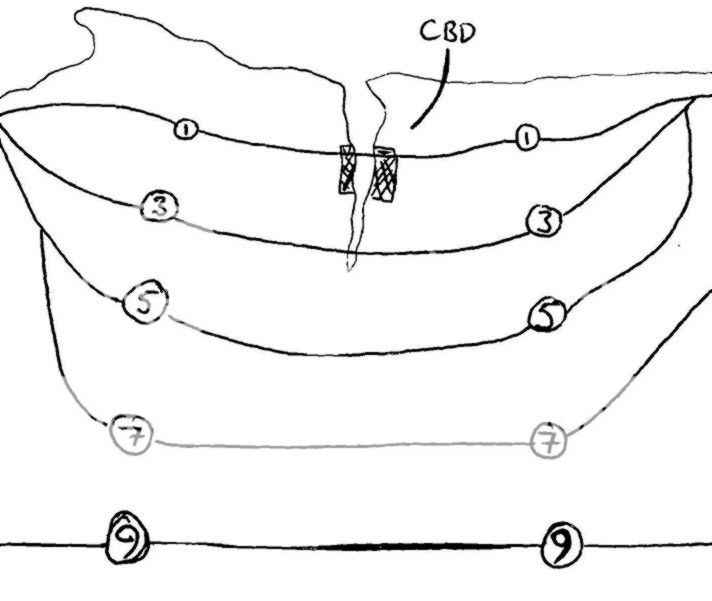
Take note of the above diagram for we shall refer to it frequently.

In designing the perfect city we shall use the principle of segregation. I don't really care for race, nationality or religion, so we'll just ignore those things altogether. We will however be employing a very robust system to segregate the population which we shall deal with later.

We shall draw inspiration for our perfect city from Frederich Engels. Now, you may have heard of the name before and that's because as the son of an immensely rich German factory owner, he saw extreme poverty and sponsored his friend Karl Marx from the profits of his father's business.

"(The City) contains at its heart, a rather extended commercial district, perhaps half a mile long and about as broad and consisting almost wholly of offices and warehouses. Nearly the whole district is abandoned by dwellers and is peaceful and deserted at night.
This district is cut through by main thoroughfares upon which the vast traffic concentrated, and in which ground level is lined with brilliant shops."
- Frederich Engels, 1848.

Victorian England had many many people who wanted to see the world change for the better. When Charles Dickens wrote of the amazing poverty of London in Oliver Twist in 1838, not even he could have imagined the city by the end of Victoria's reign with the Underground extending into the suburbs and the beginning of electricity in people's homes.
Even before the Underground was even started, Engels envisioned a city in which people did not live right next to where they worked. He speaks of the city being quiet at night; this usually means less crime as well.

The question of how to arrange people is an interesting one. Obviously you can not eliminate inequality in society as communism showed with its hideous brutality and as Occupy has showed with its abject failure to achieve anything of lasting value.
If it is largely pointless to change the level of equality in society, the best course is therefore to try to  ameliorate society's physical ills.

The biggest component cause of crime at its core revolves around the concept of jealousy. Someone has what I don't have; I want it; so I'll take it. It stands to reason then if you want to soften the biggest component cause, that you need to find a way of lessening jealousy.
Fortunately there is a way to do this and that is via segregation of the classes in society (not in an absolute or physical sense with something like walls though); this is where our coupon system comes into effect.

In the space above the line marked "1", we put all the people who have the most coupons. In between 3 and 1 we put the next group, and we keep on going until the people with the fewest coupons and they can have their houses outside the ring marked "9".
Of course how people choose to establish themselves is entirely their own business, but in general the people in greatest deviation according to the number of coupons they possess will almost never come into contact.
Engels wrote of an "unspoken implicit social contract" and an "unconscious tacit agreement" that societies naturally segregate themselves. It makes logical sense that people living within the line marked "1" have no real need to visit the zone outside of about "5"; seemingly nor would they want to, for the city itself with its brilliant shops has all that they may choose to purchase.

Likewise, the people living beyond the line marked "5" will generally not venture into the zone beyond the line marked "1", for although they might feel a sense of grievence, the 5 line would be placed sufficiently far away enough so that they'd just not bother to express their disappointment with violence.
Intriguingly, the City of Paris sort of already does this, with the 40 eme of the city. The lower classes tend to live outside of the centre of Paris and apart from religious struggles, Paris has on the whole, the lowest rate of violent crime of all the 'World Cities".

If you could move the people with the fewest coupons in the system, to beyond the boundary marked "9" and then manipulated the media outlets such that it openly referred to them as the "scum class" whilst at the same time extolling the virtues and material benefits of those people living within the "1" line, then the people living outside of "9" might be encouraged to pull themselves out of their predicament.

If all of the above-mentioned things were achieved, then society would pretty well much organise itself and there would be very little need for social engineering.

.
..
...
....
.....
....
...
..
.

That's where the little fantasy ends but not where the story does. There actually is a city in the world that runs according to such principles; that city is called "Sydney".

All you need to do is turn the diagram through 90 degrees.

Subconsciously Sydney already has this plan in full swing.
1 is marked by the Pacific and Princes Highways.
3 is marked by Mona Vale Rd, Ryde Rd, Homebush Bay Dr, Centenary Rd, King Georges Rd.
5 is marked by Pennant Hills Rd, Woodville Rd and Henry Lawson Dr.
7 is marked by the M7.
9 is marked by The Northern Rd.
The media already does a pretty good job at promoting the benefits that come with more coupons.
Most people already do not associate with people too far from their own socio-economic group. I have seen people both rise and fall between classes and suburbs and treat their former communities with utter contempt. Actually when I tell people who live within zone 1 where I live, most of them have no idea where it is; presumably because they've never been, have no intention and no need of travelling outside the zone.

If you properly think about it, Sydney is actually more segregated and well defined in this respect than London, New York or even cities in South Africa under Apartheid, and yet it does this under a purely voluntary and self selecting process.
What prompted this was an article in a newspaper claiming that Australia and Sydney in particular was a "classless" society, yet I just can't find evidence for this in the real world.

Addenda: Engels wrote his piece about the City of Manchester in 1848. What's really interesting is that in more than a century and a half, the geographical divisions which define the classes have more or less remained fixed.

October 04, 2012

Horse 1370 - The T20 World Cup is Probably a Good Thing


The ICC Twenty 20 World Cup is being played in Sri Lanka at the moment and whilst I am disappointed that England has been bumbled out of another tournament due to sheer ineptitude, I think I'm slowly coming around to the idea of T20.

Personally I dislike the game because I think that it destroys a lot of the story that develops within a cricket match. A test match is a tale which develops over the course of five days with many turns and twists (or sometimes none at all) and a 50 over One Day International is marked with the building and  consolidation of an innings followed by a flurry, but a T20 is just a bash fest where bowlers are reduced to machines and the first side to monumentally foul up, loses.

Despite this though, I'm prepared to forgive the format because unlike a test match which takes five days or an ODI which takes one day (by definition), the format of T20 allows someone with a day's ticket to see two matches and four teams. In the early stages of the tournament this allows for the showcase of lots of different nations and at the end of the tournament you'd get to see more heroes at once.

One of the criticisms of the FIFA World Cup is that it's drawn out and takes to long. The last World Cup in South Africa took 32 days to play out. The next one in Brazil is expected to include 40 teams in 8 groups rather than the 32 in the last one and will take another week on top of the already bustling calendar.
It would be possible with a T20 tournament to include 64 nations in group stages followed by a knock out, in just 9 days of play. Such a thing would be a veritable TV feast and many of the criticisms about the tournament being a benefit for the "big" nations would be completely obliterated. A match between Namibia and Germany might not draw worldwide audiences en masse but it would beam the game into living rooms in those two countries that wouldn't previously have witnessed this almost unfathomable game.
The Olympics in London yet again proved that the best kind of world cup is one in which you've invited the world.

I don't like T20 because I think that It's just not cricket. I do however hope to see it continue and change into its own thing. A thing which properly invites the world to play.

October 02, 2012

Horse 1369 - Fair Trade Is Fair But Dumb


The whole concept of so called Fair Trade to me seems somewhat flawed. Whilst the idea that well off people living in the First World are willing to pay slightly more to ensure that profits from the sale of goods and services sounds like a well meaning and well intentioned venture, we fly square in the face of the basic supply and demand problem which establishes price.

Firstly a review of the concept of "the market":
In general, people who demand goods and services will tend to want more of a particular product as the price per unit falls. Counter to this the sellers of those sane goods and services will tend to want to supply less of those goes and services as the price falls but want to sell more of that same product as the price rises.
However, as the price rises, the quantity demanded by buyers falls.
The two forces of supply and demand are perpetually engaged in a weird little dance and as conditions change, the prices and quantities also change.
Good so far? Now for the problem.

So called Fair Trade has the distinct problem of nudging the dancers. If people in the First World feel altruistic and want to pay extra for a good because it makes them feel better, then this has consequences.

Suppose there exists a Fair Trade program for a theoretical product called "Skrtel Nuts" (Skrtel Nuts are very very hard and Skrtel Nuts are ground with a mortar and pestil to produce a drink which is marketed as "Harden Up"). Farmers in the hypothetical country of Elbonia will notice that there has been a shift in the demand price for Skrtel Nuts and as a result; because they expect more profit from farming Skrtel Nuts, they will shift production accordingly.
Sounds fine so far but what of the other farming produce of Elbonia?
Because there are now more farmers farming Skrtel Nuts, this will lead to supply shortages of other foodstuffs because it stands to reason that farmland devoted to Skrtel Nut production can not be used to grow wheat or corn or some other foodstuff at the same time. Shortages of produce tends to push the price of those goods and services higher and consequently, the people of Elbonia will be paying more for those goods and services than they would otherwise.
Although some farmers in Elbonia are marginally better off, having switched to Skrtel Nut production, the rest of the people not employed in this industry suffer higher prices without subsequent increases to their wages.

Don't think that this can't happen in the real world? Perhaps a small peek into history is in order. In 2001 world coffee production as a result of two Fair Trade programs (especially in places like Bolivia and Colombia) drove world coffee production to 115 million bags. The problem was that world coffee consumption for 2001 was only 105 million bags; thus there was a 10 million bag overrun.
Coffee isn't like other commodities like iron ore or steel in that if there is a production overrun, the excess can not be stored that easily because it perishes. By mid 2001, most of the 10 million bag overrun of coffee was simply being dumped into the Atlantic Ocean; yet because there were still contracts in place, farmers were still being paid to produce more coffee.
It sounds incredible but as a direct result of Fair Trade programs (in this case the two biggest drivers were Nestlé S.A and Kraft Foods), for three years farmers were being produced to grow coffee which world markets could not absorb only to have it destroyed.

"According to a report by Oxfam, the coffee lake was partly encouraged by multinational companies encouraging coffee production around the globe. Vietnam is given as an example: a decade ago it was a minor producer; today it is one of the biggest. In Bolivia and Colombia growers of coca, the raw material for cocaine, were urged to turn to coffee instead."
- The Guardian, 18th Jun, 2001
http://www.guardian.co.uk/world/2001/jun/18/mexico

The most likely place where I'm likely to encounter Fair Trade policies in my trip around the supermarket (since I don't tend to drink Fair Trade coffee) is that little panel on purple packets of piquant, palatable, pleasant pabulum thanks to John Cadbury's sons.
Chocolate or rather properly cocoa is almost exclusively grown in the tropics, which means to suggest that by a combination of history and coincidence that almost all the cocoa in the world is grown by less developed nations and is therefore more likely to be swayed by the dangling carrot of fair trade programs; specifically those by Cadbury.

"This creates a fantastic opportunity for you to make a real difference to the lives of families in developing countries such as in Ghana. 
Our Fairtrade commitment has generated significant social premiums for cocoa farmers. In 2009 and 2010, we were the world’s largest buyer of Fairtrade certified cocoa."
- Cadbury Website, as at 1st Oct, 2012
http://www.cadbury.com.au/about-cadbury/fairtrade.aspx

Cadbury is the world’s largest buyer of Fair Trade certified cocoa. Does this then, if by their own admission, that although they will pay a higher price for their cocoa, they able to then put up the end prices to the consumer by a suitably higher amount (and pocket the margin)?
Perhaps more importantly because Cadbury is prepared to pay more for the product, as a price maker they're able to draw more of the suppliers to deal with them exclusively and thus corner the supply of the product. By an exercise of market power and at the cost of short term pain, they'd be able to lock in farmers to longer term contracts; thus blocking other firms like Nestle, Hershey or Mars out of those markets entirely. Fair Trade isn't then necessarily done with the intent of making people's lives better but extracting more profits from consumers but making them feel all warm and fuzzy for having done so.

The above circumstance doesn't sound an altogether bad idea at first glance because in theory it "guarantees" the conditions of a contract and should make revenue streams for the farmers and suppliers predictable but you have to remember that contracts are almost always invariably written in the favour of those with the most market power. One of the most shocking cases of this was The Body Shop's contracts with farmers of ten villages in northern Ghana in the purchase of Shea Nut Butter in 1994 at US$2.02/kg (the then market rate was about US$1.60) and then after the predictable glut of four times what The Body Shop wanted, it scaled back the orders for the next season; thus leaving those ten villages with no obvious income at all after the crop had been planted.

Fair Trade programs appeal to the moral reasoning within us but unfortunately moral reasoning does not follow the same rules as economics and the most fundamental mechanism in economics no matter which system you happen to be in be it unregulated Laissez-faire capitalism or completely regulated communist socialism with all points in between is the price mechanism. Fair Trade programs are like adding an incentive to the market and like any other human endeavour, as soon as you add an incentive, you change how the game is played. In the case of Fair Trade with respect to the market, the game changes to produce unintended wastage in almost every case to respond to the level of incentivisation.
Fair Trade programs unfortunately tend to exist only on luxury goods. The main reason for this is because the market for most commodities is such that as soon as there is a shift in prices, the market reacts very quickly. There is no fair trade program for goods like Kent Pumpkins or Bananas for this reason.

From a more general perspective, history has shown that the countries which tend to benefit the most from trade programs are those whose economies shift from agriculture to more elaborately transformed manufactures like electrical goods or machinery. It is no accident that countries like Thailand which now produces Toyotas or Vietnam which produces Nike shoes have had far more economic benefits as a result of producing those goods than any Fair Trade program.

October 01, 2012

Horse 1368 - The Rights Of A Company


During the discussion on a forum I frequent to do with the US Presidential Election in November, the issue of undue influence that so called Super PACs have over advertising during the election was brought up and it got me thinking about the rights that a corporation might have.

To start this discussion it is important to note that a company at law is a separate legal person. As a separate legal person, I personally don't see why it should not have the same rights as a person made from flesh and blood. Obviously it probably is ridiculous for a company to get married, divorce and vote (all sorts of abuse might ensue) but as for the more universal rights of things like free speech, then why not, if that free speech is being used to exercise the corporate wishes of the company and ergo its shareholders.

If you take a look at a document like The Universal Declaration of Human Rights it states in Article 2 that:

"Everyone is entitled to all the rights and freedoms set forth in this Declaration, without distinction of any kind, such as race, colour, sex, language, religion, political or other opinion, national or social origin, property, birth or other status."
- Article 2, UDHR
http://www.un.org/en/documents/udhr/index.shtml

I take note of two key phrases here; namely "without distinction of any kind" and "or other status". If something is to be made without distinction and irrespective of status, then surely that also means that the person in question doesn't even need to be a corporeal entity. Basically a "person" is an entity who has certain rights, privileges, responsibilities, and legal liability at law.
If you read through the rest of the rights in The Universal Declaration of Human Rights it mentions things such as "the right to recognition everywhere as a person before the law" (Article 6), "the right to own property alone as well as in association with others" (Article 17), "the right to freedom of opinion and expression" (Article 19); all of which it makes perfect sense for a company to possess.
Some rights are simply ludicrous for a company to have on the basis of irrelevance. What use is "the right to rest and leisure" (Article 24) or "the right to marry and to found a family" (Article 16) to a company, for instance?

If you were to look at the Bill of Rights in the US Constitution, again it makes perfect sense for a company to be in possession of the rights therein:

"Congress shall make no law respecting an establishment of religion, or prohibiting the free exercise thereof; or abridging the freedom of speech, or of the press; or the right of the people peaceably to assemble, and to petition the Government for a redress of grievances."
- Article 1, US Constitution

The right to free speech is as important for a company as it is for a normal person for the same reason. Some companies such as lobby groups are set up for such purposes and the entire of the advertising industry hinges around this. The question of lobby groups is interesting, from a completely objective point of view, it makes complete sense for people to form collectives to speak to law makers. Indeed if you get enough of a collective voice all asking for something and it happens to go before the house and is voted for, then isn't that they very point of democracy? By the people, for the people? Isn't a referendum in principle exactly the same? The difference between a referendum in that respect is purely a matter of scale.

If enough of a collective voice was formed together by the instrument of a partnership, association or company, it might even make the leap and be registered as a political party. If the rights that a corporation did not include the right to free speech then, Labor Holdings Pty Ltd in Australia, the Conservative and Unionist Party plc and the Republican National Committee Co. would be voided from that right (as would their opposite parties); ergo politicians who act as both agents for their constituencies and their parties would likely be voided from speaking in their capacity as party members.

Other parts of the US Constitution also make perfect sense when applied to a company:

"The right of the people to be secure in their persons, houses, papers, and effects, against unreasonable searches and seizures, shall not be violated, and no Warrants shall issue, but upon probable cause, supported by Oath or affirmation, and particularly describing the place to be searched, and the persons or things to be seized."
- Article 4, US Constitution

We expect that when the police or other law enforcement agents arrive on the premises of an individual, that they should have a warrant to enter. Likewise, exactly the same principle should apply to companies. It wouldn't make practical sense for a document to be "safe" whilst on the premises of an individual but not whilst in the offices of a company. In some cases where very sensitive information is held on company premises such as a law firm, if any government body had the power to seize or check effects without a warrant, then real people's lives might be affected.

The question then isn't so much about what rights that a corporation might or should have but rather the degree of influence that monied parties have in swaying the decisions of lawmakers and other people in government. It's probably been true since the very beginning of governments in the very first cities that money is an analogue of power and that it shouts very very loudly indeed. Corruption is the undue influence to derive private gain and in the realm of government, that includes such subtleties as grift, nepotism and even patronage. That however is a different question to whether or not a corporation has the same rights as a person though.

September 24, 2012

Horse 1367 - And The World Is Made Of Energy


There is an advert on telly at the moment for AGL's 175th anniversary, which does an historical pan through of the company lighting gas lamps, selling gas and electric to people's homes, before finally laying out their token green credentials in making reference to their wind farms. The adverts are quite jolly and I do like them but originally I thought that they'd written a jingle for the advert. It turns out not. The song playing is a grab from The Apples In Stereo's song "Energy". The chorus of this song goes:

"And the world is made of energy,
And the world is electricity,
And the world is made of energy,
And there's a light inside of you and there's a light inside of me"

Link : The Apples In Stereo - "Energy"

Nice sentiment I'm sure but lo and behold, it's also true. Here's why:

Proposition 1:
"And the world is made of energy"

E=mc2

Einstein's general equation of energy is familiar but most people probably don't know what it means. It does not refer to the E=McSquared burger from McDonald's which is a square burger; and the main reason that it does not is because I've only just made that up. If you are reading this McDonald's, I am ready for my royalty cheque now.

Seriously, E=mc2 refers to the amount of energy liberated from mass when it is subject to speeds at the speed of light. (Do this again). The only practical use for this that I can think of is to do with the energy liberated from the atom in a nuclear reactor or bomb. I imagine that if we were able to somehow turn the entire of the earth into one massive nuclear device, then the energy liberated from all that mass would be immense; certainly more than enough to boil your kettle to make a nice cup of tea.

E =  5,972,190,000,000,000,000,000,000,000g x (290,000,000m/s)²
E = 502,261,179,000,000,000,000,000,000,000,000,000,000,000,000 Joules

Of some interest is the  the Greek word "kinema"; from which it is unsurprisingly get our word for moving pictures "cinema". Things that are moving also have energy; it is also not surprising that the energy of moving objects is called "kinetic" energy. Isaac Newton described that energy with a number of equations relating to motion.

The Earth has a mass of 5,972,190,000,000,000,000,000,000 kg. In a year it moves almost 940 million km but in a second it moves at a paltry 30m/s which means that the Earth has a Kinetic Energy of:
2,900,000,000,000,000,000,000,000,000,000,000 Joules
If we're talking about phenomenally big numbers like this, then it is true that "the world is made of energy".


Proposition 2:
"And the world is electricity"


The thing with electricity is that its only one specific way of transmitting energy. The fact that the Earth has both mass and is moving means that there is a potential to change all that energy to electricity but if you've destroyed the earth in the process of its creation, there would scarcely exist the means or point to use it anymore.

Having destroyed the Earth, there then needs to be some point to liberating all that energy. Maybe if we'd ruined the Earth beyond the point of livability then that might have some utility in powering a battle star type object but until that day, this is all a bit too dreamy for me.


Proposition 3:
"And there's a light inside of you and there's a light inside of me"

There is enough fat even in a skinny human at least to power a small oil lamp. Personally I'm not prepared to want to undertake such a task but I imagine that the thought might have occurred to Lawrence Oates on his disastrous trip to the South Pole.
I once saw a documentary on the truly bizarre phenomenon of spontaneous human combustion in which for as yet undetermined reasons, a living or dead person which just burst into flames.

Anyway, the point of the AGL advert was to attract new customers to that company and buy their electric and gas. I personally don't reality care through whom my electric comes as long as its clean and no-one else has used it. I simply can not abide with getting used electric.
In the mean time, I hope that no-one including AGL has decided to wantonly destroy the earth in making electricity or burning people, though they do mention in the advert that they've invested over $3 billion in renewable energy generation.
Maybe it could be that The Apples In Stereo are onto something... AGL has been burning people since the 1980's...


RUN FOR THE HILLS!

Horse 1366 - Big Brother is Watching You (he doesn't really want to)


One aspect of George Orwell's dystopic novel "1984" that journalists like to ape in an almost troperific way is the idea that with all the surveillance cameras now peering into our lives, that Big Brother has the ability to watch and control us but the truth is far less scarier than that.

I don't know what the statistics actually have to say on the subject but I would wager that the vast bulk (maybe as many as 95%) of all cameras installed are privately owned. This means to suggest that Big Brother isn't the one doing the looking but someone else; that someone else is likely to be a rent-a-cop who doesn't want to be there. I mean, would you honestly want to sit for hours on end whilst precisely diddly squat happened? It would be enough to drive you to read Jane Eyre (which is a fate worse than a fate worse than death).
Private surveillance cameras are installed with only two purposes in mind, either the protection of assets or identifying people who have stolen said assets. These cameras act not as a means of actively controlling the population but as a witness to defend against them. That is very different in principle to Orwell's nightmarish vision.

In an idealised, rose tinted world, perhaps eulogised by our grandparents, people speak of leaving their front doors unlocked in days gone by. I sort of doubt whether this was ever the case, for as long as people have been living in houses with stuff inside worth protecting, there have been locks of a fashion. The idea of armed guards to protect assets goes well into antiquity. There were guards at the Oracle of Delphi as far back as 600 BC.

So forgive me if I am a little sceptical when I hear suggestions as I did on the radio this morning that installing more surveillance cameras is "Big Brother gone mad" because quite frankly I don't think that the real world supports this theory. We wouldn't need surveillance cameras if people didn't need surveillance and the only reason we need it in the first place is because a few select nasty people don't think anything of stealing other people's stuff.
I don't think that the state either cares or even wants to care about controlling the population when as it is they can't control people's desires to liberate other people's property.
The state itself is usually trying to madly cut costs where it can, so deliberately engaging in a new range of costs when the benefits to it aren't immediately obvious, doesn't make a whole heap of sense.

The surveillance cameras in question are supposed to be installed on George St in the City, and would not be used to "control" the population but rather to help identify those miscreants who are going about causing civil damage; usually under the influence of drink, drugs or both. They haven't been proposed because the state wants them but rather that private firms want the state to foot the bill for their security costs.
Somehow, I think that the state would rather not pay either the cost to install the cameras, or the costs of maintenance, or the costs of paying someone to monitor them either.

OK, so maybe we are being watched more than ever before, but if you don't break the law, then you don't have to fear the enforcers of the law. They'd rather be at home with their families or friends, or doing anything other than watching you. If Big Brother is in fact watching you, I'm sure he's very bored.
Why do we accuse Big Brother of being more invasive, when it is our requests which cause him to do so? That isn't Big Brother gone mad but his snot nose Little Brother (namely us) who are out of control.

September 21, 2012

Horse 1365 - Boris


Boris Looking Regal - From Instinctmagazine (Without Permission)

I like Boris Johnson. I like Boris as a character, a writer and a thinker; maybe not so much as a politician though.

Boris has been Mayor of London in a period of boom and has ridden the wave of acclaim that comes from holding the Olympic Games to much success. He has also been in oversight of a city which has undertaken a new wave of transport infrastructure building with the construction of Crossrails 1 and 2.
Boris though is an old school Tory, cut from the same cloth as Lord Stanley, Disraeli and Balfour. For this reason, In the 21st Century, he doesn't fit into modern politics all that well, let alone the current Conservative Party. I suspect that he would have fit into a Churchill cabinet nicely because being an older style of conservative, he stands for preserving the grand  institutions which hold pomp and power and preserving the status quo, rather than as the current crop of Tories who would prefer to reduce the scope of government by simply applying the axe to the  budgets of everything under its control. From an academic standpoint of economics he does write about giving firms the freedom to go about their business unimpeded but he writes more about the state being cohesive enough to provide the environment for that to happen.

Polls last week came to the conclusion that if Boris were to win a seat in the Commons and make a tilt for the Premiership, that the Tories would enjoy a groundswell of popularity and win government in their own right.
This unfortunately would mean that Boris is the Prime Minister. The Prime Minister is minister without portfolio and thus a Tory Johnson Cabinet would look broadly similar to a Tory Cameron Cabinet, save for Cameron himself probably being Chancellor of the Exchequor. Boris would still be selecting from the same pool of MPs as any other Tory Prime Minister.

Despite being a Tory; who are suffering a current wave of unpopularity (and who could only form government in coalition with the LibDems; following the MP expenses scandal), somehow he has managed to convince the electorate that although he appears eccentric and a bit of a bumbling fool, that underneath he is actually some sort of magnificent master of puppets, when in reality he is really only the head of a statutory legal body; one which just happens to contain "The Square Mile" and thus the vast bulk of economic decisions and power held in the UK. The Olympics themselves were bankrolled by the nation rather than the City.
Boris was also helped somewhat by PR provided by the BBC when he appeared on Have I Got News For You. He was able to do so at the time because he was only a backbench opposition MP who didn't even have a Shadow Cabinet portfolio to look after. Almost like the fable of the grasshopper who sung and danced during the summer, Boris very effectively courted the media and since becoming Mayor of London, his appearances on such programs have been reduced to a trickle. I think that it is not unreasonable that after politics, Boris should move to BBC Radio Four and shows like Just A Minute or I'm Sorry I Haven't A Clue, much like the late Clement Freud did, when the need to play the media game for political gain will have passed.

Then again, politics has always been about managing PR. Churchill is mainly remembered for his great speeches in the Commons rather than his time in the admiralty when he was responsible for sending thousands of men to be butchered in the Dardenelles and yet history regards him with kindness; whereas history regards  Chamberlain with disdain despite him delaying the war for two years, which was utterly critical at a time when there was no way in 1937 that Britain would have even cone close to defending itself. If the Battle of Britain had been fought in 1938, the RAF would have only have had Fairey Battles at its disposal and not Hurricanes or Spitfires.
History also tends to regard  Macmillan kindly despite Dr Beeching's axe to British Railways which effectively destroyed one of the greatest legacies of the Victorians and which the county is still desperately hurting from half a century later.
History largely doesn't regard statesmen by what they actually did until long after they have passed.

I suspect that Boris will not even  challenge for a seat in the Commons whilst he is still Mayor of London because the PR result from being in a current Tory government would be terrible. It would make sense for him to play the more boring and safer game of patience.
The election in 2015 is far away enough that he could invent some new shiny propaganda campaign (maybe casting himself as a Tory "Third Way" like Tony Blair did with New Labour) and like some valiant knight coming to save the fair maiden of politics, he'd sweep the light fantastic, skid the light fandango and take up residence at Number 10.
Then everyone after a while notice that Boris really is an old school Tory and that nothing would change insofar as much as it would remain exactly the same. A Johnson Premiership would retain the status quo and although nothing new would be done, at least there'd be a new wave of eccentric sound bites on the six o'clock news. If it never happens, Boris will have written himself into history though more for being a character than for the scope of his job, which in the grand scheme of things is materially less than it is made out to be.

September 20, 2012

Horse 1364 - Risk:Legacy - Sorry and Forgiveness


On Saturday night, there were five of us engaged in the game of Risk:Legacy. Normal "vanilla" Risk is a board game where you try to take over the world; games can last up to eight hours if two sides at the end are evenly poised. Risk:Legacy has the added bonus of actions in past games having present consequences.
The thing about games and sports generally is that they don't matter. Unless you actually happen to be gainfully employed as a game or sportsplayer, at the end of it, you go home, or the board is packed away and that's it - line in the sand, Game Over.
Risk:Legacy is a little different in that actions do have consequences but only so far as the game is concerned. Come Monday when you have to go back to work, what happened in a board game is of zero consequence.


This brings me to the word "sorry". Sorry is a word which expresses regret over an injury which has occurred to a person or people, or their property; saying sorry usually implies a request for forgiveness. When Kevin Rudd made his famous "sorry" speech in 2007, he was in effect asking the aboriginal people of Australia for forgiveness on behalf on the nation. Some Aboriginal peoples expressed a wish to hear that word "sorry" precisely because it was an admittance that terrible injuries had been made against them.
Admittedly a board game like Risk can not possibly even hope to compare with the sheer magnitude of something like this and I do not intend to diminish its importance by any stretch of the imagination but it illustrates the point perfectly, the word "sorry" and the simple request for forgiveness contains an almost unbelievable amount of power; used properly it can go towards mending and healing relationships or forging new ones.

A board game like Risk does indeed have injurious acts and circumstances which are exacted on other players, but the thing is that in the context of the game, not only are they acceptable but also, every action undertaken is deliberate. Saying "sorry" is therefore not only meaningless because nobody ever means it but also because ultimately, injuring other players positions is in fact the point of the game. Like chess, Risk is a war game. Also like chess, the reason why you can afford to play much harder and also why its bigger and better than "grown up" games like love and war, is also due to the fact that it is ultimately of zero consequence. In some respects, it is a mark of the highest nobility to play at games of war like Risk, to be laid utterly to waste and be hopelessly defeated and to say "well played" to your fellow players.
For the same reason I like to say "There is no sorry. No-one is sorry for anything... EVER." I would hope that my fellow players of a sport or game would play as hard as they can, as I also hope to do. There is no shame in being defeated on a tabletop or the sporting field.

Forgiveness however is a slightly more spiky concept. After someone has said sorry, they are not automatically forgiven. Forgiveness requires the injured party to set aside their claim for restitution, or in some cases where punishment needs to be exacted, some other willing party to pay the price.
There are of course obvious parallels to be drawn here in that we have caused God an injury of honour by violating His person through lack of respect for Him and His law and forgiveness is brought about in this case because restitution had been made through the death of Christ but the underlying point here is that for this to be exacted, there first has to be an admission of the injury and a request either implied or direct through the act if saying "sorry".
Forgiveness though rests on the fact that the person actually does decide to accept it. If they decide for instance not to forgive someone, then the person who has said sorry is left hanging. Thankfully when it comes to God we are told that  "If we confess our sins, he is faithful and just and will forgive us"* so we aren't left hanging at all.

Back to Risk:Legacy, not only is there no sorry and there is no forgiveness, what's weird is that even the game itself does not forget because it carries scars and marks from the injuries which it sustains and they consequently come back to injure you. As far as board games go, I have never seen this mechanic in a game before and I wonder if it is (as yet) unique in this respect.
Risk:Legacy is a game which does not forgive and it does not forget, which either makes it a terrible role model or an accurate life lesson in dealing with most people. The people playing aren't sorry for their actions and nor should they be because they wouldn't play as hard. For these reasons, it's one of the better games out there, unlike "grown up" games like love and war where people who don't say and genuinely aren't sorry, for their actions continue to perpetrate hurt.

*1 John 1:9

September 19, 2012

Horse 1363 - Cutting Education Budgets To Avoid Worse Pain In The Future


"It is tough when you wind back expenditure clearly people are going to react to it, but I say to those individuals, economic conditions are tough. I can't spend money that I don't have. If I do, I'm condemning those students at school now to further deeper cuts in the future."
- Barry O'Farrell, as quoted Sky News, 13th Sep 2012.
http://www.skynews.com.au/local/article.aspx?id=794481

I like what the NSW Premier Barry O'Farrell is doing here, he's playing the long game. He knows that cutting $1.7 billion from education budgets will avoid worse pain in the future. Mainly because students in the future won't be so demanding.

BHP's chief executive Marius Kloppers cited that BHP needed to find a "less capital intensive way" of doing business and that "Wages are too high in the entire country and working conditions too generous" when interviewed on 702 ABC Sydney.
Gina Rinehart suggested that "Australia is indeed becoming too expensive and too uncompetitive to do export-orientated business" and ungraciously suggested that African workers are more competitive because they will work for less than $2 a day.
Network Ten's Masterchef judge George Calombaris said that the cost of staff wages was prohibitive and that his restaurants "don't open Sundays because it's not viable" on 720 ABC Perth.

Time and time again we hear that wages in this country are simply too high and that Australian businesses are uncompetitive because of it. This is where Barry O'Farrell has played an uttter masterstroke.

Most people who attend primary and secondary schools can not vote because they are under the age of 18. The same goes for a great deal of TAFE students who are doing apprenticeships and or attending academic studies having just left school. For those students who have only recently left school and are between the ages of 18-24 which is typical, they won't be able to vote in a NSW State Election until 2015 by which stage, they won't actually be in TAFE any more.
Cutting education funding in the short term comes with absolutely no consequence whatsoever because they people who you directly affect will have either moved no or still will not be able to vote; because it comes with no consequence, there is no moral obligation to do otherwise. Moral obligation in politics seems to only extend as far as the ballot box.

In the long term, it makes perfect sense to cut education funding. Cutting education funding reduces and degrades the quality of the labour force in the long run. By degrading the quality of the labour force, it also has the net effect of reducing the bargaining power of future workers who are probably in primary school right now.
Of course the sorts of people who go to TAFE are usually those people from poorer income brackets, so it's probably for the best that they start to learn to accept longer hours, lower pay and reduced conditions now to "avoid worse pain in the future".
By drastically shifting the supply curve for wages to the right a new lower equilibrium price can be established. Shift it far enough and we will be able to compete with Africans on price because there'll be workers here who will settle for less than $2 a day or its future equivalent.

Students in future won't be so demanding and moreover they'll be increasingly ill-informed and hopefully illiterate. Admittedly there needs to be some sort of functional literacy so that people can run machines and file reports but again, these workers will merely blame their employers rather than the government. In that respect, maybe it is a good idea to cut funding from education budgets now because if he survives 2015, I'm sure that he would not want to be premier in 2019 when the ill-informed; illiterate make their anger known at the ballot box.

September 18, 2012

Horse 1362 - The Identity of Doctor Who


For almost half a century, the BBC produced documentary series Doctor Who has been beamed into our portable picture palaces and has well and truly etched its way into our collective consciousness. I think we can take it pretty well much as fact that the BBC has a network of news gatherers throughout our sector of the Milky Way and that the Controllers of the BBC have signed some sort of non-disclosure agreement with the Sub-Sector Government to ensure that Earth doesn't get technology before its time (insofar as time itself is linear and not a wibbly-wobbly-timey-wimey ball of stuff as hypermathematics now knows it to be).
We can therefore assume that the person on Doctor Who is only playing at being The Doctor and that the actual Doctor is somewhere on Earth, in relative obscurity. If this is the case, then who amongst the now seven and a bit billion of us is the one person who isn't human? Who of all of us is a ring in?

We can ascertain that The Doctor is likely to be a tinkerer; someone either engaged in a technical or semi-technical field. We also know that because the TARDIS is an old and unreliable "ship", that its owner would have to be meticulous in its maintenance.
The Doctor is often shown on telly as being frequently annoyed at other people either breaking things but he himself is not above hitting things with hammers or pressing buttons of completely unknown function.

It can be pretty much taken as fact that flying the TARDIS requires skill but that because it is a time travel device, its owner would not be all that bothered about arriving late or on time because they could just ad easily change the point in the time stream that they wanted to appear in. Our suspect would therefore be likely to be accused of being tardy and have no conscience in this regard, they may even wear such a tag as an epithet.

The TARDIS itself has had many changes of interface over the years and all of them appear to be outdated for the relative time that they're in. The Doctor himself has stated amongst other things that  Stetson hats, fezes, scarves, ruffs and bow ties are "cool"; so clearly The Doctor is someone who has no fashion sense whatsoever and given the opportunity would probably own a range of downright hideous looking shirts.

Operating the central console of the TARDIS is akin to playing a very complicated instrument. The Doctor doesn't dance but we can assume that after travelling throughout time and space that he has probably picked up a good ear for music. Since the invention of the piano circa 1698, it has become the instrument of default for the majority of composers because of its tonal range and because the word pianoforte means "soft loud", it also is able to carry a lot of the functions of the various voices of a full orchestra.

The documentary series suggests that The Doctor is hiding as someone British because Gallifrey's accents mimic those of the UK. Even The Doctor himself when asked about his accent said that "lots of planets have a north" which I can only assume to mean that Gallifrey through some freaky coincidence (that wobbly-wobbly-timey-wimey thing again) has a set of accents similar to the UK; hence the reason why he'd want to hide there.

So then, we're looking for a fashion illiterate, piano playing, tinkerer who is accused of being late or slow and appears to be British. The only logical candidate in the world then is James May. This also fits together the facts that the BBC doesn't generally shoot episodes of TopGear whilst they're filming Doctor Who for "budgetary reasons".

The jig is up James, you've been ousted... James May is Doctor Who. Matt Smith is just an actor.

No one would knowingly wear shirts that hideous unless they were The Doctor would they?

All the facts fit together. His telly show James May's Man Lab is all about getting out and making things and doing things. No-one else would logically conceive that tinkering with an unexploded German 500 pound bomb was a good idea and there can't be any other reason why he likes to hang about with a person of the species Cricetinae Sapiens (Hamster people) and a companion who likes to use hammers for basic maintenance. He is an incredibly talented piano player and has presented telly programs about all manner of science, technology, toys, pastimes, culture and the decline of mankind. It also makes sense that he'd make a documentary about the moon landings and go to the edge of space in a U2 spy plane, considering that he'd been there before.
I'd also go as far to suggest that in 1963 during the Dalek Invasion of Earth, that he was able to tinker events such that Kennedy was shot just at the right time so that no-one would even notice the seriousness of the situation.

Of course it makes sense that James May is The Doctor. That is the most logical conclusion.

September 13, 2012

Horse 1361 - Leftovers


Traveling hither and yon across Sydney, I tend to write a lot of paragraphs that don't really seem to go anywhere. These are embryonic blog posts that never get completed and in the past these ideas would have simply dissolved into the ether.
This then is a selection of the detritus which has built up before I clear the rubbish:

- The thing with these conspiracy theories is that most of them suggest that the moon landings  took place in a studio. That for me is even more unbelievable.
They put a studio on the moon?!

- I'm wondering what other sorts of films could be made with supergroups of actors.
Take Nicholas Cage, Christopher Walken, Patrick Stewart and Sean Connery and put them all in the same film. There'd be more cheese than a fondue set.
Maybe add The Stig, I'm not exactly sure what he'd do but it doesn't matter because The Stig can walk into any film he feels like.

- Barry's 20 year transport plan plays the skillful gambit of having three prongs to the trident.
1. Being over 20 years, he'll be either long gone from politics or dead by the time that the expiry date of the policy has elapsed; thus removing him from all responsibility.
2. Initial build dates of the projects announced don't occur until after the next election, which either means that if his government isn't returned he can blame the other side for not implementing the plan, or if his government is returned, he can still claim that they're still within the time frame. Either way it removes him from all responsibility.
3. The good and fair people of NSW have heard so many of these plans over the years that we simply don't believe them anymore. If the people of NSW expect failure from the outset then it doesn't put any pressure on the government to carry out it's plans; thus it removes him from all responsibility.

- Time is one of those things that we can observe but have no real adequate explanation for. Why does it relative to our perception only seem to flow one way? If we actually could see it go the other way, could we for instance unbake a cake?

- When the Commodore does finally suffer the chop, since the whole lineup will be made by Chevrolet, Detroit would probably be looking over its shoulder and wondering why the lion shouldn't just be replaced with the gold bow tie.

- It seems pretty obvious to me that if science itself only hinges on what can be observed, then everything beyond that scope doesn't by default not exist. Radioactivity and magnetism can not be felt within our bodies and yet they permeate throughout the universe. Moreover did radioactivity simply not exist before 1850? What of physical things which did exist but were unobserveable? I'm reasonably sure that kangaroos existed before Cook landed at Botany Bay in 1770.
Obviously we must occupy some point in say the 7th or 8th dimensions and yet we can only really observe things in maybe five or six.
All of this assumes automatically that the entire of existence only exists in the physical realm. Logically it is not impossible for things, beings, us even, to exist in spiritual dimensions and not really be able to observe them. If we can not observe any more than the half dozen physical dimensions we occupy, then how can we possibly hope to rule out the possibility that spiritual dimensions exist? Once that door of doubt is left even a crack open then to rule out that possibility entirely is to deny logic itself.

- Even in the days of the late Thatcher and early Major governments, they were still referring to "thirteen millions" being spent on the M53. Why did the plural of million change from "millions" to "million" in such cases?

- Then again green trousers were perfectly fine for Babar, King of the Elephants.

- If graffiti is truly the manifestation of artists, then where is the artistic value in writing "Akix" a few hundred times from Croydon to Petersham?

- The Queensland Space Program would consist of 9 blokes in a garage with an esky, the probe itself would be made out of a few XXXX Gold cans (because they ain't wasting the real stuff in space) and it would be beaming back the message 'QUEENSLANDER' every eight seconds. The Arecibo Observatory in Puerto Rico would think it was life from another planet... maybe.

- I am 100% convinced that world food production combined is easily more than enough to provide for all the world's population comfortably. I would suggest that the reason that it does not comes back to the same old issues of greed, profit, greed, logistics, greed, pure hatred of certain peoples and greed.

- Justin Bieber and One Direction are this generation's Hanson, Backstreet Boys, East 17, Monkees and Elvis. Yes I know that Elvis eventually learned how to play a guitar but the truth is that he couldn't when he started and wasn't really a technical singer either. The girls liked him... just like they do with Justin Bieber and One Direction.
The actual goodness of the product is practically irrelevant.

- Gambling is a voluntary tax paid by the stupid.

- The Mars Curiosity Rover is able to do its job in peace because it isn't interrupted by its friends sending it messages on Facebook.
'LOL rocks. Dude I am so lost.'

- Can you imagine if cats actually were voted into parliament. The Chamber Rod would need to be retro-fitted with a scooper for cleaning up poos, there would be a Minister for Sleepytime and Naps (with a distinction made at law) and cat calls such as were once made to Penny Wong in an estimates committee would have to be taken to mean that someone was trying to contact the Member for Forrest.

I don't know exactly what all this garbled mass of gibberish says about me. I must admit that when Mrs Rollo asks that question "what are you thinking?", I'd like to be able to answer with something profound, deep and romantic but the truth is that this is what I actually usually am thinking about.
Now then, about that studio on the moon...

September 12, 2012

Horse 1360 - Occupy Failure

I return to the 1899 work of Thorstein Veblen,  "The Theory of the Leisure Class" (see Horse 1358) because I think that this book held within its pages, an adequate explanation of why the Occupy movement has thus far failed so comprehensively and why it was doomed to fail from the beginning.
However, before we look at Veblen, we need to start with something smellier, something even more raw, something fundamental. Therefore, we start out this essay with one of Adam Smith's basic premises:
“It is not from the benevolence of the butcher, the brewer, or the baker that we expect our dinner, but from their regard to their own self-interest. We address ourselves not to their humanity but to their self-love, and never talk to them of our own necessities, but of their advantages” 
- Adam Smith, Wealth of Nations, Vol 1 (1776)

The Occupy movement was begun by the Canadian group, the Adbusters Media Foundation and was at the time inspired by the Arab Spring. They say of themselves that:
“We are a global network of artists, activists, writers, pranksters, students, educators and entrepreneurs who want to advance the new social activist movement of the information age. Our aim is to topple existing power structures and forge a major shift in the way we will live in the 21st century.”
- Adbusters website - http://www.adbusters.org/about/adbusters

Given Occupy's aim to topple existing power structures and Adam Smith's suggestion that people are driven with regard to their own self-interest, it would therefore follow that either Occupy had intended to do something about how power was organised, or perhaps replace the people in existing power structures with new people and modes of thinking or more likely themselves; again Veblen addresses this:
"The reason we will not have a revolution in America is that the lower classes do not want to overthrow their managers but to join them."
-  Thorstein Veblen, The Theory of the Leisure Class (1899)

This of course poses a problem. The actual real power structures which exist in industrialised nations, exists not the legislatures of the land but in the board rooms of corporations and to a slightly lesser degree, lies with the ownership of those corporations. Corporations and the Company is where the four basic economic questions are asked. Namely:
1. What goods and services should the economy produce?
2. How should goods and services in the economy be produced?
3. Who should receive the goods and services produced?
4. How should the economy provide for growth? 
Unfortunately the vast majority of people who live in a nation never ultimately ask these questions directly except through the mechanisms of selling their labour and using their wages/salaries in the purchase of the goods and services being produced by the economy. People's real wages are usually their only real bargaining chip in the economy and ergo the power of that economy.

The thing is though that real wages in the United States (and I use the example of the United States because that is where the Occupy movement has primarily had any influence albeit incredibly minor)  have been falling since 1972. It seems that with real wages falling therefore, that labour itself is being punished and that the relationship of enterprise and labour is returning to a state similar to that of the mid to late Victorian period.
Veblen writes that:
"The actitivites of the moneyed class are given society's stamp of approval. Labour by contrast us regarded as undignified even by the people who perform it."

If you want to talk about class warfare and by inference the excercise of power within the existing power structures then surely that is an expression of that just there. Of course we like to view ourselves as living in more enlightened times and surely such expressions of contempt can not be found today, or can they?

"If you're jealous of those with more money, don't just sit there and complain. Do something to make more money yourself - spend less time drinking or smoking and socialising, and more time working.
Become one of those people who work hard, invest and build, and at the same time create employment and opportunities for others."
- Gina Rinehart, as quoted in The Australian, 30 Aug 2012
http://www.theaustralian.com.au/business/gina-rinehart-tells-whingers-get-out-of-the-pub/story-e6frg8zx-1226461138251

Or maybe:
"Furthermore, Africans want to work and its workers are willing to work for less than $2 per day; Such statistics make me worry for this country's future."
- Gina Rinehart, as quoted in The Daily Telegraph, 5 Sep 2012
http://www.news.com.au/news/australia-is-too-expensive-for-business-rinehart/story-fnehlez2-1226465528843

Such contempt of workers and labour generally appears both incredibly churlish and mean spirited but also ignorant if the fact that the employment of labour is to some degree what gave her her fantastic wealth in the first place. It is as almost as though she had read Mrs Beeton's Book of Household Management and taken the suggestion that "abuse of servants" should be taken as an instruction.
2153. It is the custom of “Society” to abuse its servants,—a faon de parler, such as leads their lords and masters to talk of the weather, and, when rurally inclined, of the crops...
Young men at their clubs, also, we are told, like to abuse their “fellows,” perhaps not without a certain pride and pleasure at the opportunity of intimating that they enjoy such appendages to their state.
- Isabella Beeton, Mrs Beeton's Book of Household Management (1865)

Given the contempt and disdain which enterprise has for labour, why then isn't there a modern political revolt by the labour classes as there was in the late nineteen and early twentieth centuries? These political movements even lend the name of Labour itself to political parties in Australia, the UK, New Zealand, and formerly in places like Canada and America itself before the ideals died off.

It seems that Veblen's suggestion that  "the lower classes do not want to overthrow their managers but to join them" may hold more of a ring of truth than he envisaged. We saw in the riots across England and in particular London in 2011, not a sense that people wanted to change the system of power or indeed that the system itself was broken; nor did it appear that anything was going to be done about it. People seemed to be more interested in the material trappings of the upper class (mainly plasma screen TVs and lots of trainers) than any real desire to enact change.

I think that the Occupy movement has generally failed for precisely the same reason. Instead of the creation of a new political party, which given the presidential elections later this year in November, would have seen actual pressure been brought to bear, it dissipated.
Occupy in the United States should be fielding a candidate against Obama and Romney, it should be running for congress, it should be, well... occupying the political institutions which it sought to change. The mechanics of most modern democracies are such that that requires installing people on the floors of legislatures.
The mechanics of most modern power structures when it comes to an economic bent is such that it requires installing people on the boards of companies. Occupy should have been setting up collective investment schemes to buy shares and the seats on boards of companies that go with them. Occupy did none of those things.
Instead Occupy did exactly as I suggested it would 11 months ago in Horse 1135.
Occupy became a but a walking shadow, a poor player, that strutted and fretted his hour upon the stage and then was heard no more. It was a tale told by an idiot, full of sound and fury... Signifying nothing.

September 09, 2012

Horse 1359 - California - Farewell, Promised Land


After much discussion on forum boards people think that my assessment of the 2012 Presidential race is mostly correct save for California. That westerly of states defies so much of American history that explanation is required.
California right up until the end of Reagan's Presidency more or less always voted Republican. This I suppose was in reaction to the then Southern Democrats who usually won elections south of the Mason-Dixon Line. During the terms of LBJ, JFK and Nixon, California blinked red-blue-red and remained red up until Clinton when it flipped and has remained blue ever since.

The reasons for this change in the last 30 years seem to be demographically obvious. California has a largish Hispanic population towards the south and places like Angeles have either staunchly Democrat voting Black communities or in the case of San Francisco, a socially "liberal" demographic and the capital Sacremento itself, has a tendency to swing either red or blue at a whim.
On a county by county basis, the 2008 Presidential Election showed a blue tendancy down the coast.
However, go to the other side of Interstate 5 which is like a giant sort of spine running through the state and you find that most counties vote Republican.

The big problem with trying to predict the future based on past performance though is that it's a bit like trying to fly backwards. You can see where you've been but not where you're going.
California at state level is racked with a crippling amount of debt ($386 billion). Although they have chosen a Democrat state Governor in Jerry Brown, this was in reaction to previous Republican Governor Arnold Schwarzenegger. At a national level, only this week the debt passed the $16 trillion mark. Indeed it is largely symbolic and the scope of a fourteen digit number is beyond the comprehension of most people but the fact is that whoever is encumbent when debt announcements are made usually suffers in the polls as voters decide on change for change's sake. The United States to less of a degree than Australia will tend to try to "punish" the party in government at state or federal level by voting for their opposite in at the alternate level. As a rule this is insensible but on a booth by booth basis, there is a statistical tendancy for it.

Unemployment nationally now stands at 8.3% and whilst this is only a raw statistic, the real world side of it is that people don't have jobs and find it increasingly hard to make ends meet. Add to this the utterly woeful state of health care in the United States generally (if you do not have a full time job), Obama's failure to pass the legislation he intended and many black voters especially in urban areas may feel as though their kid has failed them. Rather than vote for the opposition as per Australia because voting isn't compulsory in the United States, this might result in lower voter turnout.
Pair this with a toxic media environment, in which politics itself is reduced to a slanging match and a bizzarely strange state of affairs where the religious right are whipped into a frenzy every four years with the mere mention of the code words "abortion" and "gay marriage" and the environment is laid out for a higher than normal Republican turnout at the polls.

Don't get me wrong, I think that it will be a close run thing. Obama hit statewide results of 61-37 in '08. In '12 I suspect that neither Obama nor Romney will achieve more than half the vote. I think that California will vote Obama in the range 46-48 and Romney between 47-49. This very much allows for blend and the margin of victory could well be within 50000 statewide.
The places where the change will come will be in urban areas in LA and south towards the Mexican border; especially in and around San Diego.

The thing is though that California is a "winner takes all" state. Even if the margin of victory was a single vote, California sends 55 votes to the Electoral College. In that respect it acts like a single member constituency but unlike say a parliament where a single member makes very little difference, it is a bloc vote; just the single state of California will make the total number of Electoral College votes swing like a gate on a hinge.
California in essence is like a "6 point" fixture in English Football or the second Bledisloe match in rugby. It isn't enough to determine the outcome an election season but it is critical in and of itself to be very very important.

With an increasing sense of discontent with Washington generally and a sort of negligence by both parties to address Californian issues (because it's basically assumed to be a Democrat stronghold), I wouldn't be surprised if California flipped to red under people's noses and ergo why Romney will be president.
Or to quote a much older adage "Oppositions don't win elections so much as governments lose them". The Republicans are currently in effect the opposition to a Democrat presidency and I think that Obama has lived through an economic storm. Since the commander-in-chief of the United States and the place where "the buck stops" is Obama, Romney will be president but not because he will have done enough to win the presidency but because Obama will have lost it and specifically in California.

September 06, 2012

Horse 1358 - Pod Machine Coffee and Veblen


I find it fascinating and amusing that Nestle in particular has managed to hoodwink people into making coffee in machines which cost upwards of $170 fashionable and locked purchasers of said machines into buying sub standard coffee at premium rates.

The term in economics for these sorts of goods is Veblen Goods; named after the economist Thorstein Veblen who first wrote about such goods, conspicuous consumption and status-seeking by consumers in his 1899 treatise "The Theory of the Leisure Class".

Veblen Goods are goods which defy the usual trend of demand. Usually people will tend to want to buy more of a good as the price drops. If say tomatoes are on special, consumers will on the whole want to take advantage of conditions whilst their money has greater purchasing power and they will tend to purchase more tomatoes.
Likewise as the price for a good goes up, people will tend to want to buy less of them. After Cyclone Yasi ripped through Queensland in 2010, a lot of the banana crop was totally destroyed and consequently due to bananas relative scarcity, they were supplied at higher prices.
The problem is that consumers don't particularly want to pay higher prices and so the quantity of bananas demanded fell. Bananas are a perishable good and instead of this causing a glut as is the case with most goods and services, a lot of the bananas on supermarket shelves simply rotted and were thrown away.

Veblen Goods on the other hand defy general demand rules in that as price goes up, bizarrely, the quantity demanded also goes up.
The classic example of this was Rolls-Royce in the 1970s. Mercedes-Benz produced the 450 SEL 6.9 during the middle of an oil crisis. At the time it became the world's most expensive car at £38,000 (£168,000 in 2012 terms) . Rolls-Royce responded, not by producing a better appointed or more technologically advanced car, but by simply upping the price of their Silver Shadow II from £35,000 to £40,000 just so they'd have the most expensive car in the world. Perversely, they sold more cars at the higher price.
There is also the story of the iPhone app called "I am Rich" which served no purpose whatsoever but cost $999.99. Amazingly they still managed to sell such a pointless application even though it conferred no benefit to the purchaser, save for having an icon and a splash screen reminding them that they'd spent the money.


According to Thorstein Veblen:
The rich are primarily concerned with wasteful expenditures in order to impress others with their material wealth. They busy themselves with "conspicious consumption".

The thing is with Pod Machine coffee, it really is no different to instant coffee with flavour additives. Pop the top of the pod, and you don't actually need the Pod Machine to make coffee.
The difference between Pod Machine coffee and espresso coffee from a Moka Pot is that because water in a Pod Machine is forced under pressure through the pod, a crema develops on top of the coffee, whereas with drip coffee or a Moka Pot the pressure is either nil or not enough to produce the effect. A Moka Pot will develop the full flavour of the coffee but that is a function of the water being superheated to just over 100°C.

I note that the sorts of people likely to buy a Pod Machine are those people who are vivacious and bubbly and more likely to have people over for coffee anyway. This means to suggest that the benefit conferred by the Pod Machine is the ability to brag and/or be big noted for having the machine. If this is true then a Pod Machine is an aspirational or status good and it might be also true that the people who buy said machines actually don't know that much about coffee anyway. These sorts of people probably buy flavoured and syrupy coffee at Starbucks. I had something to say about that in Horse 1192.

It seems otherwise strange to me as to why you'd want to pay more than $109/kg for coffee when you can buy bricks of Lavazza or Segafredo at the supermarket. Also if you really wanted expensive estate coffee which is produced on a small scale (usually only one plantation) then you'd buy the beans and grind them yourself, although people who do that are just as easily likely to have a full espresso machine and they can sell for over a thousand dollars anyway.
Nespresso use George Clooney in their adverts and to be honest I don't know which movies he's been in but I'm willing to bet that he probably wouldn't either own a Pod Machine or be that impressed by the coffee made by them.

Pod Machine coffee represents the very definition of a Veblen good. Conspicuous? Yes. Status-seeking? Most certainly. Demand which goes upwards as the price goes up? Curiously yes. And all of this for a product which after is all said and done, a hot beverage.
I though about certain fizzy drinks to come up with a more blatant example of a Veblen good but sadly, I failed... aw well:


September 03, 2012

Horse 1357 - 2012 Presidential Prediction

Political writers and pundits in the US like to bang on about "swing states" based on pre-polling surveys but I think that this US Presidential campaign will be won and lost on the decision of just two states, namely Florida and California.

Owing to the way that the voting system works, votes are weighted on a state by state basis through something called the Electoral College, with more Electoral College votes allocated to the more populous states. There are 538 in total with 269 required for majority and hence to win office. For the 2012 election, California gets 55 electoral college votes and Florida gets 28.
Because Electoral College votes are usually allocated on a winner takes all basis for a state, winning a state has the result that votes are not won by the opposition. If we use the 2008 results as a basis for predicting the result of 2012, then this is what I think will happen. I will however place a caveat on this.
The big problem that I have in trying to pick a result this far out is that depending on the news source, the poll results tend to be self-serving and biased. Finding a truly objective picture is somewhat difficult.

After looking at surveys in the New York Times, CNN, Fox News, PBS, the BBC and AC Nielsen, I took a simple tally and came up with a total picture. I then plugged those numbers into PBS's handy predictor and came up with this:


http://www.pbs.org/newshour/vote2012/map/calc.html#states=lmGmpBqGBlqGCqBlGp

Based on the 2008 results with the redistrubured electoral college numbers, Obama would be on 347 and Romney would be on 191.
Since 2008, Florida has elected republican Rick Scott to be its Governor; given that Florida has an increasingly disenchanted Hispanic population who in '08 voted for Obama but in '12 probably will not bother to turn out, Florida is likely to flip to red.
California is a strange thing. After the former Republican Govenor Arnold Schwarzenegger ended his term, Californians elected Democrat Jerry Brown who has previously been Govenor from 1975-83. The thing is though that California as a state is suffering from lack of infrastructure and a mounting debt crisis; because people have a tendancy to want to "punish" political parties by voting the opposite party into federal politics, Californians are likely to also flip to red.

Assuming every other state in the Union voted exactly the same way as it did in 2008 (which isn't likely, given that the American people are angry at government and are more likely not to turn out to vote), then just these two states flipping would be enough to put Obama on 263 and Romney on 275 and thus the Presidency.

Personally I think that a Romney presidency is worse for the world at large, because I can conceivably see him taking the country to war against Iran for reasons yet to be invented, so this is more of a dispassionate expectation of what will happen than what I'd like.
And to be honest, as someone who isn't American, doesn't live there and doesn't vote, what I'd like is worth bupkiss.

August 31, 2012

Horse 1356 - They Are Among Us


Overview:


A new breed of alien has invaded our public transport systems; worse than the Stinky Foody, even more annoying than the Platform Penguin who stands around and causes you to miss that train you've just run up a flight of stairs to catch, this breed of bad beast arrived almost anonymously; silently sitting.
If you hadn't noticed and maybe because you have just decided to give up against this vile opponent, I am referring to... The Bag Sitters.

In the late 00s they'd been kept away by rising incomes and rode in the footwells of people's motor cars. Then as the GFC, rising costs of petrol and ironically, improved train rolling stock, they made their sneaky appearance.
This post, is the last futile call of humanity before they become sentinent and kill us all.

Exhibit 1:


This man who we will refer to as P27, is unaware that next to him is a potential killer. Happily tapping away at his computer, perhaps typing "LOL" or "THIS ROXORZ DA BOXORZ" or whatever it is that the cool kids are typing these days, he hasn't noticed that a Bag Sitter has quietly taken up residence next to him.
The Bag Sitter has no other purpose it would seem than to take up space that another commuter would like to sit in. Early in the morning, many commuters wake up dazed after a.night of being kept awake by their sprogs, goons on motorcycles, and bin collection people who find their highest joy in making enough noise to wake the dead.
I can report that this Bag Sitter successfully kept all commuters from sitting in that space all the way to the city.

Exhibit 2:


This Bag Sitter has developed an unhealthy relationship with this commuter, T28. Not content with just taking up the space itself, it has used dome sort of freaky mind control over this lady and has kept her away from the window; thus spoiling her view of this stunning conurbation we call Sydney.
Our poor subject T28 also shows signs of Stockholm Syndrome, for it is obvious that the Bag Sitter has snuggled right up to her. T28 never even once made any attempt to shift the Bag Sitter even when asked by a standing commuter.
Thus this Bag Sitter was successful in its mission to keep commuters standing whilst it was seated, all the way to the city.

Exhibit 3:


Here the Bag Sitter has had to make a comprise. Commuter N29 had been sitting quietly from north of the Harbour Bridge, commuter W29 who was actually carrying this Bag Sitter, plonked it in between them and thus the bag sitter was able to take up a seat in a crowded evening train.
Evening trains have the first problem of having Platform Penguins standing around doorways; thus impeding a would be passenger's progress and it is almost like a dull torture when you find out that you're forced to stand for anything up to 45 minutes on a train after previously standing for half an hour on a bus.
N29 departed the train and had to undertake a macabre obstacle course, with a sort of bent knees motion. Commuter W29 did not move throughout this exercise.
Thus, this Bag Sitter completed a rare double of keeping other commuters standing, whilst impeding the passage of one who had been previously seated.

Exhibit 4:


Bag Sitters have not just invaded our trains, they have also violated our motor omnibuses with their horrible hideousness. This tale is from a Metrobus en route from Mosman to the City.
Commuter C30 held an inane conversation with someone in marketing about "the show". The Bag Sitter which is just in shot here valiantly defended the space and even though the aisle of the bus would eventually be packed with commuters being bustled fro and to by the movement of the bus, commuter C30 was oblivious to any of their feeble requests to move said Bag Sitter.
In such cases, the Bag Sitter develops a symbiotic relationship with a commuter because the Bag Sitter needs a place to sit and the commuter needs to feed their inherent obliviousness.

Exhibit 5:


Commuters R31 and S31 were double teamed here by a Bag Sitter and a Box Sitter. In cases like this, there is no hope at all for the commuter. The Bag Sitter and Box Sitter played this so well that because of their complete domination of two commuters. Clearly there could have and should have been space for six commuters to sit but because of the  Bag Sitter and Box Sitter, only these two remain seated. Other commuters remained standing in the aisle and several others looked upwards from the vestibule areas at the doors of the carriage.
Commuter R31 (pictured here with the brown pants) has obviously been affected so badly by his experiences with Bag Sitters in the past, that in the box is a Pod Coffee Machine. Coffee Pods for said machines really take advantage of brain dead commuters because not only will they pay hundreds of dollars for a machine that makes slightly worse coffee than a Moka Pot, but the coffee in said Pods sells for more than $110/kg.
I was still standing when I got off the train at Seven Hills, which means that the Bag Sitter and Box Sitter  successfully kept all commuters (including me) from sitting in those spaces all the from to the city.

Conclusion:


Obviously there is something wrong with the state of commuting if aliens such as these Bag Sitters are able to take spaces on crowded trains and buses whilst commuters stand. We need to combat these aliens on their own terms and lay waste to their war of nastiness.
You can help wage this war by keeping vigilant for the appearance of Bag Sitters. If you are in possession of a Bag, then stow it under the seat and thus, you'll help to ensure that it will not infest free seats on commuter trains and buses. If you do happen to find Bag Sitters, then you can do your part by either employing your pointing finger of shame and shouting "Shame On You!",  employing your wagging finger of shame and giving the commuter the "Naughty Naughty" wag or finally, taking surveillance photographs and letting the world know.
We need to take Tony Abbott's suggesting and modify it to Turn-Back-The-Bag-Sitters; hopefully this scourge will end soon. If you are reading this in 2062 and the trains and buses are full to the ceiling, then please take a moment and spare a thought for this lone voice, shouting into the long dark night of the Bag Sitters.