March 29, 2013

Horse 1456 - Glen 20 - 101 Other Uses

I don't know if it has occurred to anyone else but in the advert for Glen 20 currently playing on telly, although it says "101" uses, the numbers that it cites are actually the numbers associated with different products.

Where would you be without Glen 33?

Brut 33 was given that name because FabergĂ© decided to market a gumby cheapo version which had only 33% of the fragrance of the original Brut.
I don't know if Glen 20 could be used as an underarm deodorant like Brut 33 but the idea must've occurred to someone at some point. Maybe some uni student somewhere after a night on the town who has awoken to their own foul fug, upon realising that they do not have any "B.O. Basher" has decided to use Glen 20?

57 Varieties? 

Perhaps more famous for their lines of Tomato Soup and other canned goods, Heinz's "57 varieties" wasn't even true when the slogan was invented and was only chosen because it sounded pleasing. I have heard theories that it was supposedly linked to the occult and other weird things but there appears to be no evidence for this at all. Nevermind the fact that by 1892, HJ Heinz Co already had more that 60 different lines of product. Henry Heinz said that he chose the number 57 because he liked the "psychological influence of that figure and of its enduring significance to people of all ages".
I imagine that Glen 20, particularly their "Forest Glen" scent, might be thought of as some sort of spray marinade for meats. I have seen people rub rosemary or pine needles directly into meat for roasting, so maybe the idea might've occurred to someone? Perhaps not. Yeeeuch.


In the UK Nescafe is branded as Blend 37 (see Horse 1185) but in Australia, to satisfy local tastes they make a rounder and less bitter brew. Blend 43 is usually marketed as Original or Classic in other markets.
There used to be the slogan "43 beans in every cup" but I always thought that if you added a Vallium tablet you'd get 43 winks as well.
I really can't imagine why you'd want to add Glen 20 to coffee except to get rid of coffee breath but even then, the taste would be so horrid that no-one would want to drink it. Maybe you could add Glen 20 to International Roast? That blend of coffee is already so horrid that it might actually be improved.

As most teenage boys know, because Glen 20 as indeed most sprays which use hydrocarbons as  a propellant, is highly flammable. This makes it excellent to use as a small flame thrower, or perhaps as the fuel for a potato cannon. I'm pretty sure though that Reckitt Benckiser, the manufacturers of Glen 20, probably don't think that marketing those uses is a particularly good idea.
Mind you, I never said that any of them were "good" uses, did I?

March 28, 2013

Horse 1455 - Cruze A14X

To the west of Sydney, some three hours' drive away, there lies a 6.1km piece of tarmac which has become the place of legend. If you ask the question to find out  what is the most legendary of the legendary machines that ever roared around that piece of tarmac, there are but two in my mind which stand above all others, the Falcon XC Coupe which Moffat and Bond brought home in a 1-2 formation finish and the Holden Torana A9X with which Peter Brock crushed the opposition by six laps.
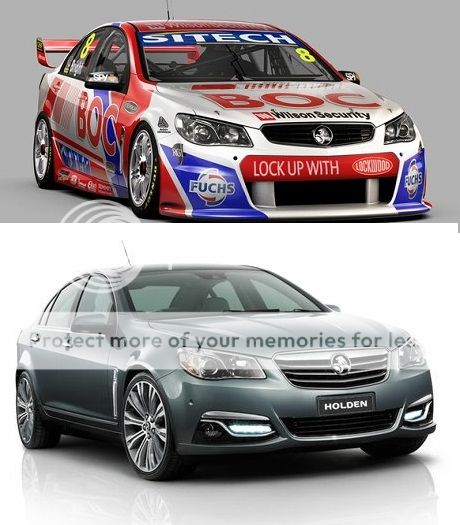
35 years later, both of them still look menacing. I look at the vast majority of traffic on the road with quiet despair because the cars of today do not inspire me at all. Today's road cars are shaped by the wind tunnel and just don't have that sense of raw purposeness about them. To this end, I've had a scribble and I hope that Holden is listening.

The A9X which started out life as a humble Torana hatchback, sprouted a duck tail, bolt on flared wheel arches, that reverse bonnet scoop and drop fuel tanks. From the ordinary hatchback, they gave it enough character to say "don't mess with me or I'll bite your face off". Looks are a little deceiving though.
The 5L V8 which they somehow shoehorned in there, in "SS" trim put out 186kW of power. In comparison, the standard base model Commodore puts out more than that. Let's call 186kW 250bhp just to be kind. 35 years later Opel can drag 270bhp out of the same 2L engine as the Cruze. So if they can do it, I can't see why HSV can't do it.
The formula is pretty easy: 2L, turbocharging, 4WD and you've got the specs for a 300bhp World Rally Car of the late 1990s; it certainly helped Subaru achieve plenty of kudos. Maybe turn the wick up a bit to 350bhp and give it a retro style name, the Cruze "A14X" (14 for the 2014 car) and hey presto, something emerges.


This is my major point.
The Ford Focus RS can be spun out to 350bhp in road trim. If Holden are serious about their next halo car beyond the Commodore's demise in 2016, then the car to be thinking about is the Cruze; since the Cruze is the logical competitor to the Focus, then the perfect place for the battle to be waged is the same place it has always been - that 6.1km piece of tarmac around the mountain. A c.350bhp Cruze might be difficult to sell as it currently stands but give it a face of menace and a place to get angry and you have the same elements which existed a generation ago. The Commodore is now a larger car than the Kingswood and Monaro ever were and the Cruze has a marginally bigger footprint than the Torana did, so even these details are converging in the same way.

Admittedly, the first Sunday in October has been taken over by a purpose built set of race cars, and whilst the V8Supercars bear a passing resemblance to their road-going counterparts, they're not really derivations of them any more. The event to race the 350bhp Cruze A14X would be the 12 Hour race; maybe make up some story about how the Audi R8s and Mercedes SLSs which currently vie for top spot are playing in Holden's backyard and you've got a story to sell as well.

Ok, I admit that that all of this sounds like it has come from the board room of Half Baked Ideas And Ill Conceived Concepts Pty Ltd but isn't that really all selling motor cars is about anyway? Motor cars in essence are little more than mechanical boxes which take us places and get us stuck in peak hour traffic for hours, but attach dreams, legends and stories to them and that's where sales come from; those dreams, legends and stories travel well into the future.
So come on Holden, how about it? Maybe even give me one for thinking it up? Yes?

March 27, 2013

Horse 1454 - The $1 Variation Budget Option


Tony Abbott has said that when parliament resumes for the handing down of the budget in May, he intends to ask for another motion of no confidence. I suppose that this would have the effect of triggering off an early election if it is successful but there is another avenue open to him in the rather likely event that it is not; another sneakier avenue; one so dastardly that it has only succeeded once previous in Australian politics.
That is, the way of the $1 variation.

In 1941 the budget was handed down and to displace Fadden's UAP-Country Coalition Government, John Curtin's Labor Party secured government by copying verbatim the entire of the 1940/41 budgetary legislation and making a change of a mere £1 in the spending figures.
Although this is almost trivial, just £1 of variation meant that the legislation was materially different and that the members were voting on a different budgetary bill. The fact that it was passed meant that supply was stolen on the floor of chamber and with it, the reins of control. Shuffle forwards more than 70 years to 2013 and given that the current parliament sits on even more of a knife-edge, it looks like a semi sensible strategy.

The members of parliament would be asked to vote on basically the same piece of legislation. As far as neutral members or even members of the government are concerned, to turn down legislation that is almost identical save for $1 might mean something even more drawn out and tedious. If the budget isn't passed at all, then there is a loss of supply and that would trigger a dissolution of parliament, unless of course it was stalled in the Senate in which case it'd be 1975 all over again. If a variation budget is passed, then the party which got this through, would have the option of immediately issuing writs to dissolve parliament, safe in the knowledge that they'd then have 11 months before they would be required to produce a new one, provided that they won government in the general election.

Of course it probably goes without saying that under normal circumstances, that such a plan would be impossible for an opposition to explore. Government in a Westminster Parliament is formed from a majority of members on the floor but when government is only formed with the support of independents and minors, then the opportunity for those members to switch sides is very real.
Unlike a censure motion, to pass a budgetary bill runs with the same mechanics as any other bill and instead of failing 73-71 but still being short of the 76 required for a censure motion, 73-71 would have been sufficient to pass a budgetary bill. It would then need to pass the Senate as per any other bill but assuming that the negotiations would be conducted in an entirely different climate, then it might be far easier.

I personally think that an Abbott Coalition Government would be worse for the country than a Gillard Labor Government but I am not the majority of voters in 150 electorates. If Abbott can get a variation budget to pass through the parliament, he'd then have the option of making the people of Australia make a choice about who governs. I'm wondering though what happens if through some bizarre freak of nature, they make the same choice as 2010... then what?

March 26, 2013

Horse 1453 - There Are No Gentlemen in F1 (Rd.2)

Apart from Fernando Alonso who decided to dump his Ferrari into the gravel, Jensen Button who had a wheel fall off, Kimi Raikkonen who was almost absent, the tyre choices from the FIA looking gimmicky and the mileage marathon at the end of races starting to look silly, the Malaysian GP ended with two sets of team orders from Red Bull and Mercedes. Interestingly I think that both of them reveal something of the character of all four drivers concerned.


Firstly Sebastien Vettel was not prepared to just sit idly behind Mark Webber in the two Red Bulls. Amongst other things, Vettel is accused of being whiny and spoiled but out on track, he's prepared to take positions by force, even whilst being told off by his race engineers.
In contrast Webber is more prepared to let things go.

"Webber will never win a World Championship and unless he's given the best car in the field, probably will never win a race either."
- Rollo, Motorsport Forums, 25th Mar 2006,

Although Webber has now won nine Grands Prix (as at 26-03-13), he did so in arguably the best car. Nevertheless, I still stand by my opinion of him from seven years ago.
Mark Webber is in my opinion too nice a person to ever win the World Championship. Compared with firey Vettel he's a more stayed person and I think that that is his undoing. To survive in Formula One you need skill, which he possesses in spades but to peak through into that ratified air of greatness, you need an ego the size of Belgium and you also need quite a bit of unadulterated mongrel about you. Go just a little further down that road and we find Senna, Schumacher and Prost who were all nasty pieces of work on track. Webber is far too nice a person to go down that road and I think that this is why he'll never be World Champion.

Behind them in the two Mercedes a similar story was being played out. Nico Rosberg had earned his third place and was faster than Hamilton ahead of him. Nico was given similar messages to Vettel but unlike his fellow German, remained compliant and docile.

Now of course you can understand the teams' points of view here. Formula One cars are expensive bits of kit and binning them in the gravel is not the best of outcomes. In a championship which could be won and lost on a single point, keeping them on the black stuff is vital.
Also, those of us with very long memories remember the mileage marathons which happened in the 1980s. There was something sad about watching Prost push his McLaren towards the line in the 1986 German GP and the 1985 San Marino GP had five cars run out of fuel and the race winner disqualified for finishing with an underweight car. Race engineers know this and when they ask drivers to slow down to conserve fuel at the end, they do it with learned and sometimes bitter experience behind them.

Vettel's decision to defy orders, says a lot about him; it also underlines a character that is prepared to do whatever to win. There is good reason why he is already a Triple World Champion and why Webber still has the number 2 on his car.
Rosberg it seems, doesn't want to test the patience of his employers. Of course the gentlemanly thing would have been for Lewis Hamilton to move over and let Rosberg through but there are very few gentlemen in Formula One - there might have been some in the 1930s maybe - Lewis is also an ungentleman and a previous World Champion.

March 24, 2013

Horse 1453 - Looking for Vitamin H


I was in the bathroom one day and whilst in there, I tend to read all sorts of things. On this particular occasion I picked up a bottle of shampoo and noticed that not only did the list of the ingredients made no sense to me whatsoever but that I had no idea what Vitamin H was, or really what a vitamin is for that matter. I was pretty sure that vitamins sort of ended when they got to E because I couldn't for the life of me, remember that there even was a Vitamin F let alone Vitamin H.
I then remembered that vitamin H did mean something too me after all but that the source that it came from wasn't really that reliable or helpful:

“It also contains vitamin C, vitamin D, vitamin E, vitamin F, vitamin G, vitamin I, vitamin J, vitamin K, vitamin L, vitamin M, vitamin N, vitamin O, vitamin P, vitamin Q , vitamin R, vitamin T, vitamin U, vitamin V, vitamin W, vitamin X, vitamin Y, and, believe it or not, vitamin Z! The only two vitamins it doesn't have in it are vitamin S, because it makes you sick, and vitamin H, because it makes you grow horns on the top of your head, like a bull. But it does have in it a very small amount of the rarest and most magical vitamin of them all — vitamin Wonka.”
- Charlie And The Chocolate Factory, Roald Dahl (1964)

Of course basing one's knowledge on a children's novel is a silly idea, but I at least saw the irony that vitamin H in this list would make you grow horns on the top of your head and shampoo is used precisely in that location. If this story in Charlie And The Chocolate Factory was fact, then you'd be well advised never to use this brand of shampoo ever again.
It still leaves my two questions of what is Vitamin H and what is a vitamin anyway?

A vitamin is a chemical which can not be synthesised in sufficient quantities by the human body and must be absorbed through the diet. This is different to an essential nutrient which can not be synthesised by the body at all and a "dietary mineral" which in terms of the human diet are the chemical elements other than carbon, nitrogen, oxygen and hydrogen which are required by the body.

There used to be a pretty long list of vitamins that all the way down to Vitamin U when for one reason or another, it was either discovered that they were either synthesised in the human body or non essential. The other problem was that Vitamin B was expanded to include a whole group of  water-soluble chemicals which  are all needed for cell metabolism. Vitamin B instead of being a single chemical was actually found to be a whole host of them.
This is where Vitamin H comes in.

Vitamin H was discovered in 1935 by Dean Burk and was named for the German words "Haar und Haut" being "hair and skin". This sounds perfectly in line which it being included in the list of ingredients in a bottle of shampoo. It was later found to be the same chemical as Bioton which had already been identfied as Vitamin B7.
Biotin is needed in the production of some  fatty acids, and the metabolism of fats and amino acids; all of which produce all sorts of useful chemicals in the human body. Also, there appears to be an anti-Vitamin called Avidin which mainly comes from egg whites which impedes the effectiveness of Biotin.

There it is then. Vitamin H is a thing but probably shouldn't be called Vitamin H because it's actually the same thing as Vitamin B7. Assuming that Mr Willy Wonka was correct in saying that Vitamin H "makes you grow horns on the top of your head, like a bull"  then the cure would be to start smashing egg whites into your scalp.
Also as a curious aside Vitamin S which "makes you sick"  is the chemical Salicylic Acid which is active ingredient in Aspirin. I don't know about it making you sick but certainly just thinking about all of this, gives me a headache.

March 22, 2013

Horse 1452 - Much Ado About Political Nothing

Few would suggest that 21st March 2013 was not an important day in Australian politics. It was not as important as 11th Nov 1975 but thanks to the immediacy of the internet, unlike 1975 when half the players themselves had no idea what was going on, this was called play-by-play like some macabre football match. Just like a political football match, despite shots being fired no-one scored and it's still 0-0 and all to play for.

I wrote in Horse 1280 in February of 2012:
http://rollo75.blogspot.com.au/2012/02/horse-1280-no-confidence-in-no.html
I think Abbott if he was really serious about forcing an election, he should have called for a censure motion. The fact that he didn't means that although he personally has "no confidence in this prime minister", I suspect that he can't get sufficient people to cross the floor with him in his lack of confidence.

And later in the same piece that:
If Abbott was serious about wanting an election, then why doesn't he just force one. The mechanism exists. Maybe he's just too politically cowardly to pull the levers?

Yesterday, after the spill had been announced by Ms Gillard in the chamber, Mr Abbott finally rustled up the courage to pull one of those levers. After a bout of sound and fury, in the end it signified nothing.
Although he did win more votes on the floor of the chamber, 73-71, he was still short of the 76 required to force a dissolution.

Abbott finally did call for a censure motion. So how then could I guess, from thirteen months ago, that he couldn't  "get sufficient people to cross the floor with him in his lack of confidence"? Mar 2013 shares one key similarity with Feb 2012; it is the same reason why I think that any censure motion is always doomed to fail in this particular parliament.
An MP is unlike most employees in that every time an election is called, their job security disappears; this is even true if you are a sitting Prime Minister. Every MP, especially in a hung parliament, already has diminished job security and so unless they're pretty sure that they'd retain their seat after the election, the motive not to vote in a censure motion and thus deny the possibility of it passing is stronger than ever.
In other words, to pass the motion is to vote to possibly lose your own job. Most people would be quite daft to do that.

As for the spill:

Simon Crean who must surely by now have gotten the message that he's horrible at picking winners for the leadership (having led the party himself in 2001 on a brief walk to nowhere), tried to thrust Kevin Rudd into the top job, and failed gloriously.
Like his father Frank before him, Simon Crean also failed to be Prime Minister. Now, having failed to lead his own troops to victory, he's now tried to make a run across no man's land... with no gun.

Rudd pretty well much knew that he didn't have the numbers to make a challenge and he's been on television and radio now for weeks saying precisely that. When 20 MPs arrived in his office, even if they could all convince just one friend each, they'd have still been 11 votes short in the caucus room. No wonder despite the goading of Crean, Rudd still would not challenge for the leadership. To do so would be a waste of time and worse, provide statistics and ammunition to his rivals if he ever does decide to lead the party again.
Maybe this this a case of CHICKEN KiEV but there's certainly no hot bed on which to get anything cooking.

What we saw then, was no leadership challenge. I'd like to say that again - there is no leadership challenge. Maybe I need to restate this for the benefit of Fairfax and News Ltd who have driven the public mad and beyond the point of distraction  - there is no leadership challenge.
I for one am sick and tired, my teeth are floating due to the incessant grinding because of the media's endless speculation about a leadership challenge when there is in fact no leadership challenge. There is no leadership challenge. Get it? Got it? Good. There is no leadership challenge.
This question is so boring, that it provides me with an opportunity to get up and make a cup of tea during QandA, makes me change channels if I'm watching the nightly news and makes me doubt why I bother to read through the political pages of the Oz, the Tele and the Herald.
This question fills up column inches which could be better put to use writing proper editorials and probably explains to some degree why the Herald and the Age in particular which used to be newspapers of record, are slowly sinking into the ooze of tabloid journalism.

Dear Media, 
Writing pieces with nothing more than mere speculation will not win you Walkley Awards.
Yours very sincerely,
The overly irritated people of Australia.

Mr Abbott can claim all he likes that the Labor Party is what he calls a "civil war" but really it's difficult to actually have a war when one side repeatedly refuses to fight, no matter how much people really really really want them too. A vote of 100-0, can not possibly yell any more loudly. As far as the spill goes, even Crean who called for the spill, Fitzgibbon who canvassed MPs who join Rudd, the 20 MPs who showed up in Rudd's office and even Kevin Rudd himself who never said that he would challenge, all voted for Gillard to remain as Labor leader.
Maybe it's entirely possible that part of what we saw yesterday was stage managed. If it was, then the Labor Party have trolled the media wonderfully.

Whatever rolls out of this I think that we can say with 99% certainty, that the election will still occur on September 14, despite and now in spite of Abbott's (and News Limited's) repeatedly shrill calls for it to be earlier. Unless Abbott is somehow able to force a loss of supply, it just doesn't seem likely.

March 18, 2013

Horse 1451 - Keep Kimi and Carry On (Rd.1)


- photo from ABC.net.au

To be honest, when Vettel stuck his car on pole at the Melbourne Grand Prix, I honestly though that this would be yet another steamrolling performance from the Red Bulls and that at the end of the day it would be Vettel 1 and Webber 2. The people at Pirelli had other plans though. Pirelli could have taken any tyres to the GP that they wished and it would have been possible for their hard tyres to last the entire race distance but the reason that they gave for only providing the Medium and Super Soft tyres was to "make the race more interesting".

So then, what did we learn from this "more interesting" race?
As time goes on, I don't think that you can honestly blame the Red Bull for Webber's bad starts. Vettel got off the line quite nicely and so I think that it's fair to say that the common component behind all of Webber's poor starts is none other than Mark Webber.
Entirely because Pirelli chose to use tyres which would degrade very quickly, we saw Vettel, Hamilton, Alonso, Massa, Raikkonen and even Sutil lead the GP at some point. Thus it became a tactical battle to ensure that drivers were filed back into the queue where they would be held up the least. In this respect, both Ferrari and Red Bull played the game rather excellently; Mercedes still seem a little unsure about how to give Hamilton relevent information but Raikkonen who ultimately won the GP, didn't seem particularly bothered about where he slotted back in.
I think that what the result shows us more than anything is that the Ferraris have the most power to play with (being consistently fastest through the speed traps) but that the Lotus either because Raikkonen is able to drive sympathetically or maybe because of pure balance, is the kindest on its tyres. Most markedly the Force India of Sutil had very thick black wear lines down the centre of the tyre, with possibly could indicate that they'd misread the track and had set pressures too high.
Despite the FIA and Pirelli's tampering with the rules and trying to fiddle with results through gimmickly tyres, it's still interesting that the podium was still occupied by three world champions.

It will be interesting to see just how much of this race victory was due to purely the car or Raikkonen. Grosjean started in 8th after a very strange set of qualifying crcumstances and finished 10th so I don't know what if anything that tells us at all. Raikkonen again proved though that he does know what he is doing and that he is rather good at doing it.

March 17, 2013

Horse 26533 - Diary from Die Mechaniker

Hallo.

The year 2178 came too quickly for us. We have been engaged in an hideous war which has been prolonged for far longer than most of us can remember. Our grandfathers began this conflict 50 years ago to the day and we still fight on, bearing the legacy of conflict without remorse; without fear; without end in sight. 

We are Die Mechaniker.

Saturday March 14, 2178

We are still in the Ural region. This morning we encountered a small hamlet being held by three sand people and their getaway buggy. We sent a relatively minor detachment of 35 powered troops, 10 mechs and 10 skorps and they surrendered almost immediately. It was very very disappointing.

Sand people... surrendering.

As night falls in this region, the temperature drops well below -30°C. Some like to blame this on the nuclear winter which has descended upon the Earth; others like to blame climate change. We however have had our top scientists for almost 20 years try to develop equations so that when we finally take over what is left of this planet, we can balance nuclear winter against global warming.

Some of the local inhabitants we find are very very primitive. We found these two individuals in an abandoned town where the radiation levels we well over 3500 microroentgens per hour. They could only communicate in grunts and other short noises. After we had backed them into a corner, they too surrendered .  It was very very disappointing.


Primitive people... surrendering.

Sunday March 15, 2178

As the morning arrived on Sunday, temperatures rose above -10°C. We are well insulated against the cold by our thermo exo-armor but these primitive people appear to have nothing more than skins from animals that they have killed.
These three primitives tried to attack a mech whilst we were in bivouac. Of course, waking us up is not something which we suggest doing unless you want to end up as a pulpy mess upon the tundra. We engaged a chase, however they escaped via some sort of armed bear cavalry. Bear cavalry? I ask you, are these primitives even the remotest bit sane? We suspect that 3500 microroentgens per hour might have something to do with it.

Primitive people... fleeing, on bear calavry.

A campaign would not be complete without a photograph for posterity. We found what appears to be a statue from over 300 years ago. It is marked "General Vladimir Vladimiros - 1802 - 1866". We do not know who in history this is; perhaps the general was a hero of this town. Alas their efforts have come to nought. The great and powerful Die Mechaniker have arrived.
Sgt Klow, Pte Illych and Pte Nvosk pose with one of our proto-plasma cannon. This is yet another victory in the name of  Die Mechaniker. The rest of the battalion is off in the distance, enjoying morning provisions.

Three comrades... victorious.

Tommorrow we push towards Siberia. We expect to find very little resistance. We fear none, we dread nought, we feel no pain. We are Die Mechaniker.

Over and out.

Colonel Petr Miktau. 97th Batt. Asia Div.
15-03-2178.
****
**** collected via timeslide transfer ****
****

March 14, 2013

Horse 1449 - Public Interest Media Advocate... YOU'RE STALIN

He who shouts the loudest, has the floor...

If you'd opened a newspaper in Australia over the last few days, you'd be forgiven for thinking that a fascist government had just been elected and that we're all facing some Orwellian nightmare where the government is going to take control of all print and broadcast media. The actual truth being so far removed from all of this, that the public has almost been neglected in being told what is intended, that is a statutory watchdog called the Public Interest Media Advocate (PIMA) which would be appointed to do the job which ACMA and the press council currently fail to. Presumably the PIMA would look into and possibly enforce the existing standards when it comes to press reporting.
Can we all just take a stress pill and take a little time to calm down? No-one is talking about imposing licences, or restricting what can and can't be printed; not at all. Given the results of the Leveson Enquiry looking at media and ethics in Britain, which failed to find much use of ethics and that News Corp is a sister organisation to News International, is it little wonder that the frame of reference is a little wider than when the idea was first floated in July of 2011?

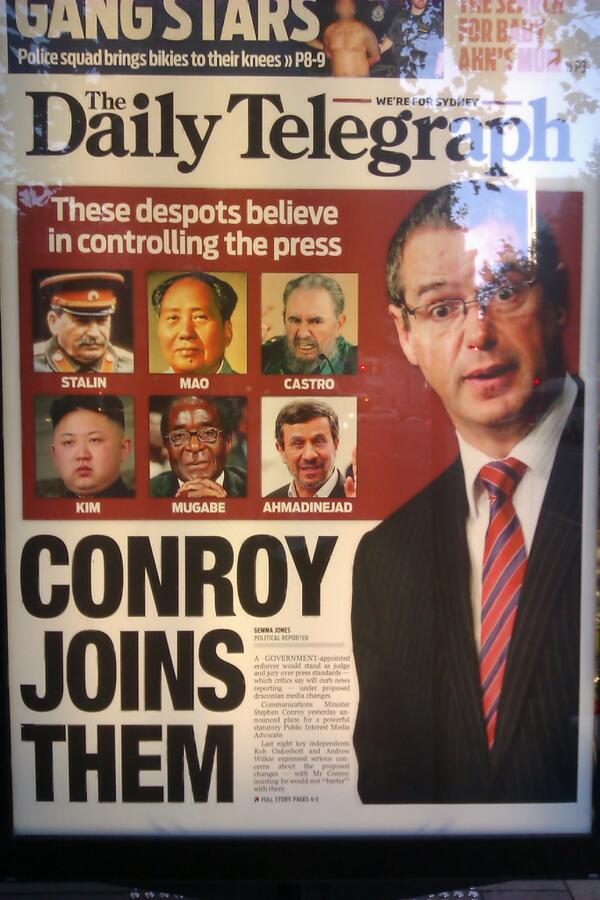
Perhaps the response was obvious. Communications Minister Stephen Conroy said that he hadn't seen the front page of the Daily Telegraph in Sydney when interviewed by the ABC but that he had expected to be lampooned.

As despotic as Stalin? Really? Come on people...

The Daily Telegraph itself must surely be trying to turn itself into an Australian version of Britain's Sun Newspaper if comments like these are splashed all over the front page. They haven't actually invoked Godwin's Law* but comparing Stephen Conroy to six of the world's despots is hardly non-partisan - maybe it falls under the Fox News banner of being "fair and balanced".

I for one believe in the freedom of the press, despite how News Corp decides push public opinion on the matter. That in itself makes you wonder what exactly is meant by freedom of the press in the first place.
Freedom of the press is an interesting concept to begin with. Although any given writer is free to write whatever they wish, they're more likely to be published by a media outlet if they either represent or have internalised the values of the media outlet. In other words, although an outlet like Fairfax or News Corp might say that they're highly in favour of expanding free speech, they aren't the one's through editorial practice who are going to attempt it in the near future.
What is being objected to here is any form of regulation and compliance whatsoever; most likely on the basis that it will hurt profits in what by most accounts is already viewed as a sunset industry. Quite apart from the fact that to set up a daily or even weekly newspaper is hideously capital intensive and therefore already a barrier to entry for new firms; especially this late in the game, you're not going to get any new media in print to compete with. Not even Britain's Guardian newspaper which intends to set up shop later this year has any intent to go to print, preferring to remain online.

Also, given that copy is now written and published online at such a furious pace, I don't honestly see how the media companies imagine that the government would even have the ability to censor or muzzle the press. We've already seen with the reduction in size of newsrooms, the mass laying off of subeditors and the willingness to print third party copy from companies like Reuters and Associated Press, that newspapers don't even have the same scope to write slamming editorial pieces anymore.
To be honest, 80% of the population was already too disinterested and disengaged to read much beyond the headlines; and the remaining 20% is mainly comprised of business people who have a natural tendency to lean right anyway. Of that 80%, most of them can name the contestants of MasterChef, My Kitchen Rules or The Biggest Loser, more than they can the Minister for Trade or the Shadow Minister for Finance. Admittedly there are other opinions but unlike a media environment such  as France or Germany, they were quietly killed off some time ago; you certainly won't find them in a daily newspaper in Australia.

No, I think that PIMA would be more concerned with actual breaches of the law and standards than it would trying to put a dummy in the mouths of the press. Instances where they've published names in court cases while its still under orders not to, where there has been violation of the law such as hacking a dead girl's mobile phone or bribing police officers to extract information.

I also don't think that "Cabinet was cornered into backing" anything as the Daily Telegraph and Herald Sun so brazenly trumpeted today:
http://www.heraldsun.com.au/news/cabinet-rolled-in-conroy-media-reform-ambush/story-e6frf7jo-1226596816006
Cabinet was cornered into backing the government's draconian media regulations during a special meeting on Tuesday, senior Gillard ministers have confirmed.

Cabinet sources revealed that most ministers were denied time to properly read Communications Minister Stephen Conroy's proposed media reform rules before they were rubber stamped.

- Simon Benson, Daily Telegraph, 14 Mar 2013

It seems rather a bit daft that Cabinet hadn't had time to read the recommended media regulations when you consider that Ray Finkelstein, QC, handed his report to the government on 30th March 2012, or 349 days ago. By the government's own admission:
The government also announced that it will continue to progress its consideration of the report with further announcements to be made during 2013. 
http://www.dbcde.gov.au/digital_economy/independent_media_inquiry

Ray Finkelstein's report can be found here:
http://www.archive.dbcde.gov.au/__data/assets/pdf_file/0006/146994/Report-of-the-Independent-Inquiry-into-the-Media-and-Media-Regulation-web.pdf

While we're at it, I find it a little daft in that report that:
News Limited CEO Kim Williams, publisher of this website, described the Conroy reforms as "Soviet"-era argument and a "travesty of public process of the most heinous kind". 
Yet:
could revoke a newspaper's privacy protections if it didn't abide by new unknown standards which have not yet been set.
Now correct me if I'm wrong but how can you describe anything as heinous and a travesty if you don't actually know what it is?

It seems to me that the Public Interest Media Advocate which is being proposed by the Minister for Communications, Stephen Conroy, is in essence similar to the proposed News Media Council in Ray Finkelstein's report of almost 12 months ago.
We've seen in Britain the sorts of criminal activity an unregulated and under-supervised media will get up to. It is naive to think that that isn't going on in Australia. If the current Australian Press Council is under funded under a voluntary system (by “constituent bodies”, which comprise News Corp and Fairfax) and seemingly deliberately so, so it can't perform its job properly, then maybe the PIMA is both a timely and needed shot in the arm.

*Godwin's Law - As an online discussion grows longer, the probability of a comparison involving Nazis or Hitler approaches 1.

March 12, 2013

Horse 1448 - Labor's Long Road To Ruin


I'm going to make a prediction now, although somewhat begrudgingly and that is that on September 15, Australia will wake up with Anthony Abbott as Prime Minister and a fairly handy majority in both houses of parliament (98-49 seems like a good sort of spread*).
The thing is though, this prediction doesn't necessarily just apply for Election '13, if applies generally for Election '16, '19, '22 and in broad terms until '43.
People might talk about the Obeids, the powerbroking of the NSW Labor left and right but the simple fact is that what the Labor Party represents is dead.

The Labor Party traditionally not only represented workers but its basis of power coalesced around trade unions and the power which they could wield. Largely because corporations over the past 30 years, have found new and cheaper sources of labour, without the shackles of working conditions imposed in western countries, the sorts of people who would have organised themselves into trade unions are no longer within our borders but overseas. Thanks to the move from a manufacturing to a service based economy, the unions themselves have either deliberately voluntarily or chosen to ignore newer classes of workers which have formed.
What's especially strange about this is that the situation which exists in Australia now, is roughly the same as in Britain in the late 1970s (even with a twice elected Labor government). The manufacturing sector has been white-anted and although we don't have the series of strikes which existed in 70s Britain, the more conservative alternative hasn't really worked that hard to impress the public. The Labour Party in Britain in 1979 was dumped out because it found that its former base no longer was behind it.
The ironic thing is that Thatcher brought a dynamism to politics whereas Abbott does not. Just like the Conservative Party in Britain in 1978, the Liberal Party's biggest asset in Australia in 2013 is that the vast majority of members and potential members of parliament who will likely form government, have kept their fool mouth shut. Sometimes saying nothing is the best policy, for a politician it may even give you employment.

Basically the unions are gone, power is dissipated and the party which was made up of a loose federation of those organisations, now finds itself sitting atop a structure where all the supports have been shipped out of the building and the only thing holding up the ceiling is the wallpaper - such a structure must invariably collapse.
What we're left with is a Labor Party which fails to represent the kinds of labour which most people currently provide. A party which fails to represent potential voters, whatever the colour of the politics it peddles, quickly finds that people tend to take their votes elsewhere. Criticism which exists about the Greens taking votes away from Labor is perhaps apt but helped along by Labor volunteering those votes through inactivity.

Especially during the decade of the 00s, politics in Australia shifted away from grand policy and ideology to a situation where both sides now argue over who will be the best administrators of the economy. Politics has now become about who will be the best managers of what already exists rather than who is best at setting targets to aim at.
In this respect, the factionalism which is publicly displayed by Labor hurts their cause. I'm 100% sure that factionalism exists in the Liberal Party but because they haven't aired their grievances in public, the voting masses haven't judged them for it. Mind you, the media in this country willingly stirs up angst if it can because both print media companies and three of five television networks are broadly right of centre.

The real thing that bothers me and will do for the next 30 or so years (because I think that in that period there will be 24 years of LNP governments and 6 years of Labor governments) is not so much that the Liberal Party will be in power but that Labor will slowly shift further to the right and morph into a clone of the US Democratic Party. Politics in Australia will be fought over 'social' issues and what to do about the aging population and the growing class of under waged people as though they were not in the room.
I don't know where, or even if the intelligentsia of the left even exists any more. Maybe it will take the reemergence of squalor and dire poverty for the left to finally find its voice but until then, I just don't see it happening. There just aren't the big issues like the extension of the franchise to deal with anymore; so the movements which would have given the left reason to write and enter the body politic simply won't exist. Without Labor's left doing anything, the right squabbles with the Liberals into irrelevancy.

*Based on a 5.5% swing to the LNP which I think would be reasonable

March 08, 2013

Horse 1447 - The Falcon Is Very Replaceable

http://news.drive.com.au/drive/motor-news/falcon-not-part-of-ford-future-20120307-1uj2a.html
The nails show no sign of being removed from the coffin of Ford's flailing Falcon, with the brand's international president all but confirming there is no long term future for the Australian large car.
While remaining guarded with his comments, Ford boss Allan Mulally gave his strongest hint yet that the Falcon - and possibly the Falcon nameplate - is headed for the scrapheap.
Speaking at the 2012 Geneva motor show Mulally reinforced Ford's One Ford policy, whereby cars are produced for a global market. He also named almost every model in the new Ford line-up, missing the Falcon, which has government assistance to keep it being produced until 2016, but faces almost certain death beyond that.
- Fairfax Media, 7th Mar 2012

This article was probably in the Drive Section of both the Sydney Morning Herald and The Age and a year later by accident, I found an advert in an American magazine which led me to put two and two together.
Assuming that the Falcon is facing "almost certain death" beyond 2016, Ford would need to source their large car from somewhere and perhaps the Ford Police Interceptor variant of the Taurus would be the logical replacement.

http://www.ford.com/fordpoliceinterceptor/#/models/sedan

The Police Interceptor according to Ford's website, is pretty well much the same car as the Ford Taurus except with some differences in specification. Like the Taurus is sits on Ford's D3 platform and shares the same 3.5L V6 engine; as opposed to the current Falcon which sits on pretty well much the same platform as the XK Falcon did in 1960 and the block which started out at 2.3L which was eventually bored out to 4L in 1970.
The Taurus does have some variations such as the SHO (Super High Output) which comes with direct-injection and twin-turbo chargers but also intriguingly in four wheel drive which would probably satisfy Ford Australia's wishes as the standard Taurus comes in front wheel drive.

The Ford Territory which is derived from the Falcon could in theory be just as easily replaced with the Ford Explorer which also shares the same engines and drivetrain choices. This would leave only one problem with the ute unaccounted for but Ford being the company that it is, would just as likely foist upon Australia some variant of a future Ford Explorer Sport Trac like it did with North America, although maybe the current Ford Ranger is sufficient enough to the line up that an Australian built ute, is an extravagance that Ford simply can't be bothered with (I already suggested this in Horse 1175).

It's the numbers which really tell the scary part of this story, once you start putting things into metric, the blown 6 chucks out 272kW of power and 474Nm of torque. The blown 6 in the XR6 puts out 270kW and 533Nm. Apart from the amount of torque, which is still more than adequate to tow a caravan, pull stumps out of the ground and give you that nice kick in the bum when you put your foot down, the whole point of producing the Falcon at all starts to fade.

As for the last bastian of boganimity, the V8 Supercars, the Nissan Altima and the Mercedes-Benz E-Class have both proved that the public will still enjoy the spectacle irrespective of the brands competing. If Ford was serious about the game, then why are there only 6 Falcons? Surely if you want to make the brand and the model retain the profile, you'd be fighting harder. Instead, Ford seem content to let it roll over and die slowly. Pity really.
Maybe Ford would be content to put the Falcon nameplate on the Taurus for the Australian market. Making stick on badges is cheaper than running an entire plant here.

March 07, 2013

Horse 1446 - Nani Sees Red

Sir Alex Ferguson who is very well known for his one-eyed partisanship when it comes to decisions that have gone against him, obviously felt rather hard done by when Nani was sent off in Manchester United's Champions League tie against Real Madrid. Probably as a direct result of this, United after going down to ten men, conceded two goals and were bundled out of the tournament.

I was waiting for the usual post match interviews and found that neither Jose Mourinho or Sir Alex gave any. Presumably Sir Alex was still fuming in his Glaswegian way as is his wont and so it would have been fair.

I found this on the SBS website this morning and the following words from former Manchester United player and captain Roy Keane:

http://theworldgame.sbs.com.au/real-madrid/news/1143108/keane-backs-ref-over-nani-red-card
"I think the referee has actually made the right call. Everyone's upset about it and it's slightly unlucky, but it's dangerous play. Whether he meant it or not is irrelevant. It's dangerous play - it's a red card. You have to be aware of other players on the pitch. Does he think he's going to have 20 yards to himself?
Whether it's a brave decision or not, it's the right decision. Whether he meant it or not doesn't matter. Nani's a quick boy to go down anyway. He's not the bravest player on the planet."

Keane insisted the referee had carefully considered his decision.

He added: "It doesn't matter if he knows there's somebody there or not, it's irrelevant. I don't think the referee actually made the decision because he waited a couple of minutes while the player was getting treatment.
I think it might have been the assistant that made the decision, and I actually think he's made the right call.
We always say referees are very quick to make decisions - he waited a couple of minutes.
Any time I was sent off in my career I always thought, 'did I give the referee the chance to send me off?' And if the answer is yes, then it's out of your hands."
- SBS Website, 6th Mar 2013

The key words in this are these "It's dangerous play - it's a red card". I thought about this and because I've taken the referee's course so I can official at churches' level (in truth I only run the linesman's flag) and couldn't recall the actual words of "dangerous play" even though it made perfect sense. So I consulted the FIFA website to find Law 12 and what constitutes either a foul or misconduct.

http://www.fifa.com/aboutfifa/footballdevelopment/technicalsupport/refereeing/laws-of-the-game/law/newsid=1290868.html
Law 12 - fouls and misconduct
Direct free kick
A direct free kick is awarded to the opposing team if a player commits any of the following seven offences in a manner considered by the referee to be careless, reckless or using excessive force:
- jumps at an opponent
- charges an opponent

With Nani, a very strong case can be put forward that he both jumped at and charged an opponent. Careless? Certainly. Reckless? Possibly. Excessive force? Well, going in with the studs of your boots aimed directly at the chest of an opponent doesn't help your cause. Going in studs up anywhere on the pitch is at the very least going to earn you the ire of the referee and most likely a yellow card.

Helpfully, FIFA clarifies each of these terms in an interpretation document on Law 12:

http://www.fifa.com/mm/document/worldfootball/clubfootball/01/37/04/28/law12-en.pdf
Careless, reckless, using excessive force
“Careless” means that the player has shown a lack of attention or consideration when making a challenge or that he acted without precaution.
- No further disciplinary sanction is needed if a foul is judged to be careless
“Reckless” means that the player has acted with complete disregard to the danger to, or consequences for, his opponent.
- A player who plays in a reckless manner must be cautioned
“Using excessive force” means that the player has far exceeded the necessary use of force and is in danger of injuring his opponent.
- A player who uses excessive force must be sent off

Charging an opponent
The act of charging is a challenge for space using physical contact within 
playing distance of the ball without using arms or elbows.
It is an offence to charge an opponent:
- in a careless manner
- in a reckless manner
- using excessive force


This photo quite clearly shows that Nani went in with without using arms or elbows and whether or not it was careless or reckless, the fact that Arbeloa went flying afterwards, would give the vast majority of referees the idea that the amount of force was excessive and FIFA's interpretation document on Law 12 says that a player who uses excessive force "must be sent off".
I don't think that Nani helped his cause either by rolling around on the ground; maybe feigning injury for almost three minutes, when it was obvious that Arbeloa had been hurt more badly and was winded.

Was the referee justified in his decision then? If the people who interpret these things have provided direction on the issue have said that the player must go, then the only conclusion I can come to is that he has acted directly as instructed to.
I personally think that the referee responded correctly. The only people who are kicking up a stink are Man United fans which is understandable because no-one likes to be on the end of a decision like this... even if the referee is right.

March 06, 2013

Horse 1445 - Is Western Sydney A Separate City?


Is Western Sydney a separate city because the people can't get to Eastern Sydney?
- Alan Kohler, 5th Mar 2012. (from Twitter)

No Mr Kohler. Western Sydney a separate city because the people of Eastern Sydney who own and run the city, won't spend the money on public infrastructure like they have done in Eastern Sydney.
As a resident of Western Sydney who works for a majority of clients who live in Eastern Sydney, it is my experience that few of them ever venture out to Western Sydney and even then only have a vague idea of where it is, let alone the names of any suburbs.
I'd suggest that great numbers of people living in Eastern Sydney would barely recognise that there even was a Western Sydney; let alone recognise the issues and concerns of the people living there.
You can nicely divide Sydney into two distinct halves just on the basis of postcode. 2000-2108 and 2109 onwards.

It's a funny thing, this whole business of 'recognition'.
The Prime Minister, Ms Gillard is treading the pavements of Western Sydney in an effort to recognise the issues which uniquely face the region.
The Premier of New South Wales, Barry O'Farrell appointed himself the Minister For Western Sydney, probably also in an effort to recognise the issues which uniquely face the region.
As a resident of Western Sydney, I think that I possibly recognise the issues which uniquely face the region more than Ms Gillard or Mr O'Farrell by virtue of living there.
The two biggest issues are the cost of living and the lack of decent public transport; both are linked in ways that Ms Gillard or Mr O'Farrell fail to address.

http://news.theage.com.au/breaking-news-national/gillard-denies-dodging-westies-20130306-2fjz2.html
But Mr Darley said western Sydney's problems, like cost of living pressures, lack of good infrastructure, crime and closed shops, could be found across Australia.
- The Sydney Morning Herald and The Age, 6th Mar, 2013

When the consultation for the M2 was being done, residents' groups quite loudly and longly asked for heavy rail services to be built through Castle Hill and the North West. In the original Environmental Impact Study, this was recognised over and over again but instead of acquiescing with the people who actually live out there, Macquarie St in its wisdom decided that another toll road was in order. It took about five years but eventually after toll road operators whinged that they weren't collecting enough in revenues, lanes were diverted to shove more cars onto it and now, the M2 twice daily becomes a slow moving car park.
When the M7 was being built, it was touted as being the road from nowhere to nowhere. It also had a lovely toll slapped on it. Whilst being far harder to divert traffic on and off, the operators installed electronic toll collectors at every entrance and exit to ensure that maximum revenue is collected.
Now that Julia has been to Western Sydney, she's suggested that a $1B extension to the M4 should be built, by West Connex and that it should have a lovely shiny new toll slapped on it.
Compare the impact of more toll roads with the concerns of Western Sydney residents; namely the cost of living and the lack of decent transport. Obviously it stands to reason that more toll roads will only add to the cost of living; with the added bonus that within five years, those new toll roads fill up and become slow moving car parks, which doesn't really do anything in addressing the issue of decent public transport.

I could be wrong about this but the nine toll roads in Sydney (M2, M5, M7,Harbour Bridge, Harbour Tunnel, Falcon St, Gore Hill Tunnel, Cross City Tunnel and Eastern Distributor) are the largest number of toll roads in a single city and possibly province in the world. Sydney has more toll roads than quite a number of nations.
People used to joke about carrying a bag of coins if you wanted to travel down the Autostradas in Italy. Thankfully in the twenty first century we have dispensed with the need from coins and now toll road operators can collect revenues directly from your credit card via electronic tags.

Toll roads in Australia and especially Sydney are different in spirit to the freeways and interstates in the United States or the Autobahn in Germany and even most of the Motorways in the UK, in that instead of bring built in advance to cope with traffic not yet even thought about, they're invariably built after the event; through transport corridors originally earmarked for railways and with the express intent of collecting revenues. In most cases there aren't the same number of exits say in the US and so traffic is channeled into tighter currents, simply waiting to be dumped out at their end; anyone who's driven through Strathfield and the end of the M4 or at Hornsby where the F3 still remains unconnected to the M2 (if it is connected, expect toll road number ten), experiences this twice daily.

Barry is at least trying though. Since cancelling the North West Metro project and even promising to fill in the holes if work was ever started, there is a new project being built to help alleviate traffic in Western Sydney - the King St pedestrian tunnel at Wynyard.
Okay, maybe it falls short by only about 56km but building a tunnel which covers a full 1% is better than none, right?
It also has the added bonus of conveniently blocking the transport corridor underground, should any future government decide to build a railway line. Barry knows that if the last 80 years since Premier Lang proposed the idea of a railway line to Castle Hill are any indication of future progress, that maybe by 2093 a tunnel might stretch all the way to Pyrmont.

London experienced traffic troubles which choked the city in the 1850s. 150 years ago in 1863, the first few cuts underground were made and by 1890 the system was electrified. Without the Underground in London, the city would come to a standstill. One train draws two thousand cars off the road; prevents a great deal of traffic from ever being created.
The big problem with the Underground and indeed all public transport systems, is that unless they're built or run by private firms, they stand in direct competition to things like toll roads. Private firms often do not want the immense capital outlay to even start such a project and governments who at the moment are swinging through that part of the long ideological cycle which dictates small government, also do not wish for the immense capital outlay to even start such a project; preferring half-baked Build-Own-Operate-Transfer schemes which in the short term, continue to ensure that these things remain unbuilt.

The building of M4 East by West Connex really won't solve or address the two issues of the cost of living and the lack of decent public transport. If anything, yet another toll road merely adds to the cost of living for those people who choose to use it, funnels traffic to a different point in the city and if you're living far away enough not to be able to use it, isn't a public transport solution either.
I can sit in relative smugness because I live in a suburb with its own train station. It's somewhat disappointing that the line was built in the 1890s at around the time that the Underground in London was being electrified and more than 100 years later, remains one of only a few feeble ribbons of public transport infrastructure through a population which accounts for almost a quarter of this great metropolis.

I thought it was obvious that making people pay to drive on toll roads was going to add to their cost of living and building toll roads instead of railways merely perpetuates the lack of public transport. Then again what would I know?

Addenda 1:
As an aside, this in essence is why Julia and the Labor Party will lose seats in Western Sydney and possibly with them, the election in September (as well as the 2016 and 2019 electionpublic transport.s). For some reason or another Labor wouldn't or couldn't properly address the issue of Western Sydney whilst they were in government and as far as Sydney is concerned, the Liberal Party doesn't care to, and doesn't really need to address the issues facing the people of Western Sydney because they don't really care if they vote for them or not, expect when it comes to making governments.

February 28, 2013

Horse 1444 - Third Man


I think I've found possibly a worse position on the cricket field than Fine Leg, a position so horrible that even captains are loathed to use it - Third Man.

I don't know why he's the Third Man, presumably the captain is at First Slip standing next to the Wicket Keeper and that's two men, so maybe it is given that title of honour because it is so horrid.
Third Man to Third Man duties are equally as arduous when it comes to the change of over because like Fine Leg to Fine Leg duties, the fielder has to run the longest chord of the ground. Unlike Fine Leg (see Horse 1409) though, the Third Man is expected solve problems.

Fine Leg is usually where a captain will put either the worst fielder or perhaps a bowler who they'd like to rest between overs. Fine Leg is known in advance to be either a bad fielder or someone resting and so captains don't tend to give Fine Legs all that bad a time.
In contrast, Third Man is assumed to be at least half way competent and it is therefore completely justifiable to give them a display of anger if they make even the most minute of mistakes.

Third Man is placed deep behind where the slip cordon would usually go but so far back, that just like Fine Leg, they're expected to cover an area comparable to a sheep station in Queensland where distances are measured in hours rather than miles. A ball is almost never consciously played to Third Man; usually it involves the batsman slashing wide and high and then getting a thickish edge. So unlike Fine Leg where balls are directed, clicked, glided even, at Third Man the fielder has to do their best to diffuse a hand grenade and if they don't, they can expect a volley of abuse to come their way.

Not being content with requiring a Third Man to have springy legs and the hands of a bomb disposal expert, the captain also needs them to stay awake.
Fielders at Cover or Mid-Wicket can generally keep their brain ticking over due to the constant threat of being struck by a full blooded drive, or a bash directed at Cow Corner but the poor old Third Man is so far away from any action, that the whole match takes place 'out there' somewhere.
A fielder at Third Man has so much time to let their brain wander whilst waiting for anything to happen out there that in the mean time, great books and ideas can be composed; great writers like Arthur Conan Doyle, Earnest Rutherford, Isaac Newton and even Frederich Engels were all known fielders at Third Man and dare I suggest composed their literary work out there. Isaac Newton the inventor of gravity, of course, never fielded at Third Man; the story of him being struck on the head by "an apple" (this is obviously a metaphor; we might call it a "cherry" today) took place at Deep Mid-Wicket and he reported as a side note to his book of optics that he was looking into the sun at the time and just lost it. His mistake cost Essex the match as Surrey would cruise to 784-9 dec. and even the plucky batting of Essex's Nos. 8 & 9, Marks and Spencer wasn't enough to save them.

Third Man might start to come into prominence as the Ramp shot in Twenty 20 cricket begins to take hold but that goes along with a whole raft of new developments, like fielders at Leg Slip and Deep Extra Cow Corner.
For the moment if you are asked to field there, accept the job in deference to the captain but remember to take a microphone and a sound recorder so that you can dictate notes to turn into a Pulitzer Prize winning novel later. It'll be worth it.


February 26, 2013

Horse 1443 - An Indian Summer

India 986-1 dec. defeated Australia 14 & 22. An innings and 950 runs.

I'm sure that that's not the result of the first cricket test between India and  Australia but it may as well be. Thanks to the Board Of Control For Cricket in India who seem determined to beat everyone who does not pay them lots of money, with their "board of control", the result is as relevant to me as the Farnarkling match between Titan and Europa.
The BCCI have decided in their wisdom that cricket isn't really a sport anymore but a multi-million-lakh DollarPoundRupee business, and because they're benevolently hosting the series that they have the right to charge beyond what free-to-air radio will bear because their pay TV subscribers will more than compensate for the shortfall.
The thing is that Cricket Australia and the players who continue to play in the IPL, are complicit in this because they too want their cut of the gloriously tasty pie on offer.

http://www.abc.net.au/news/2013-02-12/statement-on-abc-cricket-coverage/4514890
The escalating costs of broadcasting rights, audience demands to return to normal programming and the need to keep the airwaves open for emergency broadcasting contributed to the ABC's decision not to send a commentary team to India.
- Statement on ABC cricket coverage of Indian tour, 12th Feb 2012.

I just don't buy the ABC's statement about keeping the airwaves "open for emergency broadcasting" because in the age of digital radio, they can open an emergency radio station in a matter of minutes; I know this because this has already happened with various cultural festivals. This is purely about money as further evidenced by this funny little statement:

2013 India Test series
Due to restrictions on media accreditation imposed by the BCCI, we will be unable to provide photos from the four-Test series between India and Australia.

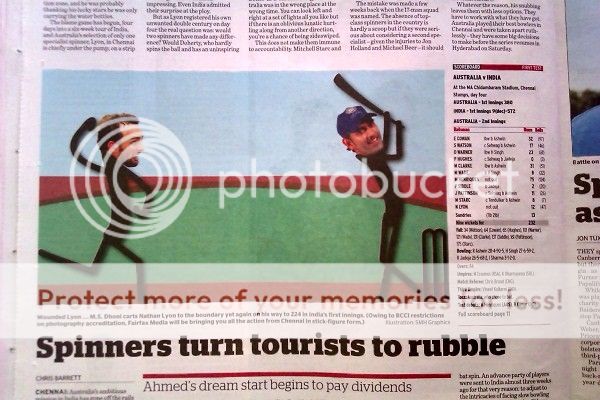
Further to this the Sydney Morning Herald has also found it difficult to obtain photo accreditation and quite rightly I think, has decided to ridicule the BCCI on its pages:

- Sydney Morning Herald (Print Edition), 26th Feb 2012

I do find it a little amusing though, that rather than trying to bash an independent voice as Christopher Martin-Jenkins tried to last year and as I later reported on in Horse 1394, the ABC have decided to embrace the independent voice of Test Match Sofa. Their website is here: http://testmatchsofa.com/

http://blogs.abc.net.au/nsw/2013/02/how-you-can-listen-to-the-australian-cricket-tests-in-india.html
Last week, as the Australian cricket tour of India was gearing up for the first Test, the realisation dawned on many cricket fans that short of having access to Pay TV, there's no live broadcast of the series available in Australia.  Well, that turns out to be not quite true.  Provided you're happy to listen to an unofficial cricket broadcaster that has developed quite a cult following on the Internet.
- Chris Coleman, ABC 702 Sydney, 25th Feb 2012.

This might sound like sour grapes on my part (which it is) but I completely understand the mentality. Professional sports players, coaches, grounds, trainers, coaches and managers, now command such high salaries in all sorts of sports, that monetising and squeezing the wallets of the fans ever harder and harder is the only way to go.
Sure you might end up with a situation as with the Australian summer of cricket where spectators have been priced out of the grounds and crowds begin to dwindle to the point of embarrassment but that doesn't matter when you have more than a billion people across the globe who can potentially pay for it through a pay TV subscription.

Cricket is a weird game by nature. At provincial level across the world, you could lower the price of admission to zero and because most people go to work for five days a week, even then the only people who'd show up are uni students and retired people, or exactly the same crowds as now. One only needs to look at any Sheffield Shield match to realise that of the nine paying spectators, three have knighthoods, three are trying to sneak alcopops into the ground and one is a dog called Kevin.
Move up to international level though and series like the Ashes and whoever is playing for the number one world ranking, have sell out crowds and often a scramble to even get tickets. That however only applies to a few select nations, other test playing nations find it a little more difficult to attract spectators to the ground.
India vs New Zealand for example, probably isn't likely to have an incredibly large demand but India vs Australia is such that the BCCI figures that they can charge billions. Consequently organisations like the ABC and the BBC have been priced out, for the BCCI honestly couldn't give a rip if other nations' taxpayers have to fit the bill for their greed.
Honestly, I think that the BCCI are playing the long game here. With the 50 over One Day International dying on its feet, if the BCCI can successfully finally kill off test cricket, then all those professional players will come and play in their shiny; glittery; "whatever it is" cup. It was the cricket world's fault for not milking the game for all it was worth earlier.

I'm sitting here completely surrounded by NO cricket!

The fact that the test series is not on the radio, even when technology exists to broadcast all sorts of things on digital radio simultaneously, is the ultimate expression of the fact that the game of cricket is no longer for the people but for those prepared to pay.
The BCCI after trying to lock out the BBC on the England tour, have now successfully done so with the ABC on the Australia tour. Once looks churlish; twice looks downright mean. The rest of us just have to accept a world where the BCCI is trying to destroy Test Cricket.
There is a strange irony that it was possible to listen to a test series from the newly independent India in 1951 on ABC Radio but impossible more than 60 years later. Oh look how far technology has come.

I congratulate India on its 17-nil Test Series win; well done to the BCCI. Maybe in a few years' time once the state of cricket has been completely tainted, the BCCI will apply to leave the ICC... we can only hope.

Horse Meat Scandal - Official Notice

Although this blog is called "The Horse", it is not connected to the kerfuffle currently surrounding British supermarkets nor Swedish furniture company IKEA.

When I consider that a piece of toast bearing the face of the Vurgin Mary can sell for thousands of dollars, or that the share price of Berkshire Hathaway is affected every time that Anne Hathaway is mentioned in the newspaper, nothing really surprises me any more.
All that is really left for me to say is "thank you" to the more than two dozen people who have emailed me and the one person who left a curious comment; if I ever find out what "posoinong" (sic) is, I'll let you know.

February 18, 2013

Horse 1442 - On The Right To Privacy

http://www.deakin.edu.au/news/2013/06022013Mirkoprivacy.php
“The right to privacy has blossomed in recent decades, to the point where it has developed into an enforceable legal right in many countries. The existence of a right to privacy has been assumed, but not proven and no one has rigorously analysed whether privacy is desirable, until now.”
“The current legal focus and level of discussion concerning the right to privacy is an illustration of the human propensity to lose perspective,” 
- Professor Mirko Bagaric, 6th Feb, 2013

Professor Mirko Bagaric, dean and head of the faculty of law at Deakin University has argued in an essay published in "Future Proofing Australia: The Right Answers For Our Future" that in an age of increased social media, that the right to privacy is either becoming so irrelevant as not to exist or that it never truly existed in the first place.
It is an interesting concept to be sure and I can sort of understand that given that people are prone to publish so many details about themselves, which is the distinct opposite of anonymity, why the Professor would draw such conclusions.
Is it a worthwhile suggestion to make though? By inference, would he be prepared to perform the experiment with his own personal details and effects? I wonder how quickly Mr Bagaric would be to claim his own right to privacy once his itself had been violated. How would he feel if where he lived, his date of birth, tax file number and/or medical records were published for all and sundry to see without his permission? Would he then claim a right which he currently argues does not exist?

One of the most obvious things for me when it comes to the use of social media, is the question of whether or not something has been proffered for publication or not. The internet generally sort of acts like a giant newsstand on the street corner, except that the barriers which used to exist when it came to publication (printing costs, access to space on the newsstand etc) are vastly reduced to the point of almost zero. Although the very point and aim of the internet was the fast dissemination of information, the very act of publishing something still implies that consent has been given to publish that thing which has been published.

Mr Bagaric has this to say:
“Facebook has more than 800 million users of which more than 50 Per cent log on every day. Users select the amount and type of data they upload and commonly it includes photographs, often of a revealing nature, relationship status, work and study activity, likes and dislikes and intimate personal details.
Nothing it seems is out of bounds in terms of the information people share about themselves.”

Whilst I agree that nothing is necessarily out of bounds in terms of what people publish, which also sort of goes hand in hand with the right to free speech, it still nevertheless requires a willful act to publish something.
For instance, when I write a blog post, i am in fact required to press a button marked publish before it appears for general consumption. My permission is granted at that point if you will, by the willful act of pressing the button and consenting to publish. That is quite different to an invasion of privacy which is the publication of something without any consent to publication being granted.
Perhaps Twitter and Facebook are far more ethereal. In some respects they're like speaking in that whatever is communicated is done so more or less instantly but unlike the mere act of speaking, those words and pictures form a record which can be traced. Even then though, they still require someone at some point to consent to the thing to be published.
Some dispute though exists when Facebook in particular claims that everything posted and every detail which is offered to it, is its property. Facebook tries to claim in its Terms Of Service that because it offers a voluntary service that it has the right to on sell details given to it. I suppose that that's fair enough provided that that is what people signed up to but when a major corporation unilaterally decides to change how it deals with the public and by inference steal information from them which they thought they offered under different terms, no wonder they're not happy.

As with so many things there is a material test of intent which can be applied. If in surrendering details about one's self, what does the individual expect that the person to whom those details have been surrendered, will do with them? If you give details such as your address when you fill in a form to win some competition, they will generally tell you up front that they will then use those details to send you advert material. If though, you give details to someone in which there is a degree of professional trust, like a doctor or your child's school, you would hope that they would keep them confidential.
The most obvious reason for wanting personal details kept private is that of theft; theft of physical property, direct theft of money if banking details are obtained and perhaps the theft and violation of one's reputation and good character. I have heard of instances of prospective employers trawling Facebook and not hiring someone because they'd been prejudiced against them because of photographs which had been published; sometimes not even by them but by other people who had tagged them as being in photographs.

“Modern technology underlines the irrelevance of arguments for the need for more privacy. People are more likely to seek attention rather than anonymity.”

I would argue that technological advancements do no such thing. The invention of the telephone for instance did not instantly remove any right to privacy that people have when having a discussion. The Surveillance Device Act 2007 at least implies through the "prohibition on use, communication or publication of protected information" in Section 40 that a right in theory must exist, or else there wouldn't have been the need for legislative protection.
Modern technology does not underline the irrelevance of arguments for the need for more privacy at all; far from it and quite the opposite. Information can now be shared so quickly and easily that even something which consent was never given for can escape into the world with alarming speed and swiftness. If anything modern technology underlines the urgency of arguments for the need for more privacy. 

Presumably as head of the faculty of law at Deakin University, Mr Bagaric must have come across the United Nations' Universal Declaration of Human Rights at some point. The point is moot whether or not the rights contained in the document already existed or whether member states have decided to voluntarily embrace them but it seems somewhat strange to me that the brightest minds of a generation who had at the time recently witnessed some of the most gruesome horrors that the world has ever produced, would be wrong in including as Article 12.

http://www.un.org/en/documents/udhr/index.shtml
Article 12.
No one shall be subjected to arbitrary interference with his privacy, family, home or correspondence, nor to attacks upon his honour and reputation. Everyone has the right to the protection of the law against such interference or attacks.

Does Mr Bagaric mean to suggest that either the inclusion of this in the Universal Declaration of Human Rights is wrong, or that the codifying of any human rights is wrong, or that the very concept that people as a result of their inherent dignity do not possess any human rights at all? It is a very slippery slope indeed.
It appears that Mr Bagaric seems to think so, judging from other things he has written:

http://www.theage.com.au/news/Opinion/A-case-for-torture/2005/05/16/1116095904947.html
First, no right or interest is absolute. Secondly, rights must always yield to consequences, which are the ultimate criteria upon which the soundness of a decision is gauged. Lost lives hurt a lot more than bent principles.
- Mirko Bagaric, from The Age 16th Dec 2005

No right or interest is absolute? Again I'd like to quote the preamble to the Universal Declaration of Human Rights: Whereas recognition of the inherent dignity and of the equal and inalienable rights of all members of the human family is the foundation of freedom, justice and peace in the world,
Not good enough? Perhaps we should quote "one of the best-known sentences in the English language"?
We hold these truths to be self-evident, that all men are created equal, that they are endowed by their Creator with certain unalienable Rights, that among these are Life, Liberty and the pursuit of Happiness.
Actually I'd like to hear from Professor Bagaric. It would be interesting to find out on what basis he thinks that his opinion is stronger, than the weight of thought and ideas which grew out of some of the bloodiest conflicts the world has ever seen.

February 15, 2013

Horse 1441 - The Most Un-Australia Day of all is Australia Day


http://www.pm.gov.au/press-office/act-recognition-passes

Australia has moved closer towards constitutional recognition of Aboriginal and Torres Strait Islander peoples with the Act of Recognition passing the House of Representatives today.
The Prime Minister was joined in the House by Aboriginal and Torres Strait Islander and community leaders to mark this significant step towards a referendum.
The Bill recognises the unique and special place of Aboriginal and Torres Strait Islander peoples.
This reflects wording suggested by the Expert Panel on Constitutional Recognition of Aboriginal and Torres Strait Islander peoples, whose significant report has put in place the foundations to enable us to progress constitutional recognition.
Today also marks the fifth anniversary of the National Apology.
On 13 February 2008, we said sorry to Indigenous Australians, in particular the Stolen Generations, for past wrongs. We apologised for the pain and suffering and hurt that successive policies had inflicted on Indigenous Australians for more than two centuries.
This was the first step in building a reconciled Australia with relationships based on mutual respect and understanding.
- except from the Media Release, Prime Minister's Office, 13th February 2013.

When Kevin Rudd formally said 'sorry' to the Stolen Generation, it should have been the first of many steps towards proper reconciliation with the Indigenous peoples of this nation. The event of February 13, 2008 is one of many symbolic steps that can and should be taken. February 13 is also an excellent date because it has the potential to become so much more and I think that we can learn some valuable lessons from our cousins, our best enemies and closest of mates on the world stage, New Zealand.


February 6 in New Zealand marks Waitangi Day. Unlike January 26 in Australia where Australia Day pretty well marks the date of formal invasion of Australia, Waitangi Day marks the date when the Treaty of Waitangi was signed, which marked peace between the British and Maori peoples.
When you go to Wellington and Parliament in New Zealand, the first thing that strikes you is the direct representation of Maoris in the chamber. There are a certain number of seats allocated in parliament, which can only be taken by and also, only voted for, by Maoris.

The other peculiarity is that on key issues, the question is raised about legislation is keeping with the spirit of Waitangi. New Zealand has no formal constitution, rather like the British parliament in Westminster and although like Australia and Britain, debate in the chamber can get outright rude and sometimes degenerate into a slanging match, the question of outcomes for New Zealand's indigenous people isn't argued in the abstract but rather, because there are representatives in the room, direct responses are given. You would have trouble even finding an Aboriginal member of parliament in Australia and when they are appointed, debate isn't nearly as thoughtful as in New Zealand.

If I could wave a magic wand and change the constitution tomorrow, I'd place at least one Aboriginal representative from every state in the Senate, to be voted there by Aboriginal people only.
Although the idea of recognising Indigenous Australians in the Constitution sounds like a nice gesture, to me that's got less meat on it than a chicken nugget. Real change and real representation comes about by putting real voices on the floors of chambers. People generally have better outcomes when they speak for themselves and to be perfectly honest Australia as a nation has been pretty shameful in this regard. It took until 1967, or 66 years after federation for Aboriginals to get the vote and that's not even including the 113 years before that since the land was stolen after being wrongly declared 'Terra Nullius'. People prefer to speak for themselves than being spoken to and that is precisely what this country has done to entire groups of people for 225 years. It's a disgrace.

The other thing we can learn from New Zealand is the day that is celebrated as the national day. Waitangi Day is as close to a national day as New Zealand has. Australia Day neither commemorates the day that Australia became a separate nation (January 1, 1901), it doesn't celebrate the day that Cook sighted the Australian coast, nor does it celebrate the day that the First Fleet landed. They arrived 8 days earlier at Botany Bay but Governor Phillip decided to go round the corner and look for somewhere nicer. January 26 marks the day when Britain stole the Australian continent through the cunning use of flags. Sail round the world, stick a flag in, ignore the people who were already living there. No wonder January 26 (in my opinion quite rightly) is called Invasion Day by some people. I think Australia Day itself is un-Australian.

In the spirit of true reconciliation, along with the changes to the Senate, the public holiday and celebration of January 26 would be done away with.
Perhaps to add a touch of symbolism, the date of February 13 should be chosen as both the day that a proper treaty is signed with Indigenous Australians, the date when those new Senators would enter the chamber, and the date of the new public holiday while the old one is quietly forgotten forever.

February 14, 2013

Horse 1440 - Divine Dynamite Drug Debate

As the drugs and doping crisis engulfing Australia threatens to name and shame clubs, players, trainers, officials and coaches, one name that hasn't been mentioned in all of this is conspicuous by its absence and perhaps a little suspicious due to the timing of his resignation... that being Pope Benedict XVI.

Although as a 14 year old he was forcibly conscripted into the Hitler Youth, he was unenthusiastic and refused to attend many meetings. He saw out the Second World War in an Internment Camp after being taken prisoner as a POW. After the war he moved back to Munich, which is where the trouble really started.
Of course living in Munich, he would have seen the inception of the Bundesliga in 1963 and the rise of Bayern Munich who has subsequently gone on to win 22 national titles and 15 cups including the then  European Cup three times in a row from 1974-1976.

In the mid 00s after being elected to the position of Pope in 2005, Italy mysteriously won the 2006 FIFA World Cup after a penalty shoot-out against France in the final. Fabio Grosso at the time remarked that "divine intervention helped us to play above ourselves". Maybe this should have been seen as a confession that something was amiss.
It should have been obvious in 2007 when Pope Benedict XVI was bought for 770 lakhs rupees (A$1.38m) by the Chennai Super Kings in the Indian Premier League but politely declined. There were unconfirmed rumours that he was seen hanging around the clubhouse of the Melbourne Storm last year and we are pretty well much certain that he has enjoyed hooning it up in Lygon Street in the past.

Of course these sorts of scandals take years, sometimes decades to finally come out in the wash. During the 1986 World Cup, Diego Maradona famously in the post-game conference after the Quarter-final against England that his now famous goal was scored "a little with the head of Maradona and a little with the hand of God".  It took him until his 2005 autobiography to finally admit that he had cheated.

Perhaps Pope Benedict XVI won't admit immediately to being linked to the 'drugs in sport' crisis but it is curious that he is citing ill-health as the reason for his resignation. It is worth noting though that between 1987-1990, 18 Dutch and Belgian cyclists died suddenly and it was later found that they'd been using EPO. I'm not immediately suggesting that that is what's going on but the timing of Benedict's resignation is curious to say the least.

February 11, 2013

Horse 1439 - VF Commodore Breaks Cover


In Horse 1436 I posted photos of renderings of what the Chevrolet SS might look like and what the Chevrolet SS NASCAR finally does look like. The official launch over the weekend is of the Calais variant of the car is different to the front headlight and grille treatment that the V8 Supercars will be getting. The rear light clusters look the same, but the front of both the BOC and Garry Rogers Motorsport cars, looks more like the Chevrolet SS renderings.
What then are the V8 Supercars based on? Are they based on an upcoming SS version of the Commodore or perhaps they're of the base model Executive. HSV which likes to violently beat cars with the ugly stick, probably won't debut their variants of the VF until the Melbourne Motor Show in July.

The entire of the VF between the A and C pillars is identical to the VE. Holden have announced though that there is a complete difference in the trim and appointments but under the bonnet, the same engines carry over from VE. As expected the gills behind front wheel arches are there and the shape of the chin lamp holes is pretty well much as expected.
To be perfectly honest though, it's just not very awe inspiring; it's not offensive either. The VF will fit into traffic and just sort of blend in.

The very fact that this car follows the design trends laid down by both the Cruze (in the front and rear lights) and the Captiva (addition of gills), doesn't instill me with confidence despite the noises coming from Holden. Mike Devereux announced that the VF will be sold in South Africa, the Middle-East and the US (so it being the Chevrolet SS is more or less confirmed) but the fact that it won't be sold in Brazil where it currently is, is ominous by its silence. Even Devereux himself conceded that the Australian Dollar is working against the export opportunities of the Commodore, which again makes me think that the Commodore's days are numbered.

Maybe that's what the Holden Malibu is for: "a strong example of the exciting new generation of products coming from General Motors". It could be that the Commodore just isn't one of those new generation of products.