January 27, 2014

Horse 1603 - 2017 V8 Supercars Championship. Malibu vs Mondeo?

One of the questions which has been flying about the media and in particular Auto Action, is the question of what the likely replacements will be for the Commodore and the Falcon in the V8 Supercars now that they've both been canned and end production. With no road cars at some point the future, there'd be no donors for the race car.
There are of course several possible replacements and I'm going to outline them now.

Holden:
Assuming that Holden as a brand actually survives, then the lion remains on the front of the car. I can't for instance from a marketing point of view, see Holden putting on the Camaro as that would be quite obviously a Chevrolet.

Impala:
The Tenth generation Impala could very easily slip into the Holden lineup as a direct replacement for the Commodore. It comes with a 2.5 inline-4 or a 3.6L V6 which is the same broad sort of engine which currently appears in the VF Commodore.

Malibu:
The Malibu is currently on sale as a Holden and surprisingly comes with the same engine choices as the Impala but also has a couple of 2L engines. It is a physically smaller car but given that the VE and VF both had significant amounts of metal cut out of them to make them shorter and narrower to meet the regulations, reprofiling the Malibu for the job just doesn't seem like a difficult task.

Camaro:
If Holden doesn't survive as a brand, then I can see some remote possibility that the future Chevrolet Racing Team (in this case bow ties aren't cool), might want to use the Camaro but that might be a mistake considering that if you mention the word Camaro to a motor-racing fan in Aystralia, the first two words they think of are "upside" and "down".


Ford:
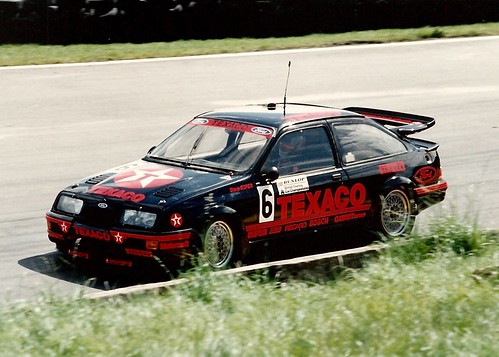
Ford have a slightly different set of issues. As a motor company, the only real time that Ford ever put any monumental effort into motor racing was when they threw bucketloads of cash at the GT40 project. Their F1 efforts were mainly down to Cosworth; which also goes for their all-conquering Sierra touring cars; and to be honest, the coolest livery ever to appear on a race car:


Mustang:
It has been suggested that Ford wants to use their Mustang but that first assumes that Ford would bother to reenter V8 Supercars once the Falcon is finished. Ford in Australia dropped Alan Moffat like a sock full of custard in late 1978*; didn't really support Dick Johnson properly and have threatened to dump what's left of FPR. I can't really see Ford stumping up the cash to develop the Mustang.

Mondeo:
The really weird thing is that Volvo are entering the 2014 season with their S60. Officially Volvo call the platform that the S60 sits on the "Volvo Y20" platform. In reality it is identical to the "Ford EUCD" platform which both the Mondeo and the Mazda 6 also sit on.
The thing about the V8 Supercars Car Of The Future program is that the platform which all cars ultimately sit upon is dimensionally identical and the specification is fixed. If Volvo can fit their S60 to it, then it should be a snap for Ford and in theory Mazda to do likewise.

Conceivably, the 2017 V8 Supercar Championship might have up to 6, 7 or even 8 brands in it. I could for instance see the Holden Malibu, Ford Mondeo, Mercedes-Benz E63, Volvo S60, Nissan Altima, Mazda 6, Kia Cadenza and Hyundai Genesis. It'd be highly unlikely but it might be interesting.

*After Moffat was dropped like a sock full of custard, he would eventually run the RX-7 at Bathurst. This caused Holden to sit up and take notice and they threw sufficiently enough money at the HDT to ensure that the plucky little RX-7 did not win Bathurst... the 12hr which came much later was a different story though... as was the Le Mans 24 Hour but that's another story entirely.

January 26, 2014

Horse 1602 - January 26th Actually IS Invasion Day.

http://www.abc.net.au/news/2014-01-24/cooks-cottage-anti-australia-day-graffiti/5216816
Meanwhile an eight-kilometre stretch of foreshore at Botany Bay, where Captain Cook first landed on Australian shores, has been sprayed with graffiti denouncing Australia Day as 'Invasion Day'.
Local mayor Shane O'Brien says he supports reconciliation, and sees this kind of attack as setting back the cause of bringing people together.
When incidents like this happen on a day that's supposed to celebrate our success as a nation as well as reflect on what we didn't get right and what we could do better, you give those that don't want to move another reason not to," he said.
- via the ABC, 24th Jan 2013

Let me just repeat this statement by Rockdale City Council Mayor Shane O'Brien: "a day that's supposed to celebrate our success as a nation". Is it? Really? Does Mr O'Brien know history?
What is 26th January?

Is it the day that Australia became a nation? No. That was 1st Jan 1901.
Is it the day that Captain James Cook landed at Botany Bay? No. That was 29th Apr 1770.
Is it the day that the first colony, New South Wales, was proclaimed? No. That was 7th Feb 1788.
Is it the day that the First Fleet landed in Sydney? No. That was 23rd Jan 1788.
Is it the day that the First Fleet landed in Sydney Harbour? That was 25th Jan 1788.

So what is 26th Jan 1788? Specifically, it is the day that the British Flag was first hoisted on Australian soil, or more importantly it is the day that Eddie Izzard once said that the British stole Australia "with the cunning use of flags".
If you read the rest of the report, Captain Cook's cottage was vandalised again and the indignation that was raised was about the vandalisation (which itself is justified) but the question about what Australia Day is actually for and what it represents was once again ignored.

Australia Day specifically is designed to celebrate the day which as confirmed by Case Law, that Australia really was terra nullius. In New Zealand, they have Waitangi Day on February 6 which marks the day on which the Treaty of Waitangi was signed in 1840, making peace with indigenous peoples and more importantly guaranteed the Maori rights to their land and gave Maori the rights of British subjects.
In contrast, Australia Day actually marks the day which Aboriginal people had their rights to their land removed and which any rights which they might have had as British subjects were also quashed. Although there was a referendum in 1967, the actual date which marked the full right or Aboriginal peoples' right to vote enshrined in legislation was 1984 when the Commonwealth Electoral Legislation Amendment Act 1983 came into effect.

If there really was to be an act of reconciliation, maybe the date of the 1967 referendum should be celebrated and Invasion Day quietly put to sleep. Suggesting that it's "a day that's supposed to celebrate our success as a nation", significantly misses the mark and is a denial of history itself.

Happy Invasion Day.

January 25, 2014

Horse 1601 - I Have Now (In Theory) Driven Every Porsche 911 Ever

...according to Jeremy Clarkson.

It's kind of known by some of our more regular clients that I quite like reading about motor cars; I also quite like driving them too. Of course if someone wanted to pay me enough money to drive them and write about them as a full time job, I'd jump at the chance but as Kid President reminds us "Don’t stop believing, unless your dream is stupid… then get a better dream and keep going, keep going, keep going…"
In that spirit and knowing that I'm only doing this for the fame and ovation of the people forever, this is what I have to say about the Porsche 911.

I don't understand it.

The 911 Carrera Convertible that I drove at Friday lunchtime was one of our client's and he sat in the passenger's seat whilst we went forth and back. I suppose that to the outside world, it either looked like that I was driving daddy's car or perhaps that I as a high-flying executive was taking daddy for a drive.

The first thing I noticed apart from the slightly overly squishy seats, is how low you sit in the car. This common problem that I'm finding with a lot of modern cars is that the window line is rather high. Now I'm probably 6 feet tall; so it isn't as much of an issue but if I was 5'4" or something, I'd imagine that I'd have felt claustrophobic.
Also, this particular example being a convertible, wasn't exactly helped by the convertible top being packed in where the rear parcel shelf would have been.

The second thing which was obvious was just how strange the engine note is. With a V8 you get a nice kind of rumble which sort of says that the car wants to run and run hard. With a V12, there's an exotic symphony which Franz Liszt or Edvard Grieg would be proud of. With the flat-6 engine in the back of the Porsche, it's a confused cacophony which is part Subaru and part Sunbeam Mixmaster.
The engine spins up as though it were like a child's mechanical spinning top before letting go in a mad rush that hits you square in the butt; though in all honesty that is what a sports car is supposed to do. I've driven other cars (hey Mercedes-Benz, I'm looking at you) and when you put your foot down, it's like it goes through the computer which then has a committee meeting about it before deciding. Not the Porsche, it acts like a willing servant.

Gear changes in this thing are a dream. The throws in the box are effortless and I swear that you could probably flick the lever through with just one finger if you wanted to. It was also kind of fun to watch the rev counter and the speedo run around as though they were in some strange ballet piece; though listening to the noises out the back, such a ballet piece would have all the subtlety of Carl Orff's "O Fortuna".
You know that you're in control of a machine in a Porsche. It's just not an organic experience at all. I imagine that to properly drive a Ferrari would be like becoming one with the car and I know that driving a big Mercedes is like being the captain of a ship.
Driving a Porsche is all so severe, very adroit, pellucid in execution, so... Teutonic.

This is the part I just don't get though. We drove down Strathhallen Avenue and across what I suppose is called the Northbridge and although the Porsche felt really solid, it didn't communicate a sense of nimbleness to me. This car is all about being powerful and stable but you equally get a sense of that from a Ford Falcon. The point being that because I'd only ever seen a Porsche from the outside, the packaging gave me a sense that I should be expecting something like a pair Nike Mercurials. Instead it was like getting a pair of Doc Martens - something completely adequate and even a bit stylish but not exactly what you'd want to go dancing in.
I suppose in a roundabout way, the way the Porsche felt to drive exactly encapsulated the mentality of German efficiency. To put this in perspective, in the Le Mans 24 Hour Race, Porsche have won 16 times and Audi 12 (only missing out on 2003 this century), yet if you want proper passion, Ferrari is the marque. If you want insanity and crazy-go-nuts-bonkerousness, Lamborghini is the way to go, and if you like breaking down on the side of the motorway, get something British.

I'm sure that this 911 and indeed every 911 would make an excellent track day car; especially if you wanted to punch out quick lap times. All things being equal though, if you had a Porsche and a Ferrari which gave you identical lap times, I'd take the Ferrari because I'm pretty sure that the soundtrack would be better and there'd be a greater chance of it breaking down on you. Now that sounds slightly ridiculous on the face of it but I'd rather have a car with feisty sort of character than one with solid stoicism.
The Porsche just does everything you ask of it very very well and I suppose I understand that sort of reasoning but it isn't for me. People ask that sort of motoring from a Toyota Corolla and I wouldn't have one of those either.

I don't know if Clarkson's claim that all Porsches are the same is valid or not and it might be for purposes of writing hyperbole but it wouldn't surprise me if they all feel the same. It makes sense if people expect that, to keep on producing something that evokes that same sort of spirit.
If nothing else, I can tick that off my list of marques that I've driven now but if it's all the same, I'll continue to be content with my little Peugeot 206. It doesn't have anywhere near the same amount of power as the Porsche 911 but it has something in buckets that the Porsche doesn't have - Fun.

January 24, 2014

Horse 1600 - The Commission of Audit's Final Sixteen Items

Before I go any further I should like to point out that I spent most of last night carefully considering my first words for this edition of Horse because I realised that they had to be quite prolific, so then, here it goes:
Welcome to Horse 1600.

http://www.smh.com.au/federal-politics/political-news/commission-of-audit-to-delay-report-20140121-315nd.html
“The Commission has advised the Government that while it has made considerable progress in preparing the report, it would require a short extension,” Mr Hockey said on Tuesday.
“The Government has granted this extension on the basis that it is important for this report to be as comprehensive as possible.”
- Sydney Morning Herald, 21st Jan 2014

How curious. The Commission of Audit which is supposed to find 'savings' in the budget and being led by Tony Shepherd who is the President of The Business Council of Australia, has even before it's reported found a way to blow out its own budget.
In 1996 when Peter Costello organised a Commission of Audit, it was chaired by a lecturer at Melbourne University’s Business School, Bob Officer. In contrast, not only is Abbott's Commission of Audit being led by the BCA's President but the Secretary for it is Peter Crone who also just happens to be the Chief Economist and Director at the BCA:
http://www.bca.com.au/Content/100831.aspx
I suppose that provided that you can get a free lunch, a little pork whilst on the gravy train is pretty tasty. In days gone by you could have used words like Nepotism, Cronyism and Plutocracy but mention such things now and you'd be accused of bias. I digress though.

The two main cuts and thrust if the audit will be to privatise and or abolish a lot of current government services. To be honest, business has repeated said that it HATES the government sector in places where it sees a profit to be made. The thing is that I don't see Abbott as particularly gutless when it comes to dealing with business as much as he and the party is owned by business.
However, rather than wait for the The Commission of Audit to report, I'm going to try and predict what it's going to suggest. I have a feeling that the Business Council of Australia probably already wrote the report and if it wasn't then, then the IPA probably did the work for them. Mr Shepherd probably doesn't need to do anything in reality except write speeches for when the report is finally published.
I think that the sixteen main items that Commission of Audit will probably suggest will be to:

Privatise:
- Australia Post
- Medibank Private
- NBN
- SBS and sell off the subtitling and transcription service
- the ABC, or if not then break it up and tender out each individual function
- the AIS
- the CSIRO
- the Snowy-Hydro Scheme

Abolish:
- ACMA
- ACCC
- The Department of Climate Change, and with it repeal the Carbon Tax, withdraw from the Kyoto Protocol requirements
- Clean Energy Fund
- Commonwealth Grants Commission
- FIRB
- Medicare
- Human Rights Commission

There are other issues which may or may not fall into the remit of the audit but I suspect that they'd be included either in submissions or tabled before other committees in connection with it.
Tim Wilson of the IPA was parachuted into the role of Human Rights Commissioner and so he's probably going to suggest a repeal of Section 18C of the Racial Discrimination Act and that would be his last act as Commissioner.
People like Mr Murdoch who want to run the Australia Network will probably want things like local content and media ownership rules eliminated and both the IPA and the BCA will want an end to mandatory disclosures on political donations and abolish mandatory voting in Australia.

The obvious question that arises from all of this is how can I possibly know what savings that The Commission of Audit are going to find before they've reported. The reason of course is simple. Most government Commissions, Royal Commissions and Inquiries are bound by guidelines. It could be argued that these bodies are in theory supposed to be impartial. I ask how that's even possible when clearly the Business Council of Australia is basically running the show here.

If the 2014-17 Senate proves to be friendly and depending on how much of a gamble the government wants to take, we might very well end up at the polls well before the first normal House and half-Senate election date of 6 August 2016. If the Senate does prove to be friendly, then we may start hearing the word "mandate" being thrown about like a truncheon whilst its used to beat us all up with. I wouldn't necessarily expect a 2014 election but a late 2015 election might happen, after the '15 budget has been handed down.
In the mean time, there's sixteen items that I think are in the gunsights of The Commission of Audit, currently standing in the lights like stunned rabbits, not knowing that they're going to get their brains blown to pieces; all in the name of savings.

January 23, 2014

Horse 1599 - The Next England Cricket Coach - Brian Butterfield

After an appalling Ashes five-nil whitewash and a one day series which has also already been lost, coach Andy Flower might very well be looking over his shoulder to see where the axe might fall. Alastair Cook is probably also wary of the sword of Damocles dangling ever so precariously above his head.
Obviously something hasn't been working this summer and although it is tempting to wipe the slate clean, sack everyone and start again, one option might be open which wasn't previously thought of.

There is a saw which says that 'things can only get better'; yet what happens if things literally can not get any worse? Is there a way to induce that bounce off the bottom? I believe so. For that reason, I think that the ECB can not literally do any worse than appointing Brian Butterfield as temporary coach of the England cricket team.

- Brian Butterfield: he means business
First some stats:
Tests: 3
Runs scored: 29
Highest Score: 5
Batting Av: 4.833
Balls Bowled: 144
Bowling Av: n/a
Best Bowling: 0/73

In 1982 The Times did not call him "the most complete batsmanperson in cricket" and in 1984 The Guardian certainly did not afford him the title of "England's greatest modern bowlerman". Whilst that doesn't immediately sound like ringing endorsement, after the lacklustre and somewhat clueless performance of England over the summer, they wouldn't have fired off praise to anyone in the current squad either.
Brian was selected for the English cricket team on the 1982/3 tour of Australia after a series of injuries reduced them to just 9 players. Although on the tour as the tour manager and mainly concerned with sorting out accommodation and air travel (including attempting to fly the England side to Australia on a zeppelin) and never having been selected to play first-class cricket ever before, incredibly Bob Willis thought it would be a good idea to give him a go; Brian proved to be a better player than Vic Marks.

Professional cricket was never going to be Brian's domain and over the next two decades, he would go on to found a business empire with such enterprises such as a detective agency, time line and the fledgling home computer gaming market and was never again selected to play cricket for England... or anyone really; and yet he always maintained an interest in the game and wrote many columns in such fantastic newspapers as the Bristol Post, the Beccles and Bungay Journal and the Driffield Times.
He would often write about how players who were not English should be press-ganged into becoming English citizens to play for the national side; even going on to suggest mistakenly that the Republic of Ireland was part of the United Kingdom and that South Africa was also British, after looking at a series of maps dated 1904. One wonders if the addition of players like Eoin Morgan and Kevin Pietersen were added on the basis of his exhortations.

More recently, during the 2013/14 Ashes series, he even Tweeted some Twooshes on the Twitbox which were incredibly insightful:
Hopefully Ballance will bring some equilibrium to the team #ashes - 4th Jan 2014
I know I'm biased and it may be optimistic but I think Stokes could be the first batsman ever to get 1000 runs in one innings #ashes - 17th Dec 2013
If Panesar can get a double hundred then we might still be in this #Ashes - 7th Dec 2013
- Via Twitter - https://twitter.com/MrBButterfield

The truth is that Gary Ballance did have a stellar season for Yorkshire last year, Ben Stokes did shine out amidst the bleakness and why on earth the selectors didn't pick Monty Panesar for the Sydney Test; on a wicket that traditionally supports spinners, is totally beyond me.

Sometimes the best and most successful selectors and managers are people who never competed in the sport which they love at the highest level. Sven-Göran Eriksson was a mediocre footballer, Murray Walker never drove racing cars and Henry Blofeld who surely became the voice of cricket for a generation, never played for England.
Managing a national cricket side I imagine would be rather like running a business and Brian Butterfield's legendary entrepreneurial skills must surely put him in good stead to be the next England cricket coach. I put it to the ECB that appointing Brian Butterfield as England cricket coach would be like opening up a giant festive Bonbonbonbon and they'd be crazy not to CALL NOW.
Given that on the current tour England have won zero from seven against Australia, he literally can not do any worse than Andy Flower.

January 22, 2014

Horse 1598 - Three Is a Magic Number

WARNING: MATHS AHEAD!**

Firstly, something really weird to get your brain ticking over:

1 + 2 + 3 + 4 + 5 + 6 + 7 + 8 + 9 + 10 + 11 + 12 + 13 = 91
and
1² + 2² + 3² + 4² + 5² + 6² = 91

woo boggity boogity boo... spooky...

Okay, enough of that. Onto the main subject: 3. It's a magic number. Oh yes it is.

There a number of check calculations that I do in accounting such as, if an amount is wrong by some multiple of 9 then there's a transposition of digits, then there's the method of casting out nines to see if a very big calculation is correct but some of the short tests I use are divisibility tests. To wit:
- A number that is divisible by 5 will end in either 5 or 0.
- A number that is divisible by 4 will end in another two-digit number divisible by 4. The number 8,539,756 is divisible by 4 because 56 is.

But the two divisibility tests which are the freakiest are that:
- A number that is divisible by 9 if you sum the digits, is also divisible by 9.
151,732,989 is divisible by 9, 1+5+1+7+3+2+9+8+9 = 45 and 4+5=9 (151,732,989/9 = 16,859,221)
- A number that is divisible by 3 if you sum the digits, is also divisible by 3.
68,906,247 is divisible by 3, 6+8+9+0+6+2+4+7 = 42 and 4+2 = 6 (68,906,247/3 = 22,968,749)

It must said though that 9 is only freaky because 9 is 3 in a 3ish way. 3*3=9. However (and this is the part which blew my mind to pieces whilst I was playing with this in my mind on the train), the divisibilty test for 3 also works for any base 3n+1 where n is any number you like.

Pick any number in base 10. Let's pick 120 (1+2+0 = 3). What does that number look like in other bases 3n+1?

n=1, 3n+1=4 Base 4 = 1320 (1+3+2+0 = 6)
n=2, 3n+1=7 Base 7 = 231 (2+3+1 = 6)
n=3, 3n+1=10 Base 10 = 120 (1+2+0 = 3)
n=4, 3n+1=13 Base 13 = 93 (9+3=12 1+2 = 3)
n=5, 3n+1=16 Base 16 = 78 (7+8=15 1+5 = 6)
n=11, 3n+1=34 Base 34 = 3I (3+I = L*)

Actually this all has to do with modular arithmetic and number theory itself. There are practical applications for this sort of thing, particularly in cryptography but for someone who works in an office, looking at boring base 10 maths in a plusish and timesish sort of way, it's a fun diversion.

*For bases bigger than 10, you're going to need some new symbols for the numbers; the usual suggestion is to start using the letters. L is whatever the twenty-first one is, except that even describing it as the twenty-first, still implies base 10. I briefly touched on this idea in Horse 1109.
** On that note, I don't know what factorial "MATHS AHEAD" would be. I imagine though that the base used would be pretty big though.

January 21, 2014

Horse 1597 - I Am Not A Real Journalist

I open this post with a great spot of naval gazing; looking at two very different comments that arrived recently:

you're not a real journalist. you're only commenting on government policy. that's not journalism, that's leftist trolling.
- Yoda's Ghost, 20th Jan 2014

Oh my goodness--haha this is amazing. :) Found your blog via the nerdfighter  forums; will definitely follow. Googol. Love your writing style.
- Bailey Anne, 20th Jan 2014

Two very different comments; two very different sentiments. Whilst it is true that compliments tend to oil the gears of one's ego most excellently, often it is the negative comments that I find the most fun. The internet is generally a land where snark grows as far as they eyes can see but even wild snark can produce fruit that can be quite tasty.

I have visited the question of whether or not bloggers are journalists before (in Horse 1384) and concluded that bloggers probably are. As far as I can tell, lack of formal education in journalism isn't necessarily a hindrance.
For instance News' Andrew Bolt doesn't appear to have any formal qualifications and yet he is quite successful. Okay, whether you agree with his opinions is another matter entirely but the point of the matter is that from a technical standpoint, his opinion pieces, are actually reasonably well thought out and display a high command of the English language. He obviously writes for an audience and an audience he understands well. In fact it probably can be argued that from a Flesch–Kincaid readability test perspective, he writes too well and in that respect, despite not having any any formal qualifications, his material is excellent.

So then, having established that one doesn't need a formal qualification in journalism, the only real distinction that can be drawn is that as the OED suggests, that a journalist is 'a person who writes for newspapers or magazines or prepares news to be broadcast on radio or television'
I do not do this. Actually increasingly with newspapers buying in articles from sources like Associated Press and TV companies buying stories from Al Jazeera and the BBC, I'm wondering if the number of real journalists has headed even further south than I thought.

This brings me to the second clause of Yoda's Ghost's comment, that I'm 'only commenting on government policy'. I suppose that that might be a fair cop? I don't know really. Would I comment on something that wasn't government policy but should be? Would I comment on something that wasn't government policy and shouldn't be? Possibly yes to all combinations of those type of questions. Whether or not it's journalism is another question and whether or not it's 'leftist trolling' is I suppose is a matter of both my bias and the person making the comment.

Famously though (and I reproduce this because it is simply stunning), there are sections of established media which utterly HATE people like me. No really, you need to see this, it's a doozie.

http://www.townsvillebulletin.com.au/article/2010/10/08/175671_opinion.html
The great thing about newspapers is that, love us or hate us, we're the voice of the people. We represent the community, their views, their aspirations and their hopes. We champion North Queensland's wins and we commiserate during our losses.
We try to make North Queensland a better place to live. We are the media of choice that our business and political leaders turn to when they want to deliver their message to the masses.
...
Bloggers, on the other hand, represent nothing. They whinge, carp and whine about our role in society, and yet they contribute nothing to it, other than satisfying their juvenile egos.
Bloggers are fond of trying to suggest that newspapers are on the way out, that we've lost our relevance and importance to the community.
The fact that every week, three in four people read the Townsville Bulletin in North Queensland, and that we've been around since 1881, underpins the shallowness of their argument and reveals their lack of understanding of a subject.
The Macquarie Dictionary refers to someone who writes anonymously as "lacking individuality", or lacking individual characteristics. We prefer to call them cowards.
- Townsville Bulletin, 8th Oct 2010*.

The only qualification that the Townsville Bulletin made that day to suggest its superiority is that it had been around since 1881. I love how it single-handedly declared without qualification that newspapers are 'the voice of the people' and that bloggers 'represent nothing' and 'contribute nothing'. 
It's also rather amusing that immediately after declaring that they are the voice of the people, within five lines they also trumpet that 'We are the media of choice that our business and political leaders turn to when they want to deliver their message to the masses.'
There's nothing like being two voices at the same time is there?

Is Journalism therefore itself, purely a matter of professionalism and income? It would seem then that Yoda's Ghost may very well be right. The truth is that under the OED's conditions, I am not a real journalist. Moreover, I didn't really claim to be one either. If I was, then by definition, I should be paid for it; which I am not. However, if just one person 'loves my writing style' then like Robert Frost taking the road less traveled by... that has made all the difference.

*Actually via the Wayback Machine. The Townsville Bulletin (who aren't "cowards") accidentally threw this down the Memory Hole.
http://web.archive.org/web/20110822051340/http://www.townsvillebulletin.com.au/article/2010/10/08/175671_opinion.html

January 20, 2014

Horse 1596 - Calling Last Drinks

The NSW State Cabinet is meeting today to discuss ways to try and lessen so-called "alcohol fuelled violence". Admittedly media outlets love this sort of thing because they get to put pictures of bloodied people all over nightly news bulletins and on the front pages of newspapers, whilst at the same time writing editorials which are basically hospital handpasses of moral indignation and self-righteousness, because it'd be blatantly and morally stupid to disagree with them. Really it's a advertising gold mine because it combines graphic images with a free chance for pontification, with a giant pat on the back all round.
When it actually comes to providing possible solutions though, it's pretty light on. Maybe a look at the actual statistics will help.

I think that what would be useful would be to collect the postcodes of where the perpetrators come from. It is most definitely worth a look to see the sorts of demographics of people which are likely to cause violence and look for trends.
Police should be asking for incidental information such as whether or not perpetrators are regular gym users and whether or not they're likely to have used steroids. In my job as an accountant, I've noticed that within the last year especially, a notable increase in the amount expended by gyms on repair bills. Admittedly damage  in gyms probably isn't caused by alcohol but are the people who frequent those sorts of places, likely to have marginally higher disposable incomes to spend on alcohol at the weekend? I think that it would be a fair assumption that people who go to gyms are probably stronger and less empathetic of other people due to an increase in vanity.

As the law currently stands, licenced premises are quite rightly, legally required to put people out who are intoxicated, which means that instead of being the licenced premises' problem, those people end roaming the streets; becoming the problem of police officers and anyone else who happens to be walking by. The question then is, where are these people to go?
If we assume that great numbers of people are like water and or electricity, then they should follow the same sorts of rules when it comes to dynamic flow; that is they follow the path of least effort. If most of these coward punches occur in the city and King's Cross after midnight, then it follows that it might be advisable to get more people out of the city after midnight. Yet if you look at the following something strange emerges.


- This goes on and on for T4-T7 too - we are completely surrounded by NO trains.

Between the hours of midnight and 4am, for an area of 1120 square kilometers and approximately 2.73 million people, there is one single train which leaves Central on a Saturday night. At the same time, there is a NightRide service in operation, however people are left at street level whilst they wait for a bus. How does this make any sense? Government buses continue to run of a somewhat limited timetable through the eastern suburbs but if you live anywhere west of the M1/A1 you may as well be living on the surface of Mars.

With all of these people hanging about the CBD, becoming increasingly annoyed and cranky and cold as the effects of alcohol and tiredness begin to take hold, what does the state government expect will happen?

In addition to this, I've already made the irrational assumption that most of the people who are likely to cause violence are likely to come from Sydney's West and South-West for at least three reasons:
1. They're more likely to come from a less well off socio-economic demographic.
2. People in the Northern, Northern Beaches, the East and the South-East are provided with more buses and more trains.
3. Bogans like fights.

Now admittedly I do joke a little bit with point No.3 but it still remains that in the City of Newcastle which has a higher Bogan population than Sydney, alcohol-related violence in Newcastle fell markedly after the imposition of a 1am lockout for all 14 hotels in the CBD and restriction on what could be sold after 11pm. I see no reason why similar campaigns could not be launched in Sydney.
The best policy would simply be to increase the number of trains through the night to get people out of Sydney's CBD and to issue hefty on-the-spot fines for disturbances. Policies such as lockouts which work in Newcastle are also a good idea but the NSW State Government seems to be under the thumb of the NSW Hotels Association on this issue and they're also fearful about potentially passing legislation which would jeopardise the proposed casino in Barangaroo from being built; I suspect that could be the elephant hiding in the corner.

I will suggest that legislation asking to control peoples' behaviour is for the most part pointless, however law exists for three fundamental reasons: the regulation, protection and the standards of society. If society can not be made to control itself, then the law must act to protect it against itself. If it doesn't, we'll continue to see one-hit coward punches and people's skulls cracked open on the pavements.
It's time to call last drinks on violence. I think that the state's had enough.

January 19, 2014

Horse 1595 - Tonight We're Gonna Party Like It's 1889

I live on a house on Pedant Corner; overlooking Persnickety Lane. From here I can look out the window and notice all sorts of things that the world cares nary a thought about. To wit:

Consider the following two adverts from Ancestry, both their Australian and British websites.


- From Ancestry.com.au


- From Ancestry.co.uk

If you stop both adverts at 9 seconds, you see "Jane Abbey". In the Australian advert it states that she was born in 1890 yet in the UK advert she was born in 1874. What gives? Are the people at Ancestry trying to localise the adverts and figure that the UK is an older country and therefore should have older dates? The truth may surprise you.


As far as voting rights go in Australia, women gained the right to vote in Federal elections in 1902, with the right to vote in state elections varying from state to state. Interestingly, in both South Australian and Western Australia, women were enfranchised, but in the other states they could not vote.
Even assuming that Jane Abbey was born in 1890 in the Australian advert, she would be just 12 years old when women were given the right to vote at Federal elections. Granted that she would have been 18 at the time that women were given the right to vote in Victorian state elections but even then, the lady in the advert looks older than 18 years old (she's probably 21 again).

This brings me to the curious question of the British advert. The achievement of Women's Suffrage in Great Britian was accelerated by the excellent record of women in traditional male jobs during World War I. Full voting rights were given to women in Great Britain in 1928 with the passing of  The Representation of the People Act 1928. In context, Jane Abbey would have been 54 years old when she was enfranchised and so this makes good sense but you'd think that a site like Ancestry which purports to be an historical website, would have at least done a wee bit of research before playing these adverts.
What makes this advert even more strange is that in New Zealand, they use the Australian version BUT in New Zealand, the franchise was extended to women even earlier in 1893, which means that Jane Abbey would have been a mere 3 years old. At the age of 3, most children probably don't know how to read, let alone form political opinions about who to vote for.

Yes I I live on a house on Pedant Corner; overlooking Persnickety Lane but the thing is that when you're doing research, you expect the information to be correct; even if it is just an advert. If not, then Google really is 300 years old and Al Gore really did invent the internet... in 1890.

January 18, 2014

Horse 1594 - Google's 300th Anniversary

- Woodcut of "The Googol Company" offices, c.1718

On the 19th of January 1714, in the coffee house of Peter Gresham, fourteen gentlemen of learning, decided to create a joint stock company for the "location and retrieval of all information from matters trivial to matters important". They collectively bought an elaborate rambling house in Exchange Alley in the City of London; within walking distance of both the Bank of England and the London Stock Exchange.
Along with their own private libraries which contained a whole host of information, they very quickly formed a network with all sorts of partners including the British Museum and the British Library and named their joint stock company The Googol Company for "there are more than one hundred pieces of information; there are more than one hundred hundred pieces of information; there are more than one millions millions of pieces of information; there may be as many pieces of information as one with one hundred zeroes after."

From their room of the "Search Engine", men were employed with queries written on slips of paper, to go away and retrieve the answers to people's questions. Initially the fee for finding such information was fixed at two pence, which at the time was considered extravagant as many newspapers including the London Standard could be purchased for a penny. Googol's couriers and carriers would scoot all about the vast metropolis of London, making inquiries on all sorts of matters and if possible would return a result within the week. It was laborious and sometimes tedious as people had to wait for the job to be carried out.
Nevertheless, the company survived quite happily until the 1834 when fire broke out in Exchange Alley but existing fire brigades were already employed fighting the fire at the Palace of Westminster. Many company records and internal slips were lost at this time and the company's usefulness was significantly diminished.
With the advent of more modern offices, their query slips became far more numerous; ranging from the sublime to the ridiculous and the number of queries being made per day approached one hundred thousand per week by 1950.

- Googol Punched Cards, c.1965

From 1958 the company replaced its ancient system of slips of paper with modern IBM computers. For the first time, many exabytes of information could be stored easily and results were stored and recycled via an elaborate store of punched cards. These punched cards would be sent around the building via a series of tubes and not a giant truck as previously thought, internal documents can reveal.
It was decided though, that the name of a number could not be patented and so in 1961, the name Googol was replaced by the proprietary name of Google.

But it was the invention of the internet by Al Gore in 1969 that opened up the world to relatively free information and from Eternal September in 1993, the search queries could easily be automated and so, via the internet, people could pretty well much look up anything, including pictures of cats. From 1996 Google began to operate a website from new offices in Menlo Park, California and it now handles an estimated 24 petabytes of user-generated data each day, which is a far cry from hand written notes in a coffee house in London.

Happy 300th Birthday Google!

PS: Some of this probably isn't true. The research was a little hazy.

January 16, 2014

Horse 1593 - Devon

The county properly known as Devon (not Devonshire) is on what is most properly called "the pointy bit" on the southwest of Britain. Once you've reached pasty county, Cornwall, you've gone too far and it's time to turn around. 
Actually the western boundary with Cornwall was set as the River Tamar as long ago as 936 by King Æthelstan. Hopefully by 936, Æthelstan had learned how to make decent scones because his grandad Alfred the Great, burned the cakes. Maybe Ă†thelstan preferred making sandwiches, for it is roughly around his time that Devon became famous for suspicious meat products which according to the list of ingredients contain "Meat including Pork". 

Fun Fact 1: If you put Devon in a toaster, it expands. This is completely different from most meat which becomes smaller when cooked.
Fun Fact 2: If you were to go from Devon to Towcester, you would pass very close to the Silverstone Grand Prix circuit and Kingston Bagpuss
Fun Fact 3: If you were to put the county of Devon in a toaster, then the slot would only need to be about 75 miles across. I don't suggest it though as many parts of the county are highly flammable, such as the forests of the Mendip Hills.

Also located in the Mendip Hills was Britain's oldest complete human skeleton, called the Cheddar Man, after the area in which he was found, Cheddar Gorge. This particular formation is noteworthy as it is entirely made from cheese and comma though strangely...

Some of the most notable Devonians include Francis Drake who played lawn bowls, Walter Raleigh who invented the potato, Agatha Christie who popularised old ladies going around solving crimes and Chris Martin who invented whinging whilst singing songs and playing the guitar.

Devon is also presumed to be the birthplace of Bovine Spongiform Encephalopathy (BSE) which is more commonly known as Mad Cow Disease. This appears to have been first spotted in a breed of cow called the Red Devon; this also might help to explain the existence of above mentioned suspicious meat product which is named after the county.

Devon though is possibly most famous for the incorrectly named Devonshire Tea which includes tea, scones, jam and cream, or maybe tea, scones, cream and jam. Is it jam first and then cream? Or is it cream first and then jam? There's only one way to decide this...

FIGHT!


January 15, 2014

Horse 1592 - The Lion's Last Bite?

http://motorsportstalk.nbcsports.com/2014/01/13/corvette-racing-officially-reveals-c7-r-race-livery/
Corvette Racing has, officially, taken the wraps off the racing version of the C7.R at this morning’s North American International Auto Show in Detroit. The car tested at the Roar Before the Rolex 24 test from Jan. 3-5 in a checkered, camouflage livery.
The trademark Corvette Racing yellow – which made its mark in the American Le Mans Series – will again be showcased in the new TUDOR United SportsCar Championship. Some black accents make up the car, as they have in the past.
As for the car itself, much of the racing C7.R shares DNA with the new 2015 Corvette Z06 production car. Technology transfer between the two represents a large part of GM’s programs, with the racing side working in tandem with Pratt & Miller in Michigan.
- via NBC Sports, 13th Jan 2014.

Seeing that General Motors have decided to pull the plug on Holden's manufacturing operations in Australia and have held the possibility that the lion could be put to sleep and replaced with Chevrolet's bow-tie (in this case bow ties aren't cool), I think that there's a very good case to strap on the gloves and take Chevrolet on in a fight. Since we are talking about motorsport, then that means on the track.

In theory, Holden don't really need to develop an awful lot to take on the Corvette C7.R for the simple reason that they could just raid the parts bin of V8Supercars and have a complete racing car, fully built to FIA regulations in a day or else just take an existing V8Supercar and be done with it if the rules allow.
We found out a decade ago, with Garry Rogers' built 427 Monaro that it is possible to go racing against the world's best and beat them; though that was a bit unfair because those 24 hour races were at Bathurst and local knowledge certainly helped.

Holden themselves proudly boasted that around the NĂĽrburgring, their VF Ute was good for 8min19.47sec; which itself would have stuck the car on pole by 20 seconds at the NĂĽrburgring 24 Hour Race. That sort of performance would be embarrassing for everyone else and struck fear into the chasing pack.
http://www.24h-rennen.de/uploads/media/24h_Qualifying_1_02.pdf
A Ute at Le Mans I think would be brilliant. Of course you can't have a Ute without a dog; so a couple of Blue Heelers might be handy for balance. They could lean into corners and bring the lap times down even further.

Kenneth Wolstenholme of BBC commentary fame once said that "if you've been beaten badly, the only proper way to get revenge is to play harder, better and more nobly". If at the start of motor races they say "Gentlemen, start your engines", then possibly the only last way for the gentlemen at Holden to extract any sort of revenge with Detroit is to play harder, better and more nobly and beat them in the crucible of motor sport. Really there's very little other way for them to fight back at all, considering that the decision to give chop off the lion's head has already been made.

January 13, 2014

Horse 1591 - The War On... [insert noun]

“Never go to war with a noun. You will always lose.”
- John Green

http://www.news.com.au/national/tony-abbott-compares-stopping-asylumseeker-boats-to-war/story-fncynjr2-1226798726896
"In the end we are in a fierce contest with these people smugglers and if we were at war we wouldn't be giving out information that is of use to the enemy just because we might have an idle curiosity about it ourselves," Mr Abbott told Network Ten's Wake Up breakfast program.
- via News.com.au, 10 Jan 2014.

Tony Abbott likening a so-called fight against people-smugglers to war, is not a terribly new or novel concept. In the United States, wars have been declared on nouns for half a century.

Lyndon Johnson in his 1964 State of the Union address declared “unconditional war on poverty in America.”¹ Two years later Johnson declared "a war against hunger"². Richard Nixon declared "war on drugs"³ in 1971 (and as we've seen in California and now Colorado, drugs won) and Ronald Reagan declared a "war against terrorism" in 1984, although it was George W Bush who is most associated with the term. (Incidentally all four of these presidents who went to war with nouns, were all reelected; so that was technically a win for them).
The thing is that unlike a war against a corporeal entity like a foreign nation or a group of insurgents, going to war against a concept doesn't really have a definite end point. When Neville Chamberlain declared war against Germany in 1939, the enemy was "Germany" and the war would be over when "Germany" surrendered. Now due to a quirk in history, I suppose that it could be argued that World War II ended in 1990 with the  "Treaty on the Final Settlement with Respect to Germany" because Germany as a thing didn't begin to exist again until 1990, but for all intents and purposes, the war ended in 1945.
When does war against a concept or a noun actually end? If the war with Germany ended when Germany surrendered, does that mean that a war against people smugglers will only be over when all people smugglers have surrendered? That seems like a wistful wish to me.

Declaring war on people smugglers seems akin to the sort of airy promise that  George W Bush made when he said that America would:
"pursue nations that provide aid or safe haven to terrorism. Every nation, in every region, now has a decision to make. Either you are with us, or you are with the terrorists. From this day forward, any nation that continues to harbor or support terrorism will be regarded by the United States as a hostile regime"
or perhaps comedian Bill Bailey's take on the matter (as George W):
"I will tame evil, I will get the evil ones, We must find the evil ones. We must get evil, we must laminate evil, we must wear it round our necks, at the backstage party in paradise!"

So why declare war on a nebulous concept? What's the point? If declaring war on an undefined concept and nouns in general has no obvious end point, then isn't that an empty promise and put the government on a hiding to nothing?
Well not quite. By declaring war on a noun, it means that an obvious enemy is created in terms of rhetoric. It creates an "us and them" mentality in which if you aren't "us" then you must be "them". As George W said "Either you are with us, or you are with the terrorists".
Logically as far as rhetoric goes, if the crusade against the particular noun fails, you can blame the other side of politics for the failure and any victory against the concept can be played for all it's worth, including and even if you didn't do anything positive to solve the problem.
Why specifically liken an initiative stopping people-smugglers/asylum seekers/boat people from arriving in Australia to war? That's a little bit more complicated.

US Politics likes the idea of a war on a noun because so much of US Politics has been viewed through the prism of being a nation at war since World War II. Selling ideas in politics relies heavily on the constant rewriting of myth and in America, a nation which was created as a result of a war, likes to frame so much of its politics through that lens.
Australia though, has a different set of myths and so it didn't really make sense to use the lens of war to colour political debate until 2001. In August of 2001 the MV Tampa which had picked up mainly Hazara people from Afghanistan, was refused entry into Australian waters. The MV Tampa which had been turned around, then Australian waters anyway. In September of 2001 the Twin Towers at the World Trade Centre in New York came down and in October, the Children Overboard affair made life politically difficult for the Howard Government. Thankfully for the Howard Government, the United States started bombing Afghanistan on 7th October and Australia also found itself at war. Suddenly, there was a genuine real blowing-stuff-up and killing-people type of war on and both the Tampa Affair and Children Overboard could be quashed under the wave of actual war information. The plan worked magnificently and in November of 2001 and in just three months, the Howard Government saw its polling figures bounce back incredibly and was returned in an election which up until October, they were probably otherwise going to lose.
Fast forward eight years and one months and on 31st December 2009, just thirty days after becoming Leader of The Opposition, Tony Abbott mined the same rhetoric which worked so well for John Howard in 2001. Prior to this, neither Malcolm Turnbull nor Brendan Nelson before him had mentioned this as a policy. Tony Abbott though, found a pet policy with no obvious winnable outcome and milked it for all it was worth for four years until he finally became Prime Minister. By likening the issue of people smuggling to a war in 2014 is just a new application of rhetoric. It's rhetoric which probably wouldn't have worked pre-2001 but works absolutely fine now.

A more useful question to be asking is whether or not framing the question of people smuggling (or indeed any war against a noun) makes the world a better place. The answer to that in this case is a resounding no. By declaring that people smugglers and by inference asylum seekers are an enemy, it does that most wonderful of things that always happens during a war and that is the dehumanisation of that enemy. Never mind the fact that the people themselves might have faced treacherous conditions, fled a country where they were likely to have been killed or come from a country which Australia has had a part in bombing. A dehumanised enemy is one which the public don't really have to care for at all. If the shoe was on the other foot and it happened to be you who escaped a country with racial tensions, or was on the brink of civil war or perhaps where abject poverty was rife, would you want to escape?
I'm reasonably sure that the current Prime Minister whose electorate happens to contain Mosman which has a "combined taxable income higher than the gross domestic product of dozens of countries" and "is similar to the GDP of Burundi, an African nation with 10 million people"⁸ probably knows nothing of the sorts of journey whom he's classified as an enemy. He certainly makes no effort to sympathise or empathise with them, I bet.

If the subject of asylum seekers/people smugglers can be framed as a conflict against an enemy, then when will the war actually end? Is that even the right question to be asking? Does the war even need to end? Provided that there's still an "us" and "them" narrative which is useful for political gain, then the war can go on forever and ever amen.
As an exercise in creating rhetoric and telling narrative for political gain, going to war with a noun is never a recipe for failure because you can never lose. The story can always be told anew.

¹http://www.presidency.ucsb.edu/ws/index.php?pid=26787
²http://www.presidency.ucsb.edu/ws/?pid=28038
³http://www.presidency.ucsb.edu/ws/?pid=3048
http://content.time.com/time/nation/article/0,8599,1973131,00.html
http://www.bbc.co.uk/archive/ww2outbreak/7957.shtml?page=txt
http://usa.usembassy.de/etexts/2plusfour8994e.htm
http://www.theaustralian.com.au/news/nation/tony-abbott-pledges-to-turn-asylum-boats-back/story-e6frg6nf-1225814849388
http://www.smh.com.au/nsw/australias-richest-suburb-theyre-swimming-in-it-20140103-309o8.html

January 10, 2014

Horse 1590 - Conscience Vote

The idea that parliamentarians are free to vote according to their conscience on particular issues upon first glance seems alternatively sensible and idiotic: sensible in the sense that shouldn't all votes in a legislature involve a member's conscience and idiotic in the sense and idiotic in precisely that same sense, shouldn't all votes in a legislature involve a member's conscience?
The fact that so-called conscience voting is even a thing in parliamentary democracies and particularly those within the Westminster tradition, stems from the modern system of formal parties; where certain members who have the curious name of "Whips" enforce party discipline. Straying to far from the intentions of the party caucus can lead to expulsion from the party in some cases and this does happen on rare occasions.
However, I'm not at all a fan of the conscience vote, and the reasons are somewhat blurry.

When someone becomes a Member of Parliament, they in theory are there to represent the views and opinions of the electorate which put them there. This is where my first problem with a conscience vote begins.
I would argue that that the conscience of the Member of Parliament is to some degree irrelevant if they are there to represent the members of their constituency. A member of parliament is a public servant with a specific function and that function is to provide their particular constituency with a voice. I would argue that if there was a matter upon which it was decided that there should be a conscience vote, then it stands to reason that it should be the opinion of the electorate which is expressed and not the member. There might arise for instance, a matter which the majority of the electorate vehemently and violently disagrees with the opinions of the sitting member. Does the Member of Parliament have the right or even should they even be allowed to have the right to vote in a manner contrary to their electorates wishes? If such situation were to arise, then their position would not be very representative at all and the whole point or representative democracy is for naught.
Then there's the problem that in a representative democracy with single-member constituents, the sitting member represents a majority of opinions but since there are people within the electorate who didn't specifically vote for them, their opinion is effectively quashed and negated entirely. Forgive me, but in contests where several candidates might share first preferences equally, then the conscience vote of a single member might only represent a small portion; to which a majority even within that electorate might disagree and for matters of such high import which would require a conscience vote, that doesn't seem particularly democratic to me.

Secondly I ask the question, does a Member of Parliament even have a conscience? Admittedly I am being quite vexatious here but when you have political parties which are being lobbied by interest groups with money, the whole question of who the members actually represent comes into play? Are the interests of lobbyists representatives of the community at large, or are they a small section who just happen to be organised and vociferous?
Section 51 of the Constitution contains the much ignored clause that the parliament has the power to make laws for the peace, order, and good government of the Commonwealth with respect of a list of many things. I take particular note of the words good government and question whether or not our Members of Parliament can honestly say that their conscience votes or even votes down official lines have contributed to this end; if they have not, then even the conscience vote itself fails in its section 51 obligations.

I'd argue that that if there was truly a matter upon which a parliament was called upon to make a conscience vote, then we're probably really only concerned with contentious issues and usually along lines of ethical, moral and religious lines. It makes sense that if parliament was called upon to vote upon those issues, then I'd rather see the people consulted via the process of a referendum if it were that contentious. I am aware of arguments that referenda should not be used in such circumstances but really, if we do happen to be dealing with some issue so important, then the majority of voters in the majority of states criteria as used in section 128 is the most accurate method of assessing the conscience of the nation, which is after all the aim of a conscience vote anyway. Anything less is a failure of democracy and not good government.

Or maybe it's just that I'd rather the people be consulted about important issues more often. You know? That thing called democracy?

January 09, 2014

Horse 1589 - Uncle Victor's Museum of Dead Things


- Uncle Victor Wynyard (1898-1965), looking stunned... again.

Sir Victor Wynyard, born September 30, 1898, was the eldest son of Lord Bernard Wynyard. He graduated from the Royal Military College at Sandhurst, but after avoiding service in both Turkey and the Somme he Was hunted down by the Ministry of Defence as a draft dodger and sent to a military prison. Three weeks after the Ministry of Defence had captured him, the First World War had come to an end, and so his imprisonment was therefore ultimately proven useless.

Nevertheless, he still escaped from the military prison and the publicity turned him into a national hero, almost overnight. On this wave of popularity, in 1920 he was elected to Parliament as a Member of the Labour Party.
He served as a Member of Parliament right up until hostilities again resumed in WW2 and despite his aristocratic background, he again refused to take part in military matters until a Royal Commission discovered his abscondence‎ in WW1, and he was forcibly conscripted against his will. His army unit was then posted to Singapore and just happened to be on duty there went the naval port fell at the hands of the Japanese.

It was during this time that he developed an unnatural obsession with the dead, and actively barracked to be sent to France for the D-Day invasions. He was appointed as a tank commander and it was generally thought that he was unfit for service when he started taking parts of corpses from the battlefield and mailing them back to England. By 1945 he had amassed some 85,000 pieces, however he did not have even the slightest inkling as to what to do with them. The military fearing what he may do before the end of the war, suggested to royalty the he be knighted and removed from the front line. He then became Secretary to the Exchequer and remained there until the close of hostilities.

After the war had finished, and after showing incredible prowess at managing people he became head of the Bank of England. On March 1, 1946, the bank, privately owned for 252 years, was placed under government ownership, the treasury holding the capital stock. The nationalized bank, operating under the charters of 1694 and 1946, was to manage the British national debt. Again suspicions arose when over a period of four months had had managed to steal some £11,500,628 in copper coins from the banks stores.


He was deposed as the Bank's head and became a virtual recluse, but returned to his life of poaching the remains of deceased animals and victims of car crashes. His most daring attempt to acquire a corpse came with the passing of Sir Winston Churchill. After successfully scaling the walls of the Houses of Parliament he managed to flee with the late Sir Winston in a disguised bakery van and thus on January 24, 1965, armed guards shot Victor at Tower Bridge. He had long championed for a public service of the Bank and it was a disaster for the country that he did not live to carry it out.

- The Museum of Dead Things, Opening Day, 5th May 1971

Using the funds acquired by Sir Victor, by that stage only £9,325,714 in copper coins, the building on Myrtle Street, in the grounds of the University of Equinus was completed. It now houses ten departments and part of the University Library. 

In 1971, the museum opened its doors to the public for the first time. Officially the building was opened by Sir Victor's third son Partario. The north wing of the University Library was vacated and transformed into exhibition areas. Later in 1996 the South Wing housing an auditorium, and galleries for temporary exhibitions, was also opened with additional restaurants, shops, and parking facilities. 

The collection is home to some 94,000 artefacts, either collected by the man himself of laid intestate to the museum by benefactors who wish to see the man's dream turn ever into reality. Other departmental divisions of the museum are the Research Laboratory and the Department of Conservation. The museum also publishes numerous catalogues and handbooks on the collections.   

It contains more than 30,000 limbs which were retrieved from fallen soldiers, 15,000 skulls, 12,000 fingers which had been taken as payment for unpaid debts, a vast variety of dead cats, dogs, badgers, voles, rabbits, bears and stags which had been struck by motor vehicles, the bodies of more than 3000 drowning victims and a little over 900 harlequin babies.

Entry to the museum costs £9.50 or £6.00 for "friends of the museum". 

January 07, 2014

Horse 1588 - I Wanna Be A Neapolitan

In Horse 1586 I wrote about the curious phenomenon of Ice Cream Vans always playing the tune Greensleeves. As I write this at 11:39 in the evening, having just played an Australian FA Cup match on FIFA 04 with Wentworthville Uniting against Nefarious FC, I thought about the fictional Republic of Neopolita and how much I'd like to get a Neapolitan football shirt.
Nefarious FC (as you'll remember from Horse 1561) is a filler side which I created in FIFA 04 to round out the complete A-League to 92 clubs. Nefarious FC who play in all black is made up of some of history's greatest monsters and suffice to say, my Wentworthville Uniting side were bundled out of the FA Cup because they couldn't slot the ball past their keeper Idi Amin, whilst at the same time Joseph Stalin and Alexander the Great (with his flowing luxuriant blonde hair) both bagged two; dumping us out of the tournament 4-0.

This got me thinking. I know that I've said previous that the Imperial March would be brilliant to march into an Olympic Stadium to but would I really like to go in with that flag?
- It's a cool National Anthem but not really a cool flag.

http://rollo75.blogspot.com.au/2006/05/horse-543-star-wars-day.html
If I was competing at the Olympic Games I'd rather be entering the stadium to the Imperial March than Princess La-De-Das flowery ditty. The Imperial March as a national anthem even puts God Save The Queen or L'Marseille to shame.
- Horse 543

In an age when the Australian Government is considering making its own citizenry pay for consular support whilst overseas, just why should I pledge allegiance to Australia when it clearly couldn't bother to bat an eyelid for me?
No. There is however one flag under which I would gladly march. A flag which brings universal happiness to all who behold it. A flag which even looks sweet.

Therefore:
I pledge allegiance to the Flag of the Lolly Snakes of Neapolita and to the Republic for which it stands, one nation, indubitable, with jelly and sprinkles for all.

I pledge allegiance to the yummiest flag of all

Isn't that glorious? Doesn't it just fill your heart with three kinds of joy? Excellent things come in threes: Larry, Curly and Moe - Faith, Hope and Charity - Arson, Murder and Jaywalking... okay maybe not the last but you get the idea.

The National Anthem of the Republic of Neopolita is obvious as well - of course it'd be Greensleeves. Mind you as previously discussed, that might cause some sections of the Olympic Stadium to think that there's an Ice Cream Van coming.

Addenda:
This addenda was written before this post had actually come to an end. This either means that my brain has melted into a tri-coloured goo or else, this is sheer brilliance.

The Republic of Neopolita should be given it's own football team. Their strip is shown below:

I then had the task of creating a squad of eleven players.

1 GK - Andy Lime

12 RB - Jimmy Caramel
5 SW - Charles Strawberry
4 FB - David Vanilla
16 LB - Petr Cherry

17 RWM - Phillip Peanut
8 RCM - Alessandro Mango
11 LCM - Marco Vanilla
4 - LWM - Rojas Banana

9 RS - Pierre Chocolat
10 LS - Matt Almond

I have heard it said that California was the land of fruit and nuts but somehow I think that the Republic of Neapolita wears the epithet better. The Brown, White and Pink is also somehow more... oh what's the word I'm looking for? Oh who knows?

From Chocolatey to Strawberry, We'll keep the tri-flag flying high.
Flying high, up in the sky. We'll keep the tri-flag flying high.
From Chocolatey to Strawberry, We'll keep the tri-flag flying high.

January 06, 2014

Horse 1587 - Ashes Five-Nil Whitewash

Even the most one-eyed of English cricket fans can not help but admit that this five-nil series loss is an absolute pasting. Only Warwick Armstrong in 1920-21, Ricky Ponting in 2006–07 and now Michael Clarke in 2013-14 have led 5-0 whitewashes in Ashes history.
It was fitting that the same eleven who started the First Test at the Gabba, played all five tests and even more resounding that the last wicket of the series, Boyd Rankin, fell into the hands of the Australian captain Michael Clarke.
Full credit to Australia for beating England because that's what sport is about - not taking your foot off your opponent's throat, even if they're choking.

The truth remains though that this was an utterly dour Australian side which won five-nil. It just happens that they were facing a horrendously poor England side, who after the Third Test at the WACA, lost heart once the series was a lost cause. In fact this was very reminiscent of the ill-fated Indian tour of England in 2011, when they too suffered a series whitewash (and in the process handed over the Number One Test Ranking). It also bears noting that this really wasn't the same England which played in England.

If you look at the England side from the First Test at Trent Bridge and compare it to the one which played in Sydney, there was no Joe Root who was dropped, Johnathon Trott who didn't tour, Matt Prior who was dropped in favour of Johnny Bairstow as keeper, Graeme Swann who announced his retirement from all cricket when England were 3-0 in the series and Steven Finn who "suffered a loss of form" though I wonder how you suffer a loss of form when you don't actually play.
This is quite apart from the curious case of Tim Bresnan who was effective in England but not Australia and Monty Panesar who should have excelled on a Sydney pitch but was allowed to do so.

I think what we did see was a side that gave up and then having done so, try and blood new players. To throw four debutants into the fire of Test Cricket against a side chasing a whitewash is pretty cruel I think. The experiment might yet prove to pay off but in the meantime and during an English winter, the press will be calling for the heads of all an sundry at the ECB. Maybe Tim Flower already knew that he was on a hiding to nothing and was resigned to the fact that it literally can not get worse than a five-nil whitewash in a series.

On the upside, Joe Root has already proven at test level that he's capable of centuries; Michael Carberry looks very composed as a batsman, even though he shows a weakness to deliveries which are fired across his body rather than through the supposed corridor of uncertainty. I suspect that when 2015 rolls around that these two will be the opening pair with the Sledgehammer Of Eternal Justice*, Ian Bell, moved back to first drop.

Australia in 2013-14 were made to look fantastic by an England side who were walking about like wilted lettuce, left behind on the market stall at 3pm. Of course they were going to get five/fors but a series which yielded only one 500 plus score when the opposition was as dire as England, really makes you wonder how good Australia actually is.
I suspect that this Australian side will probably hit a very hard wall in South Africa. Beating England is one thing but to come up against the Number One Test side at home will be a very difficult task. Admittedly it will only be a three test series but Australia could find themselves bringing their tails behind them on their own 3-0 series defeat. The likes of Hashim Amla and Graeme Smith will offer a greater degree of resistance than England did. Also, Australia's top order needs to be rescued often by the likes of Haddin and Clarke and that could prove problematic in posting defendable scores. Whitewash? Maybe a case of wallpapering over the cracks.

Yeah, five-nil. Australia deserves their day in the sunshine. It's just that it might not last too long.

*NICKNAME ALERT: Sledgehammer Of Eternal Justice, Ian Bell - thanks to Andy Zaltzman. 
http://www.espncricinfo.com/blogs/content/story/636976.html

January 05, 2014

Horse 1586 - Why Is Greensleeves The Default Song Of Ice Cream Vans?

From Wikipedia, the font of all knowledge; with the reliability of a bunch of people yelling down the pub:
In some parts of the world, including areas of the United Kingdom, Australia and New Zealand, the "Greensleeves" tune is popular as a standard chime for ice cream vans.

- take note of the complete absence of children in this picture

Why Greensleeves?
Can someone explain this phenomenon? For many of us, ice cream vans were something which went down the streets in our childhood and from which very little was bought. Invariably all sorts of excuses were invented as to why we were never likely to get any "fake" ice cream and then we'd all stand to the side of the streets and watch as the pastel pink Bedford CF or Ford Transit van went off sniggering; still playing Greensleeves.

Why Greensleeves?

We know that the song was assumed to be very well known by the late 1500s, for Falstaff in Shakespeare's "The Merry Wives of Windsor" remarks: Let the sky rain potatoes! Let it thunder to the tune of 'Greensleeves'! and there are no other remarks as to what that tune is - a bit like
Psalms 57, 58 and 59 which are all to the tune of "Do Not Destroy" (whatever that was).
There is a theory that Greensleeves is about the advances of King Henry VIII being continuously rejected by Anne Boleyn but it appears to have been published after his death - it can be found in "William Ballet's Lute Book" which was published in 1580.

A full set of lyrics to Greensleeves can be found here:
http://www.uiweb.uidaho.edu/student_orgs/arthurian_legend/game/music/GreensleevesLyrics.htm

Alas, my love, you do me wrong,
To cast me off discourteously.
For I have loved you well and long,
Delighting in your company.

Chorus:
Greensleeves was all my joy
Greensleeves was my delight,
Greensleeves was my heart of gold,
And who but my lady greensleeves.

Your vows you've broken, like my heart,
Oh, why did you so enrapture me?
Now I remain in a world apart
But my heart remains in captivity.
etc.

Inherently it doesn't make any sense to me as to why a song about a suitor who has been brushed off and burned so monumentally should be the default tune for ice cream vans. There could be an argument mounted that because it was published in 1580, it has well passed beyond the reach of copyright law but equally, the same could be said for all songs for which copyright has lapsed. Is it merely a matter of expectation because one ice cream van played Greensleeves; so therefore all others also play it to fulfill that expectation?

I have on good authority and good humor that ice cream vans in the United States play a far wider range of tunes than they do in Australia; including "Turkey In The Straw", "The Entertainer" and even "Anchors Aweigh" among other things. Does this mean that Australian ice cream vans are just less ambitious than those in the United States? Ice cream trucks in the United States date from the 1920's whereas in Australia, they don't appear to have made much of an impact until after WW2; our American friends had a 30 years' head start. Mind you, America as a thing generally does Christmas, New Years', the national day; practically everything requiring celebration, better than Australia does.

Is that what's going on here? Maybe America simply knows how to have fun better than we do. It makes sense to have happy songs blaring out from the ice cream van. The ice cream van for America is the harbinger of joy whereas in Australia, it is not.
America has bound up in its modern mythology, the idea of summers and surfing, even if you're a thousand miles inland but Australian summers are etched with the noises of a billion cicadas, cricket on the radio and the sensation that we're simply not as likely to get any "fake" ice cream from a van which goes down the street. The Ice Cream Van in America is a sweet sweet noise drifting through the air but in Australia it marks the bitter taste of disappointment for most children. We seem to have inherited a very British sense of unworthiness when it comes to having fun and we can't seem to escape from it.

Greensleeves might be the song of the van itself - "Alas, my love, you do me wrong, to cast me off discourteously" - wailing as it goes, for the joy which continues to be undispensed in white zwiebelturm and the lament of millions of Australian children, who have been brushed off by their parents and barred from buying ice cream from the van.

- also take note of the complete absence of children in this video

Thou couldst desire no earthly thing,
but still thou hadst it readily.
Thy music still to play and sing;
And yet thou wouldst not love me.

January 01, 2014

Horse 1585 - End Potato Bake In 2014

People of Australia,

On January 1st, people often make all sorts of New Years' resolutions. They might want to lose weight, give up smoking, stop hitting the kids or kicking the dog, whatever. There is one New Years' resolution which I suggest that everyone needs to make for 2014 with utmost urgency:

END POTATO BAKE - FOREVER

Potato Bake, Potatoes au Gratin, Scalloped Potatoes, call it what you may, it's simply disgraceful and needs to end in 2014.
Potato Bake is not only terrible but inhumane. I'm pretty sure that Article 5 of the Universal Declaratrion of Human Rights, also prohibits Potato Bake:

http://www.un.org/en/documents/udhr/
No one shall be subjected to torture or to cruel, inhuman or degrading treatment or punishment.
- Article 5, Universal Declaratrion of Human Rights

I'm not calling for the outlawing of all potato products, that'd be stupid. Potato Crisps, Scallops, Wedges, Baked Potatoes, Mashed Potatoes etc are all fine, but the second you start making Potato Bake, you move into dangerous territory.
I'm also not calling for the outlawing of all bakes either. Pasta Bake and Flat Casserole including some versions of  Shepherd's Pie (which also contains potato) are also perfectly fine. Potato Bake on the other hand is a violation of decency and this is why I'm calling for an immediate end to it, a moratorium if you will.

There are those occasions we find ourselves in life, when we're asked to "bring a dish". You know the sort - Pot Luck dinners, WI evenings, the local chapter meeting of the The People's Liberation Front of Neopolita etc. The real winners at the end of such nights are those people who do not have to take home what they've brought. Of course there are always the lazy sorts who think that bringing a packet of frozen Party Pies and or Sausage Rolls makes them a winner but no-one remembers who those people are. No, the real winners are those people who have a signature dish: Mrs Button's pasta salad, Mr Gavaskar's mystery hot pot which no-one is ever sure exactly what meat is in it but are too afraid to ask and Mme Ramotswe's cinnamon buns which are guaranteed to be toxic but they're oh so delectable.
This brings us around to Potato Bake. No-one likes Potato Bake. People smile politely if you bring Potato Bake but really Potato Bake is just one step above Party Pies except with the added step that Potato Bake will still be there at the end of the evening. If you'd made wedges or crisps, or even curly fries, they'd all have gone but Potato Bake is the spew of spews of dishes; so NEVER EVER MAKE IT.

I should reiterate one sentence from that previous paragraph. No-one likes Potato Bake. Let me make this clear: No-one likes Potato Bake. Basically, Potato Bake is like feeding people one giant slimey heap of phlegm. Oh come on, you know in your heart of hearts that this is true. Even the French term "pommes de terre gratinĂ©es" means literally "flower of the earth, scrapings"; so even the French will admit that it's worse than scraping the bottom of the barrel; it's scraping the very earth itself. Potato Bake is the metaphoric equivalent of asking your guests to eat dirt.

I have it on good authority that the night before Kurt Cobain died, he ate Potato Bake. Janis Joplin was found dead in the Landmark Motor Hotel in Hollywood after an overdose of heroin but there was a $4.50 charge for Potatoes Au Gratin on the hotel tab. Harold Holt was also a keen fan of Potato Bake and look what happened to him.
Celebrity, Royalty, people of nobility, infamy, fame, fortune and poverty have all fallen under the hideous scourge of Potato Bake. If Potato Bake isn't covered by The Geneva Conventions which supposedly limit the barbarity of war, then at least morally, there should be some stops in place.

You can do your part. Stand up and resolve never to make Potato Bake again. Make something else, anything else. You'll be doing it for the world, for society; for the future.