June 19, 2014

Horse 1696 - Millions, Billions, Trillions, Bajillions, Zillions, Brazillions, Chileons!

Spain 0 - Chile 2
Vargas 19', Aránguiz 43'

"Two World Wars and one World Cup, doo-dah... doo-dah..."
No wait, that's England.
"One Civil War and one World Cup, doo-dah... doo-dah..."
That's better. Now Spain can join England in that fine club of only ever winning one World Cup but going on about it for the next 50 years and never winning anything ever again.

With Aránguiz' 43rd minute strike, the period of Spanish domination of world football has officially ended; it ended with a whimper and most definitely no bang.
Despite a world class line which included the likes of Xavi, Jordi Alba, Torres etc, Spain looked about as threatening as a seven year old trying to hold up a bank, armed with a tulip. For extended periods of the match and most of the second half, Spain were content to occupy the central third of the pitch, playing tiki-taka but were unwilling to press.
When they did finally secure some chances (I counted 3 for the entire match), they were woefully wasteful and for a side whose players when playing for their respective clubs, attract greater salaries than the GDP of small nations, they delivered little.

Chile in contrast appeared dangerous and were willing to work hard to win the ball; in attack, their two wing-backs, Isla and Mena, were able to break deep and cross to the centre with precision.
Apparently, no-one told Chile about the supposed gulf in talent between the two sides because they always looked at least Spain's equal in both attack and defence. Either Spain suffers from a case of ageing (Barcelona's sextuple was all the way back in 2009) or Chile have found a new way to beat tiki-taka (The Netherlands 5-1 win was through sheer brute force and speed), by employing man-to-man marking as opposed to zonal marking which seems to have settled as the norm in top level football.
Blaze and rage away with arguments as to which is best but the point remains that Chile looked solid for their 3 points and Spain will now have to face a three course meal of crow, damp squib and humble pie.

- This pretty well much sums up Australia's World Cup campaign.

Australia 2 - Netherlands 3
Cahill 21', Jedinak 54' (pen)
Robben 20', van Persie 58', Depay 68'

For four whole minutes, four minutes, Australia dared to dream the impossible dream before Van Persie and the Depay scored, to give the Netherlands their second win and confine Australia to the dustbin of vanquished nations at the 2014 World Cup.
Admittedly Australia weren't disgraced but they were outclassed by a side which found the same extra gears in efficiency and work rate which helped them see off Spain in their Group B opener.
These two results set up a pair of third matches in the group in which Chile and the Netherlands will both be playing out of their skins to win and thus avoid Brazil in the next stage of the competition; whilst Australia and Spain will be playing to avoid the scorn and blame of the people forever.

Aside:
In terms of world wide interest, the football World Cup eclipses even that of the Olympics. However, if you'd been reading Sydney's Daily Telegraph, Brisbane's Courier-Mail or even the Sydney Morning Herald, you would have had to turn several pages in to even know that the World Cup existed.

Had I bothered to watch the State of Origin Rugby League match last night, I would have probably thought that it was a dour affair. 6-4 means that both sides only crossed each other's lines once, which is usually a criticism of football.
I'm sorry but when football has a World Cup, the world cares. When Rugby League has a world cup, not even the only two nations which have any real chance of ever winning it, care all that much. Like tinned Spaghetti Hoops are to cuisine and Mills & Boon books are to literature, Rugby League is to sport. 

Actually if you really want to stop and consider why Australia keeps on failing at the World Cup, a great deal of the blame has to be laid at the feet of Rugby League, Rugby Union and the AFL. Where your heart is, there your treasure is also and Australia has decided to throw its treasure at sports which the world doesn't care about; neither do I.

June 17, 2014

Horse 1695 - Australia Has No National Personification Like Marianne

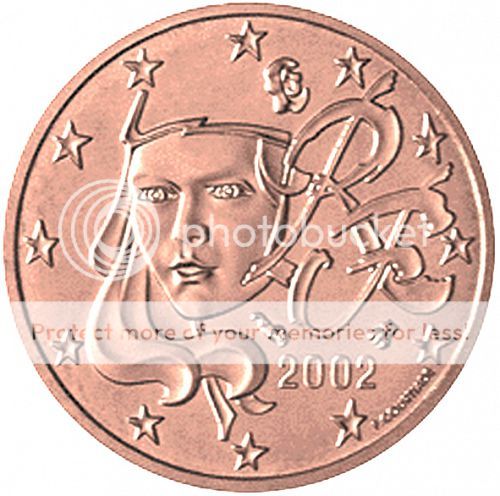
Some time last week, I was given in change; in place of a Two Dollar Coin, a Five Eurocent coin from France. RF in this case stands for République Française. The lady on the back of the coin is Marianne, the embodiment of the French motto Liberté, égalité, fraternité, and of France itself.
Marianne probably dates from about 1792 after the First French Republic was declared and was usually portrayed with a Phrygian cap which stood for liberty and freedom but in most cases, just makes the wearer look like a giant Smurf.

This got me thinking, the United States is embodied by Lady Liberty, Uncle Sam and even Columbia. The United Kingdom has Britannia and John Bull. Greece or more specifically Athens has Athena; Iceland had The Lady of The Mountain, Ireland is personified with Kathleen Ni Houlihan and Germany has Deutscher Michel and Germania.
This is going to sound really strange but even New Zealand has as their national personification, the lady Zealandia, who is the daughter of Britannia standing on the left hand side of their coat of arms.
No, I am serious:


In contrast, who does Australia have? No-one.

It's interesting how in 2014, in the hundredth anniversary of the outbreak of possibly the most idiotic ever fought upon the earth, in which "lions were led by donkeys" and where men's lives were describer as the "coin of the realm on the battlefield", that Australia which was prior to this a tin pot little post of empire, on the other side of the world, is supposed to have forged its national identity.

Yet even with a casualty rate of 65% of Australian soldiers who served in World War One, that still wasn't enough to give either Australians or the nation a sense of its nationhood, that it would become personified.
British solidiers would become known as Tommies and Germany would gain the name of The Hun, whilst its soldiers would become known as either Fritz or Jerry. Granted there are uses of the terms Digger and ANZAC but really, they aren't the same sort of concept as a national personification.

I've had a go at trying to picture what the personification of Australia might look like but sadly, I can't come up with anything constructive. The only images which really stick are either the slouch hat or possibly a hat with corks on. Mostly all the other stereotypical images of Australia are all of things which have long passed.
We might think of the stockman and the concept that Australia rides on the sheep's back but when it comes to actual exports, mining overtook agriculture in the 1960s. We might even try and think of some sporting hero but the problem then is that you actually think of the sporting hero rather than the nation as a whole.
You could try and think of something more contemporary like a family in surburbia; with a house on a quarter acre block but that dream is very quickly fading indeed with the beginning of generations to be locked out of affordable housing forever and being forced to rent. Even the idea of far to many summers on the beach, burning their way into the national psyche are outdated for the same reason. No-one can afford to park all day near the beach anymore, have you been to Bondi or Coogee lately? I don't know if the idea of someone having to put coins into parking meters all day long is exactly the sort of image that we'd like to have as our nation personified; though given the amount of toll roads which we have to drive down just to get anywhere, maybe we should?

Thinking about this logically, it would be fitting if our national personification was four people named Wong, Smith, Santarelli and Jagamurra, driving down the street in a Mazda 3. The car is imported (because Australia soon won't build cars anymore) and apart from Jagamurra who is indigenous, the other three are migrants because everyone except the First Australians are either migrants or descended from migrants at some point.
Maybe they'd have green and gold scarves flapping out of the windows in this sport obsessed nation, for we watch plenty of it but not as many of us actually play as we used to. There'd probably be a kebab, a curry and a pie in the car, and Smith would probably be trying to convince everyone that cous-cous is really special. One of them would be checking out the latest talent competition TV show on an iDevice and they'd all be worrying about housing or rental prices.

The problem with a national personification is that in principle, everyone sort of needs to agree on how they're going to present themselves. The local council area in which I live in has people who came from 205 countries in the world out of 206 and the only reason that we didn't get number 206 is because that's the Vatican City and that'd mean asking curious questions.
If Australia were to become a republic, it couldn't really put anyone like Marianne, Lady Liberty or Athena on the back of the coins because Australia doesn't really have a national personification and I suspect that it couldn't really ever expect to have one either...
...except the lady on the box of Redheads matches.

June 16, 2014

Horse 1694 - Posting Entries to the Gospel Ledger Accounts

There's an amusingly lovely concept which is formally called the Law of the Instrument, or perhaps psychologist Abraham Maslow's Hammer, which stems from his 1966 work The Psychology of Science which states:
"I suppose it is tempting, if the only tool you have is a hammer, to treat everything as if it were a nail."
I suppose that because I work in an accounting firm, I also suffer from this particular aspect of confirmation bias; conseqently, I tend to see lots of things with regards economic, accounting and legal concepts.
When I read Romans 4 in The Living Bible though, my mind attempted to change gears without the clutch, sparks flew everywhere and I was left in a state of annoyance.

This comes from the passage in question:
For the Scriptures tell us Abraham believed God, and that is why God canceled his sins and declared him “not guilty.”
- Romans 4:3 (The Living Bible)

For the record, I agree with what it says. This paraphrase is attempting to put this into plain English which is perfectly acceptable and reasonable; however, I rather like both the NIV and the King James' better because of their selected word choices.

If, in fact, Abraham was justified by works, he had something to boast about – but not before God. What does Scripture say? ‘Abraham believed God, and it was credited to him as righteousness.’
Now to the one who works, wages are not credited as a gift but as an obligation. However, to the one who does not work but trusts God who justifies the ungodly, their faith is credited as righteousness. David says the same thing when he speaks of the blessedness of the one to whom God credits righteousness apart from works:
- Romans 4:2-6 (NIV)

Let's for a minute assume that God is keeping a set of accounts. Assuming that each sin has a price which needs to be paid for, that price will accumulate in a Debtor's Ledger. Most sets of accounts will at some point contain a header account called Trade Debtors or something similar.
It's not like the concept is particularly uncommon in scripture either. Right in the middle of The Lord's Prayer in Matthew 6 is the phrase: "And forgive us our debts, as we also have forgiven our debtors." 

The word "credited" used here is the Greek word "Elogisthe" which means to  assess or to count. Now I'm not a Greek scholar in any sense of the word but I do remember that in Plutarch's Parallel Lives written in the year 75AD, he uses the word in relation to the extracting of taxation from people who were unwilling to pay.
Similarly, the word "credited" used later is the Greek word "Logizetai" which is just a different form of the same verb and is similar in meaning.

The King James version which was published in 1611, chooses to translate that same passage like this:
For if Abraham were justified by works, he hath whereof to glory; but not before God. For what saith the scripture? Abraham believed God, and it was counted unto him for righteousness.
Now to him that worketh is the reward not reckoned of grace, but of debt. But to him that worketh not, but believeth on him that justifieth the ungodly, his faith is counted for righteousness. Even as David also describeth the blessedness of the man, unto whom God imputeth righteousness without works,
- Romans 4:2-6 (KJV)

I like the word "imputeth" here. Okay, ignore the archaic past tense of the word, and we get the modern word "impute". In an accounting sense, we see so-called Imputation Credits all the time, where a company has already pre-paid the tax which is due and forwards on the remainder to the receiver. Go on, check it out when you do your Tax Returns in a fortnight's time.

In every possible sense, the words "Elogisthe" and "Logizetai" are both words used in an accounting sense; in reference to a debt which will become payable at some point.
A creditor has every right to collect upon a debt and in the case where the person who has accumulated a very large quantity of debt and declares bankruptcy, there are even cases where creditors have the right to claim and seize property.
The question then in Romans 4 if this is the case, is why would the people at The Living Bible choose not to select this sort of language?

Perhaps I should show the case visually:

In a debtor's account, invoices (debts) are shown on the Debit side of the account. An account that shows a debit balance, will appear on the left hand side when it comes time to generating a set of accounts.
These debts will continue to accumulate until such time as they are either paid, or written off. A payment into a debtor's ledger is shown as a credit.
Later on in Romans, Paul describes the wages of sin as death; that is, that and obligation exists which at some point will be called upon.

Obviously, we can choose to pay the debt ourselves, but to use the analogy given for us in Romans 4, where Paul is talking about a saving faith which is being credited as righteousness, it is like Christ's death is a massive credit note and moves use from the debtor's to the creditor's side of the ledger with a carried forward balance.

Now I know that I'm hardly the first to have seen this, or even the best person in the world to explain the concept, or even the first person to have been annoyed by it but it was an interesting sort of diversion; especially considering that here we are in the last two weeks before the end of the financial year and I'm busily trying to extract payment from people who are unwilling to pay and having to pass Credit Notes to forgive debts that I will never be able to collect on.
In a monetary sense those accounts are being credited as righteousness or being put right; and I just happen to see parallels all over the place.

June 13, 2014

Horse 1693 - 2014 Copa Du Mondo - ABRE!

Brazil 3 - Croatia 1
Neymar 29', Neymar 71' (pen), Oscar 91'
Marcelo 11' (o.g)

With allegations of corruption surrounding the selection process for the awarding of the 2022 World Cup to Qatar, FIFA should have been looking for an opening match which was free from futher controversy. Unfortunately, controversy had booked a ticket to the very first match of the 2014 World Cup in Brazil and was not only rearing its ugly head, it was actively barracking and cheering.

Tactically, both sides went into this fixture with a 4-5-1 formation, perhaps hoping to force the other into some sort of mistake. I would tend to suggest that at Brazil '14, we can probably expect to see mainly 4-5-1s and 5-4-1s as teams prefer to not lose as opposed to try and win. Only teams with no real chance will probably buck that trend.

The first thing I noticed even before a ball was kicked, was that the tradition of Brazillian stage names is alive and well. The problem is that after 84 years of World Cups, all the good names appear to have been exhausted.

Sure, there's Paulinho and Marcelo but with names like Jo, Maxwell, Victor, Willian, Bernard and Fred, are they even trying any more?
Again there's Fernandinho but how long is it before we can expect Ronaldinho McDonaldinho com a sua el classico Grandé Mac et McChickinho?
Amusingly though, there's The Un-Incredible Hulk who instead of smashing stuff when he decides to have a ragequit, just falls over and demands a penalty.

The crowd in this match was silenced 11 minutes in when a perfectly weighted Croation cross into the box, found Marcelo unsighted and with a limp left foot, he perfectly batted the ball into his own goal to put the hosts 1-0 down.
Just before the half hour, Neymar's hopeful strike from 25 yards away lifted Brazil, who at that stage although played with sublime skill, lacked any real sense of direction.

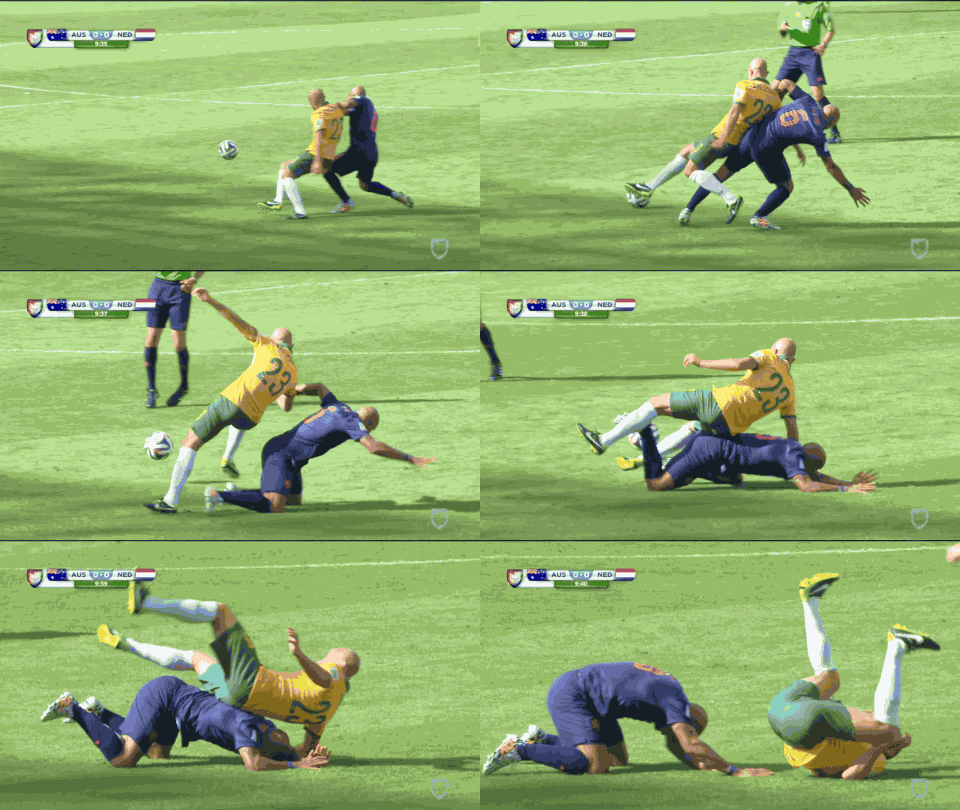
However it was 71 minutes in that gave us what we'd all feared would happen when everyone in the whole world except referee Yuichi Nishimura saw that Dejan Lovren got the lightest of hand touches on Fred who hurled himself at the ground with the sort of dive that will probably win a bronze medal at the Olympics in Rio in two years' time.
I'm going to come out and say that this sort of thing will conspire to produce a Brazil-Argentina final. When the outcome of a match is swung on the hinges of only a few key moments and they happen to be as the result of a referees' decision and that decision is influenced by shadowy controllers upstairs, what else are we supposed to think?

Croatia appeared to be visibly on top both before and after this incident and this prompted them to play even higher up the pitch; in an effort to try and grab an equaliser which they never have should have been forced to do in the first place. Brazil sat back and contained the next 20 minutes of barrage until into extra time, they found a break out and because Croatia had been playing so far up the pitch, Oscar found himself in a one on one with the flailing Croatian keeper, Pletikosa, and duly slotted one past him from 19 yards away.

The match probably was worth a Brazil win but when matches and tournaments have tempos and attitudes which rise and fall depending on the referee, it does really bring into question the integrity of FIFA as a whole; especially considering that FIFA answers to no-one.
As for Brazil itself, it hasn't necessarily played as attractive football as say Spain or Argentina will, but it is entirely functional and they will be very hard to beat at home (and they'll have help).

Addenda:
During the 2014 World Cup, I probably won't write that many match reviews. I'll say up front that as an England fan, I'll follow them all the way to the Quarter Finals, where they'll be knocked out on penalties. I'll be amused as the Grauniad, the Express and the Daily Mail all splash news reports with begrudging cynicism, then wild optimism invoking the spirit of 1966, before heaping scorn on the England side as it fails at yet another world cup.

As for Australia, I expect that they lose 4-0 against Chile, 8-0 against the Netherlands and 8-0 against Spain. Especially publications like The Daily Telegraph, just don't seem to appreciate the fact Australia is the most minnowy team at this tournament; that is because unlike Rubgy League or Australian Rules football, the Football World Cup is for a sport which most of the world actually plays.

June 12, 2014

Horse 1692 - The Curious Tale Of A Premier Of Queensland And A Cabinet Minister

Frederick Isambard Morton, born 17th July 1877, was the son of a pastoralist in the Maryborough region of Queensland.
At the age of 8, whilst working out in the top paddock; trying to chase some loose kangaroos, he was thrown from horseback and landed with such a heavy thud that he broke his pelvis and several bones in his right leg. The impact with the ground also left him blind, and whilst he recovered from his broken bones, he never recovered from his blindness; hence his famous epithet.
As young Frederick was unable to continue work in the fields and indeed most rural settings, he attended diligently to academic study and not only graduated his school as dux but would go on to study Law at The University of Queensland; which he passed with distinction.

After working for several years at a few law firms including Dewey, Cheatem & Howe and later at Buckleys & Nunn, it was at the law firm Screuham & Burnham that he would really make a name for himself when he defended Queensland State MP for Chatsworth, Lawrence Phurphey against a murder charge.
Phurphey was apprehended by the Queensland Police at the scene of the crime, in which the victim had had his head hacked off with a one-inch butter palette. The room in which Phurphey was found, was locked from the inside, no fewer than 29 signed confession notes were strewn about the room and on his person and Phurphey was himself, covered from head to toe in blood. Phurphey was still brandishing the one-inch butter palette and whistling "I Wish I Was in Dixie" when police arrived.
Frederick was able to argue that certain aspects of Phurphey's case were presented incorrectly under the terms of Queensland's Criminal Code Act 1899 and so all charges against Lawrence Phurphey were dropped.

Having been acquitted of murder and the case declared Nolle Prosequi, Lawrence Phurphey stayed on as MP for Chatsworth and would rise to become Premier of Queensland in 1919. Two years later during a by-election, Frederick Morton would become Member for Ashgrove and was appointed State Minister for Justice and Law soon after.
The increasingly jovial Premier Lawrence Phurphey was said to have been more than happy when Frederick Morton personally oversaw the Constitution Amendment Act 1921 which abolished Queensland's Upper House (Queensland Legislative Council) on the 23rd of March 1922.

Aside:
In doing the research for this post, many of the accounts were found to be fabrications of that particular Premier of Queensland and had that State Minister for Justice and Law been still alive today, his sharp intellect would have seen this.

June 11, 2014

Horse 1691 - How To Stop People Complaining About Buses That Are "Not In Service" Through The Simple Use Of Applied Psychology

Picture the scene:
It is a little bit beyond five o'clock and the commuters at the bus stop that I was stood standing at (as opposed to sat sitting) are rippling with disapproval that yet another bus has whizzed past at 60 clicks and bearing the message "Not In Service" across its destination board.
Now I'm perfectly aware that complaining about stuff is sort of a national sport along with whinging and tutting to make an Olympic style triathlon, and so I was pondering as is my wont, if it might be possible to employ a little psychology to dissuade the disapproval being shown.

The complaints which are shown as a result of buses whizzing past, stem from the perception that a service is not being provided or more specifically that it is not being provided to "me" and not being provided "right now".
We all tend to have an egocentric sort of view of the world when it comes to these sort of things; despite the fact that a public bus company's job is to provide a bus service and when a bus whizzes past, they are in fact providing that service but just not to "me" and just not "right now". Very few people in the world drive around in buses specifically for fun.
This got me thinking that if people were more aware of the fact that the bus in question is being provided for someone else, then they might not be so whingey about it.

If the bus had the next route number and the target destination across its destination board en route to the beginning of its next run, then would people show as much disdain?

I'm not entirely sure of this but maybe there would be a difference in projected attitude if people were aware that the bus was for "someone else" as opposed to a generic "Not In Service" message.
I already note that people don't tend to complain as loudly when an eXpress, Express or Limited route bus whizzes past and the reason that I suspect that this is the case is because people visibly see that those buses are "In Service", even though I personally find it bizarre that this message even exists.
The way I see it, a bus is always "In Service" except when it's at the depot because either its en route to the beginning of a run or else, its on its way home again; maybe if people were made more mindful of this, they might not be so quick to complain.

Then again, maybe they would. People like to complain about stuff; why stop now? Not when there's an Olympic style triathlon to be won.

June 10, 2014

Horse 1690 - Pizza Maths

Yesterday was the Queen's Birthday Weekend Holiday, which is amusing as her birthday is really on the 21st April. If for no other reason than to keep a public holiday, hurrah for the Queen's Birthday Weekend!
I had a lovely sleep in; in a nice warm bed and as if to cap off a lovely morning, Mrs Rollo made buttermilk pancakes.
This is where the story gets weird...

I cut across a pancake with my knife and noticed that it cut into 2 pieces (okay, that's blatantly obvious). I then made a second cut across the pancake and that second cut, made 4 pieces. I was then thinking about making a third cut when I was told that it was going to get cold.
I'm sure that I must at times drive Mrs Rollo bonkers at times with my incessant wondering; so I kept this one quiet.

What is the maximum number of bits that you can cut pancakes, pizza, lahoh, chapati... into, with every new cut?
I don't really care about the size of the bits.

On the train this morning, I sat doodling; thinking of Blind Freddy working away for Hypothetical Pizza Inc. and I bet he'd know how many bits he could get for every cut of his blade. Being the kind of numbers person, I am, I thought I'd take note of the number of bits I could get for every new cut.

For 0 cuts, you get 1 bit
For 1 cut, you get 2 bits.
For 2 cuts, you get 4 bits.
For 3 cuts, you can get 7 bits.
For 4 cuts, you can get 11 bits.

If we let c be the number of cuts and b be the number of bits that you get, then this should resolve nicely into a simple equation. I also noticed that for every new cut, the number of new bits increased by 1 every time; this means that whatever equation arises, it must be of degree 2.

The general formula for any equation of degree 2 is ax²+bx+c = y
In this case x is the number of cuts and y is the number of bits.
Since the number of bits that I have with 0 cuts is 1, then it's a safe bet to assume that the final constant is 1.

This is where brute force came into play; since I couldn't remember how to actually find a specific equation from the data it generates but I did remember the basic quadratic formula; so I punched in a stack of numbers and fiddled with things until I magically found my answer.

The number of bits that you get from a given number of cuts is defined by the equation:
(c²+c)/2 + 1 = b
I figure that for 10 cuts, you should get 56 bits; for 13 cuts, you should get 92 bits etc. I have no idea what each of those very small bits would look like but to be honest, I don't care all that much. The best number of cuts to make in a pancake, pizza, lahoh, chapati etc... is none.
I can eat a whole pizza.

June 08, 2014

Horse 1689 - Poverty: The Left and The Right

"Poverty is not a left or right issue. It's God's issue." Think I'm at the wrong church. We never talk this much about our call to act.
- Tweeter's Name Withheld, 8th Jun 2014

Firstly to set this straight. On a left-right scale where 0 is the exact centre:
The Economic Left: The point (-∞,0) is the economic position in which the state owns and controls everything.
The Economic Right: The point (∞,0) is the economic position in which the state owns and controls nothing. In a purely economic rightist economy, everything is owned and controlled by private enterprise.

More generally, left-wing politics generally espouse higher degrees of social equality; suggesting that private enterprise because it is selfish has no motive to change or even address inequalities.
Right-wing politics which espouse individual responsibility often also suggest that social inequality is a consequence of the operation of markets and that some degree of inequality is either completely normal or in some right-wing policy sets, even desirable.

Both of these positions are on a different scale to the Authoritarianism/Libertarianism axis in which:
Authoritarianism: The point (0,∞) is the social position in which authority is not allowed to be questioned or must be formally obeyed in all circumstances.
Libertarianism: The point (0,-∞) is the social position in which all authority rests in the individual.

Poverty which is that state in which an individual lacks either the means or capability to meet certain needs, which may include food, shelter and clothing etc. is very much an economic issue because it then calls into question a matter or responsibility.

The Left would suggest that governments should do something about poverty since private enterprises have no motive for solving the problem.
The Right which would prefer that government got out of the economy or at least minimised its impact on how the economy works either through direct action or the removal of regulation, would in most cases tend to suggest that because poverty is essentially a problem which affects members of society which would then fall into economic irrelevance, would tend to look upon the problem of poverty as either a category error or something which is a negative externality, and would generally choose not to incur the cost of doing anything about it if they can.

I found this quite interesting during the 2012 United States Congressional campaign:
Graduate from high school, work hard, and get married before you have children and the chance you will ever be in poverty is just two percent. Yet if you don’t do these three things you’re 38 times more likely to end up in poverty!
- Rick Santorum, at the Republican National Convention, 21st Sep 2012

If we boil down these three things:
1. Graduate from High School - this either assumes that a high school has been provided and/or that it is accessible to attend. If schooling is too expensive to attend, then people do not so so. This argument is being played out in Australian politics at the moment with respect to universities.
2. Work Hard - this again assumes that there is in fact at least a subsistence level of employment in which someone can find themselves. That might be a tall order when private enterprises either find cheaper sources of labour and decide to move or if wages are sufficiently low enough to make even a subsistence level of life difficult.
3. Get Married Before You Have Children - As a societal problem, the issue of marriage is an economic irrelevancy these days. The problem here is whether or not an individual has children and as a result, it minimises their ability to find meaningful and gainful employment; usually this is the case for very young mothers and the fact that very young fathers are able to just leave to bear the economic burden them so easily.

Again, the real crux in all of these three issues is one of a matter or responsibility. The Left would suggest that it is fitting and proper that the government should act as a backstop to ensure at least a minimum standard of living for people whilst the Right would tend to suggest that this is an economic irrelevancy.

Getting back to the original comment:
"Poverty is not a left or right issue. It's God's issue." 
Well, poverty is a Left issue because the Right simply doesn't even regard it as an issue. Taken to its ultimate extreme, in a perfect world where God himself runs everything benevolently, then God lives on the Economic Left. It stands to reason that if The Left is the economic position in which the state owns and controls everything and the state happens to be God himself, then God is leftist.
Also assuming that God's law is perfect and that to disobey God is sin, then God is also the ultimate Authoritarian.

Even if you look at the description in Acts 4:
All the believers were one in heart and mind. No one claimed that any of their possessions was their own, but they shared everything they had. With great power the apostles continued to testify to the resurrection of the Lord Jesus. And God’s grace was so powerfully at work in them all that there were no needy persons among them. For from time to time those who owned land or houses sold them, brought the money from the sales and put it at the apostles’ feet, and it was distributed to anyone who had need.
- Acts 4:32-35 (NIV)

This very much is a description of a group of people working together. If they are their own little state, then it's very much a commune, a community, dare I say communist. This is not Soviet Socialism which ran on the basis of greed in many cases but an actual proper community.

Poverty is a Left issue because the Right does not care. As far as God is concerned, he cares for people - God is a leftist.

Our Response:
What should be an appropriate response to this?

For there will never cease to be poor in the land. Therefore I command you, ‘You shall open wide your hand to your brother, to the needy and to the poor, in your land.’
- Deuteronomy 15:11

Whoever is generous to the poor lends to the Lord, and he will repay him for his deed.
- Proverbs 19:17

And Jesus, looking at him, loved him, and said to him, “You lack one thing: go, sell all that you have and give to the poor, and you will have treasure in heaven; and come, follow me.”
- Mark 10:21

Let me just re-iterate the conclusion from before:
Poverty is a Left issue because the Right does not care. As far as God is concerned, he cares for people - God is a leftist.

What would be an appropriate response be with regards the poor? We can give monetarily, we can write to our members of parliament in response to the economic consequences of government policy, we can even seek to help those people who we meet who need out help. Maybe we could in the first instance; and considering that God cares for people and we should be trying to be like Him, we could also be concerned for people? Just maybe?

Horse 1688 - People Used To Believe That The Earth Was Flat - Did They Now?

I was watching the rather hokey Star Trek V last night and one of the comments made by Sybok, who turned out to be Spock's half-brother (in something of a deus ex machina), was that "People used to believe that the earth was flat"; as though that were some sort of proof that we know live in more enlightened times.
Granted that many people did in fact think that the earth was flat and in some cases a disk like object suspended upon the seas, this was in no way universally the case. Plenty of people did not think that the earth was flat; many even took measurements which quite conclusively proved otherwise, even though their calculations and basic assumptions were wrong.

He spreads out the northern skies over empty space;
he suspends the earth over nothing.
He wraps up the waters in his clouds,
yet the clouds do not burst under their weight.
He covers the face of the full moon,
spreading his clouds over it.
He marks out the horizon on the face of the waters
for a boundary between light and darkness.
- Job 27:7-10  (NIV)

There are theories which suggest that the book of Job might be the oldest book in the Tanakh. Job appears in the third section of the Tanakh called the Ketuvim, which include the poetic writings, as well as other assorted leftovers and the two books of Chronicles.
Job was possibly written between 2200-1800BC and if this is the case, then a rather obvious and stark question arises... How could Job have possibly known that the earth hangs over nothing?
Second to this, anyone who has ever stood on the shore of any beach, stood on a very high mountain or even been on a ship in the middle of the ocean, will immediately be struck by the round shape of the horizon; no doubt this is what Job refers to at the end of this little section.

Still further in the book of Isaiah which identifies itself in the 8th Century BC, we find this little nugget:
He sits enthroned above the circle of the earth,
and its people are like grasshoppers.
He stretches out the heavens like a canopy,
and spreads them out like a tent to live in.
- Isaiah 40:22 (NIV)

The word circle in this verse is the Hebrew word "chug" (חוּג). This word is almost exclusively used as the word "circle". I've heard descriptions both arguing in favour of this meaning a globe and a disk and so it perhaps isn't wise to use this as a basis to start an argument as to what the ancients thought. Bear in mind that the Bible itself is more a description of how God relates to people and so if you want to find out what scientists thought, then perhaps it;s best to ask the scientists.

Both Pythagoras who lived in the 6th Century BC and is best known for his theorem relating to triangles and Parmenides a century later, concluded that the Earth is spherical; as did Aristotle and Eratosthenes of Cyrene not only tried to calculate the circumference of the earth but also the angle of the tilt of the Earth.
Aristarchus of Samos even put the sun at the centre of the universe and using trigonometry, thought that the Sun was 18 times further away from the Earth than the Moon is (it actually is about 400 times).

Skip forward many hundreds of years and Columbus who sailed to the new world, didn't leave Spain on the basis that he thought that the world was round when everyone else thought that it was flat, but rather that he thought that the Earth was much smaller than it actually is. Columbus thought that he'd landed in India, despite never having been there before and called the people who lived there "Indians" on that basis.

If anything it might be true that the idea that "People used to believe that the earth was flat", came from a political conflict rather than what people actually believed:
The myth that people in the Middle Ages thought the earth is flat appears to date from the 17th century as part of the campaign by Protestants against Catholic teaching.  But it gained currency in the 19th century, thanks to inaccurate histories such as John William Draper's History of the Conflict Between Religion and Science (1874) and Andrew Dickson White's History of the Warfare of Science with Theology in Christendom (1896).  
- James Hannam, God's Philosophers: How the Medieval World Laid the Foundations of Modern Science  (2009).

All of this leads me to wonder why people think that people thought that the earth was flat but I don't wonder for very long. The truth is that if you ask most people a whole range of questions, they don't really know the answers and more importantly, don't care.
Maybe people think that people thought that the earth was flat because they don't question things enough; that has far more serious implications that the mere shape of the earth.

June 06, 2014

Horse 1687 - The Leadership Challenge That Not Only Never Was But Also Was Actually Never Was

http://www.couriermail.com.au/news/opinion/hungry-clive-palmer-is-a-dilemma-for-tony-abbott/story-fnj45fvb-1226939058011
In fact, Turnbull has lavished a lot of charm lately on Abbott’s natural predators, even last week launching a new parliamentary group of friends of the ABC, which got a (small) cut in the Budget.

“I think the ABC is more important than ever,” declared Turnbull, even though it is in fact dangerously huge and biased, stifling competition and punishing conservatives on its five radio stations, four TV networks and online newspaper.
This is Turnbull, on the far Left of the Liberal Party, charming a constituency that hates Abbott and which would back Turnbull to replace him — even if it still wouldn’t vote Liberal.
- Andrew Bolt, Herald-Sun, 2nd Jun 2014

On Monday this week, Mr Bolt's comments launched a wave of discussions which questioned Malcolm Turnbull's disloyalty to Prime Minister Tony Abbott. Turnbull's supposed disloyalty stems from the suggesting above that he actually had the temerity to stand up in defence of the ABC.
Meanwhile, Alan Jones over on 2GB, also decided to jump upon this idea that because Malcolm had stood up for the national broadcaster, then that was a display of disloyalty.
Since the budget though, Malcolm Turnbull has cancelled appearances on ABC Local Radio's AM program, cancelled two appearances on ABC1's 7.30 and also an upcoming appointment on Insiders.

I find some of Andrew Bolt's comments particularly confusing. I am really confused. I mean really really confused. Really really really ('chazakah' - the emphatic Semitic triplet type) confused. Specifically I'm confused about this phrase "stifling competition".
Admittedly this column appeared in print in all daily drabloid News Corp rags around the nation on Monday but for several of those rags, such as Brisbane's Courier-Mail or Adelaide's Advertiser, there was no competition. I'm really confused at this point how a newspaper with no other competitors actually has the temerity to print something like this, suggesting that the ABC is stifling competition when from many news-stands across Adelaide and Brisbane, if you wanted to pick a newspaper, you had a choice of ONE.
This is quite apart from the fact that  News Corp Australia owns 50% of Foxtel, Lachlan Murdoch owns Illyria Pty Ltd which holds both the Nova FM and Smooth FM Networks, who by the way also sat on the board of Network Ten Holdings (which by the way, I'm betting has been deliberately run into the ground, just so Lachlan can force the government's hand into changing the way that media ownership rules work).
I'm also a little confused as to how a person who even has his own private Human Rights Commissioner (and we all know that's precisely why Tim Wilson of the IPA was given a golden ticket into the job) can even bandy about the words "stifling competition" in the first place.

When I had started this post on Monday night, it looked pretty simple to tie off. However, fast forward to today the 6th of June and Tony Abbott gave a press conference trying to quell the rumours that Messrs Bolt and Jones had stirred up. Prime Minister Abbott passed off the rumours as "meaningless chatter" and that in itself makes me wonder who the puppet masters are in all of this.

Aside. The following did not appear in the print versions of either the Courier-Mail, The Herald-Sun or The Daily Telegraph. News Corp Australia or rather its version of Minipax has gone back and changed the online version of this article.
"That said, a disclaimer: I’m sure Turnbull isn’t contemplating any imminent challenge or is fostering destabilisation.
Nor do I think the Liberals are considering any such switch at the moment, especially not to a man whose strategic nous is so lousy that he last led the Liberals into the toilet."
- Was not in the physical papers on June 2.

This all brings me around to the concept of plausible deniability. Andrew Bolt can very easily deny that he was directed either by his bosses at News Corp or the Prime Minister's Office that he was told to write this article. Alan Jones also can deny that he was given any scoops or inside information from the Prime Minister's Office. The Prime Minister's Office and even Mr Abbott can deny that they either leaked any directives, press releases or other information.
So who is pulling the strings here? Bolt? Jones? Abbott? Turnbull? Rupert? Lachlan? The IPA? Who knows? I honestly have no idea.

I do know that Malcolm Turnbull who has been in parliament since 2004, certainly saw from the other side of the chamber as Ms Gillard and Mr Rudd pulled ribs out of each other. Even Blind Freddy who was the fictional member for Leichhardt from 1910-1928 could see that it would be an inherently stupid idea to make a leadership challenge during the first term of office of a government. If there is one fixed point in this entire swirling galaxy of intrigue and subterfuge, then this is that.
Malcolm Turnbull can definitely deny that there's a leadership challenge because of the incredibly obvious fact that there is no leadership challenge. Plausible deniability works its best when the thing that you happen to be denying, never actually happened.

No the real reason why Turnbull has been gagged here has nothing to do with a supposed leadership challenge but his statement that “I think the ABC is more important than ever." It is very much in Andrew Bolt's interest as a News Corp lackey to see the ABC kneecapped, as it is for Alan Jones who in effect is John Singleton's. Any dollar pulled from the national broadcaster is a victory for them and this is a classic move in playing the man and not the ball.

There is however one grain of truth in Mr Bolt's initial column that started off this mess:
This is Turnbull, on the far Left of the Liberal Party, charming a constituency that hates Abbott and which would back Turnbull to replace him — even if it still wouldn’t vote Liberal.
Okay, as far as Mr Bolt is concerned, everyone in the world is on the far left to him. He's been on the bus to Far Right Town for a long time now but the truth is that being charming certainly is a good way to win over a constituency - you catch more flies with honey than you do with vinegar.
Right now, a great deal of the electorate actually does hate Abbott and probably would back Turnbull to replace him — even if it still wouldn’t vote Liberal, but I'd suggest that's mainly because that's because of everything that his government has said and done, and cutting the budget of the ABC is only the first in a very very very long line of thing.

Horse 1686 - D-Day, X-Day, Y-Day, A-Day

Today, June 6, is perhaps best remembered for Operation Neptune which formed a part of a greater plan called Operation Overlord and specifically were the allied landings across Normandy. They would in turn led to the liberation and restoration of the French Republic and later, victory to the allies in the Second World War.

D-Day as noted by the United States Department of Defense in their "Dictionary of Military and Associated Terms" is an:
unnamed day on which operations commence or are scheduled to commence
http://www.dtic.mil/doctrine/new_pubs/jp1_02.pdf

This suggests something about 6th June 1944 that perhaps isn't immediately obvious. The allied invasion of France was headed by General Dwight D. Eisenhower, in his role as Supreme Commander of the Allied Forces in Europe. Naturally, this means that he was always going to use his existing terminology when planning the invasion. Also, since Montgomery, Bradley, Ramsay, Leigh-Mallory and Smith it also explains why they too would also use that same terminology.
Further to this, days like W-Day which is used as the day that the President of the United States makes an adversary decision to prepare for war, C-Day which is the day that a deployment operation commences or M-Day which is the day of mobilization, would also form part of official communications when it came to planning operations.
I supposed technically W-Day for the United States in the Second World War was the 8th of December 1941, which is the day after the "date which will live in infamy". W-Day would have been the date of formal declaration of war. 

More formally though, apart from D-Day at least four more days were noted as lettered days:
A-Day - 20th Oct 1944 - Invasion of the Gulf of Leyte - Operation King Two
L-Day - 1st Apr 1945 - Invasion of Okinawa - Operation Iceberg
Z-Day - 10th Jun 1945 - Invasion of Borneo - Operation Oboe Six
Q-Day - 23rd Jun 1945 - Trinity Test dress rehersal for the Atomic Bomb - Manhattan Project

Two lettered days never took place:
X-Day - 1st Nov 1945 - Invasion of Kyushu - Operation Olympic
Y-Day - 1st Mar 1946 - Invasion of Honshu - Operation Coronet

I have it on somewhat second-hand information that the standard notation relative to a lettered day is the letter plus or minus the number of days. When "undoubtedly the most complicated and difficult operation undertaken" (as noted by Churchill) finally ended on 25th Aug 1944, I suppose that it would have been noted as D+80.

Of all these lettered days, one of the most important is conspicuous by its absence; that of course being the date when the guns fall silent and hostilities cease; those dates can never be written in advance by generals. Those dates are the most looked forward to though and generals and officials who make up plans for lettered days and lettered hours, would do well to remember that.

June 05, 2014

Horse 1685 - Cotard's Syndrome Redefined?

http://www.theage.com.au/business/pharamceutical-company-gsk-has-no-plans-to-close-sydney-factory-despite-recent-outsourcing-of-victorian-jobs-20140603-39h0g.html
A senior executive of pharmaceutical group GSK Australia said high labour costs that led to the outsourcing of about 150 Victorian manufacturing jobs were unlikely to affect workers making Panadol at its Sydney factory.
Vincent Cotard, general manager of consumer healthcare Australia, said although all GSK manufacturing facilities were continually compared with operations in other countries, the company's factory in Ermington was a centre of excellence. 
...
The company submitted its 2013 financial report to the corporate regulator on Tuesday, showing a less than 1 per cent drop in revenue to $1.4 billion. Profit before tax rose 3 per cent to $42.8 million.
- The Age, 4th Jun 2014

I hope that I've done the maths correctly here; so here it goes.

150 workers X $250,000 each = $37.5 million.
$42.8 million - $37.5 million = $5.3 million.

I'm confused.
"A senior executive of pharmaceutical group GSK Australia said high labour costs that led to the outsourcing of about 150 Victorian manufacturing jobs"
Assuming that each of those 150 workers were given a pay increase of $250,000 per year each, then GSK Australia would have still been turning a profit of $5.3 million. This isn't paying them wages of $250,000 per year each but increasing their wages from whatever they were paid by 3.3 times the rate of Average Weekly Ordinary Time Earnings.

I decided to do a little investigation and find out exactly what Vincent Cotard, general manager of consumer healthcare Australia for GSK was paid but GlaxoSmithKline doesn't publish those figures. In fact if you try to do a search for Vincent Cotard, it turns up very few results but curiously, it does give you this:
http://www.researchgate.net/publication/8031874_Co-existence_of_lycanthropy_and_Cotard's_syndrome_in_a_single_case
Cotard's syndrome is another rare condition in which the patient has nihilistic delusions and ideation of immortality. 
I don't know if this is a strange case of irony or not.

Some time during the twentieth century and presumably after the horrors of the Second World War, society collectively abandoned the idea that work was noble.

From about the time of Martin Luther onwards, the idea of work itself, that is the idea of everyday gainful employment as opposed to the Christian idea of "works", was rethought of as something which both benefits the individual and society as a whole.
This idea would become known as the "Protestant Work Ethic" which other writers like Max Weber eventually came to see as the driving force behind much of Europe's industrial capitalism.

Coupled with the idea that work was noble, was also the idea that monetary success itself was almost vulgar and base. The American philosopher William James once wrote in a letter to H.G. Wells that:
"The moral flabbiness born of the exclusive worship of the bitch-goddess "Success". That — with the squalid cash interpretation put on the word success — is our national disease."
- William James, to HG Wells, 11 Sep 1906

Noted orator, satirst and writer Hilaire Belloc wrote:
Lord Finchley tried to mend the Electric Light
Himself. It struck him dead: And serve him right!
It is the business of the wealthy man,
To give employment to the artisan.

After the Second World War in an area of real rising incomes, at some stage success itself came to be the thing to strive for. I suppose that this is fine in an era when the rising tide of incomes causes all boats to rise but from about the late 1970s onwards, success no longer depended on actual work.

Work can now be done by people in even cheaper countries and so business managers (especially of very large corporations) tend  not to look at work as noble any more, but rather workers themselves are little more than economic labour units which are inherently replaceable.

I think of George Orwell's 1941 essay "The English Revolution" in which he wrote that:
A man with £3 a week and a man with £1,500 a year can feel themselves fellow creatures, which the Duke of Westminster and the sleepers on the Embankment benches cannot.
- George Orwell, The English Revolution, 19th Feb 1941

When people are treated as economic labour units which are inherently replaceable, there are little if any moral consequences for people like the Duke of Westminster or even a Vincent Cotard at GSK to push 150 workers aside. They in effect, no longer even live in the same country; so why should there be any feeling towards them.
In fact management not only doesn't think that it no longer needs to not to look at work as noble any more but also, that it actually deserves to be paid more:

Society and governments need to be amenable to disproportionately allow/encourage the few to retain that fatter profit share. The Managerial Aristocracy, like in the Gilded Age, the Roaring Twenties, and the thriving nineties, needs to commandeer a vast chunk of that rising profit share, either through capital income, or simply paying itself a lot.
- Citigroup Industry Note, Equity Strategy, 16th Oct 2005.

I have a question for Vincent Cotard, are "high labour costs" really what led to the loss of those 150 jobs? Really? Or was it something else?

May 30, 2014

Horse 1684 - What Should Chemical Elements 117 and 118 be Called?

As much as this is going to infuriate CGP Grey but possibly amuse Brady Haran, I'm going to try to address a question posed in "Hello Internet" Episode 13¹ namely:

What should chemical elements 117 and 118 be called?

http://www.smh.com.au/technology/sci-tech/anu-researchers-lay-new-element-117-on-the-periodic-table-20140501-zr2ee.html
Temporarily known as element 117 – after the number of protons in its nucleus – the new element's atoms match the heaviest ever observed and are 40 per cent heavier than lead.
It will soon have a catchier name when it is officially recognised by the international body of scientists behind the periodic table, the International Union of Pure and Applied Chemistry (IUPAC).
- Sydney Morning Herald, 2nd May 2014

As I see it, the challenge which has been set for us, is to give elements 117 and 118 names which match where they fit in the table because science likes order.

The history of naming chemical elements stretches back into antiquity. Some elements like Silver and Gold, were known by pretty simple sort of names and these are reflected in their current chemical symbols.
Silver was known as "Argentum" in Roman which directly translated means "shining grey" and as a result has the chemical symbol Ar. Gold was known in Roman as "Aurum" and likewise has the chemical symbol Au.
Hydrogen is a Greek word which means "water former". Oxygen is also derived from the Greek and means "acid former". Sodium derives its name from the Roman "Sodanum" which might mean a headache reliever and its symbol "Na" comes from "Natrium" which was the name of a mineral salt.

Greek and Roman words provide all sorts of modern neologisms because in the modern world, the real irony is that we like to mine those languages to coin new words to make them sound scientific and proper. It's a sort of cultural snobbery.
We do this with other technological things too. The word "television" for instance, comes from the Greek "tele" which means "far away" and the Roman "visio" which means "sight". This is of course kind of ridiculous because we've mashed a word together out of components from different languages.

The other place that the periodic table likes to pull names from are the names of scientists and universities who have discovered things. Element 101 for instance is caled Mendelevium after Dmitri Mendeleev who created the periodic table, element 96 is named Curium after Marie and Pierre Curie who were both famed for their work into radioactivity and perhaps rather egotisically, element 97 is named Berkelium after the city of Berkeley in California where the University of California first discovered it.

An increasing problem though is the annoying fact that beyond element 83 (Bismuth), chemical elements are generally radioactive and although a few chemical elements beyond element 92 (Uranium) do exist naturally, as the elements get more and more massive, searching for them becomes something of a scientific game and producing very large elements becomes an exercise in doing it for its own sake.

So then, knowing all of this, lets have a go a naming some elements.

Element 117 

Logically element 117 falls into group 17 on the periodic table which are the Halogens. The halogens which currently are Fluorine, Chlorine, Bromine, Iodine, Astatine (and 117), all follow a pretty obvious naming pattern - they are all "-ine". Apart from the "ine" suffix, their names mean as follows:
Fluorine - Flow
Chlorine - Green
Bromine - Brine
Iodine - Purple
Astatine - Unstable
I'm not sure what exactly what adjective would work the best here but I'd like to propose the following name:

Askopine.

Askopine retains the "ine" suffix which makes it fit nicely into the current naming convention and because it is an intrinsically useless element, I chose the Greek word for "pointless" which is "Askopos". Considering that only a few atoms of this element are ever likely to be produced, I think that its rather fitting.

Element 118

Element 118 falls into Group 18 which are the "Noble Gases". The Noble Gases are called as such because they have all of their electron shells filled and as such, don't react with very much.
Apart from Helium, the noble gases also follow a naming pattern, they all have the suffix "-on" which in Greek means "the something one"
Helium - Helios, the Sun God
Neon - the New one.
Argon - the Lazy one.
Krypton - the Hidden one.
Xenon - the Strange one.
Radon - the Radium one (because it was first derived from Radium).
I thought about the name Megalon which in Greek would mean "the Big one" because it could very well be the biggest Noble Gas if it is a gas, or even Metallon which means "the Metal one" because it might just as easily be metallic. Megalon and Metallon both sound pretty dumb though. I don't know if I'd like to be responsible for either of those names forever.

I pondered about the fact that there are currently no elements whose name begin with J. The name Jovion which means "the Happy one" might be appropriate, I  thought about a Jeroboam which is a very big wine bottle and derived the name Jerobon which would be sort of neat, and then a very big truck rolled down the street and rattled all the windows. Ahah, I found it:

Juggernon.

Juggernon retains the "-on" suffix which makes it fit into the group, would use the chemical symbol J which is vacant and is derived from the word "juggernaut" and so Juggernon would mean "the Very Big one".

Of course there is one name for a chemical element which I think desperately needs to be included, simply because it's just so amusing.
Phosdex, "the shaving cream atom"².
Please, please, please, IUPAC... make it so.

¹Hello Internet is a podcast in which CGP Grey and Brady Haran discuss... many things. They each have Youtube channels which are interesting.
- CGP Grey
http://www.youtube.com/user/CGPGrey
- Brady Haran has an abudance of Youtube Channels; here are three:
http://www.youtube.com/user/numberphile
http://www.youtube.com/user/sixtysymbols
http://www.youtube.com/user/periodicvideos

²from Duck Dodgers in the 24½th Century 
https://www.youtube.com/watch?v=RqAUiUDyFlY

May 29, 2014

Horse 1683 - Cut And Paste (The Australian Does Some of That)

Whilst looking through some microfiche at the Mitchell Library in Sydney for something quite unrealted, I found this article in The Australian's "Cut and Paste" section.

http://www.theaustralian.com.au/opinion/cutandpaste/calls-to-cut-funding-for-the-abc-didnt-begin-yesterday-it-was-more-like-1933/story-fn72xczz-1226781019223
Fairfax's Laura Tingle opens questions with a conspiracy theory, ABC, yesterday:
MY question was about the correlation between criticism of the commercial model with the fact it reflects the criticism of News Limited about public broadcasters including the ABC.
That's nothing new. Spigelman:
THE ABC has always impacted on the commercial interests of other media. In 1933, I think it was, when the ABC first announced it intended to introduce a news service in Australia, a campaign was launched to cut the funding. That campaign was run by the then CEO of the Herald and Weekly Times, Sir Keith Murdoch. Some things change very little.
A pat on the back for The Australian. Spigelman again:
NEWS runs an extraordinary suite of newspapers in Australia. The Australian, itself, we are lucky to have it in terms of depth and range. The Australian is a newspaper the survival of which is rare in the print landscape around the world; we are lucky to have The Australian. It runs campaigns from time to time. It's never comfortable to be the target of one of those campaigns.
There's always a "however":
HOWEVER, I would have thought the overwhelming majority of The Australian's readers are regular consumers of the ABC - radio and TV - probably both. Those readers must be quite bewildered that it (the ABC) doesn't do anything well.
- The Australian, 12th December 2013

I make mention of this for two reasons. Firstly that it made me question my own memory (having heard this National Press Club address live) and secondly, that having questioned my memory, I was then convinced that these were not the words actually said by the ABC Chairman James Spigelman.

The first problem I found was that being a National Press Club event from December last year, it was no longer available on ABC's iView to watch again. Consequently, I had to do a phrase by phrase search to find a transcript. Thankfully, one exists:

http://www.sciencemedia.com.au/downloads/2013-12-12-3.pdf
We are lucky to have The Australian. It runs campaigns from time to time. It's never comfortable being the target of one of those campaigns. However, they are entitled to do it. 
I would have thought that the overwhelming majority of The Australian's readership also are regular consumers of the ABC, either radio and television, probably both. Those readers must be quite bewildered that apparently the ABC doesn't do anything well. 
- iSentia, Sciencemedia.com.au Transcript (page 18), 11th Dec 2013

Did you notice the difference?
- Those readers must be quite bewildered that it (the ABC) doesn't do anything well. (the Oz)
- Those readers must be quite bewildered that apparently the ABC doesn't do anything well. (actual)

One thing that the text doesn't do justice to, was Mr Spigelman's tone here. If I recall correctly, he was not admitting a supposed shortcoming of the ABC but rather, speaking with a great deal of sarcasm in his voice; given that the Australian deliberately chose to misreport this, then I wonder about the validity of his previous statement that we are "lucky to have The Australian". I really question whether in 50 years of publication, whether the rag has contributed anything positive to the life of this nation and certainly it's owner can't even bothered to call himself by the nationality which his newspaper claims to be in name anyway.

I think that at this juncture given that News Ltd's savage campaign to have funding to the ABC cut and the axing of the Australia Network despite promises by the Prime Minister himself otherwise, that News Ltd has won.
Moreover, calls that it is somehow a "conspiracy theory" and therefore not trustworthy, should by evidence of history since then, be properly classified as a "conspiracy theorem".
And yes for the record, Sir Keith Murdoch was accused of trying to have funding cut to the ABC as early as 1932:

http://www.naa.gov.au/Images/Richardson_tcm16-35865.pdf
The Labor member for the Adelaide seat of Hindmarsh, Norman Makin, spelt it out to the House of Representatives on 3 May 1932 to anyone who had any doubts: 
A large newspaper combine at the head of which is the Melbourne Herald is making a determined effort to usurp the rights and powers of Parliament. Apparently it is the ambition of Mr Keith Murdoch to become Northcliffe or Beaverbrook of Australia and dictate public policy.
(CPD, 3 May 1932, p. 265)
- National Archive of Australia.

Presumably The Australia likes to consider itself as something of a "newspaper of record" though really, it can't very well live up to this title if it can not even be bothered to report actual truth as truth. The section's title "cut and paste" is presumably an ironic one?


When we do these things, we undermine our case for free markets by conveying the impression that the benefits are only for the already rich, well-connected and politically powerful - that is why we must have a press free from government intervention and why government attempts to regulate the press in Australia and Britain have been ill-conceived. The press must be held accountable, but so must our politicians - grievances and grudges should not fuel a fundamental shift in our social balance.
- Rupert Murdoch's speech to the IPA, 4th Apr 2013

Well? Where are the benefits in the press and to whom do they flow? People do begin to resent the rich only when they conclude that the system is rigged. Is it the ambition of Mr Rupert Murdoch to become Northcliffe or Beaverbrook of Australia and dictate public policy. I don't know. Maybe if his newspapers reported actual truth as truth, we might be a step closer to the answer.

May 26, 2014

Horse 1682 - What Actually Happens If Scotland Leaves

There is an assumption which I've now heard on a number of occasions that if Scotland votes yes to the referendum question "Should Scotland be an independent country?" on September 18, that it would condemn England to perpetual Tory rule.
The fact is that if you compare the actual sets of numbers, the truth reveals a very different story.

The following is a short summary of the last six General Elections in the UK. For 1987, I've included the SDP–Liberal Alliance as the Liberal-Democrats, because in 1988, that merger was formalised anyway.

650 Maj 325 1987 1992 1997 2001 2005 2010
Conservative 376 336 165 166 198 306
Labour 229 271 418 413 355 258
Lib-Dem 22 20 46 52 62 57
591 Maj 296 1987 1992 1997 2001 2005 2010
Conservative 366 325 165 165 197 305
Labour 179 222 362 358 314 217
Lib-Dem 13 11 30 42 51 46

For all of these elections, there were 650 members and a majority of 325 required on the floor for government (owning to the peculiarity that one member would become speaker). This is irrelevant anyway as in every general election, this doesn't matter.
If we pretend that Scotland's 59 members never existed, then the slightly smaller House of Commons would only have 591 members and require a majority of 296 to form government.

What's telling is that of the last six General Elections, the only difference is that the Conservative Party would have formed government in its own right in 2010; rather than needing to form a coalition government with the Liberal-Democrats.

Actually, if you extend this all the way back to the time of Churchill, then only with the hung parliament of 1974 in which Harold Wilson formed government and ten years previous in 1964, would the lack of Scottish MPs have made a difference at all. On those occasions, instead of Labour governments, there would have been Conservative governments formed with very small majorities.

In 1987 the Thatcher government held a very strong majority; whilst in 1992 John Major's government was elected with the single largest number of raw votes in British electoral history. Tony Blair's 1997 win produced a massive change in the number of seats as did the Cameron government of 2010.
What's not stated in this whole discussion is that it isn't Scotland which has the single greatest sway on the results of elections but the 79 seats of London.

I think that the premise that the UK would be condemned to perpetual Tory rule if Scotland leaves is flawed on the basis that the numbers simply don't work. What might be unclear is what would happen in the 2015 election if the Lib-Dems again end up as kingmakers caught between the Labour Party and the Conservatives. Considering that they were actively fought against when it came to the issues of tuition fees and the Alternative Vote, would they be so willing to try that again?
The House of Commons will basically continue to operate as it always has done. If Scotland leaves, although they take 59 seats out, it is still the public barometer which determines who is returned to government and it would appear that without Scotland, not a whole heap actually changes at all.

May 24, 2014

Horse 1681 - East of Bournville


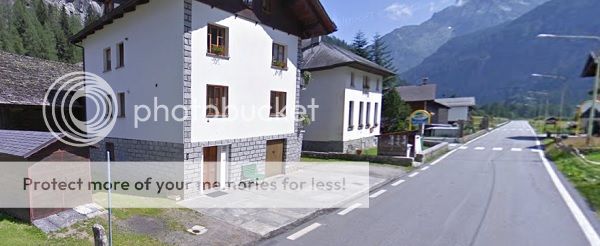
In the Italian Alps and very close to the Swiss border, lies the sleepy little village called Nutella which is famed for its wallpaper and a cuisine which is unique to the area: a sort of baked chicken which is slow cooked in Frangelico and jam.
Nutella remained relatively obscure, surviving the terrible events which swept across Europe in 1848 in which many countries were born and almost remained its own separate little country like San Marino in 1860, except that having no standing army whatsoever, it easily fell to the forces of Garibaldi when he united Italy into a single kingdom.
Nutella though is just one of a string of villages down a very special road.

After crossing the border into Switzerland, you head through the extremely narrow Pass d'Milka as the road winds its way through a series of 12 peaks known as the Tobe le Roné. The Tobe le Roné is often subject to landslides and it is feared that it will break into separate pieces into the valleys below.
At the base of the Tobe le Roné in a hamlet known as the Little Nest (or Nestlé), there is a dairy which was started in 1824 by an Italian and a Swiss entrepreneur called A.Glass and A.Häf respectively. Their dairy has a strange name in English which translates as "The Rotten Gift" but in French is called L'Cadeaux Bourri. The dairy lies on Quality Street and runs a small cafe called the Kit Kat Club.

Follow the road a little further and you pass through the villages of Rountree and Hershée and you'll find a positively turkish delight of a place called O'Henri, where many people find their work, rest and play. Turning left at a roundabout onto the E621, you head down the Milky Way for approximately five miles passing the house of the Three Musketeers and a rest area which is a nice place to settle down for a Picnic. Many tourists travel down this road on Double Deckers and usually favour the Top Deck of the bus.
Some tourists take Time Out, being careful to avoid some of the long-haired yahoos that like to ride their motorbikes on the often rocky roads in the area but if you look hard enough, there's always time for a Snack.

May 23, 2014

Horse 1680 - The Search for the First Boring Number

All the way back in Horse 1193 I asserted that 14 was the first boring number. In a series of tweets with Adam Spencer, I thought that 26 was the first boring number. It turns out that 14 is actually quite interesting and that 26 is also interesting.
Of course being the proper studious nerdulent geek that I am, the question bothered me enough to try and work out what the first boring number is.
The Interesting Number Paradox suggests that the quest is pointless because as soon as you found the first uninteresting number, then it is itself is therefore interesting because it is the smallest uninteresting number and thus contradicts itself.
I say this is bunk. The first boring number, must be the first one which isn't part of an interesting series. Like the Sieve of Eratosthenes which is a useful tool to find primes, there must be an equivalent Boring Number Sieve, which looks at all interesting number sieves.
The game is on!

1 - 1 is its own Square, Cube, Fourth... Infinitieth power of itself and it's also it's own Square Root, Cube Root, Zeroeth root of everything. 1 is a Factorial Number (1!=1), is a Bell Number, a Centered Hexagonal Number, a Happy Number and a Fibonacci Number. 1 is the starting point of most series and for that reason is possibly the most interesting number of all.

2 - 2 is the only even Prime. 2 is a Factorial Number (2!=2) and a Fibonacci Number (1+1=2). 2 is also a Bell Number which I'll explain at some point further down the list.

3 - 3 is a Triangular Number (1+2=3). 3 is a Prime Number. 3 is a Fibonacci Number (1+2=3).
A Prime Number is any number which has no positive divisors other than 1 and itself. 3 is Prime because its only factors are 3 and 1.

4 - 4 is a Square Number (2² = 4). 4 is a Semiprime Number (2 & 2).
A Semiprime number has only factors other than one, which are also prime. A semiprime number has no composite factors. 33 for instance has factors other than 33 of 3 and 11 which are both prime. 4 has factors of 2 and 2, which are also both prime.

5 - 5 is Prime. 5 is a Fibonacci Number (2+3=5). 5 is a Square Pyramid Number (1²+2²=5)
Square Pyramid Numbers - Let's make a pyramid out of chocolate squares (because that's the yummiest kind of pyramid). In the top layer we put one square of chocolate (1²), in the next layer four (2²), in the next layer nine (3²)... oh I love yummy maths.

6 - 3 is a Triangular Number (1+2+3=6). 6 is a Semiprime Number (2x3=6). 6 is a Factorial (3!=6). 6 is a Perfect Number.
How can a number be Perfect? A Perfect Number is one whose positive divisors when added together, produce a sum equal to that number. 6 has factors of 1, 2 amd 3 and 1+2+3=6 which is perfect.

7 - 7 is Prime. 7 is a Centred Hexagonal Number. 7 is Happy.
7 isn't Happy because it's lucky for some.
Start with 7; find the sum of the square of its digits which is 7² = 49. Keep going and if that that process ends in 1, then the number is happy. If not... it's a sad sad number.
7
7² = 49
4² + 9² = 97
9² + 7² = 130
1² + 3² + 0² = 10
1² + 0² = 1 yay! 7 is Happy!

8 - 8 is Cubic Number (2³=8). 8 is a Fibonacci Number (3+5=8).
Leonardo Pisano Bigollo who went by the stage name of Fibonacci, wanted to know the logical population growth of rabbits. By looking at pairs of rabbits he suggest that they should increase according to the series:
1 1 2 3 5 8 13 21 34 55... where the number of pairs of rabbits is equal to the number of new pairs plus the number of pairs alive last month.
Fibonacci obviously had a problem with rabbits. Maybe he should have asked the Chinese Emperor Nasi Goreng what to do about the problem.

9 - 9 is a Square Number (3²=9). 9 is a Semiprime Number (3 & 3).

10 - 10 is a Triangular Number (1+2+3+4=10). 10 is a Happy Number. (1² + 0² = 1 yay! 10 is Happy!) 10 is also a Harshad number (1+0 = 1 which is a factor of 10)
Actually, all the numbers from 1 to 10 in any base are Harshad Numbers. A Harshad Number is one whose digits add up to a factor of the number in question. It would be easy to be tempted for instance to assume that all multiples of 9 are Harshad numbers because of the divisibility test for 9 (see Horse 1676) but for 99, 9+9=18 and 18 is not a factor of 99.

11 - 11 is Prime. 11 is also the only prime number as far as I know which the digits repeat.

12 - 12 is a Harshad number (1+2 = 3 which is a factor of 12). 12 is also an Abundant Number.
Abundant Numbers are those whose factors add together to give a total bigger than the number in question.  12's factors are 1 + 2 + 3 + 4 + 6 = 16. Numbers which are not Abundant are Deficient and therefore not interesting. It took me forever to work this out but I think that the smallest abundant number which is odd is 945, but I'm not sure. I'm probably wrong.
Twelve is also the largest number with a single morpheme. Thir-teen which is next, is a compound name.

13 - 13 is Prime. 13 is also a Permutable Prime (with 31). 13 is a Fibonacci Number (5+8=13).
13 as a Permutable Prime has a cousin; who is 31. In base-10, Permutable Primes can only exist which contain only the numbers 1 3 7 and 9, since the only other primes which exist and do not contain these integers are 2 & 5. All numbers ending in 2 are divisible by 2 and numbers ending in 5 are divisible by 5; so apart from 2 & 5, they're all complex and therefore not interesting.

14 - 14 is Semiprime (2x7=14). 14 is a Square Pyramid Number (1²+2²+3²=14).

15 - 15 is a Triangular Number (1+2+3+4+5=15). 15 is Semiprime (3x5=15).

16 -16 is a Square Number (4²=16). 16 is also the fourth power of two.

17 - 17 is a Permutable Prime (with 71).

18 - 18 is a Harshad number (1+8 = 9 which is a factor of 18). 12 is an Abundant Number (1+2+3+6+9=21).

19 - 19 is Prime. 19 is a Centered Hexagonal number. 19 is a Happy Number.
19
1² + 9² = 82
8² + 2² = 68
6² + 8² = 100
1² + 0² + 0² = 1 yay!

20 - 20 is an Abundant Number (1+2+4+5+10=22). 20 is a Harshad number (2+0 = 2 which is a factor of 20).

21 - 21 is a Triangular Number (1+2+3+4+5+6=21). 20 is a Harshad number (2+1 = 3 which is a factor of 21). 13 is a Fibonacci Number (8+13=21).

22 - 22 is Semiprime (2x11=22)

23 - 23 is Prime.

24 - 24 is an Abundant Number (1+2+3+4+6+8+12=36).  6 is a Factorial (4!=24). 24 is a Harshad number (2+4= 6 which is a factor of 24).

25 - 25 is a Square Number (5²=25). 25 is Semiprime (5x5=25).

26 - 26 is Semiprime (2x13=26). 26 is also a number between a square and a cube (25 & 27) but nobody knows if that's unique or not. 26 is also a Permutable Semiprime (with 62).

27 - is Cubic (3³=27). 27 is a Harshad number (2+7 = 9 which is a factor of 27).

28 - is a Perfect Number (1+2+4+7+14=28). 28 is a Happy Number.
28
2² + 8² = 68
6² + 8² = 100
1² + 0² + 0² = 1 yay!

29 - 29 is Prime.

30 - 30 is a Square Pyramid Number (1²+2²+3²+4²=30). 30 is a Harshad number (3+0= 3 which is a factor of 30).

31 - 31 a Permutable Prime (with 13).

32 - 32 is the fifth power of two.

33 - 33 is Semiprime (3x11=33).

34 - 34 is Semiprime (2x17=34).  34 is a Fibonacci Number (13+21=34).

35 - 33 is Semiprime (5x7=35).

36 - 36 is an Abundant Number (1+2+3+4+6+9+12=37). 36 is a Harshad number (3+6 = 9 which is a factor of 36).

37 - 37 is a Permutable Prime (with 73).

38 - 38 is Semiprime (2x19=38).

39 - 39 is Semiprime (3x13=39).

40 - 40 is a Harshad number (4+0 = 4 which is a factor of 40). 40 is an Abundant Number (1+2+4+5+8+10+20=50).

41 - 41 is Prime.

42 - 42 is a Harshad number (4+2 = 6 which is a factor of 42). 42 is an Abundant Number (1+2+3+6+7+14+21=54).

43 - 43 is Prime.

44 - 44 is a Happy Number.
44
4² + 4² = 32
3² + 2² = 13
1² + 3² = 10
1² + 0² = 1 yay!

45 - 45 is a Triangular Number (1+2+3+4+5+6+7+8+9 = 45). 45 is a Harshad number (4+5 = 9 which is a factor of 45).

46 - 46 is Semiprime (2x23=46).

47 - 47 is Prime.

48 - 48 is an Abundant Number (1+2+3+4+6+12+24=52). 48 is a Harshad number (4+8 = 12 which is a factor of 48).

49 - 49 is a Square Number (7²=49). 49 is Semiprime (7x7=49).

50 - 50 is a Harshad number (5+0 = 5 which is a factor of 50).

51 - 51 is Semiprime (3x17=51).

52 - 52 is a Bell Number.
Bell Numbers count the number of different ways to partition a set. 52 is the 5th Bell Number and so counts the number of ways to count off the number of possible sets for 5 things.
- All the singles.
- All the possible pairs.
- All the possible triples.
- All the possible quad groups.
- All the possible quint groups (which for 5 things is 1).
- All the possible two pairs.
- All the possible full houses (a pair and a triple).

Rather than bother to count them up, simple start a Bell Triangle.
Copy the last term to start a new row and for every new term add downwards; then place the result next to it. Bell Numbers appear at both ends of a row.
 1
 1   2
 2   3   5
 5   7  10  15
15  20  27  37  52
52  67  87  114 151 203

Simples.

53 - 53 is Prime.

54 - 54 is a Harshad number (5+4 = 9 which is a factor of 54). 54 is an Abundant Number (1+2+3+6+9+18+27=66).

55 - 55 is a Triangular Number (1+2+3+4+5+6+7+8+9+10=55). 55 is a Square Pyramid Number (1²+2²+3²+4²+5²=55). 55 is Semiprime (5x11=55). 55 is a Fibonacci Number (21+34=55).

56 - 56 is an Abundant Number (1+2+4+7+8+14+28=64).

57 - 57 is Semiprime (3x19=57).

58 - 58 is Semiprime (2x29=58).

59 - 59 is Prime.

60 - 60 is a Harshad number (6+0 = 6 which is a factor of 60). 60 is an Abundant Number (1+2+3+4+5+12+15+20+30=92).

61 - 61 is Prime. 61 is a Centred Hexagonal Number.

62 - 62 is Semiprime (2x31=62). 62 is also a Permutable Semiprime (with 26).

63 - 63 is a Harshad number (6+3 = 9 which is a factor of 63).

64 - 64 is a Cubic number (4³=64). 64 is a Square number (8²=64). 64 is the sixth power of two.

65 - 65 is Semiprime (3x13=65).

66 - 66 is a Triangular Number (1+2+3+4+5+6+7+8+9+10+11=66).

67 - 67 is Prime.

68 - 68 is a Happy Number.
68
6² + 8² = 100
1² + 0² + 0² = 1 yay!

69 - 69 is Semiprime (3x23=69)

70 - 70 is a Harshad number (7+0 = 7 which is a factor of 70). 70 is a Happy Number.
70
7² + 0² = 49
4² + 9² = 97
9² + 7² = 130
1² + 3² + 0² = 10
1² + 0² = 1 yay!

71 - 71 is a Permutable Prime (with 17).

72 - 72 is a Harshad number (7+2 = 9 which is a factor of 72). 72 is an Abundant Number (1+2+3+4+6+8+9+12+18+24+36=123).

73 - 73 is a Permutable Prime (with 37).

74 - 74 is Semiprime (2x37=74)

75 - 75... er... 75... 75? Hello?!

At this point my brain collapsed because I couldn't find anything that 75 was. 75 was sufficiently uninteresting enough to be called the first boring number in my sieve.
Except now I find out that 75 is a pentagonal pyramidal number, a Keith number and a
Colombian number.

ARGH!

Is there no end to this madness?!

Maybe.

A chap called Neil Sloane invented a thing called the On-Line Encyclopedia of Integer Sequences or OLEIS (Link: http://oeis.org/). It has a whole host of number lists; so maybe a boring number would be the first which doesn't appear in those lists.

Alternatively, an irrational number which is even more irrational than √2 or π might very well be boring simply because it's not particularly useful for anything. We care about π and √2 because they have some useful meaning to us. Even just between the integers of 0 and 1 there are an infinite amount of equally boring un-useful numbers that we simply don't care about.
The first boring number is maybe just some nebulously small number, infinitesimally larger than 0, just hanging about minding its own business; safe in the knowledge that it won't be found because nobody cares about it.
Of course, I've just been told that Maths itself is boring; so ALL numbers are boring; so I suppose it depends who you ask anyway.