September 19, 2015

Horse 1986 - Between Corporations and Socialism

With the election of Jeremy Corbyn to the leader of the British Labour Party and his decidedly leftist leanings, cries shot up from all over the land about collectivism and socialism, either there being too much or not enough, with calls for Corbyn and the Labour Party to renationalise industries to fears that Corbyn intends to renationalise industries.

One of the most strident articles which I saw come out against socialism was this piece in the Independent. One line in particular, I found particularly amusing:
Personally I couldn’t disagree more with Corbyn’s economic policies. I am an unrepentant free market fundamentalist with an unapologetic contempt for socialism in all its varieties. 
- Kristian Niemietz, The Independent, 18th Sep 2015.¹

Let's take this on face value and say that Dr Niemietz means exactly as he says; that he has "an unapologetic contempt for socialism in all its varieties". Presumably he opposes all public roads, hospitals, schools, the police, the fire service, the judiciary, public broadcasting, the defence forces, he hates national parks and would prefer that democracy is dismantled and return to a system akin to that before the franchise was extended to normal people and that the government should be run by those who have the most money.²
That's what an unrepentant free market fundamentalist should be in favour of and anything less than an all out plutocracy he has an unapologetic contempt for.

There is a problem though. So called free market fundamentalist have one very big blind spot that they will not admit to. Socialists advocate a collective means of ownership or control over production and economic management. When you think about the free market though, the biggest players in the market place are not individuals but corporations. A corporation by definition is a collective means of ownership or control over production and economic management of something. Even the word corporation is derived the Latin word "corpus", which means a "body". It's exactly the same root where we derive the word "corpse" from, which is also a body albeit a dead one.

The first company to issue stock was the Vereenigde Oost-Indische Compagnie (VOC) or the United East Indian Company (founded 1602) which is usually referred to in English as the Dutch East India Company to distinguish it from the British Empire's own East India Company (founded 1600).
I should point out that following the great wave of bubbles which saw the passing of the British Bubble Act 1720 and which remained in force until 1825, basically saw the end of the first generation of companies and it was until the Joint Stock Companies Act 1844 that the idea the modern corporation arrived.

In context, it was mainly the rise of the railways (particularly in the United States) and the invention of easily produced steel which launched the Industrial Revolution proper and saw business massively outgrow the abilities of a single individual to raise sufficient capital which investments in machinery required.
Truth be told that corporations which now extend beyond national borders, often think themselves beyond the confines of law, even though they may sometimes generate massive negative externalities such as pollution and disregard for labour conditions, they are generally efficient because if they are not, they find themselves suffering a spontaneous massive existence failure.

Adam Smith in his 1776 work "The Wealth of Nations" had something quite scathing to say about companies and corporations and which looks like it could have been written during the height of the Global Finanical Crisis of 2008. One immediately thinks of the recklessness of investment bankers who suddenly cried to the public purse when their plans all exploded in their face and the rank hypocrisy when bailed out, gave bonuses to their own kith:

The directors of such companies, however, being the managers rather of other people's money than of their own, it cannot well be expected that they should watch over it with the same anxious vigilance with which the partners in a private co-partnery frequently watch over their own. Like the stewards of a rich man, they are apt to consider attention to small matters as not for their master's honour, and very easily give themselves a dispensation from having it. Negligence and profusion, therefore, must always prevail, more or less, in the management of the affairs of such a company.
- Adam Smith, The Wealth of Nations, 1776

One one hand Dr Niemietz has a contempt for socialism in all its varieties, when socialism is a collectivist means of ownership. One the other hand Dr Niemietz as an unrepentant free market fundamentalist probably also approves of corporations, when the corporation itself is also a collectivist means of ownership.

It's interesting to look at the descriptions applied to corporations throughout the world. They tell a rather pointed story.

In Australia we have two descriptions:
- Pty Ltd - Proprietary Limited
- Ltd - Limited
Proprietary is one of those delightfully archaic word which means "ownership". In this case, the proprietorship and the liability that someone can be held to, is limited to just the shares that a person owns. Note that Proprietary is different to propriety, which is moral rightness; even though they both stem from the same French root from which we get the word "property". Proprietary Limited companies and indeed Limited companies often fail to show any propriety in their business.

In the UK the terms almost seem to be exactly backwards to that of Australia with:
- Ltd - Limited
- plc - Public Limited Company
A Limited company is Australia is one that people in the general public can buy shares in but in the UK, they may not and so the distinction has to be made.

Canada is a little bit more discrete:
- Pte Ltd - Private Limited
- Ltd - Limited
A Private Limited company implies that the shares are not for sale to the general public. This might also imply a shadowy refusal to show responsibility to the general public as well.

In Germany the labels are typically German in that they are functional and straightforward:
- GmbH: Gesellschaft mit beschränkter Haftung - Company with limited Liability
- AG: Aktiengesellschaft - Shares Company

The names that France applies to corporations definitively makes them sound shadowy and secretive:
- S.A.: Société Anonyme - Anonymous Society

In Italy the names for corporations gives them a sort of semi-superhero sort of feel to them:
- S.p.A.: Società per Azioni, - Company for Actions

If you look over those words such as "private", "anonymous" and "limited" in connection with proprietary, I wonder if this has shaped the mentality that corporations often adopt.

The original Clause Four of the Labour Party's constitution read:
To secure for the workers by hand or by brain the full fruits of their industry and the most equitable distribution thereof that may be possible upon the basis of the common ownership of the means of production, distribution and exchange, and the best obtainable system of popular administration and control of each industry or service.
Those words of common, popular, equitable, seem to me to be generally good things for society. I also like the idea that things like roads, hospitals, schools, the police, the fire service, the judiciary, public broadcasting, the defence forces, national parks, electric, water, gas, railways etc are owned by the general public.

I will concede that socialism is nominally less efficient than free markets with the allocation of goods and services in some areas but in other areas it is demonstrably better. One only needs to look at the costs of health care in the US as compared to Britain to notice that, or to look at the price of a railway ticket in Britain as compared to France to notice that same thing.

It was Margaret Thatcher who famously said that "The trouble with Socialism is: sooner or later, you run out of other people's money". The sentiment here is that people in charge of others' money do not exercise as much care with other people's money as they do their own. The thing is though, that private, anonymous corporations tend to act in ways which are not equitable; they also act by being in charge of other people's money.
Socialism which is collectivist, implies that most elusive of terms, a Commonwealth.

¹http://www.independent.co.uk/voices/comment/i-loathe-socialism-but-have-to-admit-jeremy-corbyn-has-economic-policies-that-could-win-him-an-election-10507354.html
²Actually I'm pretty sure that this is the case, given that Dr Niemietz is a member of the Institute of Economic Affairs, which is a free market think tank like our own IPA.

September 18, 2015

Horse 1985 - On My Thalassophobia And Aquaphobia

Even though I live on the wrong side of the world, one of the things I like to do before I close my eyes is listen to the 0048 Shipping Forecast from BBC Radio 4 (see Horse 1898; also the Shipping Forecast on the BBC website). This is despite the fact that I really really really hate the sea.
That "big blue wobbly thing that mermaids live in" and which covers about 71% of the earth's surface, is a nice place that's out there somewhere; so long as it stays there. As far as I'm concerned, the sea is a horrible place, which is full of bitey things and stingy things and the sea itself is trying to kill you by drowning you.
The sea as far as I'm concerned, can take a flying leap and jump in itself. "Get in the sea!" I say to the sea. The sea isn't a lone culprit though. The sea would be fine it if were made out of rocks. I think that I would quite like to go to the Sea Of Tranquility and drive around in (on?) it for a bit. No. The reason that I hate the sea is because the sea is made out of water and water drowns people; specifically me.

In my slightly more than three and a half decades upon this planet, I have travelled in aircraft which are no safer than a packet of chewing gum with wings, fractured bones, had surgery on tendons, been punched in the face, been involved in motor accidents, struck by lightning, been in hostile countries that have questioned my passport and have been ill enough that I thought my skin was creeping. I have worked for government agencies, banks, a furniture factory, an abattoir, the courts, the military, the police as well as private enterprise. I would be perfectly happy to jump out of a working plane and I have stood in places that the public is not normally allowed to go, including on top of the sails at the Sydney Opera House. My tolerance for pain is above average; my ability to cope with stress is also I think, above average.
Yet the two things which I can not do, is bear the sight of blood and I can not swim.

One of the benefits about working at Australia's Wonderland (which was a defunct theme park in Sydney's west which has long since been replaced with an industrial estate) was that after I'd spent hours walking around as Yogi Bear or Huckleberry Hound, I could go on all the rides I wanted to for free. Big roller coasters such as the Bush Beast or the Demon were fine, as were the rides which were designed to make you spray your lunch all over the inside of them, like the flip over upside down pirate ship ride or the whirl 'til you hurl Tasmanian Devil or Funnel Web. I could not stand to go on many of the water rides though, for fear of drowning.

One fateful day in December, which is traditionally the month in which people in Australia start hurling themselves into the sea at every opportunity because the temperatures rise into the mid 500s and everything and everyone slowly melts into oblivion, I decided to take a ride on a ride called "The Mountain Cascades"; which was basically a quarter mile of water slide with giant inner tubes in.
The ride lasted about 40 seconds and whilst gravity drew me down the cascades as a passenger, I was happy enough but as soon as I reached the end, I was unceremoniously dumped into a pool of water. Of course most people queue up to see pictures of themselves being flung into the air before they hit the water, but because I couldn't swim and still can't to this day, I did my best impression of a six foot rolled up carpet being dumped into a river. I might remember someone yelling at me but I don't know if that was because they were yelling at me to get out of the water so that the next rider wouldn't hit me, or because they were yelling at me on the side of the pool because they were waiting for me to regain consciousness.
In short, I hate water park rides, I hate public pools, I have a severe dislike of people's pools in their backyard, I hate creeks, rivers and the ocean. Don't expect me to have a nice time at the beach either. An appropriately safe distance for me to be from the water's edge is about three miles and in the Rose, Crown & Thistle with a copy of the newspaper and depending on the time of day, with either a long black coffee or a tall black stout.

Despite various attempts in both primary and high school by well meaning teachers, I could not be taught how to swim. Personally I think that this is because I was scientifically bred over fifty generations to live in a land of eternal rain and exquisite complaining but through historical accident, I've ended up in a land which has been hidden in the summer for a million years.
I could have died on the fields of Culloden, been gassed on the Western Front, or I would have even accepted to be instantly vapourised by an atomic bomb, over spending a week at the beach. The very thought, I find irksome.

I completely understand the type of terror that people being waterboarded must feel. Having almost drowned on the odd occasion myself, I think I kind of have an inkling of what that must be like. Of course, now that you know this and you happen to be from a terrorist organisation who is intent on extracting information from me, please know in advance that I am a total wuss and if being waterboarded, I would confess to everything that everyone in the world has ever done. I'd instantly rat everyone out, I'd divulge every official secret that I knew but they would be useless because you'd have no way of knowing what the truth was because I'd be rambling like a total madman.

FDR said in his Inaugural address upon becoming President of the United States in 1933 that "the only thing we have to fear is fear itself—nameless, unreasoning, unjustified terror which paralyzes needed efforts to convert retreat into advance" and whilst that's mostly true, there are lots of rational and irrational things to be afraid of. In my case, it just happens to be the fear of drowning and I think that although it is quite a lot neurotic, I don't mind. In 99.9% of my life, it's a non-event.

My dislike of blood though. That's not so much a fear but a violent psychosomatic reaction. Seeing blood just makes my colon want to twist itself into pieces and my stomach want to empty its contents on the floor in a hurry.

September 17, 2015

Horse 1984 - 1984

I am well aware that I could have written blog posts that relate to the calendar year number for quite some time. Horse 1914 for instance could have been about the series of stupid event which led to the outbreak of World War One but instead I asked "Who Was The Loneliest Person In History?" and decided that it was one of seven people in the Apollo Program. Horse 1978 could have been a narcissistic look at myself because I was born but I looked at the upcoming Canning By-Election.

I could not however let the opportunity to make Horse 1984 about 1984, the book not the year. The connection is pretty tantalising though and Apple Computer made use of that in their launch of the very first Macintosh (in 1984).*
The book "1984" or "Nineteen Eighty-Four" (I've seen it rendered as both) was published by George Orwell in 1949 and has given rise to a whole bunch of terms and concepts as they relate to a totalitarian surveillance state, such as thoughtcrime, Newspeak, the memory hole and doublethink, and even the unseen (and possibly non-existent) Big Brother who watches all and who lent his name to a television show and Room 101 which itself took its name from a meeting room at BBC Broadcasting House where endless meetings took place, and which Orwell though were metaphorical torture.
This post is not about the book, for whilst I think it is a fun book to read, I have my doubts about how well it is written and I don't think that it's as good as Orwell's other work like "Keep the Aspidistra Flying" (1936) or "The Road to Wigan Pier" (1937). What this post is about is the importance of what this book did for me.

If you were to ask me what the most important books that I have ever read are, I'll tell you that they were probably the first 8 chapters in Paul's letter to the Romans and the last 26 chapters in the Book of Isaiah. The bible aside, it would then have to be various editions of "Pears' Cyclopaedia" - A Compendium of curious and useful information about things that everyone ought to know, "Fahrenheit 451" by Ray Bradbury (1953), "The Road to Serfdom" by Friedrich Hayek (1944), "The Hitchhiker's Guide to the Galaxy" (the trilogy of four) by Douglas Adams (1979-1984), and of course "1984".
What "1984" did for me, was open up the works of Orwell and in particular "Why I Write" (1946) and "Politics and the English Language" (1946); both of which I have in Penguin books and they sit next to "Common Sense" by Thomas Paine (1776), "On Liberty" by John Stuart Mill (1859), "Occupy" by Noam Chomsky (2012), and "Extraordinary Popular Delusions and the Madness of Crowds" by Charles Mackay (1841).
In both "Why I Write" and "Politics and the English Language", Orwell speaks about the need for clear and precise language, or to be more attentive to how language is being used in ways to limit people's capacity for critical thinking.

As far as Orwell's poltics goes, many who would have only read "1984" with its blunt stick approach against totalitarianism would have made the assumption that he was an anti-communist, but that would have completely ignored something like "The Lion and the Unicorn: Socialism and the English Genius" (1941).
I imagine that had Orwell lived long enough to see something like Britain's NHS fully take shape, then he would have been well pleased but he would have been aghast to see the dismantling of the welfare state and the privatisation of everything in the 1980s. "1984" which in all likelihood was a combinatorial jumble of the year that the book was conceived, 1948, was a look into a possible world which very much did resemble the USSR but was just beyond sensible human imagination. Interestingly (and I know this because I am a maths nerd), because 1984-1948 = 36 and 36 is a multiple of 9, then if you add 36 to 2015 you should get 2051 because of the same transposition rules which follow as a result of  multiples of 9. I don't even need to do the arithmetic to tell you that 2015 + 36 = 2051. I just know it is.

I first read 1984 in Year 8, which for most students is in that formative period when children start to shut down. A sparky 10 year old can suddenly become a grumpy and cranky 13 year old and then one day out of the blue from about 15, they start talking again. Perhaps behavioural psychologists and people who stand around writing on whiteboards all day long have a more scientific explanation but I don't. I just know that whilst reading "The Road to Serfdom" by Hayek, I decided that he was a total pratt and that his arguments were utterly stupid. 1984 as a dystopian and anti-totalitarian or anti-authoritarian novel, didn't convince me of very much but it was a jumping point which propelled me to his other work and towards the leftist side of politics.

Four years later "1984" would become my strange sort of hero in the final exams in English. After being totally disillusioned by English in Year 10, I took 2 Unit General English on the basis that I wanted to be rid of that foul and pestilent congregation of vapours. Looking back, I wish that I'd done 3 Unit Related English because at least then I wouldn't have had to put up with the dross of novels that were foisted upon us. 3U got to read Shakespeare - I didn't.
Looking at the final exam paper, the questions all said, "with reference to the texts you have read" and included a list of prescribed texts; upon which was 1984 and I knew that book backwards. The books which I hadn't really read, which included "Looking for Alibrandi" by Melina Marchetta (1992) and "Maestro" by Peter Goldsworthy (1989), were so unknown to me that by the time I walked into the exam room, they may as well have been published in cuneiform by the Sumerians and with many of the tablets smashed upon the ground. Winston Smith's subversive scribble upon a clean white pad with a greasy grey crayon proved to be one of the most useful weapons I had that day.
High School English nearly stole away from me the joy of a good novel, it wasn't until I left that institution and started filling bookshelves with rows of orange and black by Penguin, that I got it back.

"1984" as a novel of fiction did less for me than what it did as a signpost. This is a different road, why not take it? I still think that Huxley's dystopia in "Brave New World" (1932) is more true to life than Orwell's in 1984 because it is easier to catch flies in a honey pot than it is to swat them with a newspaper.
"1984" isn't therefore doubleplusgood but it's still plusgood. I have make good bellyfeel for having read it.

*https://www.youtube.com/watch?v=VtvjbmoDx-I


September 16, 2015

Horse 1983 - Australia's Prime Ministers - Nos 23 & 24 - Bob Hawke and Paul Keating


XXIII - Robert "Bob" Hawke

Bob Hawke joined the Australian Council of Trade Unions (ACTU) as a research officer and after a spell in wage arbitration cases, he became ACTU President in 1969. Just over a decade later, he entered politics and achieved a 7% swing in the already safe Labor seat of Wills in Melbourne's north west in 1980.

Hawke was conincidentally and comically elected as Labor leader on the day of the announcement and issuing of the writs for the 1983 General Election. Thus he became Opposition Leader but never sat in the chamber in that role and in the election on 5th March 1983, the party led by Hawke won by the biggest single swing that a Labor government has ever achieved.

Australia in 1983 entered an economic slump and by the end of the year, the Hawke Government under Treasurer Paul Keating, decided to float the Australian Dollar on international money markets. Previous to this, the Australian Dollar had been pegged against the British Pound Sterling, then the US Dollar and finally a trade weighted basket of various currencies.

As Hawke was previously the President of the ACTU, he found negotiations with unions easier than a Liberal government would have done and between 1983 and 1991, seven Prices and Incomes "Accords" were brokered in an effort to formally index wages and prices; thus reducing the twin evils of unemployment and inflation, as well as hopefully reducing the number of industrial disputes and more importantly, the number of strikes. For the most part it seemed to have worked.
Towards the end of the Fraser Government in 1983, unemployment sharply rose to 10.4% but this was slowly beaten down to about 6.0% by 1989.

In addittion to the Accords, the Hawke Government also initiated superannuation pension schemes for all workers, rather than just civil servants. Although real wages fell during the tenure of the Hawke government, due to other things like the Family Assistance Scheme and improvements in leave and maternity allowances, household incomes mostly rose in real terms where both parents were working.
In addition to all of this, the Hawke Government also set about with the deregulation of the labor market and deregulated the financial sector. In 1985, the Hawke government oversaw the implementation of the dividend imputation system as well as the introduction of Capital Gains Tax.

There was also some window dressing going on as well with Advance Australia Fair finally being announced as the official national anthem in 1984, after the Fraser government had taken the question to a national plebiscite in 1977.

In 1984, the Medicare system was returned to the original Medibank model which Whitlam had proposed in 1972 but which Fraser had tinkered with; thus Australia acquired its current system of universal health insurance.
In 1986 the first Landcare scheme was initiated in Victoria, speifically to deal with eradicating feral rabbits but the scheme was so successful that it was extended to deal with other land degradation issues including soil erosion, salinity as well as weed removal and biological controls to remove pests.

Hawke's tenure as Prime Minister became increasingly tenuous and when Keating finally resigned as Treasurer in June 1991, a leadership challenge came shortly after. On the other side of the chamber, Opposition Leader Dr John Hewson released a policy called 'Fightback!'which included a 15% GST as well as other taxation reform and Hawke appeared to dither in the face of the policy. Hawke would finally be deposed in a Labour Caucus meeting in December 1990, after having led the Labour party to election victories in 1983, 1984, 1987 and 1990.


XXIV - Paul Keating

Keating who had been Treasurer since 1983 was a verteran of the party and an accomplished political fighter when he took the Premiership in 1990.
Keating started with the same sort of flurry and energy which is common in a lot of new Prime Ministers and his government passed changes to the Sex Discrimination Act, and following the establishment of native title rights for Australia's indigenous peoples following the High Court decision in Mabo vs Queensland (No.2) in 1992, he established the Aboriginal and Torres Strait Islander Commission (ATSIC).
In the middle of the early 1990's recession and as described as "the recession that Australia had to have", Keating went to the supposedly unwinnable election in 1993 and actually gained two seats in the parliament; winning 80-65.
Keating introduced legislation which would eventually lead to the 1999 Referendum on the Republic (which failed) and was active in the setting up of the 21-member Asia-Pacific Economic Cooperation, APEC.
Keating's Government also continued along the path of privatisation which Hawke had been on before and the Commonwealth Bank was fully privatised in three stages from 1991 until July 1996 and Qantas was privatised in March 1993.

Keating's Government was always on the road to failure though and following defeats at the 1995 Canberra by-election and an unfavourable result at a Queensland state parliament by-election, the momentum had waned before it even started for the 1996 General Election.
Labor suffered the loss of 29 seats and with it, the second-worst defeat of a sitting government in Australian history.

Perhaps the most famous speech made by Paul Keating as Prime Minister was the so-called Redfern Park Speech in December 1992. In that speech, Keating was the first Prime Minister to acknowledge that European settlement had brought trouble and continued to bring trouble to Australia's first peoples:
"We committed the murders. We took the children from their mothers. We practiced discrimination and exclusion. It was our ignorance and our prejudice."

September 15, 2015

Horse 1982 - The Change In Prime Minister That No One Saw Coming

The number of people in the media who predicted that Malcolm Turnbull would be Prime Minister today, is nil*. Precisely no-one saw that coming. If they did, they either said nothing or weren't believed because they certainly did not go to press or produce anything for television or radio. People might crow about how they predicted it months ago but the truth is that on Monday 14th of September, no media outlet in the country published anything and here on Tuesday 15th, we have a new Prime Minister.

It is still too early to say what sort of Prime Minister Malcolm Turnbull will be. We can guess that he will be far .ore measured in his approach, probably less engaged with the media and more concerned with the actual governance of the nation than Tony Abbott was. Tony Abbott is a head-kicker and is an excellent politician and those qualities are perfect for the Leader of the Opposition but they do not translate into good governance and are not the best qualities for a Prime Minister to possess. The Prime Minister, be they a leader by autocratic means or more of a first among equals, not only needs to hold their party together but they need to set a path of policy which moves the country along in at least some direction. I just don't know if Abbott as Prime Minister has prosecuted that case well enough. One does not rule a nation on the basis of three word slogans: they are strap lines for adverts; not policy.

Just yesterday morning, I had made mention to my boss that I thought that talk of a cabinet shuffle as predicted by Fairfax and the Sydney Morning Herald was bunk and would amount to nought. News Corp and their Daily Telegraph and Rupert's doyenne The Australian, were both far more circumspect in their assessment but even they thought that if there was a cabinet shuffle, that Abbott would retain his premiership and maybe Scott Morrison as an outside runner would become Treasurer. That was that. Speaking for myself, I thought that all of this was like throwing a bucket of cordial into the ocean and thinking that the people in New Zealand might put their cups in the sea and drink a nice raspberry drink - not very likely at all. I thought that we might even run to the very end of the allowable term of this government with the cabinet completely unchanged on the run up until 14th of January 2017. That is still a distinct possibility for the date of the next Federal election but I think that trying to predict anything at this stage is foolish.

Already on the radio, I've heard commentators who like to shout a lot, ask the question of why nobody saw this coming. Surprisingly, I suspect that this has more to do with the physical structure of Parliament House than anything else.
We tend to have this myopic view that Parliament House is just two chambers where groups of howler monkeys yell and shriek at each other and fling poo at each other, hoping to make some of it stick. Step away from the two pits though and you'll find a fun house of corridors and doors; where there aren't any funny windows but the image is still distorted anyway. Most of the doors in the subterranean maze are closed. The most prized offices to have are those which sit on the corners of corridors and have views down them into infinity. From those positions, the political parties like to install their whips and spies, not only to report on the comings and goings of the enemy but of the factions within. The press is not even remotely allowed down in those regions and so their access is nil.
In the Old Parliament House things were different. It was originally intended to be a library and even by the mid 1950s when there were just over 100 MPs, the place was cramped. Still, even on that most famous of days in Australian political history, the 11th of November 1975, the press still didn't predict the events of that day. The press offices in that building were cramped and everyone in the whole building was virtually in each other's hair but in the new building, that's impossible. The current Parliament House is so vast, that Malcolm Turnbull could have had meetings in the coffee shop which is open to the public near the front entrance to the building and people generally and the press specifically, still would have suspected nothing.

The question that now faces the nation is what sort of policy direction is a Turnbull Government likely to head in? I think that the immediate effect will be less shrill attacks on the ABC and SBS, perhaps a kinder set of foreign policies and probably a more measured approach to welfare and taxation. Whatever happens, I know that we're more likely to get a slower pace of politics and one where the reasons for why things are, should and need to happen, are explained more fully.
I think that if Malcolm Turnbull had won that Liberal Party vote in 2009, then the chaos which ripped through the Labor Party would have punished by the electorate and we would have not ended up with the hung parliament. Had that happened, the Liberal Party might have won by ten seats and I think that as at today, Malcolm Turnbull would have held the premiership for six years instead of less than one day. Rudd, Gillard and Abbott would have probably still fought battles but I think that the net result as at today would have been identical.

Maybe this is a reboot of the Liberal Party, maybe this is just an unfortunate place to be before the electorate changes its mind at the next election but I think that today, the grown ups might actually be in charge and even though at 7:49am at the time of writing this and before anyone has even stepped through the door to work, I think that the country is already better off and that almost nobody saw it coming.

*Obviously those in the party saw it coming and that includes Malcolm Turnbull but they aren't in the media.

September 14, 2015

Horse 1981 - Neon: The New One, The Cool One, The Good One

I would really like to find out what happened to my high school chemisrty book. Pasted into the back cover was an A4 periodic table of the elements which included such wonders as Davidtron (The Chihuahua Shaped Particle - see Horse 1810) and Electroluxium which was element 0 (element 0 being no electrons and therefore a vacuum).
To the far right on the periodic table is the Noble Elements and of course I'd ruled across to Ununoctium (which I think should be called Juggernon - see Horse 1684) which is element 118 and which I suspect is big enough to be the first noble metal; even though I have no idea how metallic bonding is supposed to work when you have something in a perfectly self contained monatomic state.
The "coolest" of the noble elements though, is in my ill-thought out opinion, Neon. Not the "strange one" of Krypton, not the "lazy" one of Argon but the "new" one of Neon.

Neon was first isolated and pinned down when two chemists, Sir William Ramsay and Morris Travers, chilled air, distilled it and revealed it by its distinctive crimson-orange hue in a discharge tube.
Frenchman Georges Claude's company, Air Liquide, started making and bending discharge tubes and then selling them as advertising signs and it is this purpose which makes neon famous... or did.

I fear that as printing onto plastic has become more viable and LCD and Plasma screens have started to become ubiquitous, that the need for neon signs has started to wane. When I think of what used to be the most famous uses of neon signs as advertising, in places like Picadilly Circus, Times Square and even the giant Citroën sign on the Eiffel Tower, I feel a little sad knowing that all of these are now gone. In June this year, the Coca-Cola sign which had stood over the intersection of above William Street and Darlinghurst Road in Kings Cross for more than 40 years promoting its invitation to Diabetes City, was dismantled. The Coca-Cola have said that its getting a "modern makeover" and it will be replaced with LED lighting but really that's like replacing the sugar in Coca-Cola with Bonox. It just won't be the same.

Yes, once the glass tubing of a neon sign has been damaged, then the whole sign doesn't work. It does mean that there's a degree of fragility and preciousness about them but I think that that's part of the appeal. To make a neon sign, needs someone who is skilled at bending the glass and if a mistake is made, then it's not easily corrected. The upside is that once a neon sign has been made, it can last up to 80 years; which is often longer than the life of the business who made it.

This is why I love neon so much. As a small kid who was carted about the place in the back seat of the car, I would stare up in wonder at the coloured lights as they went by. The most common lights were the sodium street lamps; every one of which sent out its light at 580nm wavelengths in flavicomous jaundice, staining the world in sickly off yellow. Neon lights though, they were things of beauty.
The signs of pharmacists, restaurants, mechanics, kebab houses and perhaps most famous of all in Sydney, the Sharpies Golf sign which stood near the aptly named Central Electric station, have all passed into obscurity and antiquity. The past is a foreign country: they do things differently there.
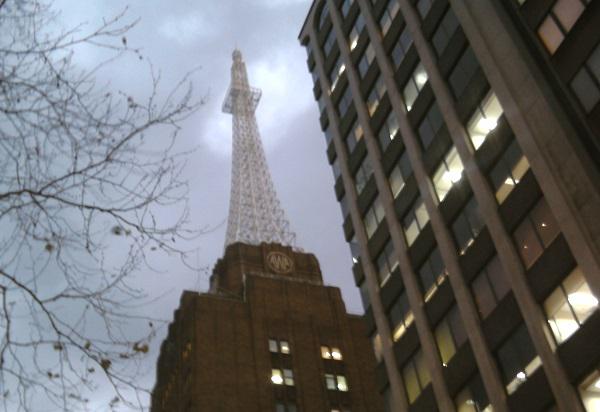
Even the AWA Building has had its neon signs removed by its new owners, the Jupiter's Casino Group. That's just awful.


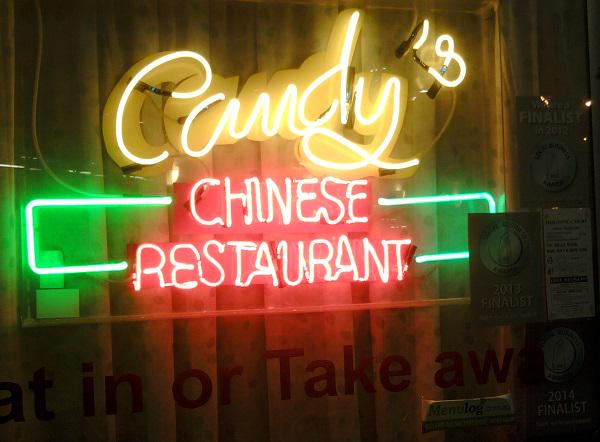
I did find this little piece of joy in Marayong though:


Officially this place is called Marayong Court Chinese Restaurant but to everyone in the known and unknown universe, this place is Candy's.

http://www.marayongcourtchinese.com.au/
If you want excellent Chinese cooking in the heart of New South Wales, you better come to Marayong Court Chinese Restaurant. 
- Marayong Court Chinese Restaurant (Candy's)

Hear that - you better come!
Seriously, their Hot & Sour Soup is second to one (in Central in Hong Kong) and their Fillet Steak Canton Style is excellent. A song of how good a place is is how crowded it is and at the weekend its often difficult to get in the door. Once you find a good thing, do not let go.
I digress.

This is a piece of new neon sign work out in the suburbs. Neon may have been replaced by cheaper and more versatile technology but their replacements aren't icons and the changeability means that when the screen changes to something else and it is gone, and its place remembers it not.
Cheaper and more versatile does not equal better and it does not live long in the memory.

Neon, element number ten, is not the "strange one" or the "lazy one" but the "new one" and neon signs even in the past, look like a future that is still yet to be. Neon is the coolest of the noble gases, the most hard working and it's far more than just noble, it's downright imperial. The Neon Kingdom though is  drawing to a close and that's sad.

September 12, 2015

Horse 1980 - If I Ran the Zoo, In The House On The Hill

There's a man with a plan, in the house down in Canberra,
To rip up the tax code, and tear it asunder.
To remove all the burdens, the small and the great,
To dismantle the workings, of the old welfare state.

The lady who sits, by the man who is yelling,
Would wish for his job, though she ain't really telling.
He struts and he frets, with his graces and airs,
And she sorts the mess out, of Foreign Affairs.

There's a man in the house, who is thinking up lines,
To protect all the workers, down the pits and the mines.
And he's trying so hard, with the message he's sent,
Not to look like a fool, or incompetent.

Now the man from North Queensland, who likes having a chat,
You can tell where he's going, in his oversized hat.
He doesn't like fracking, he thinks they're all moles,
And he doesn't like stores, neither Woolworths or Coles.

There's a man from the north, with his own brand of party,
With a voice that is loud and booming and hearty
And his ideas arranged from the great to the manic,
Like building a dinosaur, or rebuilding Titanic.

There's a weird little man, who looks kind of bony,
Who has a weird little smile, either creepy or phony,
Who's really impressed with his own information,
And charging a fortune for a good education.

A lady with hair like the tail of a beaver,
Who loved helicopters, and used to be Speaker,
She used to kick out, all the louts and the wenches,
But now she's resigned to the party's backbenches.

There's a lady upstairs who sounds really calm,
Who in estimate hearings has suffered great harm.
For the grown-ups as children within the four walls,
Are childish and churlish and give her cat calls.

There's a weird little man, of whom it must be said,
Has schoolteacher glasses and a round baldy head.
He has thousands of books, from the thick to the fibry,
And he places them all in his subsidised library.

The man from the east, an accomplished law reader,
Is the one that we want to be installed as the leader,
He's biding his time, he's aware of his station,
As he plays with the nation's telecommunication.

There's a man up the back who has done it before,
With the nation's accounts and the writing of law.
When all over the world, when the banks were all failing,
Kept our economy on course, with smooth steady sailing.

The lady across from her opposite number,
Says the government's dumb, and it's still getting dumber.
The ideas of her own, are of logic bereft,
And if everyone's right, then she's to the left.

There's a man in the cabinet, who likes a good dance,
Who chats with the Treasurer, on matters of Finance,
He blusters and rants and raves when he can,
When he speaks of economy, and the odd girlie-man.

When the House is alive, with the sounds of the funkys,
And the shouting and hollering and raving of monkeys,
There's a man in the middle, with his one wagging finger,
And they call him the leader, the Member for Warringah.


September 11, 2015

Horse 1979 - Dear Dr Uppington, The One Who Reaps Where He Did Not Sow

Dear Dr Uppington,
I make reference our conversation on Wednesday just past; where you will recall that I thought that your opinion on a certain subject was and is bunk. Please note that I curbed this opinion and brought it to heel because what I actually thought, if aired, would fill the atmosphere with so many four letter expletives (deleted) that there would be so thick with the fug, that one could slice it clean with a bread knife and then place the cubes into discrete wrapped packets.
I think that your opinion is morally bankrupt and equally reprehensible. I shall not give your words the honour of repeating them here, other than to say that because they have not been recorded, the world shall remember them not and they have already dissipated and dissolved into nothingness.
As promised, I shall present the reasons for my outrage in the blog post below.

In the kosmos (that is, the world system in which we live), we have a coupon system for the allocation of good and services. This coupon system has various names upon this planet depending on the country in which those coupons are used but collectively they are together called "money". In our country we call our particular coupons Dollars because of a series of historical accidents and etymological corruptions; derived from a now insignificant village in the Czech Republic.
All money in the kosmos which has ever been generated, is the result of the production of goods and services and all money in the kosmos serves as a store of the wealth therein. It has at various stages in history been represented by tokens made precious metals, or written promises on paper and linen, that are made that a store of these precious metals exists somewhere in the kosmos but ultimately all money is fiduciary in nature and is current and future acceptance is based upon that fiduciary nature and the hope that it can be exchanged for goods and services. The store of precious metals is now largely irrelevant but the fiduciary nature of money still exists and is now based upon the promise that everyone else thinks that it has value.
Furthermore, all goods and services are generated at some point by people's work. Whether this work is performed by machinery, physical toil or is the result of brain power; this truth is inescapable.
People's income is derived from their ability to control the rewards which flow from the production of goods and services but because the coupon system is the same across the kosmos, people tend to forget that the money which flows to them is generated by someone's work at some point. This is our first point of contention.

All money in the hands of an individual is either spent or saved. If it is spent, it is done so to acquire some goods and/or services. If it is saved, unless it is buried in the ground or placed into a shoebox under one's bed, it is placed on deposit either with a financial institution or as direct investment in the capital of a firm. In either case, those saved monies derive benefits in the form of income which is derived from some other person's work. This might sound like a trifling point but this is quite important.

Consider an individual who does not already own their place of accommodation; then consider yourself who by your own admission inherited the impressively fine house in which you live.
A person who does not own their dwelling house must pay someone else for the privilege of keeping a roof over their head. If we think of the case of someone who lives in a mean dwelling and pays $385 per week for that privilege, in a year they will have expended $20,000. Usually someone who has to rent the place in which they live, also has to pay those monies which are derived from their work. Those monies by definition which have been spent, can not be saved and therefore can not go on to derive the benefits which flow as a result thereof. Someone who does not have to pay these monies for their dwelling place, can put those monies on deposit to derive the benefits which flow as a result thereof.
In the course of ten years (if we negate inflation) then the person who has spent those monies has saved precisely nil. The person who has not had to spend those monies, if they put those monies on deposit at a paltry 2% per year, will not only have saved ten lots of $20,000 but they will have derived an additional $23,347.30. The first person who had to generate their monies through real work has somewhere to live but the person who has done zero work, they may have spent the whole ten years watching television for all I know, has effectively picked up an extra year's worth of work for nothing.

I could have used any example where the income gained from invested capital is different to that gained from real world work really but the point is still instructive. Savings reaches a point where it is automatic and the people who derive the benefits thereof, do so without any work of their own. Assuming work itself is virtuous, then those benefits flow not to the virtuous but the invirtuous. If you multiply this across the kosmos and all sectors of the economy, then your theory that poorer people should work harder because that will generate money and that richer people obviously do work harder as evidenced by their incomes, instantly falls to pieces.
If a poorer person wishes to save, then they shall have to scrimp from other areas of their life. Their savings will need to either be derived from working even harder, or from diminishing some other aspect of their quality of life. Whereas the richer person who doesn't even need to work to derive the benefits which flow from other people's work, does not need to work even an iota harder; yet they will still win out in the long run.

I find your disdain of those who need to work harder (and indeed at all) irksome. I don't know if this is because your friends are Lord Puppington, Dame Juppington and Professor Huppington, and therefore you never come into contact with people who do real work but I reject your proposal outright that poorer people are poor precisely because they do not work hard enough. Such a belief assumes from out outset that all people are born into equal circumstances, when clearly this is not the case. Where one stands depends upon where one sits, and if one sits in the languid lap of luxury, one is not going to feel as though they are in a common country or kosmos as one who stands sweating in the service of simoners and so-and-sos.

I reject your fantasy and substitute it with reality. The real world is often grittier and uglier than a dream; please consider how the other half lives within the kosmos.

Yours begrudgingly,
Rollo.

PS:
If you entertain me a while, please allow me to entertain you as well. Some of my best work is done while the cruise control is set to a hundred miles an hour of crazy ranting. If you are driving the rant-bus down the highway of insanity, you don't even need to steer.

Can I just say this? If you are working in the financial sector, you aren't making or selling financial "products". A "product" is a thing that you can hold in your hands or something intangible that you have used skill to create. People working in factories making widgets, gadgets and doodads, sometimes in horrible conditions in developing nations, they're making "products". People in garment factories who sew clothes together are making "products". I'll even go so far as to say that people making incorporeal goods like music, radio programs, podcasts, television shows, videos on YouTube and the like are making "products". But you financial people, people working in banks, investment houses, finance corporations etc. are like me; we provide "services". The difference between most people who make products and provide services and you, oh financial sector, is that you don't even provide a service which generates anything of proper value.

When a bank lends out money, other people in the real world do actual work and repay the original money plus extra that was generated with extra work. You, financial sector, don't do that. You shift the giant pile of money from one place to another while other people do real work and extra work to make the pile bigger and all you do is cream the top off of the pile.
Don't talk to me about how hard you're working because you're not. Other people do the real work and you know it. You have no right to look down on the people who work as front line staff, or the people making widgets, gadgets and doodads, or the cleaners, or the people fixing the machinery of industry, or the people with their hands down in drains all day long because they're cleaning out the gunk and effluent from everybody else, because all of those people are making products and providing services which are more real than your entire sector.

A widget maker can at the end of the day, hold aloft their widget and say "I made this". A shop assistant can at the end of the day, say that they sold 15 of Product X, 3 of Product Y and 22 of Product Z. Even I can look back at the end of the day and say that I've generated a set of accounts, or someone's Income Tax Return. But you, financial sector, can only look at the portion of the pile money that you've shifted and say that you're income came from moving it about a bit.
That's not a widget, gadget or doodad and it's not really a service which produces incorporeal property either. Even the law firm of Dewey, Cheatem and Howe name provides navigation through the shoals of legislation.

The artist, the scientist, the labourer, the tradesperson, the manager, the entrepreneur, the factory worker etc. all expend human effort and human costs in the generation of goods and services. The landowner and the rentier expend no human effort when they rent out their property and you oh financial sector don't even lend out your own property or capital but other people's. You reap where you do not sow.
Oh financial sector, thou vast wen upon the economy, what dost thou do?

September 10, 2015

Horse 1978 - Canning By-Election: Hyper Hype

Many commentators in the media who purport to know about these things have said that the Canning by-election is something of a litmus test for the Abbott Government. I've heard opinions which have said that the result could force a leadership challenge but I fail to see how that would happen. Politics is a far simpler game than a lot of people will admit and this by-election is no different.
The seat of Canning in Western Australia became vacant after sitting member Don Randall was found dead in his car after suffering from a suspected heart attack. Randall who was a member of the Liberal Party had held the seat since 2001 and going into the by-election, a swing of 11.8% is needed for the Liberal Party to lose the seat.

Some have said that the Labor Party has been running a zombie campaign with no real intent for their candidate, Matt Keogh, to be elected but even a quick glance of the facts renders this false. Keogh who was a prominent lawyer, resigned his position as the President of the Western Australian Law Society; that just doesn't seem like the actions of someone whose intent wasn't genuine. Sure, he might just very well walk back into his old job again but the sheer cut and thrust of politics is such that to even make it to be an endorsed candidate and fight through the preselection process means that there must have been more than just a passing fancy in getting the job as an MP. This is serious and to think otherwise is bunk.

On the other side of the great divide, the Liberal Party has put forward a candidate which they think is of blue ribbon quality. As an ex-Army officer, Andrew Hastie is already the sort of candidate which the Liberal Party thinks will be written about in glowing terms. Thee has been a smear campaign which has been run by Fairfax but this hasn't done very much and not could it do so. You just can't fling mud and hope to hit a target if you're aiming at the wrong target.
Since this by-election is more than likely going to be a two horse race (I don't honestly think that the Palmer United Party is going to poll at any more than about 10% of first preferences) then Canning will either be retained by the Liberals or be won over by Labor.
If Hastie of the Liberal Party wins, then the numbers in the parliament remain unchanged. The government still holds a comfortable majority and we can go back to sleep. I don't think that the internal support within the factions of the Liberal Party (and certainly not their National coalition partners) is going to alter by even a single member. Abbott was installed as leader of the party in 2009 and almost won the 2010 election and did win the 2013 election. In the six years which have followed, thee hasn't even been a leadership spill within the Liberal caucus. Why the election of one MP who initially is unaligned within the party would swing the whole caucus of the Liberal Party is totally beyond me. Maybe we would hear the cries of 'spill' and 'havoc' but that would imply that there was someone who was considering challenging Abbott for the leadership of the party and with it the top spot but there hasn't been any indication of who that would be.
If the Labor candidate Keogh, wins the by-election then although this reduces the majority of the government by one, it doesn't alter the current numbers within the factions of the Liberal Party. Again we're faced with the exact same set of circumstances if the government retained the seat.

I'm not convinced that this by-election is an indicator of the result of the next Federal election either. Oppositions almost never win elections in Australia: governments lose them. By-elections almost always contain an element of grumbling by the electorate against whoever is in power; no matter what political colour they happen to be. The default position of a lot of politics is for the electorate to boo politicians generally and I don't see this by-election as any different.
What would be remarkable would be if the Palmer United Party or some other third party candidate won the election. That would very much send a message of rejection of the status quo to Canberra but I think that that's as likely as there being a leadership spill.

Probably Hastie will win and the Liberals retain the seat. More than likely there will be no leadership challenge at all. Most likely is that on Sunday 20th of September, News Corp newspapers will incandescently praise Abbott and rail against Shorten, Fairfax newspapers will grumble against Abbott and weakly make happy faces about Shorten, and the West-Australian which is actually in Western Australia unlike News Corp or Fairfax will devote its front page of the Sunday paper to the gloriousness of the Freo Dockers and the West Coast Eagles. The east coast Twitterati think that the simple game of politics is the only game in town but I bet that even the people of Canning aren't that bothered.

September 09, 2015

Horse 1977 - 2 Is A Good Number

Not quite a month ago our Peugeot 206 decided to throw a timing belt and spear several valves through the top of the cylinder head (see Horse 1961). Such a thing as you might expect is quite expensive and the cost of repairs to the vehicle ended up being worth more than the vehicle itself; at that point the economic decision was reached to dispose of the Peugeot. Au revoir, tu frai des ennuis. Au revoir, oh sourse de la douleur!
The replacement then was going to be either a Toyota Yaris, Mazda 2 or Ford Fiesta. As the race tightened, it was obvious that the Yaris and the Fiesta were going to lose because of their interiors; so we bought a Mazda 2.

The fourth generation Mazda 2 DJ was launched at the 2014 Geneva Motor Show and is the the first 2 to be produced after the Ford-Mazda divorce. To be honest, it doesn't share the same chuckability or absolute positive handling of the Fiesta (which is still in my opinion the best supermini currently on sale) but it has very pleasant handling anyway.
The steering is direct, though I would prefer more resistance through the wheel and there is less pitch than I would have expected. The wheels are jammed right into the corners and so in every circumstance that we've tried so far, which includes some very windy roads with changes in elevation, the car corners pretty well much flat; even at speeds of more than 100km/h.

Where does one take a new car? For anyone living within three hours of the place, the choice is obvious. On the other side of the Blue Mountains from Sydney and in the Central Tablelands, lies a city of about 33,000 people and which is the oldest inland settlement in Australia. In the 1850s the first discovery of payable gold in Australia was made in the area but today it is more reknown for being the location of the most famous mountain in Australia: Mount Panorama.
The motor racing circuit at Mount Panorama is arguably the most revered 6.2km of tarmac in the nation and so should have been the perfect choice to take a photograph of a new chariot, if it wasn't for the fact that Bathurst City Council have rangers patrolling every square inch of the place and there are signs every 40 yards telling you not to stop on the grass verges.


This photograph is on the mountain itself; looking over Bald Hills and off in the distance is the delightfully daftly named Hen & Chicken Rd and the Mid Western Highway which will take you on to Cowra, Young and Wagga Wagga (so good they named it twice).

The plucky little hobgoblin from Hōfu puts out 113 horsies from its 1.5L SkyActiv engine and although I had to bite my tongue and we got the six speed automatic, it comes with a tiptronic option which what I use most of the time. Those 113 horsies are so well behaved and so quiet, that I've already found myself on the wrong side of 120km/h without even really trying or even noticing until the speed warning started beeping at me.
I think that it looks reasonably attractive, though I don't quite like the C-pillar and the narrowish rear windows. The car does tend to present some problematic blind spots but that unfortunate is common across a lot of cars these days. Gone are the likes of the Ford Laser KC with its massive theatre of a rear window.

Driving this car is perhaps not as fun as it could have been but it is incredibly smooth. I like a car which does its level best to shake all of bones from their sockets but Mrs Rollo doesn't; this car feels more like wearing a pair of fur lined slippers than a pair or football boots. It is very comfortable to drive and I fully expect that after 12 hours at the wheel, you'd still be quite happy and fresh. It's happy enough that it invites you to play but it isn't so plush that it feels dead like a Yaris.


Inside it comes with more electronic toys than I've ever seen in a car which makes me a little bit scared but everything comes to hand quite nicely. Details such as the vents and a trim line which runs across the car, reminds me of the sort of thing that you might find in cars from the late 1950s, though I'm sure that if the little 2 was on the roads at the same time as Chuck Berry was on the radio, the people of the time would have thought that a spaceship had landed on earth. The car also has keyless start/stop which I've already been caught out with once; having tried to lock the car with the engine still running.

This is the car which I'll most like have well into the next decade and I think I'm quite happy with it. Sure, it isn't a Fiesta (and sadly isn't a Ford Ka either) but it does everything properly and more than everything I've asked of it. It even comes as advertised with a bit of "zoom-zoom" under the bonnet; so 2 in this case is a good number.

September 08, 2015

Horse 1976 - What Is Australia's Response?

In 2011 the population of Syria was 21.9 million people. In 2015, 4 million have fled to other countries, 7.6 million people have been displaced internally and another quarter of a million people have been killed in the fighting. This means to say that over the last four years, not quite 12 million people have either been killed, have died or have been displaced as a result of the combination of the Assad régime, ISIS and various liberation and other organisations who all hate each other to varying degrees. To say that this is a humanitarian crisis which demands urgent action is to understate the case to many magnitudes or order.
In the light of this, what has Australia's response been?

Australia's default response since the Abbott Government came to power is one of abject cruelty. This has either meant sending asylum seekers to island nations in the Pacific who are I'll equipped to deal with the issue or in some cases it has meant turning boats around and or paying people smugglers to take people back out of Australian territorial waters.
In an international relations sense, it was revealed that the Australian Government asked the US Government to ask Australia if they would like to help bomb ISIS and Syria. The general tone appears to be that of the rhetoric immediately before a state election in that we want to get tough on Syria and we want to get tough on the people fleeing Syria.
It is perhaps fitting that if you were to read through Hansard, you would find that the last time that Tony Abbott used the words "asylum seekers" on the floor of the parliament in any other sense other than to offer condolences, was all the way back in November of 2012. Since then, most speeches that Mr Abbott has made have referred to "illegal immigrants". This is despite the fact that seeking asylum isn't illegal and under the terms of the UN Refugee Convention 1951, there is no prescribed method of entry.

Germany and Austria's response over this last week has been remarkable. German Chancellor Angela Merkel promised that Germany would accept 800,000 refugees from Syria and across Germany and Austria, crowds cheered as asylum seekers and refugees emerged from trains and into communities. In contrast, the Opposition Leader Bill Shorten, has practically pleaded for Australia to increase its intake of refugees from the crisis from 2,200 to 10,000; which is 1.25% that of Germany's. In an act of just bizarreness, PM Tony Abbott declared at the weekend that ISIS was "worse than the Nazis" because the Nazis showed a degree of shame in what they we doing and tried to hide it

In 2013 in a speech to the IPA, Tony Abbott said¹:
"Do unto others as you would have them do unto you” is the foundation of our justice. “Love your neighbour as you love yourself” is the foundation of our mercy. Faith has weakened but not, I’m pleased to say, this high mindedness which faith helped to spawn..." but how is that policy being put into practice?
That last quote "Love your neighbour as you love yourself" which comes from Luke 10 comes out of the parable of the 'Good Samaritan'² when an expert in the law asks the question "And who is my neighbor?". The Samaritans were hated by the Jews and so this parable is very much a provocative story; making use of people's racism at the time. The parallel with today is obvious. Just like the parable, our policy as a nation and as enacted by the current government is the same as the priest and the Levite. We would rather pass by on the other side of the road and do nothing if we can get away with it. It's even better if we can exercise our continuing racist and Islamophobic agenda as a nation because if we can cast asylum seekers and refugees as less than human, we can justify our total apathy towards them. Quite frankly, it's pathetic and if this is how "Team Australia" operates then I don't want to be part of it.
PM Abbott of all people, who was once a youth pastor in a Catholic church should be familiar with the story of Jesus and remember that Joseph, Mary and Jesus also fled their homeland for Egypt because of a barbarous régime intent on the destruction of its own people. If Egypt had closed its borders in the first century, then this story might read rather differently.

Admittedly Section 116 of the Australian Constitution³ expressly forbids the state from enacting laws in respect of religion but I think that as a nation we should be exhibiting love, joy, peace and kindness, to people, irrespective of where they come from and what they believe because against such things there is no law. It seems to me that the only religion operating in Australia with any real force of law behind it is the idiotic worship of the great god Dollar.

It is un-Australian to know the second verse of the national anthem and I used to think that it was because we were collectively apathetic when it came to national pride but now I know better:
Beneath our radiant Southern Cross
We'll toil with hearts and hands;
To make this Commonwealth of ours
Renowned of all the lands;
For those who've come across the seas
We've boundless plains to share;
The truth is that we don't have "boundless plains to share" and if you dare show up at our borders, we'll turn your boats around or send you off to a detention centre on Manus Island.

If we do nothing we will "make this Commonwealth of ours, renowned of all the lands"; indeed we might already be doing that:
Prime Minister Tony Abbott has overseen a ruthlessly effective effort to stop boats packed with migrants, many of them refugees, from reaching Australia’s shores. His policies have been inhumane, of dubious legality and strikingly at odds with the country’s tradition of welcoming people fleeing persecution and war.
- New York Times, 3rd Sep 2015.

What will Australia's response be in the future?

September 07, 2015

Horse 1975 - Looking Round Australia Square

Before I proceed any further with this, I have to say that the photographs in this post are possibly illegal. The fugacious little man with the moustache who told me to leave the building lobby, informed me that we do not have "freedom of panorama" in Australia and that I needed permission from the building's owners if I wanted to take any photographs. Even when I produced a signed authority to do so, this was still above his pay grade and because I didn't want to make a scene, I left the premises.


This eighteen sided cylinder of a building is in my opinion, the most singular building in all of Sydney. Granted that they had to invent building and construction methods as they went along to erect the opera house, Australia Square has both a simultaneously more and less interesting story than the iconic building at Benelong Point.
The first thing of note is the shape of the building. Australia Square is obviously not named that because of the building but of the land upon which it sits. The plot of land is indeed a square and this was the name of the project before a sod of earth was even turned.


The reason for this octadecagonal building has nothing to do with architectural fashion but rather, everything to do with answering a very different question. The concrete from which the building is built is made from cement which comes all from a single quarry; second to that, its also some of the least dense concrete ever used to construct a building. The building is as strong as other buildings but it is far far lighter. The builders, who only had enough cement to make enough concrete coming out of that one quarry, had to make the most efficient use of that concrete. The shape of the building naturally, was decided as a quantity surveying answer to the question of how you get the most building from the available materials. A cylinder is the most efficient shape and therefore, that's the shape they picked.
Australia Square was designed by Harry Seidler (who was also responsible for Blues Point Tower and the MLC Centre) and it was at the time of its construction, Australia's only true skyscraper. By default it was also the tallest building in Australia for 9 years until in 1976, the south building of the AMP Centre stole its crown.


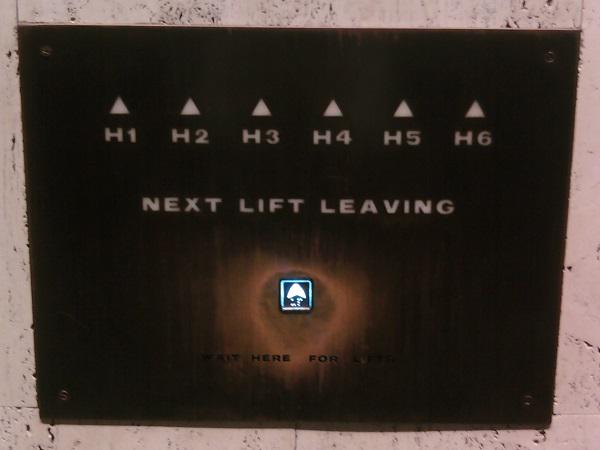
Like a lot of buildings, Australia Square is built around a central chamber that houses the lift shafts, the fire escapes and the water and electrical services. There are 24 lifts, arranged in four sets of six which service four groups of twelve floors. The lifts themselves have a sort of wedge shape and once you step out onto any given floor in the building, it can be really disconcerting because there are no straight lines to speak of inside the building. For instance, you kind of work out that Mrs Banana down on the nineteenth floor is roughly 120° around the building from the direction that you're currently facing but this never really sinks in. A lot of time for office workers in transit around the building is spent walking in what you think is some sector of a pie.


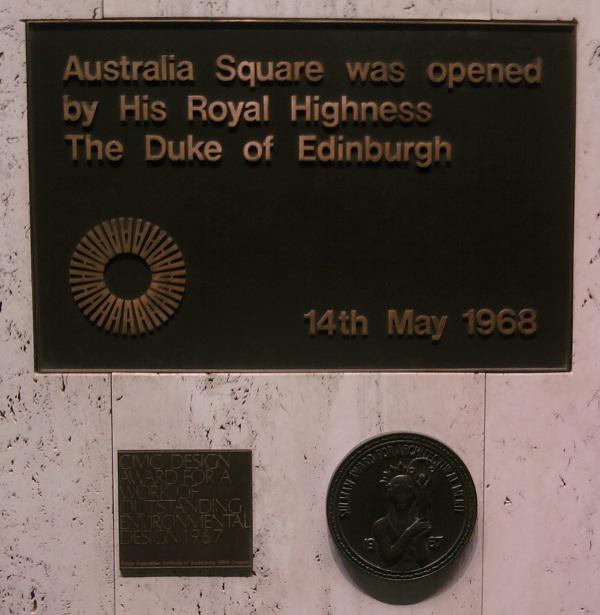
The building was opened by Prince Phillip in 1968 but not before it has already won the Sir John Sulman Medal for architecture as well as a civic award from the Royal Australian Institute of Architects. So much of this building from the fonts on all the lift fixtures, to the strange off form concrete textures in the walls and the ceilings, ties this building to that time before Armstrong kicked the moon.
Australia Square was originally occupied by various government departments including the Commonwealth Department of Housing and Construction and the Department of Defence, which just somehow seems appropriate for this building. I can just imagine rooms of civil servants in the late 1960s and early 1970s, in brown suits and super wide ties; with cigarettes hanging out of their mouths and fag ends in overflowing ashtrays.

In the 1960s when this building was under construction, Australia went from a Menzies Government that had lasted for longer than some people's memories; from a pre-decimal currency, to a Gorton Government but only after having had a Prime Minister accidentally go missing and introducing decimal currency.
The building was designed, erected, finished and open for business and it did so before the Opera House had been finished. From the outset it was as interesting as the Opera House but unlike the great white monstrosity on the harbour front, Australia Square has always been fit for purpose. It works as an office building and almost 50 years after it opened it still looks more modern than many of the buildings which have come and gone in the streets surrounding it.

September 05, 2015

Horse 1974 - Tales From Mosman: The Loveliest Vehicle In The World

I work in the insular and very homogeneously white suburb of Mosman. This is a place which I'm sure is unique in Australia in that the local government area (in this case Mosman Municipal Council) contains only one suburb, where there are no chain fast food outlets within its borders, and where the stereotypical image of ladies walking around with yappy dogs inside their handbags actually exists. There are buses and ferries but no trains and the sight of Mercedes-Benz, BMWs and Audis on the streets is so commonplace that you need something like a Ferrari or a McLaren if you want to turn heads. Things just work differently here.
Mosman is a parochial kingdom all to itself. It wouldn't surprise me if you could be charged with vagrancy for taking a nap in a public park because you couldn't produce the necessary documentation, of at least a gold American Express card and several hundred dollars in cash.

It is 1:30pm on a Friday afternoon and I am standing at a bus stop outside of Mosman High School; waiting for a bus to take me back to the office. Being Friday afternoon, many kids are getting off of school for the week and many are just sort of milling around the bus stop. There is a section of road out the front of the school which has been marked off with traffic cones, which I initially assume is for some dignitary like the Governor or perhaps the local MP who just happens to be the Prime Minister, but I am mistaken.

A group of kids walk out through the front gate and because 80s retro fashion is in right now (kids of Mosman High School do not have a school uniform), they kind of look as though they have been in an explosion at the fluorescent paint factory. Coloured pants in unalluring shades of eye bleed hideousness appear to be in vogue right now and because I am more than double the age of these students and very quickly approaching my curmudgeonly years, I start to wish that the bus comes so that I can get out of there as soon as possible.
Except I don't.
A tired looking man in a tweed jacket and a lady who is also clad in a jacket are holding a sign which reads "Happy 18th Eleanor" (not her real name) and one of these students dressed like a leftover from the 1980s starts to jump up and down and much joy is exhibited. Someone makes a phone call and this is where the fun really begins.

From around the corner a grey BMW 4-Series convertible pulls up and Mr Hyphen-Name (I can only assume that all of these sorts of people have hyphenated names) starts to dangle a set of keys; meanwhile Eleanor starts to throw a tantrum.
"I wanted a white one. I told you to get me a white one. You're so stupid. I hate you."
Please note that this statement is not verbatim, as they actual statement contained at least half a dozen expletives - such a delightful little girl.

As you can imagine, in broad daylight and where the air itself has had blue streaks burned into it, there are many people who are simply staring in stunned silence. The 257 bus to Chatswood arrives and I like about a dozen other people, try to get on as quickly as possible so that we can exit stage left before Eleanor Hyphen-Name starts to drop any more choice bombs.

Suffice it to say, I don't know what it's like to have a $80,000 plus motor car just being given to me as a present. I'm reasonably sure that when I was 18 that if I was given a brown 1974 Datsun 200B wagon as a present, with only one working window and no radio, that I still would have been ecstatic. I'm pretty sure that if I was given a brown 1974 Datsun 200B wagon now, I'd still be ecstatic. I really don't understand the mindset which causes that much rage to build up in someone because the colour, of a convertible that they were given, was wrong. As I said, things just work differently in Mosman.

Human beings have a tremendous capacity to normalise their circumstances. At one end of the spectrum, that includes really horrible conditions such as living through extreme poverty but when you move people into new circumstances the new normal becomes normal. At the very top end of the socioeconomic scale, that normalisation obviously includes a set of expectations which a lot of people would find utterly fantastic. If you were to put Eleanor Hyphen-Name into my house for a week, would she cope? Probably, but I'd doubt she'd be happy about it. I bet that if I were to live in the Hyphen-Name's house for a week, I think it would be like living in a palace.

I have no doubt that when Eleanor finally gets over her tantrum, gets will probably have a really wonderful time. It's not hard to imagine her and her luridly dressed friends driving around on a Friday night with equally obnoxious music blaring from the car stereo, before having the inevitable fight and drama that people like that tend to do.
In that moment though, I just wanted to jam forks through my brain and get as far away as possible and as quickly as possible. I didn’t care how lovely the BMW 4-Series convertible might have been, the best looking vehicle in the world at that point was the 257 bus.

September 04, 2015

Horse 1973 - Puerto Rican "Immigrants"

http://www.pbs.org/newshour/art/sesame-streets-maria-picks-favorite-muppet/
How do you choose a favorite muppet? Actor Sonia Manzano, who has played Maria on Sesame Street for more than 40 years, has some thoughts. Manzano, who recently announced she would not appear on the show’s next season, sat down with PBS NewsHour’s chief arts correspondent Jeffrey Brown to talk about her path to Sesame Street.
In her new memoir, “Becoming Maria,” Manzano talks about growing up in the South Bronx as the daughter of Puerto Rican immigrants. 
- PBS News Hour, 26th Aug 2015.

http://www.foxnews.com/opinion/2015/08/05/cost-olympic-dream.html
My Olympic dream began when I was a kid growing up in the Bronx. It was already a struggle – my parents were Puerto Rican immigrants with little money trying to get by supporting five children.
- John Orozco, Fox News, 5th Aug 2015.

http://www.forbes.com/sites/dougschoen/2015/06/24/kimberly-guilfoyle-shows-us-how-to-make-the-case-for-ourselves/
The advice in "Making the Case" is consistent: value your voice and advocate for yourself. Make the case for your career, your relationships, your health, and crucially, for those who are not able to advocate for themselves.
Kimberly practices what she preaches: a child of Irish and Puerto Rican immigrants, she has risen from working at a deli counter in high school, to law school, to deputy district attorney in Los Angeles, to juggling legal analyst positions on three major networks at four times slots each day.
- Forbes, 24th Jun 2015.

When I see the phrase "Puerto Rican immigrants" in American media, it makes me wonder just how ignorant the writer is. The Commonwealth of Puerto Rico is an unincorporated U.S. territory and all of its citizens are natural-born citizens of the United States just like anyone born in any of the 50 U.S. states¹. Just like any other are natural-born citizen of the United States Puerto Ricans can vote and run for office in any U.S. jurisdiction in which they are residents; provided they leave Puerto Rico.

As Puerto Rico is not a U.S. state it doesn't have a Senator but it does send a member to the U.S. House of Representatives, it's just that they don't have any voting rights on the floor of the chamber.
Puerto Rico is one of those strange things at U.S. law where the constitution only partially applies inasmuch as the courts have ruled that it does apply. In matters of taxation for instance, residents of Puerto Rico are subject to some U.S. Federal Taxes and pay into things like Social Security but Income Tax is levied by the Commonwealth of Puerto Rico rather than the United States.

The really weird thing is that even though almost three years ago, the people of Puerto Rico voted in favour of U.S. Statehood because the Congress is Republican-dominated, nothing has been done with their wishes; probably due to Puerto Rico's mainly Democratic leanings. If Puerto Rico were to become the 51st state, with its 3.7 million people it would have 29th biggest population in the union and probably be entitled to 5 Representatives as well as its 2 Senators. Republicans would hate that.
Puerto Rico's status as a United States' possession was established in 1898; so it's not like Congress has only just recently had this thing to think about.
Just to muddy the waters, Puerto Rico competes at the Olympic Games but the IOC also allows weird things like the British Virgin Islands and Guam to compete and they aren't nations either.

Puerto Rico is about 1000km away from mainland Florida and in the middle of a long chain of Caribbean islands which are part of "Not America" but Hawaii is more than 3800km from the mainland, has 2.3 million less people than Puerto Rico and yet Hawaii was given statehood in 1959 and one of its native born citizens is currently President of the United States. No-one from Hawaii is considered as an "immigrant" if they move to the mainland.

I can't even begin to describe how insanely weird I think that this is. The nearest equivalent that I can think of would be like saying that someone from Norfolk Island (which also doesn't send Senators to the Australian parliament) would be an immigrant to Australia if they moved to the mainland. Norfolk Island has also achieved self government and individuals also don't pay income tax to the federal government but Norfolk Islanders are Australian citizens and to think otherwise is ludicrous.

How you can call someone who is a full citizen of a country an "immigrant" when they move from one part to another, irrespective of the preposterous legal status of that territory, is beyond me. Surely such a thing is more properly termed considered internal migration, not immigration. Naturally this brings me to the rather obvious question of "why call them 'Puerto Rican immigrants' when they're not actually immigrants?" To that end, I don't have any logical answer.

Is this some sort ignorance on the part of news agencies who simply haven't bothered to do the research? I mean it's not like the people of Puerto Rico being given U.S. Citizenship is a new phenomenon. They've had 98 years to have been informed of this. Not even the slowest postal service in the world takes that long.
Is this a case of the news agencies deliberately misreporting truth because they think that their audiences are too stupid to know the difference? Fox News which trades upon the prejudices of its audience might be able to get away with that but can PBS which is supposed to be more neutral?
Is this some hitherto unknown convention that I don't know about because I'm an Australian? Given America's projection of itself in world media, I don't understand why it would want to give the impression to the world that it's just plain dumb.

The phrase "Puerto Rican immigrants" is both incorrect and dare I say it downright insulting to people who are full U.S Citizens and have been for almost a century. I can only think that the media companies feign ignorance here but for what purpose, I do not know.

¹Puerto Rican citizens have been full United States' citizens since 1917 under Section 5 of the Puerto Rican Federal Relations Act of 1917. http://www.legisworks.org/congress/64/publaw-368.pdf

September 03, 2015

Horse 1972 - Vegemite: The Ludicrous Condiment

Apart from the fact that I'm convinced that I was born in the wrong country by historical accident and will support England in every possible sporting endeavour, there are some things where my unwanted Australianess still shines through. Among these are my irrational love of Tim Tams, pie floaters and my defence of the ute as the greatest form of motor car yet devised. Also included though, is my liking of Vegemite, which by all accounts should be inedible.

Vegemite is made from ground up bits of ISIS, crude oil, mashed up and strained penguins, treacle, hatred, tar, charcoal, liquefied rubber and spent brewer's yeast. It has roughly the same consistency and viscosity as Silastic and a taste similar to salted bile. Vegemite is nasty nasty stuff, which unless fed to children before the age of 8, remains as unpalatable and inedible as a plate of cold sick (not that warm sick is edible either for that matter).

I was sat sitting in a coffee shop with a client of ours who wanted to take me out of the office and into a warm, upholstered place, when two bits of toast came out that were super thick and cut into 'soldiers'. I have to say that that thin layer of Vegemite which was scraped over the toast like children's chalk on the pavement, was thirteen kinds of deliciousness, when it had no right to be. On one hand I had a cup of coffee which was made by some Italian company and supposed to be the height of sophistication and on the other, I had a piece of toast which was covered in a substance which can be found (or should be found) in every pantry in the country. Vegemite is no respecter of class or income. Some would call that egalitarianism but the truth is closer to ubiquitousness.

This is an enigma wrapped in a riddle; wrapped in a conundrum; wrapped in a puzzle; wrapped in baked goods. There is no logical reason why this black sludge, the scrapings from the bottom of the barrel of the fermented drippings of Hades should taste so wonderful and yet it does. The fact that Vegemite doesn't really have an expiry date should come as no surprise to anyone. I bet that after we've all wiped ourselves out in a nuclear war and we've twisted the dragon's tail to the point where nuclear fire has rained down upon everything and destroyed all life on this planet as we know it, that all the jars of Vegemite in the world will still pass food safety standards and be fit for consumption by a race of people who no longer exists. Forget the cockroaches, it will be Vegemite which goes on to outlive us all. If we wanted to leave a record of ourselves in the universe, we should have just put a jar of Vegemite on Voyager 2; that way in 10,000 years when it meets up with some alien race, they'll conclude that we were all hard as nails.

I can understand a British obsession with toast an marmalade because there isn't very much which isn't improved by citrus and the French practice of adding herbs and garlic and olive oil to a lovely piece of crusty baguette is obviously something which has been honed over years of collective experience but Vegemite? Nope. That's just irrational. Even Vegemite's British cousin Marmite has had in its advert campaigns that you either love it or loathe it; at the point you're admitting to the public that great swathes of the population are going to be annoyed by your product, you know you're dealing with weapons grade insanity. Yet here I am extolling the virtues of a product which most of the world, quite rightly, thinks is both weird and strange.

Something as sweet as honey would be sensible this early in the morning and there is something to be said for the utility of peanut butter. Nutella can be put on toast but there isn't anyone alive who has the ability to show adequate restraint when it comes to Nutella. Nutella is best eaten directly out of the jar and the correct amount of Nutella to eat is "more". Vegemite isn't like that.
The famous advert says "We're happy little Vegemites; as bright as bright can be. We all enjoy our Vegemite for breakfast lunch and tea." Clearly this was written by a moron. Unless you happened to be some extreme fan of toast, I can't even begin to think of what context, or even how such a thing would even be possible. Maybe you could use Vegemite as some sort of additive for stocks and soups but otherwise the song is just spouting gibberish. No sane person would think about eating a tablespoonful of the stuff in one go; not even our onion eating Prime Minister would think about that. Vegemite is its own moderator of temperance and I can think of very few things in the world like that. People who don't like Vegemite are usually those unsuspecting souls who have eaten vast globs of the stuff in one go because they weren't told in advance of the nature of the beast; even Mrs Rollo has been converted by its salty wiles, which either indicates that her Americanism is fading with time or that Vegemite is so Australian that it swamps all common sense.

Therein lies the riddle that is Vegemite. It has every right to be horrible and it isn't. It should by logic be disgusting and it isn't. The product of an American corporation like Kraft Foods is one of the most Australian things that anyone can think of and its very existence is so baffling that not even common sense can be applied to it. I wouldn't have it any other way.

September 02, 2015

Horse 1971 - There Will Not Be Blood

Passersby were amazed by the unusually large amounts of blood.
- The Onion's "Lorem Ipsum" Text.

Commentators in the media have suggested that the upcoming by-election for the Western Australian seat of Canning is going to act as some sort of bellwether for the next Federal election when that is finally announced. I have even heard the theory that if the Liberal Party wee to lose the seat, then this might be the trigger for some sort of leadership spill or a cabinet reshuffle. Everyone from the Prime Minister to the Treasurer, to the Foreign Minister and even the Minister for Immigration have had hints hurled about in the media that their jibs are on the line, when no such indication has come out of the Liberal Party at all. There has been so much speculation in the media that we'd be well advised to collect a mop and bucket to clean up the mess on the floor. Somehow I just don't think so. You can leave your mop and bucket in the cupboard because no blood will land on the floor and there won't be a leadership spill either.

The so called "broad church" of the Liberal Party isn't as obviously split left-right as the Labor Party (and that's even before you talk about their coalition partners, the Nationals). There are members who deviate to the north and south on the Authoritarian/Libertarian scale as well as those who deviate to the left and right economically. Under someone like Robert Menzies or John Howard who had a sufficiently large enough personality to lead all the factions from central position that just isn't a problem but as Dr Brendan Nelson and even Malcolm Turnbull found out, once the party coagulates then trying to split the factions is mostly impossible.

During the last major leadership challenge (which was as long ago as 2009) which ousted Turnbull and installed Abbott, Joe Hockey found out that he had a reasonable amount of support at the time. He also learned that the forcefulness of Abbott's personality was too much though and he had to fall in line behind.
This is what the public almost schizophreniacally denies. By most measures, Abbott is usually less popular than most other potential leaders of the Liberal Party, yet because under a Westminster parliamentary system of democracy it is the party or groups of parties which come together to form government, their opinion matters nought. Under a Westminster system, the Sensible Party could win government and still appoint Dr Filthy McNasty as Prime Minister and thee wouldn't be a single thing that the electorate could do about it.

Sitting governments in Australia tend to be far more stable than oppositions. The average tenure for a Prime Minister in Australia is up around 49 months but the Leader of the Opposition can expect to spend only 31 in that job. The reason for this is obvious. Parties in government are by definition larger than those in opposition; so the factions which exist are also larger and the margins also tend to be larger. Parties in opposition are by definition smaller and the margins which determine who becomes leader are also smaller. The only real task of an opposition apart from the usual rough and tumble within a parliament is to win back government. To that end, changing the leader if it means that the party is more saleable to the public is highly advisable.
Also, in the period immediately following a general election there is a tendency for leaders to spontaneously resign. Either a former Prime Minister will resign because they have proven that the public doesn't like them or Opposition Leaders who have taken the party to electoral failure will feel a sense of disappointment. Prime Ministers do not suffer from this because they have obviously won. The only time that you're likely to get a sitting Prime Minister removed from the top job is either after a long period of government or during a period of massive internal instability. The Liberal Party as it stands, has neither of these. This is still the first term of the Abbott Government and the party shows no obvious signs of instability either. Hockey's position as Treasurer is also quite safe as well because unless he intends to launch a leadership challenge, which he has shown no indication of doing so, then unless there's some other major hitherto unknown reason why there should be any change at the top, then I expect that the entire cabinet will look exactly the same going into the next federal election as it does not.

September 01, 2015

Horse 1970 - Operation Forty-Toad

If you are in charge of a government that wants to do something either hideously unpopular or which is seen as cruel by a great deal of the population, what do you do if you intend to do it anyway? If you are going to do something which is going to cause pain, like remove someone's kidney without their permission, then maybe you can hit their thumb with a hammer. That way, while they're worried about their thumb, they might not notice that their kidney is gone.

Within the same week that German Chancellor Angela Merkel was announcing that Germany would take up to 800,000 refugees, the Abbott Government in Australia was in damage control after the Australian Border Force had announced that under Operation Fortitude, it would stop people on the streets of Melbourne and demand to see their visa papers and or passports. The announcement was made early in the morning and by mid-afternoon, there were so many protestors at Melbourne's Flinders Street railway station that the operation was cancelled. Never before have we seen an agency backpedal so furiously that they'd burnt out the tyres on their bicycle in less than one day. Of course the Immigration Minister Peter Dutton was nowhere to be found as he was mysteriously 'sick' and the Prime Minister Tony Abbott tried to lay out the excuse that it was just a badly worded press release even though the intent was absolutely obvious.
How did we get here?

The problem that the Abbott Government has at the moment is that they are at least six months away at the earliest from an election and that at the bare minimum they will have to do some governing in the interim. Usually that wouldn't be an issue but they've come to the point in the election cycle where governments start to get judged for their actions and they've realised that the electorate has memories.
The first six months for a government are usually the best because they can do the big ticket items and sound the fanfare of how wonderful they are. Every new government will also get a chance to crow about fixing the mistakes of the previous government and then there are those symbolic gestures which cost practically nothing but look as if they are fulfilling promises.

In 2013 the Abbott Government was elected on a visible platform of 'not being Labor' and of Tony Abbott 'not being Kevin Rudd or Julia Gillard', as well as the three word slogan to 'stop the boats'. Unfortunately in 'not being Kevin Rudd or Julia Gillard', Tony Abbott has been Tony Abbott, which is fine if you happen to be the Leader of the Opposition but isn't exactly the most positive of policies if you are the Prime Minister. The policy of stopping the boats whilst it has worked, has come at the price of looking extremely cruel. When you start shipping refugees off to nations with populations which are smaller than a concert hall, or when there are reports of refugees sewing their lips together in protest of being stuck somewhere for years with no obvious plan to be moved, or when you start towing boats back into open seas, it all just comes across as being a bit extreme. Then if the same government department which is in control of enacting those policies, suddenly announces a domestic policy which resembles that of a police state, the population then starts to get very worried.
Governments generally turn to a 'get tough on crime' policy footing before an election because it usually involves the loudest and most visible set of announcements for the least amount of effort. Border Force was one such announcement because it took an existing set of workers, clad them in shiny new uniforms and then employed them to do roughly the same thing. Now I would argue that having a paramilitary presence on the streets of the CBD of a major city is all kinds of crazy bonkers but I'm not entirely sure if it was sinister of itself. This smacks to me of a government which has thought to itself 'we need to be seen to be doing something; this is a thing; therefore we need to be seen doing this'. Yes it is crazy bonkers but arguably it has done its job because it is visible and for the least amount of effort.

If you look at a lot of policy which was supposedly been tossed about in the last week such as starting a debate about the republic, they were ostensibly about making noise without doing anything. Even talk about Joe Hockey supposedly being cautious about his job as Treasurer, I think was mainly about making a noise to distract from the previous noise generated by the Border Force farce; for the least amount of effort. Leadership speculation can generate lots of column inches in newspapers and mindless chatter on radio and television, without having to do anything of real value.

When it comes to serious policy such as altering the GST and Income Tax rates, by making as much noise as they possibly could, the Abbott Government has created a very nice diversion. For a couple of days the Australian electorate was too busy watching the shiny thing to notice anything else; I wonder what sort of deals were made in the background.