Who could see that coming from twenty miles away? If fourteen million people all try to log onto a website at once, then of course it's going to crash; even Blind Freddy can see that. Or rather, Visually Impaired Unnamed Person because he refused to give his name in an act of subversion.
Census 2016 will be remembered for a very long time as the night that the website collapsed and the people revolted.
I can understand the sort of paranoid hysteria that flew around in the run up to the census, where people either didn't want to put their name on it, or simply refused to fill it in altogether because human nature hasn't changed in thousands of years and people can always be made to be afraid of the "other"; especially when that other can be dehumanised and there's nothing easier to dehumanise than government bureaucracy. In this case, the existential threat is that governments once they have collected the data, might match it with other data that they already collect and then use it for nefarious purposes unknown. Never mind the fact that some of the most savage regimes which have ever existed, didn't need to collect data before they carried out their plans. Stalin, Pol Pot and Hitler (Godwin's Law invoked!), all carried out their terrible trail of destruction with the help of ordinary citizens and they never needed to collect data or carry out a census to do that.
I think that it takes a monumental leap of imagination to think that the government is going to use the data to round up people based upon their ethnicity, race, religion or nationality. In all cases where governments have done this type of thing, there had already been a prevailing level of animosity and hatred towards these groups of people by these governments and it's not like a mere census magically gave them the keys to the murder machines. Besides which, most prejudices, discrimination and vilification that people face are from other people and that's based on direct contact and not census data.
I don't know who all the wingnuts are that think that the government is carrying out some sort of terrible conspiracy but as we saw last night, the Australian Bureau Of Statistics couldn't even make one website work for one night; I don't know what they think that that same government entity might do but the evidence suggests that this is the most incompetent conspiracy ever.
As for myself, I have no problems whatsoever with giving details about myself to the government. What is the worst that they could do? Oh no, there's been a 195% increase in the number of children who were born in the area. Quick, we'd better build an evil evil government school and baby health care centre before anyone notices! Argh, this suburb is now full of older people. It would be such a tragedy to close down neonatal clinics and replace them with renal care facilities, wouldn't it? Who's going to stop this evil evil provision of services, based upon changing demographics? Man the harpoons! Let's just run from side to side like brainless sheep, shall we?
In theory Australia is a country of 24 million people. I say in theory because if 24 million people all suddenly decided to not give their details in the census, then how is the government expected to know?
As far as I can make out, the only people who really need to worry about the census, are those people who intend to carry out some nefarious project in the future. If you're not doing anything wrong then you really have no need to fear a benign and demonstrably incompetent government entity.
I for one quite like the fact that the British Government has been collecting people's names and addresses for well over two centuries. It means that if you do happen to be compiling something like a family history, then you can follow the fortunes of people in the past as their circumstances changed. The television program "Who Do You Think You Are?" regularly illustrates this as it often shows people's details from censuses of long ago. In contrast, Australia which hasn't been collecting such details, has no facility to do this at all. The best that we can hope for is to look at electoral rolls and guess at someone's life based upon what the average demographics of that electorate happened to be at the time.
As far as I'm concerned, the census in addition to providing a useful snapshot of the nation so that governments can make planning decisions based upon what currently exists, that same snapshot is useful long after we've all taken the eternal lie down and appear as a name on a lump of rock and no more censuses.
Aside:
#CensusFail in 2016 provides me with two of the best arguments against electronic voting.
Firstly, that if people are that concerned with governments collecting data by computer, then why should they trust those same governments to conduct fair elections by computer?
Secondly, if a nation of 24 million people all trying to log onto a system for the census can make it crash, what makes anyone think that an electronic system for running the election (which must be conducted in one day), is not going to crash? If you weren't able to do the census last night, then you still have about a month to complete it. If people en masse couldn't Lodge their vote in an election, then not only does that mean that the election gets mucked up but as we saw in Florida in 2000 with the "hanging chads" the very fate of the election itself can have national implications.

August 10, 2016


August 09, 2016
Horse 2150 - Vincent Van Gogh Pun Run
You may have heard of the rather famous painter Vincent Van Gogh, who among other things is known for his peculiar ear complaint but did you know that he was just one of a whole host of interesting people who were all just as colourful as he.
His aunt Flamin Gogh - moved to Florida to take up ornithological studies of large pink birds.
His cousins Grin Gogh and Amy Gogh - decided to go to Mexico and became a popular comedy double act.
His sister Chica Gogh - moved to Illinois, where she had a long and successful career on the stage and played music in blues clubs and all that jazz.
His nephew Wells-Farr Gogh - was going to live with his mum Chica but got a job as a stagecoach driver and eventually ended up in California.
Wells-Farr's first son Bendi Gogh - was living in California with his father but failed to strike it rich in the gold rush in 1849. When he heard about gold in northern Victoria, he decided to seek his fortune there.
Wells-Farr's second son Key Larh Gogh - didn't do well in California and headed to Florida where he became a shrimp catcher.
He had a fall out his brother Yuu Gogh - who moved East and ended up in Sarajevo. Eventually his descendants would start a motor company.
Yuu would eventually marry a Thai lady named Tanh Gogh - who was an excellent ballroom dancer.
They had a son who they named Fandangh Gogh - who followed in his parents' footsteps.
Yuu's grandson, who was named Pokkimonn Gogh - made an absolute fortune from developing games for mobile devices.
Their daughter Manh Gogh - didn't pursue a career on the stage but went on to run a tropical fruit farm.
Vincent had two younger brothers. The older one, called Whiskiahgo Gogh - moved into the nightclub industry and set up shop right on Sunset Strip West Hollywood, California.
Vincent's younger brother Quan Gogh - hated that sort of iniquity and got a job in a semi government related entity.
Vincent of course didn't follow in the family business. His father Carr Gogh - ran a very successful haulage business.
His first uncle Drohn Gogh - stubbornly refused to give up the old ways of doing things and continued to run a delivery business using donkeys and drays.
His second uncle Bonh Gogh - played some loose skinned drums in a very cool beatnik skiffle band.
Unfortunately for Vincent Van Gogh, he only sold one painting in his lifetime and it was reported by his brother that before he committed suicide after being plagued by mental illness that "The sadness will last forever".
August 08, 2016
Horse 2149 - Ten Things I Like: No.7 - I Like Big Orchestral Music
As I am sat sitting on the 06:49 train to the city, I am wearing a pair of Hub brand headphones which I bought from Woolworths for the grand total of $7. The irony isn't lost on me at all as I have just literally heard the theme tune for "A Fistful Of Dollars", then the theme tune for "A Few Dollars More" and am currently listening to the theme tune for "The Good, The Bad And The Ugly".
Elsewhere in this folder are Mason Williams' "Classical Gas", the theme of "The Magnificent Seven", Grieg's "In The Hall Of The Mountain King" and the Imperial March from "Star Wars". They're all big bold, massive pieces of music that are probably all scored in C Major and they all demand that the sound level gets turned up to the threshold of pain.
People who listen to rock music already know that the only proper way to listen to it is to turn the volume up to the point where the windows start to shake and your ears begin to bleed. Douglas Adams wrote in the Hitchhiker's Guide to the Galaxy Trilogy (of 5 books) about a about a rock band called Disaster Area who played their instruments remotely from a spaceship and the best way to listen to their music was to listen from an underground bunker on the next planet. All I can say is that that's loud enough; bring it on.
Sheer loudness isn't the same as bigness though. I think that one of the proofs of this will be in the year 2066 when through the great filter of time, the vast majority of dance music which is currently played in nightclubs will have long since been thrown into history's memory hole; never to be heard again. Even a one hit wonder like Pachelbel's Kanon dur D Minor manages to infect music a couple of centuries later.
Movie makers have long known of the power of a good soundtrack; the Academy even awards Oscars for Best Score and Best Soundtrack in films. My personal favourite examples of when music has been used so perfectly in movies actually both come from the same film. It took someone with a mind like Stanley Kubrick to use an otherwise forgotten "And So Spake Zarathustra" and Johann Strauss' "On The Beautiful Blue Danube" and marry them to the vision of spacecraft in flight. It wouldn't have even been possible for Strauss to imagine such a thing and here I am almost fifty years on the other side of the film and I can't imagine it any other way.
It is little wonder that the movie houses like Disney and the Warner Bros employed the use of orchestras for the use in something as frivolous as cartoons. Disney always knew that he was making pictures which would outlive him and let's be honest, Fantasia is still probably the most rewatched movie where there isn't an overarching plot. I can guarantee that almost nobody will know the name of the piece "The Merry-Go-Round Broke Down" but I bet that virtually everyone in the west who was born between 1930 and 2000 can hum its main theme as a result of watching Warner Bros cartoons.
Of course sport often conscripts big pieces of music for its cause. Both the Olympic Games and the European Champions' League have their own fanfares and they easily rival something that you might hear at the coronation of royalty. Mind you, if your mottos are "Citius, Altius, Fortius" and "Die Besten, Die Mannschaft, Les Grandes Equipés, The Champions", then it's safe to say that you have tickets on yourself and will sell tickets for your event at prices which could be described as equally as impressive.
The people of Australia who have heard the message that "a hard earned thirst needs a big cold beer and the best cold beer is Vic", during those scorching summers where the cricket is on the telly on Channel 9, have probably internalised the theme tunes from "The Magnificent Seven" and 1970's cop drama "Bluey" without being aware of the existence of either.
More mundanely, in a survey which decided the most popular advertisement in Britain of the twentieth century, the winner was an advert for Hovis bread; in which a kid walks his bicycle to the top of a hill in Yorkshire to deliver a loaf of bread and then rides back down again. I don't think that this can be explained by any other factor than the soundtrack was an excerpt from Dvorak's "Symphony For The New World". It's strange to think that what people remember from an eleven minute behemoth of a thing, is a one minute slice.
There's something visceral about playing a massive soundtrack over the mundane things of life. You might get a great deal of happiness from listening to your favourite songs while out in the car but start playing something like Holst's "Mars: The Bringer Of War" and even the smallest of cars suddenly feels like you are driving the starship Enterprise (NCC-1701) and the RMS Queen Mary rolled into one.
Start driving down the motorway with "The Dambusters March" on the car stereo and instead of just an engine with the cubic capacity of less than a bottle Coca-Cola under the command of the right foot, you suddenly have the power of RAF Bomber Command.
There is a far more practical reason why I like big orchestral and instrumental pieces of music in particular and it's the same reason why I can't listen to the radio or television and read at the same time. The part of my brain which is responsible for speech can only deal with one stream of input at a time. I am not cursed with an internal monologue which needs to speak every written all as I read it but nevertheless I still can not cope with both. Music invades a separate part of the brain and that means that I can turn it up loud and proud and not have it interrupt anything as I work or write.
Besides which, if I'm looking at a bunch of people who are milling around and waiting for a train or something, I can change the soundtrack for my own amusement. That might include Rezső Seress' "Suicide Song", Satie's " Gymnopédie No.1" or even more of The Blue Danube, then that's better than listening to that infernal song by Beyoncé that I've heard coming out of someone's headphones that I still can't be bothered to work out what it is. I think it says "All the single lettuce" but I really don't care.
August 06, 2016
Horse 2148 - Senator Malcolm Roberts Hates 18C But Probably Doesn't Know What It's For
Let me open this by saying that I like the idea of free speech. It is a good and reasonable thing that people do have the right to disseminate and publish their ideas; no matter how unhinged they happen to be. Free speech, which should also include the right to assembly and to petition the Government for a redress of grievances, is the sign of a functioning and healthy democracy.
Hand in hand with the idea of the right to free speech, comes the right to be judged upon that same speech which has disseminated and published.
New Senator Malcolm Roberts, I can forgive for looking clumsy when it comes to issues such as free speech but as someone who has the responsibility of making laws for this country, I will exercise my right to judge what he has said.
http://www.abc.net.au/news/2016-08-04/final-senate-make-up-confirmed-with-11-crossbenchers/7689788
We need people to speak up freely and deliver what they really believe and yet they get slammed for that, I'm looking at [section] 18C under the Racial Discrimination Act — that needs to be addressed because that is curbing free speech.
When we have free speech curbed, it means we don't talk about the real issues — tax, Islam, terrorism, the economy.
- Senator Malcolm Roberts - as reported by ABC News, 4th Aug 2016.
Personally I think that this sounds nuttier than a packed of mixed nuts owned by Nat Nutt. I agree that having free speech curbed means we don't talk about things like tax, Islam, terrorism, the economy and whatnot but none of these things are even remotely connected with Section 18C of the Racial Discrimination Act.
To remind you, Section 18C of the Racial Discrimination Act provides that:
http://www.austlii.edu.au/au/legis/cth/consol_act/rda1975202/s18c.html
Offensive behaviour because of race, colour or national or ethnic origin
(1) It is unlawful for a person to do an act, otherwise than in private, if:
(a) the act is reasonably likely, in all the circumstances, to offend, insult, humiliate or intimidate another person or a group of people; and
(b) the act is done because of the race, colour or national or ethnic origin of the other person or of some or all of the people in the group.
- Section 18C, Racial Discrimination Act 1975
I think that's fair enough. The explanatory note says Subsection (1) certain acts unlawful. Section 46P of the Australian Human Rights Commission Act 1986 allows people to make complaints to the Australian Human Rights Commission about unlawful acts. However, an unlawful act is not necessarily a criminal offence. I think that's also fair enough.
Section 18C of the Racial Discrimination Act provides a solidifed pathway to seek remedy if someone has acted, disseminated or published something whilst exercising their right to free speech. There have in the past, been helpful opinions on what free speech is and is not at law as well:
"'Free' in itself is vague and indeterminate. It must take its colour from the context. Compare, for instance, its use in free speech, free love, free dinner and free trade. Free speech does not mean free speech; it means speech hedged in by all the laws against defamation, blasphemy, sedition and so forth; it means freedom governed by law."
- James vs Commonwealth of Australia 1936¹
That's a very interesting and important turn of phrase, that: "governed by law". James v Commonwealth eloquently says something which is common to all of legislation; that by its very existence all legislation imposes limits to absolute freedom.
Common Law which had been refined for about 500 years to that point, had long since come to the conclusion that not only did the law apply across all of the realm (hence the reason why it was called "Common") but the thirty years which immediately preceded it had also demonstrated that the law applied even to the highest office in the realm - the king. The Bill Of Rights Act which arrived in English Law in 1689, had come after the execution of King Charles I, the English Civil War, the period of the Commonwealth which was rule by Oliver Cromwell and then his brother Richard as king in all but name, the restoration and then the so-called Glorious Revolution in which William of Orange was installed as king.
Consider the right to bear arms as contained within the Bill Of Rights Act 1689:
http://www.austlii.edu.au/au/legis/act/consol_act/bor16881wams2c2306/s7.html
That the subjects which are protestants may have arms for their defence suitable to their conditions and as allowed by law.
- Section 7, Bill Of Rights Act 1689
Again we see the phrase "and as allowed by law" but it's worth remembering what sort of allowances that the law made at the time and for whom. There are quirks of law which make it allowable for the universities to defend themselves with swords for instance. Estate owners in the 1680s still faced the prospect of wild foxes destroying their livestock. The idea of modern policing wouldn't arrive for another century and a half; so the military was the de facto and default police force. It would have been entirely inappropriate even in 1689 for wide swathes of the population of the cities like London to be armed with guns and so regulations with regards firearms followed reasonably quickly.
The people who framed the Bill Of Rights Act in 1688, would have been well aware of the chaos which had rocked England to the core and so the law was designed to act as a hedge against future chaos.
The Bill of Rights which was tacked onto the end of the United States Constitution, had faced opposition to its existence before it had been approved. The right to bear arms as currently worshipped in the Second Amendment says the following:
Thanks to 227 years of manipulation by the US Supreme Court and various lobby groups, the words "well regulated" now only seem to be applied to a militia (which doesn't exist) and any attempts to impose any sort of sane regulations, even in the wake of cases like 20 school children being destroyed, or 50 people being shot to pieces and destroyed at a nightclub, are quashed in the name of freedom.
Intriguingly, one of the most influential framers of the United States Constitution, Thomas Jefferson wrote to James Madison that:
But persons and property make the sum of the objects of government. The constitution and the laws of their predecessors extinguished then in their natural course with those who gave them being. This could preserve that being till it ceased to be itself, and no longer. Every constitution then, and every law, naturally expires at the end of 19 years. If it be enforced longer, it is an act of force, and not of right.
- Thomas Jefferson to James Madison, Popular Basis of Political Authority, 6th Sep 1789
This indicates that even they thought that law should change to reflect its circumstances. Having said that, Jefferson also write that:
Let them take arms. The remedy is to set them right as to facts, pardon and pacify them. What signify a few lives lost in a century or two? The tree of liberty must be refreshed from time to time with the blood of patriots and tyrants. It is its natural manure.
- Thomas Jefferson, Letter to William Stephens Smith, 13th Nov 1787
It's comforting to know that the blood of those 20 children who were destroyed at Sandy Hook, was a just price to pay for people's freedom. I hope that people like the NRA remember that they equate the blood of children with natural manure.
I digress.
18C exists as a hedge against injury which is caused by what people have published. The Bolt case, which is perhaps the most famous case brought under the legislation illustrates the need for 18C's existence rather pointedly.
Broadly speaking, the nature of her complaint is that the articles conveyed offensive messages about fair-skinned Aboriginal people, by saying that they were not genuinely Aboriginal and were pretending to be Aboriginal so they could access benefits that are available to Aboriginal people. Ms Eatock wants the law to address this conduct. She wants declarations and injunctions and an apology from the Herald & Weekly Times.
- Eatock v Bolt, Federal Court of Australia (2011)²
As far as I can make out, the only reason why Section 18C ever rose to fame at all, was because of the Bolt case. Precisely because Andrew Bolt was an employee of The Herald and Weekly Times Limited and he lost, it meant that The Herald and Weekly Times Limited, the rest of News Corporation, their friends at the Institute of Public Affairs and the Liberal Party, had a giant cuddle puddle pile on. It is precisely this example which illustrates why Section 18C needs to exist.
Bills of Rights are about a population asserting a desire not to suffer injury because power has been exercised by the powerful. The hope of a bill of rights is that by giving power to the previously powerless, that a new balance is established. Legislation though, is almost always about either restricting the power of the powerful or regulating society into some sort of manageable order.
Courts exist to interpret law and decide what is fair and just based upon their interpretation of that law; be that the law of equity, common law, statute law or constitutional law. Courts themselves are bound by law and employ tests to prove the worthiness of the cases that are set before them.
If you're having your name dragged across a newspaper and media network as large as News Corporation's, then it's kind of obvious what sort of injury is caused to someone's reputation as a result of that.
The esteem in which he is held, or the goodwill entertained towards him, or the confidence reposed in him by other persons, whether in respect of his personal character, his private or domestic life, his public, social, professional, or business qualifications, qualities, competence, dealings, conduct, or status, or his financial credit ...
A person's reputation may therefore be said to be injured when the esteem in which that person is held by the community is diminished in some respect.
- Radio 2UE Sydney Pty Ltd v Chesterton, High Court of Australia (2009)
When it's a matter for the courts to test and find out, to what material degree that the injury occurred and whether or nor a remedy should be instructed. This is a useful thing to look at because it admits in principle that injury doesn't have to be physical and spells out the kind of tests which are used in such cases.
If someone advocates for the removal of any piece of legislation, immediately I begin to question why. If somebody wants something then what is my motive driving the desire? It's all very well to yell "free speech" but when the ability to publish anything is so widespread, then it is deeply dishonest to claim that it is merely about a right to be heard. If you are specifically talking about a desire to remove a hedge on the ability to publish material which is racist or to remove all possible remedies to the injury caused by the publication of racist material, then the only conclusion that I can draw is that that person either wants to be openly racist and cause harm and injury or the just don't want to be held responsible for any injury that they have caused as a result of clumsy negligence.
When a political group like One Nation spruiks its desire to remove the hedges to the remedies of racist material, then what other conclusion should I draw other than they have a desire to be racist? When Pauline Hanson stood up on the floor of the Parliament in 1996 and declared that we were in danger of being swamped by Asians, then that indicates to me that at least then, that conclusion was likely to be true. I note that the new designated target has moved on to Islam. The problem is that Islam as a religion, not only isn't covered under the proivisions of the Racial Discrimination Act, Section 116 of the Consitution prohibits the Commonwealth from imposing any religious observance, or for prohibiting the free exercise of any religion.
In the words of Senator Malcolm Roberts, we do need people to speak up freely and deliver what they really believe. They also need to be slammed for that if it happens to be just plain stupid, or in this case with regards Section 18C, completely irrelevant to the legislation.
¹http://www.austlii.edu.au/au/cases/cth/UKPCHCA/1936/4.html
²http://www.austlii.edu.au/au/cases/cth/FCA/2011/1103.html
³http://www.austlii.edu.au/cgi-bin/sinodisp/au/cases/cth/HCA/2009/16.html
August 05, 2016
Horse 2147 - The Trolley Problem, The Law And Me
I saw something on the telly, recently which yet again made use of that Philippa Foot's 1967 though experiment the "trolley problem"; yet again, I though to myself that it was a load of tosh.
For those unfamiliar of what the "trolley problem" is, it runs something like this:
Supposed that a runaway tram is heading down the track towards a group of five people. Now suppose that in between the runaway tram and the group of five people, is a set of points. If you pull the switch, the points move and instead of killing the group of five people, the tram moves onto a slip track where there is an unsuspecting worker who will be killed instead.
Do you pull the switch?
In this version of the problem, most people would say that they would pull the switch and move the points; thus sending the trolley onto the siding and killing the one worker, rather than the five people. This decision is mostly grounded in utility - one person dead is a better outcome this five people dead.
If you go back and read Ms Foot's original work though, she sets up the problem within a general discussion of a legal framework. As I live in New South Wales, then the relevant piece of legislation which would cover the trolley problem is the Crimes Act 1900 and it has this to say:
http://www.austlii.edu.au/au/legis/nsw/consol_act/ca190082/s18.html
(a) Murder shall be taken to have been committed where the act of the accused, or thing by him or her omitted to be done, causing the death charged, was done or omitted with reckless indifference to human life, or with intent to kill or inflict grievous bodily harm upon some person, or done in an attempt to commit, or during or immediately after the commission, by the accused, or some accomplice with him or her, of a crime punishable by imprisonment for life or for 25 years.
- Section 18, Crimes Act 1900
And:
http://www.austlii.edu.au/au/legis/nsw/consol_act/ca190082/s211.html
(1) A person who:
(a) does any act on or in connection with the operation of a railway, or
(b) omits to do any act on or in connection with a railway that it is the person’s duty to do,
with the intention of causing the death of, inflicting bodily injury on or endangering the safety of any person who is on the railway, or who is in or on any locomotive or other rolling stock on the railway, is liable to imprisonment for 25 years.
- Section 211-1, Crimes Act 1900
I wonder if the shadow of the law changes people's opinions about how to think about this. Before, there was only the utilitarian trade off between five people and one person but as soon as you introduce the law, then things begin to change for most people I suspect.
As I understand it, a magistrate would look at the act of pulling the switch and sending the trolley onto the siding as a deliberate act. As soon as you start talking about the deliberateness of actions and especially with reference to the Crimes Act, then pulling the switch begins to look more like outright murder. More than likely, a magistrate would see the act of pulling the switch as a violation of the Crimes Act and order a gaol sentence in accordance with the law.
I am not an ethicist or a magistrate and so I don't know whether a judge would look at what a railway employee's duty is to do. Is omitting to flip the switch and immoral act, when it would cause the deaths of five people instead of one? Does simply the act being present in what is a horrible situation, constitute a case of moral obligation or duty to act?
From a moral standpoint, is it better to actively commit murder than through inaction to cause the deaths of five people? The Crimes Act seems to think that it isn't. I think that it would be very difficult to prove negligence if someone didn't pull the switch, if they weren't even a railway employee. Probably the act of touching the switch in the first place is a violation of the law because that would mean operating railway property without authorization. On the other hand, if the person flipping the switch was a railway employee, then maybe they could argue that they had a duty of care to the public.
There is a second iteration of the trolley problem; which generally reads something like this:
In the second scenario, saving the five people means pushing a fat man in front of the trolley. Most people when pressed would argue that pushing the fat man onto the tracks would be wrong, even if they'd argued in favour of pulling the switch in the first scenario.
Again, the Crimes Act has this to say:
http://www.austlii.edu.au/au/legis/nsw/consol_act/ca190082/s211.html
(2) A person who:
(a) does any act on or in connection with the operation of a railway, or
(b) omits to do any act on or in connection with the operation of a railway that it is the person’s duty to do,
with the intention of causing any locomotive or other rolling stock on the railway to be derailed, destroyed or damaged, is liable to imprisonment for 14 years.
- Section 211-2, Crimes Act 1900
As before, a magistrate would would look at the act of pushing the fat man in front of the trolley as a deliberate act. Deliberate acts with reference to the Crimes Act look very much like murder. I've even heard variations on this where instead of a random fat man, the person who you push in front of the trolley is a villain who has tied up the five people and put them on the railway tracks. Time and time again though, I have seen in courts where magistrates have reminded offenders that it isn't for the general public to self administer justice but for the police to enforce the law and for judges to make rulings and interpret the law; so destroying a villain, isn't going to acquit you either.
I have read various studies based on the trolley problem and the results generally come out to be that, for about 80% of the time people will pull the switch to make the trolley change lines but they'll baulk at pushing the fat man in front of the trolley. What this says about the human psyche is that is probably a trade-off between the utility of happiness and personal responsibility. Speaking for myself, I probably wouldn't pull the switch because I don't want to be personally responsible for someone's death and I certainly wouldn't want to push the fat man in front of the trolley; however, if you change the stakes, I probably might have pushed a villain who tied up the five people and put them on the railway line.
This whole problem though is flawed. What people say that they will do in theory is totally different to what they will do in the real world. In some respects it is like trying to extrapolate the entire universe from a crumb of black forest cake. The other thing which I think is really weird is that anyone thinks that pushing someone in front of a trolley is remotely going to slow it down. A "runaway" trolley car is probably doing in excess of thirty miles an hour and at those speeds I don't care how massive the man is that you push in front of the trolley, if he gets hit, he's probably going to be ripped apart at the joints and the trolley would still go on its terrible journey of destruction. This is the problem with thought experiments - it's really easy to break the apparatus.
For those unfamiliar of what the "trolley problem" is, it runs something like this:
Supposed that a runaway tram is heading down the track towards a group of five people. Now suppose that in between the runaway tram and the group of five people, is a set of points. If you pull the switch, the points move and instead of killing the group of five people, the tram moves onto a slip track where there is an unsuspecting worker who will be killed instead.
Do you pull the switch?
In this version of the problem, most people would say that they would pull the switch and move the points; thus sending the trolley onto the siding and killing the one worker, rather than the five people. This decision is mostly grounded in utility - one person dead is a better outcome this five people dead.
If you go back and read Ms Foot's original work though, she sets up the problem within a general discussion of a legal framework. As I live in New South Wales, then the relevant piece of legislation which would cover the trolley problem is the Crimes Act 1900 and it has this to say:
(a) Murder shall be taken to have been committed where the act of the accused, or thing by him or her omitted to be done, causing the death charged, was done or omitted with reckless indifference to human life, or with intent to kill or inflict grievous bodily harm upon some person, or done in an attempt to commit, or during or immediately after the commission, by the accused, or some accomplice with him or her, of a crime punishable by imprisonment for life or for 25 years.
- Section 18, Crimes Act 1900
And:
http://www.austlii.edu.au/au/legis/nsw/consol_act/ca190082/s211.html
(1) A person who:
(a) does any act on or in connection with the operation of a railway, or
(b) omits to do any act on or in connection with a railway that it is the person’s duty to do,
with the intention of causing the death of, inflicting bodily injury on or endangering the safety of any person who is on the railway, or who is in or on any locomotive or other rolling stock on the railway, is liable to imprisonment for 25 years.
- Section 211-1, Crimes Act 1900
I wonder if the shadow of the law changes people's opinions about how to think about this. Before, there was only the utilitarian trade off between five people and one person but as soon as you introduce the law, then things begin to change for most people I suspect.
As I understand it, a magistrate would look at the act of pulling the switch and sending the trolley onto the siding as a deliberate act. As soon as you start talking about the deliberateness of actions and especially with reference to the Crimes Act, then pulling the switch begins to look more like outright murder. More than likely, a magistrate would see the act of pulling the switch as a violation of the Crimes Act and order a gaol sentence in accordance with the law.
I am not an ethicist or a magistrate and so I don't know whether a judge would look at what a railway employee's duty is to do. Is omitting to flip the switch and immoral act, when it would cause the deaths of five people instead of one? Does simply the act being present in what is a horrible situation, constitute a case of moral obligation or duty to act?
From a moral standpoint, is it better to actively commit murder than through inaction to cause the deaths of five people? The Crimes Act seems to think that it isn't. I think that it would be very difficult to prove negligence if someone didn't pull the switch, if they weren't even a railway employee. Probably the act of touching the switch in the first place is a violation of the law because that would mean operating railway property without authorization. On the other hand, if the person flipping the switch was a railway employee, then maybe they could argue that they had a duty of care to the public.
There is a second iteration of the trolley problem; which generally reads something like this:
As before, a trolley is hurtling down a track towards five people. You are on a bridge under which it will pass, and you can stop it by putting something very heavy in front of it. As it happens, there is a very fat man next to you – your only way to stop the trolley is to push him over the bridge and onto the track, killing him to save five. Should you proceed?
In the second scenario, saving the five people means pushing a fat man in front of the trolley. Most people when pressed would argue that pushing the fat man onto the tracks would be wrong, even if they'd argued in favour of pulling the switch in the first scenario.
Again, the Crimes Act has this to say:
http://www.austlii.edu.au/au/legis/nsw/consol_act/ca190082/s211.html
(2) A person who:
(a) does any act on or in connection with the operation of a railway, or
(b) omits to do any act on or in connection with the operation of a railway that it is the person’s duty to do,
with the intention of causing any locomotive or other rolling stock on the railway to be derailed, destroyed or damaged, is liable to imprisonment for 14 years.
- Section 211-2, Crimes Act 1900
As before, a magistrate would would look at the act of pushing the fat man in front of the trolley as a deliberate act. Deliberate acts with reference to the Crimes Act look very much like murder. I've even heard variations on this where instead of a random fat man, the person who you push in front of the trolley is a villain who has tied up the five people and put them on the railway tracks. Time and time again though, I have seen in courts where magistrates have reminded offenders that it isn't for the general public to self administer justice but for the police to enforce the law and for judges to make rulings and interpret the law; so destroying a villain, isn't going to acquit you either.
I have read various studies based on the trolley problem and the results generally come out to be that, for about 80% of the time people will pull the switch to make the trolley change lines but they'll baulk at pushing the fat man in front of the trolley. What this says about the human psyche is that is probably a trade-off between the utility of happiness and personal responsibility. Speaking for myself, I probably wouldn't pull the switch because I don't want to be personally responsible for someone's death and I certainly wouldn't want to push the fat man in front of the trolley; however, if you change the stakes, I probably might have pushed a villain who tied up the five people and put them on the railway line.
This whole problem though is flawed. What people say that they will do in theory is totally different to what they will do in the real world. In some respects it is like trying to extrapolate the entire universe from a crumb of black forest cake. The other thing which I think is really weird is that anyone thinks that pushing someone in front of a trolley is remotely going to slow it down. A "runaway" trolley car is probably doing in excess of thirty miles an hour and at those speeds I don't care how massive the man is that you push in front of the trolley, if he gets hit, he's probably going to be ripped apart at the joints and the trolley would still go on its terrible journey of destruction. This is the problem with thought experiments - it's really easy to break the apparatus.
August 02, 2016
Horse 2146 - Ten Things I Like: No.6 - I Like Cats
A task which is supposedly impossible is to put a cat into a box. I can tell you from experience that it is an exceptionally easy task - simply open the box. Likewise the equally mythical job of herding cats is also supposed to be difficult when in reality all it requires you to do is walk slowly behind them. What in actual fact is a difficult task is to get a cat to come to you if it doesn't want to. I have spent many an evening with the back door open, waiting for the cats to come in. Forget cows, at least waiting for the cows to come home has a semi predictable time frame - cats operate on their own internal logic; which as far as I can tell is more unknowable than the dynamics of an electron and even Heisenberg described those things with an uncertainty principle.
It is a mistake to assume that cats do not love you. People who say that have misunderstood the basic workings of cats. Like everything else in a cat's world, they can choose to love you but they will do so on their terms and their terms only. Cats are the physical embodiment of selfishness, wrapped in a furry coat. Should you decide that you would like to have a cat, then in effect you have volunteered to be a servant to it. You do not and will not own a cat, they will choose to own you but they will do so on their terms and their terms only.
The other common household pet, dogs, have had many stories written about them. There are cases of dogs displaying loyalty and commitment to their owners even after they have died. Dogs are social and hierarchical beings, they want to know their place in the pack and will gladly accept it. Cats on the other hand already know their place in the pack, they are the rulers of their domain and they treat all attempts to change the status quo with quietly confident ridicule.
The best example that I can think of that displays this fierce confidence is the story of Matthew Flinders' cat Trim, who travelled with him extensively on board ship. Flinders' diary records that on a trip around Van Diemens' Land, in the middle of a howling gale, Trim was standing on the poop deck totally unconcerned about the tempest raging all around and the sound of him meowing for his dinner could be heard above the thunder and the shock of the lightning. In the midst of mortal peril, Trim knew that he owned both his servant Matthew Flinders and even the ship for that matter, and ruled his domain with an iron paw. Next to the State Library Of New South Wales, the statue of Matthew Flinders is overlooked by a statue of his master, Trim.
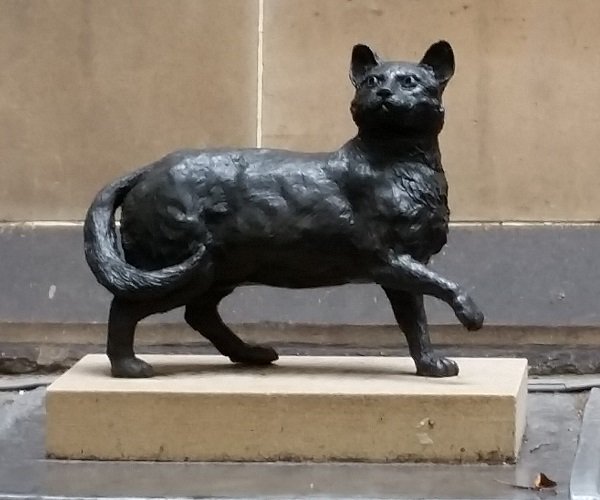
A dog can be trained and will learn something in the order of about a hundred different commands. As dogs view practically the entire of life as one giant game, this can be manipulated and this is why training a dog can be done reasonably well by those people who have that sort of skill. Cats on the other hand are far harder to train, largely because they have to choose to be, but in contrast cats can learn more than two hundred and fifty words. The words that my two cats have learned are almost entirely specifically related to their interests (about being fed, escaping the cold, going outside) because the the words that they have chosen to learn, they have done so on their terms and their terms only.
Likewise cats have their own vocabulary, which as far as well can tell is mainly about manipulating people into doing things for them and expressing things that are relevant to their interests. From the mouths of my two cats I have heard pleading, demanding, annoyance, pain, enquiry, domination of a space, affection, confusion and yelling simply because it's fun. I suspect the range of emotions that cats feel are more intense than people because they very much live in the moment but are far more short lived.
In my experience, they have a concept of the future but they only care about how it relates to them. Their internal clocks know when it is time to be fed and woe unto those who try and defy it. Their concept of the past is equally tied to the past. When Kipper demands his nightly milk, if he has already had some, his demand will change in tone from one of desperation to one of almost apology. I suspect that he hopes that we will not have noticed.
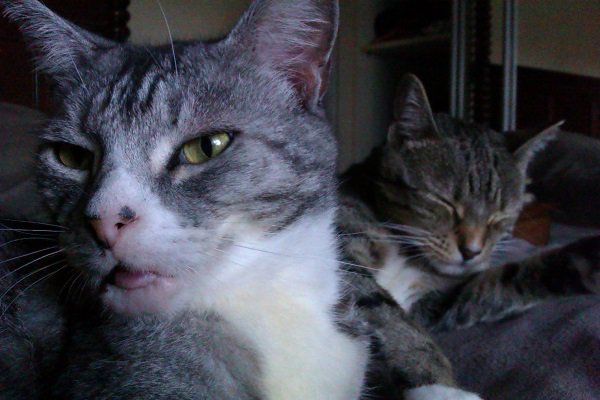
A dog is someone who will show you unquestioning, unending loyalty - a cat in contrast, who will leave you in the midst of a burning building; not because they don't love you but because they are too selfish to go and get you. They would rather curl up in front of the fire.
Although cats are often mistaken as being aloof, what they have in abundance is independence. Sometimes a cat will want something from you but they're equally fine with not being the centre of attention. If you leave a cat be, they're quite happy with doing their own thing. I've spent many a pleasant afternoon or evening with a cat close by and they have been in their own realm of joy, sometimes in a sunbeam.
I think it hardly surprising that people like Samuel Johnson, Winston Churchill, Isaac Newton and Charles Dickens all had cats. Cats are the best pet to have around if you are conducting the affairs of a nation, or investigating the boundaries of science and literature. However it was Ernest Hemmingway who perhaps said it best:
No animal has more liberty than the cat, but it buries the mess it makes. The cat is the best anarchist.
- Ernest Hemingway, For Whom the Bell Tolls, 1937
It is a mistake to assume that cats do not love you. People who say that have misunderstood the basic workings of cats. Like everything else in a cat's world, they can choose to love you but they will do so on their terms and their terms only. Cats are the physical embodiment of selfishness, wrapped in a furry coat. Should you decide that you would like to have a cat, then in effect you have volunteered to be a servant to it. You do not and will not own a cat, they will choose to own you but they will do so on their terms and their terms only.
The other common household pet, dogs, have had many stories written about them. There are cases of dogs displaying loyalty and commitment to their owners even after they have died. Dogs are social and hierarchical beings, they want to know their place in the pack and will gladly accept it. Cats on the other hand already know their place in the pack, they are the rulers of their domain and they treat all attempts to change the status quo with quietly confident ridicule.
The best example that I can think of that displays this fierce confidence is the story of Matthew Flinders' cat Trim, who travelled with him extensively on board ship. Flinders' diary records that on a trip around Van Diemens' Land, in the middle of a howling gale, Trim was standing on the poop deck totally unconcerned about the tempest raging all around and the sound of him meowing for his dinner could be heard above the thunder and the shock of the lightning. In the midst of mortal peril, Trim knew that he owned both his servant Matthew Flinders and even the ship for that matter, and ruled his domain with an iron paw. Next to the State Library Of New South Wales, the statue of Matthew Flinders is overlooked by a statue of his master, Trim.
Give me my dinner. Now.
A dog can be trained and will learn something in the order of about a hundred different commands. As dogs view practically the entire of life as one giant game, this can be manipulated and this is why training a dog can be done reasonably well by those people who have that sort of skill. Cats on the other hand are far harder to train, largely because they have to choose to be, but in contrast cats can learn more than two hundred and fifty words. The words that my two cats have learned are almost entirely specifically related to their interests (about being fed, escaping the cold, going outside) because the the words that they have chosen to learn, they have done so on their terms and their terms only.
Likewise cats have their own vocabulary, which as far as well can tell is mainly about manipulating people into doing things for them and expressing things that are relevant to their interests. From the mouths of my two cats I have heard pleading, demanding, annoyance, pain, enquiry, domination of a space, affection, confusion and yelling simply because it's fun. I suspect the range of emotions that cats feel are more intense than people because they very much live in the moment but are far more short lived.
In my experience, they have a concept of the future but they only care about how it relates to them. Their internal clocks know when it is time to be fed and woe unto those who try and defy it. Their concept of the past is equally tied to the past. When Kipper demands his nightly milk, if he has already had some, his demand will change in tone from one of desperation to one of almost apology. I suspect that he hopes that we will not have noticed.
Two cats is an acceptable number. Three cats is crazy cat lady territory.
A dog is someone who will show you unquestioning, unending loyalty - a cat in contrast, who will leave you in the midst of a burning building; not because they don't love you but because they are too selfish to go and get you. They would rather curl up in front of the fire.
Although cats are often mistaken as being aloof, what they have in abundance is independence. Sometimes a cat will want something from you but they're equally fine with not being the centre of attention. If you leave a cat be, they're quite happy with doing their own thing. I've spent many a pleasant afternoon or evening with a cat close by and they have been in their own realm of joy, sometimes in a sunbeam.
I think it hardly surprising that people like Samuel Johnson, Winston Churchill, Isaac Newton and Charles Dickens all had cats. Cats are the best pet to have around if you are conducting the affairs of a nation, or investigating the boundaries of science and literature. However it was Ernest Hemmingway who perhaps said it best:
No animal has more liberty than the cat, but it buries the mess it makes. The cat is the best anarchist.
- Ernest Hemingway, For Whom the Bell Tolls, 1937
August 01, 2016
Horse 2145 - Ten Things I Like: No.5 - I Like Utes

Charity begins at home. Why can't it begin at my home?
I am ready to accept your charity - ute please ^_^
If I look at the podcasts that I listen to on a regular basis, two are from Canada's CBC, six are from America's NPR, four are from Australia's ABC and seven are from Britain's BBC; of those six are on Radio 4. Even though I follow the England Cricket Team and the England Football Team, I still can't escape the annoying fact that without unlimited money, most of the things in my life tie me to Sydney, Australia and the green passport thereof.
Nevertheless, there are some things which I like about this country including the system of voting, the legacies left over from a time when we were still looking towards the UK for inspiration such as Medicare, the ABC and the fact that our physical isolation meant that we were allowed to grow up into whatever this country would be. One of those products of isolation was the Australian invention of the coupé utility, or as every decent Australian would call them, a Ute.
Famously the result of a letter to Ford Australia in 1934, when a lady wrote in (in 1932) and asked for a vehicle that she could drive to church on Sunday in and take the pigs to market on Monday in. Legend has it that Ford designer Lew Bandt penned it and when Herny caught wind of it, he dismissed it as a "kangaroo chaser".
Style in the front; substance in the back. If General Motors Holden wanted to crow from the rooftops that it was as Australian as "football, meat pies, kangaroos and Holden cars" while pinching the jingle from Chevrolet, then the ute is as Australian as "cyclones, fairy bread, wombats and knifing Prime Ministers".
Even though the ute was invented by what is really an American company and built by three American companies in Australia, it is still possibly the single most Australian thing ever invented. Forget Wi-Fi, the Hills Hoist, the stump jump plough and penicillin, utes are so Australian that six weeks after one particular Prime Minister decided to put the number plate C-1 on a ute, he hurled himself into the sea and was never seen again. Okay, so that story might not be true but the fact that there is a swimming centre named after him, in what surely is either a sign of poor taste or utter bravado, most certainly is.
When I say "Ute" I don't mean "Pickup Truck" either. Pickups are way cool but from the outset, they are only pickups. The Ford Ranger, Holden Colorado, Toyota Hilux and the VW Amarok are all competent and useful machines. They are all solid workhorses and loyal mules that will give many years of service. Utes on the other hand are the Martin Skrtel, the Barry Hall and the Buddy Franklin of the automotive world. They will do their job admirably and excellently but you always know that there is more than a hint of the insane about them. If you want a truck which is unbreakable, then get a Hilux. If you want a car/truck with a soul, then get a Falcon Ute or a Commodore Ute.
There is much merit to the wishes of that lady in the 1930s. Pickup trucks are designed to be a work vehicle from the outset and as such, most of them end up being massive. Regular readers of this blog will already know my sentiment towards big chunky and mostly useless blobs of status projection, SUVs. I feel that a lot of pickup trucks tend towards that same sort of spirit. A Colorado is a big thing that obnoxiously dominates the space around it and that is particularly unfriendly in car parks but because utes are based on regular sedans and wagons, they're far more civilised.
This also translates to on road behaviour. Pickup trucks because they are bigger and chunkier than the average size of traffic, tend to be driven both more aggressively and less well. I bet that between a Mazda 3, Mazda RX8 and Mazda BT-50, that the BT-50 driver is less likely to use their indicator when changing lanes and more likely to cut you off in traffic. Granted that a Holden Maloo driver is more likely to be charged for furious driving but that's probably a function of the fact that there's a big stonking 6.2L V8 under the bonnet.
The strange thing is that very few motor manufacturers have ever attempted to build a true ute. By my reckoning, there's GM, Ford, Chrysler, Subaru and Datsun and that's it. El Camino, Ranchero (and badge swap equivalents), Kingswood, Commodore and Falcon, Valiant, Royal and Rampage, Brumby and 1200/1600. I guess that the Suzuki Mighty Boy could be considered to be a ute but I honestly don't know what it is except to say that it is very very cool indeed.
In fact, without exception, all proper utes belong in either the Cool section or the Sub Zero section of Top Gear Mk2's Cool Wall. I tried to think of an uncool ute and failed. There are plenty of uncool pickup trucks on the road and the measure of this is how much I want one without having any obvious need for one. There are plenty of utes that I see that I'd secretly like to have.
One of the weird consequences of being based on a station wagon and not an SUV, is that the tray bed in the back of a ute tends to be longer and wider than most pickups. This was especially exploited in the 1970s, when the ute's cousin the panel van, was often fitted with a queen size mattress in the back. In both a ute or a panel van, you can throw a bunch of camping gear in the back and magically, millions of kilometers of road open up across this massive continent and your accommodation goes with you everywhere. I am a tall and lanky sort of chap and the only two utes or pickup trucks that I can lay down flat in the tray, are the Commodore and Falcon utes. Everything else is simply too short.
A ute satisfies three desires at once: the need to haul stuff, the need to get places and the wish to do it in style - part truck, part car, part sports car. To the latter of those three, I have to say this:
Dear Holden and Ford,
Along with Toyota who make appliances, you have decided to end motor manufacturing in Australia. Apart from the fact that you are literally killing off an entire industry, one of the side effects is that you are ripping out something which speaks to the very heart and soul of this wide brown land.
You've both spent almost half a century in sending the two tribes into combat against each other and especially on that hallowed mountain of motor sport, Mount Panorama at Bathurst, but now not only are you ripping out our hearts but by killing off the Ute, your also stomping them into the ground.
This is a love story which has turned sour and a jilted bride has been left at the altar. When you kill off the ute, part of this country dies inside.
I hope that you're happy with what you've done because the good and fair people of Australia are certainly going to vote with their wallets. You will both be consigned to the destiny of being just another car company and this place will remember you not. The children of 2020 will most definitely not look upon you with the same affection as the children of 1990 and before did. You are stealing their tomorrows.
Love, Rollo.
PS: You both had fifty years to send a ute to the Le Man's 24 Hour Race. They wouldn't have won anything except the hearts and minds of the world. The fact that you didn't is a disgrace.
I like utes but sadly, their days are numbered. The very last Falcon has already left the body shop and by this time next year, that will also be true for the Commodore. The sad thing is that the last ute on the planet will be the Ford Fiesta bakkie in South Africa and I can't lay down flat in the back of one of those.
July 29, 2016
Horse 2141 - Ten Things I Like: No.4 - I Like The Dark
In the middle of winter, I leave the house under cover of darkness. The temperature is always coldest just before the sun rises in the morning and I find that the tips of my fingers begin to burn with the beginning of frostbite. In the evening, I also leave work under the cover of darkness and even though Mrs Rollo spends her time worrying about me, I rather like the darkness. Not because I want to exact some sort of nefarious scheme but because I think that it looks pretty.
A little over a century and a half ago, the best that we could do in lighting up the world was either gas lamps or perhaps chemical filaments. With the exception of the red glows which came from coal powered factories, most of the world was pretty dark at nighttime. When Edison or Swann came along and brought light into the world via the new electric illumination, the world didn't quite instantly change but in the land of today, which was yesterday's tomorrow, our nights are brighter than any century before.
If you're flying over Sydney in a 747 in the daytime, apart from the Sydney Harbour Bridge and the Opera House, the rest of Sydney may as well be just a cut and paste in Photoshop, three hundred times over; I think that it is a mostly boring sight. At nighttime though, it changes from three hundred suburbs to several ribbons of light. The unrelenting stare of 580nm wavelength light, gives the ribbons a mostly yellow stain but occasionally you can see snakes of red and white, slink their way around as they are watched over by red and green eyes.
On the weekends, little pools of green will spontaneously appear from the darkness and if you were close enough, you'd hear them roaring as crowds inside, make various noises depending on the rise and fall a sportsball game. Meanwhile, the empty towers of industry, where numbers are pushed between them during the day, stand balefully in grey blue, as they wait for their masters to return on Monday and start pushing numbers around again anew.
I like that when you are driving at nighttime, although the world is a little more dangerous, because the cloak of darkness reduces everyone to being just a pair of red lights in front and white lights behind, it very much equalises people's attitude to each other. During the day, I've been subject to some horrendously menacing driving, especially by people in big hulking four-wheel drives because I drive a wee little hatchback and the assumed perception is that I'm holding them up, despite doing ten clicks over the limit. At nighttime though, and likely due to bias because I love long distance driving, the whole experience turns into a far more orderly and polite affair.
Speaking of being in a car at night, as a kid I thought it kind of cool that even if you were going at full tilt down the motorway, you couldn't out run the moon. The yellow street lamps and various other pieces of road furniture like signs, would whizz underneath as the moon continued on its unstoppable journey. I can still picture in my mind's eye to this day what the shape of the rear passenger windows were in the back of my parents' car looked like.
I also especially love the contrast that you get between the darkness and a place that is all lit up. Perhaps this is why McDonald's does so well. Yes, the golden arches are an iconic symbol but the fact that you would been travelling along in the dark and that golden M shines out from a backdrop of black, surely has to add to the whole visual aesthetic of it all.
This also works equally well for petrol stations whose coloured signs beckon people from afar and their lights flood the forecourt as though they were some bizarre stage upon which the most boring play in the world is being performed. Caltex, BP, Shell, Mobil, 7-Eleven and stretching back into the vaults of my youth, the big yellow merino of Golden Fleece petrol stations, are some of the strongest brands in my mind.
I also love that when you are onboard a train and streaking across suburbia or perhaps the vast inky nothing of the country at night, that when you do arrive at a railway station, it is like entering a cathedral. Very big mainline terminals probably specifically designed their booking halls to echo these places for precisely that reason.
If you decide that you've had enough of the maelstrom of humanity that we've built for ourselves in the cities, provided you get out far enough, the night sky itself with the moon, the planets and their moons and the uncountable myriad of stars, leaves you with the sensation that we really do live on a small thing suspended upon nothing. The Apollo 8 astronaut Jim Lovell remarked that he could cover everything with just his thumb and when Voyager 1 took its photograph looking back at the neighborhood that it had spent 13 years travelling through, Carl Sagan famously remarked that there we were, all of humanity, the entire of our history was all there suspended on a sunbeam on a "pale blue dot".
Even though the darkness provides a cover for all sorts of nefarious and dastardly purposes to be carried out, I still like the darkness. It is the darkness which gives you the calmness and serenity from which you can appreciate the moonlight and the stars. It is inside darkened rooms that we project moving pictures onto the silver screen, where we tell stories. It is the darkness that makes neon lights, light boxes and floodlights so pretty.
I like the darkness because it is the canvas upon which we paint with light.
July 28, 2016
Horse 2140 - Ten Things I Like: No.3 - I Like Spice And Heat
Racially speaking, I am a Celt. I have some degree of Dutch lineage but the fact remains that if we were to drill back into history two thousand years, my unknown ancestors would have probably been the sort of people who the Romans thought were a complete waste of space and time. Because of this, I have been scientifically bred to live at the bottom of a peat bog, on a diet of Moss and twigs, and stand out in the rain for months at a go.
The Celts, Picts, Scots, Welsh, who all shared the sceptered isle which is less than forty miles from Europe, never really had a cuisine to speak of. Even as late as the 1980s, British cooking was derided as dull. If you wanted to cook like the English, all you needed to do was to boil whatever it was until it had turned to mush.
In consequence, the long genetic chain of history has meant that everyone in my immediate family, has a tolerance for heat and spice of virtually nil. In contrast, I have a ridiculous pain threshold and even if you gave me something to eat which was hotter than the surface of the sun, I'd still complain that it wasn't hot enough. I am not truly happy unless the backs of my eyeballs are on fire and I'm doubled over in writhing pain. I like spice. Turn the dial up to eleven.
Mrs Mac's has a pie called the Chilli Beef And Cheese; I think that it has an adequate amount of cheese but nothing near enough chilli. There is an Indian restaurant in Neutral Bay which has on their menu next to the entry for Vindaloo Lamb: "Caution: Hot!". I feel as though neither the exclamation point, the word "Hot" or even the word "Caution" need to be there. It is lovely but if you are going to advertise something as "Hot", then I expect to be bleeding out of my ears. Not even Tabasco Sauce bothers me particularly all that much. In fact, I keep a bottle of the stuff in my desk at work because if I want a snack, then I need to turn up the volume on a Bombay Bad Boy Pot Noodle.
I would love to get my hands on a Naga Chilli. I heard Kerry O'Keefe on the radio being given one, during a cricket broadcast, and has he gagged and demanded yoghurt, I thought " I want in on that ".
I can fully understand why after successive waves of invasions, British people decided that they'd had enough of living in peat bogs; in perpetual rain. The Roman Empire was founded on a system of organisation and discipline; the Spanish Empire was established on a desire to find untold riches of silver and gold; the British Empire set its boundaries wider still and wider, not because there was some guiding principle but in the search for spices.
This is why the moon was always going to be American and not British. What's the point of landing twelve clowns on the moon and sticking a flag in it, thus stealing countries through the cunning use of flags, if after you've installed parliamentary democracy and the rule of law, if there's no hot and spicy food to bring home? If Donald Trump had any brains, he wouldn't be building a wall to keep the Mexicans out, rather, he'd embark on a policy of the full scale invasion of Mexico so that he could annexe the place and claim all the Antojitos he could find.
Give me futomaki with nothing but rice and wasabi in. Better yet, give me one of those ehomaki with the okra, horseradish sauce and ginger, drizzled in chilli oil. I want to be able to breath out and see flames darting out of my nostrils like Gojira.
A kebab isn't a proper kebab unless you need to sign a medical waiver before you purchase it. I want Texas Chilli Rice so hot that it violates the Eighth Amendment clause not to impose "cruel and unusual punishment". And after the whole thing has burned through my intestines like molten metal through a stick of butter, I want it to be so angry on the way out that even Union Carbide takes a step back and thinks that their disaster at Bhopal was less of an environmental health hazard.
While I might think that a box of Cadbury Roses is a perfectly delightful gift, what I'm secretly hoping for is a Tiger Chilli Beef Pie with mushy peas, mash and chilli sauce from Harry's Café de Wheels.
July 26, 2016
Horse 2139 - Ten Things I Like: No.2 - I Like Psalm 38
I almost feel like some kind of monster by writing this but my favourite Psalm isn't something sweepingly happy like Psalm 8 or as praiseful as Psalm 46. No, my favourite Psalm is one which I can pretty much guarantee will not be read at the beginning of a church service as a call to worship and nor will it be read as a closing thought before the congregation goes out through the doors and into the week ahead. My favourite Psalm is one of the saddest and quite frankly brutally honest Psalms of all - Psalm 38.
Lord, do not rebuke me in your anger
or discipline me in your wrath.
Your arrows have pierced me,
and your hand has come down on me.
Because of your wrath there is no health in my body;
there is no soundness in my bones because of my sin.
My guilt has overwhelmed me
like a burden too heavy to bear.
- Psalm 38:1-4
I very much doubt that Psalm 38 has inspired many hymns to be written. I also doubt whether a major publishing house would even dare to publish a song based upon Psalm 38. Could such a thing even considered to be a song of praise? I'm not sure about that.
If Psalm 38 isn't a Psalm of praise, then it obviously serves a very different function and therein lies the reason why I think it's my favourite of all.
I work in an accountant's office and part of our specialty is to provide forensic valuations for the courts. This dovetailed nicely with my previous job when I was working inside the courts as a bookkeeper and court recorder. What this has meant is that I've seen lots of people who are literally at their worst and this is doubly compounded by the influence of money upon their actions.
You might think that this would leave me jaded about the human condition but I don't know if it's technically possible to be jaded in an opinion if your initial starting point was pretty low to begin with.
When people take each other to court, they have long passed beyond the point where they have suffered or perhaps have caused wrong or injury. Naturally this means that people as emotional beings, are likely to be spitting seven kinds of bile and acid and the atmosphere around such people is generally a weird sort of fug. This isn't the fault of the courts though. The law in such instances can only provide opinions post event. The court's job is to provide remedies and punishment for actions which have already caused wrong and injury.
Enter Psalm 38. This Psalm speaks about the author's own feelings after he has caused wrong and injury but more importantly it speak towards the underlying cause of why.
One question which is often put forward to people of faith, especially after something disastrous has happened, is "Why do bad things happen to good people?". I don't particularly think it a divine perspective, considering that the evidence very much all points in one direction, that there are no good people to begin with. The question is therefore wrong and should read "Why do good things happen to bad people?"
Ah but you might say. What makes me the arbiter of who are good and bad people? Doesn't this make me sit in a point of arrogance from atop a tower made of smoke? One puff of wind and I'll easily admit that I'm not objectively a good person either.
Remove all hint of faith and talk of the divine from this and you'll find that many people writing to the world of economics, political science and philosophy generally, have also arrived at the same conclusion.
Adam Smith who wrote "The Wealth Of Nations" in 1776, meant that work to be read in conjunction with his previous book "The Theory Of Moral Sentiment" which was finished in 1759. His opening line, which serves as the premise of his inquiry was "However selfish mankind is supposed to be" and that's the starting point.
People like Nikolay Chernyshevsky and Henry Sidgwick in the nineteenth century, wrote and expanded upon the idea of rational egoism and in the twentieth century, Ayn Rand couldn't even conceal her open praise for selfishness and went on to argue that even altruism was ultimately self serving.
This standpoint was helpfully turned into a three word slogan by the 1987 film "Wall Street" when Gordon Gecko succinctly asserted that "Greed Is Good".
Don't get me wrong here, I don't think that all people are all evil all the time. Demonstrably we live in a world which is reasonably well organised and so to some degree, there must be people who work and do things for others. However, I do think that one of the consequences of living within one's own body and never being able to see the world from any other perspective than our own, does create some pretty savage blinkers and they very much frame our perspective on the world. Not only do we not see the world from any other perspective than our own but due to laziness and inactivity, most people don't think about other people's perspectives. Never attribute to malice that which can be explained by stupidity and clumsiness.
What then is Psalm 38? Psalm 38 speaks from the point of someone who knows that they have screwed up. The description of lying on a bed of tears and physical pain as a result of the realisation that one is indeed faulty and guilty as charged is, I think, proof that they have genuinely reached the point of contrition. The first half of the Psalm is basically a lament that I have done this, this is my fault, my actions have consequences and that the suffering that I am currently undergoing is indeed just. I don't know exactly what the thing that the author has done is but the consequences even extend to his friends and family steering clear of him and leaving him alone.
The end of the Psalm is not without hope though. Those last two lines say:
Lord, do not forsake me;
do not be far from me, my God.
Come quickly to help me,
my Lord and my Savior.
This indicates that even when someone is at their absolute worst, they can still look upwards. The entreaty for God as Lord and Saviour to come to one's aid, is a position of hope; even from something that looks like hopelessness but not after they've taken responsibility:
This brings me to ask the question of what the point of the Psalm actually are. If you were to do a scan of the Top 40 songs in the charts in any given week, I'd hazard a guess that at least 35 of them would be about some sort of relationship and going out and having a good time. This isn't exactly unique to just the music industry; most movies have some sort of love story or romantic entanglement in them somewhere and the Psalms after all are an historical record of the lyrics of some songs written in reference to the relationship between someone and their creator.
Given what I know about human nature, that everyone is demonstrably selfish and invariably clumsy (if not outrightly callous), then it makes perfect sense that at least one Psalm should express the contrition and sadness which someone who has caused hurt, will feel. It's not that much of a leap to imagine that I am the one who causes that hurt and that I should rightly feel bad about it.
Psalm 38 is my favourite Psalm because someone has taken responsibility for their actions and is demonstrative that I should too.
July 22, 2016
Horse 2138 - The RNC State Roll Call
I have been watching this presidential election race more closely than in previous years because this year more than any other, is like watching a terrible B-Grade movie, where you know that it ends in a horrible train wreck but you don't know who walks away from it.
This week, the Republican National Convention has been held in Cleveland, Ohio. I must admit that when America does something, it does it on a scale which makes other nations look like they are just scrabbling around in the dirt. This event, which was held in a venue which had only just been converted after holding the NBA finals, was vast.
One of the items on the program was the roll call of the states and the formal allocation of delegates votes which have come about because of four months of primaries and caucuses. To me, this was like watching the vote count of the Eurovision Song Contest but with a different sort of kitsch and gaudiness. Apart from the formal declaration of where the state's votes went, most states used this to pitch themselves and do a spot of bragging. Some of the territories used it to air grievances, some states took themselves and the convention way too seriously and still others sent it up; like the farce that it is.
The following then, is a list of what we have learned from the roll call of the states; from the serious to the frivolous:
Alabama - The home of the Saturn V rocket.
Alaska - The largest state in the union; more coastline than the continental United States, the last frontier.
American Samoa - The southernmost expanse of US soil; the greatest per capita exporter of NFL players.
Arizona - The hottest state in the country "for job growth".
Arkansas - Land of opportunity and birthplace of Johnny Cash and Al Green. Open for business. The reddest state in the land. Number 1 in rice production and catfish.
California - We have good jobs and opportunities.
Colorado - The frontier state where the planes where the planes meet the mountains and the home of the World Champion Denver Broncos.
Connecticut - The land where we manufacture Pez, nuclear submarines and the home of the WWE.
Delaware - The first state to ratify the Constitution.
District of Columbia - Instrumental in creating the Republican Party in 1856. The district which was delineated by George Washington. Capital of the country.
Florida - Home to Disneyworld, the Daytona 500 and the Florida Keys. We have no state income tax. 600 miles of beaches. The state that gave Lebron James his first two championships.
Georgia - The peach state and the state with the most peaches.
Guam - The tip of the spear of American might. Home of B-52s, B1s, B2s, fast attack nuclear submarines that are keeping the potential enemies of America at bay. The place where America's day begins.
Hawaii - (didn't say anything about themselves)
Idaho - Famous potatoes. The most republican state in the nation. When they say the pledge of allegiance, they say it to the "Republicans" for which it stands.
Illinois - (didn't say anything about themselves)
Indiana - Has a $2bn surplus. More people working than ever before in the state's history.
Iowa - Go Hawks! The longest serving Governor in American history.
Kansas - Home of the greatest fans of the World Champions, the Kansas City Royals. Proud home of the iconic Bob Dole.
Kentucky - The bluegrass state. The home of Churchill Downs; the source of bluegrass music. The state where the largest Toyota plant in the world is located and the place where they make the Ford F-150 and the Chevy Corvette. The state that produces all the bourbon fit to drink in the world.
Louisiana - The Sportman's Paradise headquarted in Terrebonne Parish.
Maine - Home of rugged coastlines, pristine forests; beautiful lakes. The state that led the Republican revival in the northeast.
Maryland - America in miniature. Home of the oldest state capitol in continuous use; where George Washington resided as commander in chief of the continental army. Birthplace of the national anthem.
Massachusetts - (didn't say anything about themselves)
Michigan - The great lakes state. The birthplace of the Republican Party³.
Minnesota - Home of 10,000 lakes; home of Spam and home of the late; great Prince.
Mississippi - The birthplace of America's music.
Missouri - Kansas I love you but Missouri is the home to the World Series Champions Kansas City Royals. Missouri, home of eleven time World Champions, St Louis Cardinals. Missouri, the birthplace of talk radio and AM 1120 KMOX "the voice of St Louis". Missouri, the birthplace of ragtime music.
Montana - (didn't say anything about themselves)
Nebraska - The good life with great opportunity. The home of Silicon Prairie News. The University of Nebraska Corn huskers. The Number 1 beef producing state in the Union. A place where people find happiness from honest work and where their word is their bond.
Nevada - Where blue lives matter. We are battle born, brought in by first Republican president in 1864. From the great shores of Lake Tahoe, to the most entertaining capital city, Las Vegas¹, Nevada, this time what's said in Las Vegas will not stay in Las Vegas.
New Hampshire - The live free or die state. A state with no sales or income tax.
New Jersey - The garden state. The greatest state in the Union.
New Mexico - The land of enchantment.
New York - The empire state.
North Carolina - The land of the long leaf pine. The land where the summer sun doth shine. Where the weak grow strong and the strong grow great. Home of the largest military installations in the world. With the majestic Appalachian Mountains in the west and the beautiful crystal coast in the east.
North Dakota - The home of the current and five consecutive year national FCS football champions, the North Dakota State University Bisons. The home of the University of North Dakota Fighting Hawks. The only state in the United States to actually grow younger.
Northern Marianas - The weather is 85° all year round.
Ohio - Cleveland, the city of champions.
Oklahoma - The heartland of America and the reddest state in the Union.
Oregon - The land of unrivalled natural beauty, snowy mountain peaks, majestic river valleys, serene high deserts, the great American pinot noir, Tillamook Cheese and hazelnuts and the reigning Major League Soccer Champions, the Portland Timbers. Home of Tracktown USA and the place where Nike made ducks and beavers cool.
Pennsylvania - The keystone state, the home of the Stanley Cup Champions Pittsburgh Penguins.
Puerto Rico - Voted to become the 51st state of the Union.
Rhode Island - (They like sailor's hats) Roger Williams founded the colony of Rhode Island in 1631, based on principles of complete religious toleration, separation of church and state and political democracy; values that the United States would after be founded upon. The ocean state. It's absolutely beautiful back home.
South Carolina - The Palmetto State, the home of "Amazing Grace", the true peach state and the birthplace of barbecue and America's vacation destination, Myrtle Beach, South Carolina.
South Dakota - Home of Crazy Horse, Mount Rushmore and other great faces and great places.
Tennessee - The volunteer state, the state with no income tax, a budget surplus and a balanced budget², in the top five in jobs growth and number one in auto production.
Texas - (They like cowboy hats) The 12th largest economy on the planet.
US Virgin Islands - Where the people are second-class citizens and denied voting rights. The childhood home of Alexander Hamilton and basketball player Tim Duncan. Where no passport is required to visit the islands.
Utah - The state that has its priorities straight: God, family and country.
Vermont - Don't expect to build up the weak by pulling down the strong.
Virginia - The mother of presidents and the capital of freedom. Where liberty sprouted from the roots of gemstone, where patriots' dreams came true.
Washington - (They like trees for hats) The evergreen state. A beautiful state of volcanoes, the mighty Columbia River, vast wheat fields and often the national Christmas Tree. Also the proud home of the Boeing Aircraft Company, builders of the greatest aircraft in the world. Named after the first president, George Washington.
West Virginia - (They like coal miner's hats) The home of the greatest golfer in the history of golf, Sam Snead. The home of the greatest football player in the history of the NFL, Sam Huff. A thundering herd.
Wisconsin - The birthplace of the Republican Party³. The home of the thirteen time champion Green Bay Packers. The home of the greatest motorcycles in the world, Harley-Davidson.
Wyoming - Home of rugged individualism, the majestic Tetons and frontier days. The world's biggest producer of low sulphur coal, an energy titan; a super red state. A $1.6bn surplus, a balanced budget², no individual and no corporate income tax. Support of state's rights, the Second Amendment and law enforcement officers across the nation.
Come November, I suspect that many Americans will feel as though they are in some sort of damage control, where they are given a choice of two equally unpleasant options. Would they rather taste something hideously sour or something hideously bitter? Whatever they choose, the four year buffet which will be served by 1600 Pennsylvania Avenue, will leave a terrible taste in people's mouths.
For the moment though, it's time to eat candy in three stripes of red, white and blue. Just remember that you can't keep on eating candy forever. It might be minty fresh now but come November, something is going to get all rotten and stinky.
¹The capital of Nevada is actually Carson City but I guess geography isn't exactly that state's strong suit.
²Which is impossible because by definition a budget in surplus isn't balanced.
³Both Michigan and Wisconsin claim to be the birthplace of the Republican Party. Depending on which side of the story you believe, either side could be right.
This week, the Republican National Convention has been held in Cleveland, Ohio. I must admit that when America does something, it does it on a scale which makes other nations look like they are just scrabbling around in the dirt. This event, which was held in a venue which had only just been converted after holding the NBA finals, was vast.
One of the items on the program was the roll call of the states and the formal allocation of delegates votes which have come about because of four months of primaries and caucuses. To me, this was like watching the vote count of the Eurovision Song Contest but with a different sort of kitsch and gaudiness. Apart from the formal declaration of where the state's votes went, most states used this to pitch themselves and do a spot of bragging. Some of the territories used it to air grievances, some states took themselves and the convention way too seriously and still others sent it up; like the farce that it is.
The following then, is a list of what we have learned from the roll call of the states; from the serious to the frivolous:
Alaska - The largest state in the union; more coastline than the continental United States, the last frontier.
American Samoa - The southernmost expanse of US soil; the greatest per capita exporter of NFL players.
Arizona - The hottest state in the country "for job growth".
Arkansas - Land of opportunity and birthplace of Johnny Cash and Al Green. Open for business. The reddest state in the land. Number 1 in rice production and catfish.
California - We have good jobs and opportunities.
Colorado - The frontier state where the planes where the planes meet the mountains and the home of the World Champion Denver Broncos.
Connecticut - The land where we manufacture Pez, nuclear submarines and the home of the WWE.
Delaware - The first state to ratify the Constitution.
District of Columbia - Instrumental in creating the Republican Party in 1856. The district which was delineated by George Washington. Capital of the country.
Florida - Home to Disneyworld, the Daytona 500 and the Florida Keys. We have no state income tax. 600 miles of beaches. The state that gave Lebron James his first two championships.
Georgia - The peach state and the state with the most peaches.
Guam - The tip of the spear of American might. Home of B-52s, B1s, B2s, fast attack nuclear submarines that are keeping the potential enemies of America at bay. The place where America's day begins.
Hawaii - (didn't say anything about themselves)
Idaho - Famous potatoes. The most republican state in the nation. When they say the pledge of allegiance, they say it to the "Republicans" for which it stands.
Illinois - (didn't say anything about themselves)
Indiana - Has a $2bn surplus. More people working than ever before in the state's history.
Iowa - Go Hawks! The longest serving Governor in American history.
Kansas - Home of the greatest fans of the World Champions, the Kansas City Royals. Proud home of the iconic Bob Dole.
Kentucky - The bluegrass state. The home of Churchill Downs; the source of bluegrass music. The state where the largest Toyota plant in the world is located and the place where they make the Ford F-150 and the Chevy Corvette. The state that produces all the bourbon fit to drink in the world.
Louisiana - The Sportman's Paradise headquarted in Terrebonne Parish.
Maine - Home of rugged coastlines, pristine forests; beautiful lakes. The state that led the Republican revival in the northeast.
Maryland - America in miniature. Home of the oldest state capitol in continuous use; where George Washington resided as commander in chief of the continental army. Birthplace of the national anthem.
Massachusetts - (didn't say anything about themselves)
Michigan - The great lakes state. The birthplace of the Republican Party³.
Minnesota - Home of 10,000 lakes; home of Spam and home of the late; great Prince.
Mississippi - The birthplace of America's music.
Missouri - Kansas I love you but Missouri is the home to the World Series Champions Kansas City Royals. Missouri, home of eleven time World Champions, St Louis Cardinals. Missouri, the birthplace of talk radio and AM 1120 KMOX "the voice of St Louis". Missouri, the birthplace of ragtime music.
Montana - (didn't say anything about themselves)
Nebraska - The good life with great opportunity. The home of Silicon Prairie News. The University of Nebraska Corn huskers. The Number 1 beef producing state in the Union. A place where people find happiness from honest work and where their word is their bond.
Nevada - Where blue lives matter. We are battle born, brought in by first Republican president in 1864. From the great shores of Lake Tahoe, to the most entertaining capital city, Las Vegas¹, Nevada, this time what's said in Las Vegas will not stay in Las Vegas.
New Hampshire - The live free or die state. A state with no sales or income tax.
New Jersey - The garden state. The greatest state in the Union.
New Mexico - The land of enchantment.
New York - The empire state.
North Carolina - The land of the long leaf pine. The land where the summer sun doth shine. Where the weak grow strong and the strong grow great. Home of the largest military installations in the world. With the majestic Appalachian Mountains in the west and the beautiful crystal coast in the east.
North Dakota - The home of the current and five consecutive year national FCS football champions, the North Dakota State University Bisons. The home of the University of North Dakota Fighting Hawks. The only state in the United States to actually grow younger.
Northern Marianas - The weather is 85° all year round.
Ohio - Cleveland, the city of champions.
Oklahoma - The heartland of America and the reddest state in the Union.
Oregon - The land of unrivalled natural beauty, snowy mountain peaks, majestic river valleys, serene high deserts, the great American pinot noir, Tillamook Cheese and hazelnuts and the reigning Major League Soccer Champions, the Portland Timbers. Home of Tracktown USA and the place where Nike made ducks and beavers cool.
Pennsylvania - The keystone state, the home of the Stanley Cup Champions Pittsburgh Penguins.
Puerto Rico - Voted to become the 51st state of the Union.
Rhode Island - (They like sailor's hats) Roger Williams founded the colony of Rhode Island in 1631, based on principles of complete religious toleration, separation of church and state and political democracy; values that the United States would after be founded upon. The ocean state. It's absolutely beautiful back home.
South Carolina - The Palmetto State, the home of "Amazing Grace", the true peach state and the birthplace of barbecue and America's vacation destination, Myrtle Beach, South Carolina.
South Dakota - Home of Crazy Horse, Mount Rushmore and other great faces and great places.
Tennessee - The volunteer state, the state with no income tax, a budget surplus and a balanced budget², in the top five in jobs growth and number one in auto production.
Texas - (They like cowboy hats) The 12th largest economy on the planet.
US Virgin Islands - Where the people are second-class citizens and denied voting rights. The childhood home of Alexander Hamilton and basketball player Tim Duncan. Where no passport is required to visit the islands.
Utah - The state that has its priorities straight: God, family and country.
Vermont - Don't expect to build up the weak by pulling down the strong.
Virginia - The mother of presidents and the capital of freedom. Where liberty sprouted from the roots of gemstone, where patriots' dreams came true.
Washington - (They like trees for hats) The evergreen state. A beautiful state of volcanoes, the mighty Columbia River, vast wheat fields and often the national Christmas Tree. Also the proud home of the Boeing Aircraft Company, builders of the greatest aircraft in the world. Named after the first president, George Washington.
West Virginia - (They like coal miner's hats) The home of the greatest golfer in the history of golf, Sam Snead. The home of the greatest football player in the history of the NFL, Sam Huff. A thundering herd.
Wisconsin - The birthplace of the Republican Party³. The home of the thirteen time champion Green Bay Packers. The home of the greatest motorcycles in the world, Harley-Davidson.
Wyoming - Home of rugged individualism, the majestic Tetons and frontier days. The world's biggest producer of low sulphur coal, an energy titan; a super red state. A $1.6bn surplus, a balanced budget², no individual and no corporate income tax. Support of state's rights, the Second Amendment and law enforcement officers across the nation.
Come November, I suspect that many Americans will feel as though they are in some sort of damage control, where they are given a choice of two equally unpleasant options. Would they rather taste something hideously sour or something hideously bitter? Whatever they choose, the four year buffet which will be served by 1600 Pennsylvania Avenue, will leave a terrible taste in people's mouths.
For the moment though, it's time to eat candy in three stripes of red, white and blue. Just remember that you can't keep on eating candy forever. It might be minty fresh now but come November, something is going to get all rotten and stinky.
¹The capital of Nevada is actually Carson City but I guess geography isn't exactly that state's strong suit.
²Which is impossible because by definition a budget in surplus isn't balanced.
³Both Michigan and Wisconsin claim to be the birthplace of the Republican Party. Depending on which side of the story you believe, either side could be right.
July 21, 2016
Horse 2137 - Ten Things I Like: No.1 - I Like Trains
Prologue:
With the exception of The Producers by Mel Brooks, there has never been a more happy and delightful piece of culture about the Nazis than Rogers and Hammerstein's The Sound Of Music. The song My Favourite Things, takes place during a storm in which some of the smaller children of the Von Trapp family are scared. Sure it's a lovely song but clearly Rogers and or Hammerstein, which ever was responsible for penning the lyrics, was only concerned about the meter of the music because no sane individual would eat "schnitzel and noodles" together - it's dangerous, don't do it, stay safe.
As someone who has the musical ability of a distressed sheep who is stuck waist deep in a muddy bog and who bleats horribly, I thought I'd run through my own list of Ten Favourite Things. Admittedly, this sounds suspiciously like an episode of the Oprah Winfrey Show but unlike Ms Winfrey, I'm not going to give away cakes, computer tablets or motor cars.
No.1 - I Like Trains
Even as a small child, going on a car ride was fun, going on a bus ride was amusing and going on a plane ride was one of those exceptionally rare things which almost never happened; going on a train ride, even if it was only a short distance, was, is and I suspect always will be, its own kind of specialness. In the grand argument of planes, trains and automobiles, trains wins every single time.
It all begins at the beginning (a very good place to start) when you arrive at the railway station. If not last century then certainly the one before, railway stations either became the sign that a place had achieved notability or the railway station itself would spawn a place. Before the widespread ownership of the motor car, railways were the only way that the masses travelled anywhere.
It didn't matter if the railway station in question was some towering cathedral or if it was just some raised platform in the middle of nowhere with a signpost on, railway stations are a place of permanency in a world and many people's lives; both of which are subject to change. Especially for larger railway stations which apart from the town hall might be the only building in town with a clock tower, they are the keepers and clergy to god of industry and their bells cry out a call to the cruel doctrine of time watching. Unlike a church, even though railway stations might be a vast shared public space, they don't really foster any sense of community. A cathedral or church building is a place where people come together, a railway station is a place which is solely devoted to going away from.
It is this sense of going that I like. Going on, on and ever on; pausing momentarily before once again going on, on and ever on. Unlike being in a car which almost always seems like some sort of competition in which you have to defend your own space, or an aeroplane in which the world slowly turns underneath you and in the case of international travel across oceans is just a peek into an inky void, travelling on a train allows the scenery to parade in front of you. Even the daily motion of forth and back, as though you were a saw blade moving across a piece of wood in the same groove, presents the world as a moving picture which is bordered by the edge of the window like a picture frame.
As a commuter, because you do pass by the same scenery every single day, you begin to notice even small changes. There are obvious things like upgrades to railway stations in Sydney at the moment but little things like the change of billboards becomes noticeable. I've even noticed when graffiti tags have been painted over - like when "Soup" disappeared and "Fazz" appeared all the way from Stanmore to Redfern.
As the world goes by the window, there is a real sense of travelling without moving. On a commuter train where you don't see the drivers, it's easy to forget that they're there at all. On a train which is travelling far greater distances, you can settle in for the journey in exactly the same way that you can't when travelling on an aeroplane. I've only been on a train with a private berth once and that was like having your own office for the evening; right down to the frosted glass light fixtures.
I also like that strange sense that a train is a shared space but one in which people more or less cease to be. I've probably seen three distinct changes in technology in my lifetime, when everybody all read the newspaper, to when everybody had walkmans, to now when everybody has smart phones and tablets. There is an active effort by practically everybody on board to mentally escape the space that they find themselves in and if they can't do that, then to fall asleep and try to physically do so as well.
This all sounds incredibly antisocial but I think that something different is going on. The term antisocial usually implies an impolite intrusion into the space of other people but on a train, there is an almost universal retreat to avoid other people's space. The weird thing about having a place full of people who are all either listening to their devices, or trying to sleep is that it means that although a train carriage might have as many as one hundred and twenty people on board, it will still be quieter than a room with two six year old children in it. This means that a train can be a place to work, to think, to write and to sleep.
Of course, overnight sleeper carriages with private berths are specifically designed so that the travellers can go to sleep but they come with a different sort of sociability. They come with the same sort of politeness that you get in a hostel, where people form acquaintances for a short period of time and might not see each other ever again.
I can't finish this ramble without mentioning the train itself. The days of steam locomotives had already passed long into antiquity before I was born and so I'm going to discount them entirely but I still think that there's an aesthetic beauty about railway trains.
The London Underground was the first to realise that tying the corporate design language together made for something which was greater than the sum of its components and it took deliberate steps to make things look like they were part of the Underground. Beck's map which shows all of the lines and stations as a schematic diagram has been copied the world over and I think that it qualifies as a piece of art in its own right. Sydney Trains has suffered due to changes in corporate design language as governments come and go but the silver trains that we have in Sydney, still evoke a feeling of modernity, in contrast to some stations which are fifty, sixty and ninety years old. I even feel a tinge of sadness that the Northern Line on the Sydney Trains map has been forcibly changed to red because internal management has thrown it's lot in with the Western Line.
I like the fact that Museum and St James stations have been restored to dignity and I like that roundels have been out put back in Town Hall station. I like the stark futurism of stations like Quakers Hill which in no way whatsoever attempts to blend in with the local surroundings. I like the details on the bottom of awnings at places like Strathfield and Summer Hill and I like the desperate calm of MacDonaldtown, as virtually every train whizzes by at speeds of triple digits.
In a list of ten favourite things, trains were always going to be on it. I suspect that of the hundreds of thousands of people who take a commuter train to work and home every day in this city, that I must be one of an exceptionally rare breed who actually likes the journey because I like trains.
With the exception of The Producers by Mel Brooks, there has never been a more happy and delightful piece of culture about the Nazis than Rogers and Hammerstein's The Sound Of Music. The song My Favourite Things, takes place during a storm in which some of the smaller children of the Von Trapp family are scared. Sure it's a lovely song but clearly Rogers and or Hammerstein, which ever was responsible for penning the lyrics, was only concerned about the meter of the music because no sane individual would eat "schnitzel and noodles" together - it's dangerous, don't do it, stay safe.
As someone who has the musical ability of a distressed sheep who is stuck waist deep in a muddy bog and who bleats horribly, I thought I'd run through my own list of Ten Favourite Things. Admittedly, this sounds suspiciously like an episode of the Oprah Winfrey Show but unlike Ms Winfrey, I'm not going to give away cakes, computer tablets or motor cars.
No.1 - I Like Trains
Even as a small child, going on a car ride was fun, going on a bus ride was amusing and going on a plane ride was one of those exceptionally rare things which almost never happened; going on a train ride, even if it was only a short distance, was, is and I suspect always will be, its own kind of specialness. In the grand argument of planes, trains and automobiles, trains wins every single time.
It all begins at the beginning (a very good place to start) when you arrive at the railway station. If not last century then certainly the one before, railway stations either became the sign that a place had achieved notability or the railway station itself would spawn a place. Before the widespread ownership of the motor car, railways were the only way that the masses travelled anywhere.
It didn't matter if the railway station in question was some towering cathedral or if it was just some raised platform in the middle of nowhere with a signpost on, railway stations are a place of permanency in a world and many people's lives; both of which are subject to change. Especially for larger railway stations which apart from the town hall might be the only building in town with a clock tower, they are the keepers and clergy to god of industry and their bells cry out a call to the cruel doctrine of time watching. Unlike a church, even though railway stations might be a vast shared public space, they don't really foster any sense of community. A cathedral or church building is a place where people come together, a railway station is a place which is solely devoted to going away from.
It is this sense of going that I like. Going on, on and ever on; pausing momentarily before once again going on, on and ever on. Unlike being in a car which almost always seems like some sort of competition in which you have to defend your own space, or an aeroplane in which the world slowly turns underneath you and in the case of international travel across oceans is just a peek into an inky void, travelling on a train allows the scenery to parade in front of you. Even the daily motion of forth and back, as though you were a saw blade moving across a piece of wood in the same groove, presents the world as a moving picture which is bordered by the edge of the window like a picture frame.
As a commuter, because you do pass by the same scenery every single day, you begin to notice even small changes. There are obvious things like upgrades to railway stations in Sydney at the moment but little things like the change of billboards becomes noticeable. I've even noticed when graffiti tags have been painted over - like when "Soup" disappeared and "Fazz" appeared all the way from Stanmore to Redfern.
As the world goes by the window, there is a real sense of travelling without moving. On a commuter train where you don't see the drivers, it's easy to forget that they're there at all. On a train which is travelling far greater distances, you can settle in for the journey in exactly the same way that you can't when travelling on an aeroplane. I've only been on a train with a private berth once and that was like having your own office for the evening; right down to the frosted glass light fixtures.
I also like that strange sense that a train is a shared space but one in which people more or less cease to be. I've probably seen three distinct changes in technology in my lifetime, when everybody all read the newspaper, to when everybody had walkmans, to now when everybody has smart phones and tablets. There is an active effort by practically everybody on board to mentally escape the space that they find themselves in and if they can't do that, then to fall asleep and try to physically do so as well.
This all sounds incredibly antisocial but I think that something different is going on. The term antisocial usually implies an impolite intrusion into the space of other people but on a train, there is an almost universal retreat to avoid other people's space. The weird thing about having a place full of people who are all either listening to their devices, or trying to sleep is that it means that although a train carriage might have as many as one hundred and twenty people on board, it will still be quieter than a room with two six year old children in it. This means that a train can be a place to work, to think, to write and to sleep.
Of course, overnight sleeper carriages with private berths are specifically designed so that the travellers can go to sleep but they come with a different sort of sociability. They come with the same sort of politeness that you get in a hostel, where people form acquaintances for a short period of time and might not see each other ever again.
I can't finish this ramble without mentioning the train itself. The days of steam locomotives had already passed long into antiquity before I was born and so I'm going to discount them entirely but I still think that there's an aesthetic beauty about railway trains.
The London Underground was the first to realise that tying the corporate design language together made for something which was greater than the sum of its components and it took deliberate steps to make things look like they were part of the Underground. Beck's map which shows all of the lines and stations as a schematic diagram has been copied the world over and I think that it qualifies as a piece of art in its own right. Sydney Trains has suffered due to changes in corporate design language as governments come and go but the silver trains that we have in Sydney, still evoke a feeling of modernity, in contrast to some stations which are fifty, sixty and ninety years old. I even feel a tinge of sadness that the Northern Line on the Sydney Trains map has been forcibly changed to red because internal management has thrown it's lot in with the Western Line.
I like the fact that Museum and St James stations have been restored to dignity and I like that roundels have been out put back in Town Hall station. I like the stark futurism of stations like Quakers Hill which in no way whatsoever attempts to blend in with the local surroundings. I like the details on the bottom of awnings at places like Strathfield and Summer Hill and I like the desperate calm of MacDonaldtown, as virtually every train whizzes by at speeds of triple digits.
In a list of ten favourite things, trains were always going to be on it. I suspect that of the hundreds of thousands of people who take a commuter train to work and home every day in this city, that I must be one of an exceptionally rare breed who actually likes the journey because I like trains.
July 15, 2016
Horse 2136 - 79 Pointless Facts On Clickbaity Fact Friday. You Won't Believe No.18
1. A note which excuses a student from classes, lectures and exams is called an ægrotat.
2. The concept of the Singer Sewing Machine, the name for the band The Beatles and the wish that one's four little children would live in a nation where they would be judged by the content of their character, were all reportedly the subject of dreams.
3. John Glenn famously saw thousands of little stars when he went into space. They later turned out to be particles of urine which had been vented from his spacecraft.
4. The two chemicals which primarily cause bad breath are appropriately called Putrizeine and Cadaverine.
5. Caprification is the artificial pollination of cultivated figs by wasps.
6. The Aston Martins which finished 1-2 in the 1959 Le Mans 24 Hour Race were both only finished on the Wednesday morning before the race. Their shakedown was the drive from Birmingham, across England and then across France.
7. The British Dyslexia Research Centre is rather amusingly and ironically based in the city of Reading.
8. The most frequently landed on square in the game of Monopoly is Jail.
9. The Mazda motor company is named after a Zoroastrian god.
10. The Sydney Harbour Bridge is shaped like an upside down catenary. A catenary has all points in tension and upside down, it means that all points are in compression; which is perfect for maintaining the strength of a bridge.
11. Unlike the United States where just about every second advertisement on telly seems to be a drug advert, Direct To Consumer advertising of drugs in Australia is illegal. It is also illegal to advertise drugs directly to consumers in the EU.
12. The device which is used to light Russian space rockets is made of wood and is basically the equivalent of giant matches.
13. The tradition in Hawaii is that ladies wear a flower above their left ear to indicate that they are married or otherwise not available. This means that the lady in the Hawaiian Airlines logo, is probably married.
14. There was a separatist movement in Western Australia to create a new territory called Auralia after the discovery of gold. Women were given the right to vote in the hope that they would dilute the votes of the people of what would be Auralia and Western Australia joined with the rest of the nation in federal as a result.
15. Pandas are not bears but raccoons. This was established only after the genome for the panda was mapped. Also, there are species of nematodes which live in panda poo which if you get infected with, there is no known cure. Don't touch panda poo.
16. Roald Dahl was a poganaphobe: he hated beards. He thought that they were a source of germs and that people who had them, wore them as a mask to hide behind. Mr Twit is kind of based on his hatred of beards.
17. Alice Roosevelt Longworth, who was Teddy Roosevelt's daughter from his first marriage before his first wife died, was once arrested for smoking a cigar on the roof of the White House.
18. Bacon is lovely.
19. Some of the mortar used in the construction of the Great Wall Of China was made from sticky rice and limes.
20. Abraham Lincoln was playing baseball at the time that he found out that he was the Republican nominee for President.
21. There were only seven American pilots in the Battle Of Britain.
22. The Great Fire of London in 1666 started in a bakery and the last house that was still alight was in a street called Pudding Lane.
23. The diarist Samuel Pepys buried documents, wine and cheese in a hole in the ground to prevent them from being lost in the Great Fire of London.
24. Harry S Truman's middle initial didn't stand for anything. It was just S.
25. Homer Simpson, Rocky The Flying Squirrel and Donald Trump all share the middle initial of J.
26. Michael J Fox's middle name is Andrew.
27. In order to obtain a restricted firearms licence in Canada, you need to declare the names of all employment, housemates and mental health issues, that you have had in the last two years.
28. Grease, No and Bird have all been the word.
29. Thomas Midgley, the man who came up with both the idea of putting Lead Napthalate into petrol and Chlorofluorocarbons into refrigerators, and who was probably the single most destructive organism to have ever walked the planet, died in his own invention of pulleys and ropes which he had built after developing paralysis.
30. The same people who popularised the Teddy Bear which was given to the President Teddy Roosevelt, tried unsuccessfully to market a toy which they gave to President William McKinley called the Billy Possum.
31. The word "lettuce" is derived from the Latin word for milk.
32. No answer was ever officially given to the riddle of why a raven is like a writing desk.
33. The campaign to elect Dwight D Eisenhower as Republican presidential nominee happened despite him not actually wanting to run for office. He was a write-in candidate in those states that held primaries; which meant that he was effectively drafted into the Oval Office.
34. The M181 motorway is the only spur motorway of another spur motorway in the UK.
35. The name Parramatta is an aboriginal word which means "the place where the eels lie down"; Parramatta Stadium is also a place where the Eels lie down.
36. Mel Blanc, the voice of Bugs Bunny, was allergic to carrots and kept a bucket in the sound booth so that he could spit them out when recording the vocal track for Warner Bros cartoons.
37. St Gertrude is the patron saint of cats and therefore by extension, the internet.
38. There is more computing power in even a dumb phone than the entire Apollo space program.
39. Because the kilogram is still defined by the amount of physical stuff in one special object, it is officially the only standard measure in the metric system which is not properly defined.
40. San Marino is the oldest country in the world. It was founded in 301 and has never been part of Italy; nor its precedents.
41. There has not been a mustachioed Prime Minister of Australia since Billy Hughes.
42. The Aztec king Montezuma, whose name coined the unfortunate eponymous Montezuma's Revenge which is a humorous nickname for diahorrea, had a nephew whose name was Cuitlahac which means "piles of excrement".
43. The current Olympic champion in the sport of cricket is the United States.
44. In the world of Star Trek the French language has gone extinct. In the French language version of Star Trek, it is the German language which has gone extinct.
45. The coldest temperature ever recorded in Antarctica is -93°C.
46. On the Early Apollo Scientific Experiments Package, there is a graffiti of the Union Jack. As this flag is always in perpetual shadow, it is the coolest flag in the universe because in the lunar night, temperatures fall to -153°C.
47. The last non-government resident of Downing St was a Mr Chicken.
48. Larry and Freya The Cats became the first residents of Number Ten Downing St who didn't have to move out because the Prime Minister changed.
49. The licence plates on the Volkswagen Beetle on the Beatles' album cover of Abbey Road and the Rolls Royce in the swimming pool on the album cover of Oasis' Be Here Now, are the same.
50. The winning margin between Australia and England in the very first cricket test match in 1877 and the Centenary Test in 1977, was 45 runs, in both
51. I can tell you how to get, how to get to Sesame Street but you will end up in the suburbs on Long Island and not in Brooklyn, the Bronx or Harlem as the television show of the same name would have you believe.
52. The bones in what is amusingly called the "Snuff Box" in your hands, are the only two bones in the human body which are completely surrounded by blood.
53. In the one episode of A Pup Named Scooby Doo, when it actually turned out to be Red Herring, they still didn't believe Fred.
54. Frogs and Toads, Rabbits and Hares, Moths and Butterflies, are all interchangeable terms.
55. The first case of grand theft auto happened in 1885 when Karl Benz' wife stole the very first motor car and took it on a joyride. As a result, improvements were made in the braking and steering systems.
56. Penicillin, the telephone and most car crashes were all discovered by accident.
57. There are four million serves of Nissin's Cup Noodle always waiting in a warehouse in anticipation of a national emergency in Japan.
58. The particular species of brown bear on the Californian state flag is extinct.
59. All of Uranus's moons have been named after characters in Shakespeare plays.
60. The country which drinks more Coca-Cola per capita is Iceland.
61. On Apollo 10, the Command Module was named Charlie Brown and the Lunar Module was named Snoopy. As Apollo 10 was never intended to land on the moon, Snoopy was sent into orbit around the moon forever.
62. Christopher Columbus' ships, the Niña, Pinta and Santa Maria, were all built as second rate ships and were never really intended for ocean voyages. Planned obsolescence was evidently alive and well in the fifteenth century.
63. Before the advent of modern English as we know it, all edible fruits in English were called apples. The tradition that Adam and Eve Ate an apple, is borne from the fact that all fruits were apples and those red crunchy things just happened to be the most conducive to painting.
64. Actually, the sun isn't a mass of incandescent gas but an incandescent miasma of plasma.
65. Nobody knows where Genghis Khan is buried.
66. Vikings never had horns on their helmets.
67. The French Air Force and subsequently the RAF adopted roundels as their logos because the Luftwaffe was using the Iron Cross. A red ring was seen to be the opposite of a black cross.
68. In 1888-89, Preston North End won the League and FA Cup Double by never losing a game in the League and never conceding a goal in the Cup.
69. John Lennon was wrong when he said "all you need is love". Clean air, water, clothes, and shelter are also fairly essential to human life.
70. With a cycleway, a footway, eight lanes of traffic and two railway tracks, the Sydney Harbour Bridge is the widest long span bridge in the world.
71. The Gladesville Bridge is the longest concrete arch bridge in the world. Also, there are no fire services up there; so if you break down and your car catches on fire, good luck.
72. There is no X in the Welsh language.
73. Both the number 73 and its transdigit counterpart 37, are Prime.
74. Part of the design requirement for the Citroën 2CV was that it should be able to drive across a field at 40km/h, with a basket of a dozen eggs on the passenger's seat and all of the eggs should remain unbroken.
75. If you are reading this, then you have not seen two passes by Halley's Comet.
76. The most searched for terms in the United Kingdom, immediately after the Brexit referendum were " what is the EU" and "what is the European Union".
77. Caffeine is the world's most popular drug in terms of quantity ingested on a daily basis.
78. The scientific name for the Gorilla is Gorilla Gorilla.
79. Not only is Queen Elizabeth II the longest reigning monarch in history but she is also the most travelled monarch in history.
Subscribe to:
Posts (Atom)