The current US Government shutdown which has now lasted for more than a month, is I think an object lesson in why Australia should absolutely not become a republic. Meanwhile, as dysfunctional as Brexit is, it is also an object lesson in why Australia needs to stay as it is.
I think that it is almost certain that the people of Australia want to elect the head of state. The 1999 referendum on the republic, proposed a system which fundamentally didn't alter anything apart from having the Govenor-General elected by a super-majority of parliament. That was turned down; not because there's inherently anything wrong with the idea but because the people of Australia just won't wear it. It must be said that the President of Germany is elected by the Bundestag and electors from the 16 Bundesländer (states) and that the system works very well but that's mainly because Germany has 8 parties and a massive chunk of non-aligned members; Australia on the other hand has a very strong two-party system. Australia probably wants a system similar to Ireland; where the President is elected by the people and holds similar powers to the Governor-General.
The problem with an Australian President as I see it, is that there is no reason in principle to assume that an Australian President would be benign. Australia's political climate, including since before Federation, has always been one akin to a gladiatorial fight to the death; to such a degree that the Parliament of New South Wales has gained the nickname of "The Bear Pit".
Setting aside the fact that in the United States, the President is personally vested with the executive of the nation, the power of veto that the President has is functionally identical to that of the Queen in Britain, the Governors-General of Australia, Canada and New Zealand and the Presidents of Germany, Ireland and France. It is also worth noting that when Japan settled on its Constitution after the Second World War, they cribbed heavily from the best aspects of both Australia and the conventions of New Zealand, and the Emperor of Japan sits over the top.
Having the power of veto, is exactly the reason why this current President is holding the normal functioning of government; holding government workers to ransom without pay until he gets what he wants.
I have complete faith that a President of Australia, who would be elected by the people of Australia, with the same powers as the Governor-General and nominally the same as the President of Ireland, would be a spiteful knave. Although in the United States there is a myth that anyone can be President, both you and I and Blind Freddy can see that that is consistently and demonstrably untrue. The only people who have ever been successful at becoming President of the United States have either been military generals, politicians who were already inside the system, and the current resident who has shown that with sufficient fame and money, actual political skill can be negated and overcome.
That doesn't mean to say that just because the current resident of the White House is a petulant man-child who is willing to hold congress to ransom until he gets his way is an oddity. The grand list of United States presidential vetoes is truly terrifying with more than 1500 pieces of legislation being directly vetoed by the President; with who knows how many more being refused, as is the situation now.
Australian politics is such that knifing Prime Ministers is almost a pastime. That means to say that political climate inside parliament can often be described as "stabby-rip-stab-stab". If the people of Australia were given the power to elect a President then I have no doubt that the weight of that election would create a mandate for that president to do something. Given what I know of Australian politics, that would mean handing the power of veto with mandate to a spiteful knave.
Suppose that Cat Party holds government; so the Cat Party is able to pass the budget on the floor of the House of Representatives via Appropriation Bill No.1 20X5. If they manage to wrangle enough votes in the Senate, which may or may not be hostile, then Appropriation Bill No.1 20X5 would pass to the President. So far so good. What if the President is a member of the Dog Party? Dog Party voters who elected a Dog Party President, have faith that the President not pass Cat Party bills that they don't like. If Appropriation Bill No.1 20X5 does not get Presidential Approval, then the functions of government no longer have a budget or the authorisation to continue; whilst Australian budgets tend to have conditions which would roll forward, unfunded portions of government would have to close; which is exactly what we're seeing in America.
I have no reason to believe that Australia is capable of electing an independent President. I have no reason to believe that if Australia were to elect a President, that we wouldn't get a "stabby-rip-stab-stab" child-President who with the power of veto, would not be a spiteful knave.
This brings me nicely to Brexit. Brexit would from the outset appear to be a tremendous calamity and proof that the system doesn't work. Actually what Brexit proves is that the system works perfectly and it is politics which is broken. The Brexit legislation which was turned down and which is actually the single "worst" turn-down by the House of Commons, is proof that you need a majority of members on the floor of the House to pass legislation. The Tory Party then went on to hold confidence; which coupled with the fact that the budget was previously passed, is also is proof that you need a majority of members on the floor of the House to hold government. If Brexit legislation does manage escape the House of Commons, there will be some adjustment in the Lords no doubt but the power of veto, will almost certainly no be exercised.
The Queen who sits outside of all of this and who is a non-elected person, has seen 14 Prime Ministers in her time, of both major political tribes, passes everything put to her. The last time that Royal Assent was refused was back in 1708. In Australia, I actually can not think of a single piece of legislation which the Governor-General turned down. In effect, the legislature which is made up of elected members is where the power actually lies and because nobody really knows what powers the Governor-General has, they are loathe to use them. I like Australia's benign Governor-General because although they are not elected, nobody really cares about them. A benign nobody is preferable to a spiteful knave.

January 21, 2019


January 17, 2019
Horse 2502 - Dear Or No Deal Brexit

After having the House of Commons reject the Brexit legislation, 24 hours earlier, the Prime Minister and the Tory Government have done what would have always been expected after Opposition Leader Jeremy Corbyn tabled a no confidence motion, by winning a the vote by 325 to 306. This means that the Prime Minister Theresa May remains installed at Number 10 Downing Street, like an appliance that's on the blink but that we're to scared to replace.
Of course it was always going to stand to reason that a no confidence motion would fail. The so-called "rebel" Tory MPs are never going to voluntarily remove themselves from government and and the DUP who en masse rejected PM's Brexit plan were also never going to voluntarily remove themselves from government when they hold the balance of power.
I not that if all 10 votes from the DUP had gone the other waym then the no confidence motion would have passed by 316 to 315 and because any government formed out of the rainbow coalition mish-mash would have to provide the speaker, the whole system could be upended by Sinn Fein who nominally don't take up their seats in the House of Commons.
What I find particularly disappointing, is that the Opposition Leader and leader of the Labour Party Jeremy Corbyn, came on the news on Radio 4 and gave a wafting wobbly speech about how Theresa May's government was now a zombie and had lost any mandate to govern. I find this particuarly annoying because as an Australian the phrase "they should resign" is yelled like a mantra whenever an opposition doesn't like something that the government of the day does.
Government by tradition is formed from a majority of members on the floor of the House of Commons; as indeed is the case for every Westminster Parliament. The only two conditions that a government needs to be in government are the ability to pass the budget and to maintain the confidence of the house, which relates to that first requirement which is the ability to pass the budget. That's all there is. There isn't any more.
Although the Prime Minister as minister without portfolio (usually) is the leader of the executive of the government, the actual power resides not in the office of the Prime Minister but the Chancellor of the Exchequer. Although almost always named as the Second Lord of the Treasury behind the Prime Minister, because the Chancellor of the Exchequer controls the purse strings of the nation, they are in reality the one who is responsible for making sure tha the functions of govrenment happen. It is like the Director and Producer of a movie, in that while the Director is able to tell people what to do, if the Producer decides that they don't want to pay people, the production of the movie stops.
Jeremy Corbyn has a right to be outraged at the failure of the government to pass legislation but the truth remains that if they liked the deal, they could have overwhelmingly passed it. That is true for every single piece of legislation. It is also true that if the Labour Party had come up with their own Brexit legislation, deal, no deal, hard Brexit, soft Brexit, Brexit with bacon, Brexit with egg and spam, spam Brexit sausage and spam, and Brexit with a soggy bottom, and they could get the numbers on the floor of the House to agree, then they could have passed that as well.
The one piece of legislation that the Labour Party absolutely can not pass is to propose another referendum. As the rules for referenda are spelled out, including the timetable, it is already too late to hold a referendum before the impending Brexpocalypse on 29 March.
Therein lies Corbyn's problem. If he somehow manages to win government on the floor of the House of Commons because the DUP decide that they want to change allegience over matters of supply and confidence, B-Day is still coming and there's no way to flush out the muck. Labour can't exactly negotiate not to leave the EU because precedent has already been set that the Great British public will want a referendum, which means that they must come up with some kind of leave plan. The Tories have been monumentally incompetent at that task and instead of having two years to try and work it out, there's only two months. I'm sorry but a party which hasn't been in government for nine years, would find it nigh on impossible to pull that off.
The problem now sits back on the doorstep of Number Ten Downing Street like a ticking parcel. Although Ms May has made some sort of noise that she would like Corbyn to reach across the aisle and find some kind of constructive strategy, because Corbyn faces the problem that many in the Labour Party don't want Brexit to happen at all, then he'd suffer criticism for even showing up to Downing Street.
Teresa May though is back to square one again. It is as if she is playing a game of Snakes and Chutes (there are no ladders). Ms May as the Prime Minister has the support of the Tory Party because somehow she ended up with the job and nobody else wants it. Ms May as the Prime Minister has the support of the House on matters of confidence and supply but that's it. We've now been shown that there are no legislative solutions and that a no deal Brexit while undesirable, will probably be what happens despite it being in the interests of nobody. Looks like we're going to get No Deal.
January 13, 2019
Horse 2501 - If Venues Wanted To, They Could Already Test Pills; So Blame Them, Not The Police
https://www.abc.net.au/news/2019-01-13/fomo-festival-death-suspected-drugs-involved/10711862
A 19-year-old woman has died after taking a unidentified substance at the FOMO music festival in western Sydney.
A NSW Ambulance spokesman said the reveller was presented to the medical centre at the festival site, appearing to have a reaction to drugs.
Paramedics treated her at the scene and in the ambulance on the way to Westmead Hospital where she later died.
Police believed the woman took an "unidentified substance" but were still confirming the circumstances behind her death.
- ABC News, 13th Jan 2019
The thing that I find troubling about the ongoing debate about pill testing in venues, is that those people who want to allow pill testing at venues, invariably think that it is the government's responsibility to provide that testing. I don't care if you want to reframe this as a public health issue instead of an issue of law and order because the bottom line is that people have died.
The Premier Gladys Berejiklian, had this to say when asked to comment:
"But I also want to make sure that we look at every opportunity to reduce deaths from drugs, and I worry, I worry that something like pill testing will actually have the opposite effect.
So as many experts have said, in the absence of evidence, we need to keep sending out the strongest message that taking these illicit drugs, kills lives; kills loved ones and we ask young people not to do it.”
- NSW Premier Gladys Berejiklian.
I actually agree with the Premier here. As tragic as this is, this was still a completely voluntary action by someone with independent agency. The only perfect solution to win this game is to assume that all drugs will kill you, and don't take any.
If the people who wanted to take drugs were actually concerned about their health, then either they wouldn't take drugs in the first place, or if they were still determined to, they'd go to any pharmacy and test the pills themselves.
https://www.chemistwarehouse.com.au/buy/74003/drug-alert-street-drugs-single-kit
Drug Alert Street Drugs Single Kit - $18.99
I do happen to agree with the fact that sending people to prison because of possession doesn't seem to work because the end result of that is merely a lot of people in prison who otherwise wouldn't have been sent there. Decriminalising drug use isn't exactly the answer either because that removes a tool from the arsenal of fighting deaths due to drug use. I think that Portugal has it about right, where people are arrested for possession and then the issue is treated as a public health issue.
In Portugal, it is still illegal for people to use or possess drugs for personal use without authorization and although the offense still stands as a criminal offense with the possibility of punishment, in general small amounts are treated as a civil offence with administrative penalties and referral to health care professionals if the amount of illegal drugs in possession is no more than a ten-day supply.
One of the arguments that is frequently put forward in this realm of discussion is that Prohibition in the United States didn't work. The truth is actually a lot stranger than that. Under all of the basic public health measurements Probation was actually a resounding success; there are a number of statistical measures which directly stem from the sharp drop in the amount of alcohol consumption during Prohibition.
- Cirrhosis death rates: 29.5/100,000 in 1911 - 10.7/100,000 in 1929.
- Admissions to mental hospital for alcohol psychosis: 10.1/100,000 in 1919 - 4.7/100,000 in 1928.
Public drunkenness fell by 50%, violent crime moved practically nowhere. Granted that organized crime did become more visible but I suspect that an undue focus was put on it by the commercial media outlets of the day and has subsequently been mythologised today.
The bottom line is that Prohibition actually worked really well; the reason why the 18th Amendment was repealed was that it immediately gave the US Government access at about $321 million in taxation revenues in the middle of the Depression.
The question which I keep on returning to in this issue to do with pill testing, is one of responsibility. I don't think that it is the government's responsibility to test drugs which are already illegal. If a venue wants to do something about harm minimisation, then there's nothing which currently prevents that venue from buying its own kits and doing its own testing. If it thinks that it has a duty of care to its patrons, then it should include the carrying costs of doing that pill testing by itself. There is currently nothing in the law to prevent that. Why blame the police when music festivals are negligent?
Outrage that the police don't do pill testing is misplaced. The police's job is to enforce the law; that means the confiscation of illegal drugs. Illegal drugs are illegal for a good reason - they kill people. Unregulated drugs; which are taken by people who don't understand the pharmacology or how they will interact with other drugs are gambling with their lives already.
Aside:
If this is a veil for an argument to legalise drugs on the basis that would lead to fewer deaths, I reject that notion outright. All that would do would shift the supply curve of drugs, which would make more of them available at cheaper prices. If you open the marketplace, then you get more suppliers and the price will drop because that creates a further economic incentive to supply drugs, as you've now removed a barrier to the marketplace.
I realise that there never going to be any perfect solution to this problem. However, if you perform an experiment more often, the likelihood of the event happening, goes up. I don't see legalising drugs as doing anything other than opening an avenue to performing that experiment more often.
January 09, 2019
Horse 2500 - Operation Orange Line - Six Stops of Solitude
I think that I can now say that I have visited every train station in the Sydney Suburban Rail Network, with the trip that I made up the Carlingford Line yesterday. Although it is one of the shortest lines and therefore shouldn't be that difficult to get to, I found that both the getting there and the getting back was overly complicated.
I live in Marayong, which is on the Richmond Line. That means that there are no direct trains to Carlingford. There are also no direct trains to Clyde, which is where you need to change in order to get a to Carlingford because the line is operated as a shuttle service with two trains heading back and forth. My journey to Carlingford involved a train to Seven Hills, another train to Parramatta, yet another train from Parramatta to Clyde, before the actual Carlingford Line train itself.
When you add to this, temperatures in the high 30s, it is easy to see why on both journeys, there was nobody else apart from myself in the carriage. Except for about a half dozen people who got off at Carlingford, the train was mostly empty. This if nothing else highlights why the trains should be held in public hands. The Carlingford Line would be a loss maker for a private corporation and there would be an incentive to close it down. Yet if that were to happen, then the loss of the service would be difficult to justify replacing and the people who use it during the peak periods, would have to drive their cars.

Clyde Station which sits on the main Western Line is now bypassed by most Western Line services. Under the current scheduling the newly minted Cumberland Line runs between Parramatta and the City Circle and is all stations. This puts us in the technically strange place of having a spur of a line which isn't actually accessible by trains on the line which it's supposedly a part of. I think that this warrants the Carlingford Line being restored to its former orange colour on maps, as a separate entity.

The line heads north and then crosses what I think is the last level crossing in metropolitan Sydney and it does so by crossing Parramatta Road. I think that the reason why this remains as a level crossing is to do with Parramatta Road being a major thoroughfare and it carrying many semi-trailers and other big lorries. A railway bridge might necessitate a pair of ramps with a rise which is so long that it's unfeasible to build it. the road can not have a bridge for the same reason.

The first stop on the line is Rosehill. There looks to be a set of tracks running to the east, immediately to the north of the station which I imagine would have served Rosehill Racecourse but the station is already so close to the racecourse that Platform 1 has ticket barriers for it, just beyond the paid area of the railway station. Consequently, normal running service of trains happens on Platform 2. The whole thing looks like a temporary structure which has never been made permanent and I suspect carries so little pedestrian traffic that a more substantial platform need not be built.

Next on the line is Camellia. Camellia as indeed every station until the end of the line looks like one half of a 'river' set of platforms with no opposite bank. Of course when you are on the platform, it looks like you are standing on an 'island' platform except that you have to remember that there is no other platform behind you.
Camelia Station sits in the middle of industrial land and there was a cement mixer parking lot on the other side of the street from the station. Also, on no fewer than four occasions up this line, Clive Palmer is telling us to Make Australia Great. I think that I prefer his big grinning whimsy than the other people who might want to use that phrase and have nefarious and racist intent.

The line heads ever onwards and crosses the Parramatta River. The waterway which will eventually become so wide that that grand piece of metalwork which is the Sydney Harbour Bridge, is only a slow moving inconvenience here. Western Sydney University's Rydalmere campus sits on the north bank of the river and this brings us nicely to the next station.

Rydalmere station is the prettiest station of the six on the line. This is only a short walking distance to the university and so is probably used by many students when school is in. On my journey though, when Australia passes within what seems like three quarters of a mile from the sun, nobody is around at all.

Telopea station is the only one on the whole line that looks to me what suburbia should look like. There is a set of shops on one side and I personally know the area because there is a local football pitch not too far away. Telopea had a set of buildings reminiscent of the style on the main Western Line and looked to be the most substantial of the set.

Heading further now to Dundas and there was actually movement of people who got off the train. The line in this part of the world had grass embankments on either side and again looked like this was an actual place where people live. Someone on the eastern side of the railway had a massive Australian flag flying from a flagpole as well as flags for Sea Shepherd, a Eureka flag, and a Jolly Roger. I am not sure what message that they are trying to send to people on the train - they like flags?

The last stop on the line was Carlingford. The indicator board, and this was the only indicator board that I saw since leaving Clyde, was one of the older style wooden framed ones with pieces of wood that would have rotated except here they didn't need to. The clock at the top of the board was manipulated by the stationmaster but the six destinations were fixed.

As I walked to the front of the train, I saw the driver and guard walking back in the other direction and just a few yards beyond the front of the train was the end of the line, marked off by a wooden buffer.

Also near Carlingford Station, on Pennant Hills Road, is the memorial to the submarine K13. 32 people on board died after seawater made its way into the engine room while the submarine was underwater.
I personally think that the whole Carlingford Line should be extended to Beecroft Station or Epping Station, both of which aren't that far away. As it stands, the whole line is a backwater that ends kind of in nowhere land. As there is only a single track for the majority of the line, and the trip takes 12 minutes, then there can only be a maximum theoretical service of two trains an hour. At Carlingford, that is expressed with trains leaving at exactly quarter to and quarter past the hour. I think that duplication of the tracks and extension north to a connection point, would mean that more people would have both cause and the ability to use it. Ideally an underground line to Epping would pass underneath Carlingford Court and through the rather populous parts of west Epping.
The difficulty in using the Carlingford Line and the fact that it ends up in the middle of nondescript suburbia is the reason why it suffers from such low patronage and also the reason why as someone who lives in this swirling conurbation we call Sydney, I have never had the need to use the line before and had never done so. It is a shame.
I live in Marayong, which is on the Richmond Line. That means that there are no direct trains to Carlingford. There are also no direct trains to Clyde, which is where you need to change in order to get a to Carlingford because the line is operated as a shuttle service with two trains heading back and forth. My journey to Carlingford involved a train to Seven Hills, another train to Parramatta, yet another train from Parramatta to Clyde, before the actual Carlingford Line train itself.
When you add to this, temperatures in the high 30s, it is easy to see why on both journeys, there was nobody else apart from myself in the carriage. Except for about a half dozen people who got off at Carlingford, the train was mostly empty. This if nothing else highlights why the trains should be held in public hands. The Carlingford Line would be a loss maker for a private corporation and there would be an incentive to close it down. Yet if that were to happen, then the loss of the service would be difficult to justify replacing and the people who use it during the peak periods, would have to drive their cars.
Clyde Station which sits on the main Western Line is now bypassed by most Western Line services. Under the current scheduling the newly minted Cumberland Line runs between Parramatta and the City Circle and is all stations. This puts us in the technically strange place of having a spur of a line which isn't actually accessible by trains on the line which it's supposedly a part of. I think that this warrants the Carlingford Line being restored to its former orange colour on maps, as a separate entity.
The line heads north and then crosses what I think is the last level crossing in metropolitan Sydney and it does so by crossing Parramatta Road. I think that the reason why this remains as a level crossing is to do with Parramatta Road being a major thoroughfare and it carrying many semi-trailers and other big lorries. A railway bridge might necessitate a pair of ramps with a rise which is so long that it's unfeasible to build it. the road can not have a bridge for the same reason.
The first stop on the line is Rosehill. There looks to be a set of tracks running to the east, immediately to the north of the station which I imagine would have served Rosehill Racecourse but the station is already so close to the racecourse that Platform 1 has ticket barriers for it, just beyond the paid area of the railway station. Consequently, normal running service of trains happens on Platform 2. The whole thing looks like a temporary structure which has never been made permanent and I suspect carries so little pedestrian traffic that a more substantial platform need not be built.
Next on the line is Camellia. Camellia as indeed every station until the end of the line looks like one half of a 'river' set of platforms with no opposite bank. Of course when you are on the platform, it looks like you are standing on an 'island' platform except that you have to remember that there is no other platform behind you.
Camelia Station sits in the middle of industrial land and there was a cement mixer parking lot on the other side of the street from the station. Also, on no fewer than four occasions up this line, Clive Palmer is telling us to Make Australia Great. I think that I prefer his big grinning whimsy than the other people who might want to use that phrase and have nefarious and racist intent.
The line heads ever onwards and crosses the Parramatta River. The waterway which will eventually become so wide that that grand piece of metalwork which is the Sydney Harbour Bridge, is only a slow moving inconvenience here. Western Sydney University's Rydalmere campus sits on the north bank of the river and this brings us nicely to the next station.
Rydalmere station is the prettiest station of the six on the line. This is only a short walking distance to the university and so is probably used by many students when school is in. On my journey though, when Australia passes within what seems like three quarters of a mile from the sun, nobody is around at all.
Telopea station is the only one on the whole line that looks to me what suburbia should look like. There is a set of shops on one side and I personally know the area because there is a local football pitch not too far away. Telopea had a set of buildings reminiscent of the style on the main Western Line and looked to be the most substantial of the set.
Heading further now to Dundas and there was actually movement of people who got off the train. The line in this part of the world had grass embankments on either side and again looked like this was an actual place where people live. Someone on the eastern side of the railway had a massive Australian flag flying from a flagpole as well as flags for Sea Shepherd, a Eureka flag, and a Jolly Roger. I am not sure what message that they are trying to send to people on the train - they like flags?
The last stop on the line was Carlingford. The indicator board, and this was the only indicator board that I saw since leaving Clyde, was one of the older style wooden framed ones with pieces of wood that would have rotated except here they didn't need to. The clock at the top of the board was manipulated by the stationmaster but the six destinations were fixed.
As I walked to the front of the train, I saw the driver and guard walking back in the other direction and just a few yards beyond the front of the train was the end of the line, marked off by a wooden buffer.
Also near Carlingford Station, on Pennant Hills Road, is the memorial to the submarine K13. 32 people on board died after seawater made its way into the engine room while the submarine was underwater.
I personally think that the whole Carlingford Line should be extended to Beecroft Station or Epping Station, both of which aren't that far away. As it stands, the whole line is a backwater that ends kind of in nowhere land. As there is only a single track for the majority of the line, and the trip takes 12 minutes, then there can only be a maximum theoretical service of two trains an hour. At Carlingford, that is expressed with trains leaving at exactly quarter to and quarter past the hour. I think that duplication of the tracks and extension north to a connection point, would mean that more people would have both cause and the ability to use it. Ideally an underground line to Epping would pass underneath Carlingford Court and through the rather populous parts of west Epping.
The difficulty in using the Carlingford Line and the fact that it ends up in the middle of nondescript suburbia is the reason why it suffers from such low patronage and also the reason why as someone who lives in this swirling conurbation we call Sydney, I have never had the need to use the line before and had never done so. It is a shame.
January 04, 2019
Horse 2499 - Wonderment And Bewilderment As Told Through Furniture (Or Lack Thereof)
The big thing that you learn as a grown up is that not only is change inevitable but that just like the grown ups who came before you, you will not change and there will be things that the youff do and don't do that will leave you in a state of utter bewilderment.
The kosmos also has a habit of leaving detritus from previous versions of itself. If these bits of stuff last for a sufficiently long period of time, they then become the subjects of history and archeology, and academics will view those bits of stuff with wonderment which is the exact inverse of the bewilderment that grown ups feel as a result of the kosmos perpetually changing itself.
I was faced with this sense of bewilderment yesterday when I was walking around a thrift store and stumbled upon this piece of furniture:

To the untrained eye, this looks like it might be a television table. That in itself is a curious thing as televisions have ceased to be impossibly heavy boxes filled with magic electronic goblins and thought wires. Upon closer inspection though, this low table has shelves built into the sides and the fact that it has a space underneath the centre of it indicates to me that this is an even older bit of cultural detritus.
This was probably sold as a telephone table. It probably also had its own little stool which nested in that space.
For the youffs who are reading this (and I already know that you're not because this is a piece of many words and only one picture (how boring!)), in the olden days when there was only five television stations, before the internet could fit in your pocket, and before everyone had their own personal telephone which they carried around with them, the telephone was a thing attached to the wall, which only one person in the house could operate at a time and which had its own piece of furniture which it stood upon.
If you wanted to make a call, you had to push buttons of the number that you had to remember, or use a spinny spring loaded roundabout thing to dial out, and everyone in the house would listen in on your half of the conversation. It was like having the comments section of YouTube, or the squawk boxes of Twitstagram, Instaface, and Whatsbook, coming at you in real time by people in your own family. If you weren't around, then the only way that someone could leave you a message was if someone wrote it down on a tortured piece of paper.
Of course I realise that by my noticing what this thing is and that the kosmos has changed around me, I am instantly qualified to call myself old. I also give away that I come from a very particular place in space and time in that I grew up in an analogue childhood but almost exactly as I hit adulthood, the kosmos decided for itself that it wanted to go all digital.
This came along like the perfect storm in my mind because only that morning, I had been listening to a podcast in which the hosts were answering questions which people had mailed in from across the world, on Christmas Cards. Christmas Cards are a delightfully analogue piece of tech that began on a commercial basis in 1843, and took advantage of the brand new-fangled penny postage system which started in England in 1840. This is 175 year old technology; 19th century tech in a 21st century world.
I again show my bewilderment because I am old because one young'un wrote in from America and said that they had to Google how to write a Christmas Card, how to address an envelope, and how to put it in the post. When I were a wee lad, this sort of thing was taught in primary school because it was necessary information. One needed to know how to write a letter and truth be told that while I write a lot of business correspondence with a computer (because nobody in the world wants to see my handwriting - which was once described as like a chicken throwing up all over the paper), this is still necessary information. Is the basic skill of letter writing and addressing an envelope a thing that will now become part of on the job vocational training?
I looked at this telephone table as a reminder of my childhood and thought that although the kosmos that children grow up in today is incredibly different from mine, the remnants of that old kosmos still remain. They might grow up with a sense of wonderment as they look at the way which we all used to live, through the detritus which has been left behind; as I continue to look into a kosmos which is increasingly filled with ever more bewilderment.
Devices have become smaller and no longer require separate furniture. Televisions and music players don't come in massive wooden cabinets any more. Computers don't really need their own table but it helps. A writing bureau is a fancy fancy thing which once was necessary to conduct business but has also been replaced with that same device which you now get television, radio, and the telephone on; all in the palm of your hand.
Future history and archaeology will be told with today's furniture; which will also be looked upon with wonderment and that's also perpetually bewildering.
The kosmos also has a habit of leaving detritus from previous versions of itself. If these bits of stuff last for a sufficiently long period of time, they then become the subjects of history and archeology, and academics will view those bits of stuff with wonderment which is the exact inverse of the bewilderment that grown ups feel as a result of the kosmos perpetually changing itself.
I was faced with this sense of bewilderment yesterday when I was walking around a thrift store and stumbled upon this piece of furniture:
To the untrained eye, this looks like it might be a television table. That in itself is a curious thing as televisions have ceased to be impossibly heavy boxes filled with magic electronic goblins and thought wires. Upon closer inspection though, this low table has shelves built into the sides and the fact that it has a space underneath the centre of it indicates to me that this is an even older bit of cultural detritus.
This was probably sold as a telephone table. It probably also had its own little stool which nested in that space.
For the youffs who are reading this (and I already know that you're not because this is a piece of many words and only one picture (how boring!)), in the olden days when there was only five television stations, before the internet could fit in your pocket, and before everyone had their own personal telephone which they carried around with them, the telephone was a thing attached to the wall, which only one person in the house could operate at a time and which had its own piece of furniture which it stood upon.
If you wanted to make a call, you had to push buttons of the number that you had to remember, or use a spinny spring loaded roundabout thing to dial out, and everyone in the house would listen in on your half of the conversation. It was like having the comments section of YouTube, or the squawk boxes of Twitstagram, Instaface, and Whatsbook, coming at you in real time by people in your own family. If you weren't around, then the only way that someone could leave you a message was if someone wrote it down on a tortured piece of paper.
Of course I realise that by my noticing what this thing is and that the kosmos has changed around me, I am instantly qualified to call myself old. I also give away that I come from a very particular place in space and time in that I grew up in an analogue childhood but almost exactly as I hit adulthood, the kosmos decided for itself that it wanted to go all digital.
This came along like the perfect storm in my mind because only that morning, I had been listening to a podcast in which the hosts were answering questions which people had mailed in from across the world, on Christmas Cards. Christmas Cards are a delightfully analogue piece of tech that began on a commercial basis in 1843, and took advantage of the brand new-fangled penny postage system which started in England in 1840. This is 175 year old technology; 19th century tech in a 21st century world.
I again show my bewilderment because I am old because one young'un wrote in from America and said that they had to Google how to write a Christmas Card, how to address an envelope, and how to put it in the post. When I were a wee lad, this sort of thing was taught in primary school because it was necessary information. One needed to know how to write a letter and truth be told that while I write a lot of business correspondence with a computer (because nobody in the world wants to see my handwriting - which was once described as like a chicken throwing up all over the paper), this is still necessary information. Is the basic skill of letter writing and addressing an envelope a thing that will now become part of on the job vocational training?
I looked at this telephone table as a reminder of my childhood and thought that although the kosmos that children grow up in today is incredibly different from mine, the remnants of that old kosmos still remain. They might grow up with a sense of wonderment as they look at the way which we all used to live, through the detritus which has been left behind; as I continue to look into a kosmos which is increasingly filled with ever more bewilderment.
Devices have become smaller and no longer require separate furniture. Televisions and music players don't come in massive wooden cabinets any more. Computers don't really need their own table but it helps. A writing bureau is a fancy fancy thing which once was necessary to conduct business but has also been replaced with that same device which you now get television, radio, and the telephone on; all in the palm of your hand.
Future history and archaeology will be told with today's furniture; which will also be looked upon with wonderment and that's also perpetually bewildering.
January 01, 2019
Horse 2498 - The US Government Shutdown Is The Result Of A Stupid Constitution
The first day of 2019 is the embodiment of so many things that I cite as proof that the United States Government is badly constituted. The fact that there is a government shutdown at all and that the government has continued to be shutdown into the new year, doesn't merely short that the system is broken but that it was never properly built in the first place. The fact that government shutdowns happen with such alarming regularity, indicates to me that whether by design or by complete lack thereof, that this is baked into the system and that the blame for this should be directed squarely at the so-called 'wisdom' of the founding fathers and probably most directed at Alexander Hamilton who most vigorously defended the document with the Federalist Papers.
The current system of government in the United States is actually the second attempt at government in the country. The first attempt with the Continental Congress and which had seven presidents, was so abominably feeble that all that it could really do was collect funds to go to war and declare that the country was either at war or peace. The idea that there should even be a central government was viewed with suspicion by the thirteen colonies of whom it must be said, acted like scared little children in a big vast land.
The Battle of Yorktown in 1781 was the last major conflict in the American Revolutionary War and the United States acted as a single country in the negotiations for peace in the Peace Of Paris in 1783. The three great peach powers who still had an interest in the North American continent argued for their bit and apart from the United States and Britain, Spain and France also secured their stakes; although the latter would suffer its own revolution because it too was broke.
I little doubt that at the bunfight of the constitutional conventions which resulted in the document in 1789, that most people saw that experiment in government as being no more permanent than the Continental Congress which preceded it. It actually speaks volumes to me that it was George Washington who became the first President because that indicates that the country saw itself as still being on a defensive war footing and not building a thing that would outlive the people immediately involved. I don't think that any real succession plan existed for who might come after Washington and that probably helps to explain why it is practically impossible to remove a sitting President.
Andrew Johnson probably shouldn't have been impeached and the Senate couldn't ultimately get the votes to do so, which is what lies at the heart of the mechanics of the process. Warren G Harding probably should have been impeached over the Teapot Dome scandal in which Federal Oil Reserves were secretly 'leased' by the Secretary of the Interior but Harding helpfully died before any charges could ever be drawn up. Richard Nixon almost was impeached and probably would have been it wasn't for the fact that he removed himself from office, after it came to light that there was no possible way that he would survive a trial over Watergate. Bill Clinton's impeachment trial fell over in the same way that Johnson's did.
The question of the impeachment of Donald Trump should be something of a fait accompli. There are almost certainly charges to be laid relating to obstruction of justice over the Russian hacking of the 2016 Election, and there are continuing questions over financial irregularities which stem from his continued running of businesses and whether or not he has used the position of the presidency for financial gain.
The Constitution requires that impeachment charges are drawn up in the House Of Representatives and that they only need a simple majority of members on the floor to agree to it. When those charges are heard in the Senate, it then requires a supermajority of two-thirds or Senators to pass the impeachment resolution. At no stage in US Senate history, has any party controlled two-thirds of the Senate. Furthermore if just a rump of 34% of Senators remained loyal to the President, then no president will ever be impeached.
This is fundamentally different to a Westminster Parliament when a party can under its own internal rules, remove a Prime Minister with comparative ease and where the Governor-General or the Queen, can remove a government. The precedents for that exist in Canada when a sitting government was forced to stay in power and in Australia where a government was dismissed. I think that you have to go all the way back to Charles I to find a King dissolving a parliament because of personal nonsense.
The Crown is a fundamentally disinterested part in the machine of a Westminster Parliament. The President of the United States is not only the Commander in Chief (which they share with the Governor-General or the Crown) but they are also the person in whom the executive of the nation is vested.
If by some bizarre imaging of history Donald Trump had made his way to the top of a Westminster Parliament, he would have been removed by either his party or the Governor-General or the Crown, a long time ago. As he is the head of state, he occupies the position which should logically have the power to remove him but with the sole exception of Nixon, no President has removed themselves. From its inception as it is constituted, that is a bad thing.
The second fundamental flaw of the US Constitution on display is the mechanism by which the budget comes to be.
The passing of the budget by a government, is the most fundamental piece of legislation that a legislature must pass. The continued functioning of government can only happen if there are the available funds to ensure that that happens. Blocking the supply of monies to a government utterly renders their ability to govern, void. The process by which the budget is passed in the United States is so flawed, that the shutting down of government happens frequently as opposed to almost never, in most other democratic countries.
The budget in a Westminster Parliament is written by the Government in the lower house, who are in the first place invited him form government because they have a majority of members on the floor in that chamber, who then almost always pass the budget through the lower house without delay and negotiate its passage through the upper house where it is then signed off on and into law by the Crown.
In Australia, money bills can not originate in the upper house and the Governor-General who is not a sitting member of either house can not debate its passage. I imagine that the Governor-General could veto the budget if they really wanted to but that has never occurred in 119 years.
In the United Kingdom, the House of Lords lost its power to block the passage of money bills with the Parliament Act of 1911, after the 'People's Budget' of 1909/10 was rejected by the House of Lords. and caused one of the most severe political scandals in British political history.
In the United States though, government is not formed by a majority of members in the legislature and in addition to that, there are practically no restrictions on the changes that the Senate can make to the budget once it has passed through the House of Representatives. In addition to that, instead of there being one appropriation bill which is the Federal Budget, in the United States there are twelve such bills because the various government departments and agencies are all budgeted for separately. That in and of itself explains why there is currently only a partial government shutdown.
The thing is though that all twelve budget bills for 2019 have already passed through both the House and Senate. The unsigned bills that remain are being held over the Congress as a ransom for Mr Trump's plans for a wall along the Mexican border. In theory, any and every bill which the Republican Party wants to pass, should have been passed without delay as they currently have a majority of members in both houses and there is a Republican President. Even if every single Democrat were to vote against legislation, the numbers exist such that that's irrelevant; so blaming the Democrats for blocking legislation is functionally a lie because that's numerically impossible.
The budget bills which haven't been passed and which currently sit on the President's desk (hence the shutdown) are being held as a ransom for a line item of $5bn in a bottom line of $4407bn. That's kind of the equivalent of throwing a tantrum and not leaving the supermarket with a hundred dollars worth of groceries because daddy can't have one nail from the hardware section; the reason why you don't want him to get a nail is because he intends to hurt children with it but he controls the credit card.
All of this means to say that the 2019 US Budget hasn't been passed because you have a President who can't easily be removed, blocking legislation which has been passed by the Congress. Either that's a design flaw, which the framers of the Constitution had never really thought about because they never saw the system of government as being permanent, or that is a design feature which was designed to keep George Washington in power. None of this would happen in a properly constituted system of government and if it did, it would be a once in lifetime occurrence; not the second in decade and certainly not the ninth in my lifetime.
December 27, 2018
Horse 2497 - Philosophy Is Wondering If Ketchup Is A Smoothie.
Knowledge is knowing a tomato is a fruit.
Wisdom is not putting it in a fruit salad.
Philosophy is wondering if that means ketchup is a smoothie.
- Miles Kingston
A lot of memes fly around the internet and people think that they are funny but never bother to interrogate the thing that's in front of them. I would argue that this distinct lack of curiosity is part of the reason why politics is broken and why we're all hurtling down the road of idiocy with no brakes.
The only Miles Kingston of note that I could find, was a humorous columnist at The Independent and then The Times; so it's probably possible that the quote is genuine.
I still think it worthwhile to interrogate the quote though. I am like a dog with a bone. I will not let this go until I give it two shakes.
Knowledge is knowing a tomato is a fruit.
1. Knowledge generally speaking is the collection of facts and information pertaining to a particular subject; or perhaps the skills and practical understanding of that subject which have been won through training and theory, or sometimes by experimental practice.
2. Knowledge is also an awareness of a thing or perhaps familiarity bred through repeated exposure to experience.
3. Knowledge is also the older archaic euphemism which means sexual intercourse; which is derived from the older idea that a marriage wasn't actually a thing unless it had been consumated.
Because parts 1, 2 & 3 have to do with the ontology of a tomato, or rather the nature of being of said tomato, then Knowledge is basically a derivative of Philosophy.
As tomato is a berry of the nightshade, Solanum Lycopersicum, it is indeed a fruit.
Wisdom is not putting it in a fruit salad.
Wisdom is not just the acquiring of knowledge and/or collecting experience about a thing but rather, the ability to exercise good judgement. Wisdom is indeed the practical outworking of that knowledge.
A collection of more facts is in order here though. Technically speaking fruits are the edible plant structures of a mature ovary of a flowering plant. To that end a pumpkin is a fruit, because it matches this dictionary definition of "fruit"; as is a cucumber and an avocado. If you were to put all of these into a soup or indeed a salad, then technically you have a fruit salad.
Wisdom would therefore yell from the rooftops that putting tomato in a fruit salad is perfectly acceptable. I would argue that such a dish would put one into a state of eudaimonia; which implies a contented state of being healthy, happy and prosperous. To that end, Widsom is also a derivative of Philosophy; and a branch of which Aristotle, Plato, Socrates and perhaps most famously Epicurus would have been proud of. Don't mention Kant though. Nobody understands Kant. Not even Kant understands Kant. If anyone says that they understand Kant, they are a liar.
Philosophy is wondering if that means ketchup is a smoothie.
We are back to the ontological question of the nature of a thing being a thing. A smoothie is a very thick drink made from fruit, vegetables, maybe dairy produce, and maybe combinations of all of them.
We could always look and see if there is anything which already qualifies ketchup as a smoothie and I would argue that a Bloody Mary which is made from Tomato Juice and Vodka, probably already qualifies as the ur-example of this.
Let's ask the direct question - can you drink ketchup? Quite obviously, yes.
Not only is the answer "yes" but the Guinness World Records people recognise the record of the Fastest time to drink a bottle of ketchup.
Can you drink ketchup? Yes. Is ketchup thick drink made from fruit? We have already established that tomato is a fruit; so the answer to that is also yes.
Is Philosophy wondering if that means ketchup is a smoothie? Not quite. Philosophy implies an ongoing inquiry. This post is an example of me doing Philosophy.
And yes, ketchup is a smoothie.
Addenda:
Should you drink ketchup?
I personally wouldn't without good reason. That good reason would be at least $101.
Wisdom is not putting it in a fruit salad.
Philosophy is wondering if that means ketchup is a smoothie.
- Miles Kingston
A lot of memes fly around the internet and people think that they are funny but never bother to interrogate the thing that's in front of them. I would argue that this distinct lack of curiosity is part of the reason why politics is broken and why we're all hurtling down the road of idiocy with no brakes.
The only Miles Kingston of note that I could find, was a humorous columnist at The Independent and then The Times; so it's probably possible that the quote is genuine.
I still think it worthwhile to interrogate the quote though. I am like a dog with a bone. I will not let this go until I give it two shakes.
Knowledge is knowing a tomato is a fruit.
1. Knowledge generally speaking is the collection of facts and information pertaining to a particular subject; or perhaps the skills and practical understanding of that subject which have been won through training and theory, or sometimes by experimental practice.
2. Knowledge is also an awareness of a thing or perhaps familiarity bred through repeated exposure to experience.
3. Knowledge is also the older archaic euphemism which means sexual intercourse; which is derived from the older idea that a marriage wasn't actually a thing unless it had been consumated.
Because parts 1, 2 & 3 have to do with the ontology of a tomato, or rather the nature of being of said tomato, then Knowledge is basically a derivative of Philosophy.
As tomato is a berry of the nightshade, Solanum Lycopersicum, it is indeed a fruit.
Wisdom is not putting it in a fruit salad.
Wisdom is not just the acquiring of knowledge and/or collecting experience about a thing but rather, the ability to exercise good judgement. Wisdom is indeed the practical outworking of that knowledge.
A collection of more facts is in order here though. Technically speaking fruits are the edible plant structures of a mature ovary of a flowering plant. To that end a pumpkin is a fruit, because it matches this dictionary definition of "fruit"; as is a cucumber and an avocado. If you were to put all of these into a soup or indeed a salad, then technically you have a fruit salad.
Wisdom would therefore yell from the rooftops that putting tomato in a fruit salad is perfectly acceptable. I would argue that such a dish would put one into a state of eudaimonia; which implies a contented state of being healthy, happy and prosperous. To that end, Widsom is also a derivative of Philosophy; and a branch of which Aristotle, Plato, Socrates and perhaps most famously Epicurus would have been proud of. Don't mention Kant though. Nobody understands Kant. Not even Kant understands Kant. If anyone says that they understand Kant, they are a liar.
Philosophy is wondering if that means ketchup is a smoothie.
We are back to the ontological question of the nature of a thing being a thing. A smoothie is a very thick drink made from fruit, vegetables, maybe dairy produce, and maybe combinations of all of them.
We could always look and see if there is anything which already qualifies ketchup as a smoothie and I would argue that a Bloody Mary which is made from Tomato Juice and Vodka, probably already qualifies as the ur-example of this.
Let's ask the direct question - can you drink ketchup? Quite obviously, yes.
Not only is the answer "yes" but the Guinness World Records people recognise the record of the Fastest time to drink a bottle of ketchup.
Can you drink ketchup? Yes. Is ketchup thick drink made from fruit? We have already established that tomato is a fruit; so the answer to that is also yes.
Is Philosophy wondering if that means ketchup is a smoothie? Not quite. Philosophy implies an ongoing inquiry. This post is an example of me doing Philosophy.
And yes, ketchup is a smoothie.
Addenda:
Should you drink ketchup?
I personally wouldn't without good reason. That good reason would be at least $101.
December 14, 2018
Horse 2496 - Imperfect And Cheap Is A Better Story Than Perfect And Expensive

Oh dear.
My 3-string chocolate tin guitar, has decided that it didn't want to be a guitar anymore and after it had happened Mrs R reported that "it just gave up"; before questioning if this was a humidity issue. I don't know how hot or humid that it got out in the western suburbs of Sydney during the day but I do know that it sat in a car on Sunday afternoon; which meant that the glue which held the headstock in place, was under a fair amount of stress. Humidity could very well be a true assessment.
Am I worried about it though? Not if the slightest. When I consider that the one which I got in a kit was No.1 and my 1-string diddly-bow Spamjo is No.2, then all that will happen to No.3 is that it will be built into No.3A. I kind of love the fact that this guitar is writing its own legend. Since the world is made of stories and No.3 was tuned to EBE with the high strings of a guitar, then maybe I have to restring it with less tension and give it a lower voice. No.3A will be the guitar which went through puberty and whose voice broke (somewhat literally).
I have seen guitars built by people whose skills exceed those of professional luthiers. Having said that, I still think that from an aesthetic point of view, the best cigar box guitars are those which are obviously the cheapest. I have seen cigar box guitars for sale and prices into the many hundreds of dollarpounds and while there is something to be said for the ridiculous amount of craftsmanship that goes into them and the fact that I admire the entrepreneurial and mercantile skills, at those prices you can buy a commercially made guitar.
There is something wonderful in the brutality of cheapness that appeals to me. I saw one guitar recently which was made out of an old oil can and the grime from the oil was still all over it. I love that this was turned into a guitar because it was cheap. There's more of a story there than a purpose built fancy pants piece of precious craftsmanship which never ever gets used.
I think this principle applies to more than just guitars made from cheap bits though. I think that it is worth applying to all sorts of things.
I completely understand the rationale behind buying a high performance car and then placing it in a garage. I also understand why you might want to take a racecar which has won something and place it in a museum. This is about preserving and maintaining a thing so that people in the future can look at it. There's nothing necessarily wrong with wanting a nice thing to remain a nice thing and not expose it to the possibility of damage.
However, I always feel sad for the thing that has been preserved. Every museum in the world is essentially a collection of dead things that will never have life in them again. Putting a car in a museum is to betray the purpose for which it was designed; to go very very fast. A television set from the 1950s that is in a museum, should be showing something like Leave It To Beaver. Ornate jewellery from ancient Britain might look pretty when it is sitting in a glass display case but it isn't displaying the power of the wearer if it remains unworn.
It gets even crazier in the world of numismatics. Coin collectors value condition as a quality of the piece in question. The very nature of coinage is that it clinks and rubs together in people's purses and wallets. Even as I look through my wallet now, I can see coins that are not even ten years old that display obvious signs of wear. They have a story which is mostly unknowable, where they are passed from person to person, facilitating commerce as they act as the tokens for previous work performed in the production of goods and services. Again, this is an ancient story and coins of thousands of years ago have a similar story. A bronze As of the Roman Empire will have moved through the hands of bakers, farmers, soldiers, artisans and tradespeople, as it acted in the process of moving value from one person to another.
As a coin collector, I am also painfully aware of Proof and Uncirculated sets, which by definition have never taken part in commerce and never will. Proof coins have polished fields and frosted details; they are the model examples of the coins in question. Proof coins which are sealed away inside their special packs, are museum pieces; whose owners are individual curators of museums of dead things. As far as I'm concerned, an 1878 Penny with Britannia on one side and Queen Victoria on the other, is an inherently more valuable thing than a Proof Penny of 2018, even though the latter has been polished, frosted, made to an obviously better standard and placed into a special set. The former which can be found in a "junk bin" at a coin shop, not only took part in commerce but did so at the centre power of an empire at a particular time in history.
I don't think that I am alone in my preference for things that have been used, abused and reused. To me this is like the Star Wars versus Star Trek question. Star Trek is known for its unbridled optimism. Right across the Star Trek universe, all of the spaceships including the ones owned by villains are all reasonably clean. The Star Wars universe on the other hand has actual junk dealers who pick their way through rubbish to make stuff. Somehow I think that most of us would prefer to live in the Star Trek universe but think that the Star Wars universe is more believable. I like the look of the Star Wars universe more for that reason and often wonder about what we don't see in those films. Surely somewhere there must be planets full of malchicks and regular schmoes who take the train to work, in factories that make all kinds of stuff. Eddie Izzard's bit about a guy who works in catering on board the Defence Sphere No.1 (Death Star according to rebel scum propaganda) under Mr Stephens has to have an element of truth about it because all of those technicians, ground crew, systems operators and pilots have to eat at some point. By the way, what happens on board something that has to deal with many species of aliens' poop? There has to be space plumbers on board the Death Star.
I'm not particularly worried about having to rebuild my 3-string guitar because at very worst, it will only cost a few pennycents. When you build a thing out of something that has the value of junk, then the emotional investment is minimal. In this case, it will take a few screws and some glue and that's about it. It already uses a dead AA battery for the bridge and rivets and a hinge for the tailpiece and so a couple of extra screws can not change the aesthetic of the thing even an iota.
I will end up using the other three strings which came out of the set and tune them down to GDG, which means that it will have a significantly lower voice than before. I don't think that that's remotely an issue either because since it doesn't pretend to be anything other than home made, not only does it not have to look pretty but I would argue that it looks better if it doesn't.
December 10, 2018
Horse 2495 - Clive Palmer Shouldn't Be In Parliament: He Should Be On The Radio
In the past week, I think I have witnessed the beginning of what is possibly the weirdest campaign in Australian political history.

Closer to home, I found that this recently appeared on my way to the railway station.

To be honest I have no idea whether or not Clive Palmer is even running for parliament or not. I have no idea if these are actually political billboards or not. I have no idea if Clive Palmer is trying to claim slogans before the racists get to them or not. What kind of political campaign is it when nobody is sure if you are actually running for parliament or not? One run by four time meme champion, Clive Palmer - that's what kind.
Clive Palmer's first foray into federal politics suffered the same kind of problem that most eponymous political parties face; a distinct lack of discipline and no real expertise in running the whips of the party. As a result, MPs defected once inside the parliament and it once again faded into the background. This problem also faces other political parties like the Jackie Lambie Network, Nick Xenophon's neXt, Bob Katter's Australian Party and of course Pauline Hanson's One Nation, and while they might individually have longevity, they should have served as instructional, in that a top down party almost never works as opposed to a bottom up party like the Greens, Labor, or the Liberal Party.
Nevertheless, I still think that Clive Palmer should be part of the cultural fabric of Australia, just not as a politician.
The obvious comparison with Clive Palmer as a rich businessman entering politics would be Donald Trump. Trump had a pretty long run on NBC's The Apprentice and although I have never watched the television show, it apparently rated well enough for long enough that the network kept on making more shows. The reason why I cite Trump is that he is someone else who also shouldn't be in politics, and to be honest, kind of sort of isn't. The current White House administration is very much an extension of his unreality television show as far as I can tell. If this is true, then what is the best answer for Clive Palmer? I think that it is radio.
BBC Radio 4 has since 1967, been running a show called "Just A Minute"; which has been a staple of its Monday Night Comedy slot, for a very long time. The premise of the show is that the host gives panelists a topic which they must speak on for sixty seconds (hence the name " Just As Minute") and they must do so without repetition of words, hesitation, and without deviation from the subject. Offenses to these rules can be challenged by the other panelists and whoever is successful gets a point and continues to speak until the sixty seconds have elapsed. There is a link provided below.
The show has been successful for more than fifty years because the premise is absurdly simple and the show lends itself to having a wide range of panelists, though it is dominated by comedians. If we were to have the ABC commission our own series of Just A Minute, it would mean that the controllers of Radio National would have to shift the network from being almost entirely serious, to a degree of fun and frivolity; which would be more in keeping with the spirit of Radio National past. For a very long time The Goon Show appeared on Radio National at midday on Saturday and that's about as crazy bonkers as you can get. Something like our own series of Just A Minute would be the beginning of aligning Radio National to where it used to be; which is something like BBC Radio 4.
Leigh Sales once said on the Chat 10 Looks 3 podcast, that Clive Palmer was impossible to interview. Like interviewing Bob Katter, he dances around subjects like a hummingbird in a field full of flowers darts from place to place. That's not exactly a good quality for a politician but it is of considerable advantage on a radio panel show. It is noteworthy that on Just A Minute, other politicians such as Clement Freud and Giles Brandreth, have been fixtures of the show. I think that Clive Palmer was an abysmal failure as a politician but as previous politicians have proven, that skill set works extremely well when the consequences are nil.
Opponents will of course say that allowing politicians and business people onto television and radio shows humanises them as though that were a bad thing. This quite ignores the fact that politicians and business people are in fact humans and not just some canvas onto which you project your fears and hatred. I say this in the defence of politicians in particular because once you take them out of the white hot heat of politics, some of them make excellent television and radio. Ed Balls for instance, made a brilliant telly series traveling through "Trump's America" and I recently saw him on QI. Boris Johnson excels at making television about the Roman Empire and I quite liked his book about the history of the City Of London. It also turns out that John Major is actually a brilliant cricket commentator who is insanely knowledgeable about the minutiae of the game. I don't know that in Australia that we do a good job at looking beyond that particular hat that politicians wear and waste a lot of potential. Clive Palmer as a politician was bad but Clive Palmer as a radio show panelist would probably be wonderful.
I like Clive Palmer. I like Clive Palmer being interviwed on television. I think that Clive Palmer with Annabel Crabb on ABC1's Kitchen Cabinet was him being a genuine and warm person. I don't think that that necessarily works in parliament but I do think that that would be excellent on radio. You need people with personality, to broadcast that across the airwaves and Clive Palmer has that in spades.
Aside:
Just A Minute on Radio National would open the door to a whole host of potential panelists.
Leigh Sales, Annabel Crabb, Shaun Micallef, Francis Greenslade, Tom Ballard, Alice Fraser, Aaron Chen, Waleed Aly, Charlie Pickering, the two Kats, Emma Alberici, Jeremy Fernandez, Tony Jones and Fran Kelly aught to be a deep enough roster to draw panelists for the first series from. Throw in any international comedians who might be on tour and you have the ingredients for a show which could last well beyond 2068.
Naturally I'd cast myself as host because I have an ego the size of Tasmania and the perfect face for radio. So come on RN, what have you got to lose?
Closer to home, I found that this recently appeared on my way to the railway station.
To be honest I have no idea whether or not Clive Palmer is even running for parliament or not. I have no idea if these are actually political billboards or not. I have no idea if Clive Palmer is trying to claim slogans before the racists get to them or not. What kind of political campaign is it when nobody is sure if you are actually running for parliament or not? One run by four time meme champion, Clive Palmer - that's what kind.
Clive Palmer's first foray into federal politics suffered the same kind of problem that most eponymous political parties face; a distinct lack of discipline and no real expertise in running the whips of the party. As a result, MPs defected once inside the parliament and it once again faded into the background. This problem also faces other political parties like the Jackie Lambie Network, Nick Xenophon's neXt, Bob Katter's Australian Party and of course Pauline Hanson's One Nation, and while they might individually have longevity, they should have served as instructional, in that a top down party almost never works as opposed to a bottom up party like the Greens, Labor, or the Liberal Party.
Nevertheless, I still think that Clive Palmer should be part of the cultural fabric of Australia, just not as a politician.
The obvious comparison with Clive Palmer as a rich businessman entering politics would be Donald Trump. Trump had a pretty long run on NBC's The Apprentice and although I have never watched the television show, it apparently rated well enough for long enough that the network kept on making more shows. The reason why I cite Trump is that he is someone else who also shouldn't be in politics, and to be honest, kind of sort of isn't. The current White House administration is very much an extension of his unreality television show as far as I can tell. If this is true, then what is the best answer for Clive Palmer? I think that it is radio.
BBC Radio 4 has since 1967, been running a show called "Just A Minute"; which has been a staple of its Monday Night Comedy slot, for a very long time. The premise of the show is that the host gives panelists a topic which they must speak on for sixty seconds (hence the name " Just As Minute") and they must do so without repetition of words, hesitation, and without deviation from the subject. Offenses to these rules can be challenged by the other panelists and whoever is successful gets a point and continues to speak until the sixty seconds have elapsed. There is a link provided below.
The show has been successful for more than fifty years because the premise is absurdly simple and the show lends itself to having a wide range of panelists, though it is dominated by comedians. If we were to have the ABC commission our own series of Just A Minute, it would mean that the controllers of Radio National would have to shift the network from being almost entirely serious, to a degree of fun and frivolity; which would be more in keeping with the spirit of Radio National past. For a very long time The Goon Show appeared on Radio National at midday on Saturday and that's about as crazy bonkers as you can get. Something like our own series of Just A Minute would be the beginning of aligning Radio National to where it used to be; which is something like BBC Radio 4.
Leigh Sales once said on the Chat 10 Looks 3 podcast, that Clive Palmer was impossible to interview. Like interviewing Bob Katter, he dances around subjects like a hummingbird in a field full of flowers darts from place to place. That's not exactly a good quality for a politician but it is of considerable advantage on a radio panel show. It is noteworthy that on Just A Minute, other politicians such as Clement Freud and Giles Brandreth, have been fixtures of the show. I think that Clive Palmer was an abysmal failure as a politician but as previous politicians have proven, that skill set works extremely well when the consequences are nil.
Opponents will of course say that allowing politicians and business people onto television and radio shows humanises them as though that were a bad thing. This quite ignores the fact that politicians and business people are in fact humans and not just some canvas onto which you project your fears and hatred. I say this in the defence of politicians in particular because once you take them out of the white hot heat of politics, some of them make excellent television and radio. Ed Balls for instance, made a brilliant telly series traveling through "Trump's America" and I recently saw him on QI. Boris Johnson excels at making television about the Roman Empire and I quite liked his book about the history of the City Of London. It also turns out that John Major is actually a brilliant cricket commentator who is insanely knowledgeable about the minutiae of the game. I don't know that in Australia that we do a good job at looking beyond that particular hat that politicians wear and waste a lot of potential. Clive Palmer as a politician was bad but Clive Palmer as a radio show panelist would probably be wonderful.
I like Clive Palmer. I like Clive Palmer being interviwed on television. I think that Clive Palmer with Annabel Crabb on ABC1's Kitchen Cabinet was him being a genuine and warm person. I don't think that that necessarily works in parliament but I do think that that would be excellent on radio. You need people with personality, to broadcast that across the airwaves and Clive Palmer has that in spades.
Aside:
Just A Minute on Radio National would open the door to a whole host of potential panelists.
Leigh Sales, Annabel Crabb, Shaun Micallef, Francis Greenslade, Tom Ballard, Alice Fraser, Aaron Chen, Waleed Aly, Charlie Pickering, the two Kats, Emma Alberici, Jeremy Fernandez, Tony Jones and Fran Kelly aught to be a deep enough roster to draw panelists for the first series from. Throw in any international comedians who might be on tour and you have the ingredients for a show which could last well beyond 2068.
Naturally I'd cast myself as host because I have an ego the size of Tasmania and the perfect face for radio. So come on RN, what have you got to lose?
December 09, 2018
Horse 2494 - The Highest Impossible Number of Chicken McNuggets
This afternoon after playing indoor football, some of use retired across the street to McDonald's for some Frozen Coke. Behind the counter there was a frantic panic as they'd run out of frozen slushee mixture on account of one person buying enough to drown a horse, and their second cause of panic was that they'd run out of Chicken McNuggets.
Me being the kind of person who questions these things, wanted to know the highest number that you couldn't buy. For that I needed some basic information.
Chicken McNuggets are sold in packs of 3, 6, 10 and 20. That means that once you arrive at the first number which ends in a particular digit, that all integers of Chicken McNuggets to infinity and beyond can be sold on account of the fact that there are packs of 10. Packs of 20 are already irrelevant to thinks because 20 could already be made up of 2 packs of 10.
1 - you can't buy 1 nugget
2 - you can't buy 2 nuggets
3 - is a packet; so all numbers ending in 3 are out.
4 - you can't buy 4 nuggets
5 - you can't buy 5 nuggets
6 - is a packet; so all numbers ending in 6 are out.
7 - you can't buy 7 nuggets
8 - you can't buy 8 nuggets
9 - can be made of 3 packets of 3; so all numbers ending in 9 are out.
10 - is a packet; so all numbers ending in 0 are out.
11 - you can't buy 11 nuggets
12 - can be made of 4 packets of 3; so all numbers ending in 2 beyond 12 are out.
14 - you can't buy 14 nuggets
15 - can be made of 5 packets of 3; so all numbers ending in 5 beyond 15 are out.
16 - can be made from a packet of 6 and a packet of 10; so all numbers ending in 6 beyond 16 are out.
17 - you can't buy 17 nuggets
18 - can be made of 6 packets of 3; so all numbers ending in 8 beyond 18 are out.
21 - can be made of 7 packets of 3; so all numbers ending in 1 beyond 21 are out.
27 - can be made of 9 packets of 3; so all numbers ending in 7 beyond 27 are out.
That means that the most number of Chicken McNuggets that you can not buy are 17.
Of course I have no idea why you'd even want to buy any Chicken McNuggets at all; considering that they're just Ingham nuggets which are already found in the supermarket and you could just as easily buy one big schnitzel from the deli counter anyway.
Now you know.
December 06, 2018
Horse 2493 - Business Has A Toddler Tantrum Because Of The Results Of What Business Did
https://www.afr.com/news/economy/growth-slows-as-households-tighten-belts-20181205-h18s2k
Business faces a testing Christmas trading period after softer consumer spending dragged down economic growth to its slowest quarterly pace in two years.
Retailers and economists blamed subdued wages for consumption growth falling to a five-year low of 0.3 per cent and households pulling back on spending on vehicles, cafes and restaurants, alcohol, recreation and other discretionary items.
Economic growth slowed to 0.3 per cent in the September quarter, half the rate forecast by market economists. Weaker household spending was compounded by a sharp fall in resources investment at the tail-end of the construction of major mining and liquefied natural gas projects in Western Australia and Darwin.
...
ANZ senior economist Felicity Emmett said the softness in consumption was underlined by weak wages growth.
- Australian Financial Review, 6th Dec 2018
Well duh.
Rub my nose in the dirt and call me stinky but I really don't understand why business is surprised at this. Unless I am just really really stupid, I would have thought that it was obvious to everyone that if you pay people less money, then they have less money to spend. I could be wrong about this though. Maybe I've just been too plain ignorant to realise what's really been going on in this country.
Last year, the Business Council of Australia ponied up to the Senate Inquiry into Penalty Rates and basically beat the Liberal Party across the back of the head until they did what they wanted. Through the pages of The Australian and on telly like Sky News and appearances on QandA by various people over several month, the drum was repeatedly belted with the same club that the Business Council of Australia was bashing the Liberal Party with.
Their submissions basically said that penalty rates were something of an anachronism and that people who work on Sunday shouldn't necessarily be paid more than those people on Saturday. Furthermore, people who were working on Saturday had made life choices to do that and their time wasn't as vauable as it used to be. By cutting penalty rates, businesses would be free to hire more people and we should see a corresponding rise in employment.
https://d3n8a8pro7vhmx.cloudfront.net/bca/pages/4197/attachments/original/1530766384/Senate_Standing_Committee_on_Education_and_Employment_Penalty_Rates_FINAL.pdf?1530766384
The Business Council has supported the Fair Work Commission’s recent decision to adjust penalty rates under the Fast Food, Hospitality, Retail and Pharmacy Awards. We support this decision on the basis that it will provide opportunities for small businesses to open longer hours, provide additional shifts for workers and create new jobs....
Penalty rates should no longer be seen as a means to discourage employers operating at certain times. They should be seen as a fair level of compensation for the inconvenience of working hours that many would not prefer to work. In this context, it is important to note
that the Commission’s decision adjusts rather than abolishes penalty rates. In all cases except fast food, workers still earn a higher rate on Sunday than on Saturday – up to 175 per cent.
- Business Council of Australia, Submission to the Inquiry into Penalty Rates, Aug 2017
But how was anyone to know that if you allowed businesses to cut penalty rates that owners wouldn't just put the money in their pocket? How could anyone have foreseen that if business kept more of their profits and didn't pass it along to labour, that labour wouldn't have it to spend? Who would have guessed that without discretionary income, people wouldn't be able to spend it on discretionary items? If people's rents are going up, then how dare they spend more money on rent instead of vehicles, cafes and restaurants, alcohol and recreation?
https://www.smh.com.au/business/workplace/penalty-rates-cuts-devastating-parliamentary-inquiry-finds-20180724-p4ztdd.html
Cuts to weekend penalty rates have hit Victorian women and regional workers hardest, threaten the state’s economic growth and have not created any more jobs, according to a Parliamentary report.
The State Parliament’s Penalty Rates and Fair Pay Select Committee was scathing of the effects of the cuts to Sunday penalty rates for retail and hospitality workers that began in July 2017, saying the reductions hurt the most vulnerable workers and had not achieved their stated goals.
- Australian Financial Review, 24th Jul 2018
I mean it's not like everyone who was going to be directly affected by this didn't spend months warning business that this would hurt them. Of course directly taking money from the from the pockets of people who work on Saturdays and Sundays, many of whom might already live week to week, would reduce their income, and therefore, spending. If your marginal propensity to consume was already 100% then it's not like you had the ability to save that money anyway.
I feel precisely zero empathy for business who suffer the effects in their profit and loss statements of reduced consumer spending, when it was business who clamoured for subduing wages in the first place. What we're witnessing is a fundamental and irreversible shift of the balance of economic power away from working people and their families and the people who have taken away that power from working people for themselves, are having a tantrum. Boo hoo.
November 28, 2018
Horse 2492 - 2019 Election Announced: After May 11 And With Bonus Time Bomb Ticking
Although we do not have a fixed date for the election next year, we know that it must happen on or after the 11th of May 2019.
Prime Minister Scott Morrison has announced that the 2019/20 Budget will be handed down on the 2nd of April; which means that the absolute shortest time frame allowing for the budget reply speech by the Opposition Leader on the 3rd of April is another 10 plus 23 days according to the ramifications of the Electoral Act 1918, which is the 36th of April; which happens to be a Monday and because an election must happen on a Saturday, then the 11th is the first available one.
I think that this is a remarkable piece of Machiavellian Political Engineering. This uses the machinery of legislation in a way which is so dastardly that I am impressed by its sheer audacity and bloody mindedness.
What Mr Morrison has done by announcing that his government will hand down a budget in the dying days of this parliament, is that he intends to leave unexploded ordnance laying strewn across the political battlefield; with the timers ticking.
If Labor were to win the election as expected, they would either issue a new budget or adopt the Apr 2 one as issued by the Coalition. If we assume they issue a new budget, then all that the coalition just has to block it and maybe not even expressly block it but simply fail to pass it. That task will be made all the more easier by the fact that the current government has only scheduled parliament to sit for 10 days in the first eight months of 2019.
http://www7.austlii.edu.au/cgi-bin/viewdoc/au/legis/cth/consol_act/coaca430/s57.html
If the House of Representatives passes any proposed law, and the Senate rejects or fails to pass it, or passes it with amendments to which the House of Representatives will not agree, and if after an interval of three months the House of Representatives, in the same or the next session, again passes the proposed law with or without any amendments which have been made, suggested, or agreed to by the Senate, and the Senate rejects or fails to pass it, or passes it with amendments to which the House of Representatives will not agree, the Governor-General may dissolve the Senate and the House of Representatives simultaneously.
- Section 57, Constitution of Australia 1900
Assuming that the budget passed the House, they the clock would start ticking from Apr 2. There'd be a minimum of five weeks already used up by the election campaign; so that leaves 21 weeks for Labor to come up with their own replacement budget and get it passed through both houses. If Labor's budget bill didn't pass the Senate, then by virtue of the House already passing the Coalition's Apr 2 one, then the Governor-General would have the Section 57 power to dissolve both houses simultaneously.
That in itself is dependent on the Coalition still having confidence and supply support from both Julia Banks who quit the Liberal Party yesterday (27th) and Dr Kerryn Phelps who stated that she would giver her continued support; though that seems increasingly unlikely.
There are more twists and turns to this story than an Olympic bobsled run and they're all just about as slippery. Christopher Pyne, who in addition to being the Minister of Defence is also the Leader of the House and therefore responsible for of government business in the House, rang MPs on Tuesday (27th) to tell them that the government would refer the new MP for Wentworth Dr Kerryn Phelps to the High Court over Section 44 eligibility issues if parliament decides to refer Peter Dutton to the High Court over his Section 44 eligibility issues.
The problem with this is that it is the parliament who gets to decide this and a minority government by definition is in the minority and so there is no guarantee that if Mr Dutton was referred to the to the High Court, that the government would have the numbers to do the same with Dr Phelps.
If Labor were to win the election as expected and simply accept the Apr 2 budget one as issued by the Coalition, then who knows what kind of landmines would be left in it. It might be theoretically possible for the Coalition, to block their own budget from Opposition, just through spite to trigger a Section 57 election.
Of course all of this completely disappears if current polling is incorrect and the Coalition somehow manages to retain government. If that's true, then that incentivises them to introduce a budget so audacious, that even they would be shocked by it. This also assumes that the Morrison Government actually survives until April 2018 because as previously stated Julia Banks and Dr Kerryn Phelps might not be willing to continue to support the government in confidence and supply. If a no confidence vote was passed on the floor of the House, then who knows what crazy land we'd end up in.
This looks like a government clinging to power in the same way that a tired old vulture clings to a branch to fall asleep, by digging its claws in. This is some serious claw digging.
November 27, 2018
Horse 2491 - The Theoretical 2018 Presidential Election
The current resident of 1600 Pennsylvania Avenue has the rather annoying quality of being able to suck all of the oxygen out of the room when it comes to the news cycle, and while we're in the midst of the worst run administration in decades it can be tempting to think that democracy is broken. Of course I have serious problems with the way that the United States' government is constituted and I think that it is telling that precisely zero other countries use the model (because it is a bad model) but that is another question.
Setting aside the bluster and nonsense, if you actually look at the data and compare it to the long term trends, then Donald J Trump actually ceases to be all that surprising.
One of the fun experiments that you can run in a mid term year is to see if the president would have retained the presidency. I know that it sounds daft but you literally have a data set with which to run the experiment with, by virtue of having just collected the data. I realise that it isn't exactly perfect but as five-thirty-eight showed before the 2016 election, if you are trying to predict the future by looking at opinion polls which are by nature incomplete, then you will be disappointed when the expected result doesn't come out. However, if you predict the present with a complete set of data, which is what the midterms are, then you will be disappointed in an entirely different way.
We can generally assume that that turnout for a presidential election is higher than for a midterm election. We can however kind of correct for that a bit by making the assumption that the Senate election is a bunch of new people who didn't vote in the House election. Yes, I know that it is wrong but its the best that we're going to get.
All we have to do is take all of the votes for both the House and Senate on a state by state basis and treat them as though they were votes for the President. Since there are already votes for the 50 states plus DC, then you just have to plug the results into the electoral college (taking careful note of those states who don't use a winner takes all basis) and then run the game out. I looked at 51 sets of results and they spat out this:
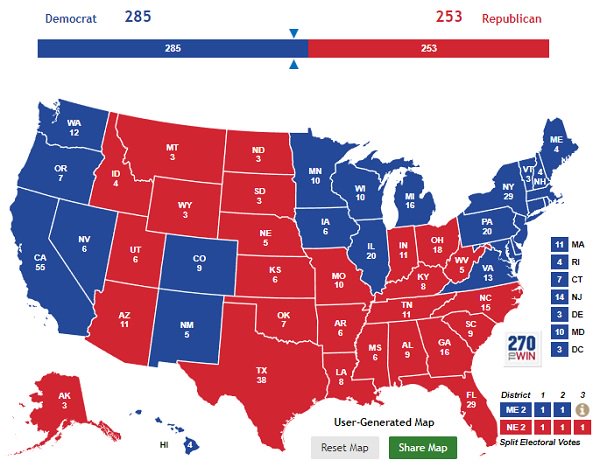
What we find is that if the midterm election in 2018 had been a Presidential Election and that a midterm is a referendum on the President, then Jo Sample running for the Democrats would have beaten Donald Trump. This fits in with the general narrative that it was expected that any Jo Sample would have beaten Hillary Clinton in 2016 and any Jo Sample that wasn't Hillary Clinton would have beaten Donald Trump in 2016. The fact that you had the two most unpopular candidates running against each other in US electoral history made predicting the election difficult and five-thirty-eight's 'incorrect' prediction was totally justified.
What we find is that over the long run, 2016 is something of an anomyly. From 2000-2012 there are four states which blink either red or blue which swing elections; Ohio, Florida, Colorado and Nevada. Trump carried Wisconsin, Michigan and Pensylvania by the barest of margins in 2016 and those three have reverted back to the long term trend of being nominally blue for the 2018 midterm.
The visceral reaction of contempt for Donald Trump did result in a larger degree of turnout at the midterms by voters of both sides but I don't think that that necessarily does anything for the political weather map except turn the pressure. As with any large pressure cell on a weather map, if the winds are blowing one way as the system passes they will blow the other way when the other side arrives. In the case of Donald Trump, I don't see him as anything other than a very high pressure system that comes and goes. I hope that there's been enough of a foul miasma in the air that come January of 2020, that rank and file Republican voters who vote in the primaries, eject this fug before he gets to the general election in November.
This is why I think that Trump is really not that exciting as a political candidate. If a Jo Sample would have beaten Hillary Clinton in 2016 and the midterms shows that a Jo Sample would have beaten Trump in 2018, then the political needle has in fact swung nowhere in the long run. That's kind of important because I don't see any road to impeaching Trump before 2020; which means to say that if by some hitherto unknown reason Trump manages to win the 2020 primaries, then I suspect that any Jo Sample would beat him in 2020. Any Jo Sample except for Hillary Clinton, that is.
What I really don't understand is why people continued to select Donald Trump and expect to get good government. People like Marco Rubio, Ben Carson, and even Jeb Bush, might have had politics that people don't like but they were at least competent to do the job. I bet that any of those people would have beaten Hillary in the election and by exactly the same margin.
I don't really think that there's a lot to worry about when it comes to dismantling his legacy because the 115th Congress has been somewhat quiet and the 116th Congress is almost certainly destined for a gridlock situation. The administration starting from the Oval Office and all other positions downwards has been so incredibly inept, that they haven't really achived anything of note. Once you remove the colour of the personality of the man himself, his administration is lacklustre and in the grand scheme of things, doesn't radically alter the grand narrative.
As for the suggestion that democracy is broken, which has been touted by various political commentators, all that proves is that the method of selecting the executive is badly constituted and I think that any other reasonably well thought out political system would have long removed him by now.
It's also telling that in this scenario, the difference is 32 electoral college votes; which means to say that if the 29 votes of Florida swing in the other direction the map turns into a red result.
Setting aside the bluster and nonsense, if you actually look at the data and compare it to the long term trends, then Donald J Trump actually ceases to be all that surprising.
One of the fun experiments that you can run in a mid term year is to see if the president would have retained the presidency. I know that it sounds daft but you literally have a data set with which to run the experiment with, by virtue of having just collected the data. I realise that it isn't exactly perfect but as five-thirty-eight showed before the 2016 election, if you are trying to predict the future by looking at opinion polls which are by nature incomplete, then you will be disappointed when the expected result doesn't come out. However, if you predict the present with a complete set of data, which is what the midterms are, then you will be disappointed in an entirely different way.
We can generally assume that that turnout for a presidential election is higher than for a midterm election. We can however kind of correct for that a bit by making the assumption that the Senate election is a bunch of new people who didn't vote in the House election. Yes, I know that it is wrong but its the best that we're going to get.
All we have to do is take all of the votes for both the House and Senate on a state by state basis and treat them as though they were votes for the President. Since there are already votes for the 50 states plus DC, then you just have to plug the results into the electoral college (taking careful note of those states who don't use a winner takes all basis) and then run the game out. I looked at 51 sets of results and they spat out this:
What we find is that if the midterm election in 2018 had been a Presidential Election and that a midterm is a referendum on the President, then Jo Sample running for the Democrats would have beaten Donald Trump. This fits in with the general narrative that it was expected that any Jo Sample would have beaten Hillary Clinton in 2016 and any Jo Sample that wasn't Hillary Clinton would have beaten Donald Trump in 2016. The fact that you had the two most unpopular candidates running against each other in US electoral history made predicting the election difficult and five-thirty-eight's 'incorrect' prediction was totally justified.
What we find is that over the long run, 2016 is something of an anomyly. From 2000-2012 there are four states which blink either red or blue which swing elections; Ohio, Florida, Colorado and Nevada. Trump carried Wisconsin, Michigan and Pensylvania by the barest of margins in 2016 and those three have reverted back to the long term trend of being nominally blue for the 2018 midterm.
The visceral reaction of contempt for Donald Trump did result in a larger degree of turnout at the midterms by voters of both sides but I don't think that that necessarily does anything for the political weather map except turn the pressure. As with any large pressure cell on a weather map, if the winds are blowing one way as the system passes they will blow the other way when the other side arrives. In the case of Donald Trump, I don't see him as anything other than a very high pressure system that comes and goes. I hope that there's been enough of a foul miasma in the air that come January of 2020, that rank and file Republican voters who vote in the primaries, eject this fug before he gets to the general election in November.
This is why I think that Trump is really not that exciting as a political candidate. If a Jo Sample would have beaten Hillary Clinton in 2016 and the midterms shows that a Jo Sample would have beaten Trump in 2018, then the political needle has in fact swung nowhere in the long run. That's kind of important because I don't see any road to impeaching Trump before 2020; which means to say that if by some hitherto unknown reason Trump manages to win the 2020 primaries, then I suspect that any Jo Sample would beat him in 2020. Any Jo Sample except for Hillary Clinton, that is.
What I really don't understand is why people continued to select Donald Trump and expect to get good government. People like Marco Rubio, Ben Carson, and even Jeb Bush, might have had politics that people don't like but they were at least competent to do the job. I bet that any of those people would have beaten Hillary in the election and by exactly the same margin.
As for the suggestion that democracy is broken, which has been touted by various political commentators, all that proves is that the method of selecting the executive is badly constituted and I think that any other reasonably well thought out political system would have long removed him by now.
It's also telling that in this scenario, the difference is 32 electoral college votes; which means to say that if the 29 votes of Florida swing in the other direction the map turns into a red result.
November 22, 2018
Horse 2490 - What Is Your Desired Salary? Probably To Be Paid One
I realise that as I have recently entered my fifth decade upon this planet, and any semblance of youth that I might have had has now been replaced with curmudgeony and the assumption of other people that I have accumulated wisdom (believe me, I haven't; I have no idea what's going on most of the time, it's just that I know how to make declarative statements); so this means that people now ask me questions in the hope that I have something good to offer. At best the advice that I can dispense is dubious and at worst it is dangerous; you would be ill advised to drink deeply from my font of knowledge.
Nevertheless, I was sent an email at work this week where I was asked a question and the answer which I gave them will be reposted below.
I am applying for an internship at a large company and they want to know what my desired salary is. I don't know what my desired salary is, I just want a job. What salary should I ask for?
Does this sound really creepy or not? What do you think is going on?
Eleanor.
(this has been edited for privacy reasons)
My reply is below:
Dear Eleanor¹ (not her real name),
What I think is going on here is that this company is conducting a reverse auction. I think that this company is collecting applications from lots of people and then wants to hire the person who bids the lowest starting salary.
There are various job sites like seek.com where you can compare the salary range for various positions and so if you want to know what you should be paid, you might like to look through those and get an idea of what would be normally acceptable.
I suspect though, that because this has been labeled as an 'internship' that this company would like to pay someone in the position nothing at all, if they can get away with it. If you think that there is a future with them then have a think about it but I would tread carefully. Find out what an employee should expect to be paid in this job. Don't devalue or undermine yourself.
Thank you,
Andrew Rollason
PS: If you want to have a gamble because you want to test the character of the company, then put down $500,000/hr see what sort of reaction that gets. If they do actually have a budget for this position and they genuinely want to pay a salary, then I think that you should be entitled to all of it.
To be fair, I haven't had to look for a job in a long time and so I'm sure that I will find it stressful when I will do again but at least I will not face this dilemma. The truth is that I did come across this tactic of asking what your salary expectation was and I stated more than 50% of what the going rate was. They accused me of demanding too much and I accused them of looking for the lowest bidder and that quite frankly I didn't want to work for them. I didn't take the job, or rather I didn't take the job when they then chased after me and disclosed what they were going to pay - because my suspicions were confirmed. I think that it benefited me not to take a job and not have to include it on a résumé, than take it and be immensely unhappy in it. Every job is going to come with its thorns but being adequately compensated monetarily kind of helps to take the sting out of those thorns (a bit).
What I didn't say in this email to Eleanor because I didn't want to include it in official correspondence but do want to have a rant about it², is that I really hate what modern 'internships' have become. Once upon a time, a firm would employ an intern or apprentice or a trainee because they had a need to employ someone and the idea was that the inter would acquire skills and experience and become more useful. Now it seems that internships are an excuse for increasingly unscrupulous employers to extract free labour out of mostly younger and vulnerable people, by dangling the carrot of hope in front of them but there's actually nothing of substance behind it. It also has the added bonus that while someone is on an internship, they are still within a probationary period and so unfair dismissal laws don't apply to them; especially if they are unpaid internships. Once the firm is done with one intern, they can spit them out and move on to the next one.
The kinds of firms that are likely to offer internships as opposed to traineeships where there is a legal requirement for on the job training and assessment or a traditional apprenticeship which comes with the prospect of a trade certificate at the end, is because an internship is not legally defined at law, there aren't any workplace arrangements which surround them either. When the internship is unpaid, then that comes with the double whammy of not being covered by workplace insurance and conditions regulations is addition to there being no pay. Get injured at work if you're an intern? Don't worry, because there's no salary attached, then the allowable minimum compensation is zero. If you were to calculate the claim then an applicable percentage of zero is still zero.
Because internships are more likely to offer zero salary, then this has the bonus effect for employers of filtering out all of the poor people. If you happen to suffer the burden of work because you need to put food on the table and keep the rent collectors at bay, then you are not very likely to want to apply for an unpaid internship. This has been especially useful for legal firms and the big media companies because it means that they get a better economic class of candidate. If you have the ability to live a comfortable life while living at home with your parents in a middle class existence, then that's the sort of future employee that these firms are looking for. Granted that it will cost you in time and money which you will lay on the altar of capitalism in tribute but if there's a hope of a job at the end, then that's worth it, right?
This is a completely expected step in late stage capitalism; having spat out all the poor people, the beast has no problem with eating the children of the middle and upper classes.
It gets even more blatant in the creative fields because design firms will often demand to see a practical application for a job and will set a task as the application process. The unstated purpose is that they've worked out a convenient method of contracting out work for free, and can get hundreds of prototype briefs at once and just use those. There might not be an actual job behind it all either.
Before you accuse me of being cynical, I already know that I am suspicious of people's intentions. Accuse all you like. I've already been convicted, found guilty and am nor imprisoned in the world. Maybe twenty years ago the myth of the dignity of work was on the surface still being respected but those days are clearly over³. When you combine the effects of capital reasserting itself in the economy with the continuing march to automation, with the desire that was always there, to pay people as little as possible, then of course it stands to reason that the veil has been taken off and we're left with naked capitalism.
It's just that if we are supposed to play the game according to these rules, where you have to name your price up front, then my price just happens to include my dignity and a decent salary. I would be very disinclined to want to work at a firm who asks for salary expectations up front because the character of the firm is already on display and if that's the price, I just don't buy it.
¹Conspicuous by its absence is a lack of a salutation line. This is already a bad start because an email is essentially a letter and as such should be treated with formality and dignity; especially if it is in a business capacity.
²Eleanor was given a link to this rant.
³As if they ever started:
It is not from the benevolence of the butcher, the brewer, or the baker that we expect our dinner, but from their regard to their own interest.
- Adam Smith, The Wealth of Nations (1776)
November 15, 2018
Horse 2488 - If Brexit Doesn't Mean A 585 Page Document, We Have No Idea What It Means
Because the world has been looking at the left hand side of the Atlantic at the continuing horrorshow of American politics that results when the people elect an unreality TV star as president, the world has largely been ignoring the horrorshow on the right hand side of the Atlantic that has resulted when the people elected for unreality as economic policy.
Unlike phrases such as "this means war" or "beanz meanz heinz" nobody knew what "Brexit means Brexit" meant before the referendum and the principle players who caused the mess, namely David Cameron, Nigel Farage and Boris Johnson, have all been conspicuous through absence having to clean it up. Say what you like about Teresa May but the truth is that through sheer dumb luck, Britain ended up with an incredibly competent head of government; with the patience of Job, the wisdom of Solomon and the longsuffering of Paul, being imprisoned in a state of cruel and unusual punishment behind the black door of Number Ten.
The draft agreement between the UK and EU has been finally published and at 585 pages¹ I decided not to print it because it would use more than an entire ream of paper. The short answer to what this monster document contains are as follows.
It decouples the Pound Sterling from the Euro; which is an easier task than had the UK entered the common currency. It undoes a lot of uniform taxation policy and payments towards the maintenance of the common market and it also removes the payments which might have flowed in the other direction. It creates a so-called "hard border" and basically pulls the UK out of both the free movement zone but doesn't have to address the issue of the Schengen Area because both the UK and Ireland always maintained an opt-out. It looks as though there's a single customs territory; which in practical terms means that customs checks are not needed on goods coming from within the EU but given that there are already security checks at both Calais and Folkestone, not much changes.
From what I can gather, the deal looks to be what would have been expected when untangling the mess and I don't really see what else could have been done differently. Nevertheless, there appears to something of a revolt brewing with at least nine cabinet minister, being Liam Fox, Jeremy Hunt, Penny Mordaunt, Sajid Javid, Andrea Leadsom, The Baroness Evans, Chris Grayling and Gavin Williamson the Chief Government Whip, in addition to David Davis, Boris Johnson and Minister from the 1920's Jacob Rees-Mogg², all expressing their displeasure.
As it stands, under the rules of the Conservative party, a leadership spill can be triggered if 15% of all sitting MPs send a letter of no confidence to the chairperson. From what I can gather, there have been 44 letters which have already been sent; there are 316 Tory MPs in the commons, so that leaves just 4 for Britain to hold its own Festival Of The Thirsty Knife.
This is further complicated by the fact that the Tory party is only help in government because of the support in condfidence and supply by the Democratic Unionist Party of Northern Ireland; who might just pull their own levers top bring down the government if they don't like the Brexit deal.
Just to throw another spanner in the works of a machine which at this stage is primarily made entirely from spanners, Scotland's First Minister Nicola Sturgeon had this to say:
Oh dear.
From here, the plan goes to the even bigger sausage machine that is the EU and then back to the House of Commons where there will be a vote. I wouldn't even like to predict how that's going to go because this whole thing has been flying around Whitehall like a hand grenade with the pin taken out that nobody wants to hold for too long.
If the Commons does actually pass this thing, which might not happen because of a Tory revolt or because the DUP decide to switch side, then it goes to the EU who then presumably have their own vote on the floor of the EU parliament. If it falls over either in the House of Commons or the EU parliament then who knows what happens?
Is there a General Election? Is there another redo referendum where Britain can say "Sorry guys, we've got no idea what we're doing"? Does Britain redo the terms of the deal? Or do they just leave with no deal and no idea of what that looks like? I have no idea. I can't find anyone whose written a decent piece on this who has an idea. Dare I say it, the 650 MPs in the House Of Commons also have no idea.
Ms May has at least tried to present an idea; despite not wanting Brexit before the referendum and being left with a problem that she didn't create. I think that it's the best that can be expected in all honesty. Brexit means Brexit, whatever that means; nobody has an idea.
¹https://assets.publishing.service.gov.uk/government/uploads/system/uploads/attachment_data/file/756374/14_November_Draft_Agreement_on_the_Withdrawal_of_the_United_Kingdom_of_Great_Britain_and_Northern_Ireland_from_the_European_Union.pdf
²https://britishpathe.files.wordpress.com/2010/05/ray-alan.jpg?w=450
Unlike phrases such as "this means war" or "beanz meanz heinz" nobody knew what "Brexit means Brexit" meant before the referendum and the principle players who caused the mess, namely David Cameron, Nigel Farage and Boris Johnson, have all been conspicuous through absence having to clean it up. Say what you like about Teresa May but the truth is that through sheer dumb luck, Britain ended up with an incredibly competent head of government; with the patience of Job, the wisdom of Solomon and the longsuffering of Paul, being imprisoned in a state of cruel and unusual punishment behind the black door of Number Ten.
The draft agreement between the UK and EU has been finally published and at 585 pages¹ I decided not to print it because it would use more than an entire ream of paper. The short answer to what this monster document contains are as follows.
It decouples the Pound Sterling from the Euro; which is an easier task than had the UK entered the common currency. It undoes a lot of uniform taxation policy and payments towards the maintenance of the common market and it also removes the payments which might have flowed in the other direction. It creates a so-called "hard border" and basically pulls the UK out of both the free movement zone but doesn't have to address the issue of the Schengen Area because both the UK and Ireland always maintained an opt-out. It looks as though there's a single customs territory; which in practical terms means that customs checks are not needed on goods coming from within the EU but given that there are already security checks at both Calais and Folkestone, not much changes.
From what I can gather, the deal looks to be what would have been expected when untangling the mess and I don't really see what else could have been done differently. Nevertheless, there appears to something of a revolt brewing with at least nine cabinet minister, being Liam Fox, Jeremy Hunt, Penny Mordaunt, Sajid Javid, Andrea Leadsom, The Baroness Evans, Chris Grayling and Gavin Williamson the Chief Government Whip, in addition to David Davis, Boris Johnson and Minister from the 1920's Jacob Rees-Mogg², all expressing their displeasure.
As it stands, under the rules of the Conservative party, a leadership spill can be triggered if 15% of all sitting MPs send a letter of no confidence to the chairperson. From what I can gather, there have been 44 letters which have already been sent; there are 316 Tory MPs in the commons, so that leaves just 4 for Britain to hold its own Festival Of The Thirsty Knife.
This is further complicated by the fact that the Tory party is only help in government because of the support in condfidence and supply by the Democratic Unionist Party of Northern Ireland; who might just pull their own levers top bring down the government if they don't like the Brexit deal.
Just to throw another spanner in the works of a machine which at this stage is primarily made entirely from spanners, Scotland's First Minister Nicola Sturgeon had this to say:
Not long off call with PM. She tried to tell me Scotland’s ‘distinctive’ interests had been protected. I pointed out that there isn’t a single mention of Scotland in the agreement, that it disregards our interests, and puts Scotland at a serious competitive disadvantage.— Nicola Sturgeon (@NicolaSturgeon) November 14, 2018
Oh dear.
From here, the plan goes to the even bigger sausage machine that is the EU and then back to the House of Commons where there will be a vote. I wouldn't even like to predict how that's going to go because this whole thing has been flying around Whitehall like a hand grenade with the pin taken out that nobody wants to hold for too long.
If the Commons does actually pass this thing, which might not happen because of a Tory revolt or because the DUP decide to switch side, then it goes to the EU who then presumably have their own vote on the floor of the EU parliament. If it falls over either in the House of Commons or the EU parliament then who knows what happens?
Is there a General Election? Is there another redo referendum where Britain can say "Sorry guys, we've got no idea what we're doing"? Does Britain redo the terms of the deal? Or do they just leave with no deal and no idea of what that looks like? I have no idea. I can't find anyone whose written a decent piece on this who has an idea. Dare I say it, the 650 MPs in the House Of Commons also have no idea.
Ms May has at least tried to present an idea; despite not wanting Brexit before the referendum and being left with a problem that she didn't create. I think that it's the best that can be expected in all honesty. Brexit means Brexit, whatever that means; nobody has an idea.
¹https://assets.publishing.service.gov.uk/government/uploads/system/uploads/attachment_data/file/756374/14_November_Draft_Agreement_on_the_Withdrawal_of_the_United_Kingdom_of_Great_Britain_and_Northern_Ireland_from_the_European_Union.pdf
²https://britishpathe.files.wordpress.com/2010/05/ray-alan.jpg?w=450

November 11, 2018
Horse 2487 - The Armistice
100 years ago today, the Allied supreme commander and Marshal of France Ferdinand Foch, the First Sea Lord Admiral Rosslyn Wemyss, MP for Biberach in the Reichstag Matthias Erzberger, a representative from the German Foreign Ministry Count Alfred von Oberndorff, Army Major General Detlof von Winterfeldt and Naval Captain Ernst Vanselow, all met in Ferdinand Foch's personal railway carriage which was in the Forest of Compiègne, and signed off on the Armistice which brough four and a bit years of pointless bloody slaughter to an end.
And for what? In some cases the border didn't move more than a few miles and within a generation it would all be on again. Probably as many as 40 million people were killed as a result of a series of disputes which started out as a bunch of cousins having a diplomatic spat and the the shooting of an archduke by a terrorist. Prior to 1914 nobody knew what an archduke was and afterwards most people still didn't know, except that if you shot one, a war would break out.
Kaiser Bill abdicated on November 9, Austria-Hungary ended on the 11th and snapped into several bits, Italy changed sides so many times that it didn't know what side it was on anymore, France remained being France, Britain remained being Britain, and the United States who joined the war late and mostly for their own amusement, decided to boss everyone around afterwards.
Did we as a world learn anything from the First World War? Not really. The words Generationshass and Erbfeindschaft, roughly describe a condition which was fought constantly between France and Germany; in which the next generation would inherit the anger of the previous. To that end after the 1756 Seven Years' War, there were the the Revolutionary Wars with a war in 1812, the great 1848 war of everyone versus everyone, the Franco–Prussian War in 1870, the First World War in 1914 and the Second World War in 1939. Only then did Europe decide that it was all pointless and the advent of the European Coal and Steel Community which later became the EEC and then EU, has meant that the wars of 1975 and 2005 never happened. World War 1 in context was a time which nothing was learned.
In fact nothing was learned to such a bloody degree that the Treaty of Versailles contained the provision that Germany was to "accept the responsibility of Germany and her allies for causing all the loss and damage" and this was written into Article 231; when assessed was worth 132 billion marks, which was utterly stupid and helped sow the seeds of the Second World War. The Arimistice was the end to the war but the Allies lost the ensuing peace.
Governments would return little pieces of metal with ribbons attached, in place of the sons and brothers and fathers who were now corpses in ditches across Europe. Sometimes they would attach little pieces of metal with ribbons to the still living sons and brothers and fathers, who were now somewhat damaged; if not physically then mentally. There were some women sent to be nurses and caregivers but they generally weren't turned into the sorts of cuts of meat that would be found in a butcher's window in anything like the same numbers. Mostly the mothers and wives were left with holes in their hearts; for which governments never truly compensated them for.
Some men (always men), congratulated themselves for their heroism in commanding troops in the field; even if they were miles away from front and being lubricated with sherry and port. They invariably won even more bits of metal with ribbons attached, and some of them won the right to put letters after their name. Sometimes the men in the muddy trenches won the right to put letters like GC and VC after their name but usually after they were already dead; which is kind of irrelevant to them.
The Eleventh Hour of the Eleventh day of the Eleventh month, is a date in history which should have never have happened because the preceding four should also have never have happened. 11-11-1918 is the end of a conflict in which the coin of the realm of the battlefield, which is people's lives, was spent needlessly, for no real net benefit. The Colonel Blimps of the world gladly spent a currency which they themselves would never be liable to pay.
This is a lesson which leaders today who want to go into the world to make war should learn. The coin of the battlefield is a very precious and terrible thing to spend and while we like to dress all of this up in colours of heroism, patriotism and national fervour, it still doesn't change the fact that those who gave the ultimate sacrifice, did so on the altar of men's pride and mostly pointlessly. If the 37 days in 1914 had played out as a game of actual diplomacy instead of total diplomatic failure, then 11-11-18 would have just passed into history as a boring cold autumn day in Europe. The war ended not because of some brilliant military breakthrough or strategy but because everyone agreed to stop. This is the greatest day of the First World War for that reason.
Lest We Forget.
Subscribe to:
Posts (Atom)