November 09, 2022

Horse 3094 - This Time, Baby, I'll Rewrite "Bulletproof"

 Owing to the fact that I have less days in front of me than behind and am thus already over the hill and on the inevitable downward slide, hurtling towards death, it shouldn't surprise anyone that the peak of my listening to music on the radio has also passed. (Memento Mori Quam Pura Nites). It also doesn't help that the death of Rock Music on the charts likely happened c.2011 and that in an age where everyone get find anything all of the time, that music is now so diffuse that Taylor Swift can occupy all top ten places on the Billboard charts with total sales of those song which two decades ago would not have even charted on the Billboard Top 100.

This means that what does pass through the filters of my personal apathy and public diffusion, is either something so very massive that everyone in the world has heard it or something so old that it's taken a long time to reach me. I for instance know about the existence of Gangnam Style and Despacito but that's likely because those songs have had literally billions of plays on the radio and the internet. Thanks to an advert for an allergy medicine which features a lady singing the song (which may or may not be the lady in the advert), the song that has finally decided to reach me of late and which is currently running around as an ear worm in my head is the 2009 song "Bulletproof" by La Roux. I have heard her version of the song far too often to enjoy it and I am not really a fan of the original but I think that I have discovered my favourite song of 2022.

"How so?" you now ask unless you are able to read text without any kind of inner voice at all. How so indeed? To listen to the version that I like, you're going to have to do some tweaking to the track via the simple controls on YouTube.

I want you to play this song at 0.75x speed because what emerges is something which I do not think that La Roux ever thought of but which in my opinion is better than all other versions of this song, which I think are mostly annoying.

At 1.00x speed, aka 'normal', I think that the usual chord structure of this song is Bm E G Bm. I should point out that I don't really know as I do not have access to a piano and therefore am unable to determine whether or not my guess is correct. I did however noodle about on the guitar and this seemed about right. If we take my guess as true, then I think that the nominal key of this song is B Minor. If so, then I think that B Minor acts as the I chord and the chord which the song constantly wants to return to. I don't really need to know what the functions of the other chords are in this song but you might like to have a play and see what you get.

If we assume that A is a concert A which sits at 440Hz, then the B at the root of the B Minor chord in question likely works out to be about 493Hz. When you stretch out the song, the pitch of literally everything drops and applied maths will give you a new root for the altered song at 369Hz. If you then work backwards from there, then the I chord becomes an F# and the four chords in the song drop to F# Bm D F#.

In principle F# is not exactly a sensible key to be writing songs in, however, because this whole thing has been pitch shifted then all of the hard work has already been done. Here's the fun thing, we already find F# B D in a bunch of Blues Chord voicings because all of those chords exist in the key of G; which is already a good blues key. GDG as a triad is the root and the fifth of G. What we have in effect is a de-facto-faux-les-blues song; which given that the original song is sort of a diss-track post break-up, seems like an apt sort of set of chords to be playing in. F# is not a sensible key to be writing songs in but when they all exist in G, then we're just playing with a chord substitution.

I like the ornamental features of this song which include a 1980s synth pad which sounds like an 8-bit video game, and the 16 bar repeating beat pattern but ultimately my wish is for someone to rerecord this song in the lower key and at the slower speed and in the style of a 1930s big band or an 1890s ragtime piece on a parlour upright piano. I guess that this is a roundabout way of saying that I am way less enthusiastic about the original version and the advert version of this song and more enthusiastic about the potential that this song has. 

Both the original song sung by La Roux and the version sung by the lady in the advert, are both in octaves which are impossible for me to reach. When you get a choir together who are all singing in different registers, they might be singing different parts or perhaps even a different set of notes but they're still singing the same song. However, my suggestion for playing the song at a slower speed doesn't just play the same notes and chords at lower octaves, it shifts everything from pitch to key; all at the same time because the same recording is used.

This is a fun thing about humans. Practically none of us have perfect pitch and to be perfectly frank, it would be a perfect storm of a perfect curse to have perfect pitch. When people remember a song, they nary give a hoot about things like key and/or about what the actual notes at. Music is not about notes but is actually about the intervals between them. Once you have pitch shifted a song by playing it back at a slower speed, it is still recognisable as the same song because it IS the same song.

November 07, 2022

Horse 3093 - Let's Assume The 2020 Election Was Stolen

As the United States goes to the ballot boxes this week for the 2022 mid-term elections where one third of the Senate is up for election, all of the House of Representatives is up for election, as well as many many state Governors and positions in state legislatures, we can not escape the miserable spectre hanging over these elections or the elephant in the room which says that the 2020 'election' was stolen.

In any sensible world, a court of justice would look at the events of January 6th 2021 and conclude that former President Donald Trump making remarks that he was going to walk up to the Capitol building constitutes an incitement to violence and that his remarks both before and after the event (which includes "I love you" to the people who marched on the the Capitol building) constitutes aid and comfort to those who caused insurrection and violence at the heart of government. However, we do not live in a a sensible world; quite the opposite. Instead we have someone who should have been disqualified for running for office, being aided and abetted by right-wing nutter media, who is very likely to announce that he will be running for President in 2024 and that he will be making that announcement on November the 14th.

But it we set all of that aside; if we lay down all shreds of morality; if we dare to deny reality and claim that the United States holds an 'election' as opposed to the fact that it actually holds 50 elections for the President, and if we arrive at the conclusion that the 2020 'election' was stolen, then shouldn't we think that it is reasonable to do something about it? 

As someone who follows politics like someone who follows sport, I get to hear a lot of analysis from pundits and former players of the game who should know better than I. Also as someone who has been watching this game for many years and who has a pretty good grasp of the rules, I think that I have at least some understanding of the nuances of the game. If we accept at face value that the 2020 'election' was stolen, then why have I heard nobody talking about actual electoral reform? If we accept that the 'election' was stolen then you should expect that the players of the game would want to improve either the rules or the refereeing but nobody has suggested this at all.

At every point from the election of Representatives to Senators, to the appointment of Judges, to the selection of the President via the Electoral College which by definition isn't direct democracy, to the absolutely undemocratic appointment of the cabinet by the President, the United States has managed to invent a bad system of government with a bad constitution; which is then populated by bad candidates and a bad method of selecting them. 

The first problem is that there is no express right to the franchise within the United States Constitution. The United States has a hyper-politicised way of reading its Constitution but for the most part it wants to return to what the intent of what a bunch of long since dead men who argued in sweaty rooms and who were openly racist, thought. I have read a lot of opinion on this and so I think that the general conclusion as applied is that as the franchise shall not be denied on account of this and that, highly factional and hyper-partisan and self-interested parties are still free to deny the franchise on account of the other. Remember, a 'right' is an ability to do an action or own a thing at law. Both Amendment XIX and XIX hint spell out upon what grounds that the franchise can not be denied but that is different in principle to expressly granting the right in the first place. You can not take an orginalist and constructionist approach to reading the United States Constitution and say that the right to the franchise expressly exists when in the first instance it was denied to people on many and several grounds. The corollary of not having an expressly existing franchise, is that it is a non-sequitur that the election can be stolen by people who didn't expressly have the right in the first place. 

The second problem is that if we accept that the 2020 'election' was stolen, then we should expect to see safeguards put in place to prevent future theft of elections. That should mean setting up a proper independent and non-partisan electoral commission and removing the administration of the election from the 50 states or at very least running all 50 elections to a set of identical rules and having a proper independent and non-partisan electoral commission running proper independent and non-partisan electoral oversight.

Not once have I heard anyone say that they want elections removed from the responsibility of the states. Not once have I seen any plan put forward for that proper independent and non-partisan electoral commission. Not once have I seen any detail put forward for the independent counting, collation, and reporting of results. At very least if you have hyper-politicised and partisan politics then you should have representatives from the interested parties and candidates in the room when the votes are counted; not once have I heard anyone say that they want this.

The third problem is the physical marking and counting of ballots. If we assume that the hyper-politicised and partisan parties hate each other to the degree that the media likes to report this hatred, then that level of distrust and hatred should be the basis for physical counting and checking if necessary. If you can not trust the other party and you do not trust the system (which is evidenced by the accusation that the 2020 election was stolen) then you absolutely should not trust any kind of process that does not involve a physical marker that can be checked and rechecked. You absolutely should not trust any voting machine. In fact, you should not trust any voting machine to the point where you would even use them. Every single kind of voting machine involves some level of obfuscation; which you must assume is being used for nefarious purposes. 

The only possible method of ensuring trust and confidence in the voting system is with the physical marking of ballot papers, which are firstly placed in sealed containers which themselves are not trusted and are being watched, and which are then counted in full view of every hyper-politicised and partisan self-interested party. This is quite apart from the method used to count the votes; which given that the United States tends to use the First Past The Post system (aka most votes wins( is already nonsensical. 

Anything less than expressly guaranteeing the right to vote, running free, fair and independent elections, and running elections where the process can be looked upon from the outside and examined and checked and rechecked if necessary, means that any calls to suggest that the election was stolen must be taken in bad faith. For if someone wants to accuse an election process of being stolen and then suggests nothing at all to reform the process and demand that proper safeguards are put in place, which by the way might actually hinder your own chances of being elected, then we can take it as fact that they don't actually care about the process and are making said accusation that the election was stolen as a shot in a propaganda war. 

November 02, 2022

Horse 3092 - Constitutional Survey - VIII

<><><><><>

81. Consolidated Revenue Fund

All revenues or moneys raised or received by the Executive Government of the Commonwealth shall form one Consolidated Revenue Fund, to be appropriated for the purposes of the Commonwealth in the manner and subject to the charges and liabilities imposed by this Constitution.

<>

From a functional perspective, the idea that there should be one consolidated fund for the Commonwealth of Australia, makes perfect sense. Since the faith and good credit of the Commonwealth is drawn upon the Crown as corporation sole, then a single consolidated fund for that corporation, strengthens the principle of fidus which underlines the currency.

At the formation of the Commonwealth of Australia, the six colonies were not issuing currency in their own right but rather, Pounds Sterling which were ultimately back by the Bank of England and the Crown as corporation sole in London. Although not explicitly stated in the Constitution, the Commonwealth of Australia as the agent for the new corporation sole, would not actually be issuing Pounds Sterling but Australian Pounds. Initially and functionally they would have been tariffed at 1 AuP to 1 GBP and in fact no actual coinage for Australia would be struck until 1910; which meant that Britannia would still rule people's pockets as well as the waves, for a while longer.

One of the features about money is that it is perfectly fungible. That is, one shilling is exactly replaceable with any other shilling. It is kind of interesting when you need to explain this to people who are convinced that you need different pots of monies to achieve different purposes. In actual fact, as money is fungible, then this is unnecessary as all monies achieve the same purpose and function which is the exchange of goods and services. 

Section 81 is the underlying constitutional plank, upon which the Commonwealth Bank sat and now the Reserve Bank of Australia sits upon. Monies collected by the Australian Taxation Office, monies which are issued by the Department of Treasury, and the physical currency which fly around the economy at a massive rates of knots, are all drawn on and destroyed upon the basis of Section 81. 

<><><><><>

82. Expenditure charged thereon

The costs, charges, and expenses incident to the collection, management, and receipt of the Consolidated Revenue Fund shall form the first charge thereon; and the revenue of the Commonwealth shall in the first instance be applied to the payment of the expenditure of the Commonwealth.

<>

This is going to sound almost ridiculous but one of the theories as to the reason why money has any value at all, is to do with the fact that governments provide goods and services and issue tokens which are then accepted as payment, which creates a liability in the central bank of the nation; then that liability is retired and destroyed when taxation is paid back to the government. Money which is a universal token system for the exchange of goods and services, could in theory be literally anything but the authority and hence the value of that token system, lies in the state's monopoly of violence to be able to lay claim to collect and destroy those tokens.

Section 82 is the constitutional basis for the invention of the Australian Taxation Office, the second plank upon which the invention of the Reserve Bank of Australia sits upon, and the basis for every single tax including Income Tax, Royalties, the Goods and Services Tax et cetera. The really strange thing is that Australia when looking for guidance for the formulation of its constitution, came up with a better solution than the United States which still hadn't resolved the constitutional question of Income Tax.

<><><><><>

83. Money to be appropriated by law

No money shall be drawn from the Treasury of the Commonwealth except under appropriation made by law.

But until the expiration of one month after the first meeting of the Parliament the Governor-General in Council may draw from the Treasury and expend such moneys as may be necessary for the maintenance of any department transferred to the Commonwealth and for the holding of the first elections for the Parliament.

<>

The Commonwealth of Australia is not someone's personal bank account. It is not there for someone to write cheques for personal advantage. Of course if you are going to appropriate public monies then there should be laws passed through the parliament which authorise that appropriation. 

Section 83 also provided the ability before that first parliament ever sat, for the Commonwealth to fund the election of that first parliament. I find it very pleasing that despite some of the knavery and horribleness perpetrated by the various Crowns of Australia, that the Commonwealth of Australia was started with a vote and not a war. It is excellent that we have a day of independence and responsible government which nobody cares about because it is so unremarkable as to go almost unnoticed. I like boring government. 

<><><><><>

84. Transfer of officers

When any department of the public service of a State becomes transferred to the Commonwealth, all officers of the department shall become subject to the control of the Executive Government of the Commonwealth.

Any such officer who is not retained in the service of the Commonwealth shall, unless he is appointed to some other office of equal emolument in the public service of the State, be entitled to receive from the State any pension, gratuity, or other compensation, payable under the law of the State on the abolition of his office.

Any such officer who is retained in the service of the Commonwealth shall preserve all his existing and accruing rights, and shall be entitled to retire from office at the time, and on the pension or retiring allowance, which would be permitted by the law of the State if his service with the Commonwealth were a continuation of his service with the State. Such pension or retiring allowance shall be paid to him by the Commonwealth; but the State shall pay to the Commonwealth a part thereof, to be calculated on the proportion which his term of service with the State bears to his whole term of service, and for the purpose of the calculation his salary shall be taken to be that paid to him by the State at the time of the transfer.

Any officer who is, at the establishment of the Commonwealth, in the public service of a State, and who is, by consent of the Governor of the State with the advice of the Executive Council thereof, transferred to the public service of the Commonwealth, shall have the same rights as if he had been an officer of a department transferred to the Commonwealth and were retained in the service of the Commonwealth.

<>

This is all pretty straight forward. Everyone who was working for a State government department which then gets transferred to the Commonwealth government, is still entitled to their pay and entitlements except that the Commonwealth will have to foot the bill and not the states. This kind of thing must have happened a lot during the initial phase of the Commonwealth and may again have happened as things like Defence, Customs, Agriculture and Rivers, Income Tax et cetera were handed over to the Commonwealth. 

<><><><><>

85. Transfer of property of State

When any department of the public service of a State is transferred to the Commonwealth:

- all property of the State of any kind, used exclusively in connexion with the department, shall become vested in the Commonwealth; but, in the case of the departments controlling customs and excise and bounties, for such time only as the Governor-General in Council may declare to be necessary;

- the Commonwealth may acquire any property of the State, of any kind used, but not exclusively used in connexion with the department; the value thereof shall, if no agreement can be made, be ascertained in, as nearly as may be, the manner in which the value of land, or of an interest in land, taken by the State for public purposes is ascertained under the law of the State in force at the establishment of the Commonwealth;

- the Commonwealth shall compensate the State for the value of any property passing to the Commonwealth under this section; if no agreement can be made as to the mode of compensation, it shall be determined under laws to be made by the Parliament;

- the Commonwealth shall, at the date of the transfer, assume the current obligations of the State in respect of the department transferred.

<>

Section 84 is the complementary property statement which accompanies Section 84. The only things which have ever existed since the creation of the world are the things in, on and under the ground and sea, and the people who live there. Since Section 84 has already dealt with the staff that are to be transferred at the inception of the Commonwealth and their respective entitlements, then Section 85 deals with the accompanying stuff. 

Section 85 is also the basis upon which firstly the Australian Capital Territory was transferred to the Commonwealth in 1913 and then Jervis Bay Territory in 1915; which contrary to popular belief, was never part of the ACT. 

<><><><><>

86. [Customs, excise, and bounties]

On the establishment of the Commonwealth, the collection and control of duties of customs and of excise, and the control of the payment of bounties, shall pass to the Executive Government of the Commonwealth.

<>

It makes sense that if the Commonwealth Government is charged with the obligation to manage quarantine and border controls, that it should also be given the privilege to charge customs duties on goods which enter the Commonwealth. Granted that some of this has to do with the protection of industries within the bounds of the Commonwealth but it also has to do with the safety and security of the people of the Commonwealth with respect to dangerous goods which may be used as weapons, agricultural and natural goods which have the potential to bring disease, and vice goods such as opiates, tobacco, alcohol et cetera which have to do with  the safety and security of people's own bodies.

Customs and excise duties on vice goods are generally imposed either as a deterrent to curb consumption through price controls, or as recovery through the instrument of taxation to help pay for the carrying costs which the consumption of those vice goods are going to impose upon the community and nation as a whole. There is also the rather strange fact that at levels on taxation above 4% of the value of vice goods, that the recovered revenues end up being slightly more than the costs incurred over someone's lifetime. A smoker for instance, generall has a shorter life and as such incurs less in the way of whole of life medical expenses, save for a sharp spike towards the end. The same can generallly be said about the amount of taxation recovered from alcoholics and dipsomaniacs.

<><><><><>

87. [Revenue from customs and excise duties]

During a period of ten years after the establishment of the Commonwealth and thereafter until the Parliament otherwise provides, of the net revenue of the Commonwealth from duties of customs and of excise not more than one-fourth shall be applied annually by the Commonwealth towards its expenditure.

The balance shall, in accordance with this Constitution, be paid to the several States, or applied towards the payment of interest on debts of the several States taken over by the Commonwealth.

<>

In the really early days of the Commonwealth of Australia, there was no Income Tax. The prime method of funding the Commonwealth Government was either through the imposition of customs and excise duties or transfer payments from the states. Section 87 suggests that the total revenue of the Commonwealth from customs and excise duties should be more than 25% of its total revenue; with the excess being refunded to the states. 

In 2022 when the size and scope of the Commonwealth has increased dramatically, the biggest source of funds flowing into the top of the bucket is Income Tax, with Company Tax and the Goods and Services Tax making up the next largest sources of revenue. I very much doubt that the percentage of revenues from customs and excise duties has ever reached as much as 25%; which means to say that Section 87 has been more or less functionally useless.

<><><><><>

88. Uniform duties of customs

Uniform duties of customs shall be imposed within two years after the establishment of the Commonwealth.

<>

The six states pretty much hated each other's existence and came together after the great powers of France and Germany started acquiring properties in the far east and the Pacific. Australia, which is more easterly than the far east, New Zealand which is more easterly still, and Fiji which is even more easterly, all came together to argue over Federation for the big purpose of defence and security. However the six states which were all singularly responsible for their own taxation, which included custom duties, excise, and what would in future be income tax, all had different rates of taxation all over the place.

A uniform rate of duties of customs does two things. Firstly it reduces competition between the states, who would have otherwise competed on taxation, excise, and duty rates, in order to attract business. Secondly, it reduces the ability for private entities to make profits via arbitrage; thus reducing dishonesty and knavery to some degree.

<><><><><>

November 01, 2022

Horse 3091 - Fragments XVIII: On Meetings, McMuffins, Magnitude, Mangling, and Michael

C21 - Conventions

The really useful thing about not having a written Constitution is that the inverse of a thing being unconstitutional and then causing a massive bunfight (which is a feature of the United States' political process) is that there can't actually be anything unconstitutional without a constitution to strike that off. What this means is that the British Parliament is always in a perpetual state of flux; where the rules are decided on an almost ad hod basis and convention lasts exactly as long as it needs to. Convention breaks down either at the point where it is no longer useful or at the point where the players in the system have already caused so much of an outrage that breaking an unwritten convention is the last straw the breaks the camel's back.

What we saw at the end of the Johnson premiership is that he was forced out of the job after everyone agreed that he was unfit for purpose. What we saw at the end of the Truss premiership is that she forced herself out of the job after she decided that the purpose was unfit for purpose. As I write this where nobody is in charge and everyone is free to eat Milo out of the tin (om nom nom nom), is that the general consensus is that the King should dissolve parliament because parliament itself is unfit for purpose.

It this sounds like an outrage of Royal Prerogative, bear in mind that the 1975 Australian Constitutional Crisis was resolved in the most sensible way possible when the Governor-General dissolved parliament and in a pique of democracy, sent the public to a General Election. Just imagine that. The 2022 Conservative Party omnishambles can best be resolved through the most democratic means possible. The best thing about not having a constitution is that Parliament can't very well complain that it is undemocratic to refer the problem to the people via the most democratic means. If they people then decided that they still wanted chaos and disarray, then it will be democratic chaos and disarray and not at all unconstitutional.

<><><><><>

M19 - The Burgerverse

The Sausage McMuffin exists. Sausage and Egg McMuffin exists. Egg and Bacon McMuffin exists. All of them have cheese on them. The only way that you can normally buy a McMuffin with Sausage and Bacon together is with a Mighty McMuffin which has Cheese, Sausage, Egg and Bacon; which is actually a Sausage McMuffin plus a Egg and Bacon McMuffin minus a McMuffin.

I do not know what kind of falling out that Sausage and Bacon had. It is clear that the mediator in the relationship is Egg, for in the middle of a Mighty McMuffin it is Egg who keeps them separate. Egg is very obviously the one in this group who is the boring friend but without whom the whole group would descend into chaos. Cheese who is everywhere, is just happy to flit between every clique on the menu and even hangs out after breakfast has ended. Cheese will play with Chicken, Beef, Fish. Bacon will also kind of play after breakfast but neither Egg nor Sausage will dare show their faces after 1030am.

Not that I am all that likely to spend very many of my Dollarpounds at the Scottish restaurant because as I walk through the Queen Victoria Building of a morning, I see the McDonald's next to a Luneburger which reminds me of the smell of spew, and Lush and Oz Hair which both interfere with my eyes. Somehow or other, the landlords of the Queen Victoria Building have managed to create a magic roundabout which is a horse tornado of unpleasant smells. 

<><><><><>

O14 - Order Of Magnitude

I have used this turn of phrase on a number of occasions, with a very specific meaning, and the other day my boss said that he always assumed that it just meant 'a lot' and sort if intuitively knew what it meant but this morning he asked me what it means. To be fair, I love things like this where you have a technical term for something but yet you can use it in normal conversation and people will kind of already know what you mean without actually knowing what you mean.

In mathematics and by extension in the sciences, an 'order of magnitude' is a multiple of the base that you are using. If you say that the new Capulet Firenza with the 4.0L V8 engine can four-wheel-drive costs $22,000 and it actually costs $220,000 then that is an order of magnitude difference because it costs 10x as much. The difference between 1 metre and 1 kilometre is 3 orders of magnitude because it is 1000x smaller, 1 kilometre is 1 meter times ten times ten times ten. The difference between a millionaire and a billionaire is also 3 orders of magnitude; Leon Musk owns more than one house or ten houses or even a hundred houses, he could buy a thousand houses; which seems like too many houses to have.

Magnitude is just an embiggenment of a thing. 'Magnify' means to look at something that has been embiggened. 'Magna' means an embiggened version of a Lancer. 'MAGA' means an embiggened version of a narciscist.

Harry Potter And The Order Of Magnitude is when Harry Potter does something ten times more impressive than a regular wizard, like actually writing that document for you instead of say "It looks like you are writing a letter. Would you like help with that?". 

<><><><><>

T26 - Weird Accent Shift

It has to be said that the purest expression of any accent, be it regional in the case of a vast unwieldy place like the United States, or a tiny place with discreet pockets like Britain, a broad shaded type of affair like Germany, or a mostly uniform place like Australia, is always that part of the population who are not only the most receptive to their parents accents but also their friends; that is, small children.

Kids up until about the age of 5 do not really develop meaningful accents. From about the age of 5-10 when they interact with other children, is when the twin forces of home and school start making massive changes to the way someone speaks; to the point that by about ages 10, 11 and 12, the process is complete.

In Australia we have a 'broad' and a 'refined' accent; with small regional variations but there isn't very much. Moreover, there isn't really a lot of variation between the Bogan West where I live and the decidedly posh Northern Beaches where I work. Whether I want to or not (usually not), I get to hear lots and lots of primary school and high school kids having conversations on the train and buses. I was already aware that there is a difference between my lack of Australian Questioning Intonation (AQI) and more people, I was already aware of my slightly different vowel constructions but recently I became aware of mid-tonal dips in long vowels.

I had always assumed that this was a feature of people's speech which I didn't understand; as though mid-sentence it sounds as though the world was falling apart. To my, a mid-tonal dip in a long vowel sounds like a whinge. What I am finding though, is that this is happening in perfectly boring sentences by a lot of younger people. I do not know if this is the impetuousness of youth or if this is in fact a slight change in the way that our flower of Australian English has bloomed.

<><><><><>

R7 - The Right to Vote

There is no explicit right to vote in the US Constitution. The 14th Amendment states that the right to vote can not be denied because of a previous condition of slavery and the 19th Amendment states that the right can not be denied on the grounds of sex. Neither of those Amendments prevent a legislature from denying someone to vote on some other grounds and neither of those Amendments express in a positive sense that the right to vote actually existed in the first place.

<><><><><>

M23 - Michael Jordan

To be perfectly honest, basketball is not a sport that I care much about. I have some broad idea about how it works but beyond knowing the names of a few teams and a few players, I can not say that I am a fan. Even so, even I who does not care about basketball, has heard of Michael Jordan. Probably as much as 30 years after Michael Jordan was at the height of his basketball tidying skills (basketball is a tidying-up game), you can still see kinds on the street who are wearing Chicago Bulls jerseys with the famous No.23 on them. 

What I want to know, is if the people who are wearing a Chicago Bulls Jordan #23 jersey in 2022, actually know who he is. I imagine that there must be at least some portion of the population who wear the jersey in the same way as people wear Ramones t-shirts; never having seen them live, or even on video.

The weird thing is that I have probably seen more of the Jordan #23 on the sporting field in the past two years than I ever cared to in the 1990s. Michael Jordan owns half of the 23XI Racing Team in NASCAR, along with Denny Hamlin; so #23 is currently in use as a sporting number. I seriously doubt though that the kids who are walking around in a Chicago Bulls Jordan #23 jersey in 2022 are likely to know this. I could be wrong.

<><><><><>

G5 - Good Enough

The people who really really appear to love burgers from the Scottish Restaurant (if you dare mention it's name then the ghost of Halloween past, dressed as an evil clown, will get you) are mostly small children and parents who want to appease small children. If you ask most adults, there are likely not many who will tell you that their favourite restaurant is the Scottish Restaurant but they will admit that it is good enough.

"Good Enough" is a similar principle to YAGNT (You Ain't Gonna Need That). If a product is good enough then it doesn't need to try harder to chase profits, and the general public who are life support systems for bank accounts and wallets with credit and debit cards will give up their dollarpounds for products which are not super satisfying but good enough.

It is said that perfect is the enemy of good. That is that in chasing perfection, a solution which would have done the job might be overlooked. Good enough is the slightly shabby cousin of good, where the solution doesn't explicitly have to be fantastic.

<><><><><>

H31 - Halloween

It is weird that in Australia, when it is still daylight outside after 7pm, that people want to appropriate a Northern Hemisphere post-Harvest festival. It is also weird that as we have no such holiday as Thanksgiving in Australia, that Christmas things are already in the shops and Christmas songs are already being played over the tannoy in shops. Santa Claus is coming to town but he has to walk past all of the pumpkins to get there.

The Mosman Chamber of Commerce issued no requests to businesses in the area to be equipped with lollies, as in previous years and so the number of children that we had arrive at our offices this year was only two. I heard a knock at the door, walked downstairs and saw a boy and a girl standing there, just sort of starting at me. One of them yelled "Lollies!" before they thrust their hands out and when I told them that I didn't have anything, I heard "****head!" before they both ran off back down the stairs giggling as though they'd made some funny joke.

October 28, 2022

Horse 3090 - Trois Mille Quatre-Vingt-Dix... Quatre-Vingt-Dix?!

"What?! FRANCE, why do you do numbers so weird?! I hope they could hear me. They need to know."

- via Facebook, 26th Oct 2022.

Anyone who has ever tried to learn French, including native speakers, must have at some point realised that the French method for naming numbers is madder than a March hare. 

It makes some sort of sense that right across Europe, that numbers beyond 12 cease to have individual names. We have ten digits on our hands plus to feet is twelve. It also helps that twelve is a nice composite number with many factors.

Like English, French has words for small numbers:

11 - Eleven: Onze

12 - Twelve: Douze

Unlike English though, French has words for small numbers which English does not:

13 - Thirteen: Treize

14 - Fourteen: Quatorze

15 - Fifteen: Quinze

16 - Sixteen: Seize

At seventeen, French finally runs out of names for its numbers:

17 - Seventeen: Dix-sept

At some point, languages just run out of words for its numbers. The most extreme example I can think of this is Hindi. Hindi does have rules and a pattern for naming its numbers up to one hundred but the forms are so weird and irregular and they change so very much that you basically have to learn a hundred different word. I am not even going try to explain Hindi.

French is so Être à l'ouest that it rattles my beans. French numbers are crazy-bonkers-hatstand. Historically, this has to do with the fact that French is just the language which happened to win, in the giant multi-millennial melee in the battle of the tongues. As I understand it, French is likely derived from Frankish. The Franks kind of smashed everyone in the whole region between the rivers Loire and Rhine, before Charlemagne from about 800 onwards, decided that he was going to have fun and smash everyone else in l'hexagone as well.  As language is malleable and changing, it absorbs things which are useful, ejects things which are not, and sometimes hard encodes weirdsies from the past.

This aspect of the French language isn't French at all but a feature of Gallic which shared a lot in common with the Celtic languages. Probably Gallic used a sexagesimal system, either because numbers beyond 60 weren't useful or because 60 is a far more sensible system to use.

100 has only 7 factors - 100, 50, 25, 10, 4, 2, 1

60 of the other hand has 10 factors - 60, 30, 20, 15, 12, 10, 6, 5, 4, 3, 2, 1.

More factors means that there are more ways to divide and share the amount; which is incredibly useful for a number system. I personally think that the world would have been better off if we had decided to use twelve and not ten because 12, 6, 4, 3, 2, 1 are more useful than 10, 5, 2, 1 as factors, as halves, quarters, and thirds (and maybe sixths), are sensible factors for normal life. 5 is only a thing because 10 is a thing. If twelve was the base, then dec and el (X and E) would have been just smallish numbers and 10 would have still been the headline for the system. 60 as a number base, retains all of the goodness of 12 but with some other fun stuff for free.

I could be generous and suggest that Gallic used a sexagesimal system because it was thinking about maths and wanted to divide stuff up fairly and equitably and that is in fact true for ancient nations like Egypt, Sumeria, Babylon et cetera who were doing astronomy. It is probably for that reason that a circle is divided into 360 degrees, with 60 minutes, 60 seconds, 60 thirds, 60 fourths... ad nauseum. I'm not going to be generous though. My suspicion is that Gallic, which was spoken by a bunch of peasant farmers, who were more concerned with making turnips and carrots and wheat and beefs and bacons grow, stopped at sixty because there wasn't really any need for much beyond that.

I live in a world where science has standardised weights, measures, distances, speeds, and currencies. The tyranny of 10 washes through so much of modern life that it isn't funny. The Gauls however, who are pre-Industrial Revolution, pre-French, and even pre-Arabic numerals, have a language which might even be pre-Roman and pre-practical maths. The Romans certainly did not help. 

The Romans may have been amazing engineers and had an amazing army buy they conquered Southern Europe, Northern Africa and the Middle East, with a very silly language and a very silly number system. The Roman Language has a Nominative, Genitive, Dative, Accusative, Ablative, Vocative, and Locative cases ; which all makes for a very silly language. Sure, they counted in tens but Roman numerals are unwieldy and daft. When you have a silly language and a silly number system, then you're not likely to influence a tribal/regional language on a technical point of order like maths.

All of this leads towards the rather obvious question of "why bother?" Why bother inventing words for something which you're never ever going to need on any kind of regular basis at all. If you are a Gaul, then when are you ever likely to have 73 of anything? Okay, maybe at harvest season when you have 73 turnips but in any practical real world sense, why would you even need to know that you have 73 turnips? The human mind nominally can hold about 23 things in a register before they cease to be individual things and just become a clump. What's 24? It's two dozen, that's what it is. Gallic never needed to bother to invent any words beyond sixty because why would it ever need to? Even now, French's words for 100 (cent) and 1000 (mille) are likely to be imports which are Roman derived. There is an Egyptian hieroglyph for the number 1,000,000 which shows a man with his hands up in the air in abject astonishment as if to say "What is this? I can't even!"

Getting back to French:

50 - cinquante: Fifty. This is sensible.

60 - soixante: sixty. That's where for all practical intents and purposes, most people's need for a number ends. Why bother inventing anything beyond that? Your average Gaul is sitting in a house where the roof leaks and hoping to get into a state of turnip based inebriation, to fend of the discomfort of raging cholera before the destroying angel comes at last to steal the light out of their eyes.

61- soixante-et-un: sixty and one. This is sensible.

70 - soixante-dix: sixty and ten. This is crazy.

71- soixante-et-onze: sixty and eleven. This is more crazy.

76 - soixante-et-seize: sixty and sixteen.

77 - soixante-et-dix-sept: sixty and ten seven. What's going on here?

French, having been derived from a Romance language and after overlaying on top of a Celtic peoples, has ended up with a weird pseudo-vigesimal number system. Of itself that's not ridiculous because a lot of languages used to be this way; even English. Remember "four score and seven years ago"? A "score" in English, is just another name for twenty.

Beyond eighty, French just counts four twenties with the appendix that it used beyond sixty.

80 - quatre-vingt: four twenties.

90 - quatre-vingt-dix: four twenties ten.

96 - quatre-vingt-et-seize: four twenties and sixteen.

97 - quatre-vingt-et-dix-sept: four twenties and ten seven.

To wit, traditional Scottish Gaelic uses a full vigesimal (vigesmus - 1/20th) system, hence based on twenty and its multiples, rather than on ten and its multiple.

10 - deich: ten

20 - fichead: twenty

30 - deich air fhichead: ten on twenty

40 - dà fhichead: two twenties

50 - leth-cheud: half hundred

60 - trì fichead: three twenties

90 - ceithir fichead ’s a deich: four twenties and ten

120 - sia fichead: six twenties

180 - naoi fichead: nine twenties

However Modern Scottish Gaelic has adopted a regular decimal system because that is what everyone else uses.

60 – seasgad: sixty

70 – seachdad: seventy

80 – ochdad: eighty

90 – naochad: ninety

While we're at it, Swiss French speakers, Belgian French speakers, and Canadian French speakers, have also adopted a regular decimal system because that is what everyone else uses.

60 – soixante: sixty

70 – septante: seventy

80 – huitante: eighty

90 – nonante: ninety

In Liège, Geneva or Montréal, it is probably more common to hear nonante-sept (ninety-seven) instead of quatre-vingt-dix-sept (four-twenty-ten-seven).

Danish has also retained a crazy-bonkers-hatstand number system; to the point where a simple number like 58, needs complex fractions. 58 is "otteoghalvtreds" and it literally reads eight-two-and-a-half-times-twenty. If we do the maths 8 + (½ x 20) = 8 + 50 = 58.

What is to be done about this? Why if the French people know that other French speakers use more sensible language do they persist? The Délégation générale à la langue française et aux langues de France (DGLFLF) is not exactly the French language police but they at least try to keep English words which are creeping into French, out. The DGLFLF will suggest new French derived terms for the French civil service but ultimately, they can't keep the tide out forever.

The truth is that France probably will adopt soixante, septante, huitante and nonante into the language at some point in the future but that time is not yet. 

They need to know. They do know. They just don't care, yet.

October 26, 2022

Horse 3089 - 3 = ? - Oh yes, it does.

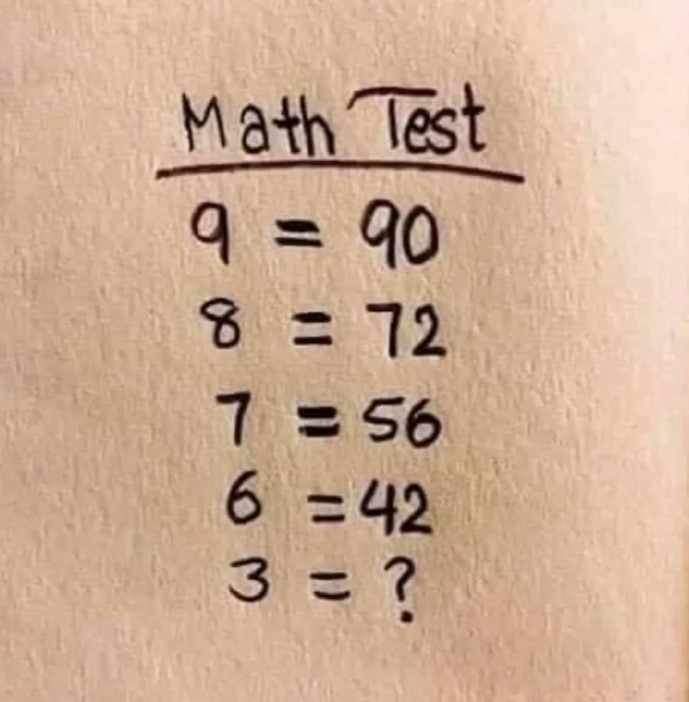
Hank Green of Vlogbrothers, Crash Course, podcasting and novels fame, posted a video working through his complaint about the following maths problem.

It will take about four minutes for you to run through the video; so please take the time to do that before I move on.

https://www.youtube.com/watch?v=lBJVyCYuu78

The big takeaway from this video is that a maths problem like this, which is deliberately vague, is designed like so much else on the internet, to be an outrage generator which then gets people arguing and thus drives clicks and advert revenues. I have no problem with this as a summary for what is going on in the maths problem. 

Even if we set that aside though and even if we ignore the fact that 9 does not equal 90, 8 does not equal 72, and 8 does not equal 56 et cetera, there's still yet another fundamental thing about this which Hank did not discuss. Let me rewrite this problem so that it makes better sense and is parsed better.

Given the points:

(9,90), (8,72), (7,56) (6,42), what should the y value be for the x value of 3.

Most people answer:

3 = 12 or,

3 = 18

This is a better written maths question and it nominally appears to be solvable. The solution of y=x(x+1) is a good fit for these points and the answer of (3,12) looks to be about right but is it the only answer? No. Here in fact is the fundamental problem with the question and why people like to answer the question so vociferously.

When you see the notation in maths of y=f(x), then this means that y is the result of doing something, that is performing some function on x. A function in maths is kind of like a set of instructions to get you from one place to another. The problem is that with such a small set of points, the function is actually unknowable. Granted that if we already know what the function is, then we can produce an infinite amount of answers according to the rules of the function but in this maths problem we are not given the function. We have a guess. We can make a good localised guess but it is still a guess. 

By only giving us a a few points, we run hard up against one of the most annoying general rules in maths; which is:

Any given set of points can be solved with f(x) such that there is at least one polynomial, linear or transcendental equation.

The statement that:

3 = ?

Is true because, yes, it does. 

3 = ?

We can make a good guess about the existing points; however 'good' is not exhaustively true. This unknown point of 3 = ? might very well be extrapolated to simple answers but what if it is not? 

y=x(x+1) will give you a parabolic shape but what if the points lie on some other curve, like a really big oval, or a strange multi-additional scribble, or some exponential function? Then what? Four points of order on an infinitely big plane, is not really all that helpful. 

Consider the following:

1, 6, 28. What comes next? The answer isn't even intuitive¹.

30, 34, 38. What comes next? If you said 42, then you would be wrong. What comes next in this series is 50²

I'm not going to tell you what the functions actually are and I will leave that for you to find out but it illustrates the point.

Even after setting aside that  9 does not equal 90, 8 does not equal 72, and 8 does not equal 56, it is actually impossible to know what 3 is paired with in this sequence without knowing what the function is. 

Since I am a maniacal mathematical monster who is currently in charge of the numbers then I get to decide whatever answer I jolly well like. Muah ha ha ha!³

I will answer... 

3 = 42

Why? Because I know that there will be at least some function will will make that true. I have no idea what that function actually is but I am confident that it must exists because ANY given set of points can be solved with f(x) such that there is at least one polynomial, linear or transcendental equation.

Why else? Because I am feeling in a parabola mood today and I am good at solving for functions with parabolas.

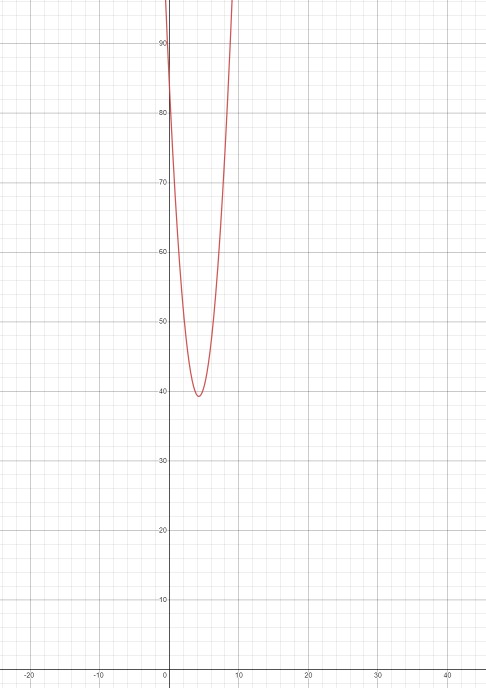
If 42 is my answer, then f(x) is sort of: y = 2.49137x² - 21.6531x + 84.2229

It looks like this:

"Oh ho ho" you might say, and point at me while you accuse me of cheating. At the same time, in arriving at your answer of 12, you must have decided that the function was something else and then solved for that function. It is a mark of insincerity of purpose to seek a high-born emperor in a low down tea shop. You can not make an appeal to authority and ignore the fundamental flaw in the question while someone else has exploited the fundamental flaw in the question and has made an appeal to authority. 

This takes me back to a quip which I once read on a poster in a classroom oh so many years ago. "Not knowing the question, it was easy to give an answer." What makes this even more fun is that when you have something that looks a bit mathsy, suddenly you get people making appeals to authority everywhere; without actually arriving at the fundamental flaw in the question. 

¹ The next number is 496 - these are the perfect numbers.

² 50 is the next number in the series because these are actually FIFA World Cup dates and there was no World Cup in 42 or 46 because a war got in the way.

³Count Von Count as a vampire can easily be distracted by throwing a handful of rice on the ground because one of the things about vampire legend is that they actually do have arithmomania and will be compelled 

October 21, 2022

Horse 3088 - King Charles Should Appoint The Prime Minister

The news came overnight Sydney time that Liz Truss has resigned as the Prime Minister of the United Kingdom after just 44 days in the job. This has come after a period of time where Boris Johnson was forced to resign after a series of indiscretions, a cabinet that has seen more people enter and exit than a Wimpy's, the Pound Sterling tanking faster than the HMS Colander and a Conservative Party in complete disarray. Lis Truss' only major achievement apart from a mini-budget when sent financial markets into panic, was that she just happened to be the resident of Number Ten Downing Street when Queen Elizabeth The Second died. This kind of parliamentary insanity kind of makes you wish for "Chaos with Ed Milliband" that David Cameron said would happen. If we would have had chaos under Ed Milliband, then what is this exactly?

I live in Australia and ten thousand miles away from Blighty. Looking at Britain's Festival Of The Thirsty Knife looks very similar to our own periodic premiership pugilism. We are quite happy to yell "Spill!" in the morning and find that in the afternoon that we have a new Prime Minister. Yet being an Australian makes me more acutely aware of the vissitudes of parliamentary democracies; namely that we the public do not elect Prime Ministers. Prime Ministers are installed in the same way that you might get an electrician to install a new water heater; which also means that when they go bang and fail, they can be removed quite easily. Indeed, Australia has had four Prime Ministers who have all served for shorter periods than Liz Truss with Arthur "Floody" Fadden reigning for 40 days and 40 nights, John McEwen for 22 days, Sir Earle Page for 19 days, and Frankie Forde who was Prime Minister for only 7 days. There may have been one other; which I will touch one later.

The office of the Prime Minister is not explicitly mentioned in the Australian Constitution. Furthermore, it is not immediately obvious as to whether or not there even needs to be one. It could be for instance that if someone were to imagine another system for organising executive cabinet, with a duumvirate or triumvirate or a cabinet of actual equals, that the functions of the cabinet could happen quite easily. It could be for instance that there is no explicit head of the executive cabinet, save for someone who has been appointed immediately for the purposes of chairing the meeting. Remember how I said that there may have been a Prime Minister for a short period than Forde? Billy Hughes may have been Prime Minister for the morning of 28th August 1941, for the purposes of chairing the meeting to decide who would replace Menzies. I do not know if he was or was not but he may have been if there was a writ of commission which was given to him by the Governor-General, for the express purpose of having the United Australia Party and Country Party to decide in caucus who would be the Prime Minister.

Herein lies an interesting point of order. Ultimately in Australia, political parties do not actually decide who the Prime Minister is. Convention would usually dictate that the Prime Minister is the leader of the party with the most members on the floor of the House of Representatives because that is where the supply and control of appropriation of monies of the Crown is decided. However, as we saw with the premiership of former Prime Minister Scott Morrison, the Governor-General can make and unmake Ministers at a whim and the only limitation is that the person appointed as a Minister of the Crown then obtains a seat in Parliament within 90 days.

His Majesty's United Kingdom of Great Britain and Northern Ireland has no written constitution. This means that there is even less direction at law on the King than there is on the  Governor-General of Australia. Previous Kings and Queens have appointed Members of both the House of Commons and the House of Lords to the office in the building with the famous black door on Downing Street. Given that there is no written constitution in the United Kingdom and that the Conservative Party is in more confusion than a herd of Meowths after Psyduck has used Confuse on them (it's super effective), then I can think of an easy solution which presents itself and which doesn't involve herding cats who want to chase money.

The King should appoint the Prime Minister.

King Charles III is the current officer of the person that is the Crown. The Crown is distinct from the monarch, as the Crown is corporation sole, with one indissoluble share, which exists in perpetuity, under someone like Cromwell comes along again and decides that the head and corpus of the monarch should part company. As King Charles III is the current officer of the person that is the Crown, he is in fact the sole officer of the functions and powers of the Crown. It is also fact that the Crown owns parliament. Legally speaking it is His Majesty's United Kingdom of Great Britain and Northern Ireland, His Majesty's Cabinet, and His Majesty's Loyal Opposition. Just like in Australia, political parties do not actually decide who the Prime Minister is. It is the King who makes and unmakes Ministers; including the Prime Minister of the United Kingdom.

King Charles III should just bypass the entire of the Conservative Party and do the job of appointing a Prime Minister; which they are incapable of doing. This would look different to the King–Byng affair and the 1975 Australian Constitutional Crisis because instead of the Crown interfering in parliament, parliament is already so much of a rabble that it needs some stability given to it. 

The Conservative Party is obviously and demonstrably so bereft of any real leadership, commonsense, and stability at the moment, that if I were King, I'd install Nicholas True, Baron True, who is the current Leader of the House of Lords and Lord Keeper of the Privy Seal, as the Prime Minister. If the Commons can't get its act together, then the Cabinet should be chaired by someone who is above the rough and tumble and stuff and nonsense of all that. A Prime Minister appointed by the King would in all likelihood give the job more seriousness and gravity than what has been shown recently. 

October 19, 2022

Horse 3087 - Eudaimonia - Element VII - Excellence And Praise

It would be remiss of me of me if I was to write a series of blog posts on the elements of eudemonia and not have seven of them. Seven appears to be a thing in western consciousness, with seven deadly sins, seven days in a week, seven dwarves and it appears on the list of the most favourite lucky number whatever that means. If you ever find "Thursday, the sneezy dwarf of superbia", you will know why.

The seventh of seven is not really one thing but two parts which combine together; they are arete (ἀρετὴ) and epainos (ἔπαινος). Arete is in its broadest sense, a thing that is excellent. Epainos in its broadest sense, is praise or accolade of that which is excellent.

The Greek concept of arete was that a thing should fulfil the function for which it was intended, to its highest ability. A table should be good at being a table. A cat should be good at being a cat. A person should be good at being a person. Plato particularly thinks that everything has its own unique highest form of excellence; that a bull which is particularly good for breeding is the best bull, which is going to be different from the best kind of person and even then, the best slave is different to the best aristocrat who are already presumed to be the exemplary of arete. In fact the root of the word for 'arate' is the same as 'aristos', which describes superlatives, superiority, and in plural the 'aristocrats' who are the nobility.

The idea of arate is not necessarily limited to the usual masculine traits of strength and bravery either. In the Odyssey, while Odysseus is off doing his quite frankly stupid things, it is his wife Penelope who is at home who is waiting for him and also has to manage the household and property, who is seen as best expressing arate. Not only does she do so with humility and wit, but also economy as she has to hold off frequent attempts by idle suitors who want to marry her and thus claim the estate and who are literally eating her out of house and home.

Aristotle's "Nicomachean Ethics" includes the virtues such as bravery, wit, strength and the quieter virtues of patience, justice, self-control, self-restraint, and even knowledge itself as included as arate. This is likely because as a philosopher, there's probably a degree of superbia going on, where of course someone engaged in the theoretical study of human knowledge is going to be considered among the virtues of highest human ability and happiness. Probably Aristotle's own name is derived from that same root word which 'arate' and 'aristos' are.

How does one be the best thing that they can be? Certainly education in the sciences, literature, the arts, languages and grammar will hopefully build someone suited to living in a society, which is why we have education in the first place but when it comes to arate, not only would we find violent disagreement between people who think that it is built up of different things but we'd also have violent disagreement about what kind of training should be done to build and acquire it. You might very well be able to say that there are common traits such as goodness, kindness, bravery, patience, the ability to take instruction, some kind of reverence for kin, kith and country, self-discipline and self-respect, but you definitely will not find agreement on the best ways to build and obtain arate in a person.

It is also something of a paradox, that not only do we not really know the best ways to build arate or even agree as to what those ways are, there isn't even a common agreement on deciding on what is praiseworthy. We can all agree that when training someone, some amount of praise or epainos is useful in encouraging the results and behaviour that we would like to see but again, what exactly those results and behaviours are is up for dispute.

We have very limited means of displaying public epainos for people. We have medals and trophies, rings and pennants for champions in sport. We have trophies for film, radio, television, painting, theatre, sculpture, journalism and writing. We have medals for valour. We even have titles which may appear before someone's name or after, such as Sir, Doctor, Professor, Dame, Lord, Lady, KC, OAM, LLB, B.Sc. B.A. et cetera. 

The problem is that for the vast multitude of people, there is mostly nothing. You usually do not get a reward for displaying any virtue save for the immediate gratitude which someone might express. Granted that there are some kinds of rewards for people working in organisations and firms which may include increased rates of pay but that is because those organisations and firms mostly see this as a transactional set of conditions, where the issue of rewards is in expectation of future reciprocal benefits for those organisations and firms (which in a corporate sense is almost always with the expectation of future profits).

So where does this leave arate and epainos? If they are reduced to mere transactional tokens, which are based on the performance of action, then what is the inherent good of them at all? I do not think that arate and epainos are mere transactional tokens which are the moral equivalents of rent, profit, dividends or wages. I rather think that the expression of rate and epainos are themselves, inherently good in themselves.

The best expression of arate is to be brave, to be kind, to be self-controlled, to be curious and know and learn, to practice and fight for justice and perhaps most important of all, to be patient with everyone else because we are all little selfish idiots who are blinkered and very much think only of ourselves and what is in front of us.

The best expression of arate in community is when people work together to do a thing. This is why corporations exist, why partnerships exist, why marriages exist, why teams exist, why republics and commonwealths exist. We all sort of know that a thing built in community is bigger and better than things which are built by individuals because of things like specialisation and efficiencies due to economies of scale. We know that people have different abilities and strengths and weaknesses and the point of being brave and kind and self-controlled and curious and fighting for justice and being patient, is that working together, we share the surpluses together.

The best expression of epainos is when people are temporarily rewarded for being their best selves and then driven onwards to be better still. The best expression of epainos in community is when the group is driven together to be its best self. I think that this is the reason why when nations go to war and win, they are collectively relieved that it is over; why when national sporting teams win, the whole nation rejoices; when teams win, their legions of fans are also joyful.

But again, being brave, kind, self-controlled, curious, fighting for justice and being patient with people, and working hard at doing those things, is not only a good thing but a good thing to do because it is good.

October 18, 2022

Horse 3086 - When George Harrison Whinged About Paying Tax

Last week I was alerted to a video on the Beatles official YouTube channel. The Beatles (or Apple Corps Ltd) have recently posted a film clip for their 1966 song "Taxman", written by George Harrison:

The Beatles didn't do a whole heap of explicit protest songs, which makes this something of a rarity in the canon, and it is even more of a rarity in popular music generally in that it name checks Wilson and Heath. There just aren't a lot of popular songs which mention Prime Ministers, Presidents, Treasurers and Chancellors, or Leaders Of The Opposition. 

As a protest song, this song ends up in the weeds of taxation policy. The song is a complaint about the then new Wilson Labour Government's set of Income Tax rates for the 1966/67 income tax year; which fixed the general rate of taxation at 8/3 in the pound¹ and thence a progressive surtax on incomes²; starting at 11% on amounts of more than £2000, going up to 55% on amounts of more than £15,000. We can find these rates in the Finance Act 1966¹ and the corresponding notes from HM Revenue and Customs. 

Since the base rate of Income Tax of 8/3 in the pound is 41.25%, then the effective rate of Income Tax on amounts of more than £15,000 is 41.25% + 55% or 96.25%.

"Let me tell you how it will be

There's one for you, nineteen for me

'Cause I'm the taxman

Yeah, I'm the taxman"

Thus the top rate of taxation of 96.25% was 19/3 in the pound. This means that Mr Harrison's complaint of "one for you, nineteen for me" was actually slightly short to the tun of 3d. In comparison, the top rate of Income Tax in Australia for the year 1966/67 was 15/4 in the pound or 76.66%. 

Essentially this is a complaint about the marginal rate of taxation on a fantastic amount of income. For incomes of less than £2000, the standard rate of 8/3 in the pound, likely covered at least 95% of the population. The average wage in the United Kingdom in 1966 was only £891. Even at twice the average wage at the time, the marginal rate of Income Tax was still only 8/3 in the pound.

It is worth remembering that Mr Harrison's complaint, actually only refers to every pound of income beyond £15,000. Marginal rates of taxation have to do with that last unit of income. Those Surtax rates are purely marginal rates of taxation which are over and above the base rate of tax; in this case the Surtax rate of 55% on amounts over £15,000 is 11/- in the pound but only starting at that 15,001st pound. At bare minimum, Mr Harrison would have had to be earning at least £15,001 for that 11/- in the pound rate to apply.

For George Harrison to pay income tax at the top marginal rate; which is 41.25% plus 55% which gives you 96.25% or 19/3 in the pound, he was on 16.835x of the average wage. (£15,000 / £891). If we put this into a modern context, Average Weekly Ordinary Time Earnings (AWOTE) in Australia as at Oct 2022 is $92,344 and 16.835x is $1,554,621 minimum. If we then accept that the average is way way skewed upwards by people on fantastic amounts of income, the median wage is probably a truer central measure of incomes and that is only about $60,000.

Here's the rub. Quite obviously income tax rates well above 50% are increasingly confiscatory in nature and since superstars like football players, movie actors, musicians et cetera are likely to have a brief yet stellar career, then then best strategy quite apart from taxation minisation, is to have that income directed into a Discretionary Trust of some kind. That way, incomes can be paid out of the Trust over a longer time frame; which is far more sensible from a life and estate planning perspective.

Also,

"Don't ask me what I want it for,

if you don't want to pay some more."

There is an whole other argument about the nature of taxation and government spending but for the purposes of this, we're going to assume the convenient lie that taxation pays for government services.

Later on in the song Mr. Harrison actually goes on to explain some of the things that government does/did.

"If you drive a car, I'll tax the street." - Well yes, Road Tax is a thing and in 1966 the UK was still in the middle of a building phase in which the Highways Agency would build some very lovely Motorways. As it is, ordinary roads need maintenance anyway.

"If you try to sit, I'll tax your seat." - This is probably a convenient rhyme however, as it currently stands, seats are taxed in the form of VAT. Again, the discussion of a consumption tax and whom the burden of taxation actually falls on, is a discussion beyond the scope of this post.

"If you get too cold, I'll tax the heat." - Given that Britain is a cold little sceptered isle, then some kind of heating tax; especially for the energy generated in order to make that heat (be it gas or electric) seems fair and reasonable to me.

"If you take a walk, I'll tax your feet." -In an urban environment, footpaths don't just build themselves. See the above argument for road tax. In a rural/natural environment, toepaths, land care, and preserving national parks is actually surprisingly cheap. I have no objections to par usage fees if it means that a national park is going to outlive all of us. If Mr Harrison meant a tax on shoes, then see above re VAT and a consumption tax.

It is like Mr Harrison forgot his own song while he was writing the song. HM Revenue and Customs wants taxation for the purposes of suring up the pound so that government services can be provided. Taxation in principle is the method which citizens in Commonwealth come together, right now, over purchases of the accoutrements of civilisation in a collective purchasing arrangement. That's what the Taxman wants it for. 

As for Mr Harrison himself, whining about the fact that you have to pay a lot of tax on the kinds of incomes per year that most of the people who bought the record would likely never even see until the cumulative effect of 20 years, is rather a bit cruel.

Let me tell you how it was, in that one year of income, you earned more money than the average teenager sitting in their bedroom spinning the disc would earn, of all the years put together until they were 36. It would take until halfway through the Thatcher Premiership before that would happen. The Beatles may very well have been the greatest rock band thus far but a protest song complaining about taxation because you are fantastically rich, is silly. 

¹https://www.legislation.gov.uk/ukpga/1966/18/pdfs/ukpga_19660018_en.pdf

²https://assets.publishing.service.gov.uk/government/uploads/system/uploads/attachment_data/file/1086429/Table-a2-SURTAX.ods

²https://www.gov.uk/government/statistics/rates-of-surtax-1948-to-1973


October 17, 2022

Horse 3085 - When The Appendix Was Better Than The Novel

I recently had the somewhat dubious privilege of sitting in one of the private bars frequented by the KCs and other silks (no longer QCs, thanks to the Acts Interpretation Act 1901), while waiting for a packet of documents to be delivered to me (after being sent there to wait); so that I could take it back to our offices.

Having been on the inside of the courts system, I am well aware of the fact that the powdered wig, silk and velvet gown class, look upon the rest of us as scum. I was also aware that as I sat in the bar in my black Crombie Coat and Cheescutter, that I am clad in the armor of the working class north of Blighty as a sort of polite defence against what His Majesty's most well read can throw at me. 

While sat sitting, I was reading my copy of "Leviathan" by Thomas Hobbes, when I was asked by an elderly gentleman, who looked like he could have come out of the century before last (the Col. Mustard/Maj. Bloodnok type of mustachioed person), what I thought of the book that I was reading and if I agreed with the general sentiment that order was not a natural tendency of the human condition. We had a neat little discussion about the nature of the monopoly of violence which is wielded by the state and I think that I might have impressed him, due to the fact that an apparent ruffian and barbarian like myself can match swords whilst not being in possession of any letters of note after my name.

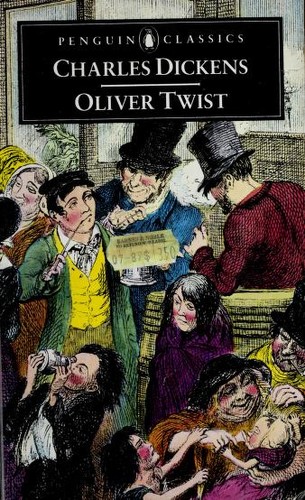
This invariably led to me asking about the book which he was carrying; which I recognised as the same imprint of Charles Dickens' "Oliver Twist" which I had read in high school. I explained that of all of Dickens' work, I found this uncharacteristically tedious but that the discussion in the appendix about the 1834 Poor Law was fascinating. He was surprised when lo and behold, this appendix was exactly as I had described.

Long ago in the mists of time, when Godzilla still roamed the holy mountain and during the recession that Australia had to have, I was but a lad of 12 years old. Back then, the Soviet Union had not yet collapsed and the teachers at my high school thought it interesting to call a 10-minute non-period during the school day "Uninterrupted Sustained Silent Reading" or USSR; which was likely a way of giving teachers 10 minutes of quiet after lunch before they would once again have to face a pack of hellbeasts.

These periods were different from the usual in Year 7, as they decided to split us all up instead of sending us around as a 30 member hoard from one class to the next. By my calculations now, dropping kids into classes of 20 which were different from the usual, meant that there was exactly 0.6 kids from every roll call class. This was ten minutes of respite for me, who spent most of the day wishing komm süßer tod and dreaming of ivy covered walls and smoky French cafes once my allotted six-year sentence was over.

I remember my copy of Oliver Twist well. I got the general impression that the reading lists that high school teachers assign are because they think that we will either enjoy them or aught to have read as part of the functioning cultural commonwealth but that what is actually happening is that they're inflicting on us the same kinds of pain inflicted upon them when they were in high school.

It should be said that Charles Dickens would have been very well versed in the poverty of early-Victorian, Industrial London. His own father had been sent to a debtors’ prison; so he experienced first hand what it would have been like to be a highly impoverished citizen with no say in his own fate; presumably he would have only gained the franchise with the Reform Act of 1830.

I get the impression that with novels like 'Oliver Twist', 'Bleak House', and even 'A Tale Of Two Cities' that the hardships that he faced as a child would have stayed in the back of his mind as an adult, while he churned out novels and other works of journalism.

Oliver Twist was begun after the passage of Poor Law of 1834, which made life worse for a great many people by halting government payments to the maintenance of able-bodied poor people unless they entered workhouses. Oliver Twist despite its reasonably happy ending (for the idiots who like that sort of thing), is more a piece of social satire which is like a flintlock aimed directly at the problem of poverty in London in the 1830s.

Probably because it depicts open crimes and murder without trying to sugar-coat it or wrap it in florid excuse, which in the 1830s was quite scandalous, it rapidly sold a heap of copies. I think that it is properly what is known as a "Newgate Novel", which is named after Newgate Prison. Presumably the character of Fagin was based on a genuine pickpocket named Ikey Solomon, however Dickens never openly made the connection. Actually, Fagin seems quite pleasant next to all the ruffians, barbarians and ne-er-do-wells of the rest of the novel.

But as far as I was concerned in 1991, the whole front of the book was but a shadow of the appendix at the back. My personal copy (number 35/120) had not been broken in by the student before me but after I was done with it, had gained a weird crack at the back.

The appendices contained notes and background to the novel; which included a possibly 20,000 word essay on the amendments to the Poor Laws in 1834. I thought that they were more interesting than the novel itself.

The broad summary of those 1834 amendment are that different classes of paupers should be segregated and that the local parishes should specialise and swap paupers. This even included the separation of husbands and wives, so that "proper regulation of workhouses" would "serve the whole of the union".

In reality, poorhouses became de facto prisons whose actual purpose was to securely confine large numbers of the lower classes at low cost. Mothers of illegitimate children received less support and there wasn't really any attempt to identify the fathers of illegitimate children. This in turn meant that there were far more children who belonged to nobody and of whom no-one would mind if they were ill-treated and went missing or died. Plus, they became practically free labour; which was useful given the Slave Trade Act 1804 and the Abolition Of Slavery Act 1830.

What I find disturbing is that the Royal Commission into the Operation of the Poor Laws 1832 was led by Edwin Chadwick, who being a Benthamite, wanted to enact changes to the 1832 on the principle of utilitarianism; which were mostly Poor Law Amendment Act 1834.

What also may be of note is that Malthus' "An Essay on the Principle of Population" instilled fear in lawmakers, who read that because population growth was geometric and that without due measures, the population would increase faster than the ability of a nation to feed it, that England was in trouble.

Thus, the existence of poverty, which was also theologically explained as the result of just punishment that God might inflict on someone, rendered any and all assistance to the poor under the 1832 laws as self-defeating. Any and all assistance to poor people should be removed; which would hopefully lead to a decrease in the number of poor people as they all died out.

I do not want to speculate why this mustachioed person (probably KC) was reading Oliver Twist, however I can not help but wonder what a person who reads law for a living, would make of the appendix at the back (assuming that it is still included in modern imprints).

Do the powdered wig, silk and velvet gown class, look upon the rest of us as things to be improved or ignored? Do they see the great many of us as a problem which should be discouraged from breeding and existing or do they not in fact see us at all?

October 14, 2022

Horse 3084 - Eudaimonia - Element VI - Admirable

The word εὔφημος (Euphemos) is like a pack of Araldite in that it comes in two parts. 'Eu' generally is signifier that something is good and 'phemos' is the report about something. In various Greek texts 'euphemos' means anything from the mere the utterance of good or auspicious words, such as a good report, or praise; to the crystallisation of the quality onto something or someone who is then said to be either very important and/or delicate or something that needs protected at all costs.

The English reception of Greek words, particles, and components, is somewhat problematic.  Consider 'euphemism' (good report) which generally means a nicer word standing in for a bad thing; or 'eugenics' (good genes) which has included policies of sterilisation and extermination of people; or 'euthanasia' (good death) which implies a calm method of either assisted suicide or veiled murder. 

The word euphemism which means a good word standing in for a bad word, also can describe a whole line of things which have stood in for the previous word in the euphemism chain; so much so that 'Eu' has itself come to stand in at the beginning of words for concepts which are unpleasant. I want you to throw all of your existing cultural assumptions about 'Eu' away because euphemos is actually genuinely good.

The thing which most people consider as admirable are generally those products of moral formation which have been expensive to produce. One doesn't usually think about things like bravery and valour, patience and long-suffering, or perseverance and determination, as being things which are made and produced but they don't just appear from nowhere. Those qualities which we tend to see in other people and maybe ourselves which are worth celebrating, are generally the result of some kind of serious work in quiet places. Sometimes these qualities are forged and work-hardened as the result of someone moving through bad and hard times. I do not think it a coincidence that the trente-glorieuses immediately followed a twice unpleasantness and the destruction of a hundred million people. 

Bravery and valour are the qualities of facing a dangerous or scary thing and then steeling one's self to do some task or work in the face of that dangerous or scary thing. We hand out medals for valour on the battlefield, where the dangerous and scary thing is the possibility of sudden and imminent death in the face of the enemy but bravery is very often not rewarded nor visible. Bravery might entail acting calmly in the face of unfriendliness which results in racism, sexism, ableism et cetera. Bravery might entail overcoming one's fear of performing a task in the face of physical danger or in the face of loss of face. It has been said that if given the job of performing a eulogy at a funeral, that most people would prefer to be in the casket than standing on the podium.

Qualities to do with standing in the face of unpleasantness, such as something which is boring, or tiring, or difficult; which leads to the moral products of patience, longsuffering, calmness, levelheadedness et cetera, are also all aspects of euphemos. 

It is the quiet and unheralded things such as going above and beyond what's expected, or offering to take on  additional duties and tasks to free up someone else, or simply as an act of kindness, are often expensive in time and effort to the person doing those things. Whether it is by offering an extra hand when you know that someone is overburdened and laid down with work, or uplifting them and making them look better, then this is when euphemos plays out in practice.

When it comes to doing work, the art of euphemos is also important. One can speak about the skill and talent which someone wields in doing a job and also the craftsmanship of that job once completed. This used to be more evident in the manual arts, such as painting, woodworking, cabinetry, pottery and ceramics, needlework and tapestry, and is positively celebrated on the sporting field when sportsball players, runners, swimmers, motor racing drivers et cetera, perform feats of skill. The "beautiful game" is not called that accidentally, for compared with the other football codes such as the two rugbys which are pugilistic, there is an amazing amount of skill in placing a well directed cross from out on the wing, onto the head of a striker at 17 yards away and having them defeat a keeper. We do not appreciate this now but Olympic medals were awarded in the past for things like sculpture, painting, and weirdly to us, town planning.

Euphemos can also involve knowing how to say something which is useful but with tact. Sometimes an opinion is extremely valuable and indeed necessary but should be offered appropriately and kindly and not bluntly or with rudeness or meanness; even though someone should rightly be told that they are doing a really silly thing in a really silly way.

By the same token, refraining from complaining about things and handling feelings of negativity in a much more constructive manner, is far more useful. Granted that life and work is often stupid, obnoxious and daft and filled with stupid, obnoxious and daft, which includes those most stupid, obnoxious and daft of all people, you and I.

Complaining is perhaps unjustly maligned as being a toxic behaviour, which can inhibit people from raising serious objections to things but serial complainers don't exactly develop the most kindly of reputations as they tend to bring everyone else down and ruin positive environments. It might be helpful to stop, get a cup of tea and come back to a thing before developing solutions or taking a different outlook.

Generally those things which display euphemos are those things which are deserving of respect and approval. None of those things just spontaneously happen and are the result of quiet work, practice, and maybe even repeated failure; which ironically is itself a display of euphemos as repeated failure and finally being able to achieve or do a thing is the result of hard work and an outworking of determination.


October 13, 2022

Horse 3083 - Constitutional Survey - VII

<><><><><>

Chapter III. The Judicature.

71. Judicial power and Courts

The judicial power of the Commonwealth shall be vested in a Federal Supreme Court, to be called the High Court of Australia, and in such other federal courts as the Parliament creates, and in such other courts as it invests with federal jurisdiction. The High Court shall consist of a Chief Justice, and so many other Justices, not less than two, as the Parliament prescribes.

<>

Yah well, hey now... here's a thought... ya know, let's have some judges eh; in a Federal Supreme Court, to be called the High Court of Australia, and other federal courts.

Of all of the sections of the Australian Constitution, this is the one that seems the most like they were just phoning it in.

Although having said this, there might have been a reason for naming the highest court in the land the "High Court" of Australia for it was the High Court at Westminster Hall which tried King Charles I and found him guilty of tyranny. If parliament is meant to have an independent bent then having sent job job its meant to sit in judgement, at least recalls this event of history.

<><><><><>

72. Judges' appointment, tenure and remuneration

The Justices of the High Court and of the other courts created by the Parliament:

- shall be appointed by the Governor-General in Council;

- shall not be removed except by the Governor-General in Council, on an address from both Houses of the Parliament in the same session, praying for such removal on the ground of proved misbehaviour or incapacity;

- shall receive such remuneration as the Parliament may fix; but the remuneration shall not be diminished during their continuance in office.

<>

Misbehaviour in Section 72 is pretty limited. Basically it amounts to things like non-attendance, neglect of or refusal to perform duties, or an outrageous breach civil or criminal law of such a quality as to indicate that the incumbent is unfit to exercise the office.

It is really really hard to remove judges due to an outrage of good behaviour. I do not think that a matter of parking fines, drunkenness, petty theft et cetera, would be enough to remove a judge. An outrage of good behaviour would have to be so serious that it would have to be found by proof, in appropriate manner, to the Parliament, and in formal proceedings where the offender has been given proper notice and opportunity to defend themself. 

<><><>

The appointment of a Justice of the High Court shall be for a term expiring upon his attaining the age of seventy years, and a person shall not be appointed as a Justice of the High Court if he has attained that age.

The appointment of a Justice of a court created by the Parliament shall be for a term expiring upon his attaining the age that is, at the time of his appointment, the maximum age for Justices of that court and a person shall not be appointed as a Justice of such a court if he has attained the age that is for the time being the maximum age for Justices of that court.

Subject to this section, the maximum age for Justices of any court created by the Parliament is seventy years.

The Parliament may make a law fixing an age that is less than seventy years as the maximum age for Justices of a court created by the Parliament and may at any time repeal or amend such a law, but any such repeal or amendment does not affect the term of office of a Justice under an appointment made before the repeal or amendment.

<>

Unlike the United States where the empanelment of a Supreme Court Justice is for life, the Australian Constitution was altered by referendum in 1977 to impose a limit on absolute dodderiness. 

To put this in context, when the old age pension was introduced in 1911, it was assumed that most people would die before they got to the age of 65 and hence, not be eligible to receive it. 70 years old, therefore, was at the time, positively ancient. Even now with better health care, most people will retire from work in their 60s or 70s, though that may change in future.

Since High Court decisions outlive Justices, it makes sense that they should at least be young enough to experience some degree of the effects of the decisions that they hand down and hopefully, this should be enough to temper those decisions.

<><><>

A Justice of the High Court or of a court created by the Parliament may resign his office by writing under his hand delivered to the Governor-General.

<>

It may seem strange as to why a resignation notice of a Justice of the High Court would need to be hand delivered to the Governor-General but I think that I understand the rationale. The rest of Section 72 is at pains to separate the legislative and judicial power of the Commonwealth and it makes sense that the structure of the Constitution itself, which not only explains a direct limitation upon the power of judicial removal, should also create a difficulty of the judiciary to remove themselves.

Remember, the desire of Section 72 is to protect and ringfence the judiciary as the interpreters of the Constitution; so in order to do that, it creates a deliberately difficult mechanism of self-removal to reflect the gravity of the situation.

<><><>

Nothing in the provisions added to this section by the Constitution Alteration (Retirement of Judges) 1977 affects the continuance of a person in office as a Justice of a court under an appointment made before the commencement of those provisions.

A reference in this section to the appointment of a Justice of the High Court or of a court created by the Parliament shall be read as including a reference to the appointment of a person who holds office as a Justice of the High Court or of a court created by the Parliament to another office of Justice of the same court having a different status or designation.

<>

Hooray. We have a grandfather clause and an equivalence clause. This is because unless a law says a thing (which includes the Constitution) then is it really a thing at law?

<><><><><>

73. Appellate jurisdiction of High Court

The High Court shall have jurisdiction, with such exceptions and subject to such regulations as the Parliament prescribes, to hear and determine appeals from all judgments, decrees, orders, and sentences:

- of any Justice or Justices exercising the original jurisdiction of the High Court;

- of any other federal court, or court exercising federal jurisdiction; or of the Supreme Court of any State, or 

- of any other court of any State from which at the establishment of the Commonwealth an appeal lies to the Queen in Council;

- of the Inter-State Commission, but as to questions of law only;

- and the judgment of the High Court in all such cases shall be final and conclusive.

But no exception or regulation prescribed by the Parliament shall prevent the High Court from hearing and determining any appeal from the Supreme Court of a State in any matter in which at the establishment of the Commonwealth an appeal lies from such Supreme Court to the Queen in Council.

Until the Parliament otherwise provides, the conditions of and restrictions on appeals to the Queen in Council from the Supreme Courts of the several States shall be applicable to appeals from them to the High Court.

<>

Up until the Australia Act 1986, the High Court of Australia was the second to last appellate jurisdiction of the nation. Section 73 provides that it can hear appeals from lesser courts from any other court in the country. If you have a parking fine which you would like to dispute and you have infinitely deep pockets and you can fight the matter on matters of law, then you can take your parking fine dispute all the way to the High Court of Australia. Though at that point, you may as well have just paid the fine. 

<><><><><>

74. Appeal to Queen in Council

No appeal shall be permitted to the Queen in Council from a decision of the High Court upon any question, howsoever arising, as to the limits inter se of the Constitutional powers of the Commonwealth and those of any State or States, or as to the limits inter se of the Constitutional powers of any two or more States, unless the High Court shall certify that the question is one which ought to be determined by Her Majesty in Council.

The High Court may so certify if satisfied that for any special reason the certificate should be granted, and thereupon an appeal shall lie to Her Majesty in Council on the question without further leave.

Except as provided in this section, this Constitution shall not impair any right which the Queen may be pleased to exercise by virtue of Her Royal prerogative to grant special leave of appeal from the High Court to Her Majesty in Council. The Parliament may make laws limiting the matters in which such leave may be asked, but proposed laws containing any such limitation shall be reserved by the Governor-General for Her Majesty's pleasure.

<>

As far as I am aware, the last vestiges of Australian citizens being able to appeal the decisions of courts in Australia, was extinguished with the passage of the Australia Act:

http://www8.austlii.edu.au/cgi-bin/viewdoc/au/legis/cth/num_act/aa1986114/s11.html

Termination of appeals to Her Majesty in Council

11. (1) Subject to subsection (4) below, no appeal to Her Majesty in Council lies or shall be brought, whether by leave or special leave of any court or of Her Majesty in Council or otherwise, and whether by virtue of any Act of the Parliament of the United Kingdom, the Royal Prerogative or otherwise, from or in respect of any decision of an Australian court.

- Section 11, Australia Act 1986

Although this act can be amended, it does by operation strike off Section 74 of the Constitution.

<><><><><>

75. Original jurisdiction of High Court

In all matters:

- arising under any treaty;

- affecting consuls or other representatives of other countries;

- in which the Commonwealth, or a person suing or being sued on behalf of the Commonwealth, is a party;

- between States, or between residents of different States, or between a State and a resident of another State;

- in which a writ of Mandamus or prohibition or an injunction is sought against an officer of the Commonwealth;

the High Court shall have original jurisdiction.

<>

Section 75 and Section 76 are taken together for the purposes of this discussion.

<><><><><>

76. Additional original jurisdiction

The Parliament may make laws conferring original jurisdiction on the High Court in any matter:

- arising under this Constitution, or involving its interpretation;

- arising under any laws made by the Parliament;

- of Admiralty and maritime jurisdiction;

- relating to the same subject-matter claimed under the laws of different States.

<>

One of the most famous cases in the Supreme Court of the United States is the case of Marbury v Madison [1803] in which...

https://supreme.justia.com/cases/federal/us/5/137/

It is emphatically the duty of the Judicial Department to say what the law is. Those who apply the rule to particular cases must, of necessity, expound and interpret the rule. If two laws conflict with each other, the Court must decide on the operation of each.

- Marbury v. Madison, 5 U.S. 137 (1803)

In practice this is one of those occasions where the constitutional arrangements of the United States is not contained within the Constitution. The American legal system is awash with cases, especially dealing with civic and civil rights, where it is the court that has decided what the state of play is and what those rights are. However, Marbury v Madison (1803) is one of the few cases where the court claimed a right for itself. It has to be said that this was a very very bootstrappy decision; which has echoed down through the ages as not only being accepted but also as useful.

The sweaty men confined in the basements of Town Halls in Australia, arguing about what should go into the Australian Constitution some 90 years later, not only saw the utility in having the High Court have original jurisdiction to say "what the law is" but also thought to codify it such that it couldn't be attacked unless through referendum. 

In America, this right of the court to say what the law is could in theory be overturned by another sitting of that same court. In Australia, that's impossible.

<><><><><>

77. Power to define jurisdiction

With respect to any of the matters mentioned in the last two sections the Parliament may make laws:

- defining the jurisdiction of any federal court other than the High Court;

- defining the extent to which the jurisdiction of any federal court shall be exclusive of that which belongs to or is invested in the courts of the States;

- investing any court of a State with federal jurisdiction.

<>

In 1901 the Commonwealth of Australia started off with exactly one court - the High Court. It stands to reason that eventually the Commonwealth would think about specialist court to deal with specific branches of law. Family law, Industrial Relations disputes and arbitration, the differences between civil and criminal law, appeals at law with regards the interpretation of law, taxation law and the law of contracts. The list goes on and on.

There is also the tension that the newly minted Commonwealth of Australia would have to fight disputes between what its responsibilities and jurisdictions were, as well as having to be the default arbiter between the states within the Commonwealth, for at the time of federation the six states were frenemies and arguably they still are.

<><><><><>

78. Proceedings against Commonwealth or State

The Parliament may make laws conferring rights to proceed against the Commonwealth or a State in respect of matters within the limits of the judicial power.

<>

It makes sense that if the Parliament has the power to define the jurisdiction of the Courts which are created, then it also has the power to confer rights to proceed against the Commonwealth or a State in respect of matters within the limits of said judicial power. 

The most obvious reading of this says that a person who has been brought before the courts, should have some legal rights in the proceedings. It would be ridiculous if someone brought before a court had no legal right to proceed against the Commonwealth or State which brought them there. 

However since 1901, the march of technology is such that there have been things invented which were not yet thought of. Would an audio recording of someone be admissible as evidence? What about a video recording? What about a recording made without someone's knowledge? What kind of documentation is allowable? Would a scanned copy be admissible as evidence? What about a document which never existed as a physical copy? Just the realm of what is and is not acceptable evidence, would need to be defined in the 121 years since the Constitution was written. 

In principle, this is why the Constitution does not have a Bill of Rights attached. The sweaty men in basements of Town Halls in the 1890s, obviously had the forethought that the world would change and perhaps beyond what they could even imagine. Electricity and the Automobile are barely a thing in 1901 but after the First World War, the world would change dramatically and change again and again.

<><><><><>

79. Number of judges

The federal jurisdiction of any court may be exercised by such number of judges as the Parliament prescribes.

<>

Does a thing need to by heard by one judge? A panel? The scary consequence which comes as a result of Section 79 is that Parliament has the power to prescribe that a case could be heard by zero judges. In principle, what this means is that it is possible and legal for the Commonwealth to invent an automatic court with no judge at all because zero judges is still a number of judges.

<><><><><>

80. Trial by jury

The trial on indictment of any offence against any law of the Commonwealth shall be by jury, and every such trial shall be held in the State where the offence was committed, and if the offence was not committed within any State the trial shall be held at such place or places as the Parliament prescribes.

<>

The 7th Amendment to the US Constitution specifies a trial by jury under certain conditions. The United States it would appear, thought of this as an afterthought; which is why it sits as an amendment which has been tack onto the end and is not part of the body of the document. The framers of the Australian Constitution, who did not have such a strange conception of rights (because an Englishman is free to do whatever he likes unless hedged in by law), did not include this as a right to be attached but rather, a specific regulation.

In practice, most of the courts which come about as a result of Sections 77-78, are not criminal cases and as such are not offences 'against' the law of the Commonwealth. Juries are not appointed to Family Law or Industrial Law cases most criminal cases are actually tried within the various state and territory courts and under the various Crimes Acts of those states and territories.

<><><><><>