December 05, 2022

Horse 3111 - Happiness Floats By Before The Inevitable Will Arrive

England 3 - Senegal 0

Henderson 38'

Kane 45+2'

Sakr 57'

Being an England fan is kind of like being a ye olde pirate who has been forced to walk the plank. You have no idea when it will happen but you are certain that it will happen because failure is inevitable. That feeling that "this could be our year" which the fans of some teams might experience, has long been replaced by one of just waiting for the day to happen; waiting with nothing but disaster. In the meantime, watching England matches is like trying to cling onto the fleeting moments of happiness for they too inevitably disappoint.

England started this match cautiously and Senegal came out with the intent to be a threat. England appeared to be confused and dazed and although they were able to control the odd pass, Senegal were here to score early and steal the ball whenever they could. This meant that for the first twenty minutes or so, nobody was really to establish any kind of control; with the ball passing from 18 yard box to 18 yard box, in rapid succession. Harry Kane's half-hearted shot in the 20th minute was met with an unnecessary tip over the line by the Senegalese keeper Mendy, and England won a corner which they duly fluffed. This proves yet again that short corner kicks never ever ever work, ever.

Two minutes later Sarr broke through the England back four and with only the England keeper to beat, he may have been brought down by Maguire at the back. His shot from 3 yards away bobbled off to the side and after demands for VAR to see if there was a possible penalty, this was waved away.

Senegal took a while to build up their second shot, and Dia managed to dink inside the England back four. With only Pickford to beat and from inside the 6 yard box, all that Dia found, was the flailing arms of the England keeper and the ball was parried out for a corner. 

Just before the close of the half and when Senegal were pressing deep into the England half, Bellingham won a ball out wide and upon spotting acres of space, ran into it. The ball that he delivered from out wide, found Foden in the centre and as the Senegalese defence arrived, Foden off-loaded it to Harry Kane who took two small touches and then appeared to manipulate space and time to give himself an eternity to jam the second goal home in the bottom right hand corner of the net. Bellingham ordered it, Foden wrapped it up, Kane put enough postage on it and delivered it.

Kane who had now broken his duck, grew three sizes. Just before the hour mark Kane decided to take a shot. This rocket was met with Mendy; who badly spilled it, and the ball wobbled under him and harmlessly outwards to safety.

England however were not happy with merely missing shots and Bellingham who proved dangerous by drawing defenders everywhere created a massive hole in Senegal's back five. With Bellingham wide, this gave Phil Foden a hallway of calm to walk through. Foden's skipped passed one tackle, popped the ball underneath the defender and the cross was met with the left foot of Bukayo Sakr inside the box, which just lifted ball ever so slightly to pull the ball over Mendy, and to put the game beyond any reasonable doubt.

If Senegal hadn't been deflated by the second goal, the third goal certainly popped the last balloon. Not only did Senegal forget how to party but the tempo of their play just collapsed. Curiously, the Senegalese crowd never once stopped their party in the stands; so I guess that at least someone in green, red and yellow was happy.

Senegal has a glimmer of hope to at least put one on the board when Jack Grealish brought down Kalidou Koulibaly in the 71st minute and Senegal won a free kick from about 35 yards away. England set up a three man wall and the question would be whether or not Sarr could hit the ball hard enough. Papp Sarr tried to go around the outside of the wall but Pickford who saw the ball at every stage on the way through, didn't even have to lay a finger on it as it curled around everything and about ten yards beyond the far post.

Deep into extra time Senegal did manage to scramble through the England defence and Sarr took a shot from on top of the ring at the 18 yard box; which Pickford punched forcefully out for a corner. Senegal's last roll of the dice was the corner kick which managed float over the top of everything and curl back over the goal line.

Admittedly England have only played teams ranked in the lower teens so far this tournament and their first real opposition will be France but at least this match proves that they can put a match to bed. England who were accused of playing with the handbrake on in the press, during the qualifiers, surely have proved by now that they can rip apart opposing teams for fun. What we've learned from this tournament, is that Gareth Southgate has selected an England side with no obvious superstar with the possible exception of Harry Kane but even then, goals have come from everywhere. It is likely that unlike the matches thus far which have been 4-3-3, that England will need to move someone from the front back into midfield to play 4-4-2 against France.

England have taken one more step closer towards the crushing inevitability of failure but for the moment, they have managed to cling onto the fleeting moments of happiness that floats by. 

December 04, 2022

Horse 3110 - ARRG! Aus...

Argentina 2 - Australia 1

Messi 35'

Álvarez 57'

Goodwin 76'

For sixteen glorious minutes Australia looked to be confident and ebullient as they not only were able to win balls but keep the ball for extended periods of time. Argentina, looking to play their way into the match, patiently pushed forward until this initial period of Australian competence subsided. At the 16th minute, Gomez finally took the first shot of the match from 45 yards out and it was equally rewarded by being 45 yards high and 45 yards wide of the goal. Nevertheless, then fact that he had simply walked in and stolen the ball from Behich, proved that this Argentina side saw Australia as a bug that needed to be crushed.

Again Australia were able regain control of the ball, but they were contained in their own half; being forced to tiki-taka the ball between the back four. By the time of Riley McGree's 22nd minute strike, Australia had managed to hold the ball for six uninterrupted minutes from the goal-kick and also gained an Australian national football record of 37 consecutive touches. His shot which was Australia's first reply in a match when strikes were rare, was also sprayed into the far reaches of Row K.

Argentina then decided to assert themselves, after finally waking up. Their ball skills are sharper and quicker than anything else that Australia has seen in this tournament, including France, but their tactics are mind-numblingly dim. Argentina's tactics must surely continue to be the most sophisticated in the history of football. Their innovative strategy of "getting the ball to Messi" and "having Messi do stuff once he has the ball" may prove revolutionary, if other nations learn to build their own Messi.

35 minutes in, their strategy of "getting the ball to Messi" and "having Messi do stuff once he has the ball", worked. Lionel Messi, self-proclaimed greatest player in the history of the world from all-past to all-future, wandered around the park like a small boy lost in a forest; then after receiving the ball, he took three touches and banged in a scorcher from 16 yards away; in his 1000th appearance as a professional football player.

Australia was stunned. 

They remained stunned going into half-time and the deficit looked insurmountable. The second half began the way that they first half ended; with Australia remaining scared and small in front of an Argentinian side that continued to play the game at not much more than walking pace.

It got worse.

57 minutes into the match and after Australia was playing the ball around the back four in an effort to play keep away, a pass back to goalkeeper Matty Ryan, led to an absolute horrorshow. Ryan, trying to play the ball short, had it stolen away from him by Julián Álvarez from inside the six yard box and he tapped home the easiest of goals, to try to kill off any remaining hope that Australia had. It was as if 26 million voices cried out in terror, and were suddenly silenced. We all feared that something terrible had happened.

From here, Australian hearts sank. It wasn't until Craig Goodwin who had come on as a late substitute for Mitchell Duke, took a shot which didn't deserve anything, took a wicked deflection off the back of Enzo Fernández, that any semblance of hope returned.

For 20 minutes, Argentina parked the bus; while Australia attempted to mount challenge after challenge; only to have them all fail. On the one occasion when Australia did break through the blue and white wall, Garang Kuol at the age of just 18 years and 79 days, very nearly wrote his name into immortality in the 90+7th minute of the match; only to have the very stretchy arms of Emiliano Martínez be a very very big barrier. The goal kick which followed was all that would be played and Argentina walk away with a routing victory, after proving that one goal is never enough.

Australia scored one goal in every match that they played, against sides ranked 4, 10, 30, and 3. If you'd asked me before the tournament who'd I thought would win, I'd have said France, Argentina or Brazil but all of them have proven to be leaky. Australia being knocked out at the Round of 16 is as about as good as they should have hoped for. 

This Australian squad tried and failed. They failed in the most glorious way; having fought in every match they played and having scored in every match they played. Better yet, as far as the long game of Australian football goes: fail, fail again, fail better. They have failed better than ever before and in doing so, they have made a nation happy.

December 03, 2022

Horse 3109 - THE PEOPLE v A PILE OF LEAVES [2022] - Judgement

The Fake Internet Court of Australia

THE PEOPLE v A PILE OF LEAVES [2022] - Judgement

H3109/1


"If leaves are necessary for a salad, is a pile of leaves a salad?"

- Name Withheld, 27th Nov 2022.

It has come to this fake internet court's attention that there are many questions to which people demand answers but where courts with actual jurisdiction fear to tread. As this fake internet court has exactly zero power to change anything in the real world and is not concerned with the nature of practical reality, it is free to answer such questions.

How many angels can dance on the head of a pin?

This question is often presented as a metaphor for the wasting of time when debating topics of no practical value, or questions whose answers hold no intellectual consequence but given that this fake internet court revels in the absurd, this ceases to be a philosophical question and becomes one of fact. As a small structure of less than one square meter, we can conclude that the number of angels that can dance on the head of a pin is exactly one, since building occupancy laws speak of the number of people per square metre and/or the distance between them and since the head of a pin is for all intents and purposes a point, then we must concluding that legally, there isn't enough space for another.

One angel can dance on the head of a pin. Sorted.

In answering the question "If leaves are necessary for a salad, is a pile of leaves a salad?", this court first needs to consider the ontological problem of what a salad is. Once we define what a salad is, we can determine whether or not a pile of leaves falls into this category.

It is worth remembering that there are many kinds of salad. If we consider Tuna Salad, Fruit Salad, Chicken Salad, Macaroni Salad, Potato Salad, Waldorf Salad et cetera then the general sort of thing that makes a salad a salad, is that it is several kinds of things which are held together with goo. Please note that in every single example stated, including fruit salad, most of the component parts are plant material of some sort; which means that other kinds of things held together with goo such as lasagne and chili, are not and should not be considered as salad. Also note that in all of these cases, these are all salads with modifiers. This means to say that the default salad, without any kind of modifier at all, is in reality a pile of various kinds of plant material. 

Please also note that the default salad does not even need anything to go with it, to be a salad. Various kinds of lettuce, carrot, cabbage et cetera, including things that one would find in the garden, like arugula, roquette, and kale, are all perfectly acceptable things which make up a salad. We may wish to call the resultant thing a green salad or a garden salad but if someone said that they were making a "salad" we would expect to see various kinds of leaves as the thing which defines the salad.

We also need to ask the question "Does salad need dressing?" Evidently not. If someone was making a salad with lettuce, roquette, and cabbage, we are free to conclude that it is not a particularly interesting salad but this does not change the fact that it is still a salad. Lettuce leaves, roquette leaves, and cabbage leaves, are still just a pile of leaves however, in no circumstances would we conclude that this was not a salad.

In stretching the other dimension of this question, we need to ask if a salad needs to be edible, for it to be in fact a salad. What is properly called schizophasia; which is actually a series of seemingly random words and phrases which are unintelligible at conveying meaning, is also in normal parlance called a "Word Salad". Although people might sometimes say that they intend to "eat their words" and that some words are "food for thought" as words both written and/or spoken, they are still intangible; which means that they are not in fact edible.

Final Judgement:

Having looked at the principle and the evidence, it is the opinion and ruling of this court that:

1. A Salad by default is made up of plant material.

1b. That they default plant material is leaves of various kinds.

2. That a salad need not be edible.

In this case, there is not other conclusion that can be drawn than that a pile of leaves is in fact a salad. Granted, it might not be edible but since edibility is not actually a necessary determinant of the saladity of a salad, then this is of zero consequence. Likewise, since tomato is a fruit, then this fake internet court considers ketchup to be a smoothie. 

To the party whose name that we have withheld, despite the fact that you have tried to bring hateration and holleration into this fake internet court, all you have brought is shame and disgrace on your family name for generations to come. We shall spare you the pain and suffering of looking like a fool in front of millions of people.

- ROLLO75 J

(this case will be reported in FILR as H3109/1 - Ed)

December 02, 2022

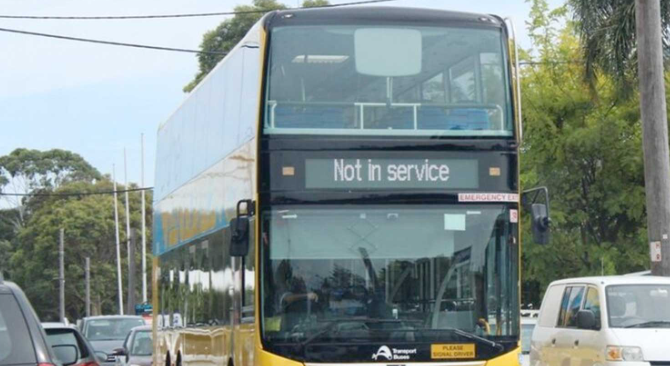
Horse 3108 - Keolis Downer - Not In Service - Just Like All Tory Politics

Margaret Thatcher famously said that "The problem with socialism is that eventually you run out of other people's money." Saying that is all fine and proper if you are at a Tory Party conference but the problem with Tories is that they eventually run out of other people's stuff to sell. By my count, the Thatcher Government successfully sold at least 103 publicly owned companies and assets which the Great British public will never ever get back. She not only ran out of other people's money but also ran out of other people's stuff. In general, I can not think of a single instance in the modern era of politics where a tory party has made the world better. 

Likewise in Australia, the party (the increasingly incorrectly named 'Liberal Party') founded by Keith Murdoch and Bob Menzies, is tory to its core. Remember, the word 'tory' is in the pejorative and comes from the Gaelic 'toraigh' which means 'thief' or 'robber'. Every single day, on my way to work, I am reminded of yet another thing that tories have stolen and which we will very likely not get back.

I work in Mosman. Mosman is a suburb of Sydney which is so devoid of atmosphere that NASA should use it to test lunar landing equipment in. Mosman is a suburb of Sydney which is so devoid of culture that a pot of yoghurt takes pity on it. It is also so nominally a tory held seat that since responsible government came to NSW in 1855, I do not think that it has ever sent a Labor member to either the State or Federal Parliament, or had a Labor majority council ever. Mosman is very happy accept the outcomes of any and all tory policies.

I think that it was for this reason, and perhaps demonstrated by the cousins across the harbour in Woolahra, that Bradfield's plan to build a heavy rail line never happened. When the then Liberal Government ripped out all of the trams in an effort to smash the RTBU in the 1950s, the replacements across the North Shore were the various bus routes. Forest Buses defended its patch and so the State Buses more or less didn't really venture that far east of the Pacific Highway and kept to themselves up the sliver of land from Manly to Palm Beach. The latest edition of the Liberal State Government, saw Mike Baird parachute his way to the NAB, Gladys Berejiklian parachute her way to Optus as well as being entangled in a corruption scandal, and Mr Perrotet complete the grand plan of flogging off the buses to the lowest bidders. 

The long plan of how we got here was firstly by painting a series of buses red. They became the Metrobus services and then those services were decoupled from a fixed timetable. Before the sale of Sydney Buses, those routes were then carved up according to the regions but they still remained decoupled from a fixed timetable. This has meant that after the buses were privatised, we the general public can not complain about the buses being late, if they were never running to a timetable in the first place. The routes which I usually use from the City, being the B1 and the 100 are both progressively being degraded and now I have the data to prove it.

The 100 bus was heralded as a ten minute service. This is 6 buses an hour. On average since privatisation, I calculate that the average time between 100 buses is 21 minutes. I have had to wait for a 100 bus for more than half an hour on numerous occasions. If the 100 bus is running to a serving suggestion of a twenty minute service, then this means that there are only 3 buses an hour and the variable running costs have been halved.

Likewise, the B1 bus was orginally slated as a 7 minute service. This works out to be 8 buses per hour. I have calculate that the average time between B1 buses is 19 minutes. Let's be generous and understate this as only 15 minutes between buses. This means that there are only 4 buses an hour and the variable running costs have also been halved.

I am sure that running half the number of buses or less is great for efficiency and is excellent at maximising profits but as a citizen of the State of NSW who have my public service stolen and then degraded, I have nothing but contempt for the process. Sure, running fewer buses might be inconvenient but when you're standing in the rain and it is six degrees outside, it is unpleasant. 


- The usual state of city bound B1 buses by the time the get to Mosman.

What's even worse is that because I work in the the Insanic Kingdom Of Mosman, which is a kingdom all to itself, what happens is that we are the last stop of all of the eXpress services to the City. 173X, 194X, 230X... there are more eXes than a jilted spouses club. Being the last stop before the City, this means that the chances of a bus being full and carrying the dreaded "Sorry Bus Full" sign, now means that if you wait for a bus and it arrives and is full, you can wait another 15-20 minutes for the next one. Because I live in the bogan west, I already know what a once hourly bus service looks like and that's fine but when other connections rely on you arriving somewhat in time, this really makes a mockery of the whole thing. Waiting half an hour for a bus at one end has knock-one effects which means that if I miss the 18:50 Busways 752 bus, there isn't another one until 19:50.

This is another case where although it might be possible for a private organisation to spin a profit, the actual delivery of services by that private enterprise is very very obviously worse. Private companies have no moral responsibility to care about the general public and as I have stood in the rain freezing, I take that as a personal slight; which proves that both a private company and the political party which sold the buses off in the first place, neither display any moral responsibility to care about the general public nor the ability to do so.

December 01, 2022

Horse 3107 - Five Scares And A Smashed Biscuit Tin - AUS 1 - Den 0

Australia 1 - Denmark 0

Leckie 60'

The best option for this fixture (and indeed any fixture) was for Australia to go out and win it. In winning the match, the results of the France v Tunisia match would be irrelevant. For Denmark, their only option for this fixture was to go out and win it. Even then, they would have to hope that Tunisia won and that they could put a sufficient number of goals past Australia, so that they would have the better goal difference. Of that match, France had already won the luxury of losing that match and elected to play an eleven who hadn't had any game time at all; which also meant that Tunisia's only option for their fixture was to go out and win it.

Given the multi-way shooting match with guns drawn, both matches started off with an intense sense of nervousness and Australia doubled-down on this by being shocked into having to defend really quickly from the outset. In just the third minute of the match, McGree found himself in space and in front of goal with an open shot but the excellence of Kaspar Schmeichel soon shut him down. When Denmark regrouped on the counter attack, Behich brought down Eriksen and also got a yellow card and gave away a free kick in a dangerous area in the process. The shot by Braithwaite was high, wide and ugly, and was so far off-target that it is now considered to be a violation of the 1959 Outer Space Treaty.

It was this kind of attack that Australia repeatedly weathered time and time again for the first half. Thirteen minutes in, and Braithwaite dragged three players with him on the edge of the 18 yard box, before passing it off to Scott-Olsen who took a left footed shot that would have beaten Matt Ryan, had it not hit the deck and spun violently away from the goal.

The third scare of the first half came at 41 minutes, when off of a corner Braithwaite in playing the pest, took a worm burner of a shot that passes underneath the Australian defence and it was only the gloves of Matt Ryan which tipped the ball outwards for another corner. That corner kick like so many of the match, was sent long over the far post and into nothingness. Going scoreless in the first half was probably the best result that Australia could have hoped for. It meant that the game was still winnable and that would be important. Had Denmark scored in that first half, then I am sure that Australia would not have been able to break them apart twice.

The fourth scare of the match happened miles away when Tunisia went 1-0 against France. There were audible gasps of exasperation in this match as everyone suddenly realised that unless they won, this would be a dead rubber by default. I do not know if this news reached the pitch, for with 30 seconds of that news, Matt Leckie broke away from the Danish defence who were just shy of half-way and being the last man, he did break apart the score with only having Kaspar Schmeichel to beat. 

Denmark immediately made three substitutes; knowing that they had to do something or else just back out of the campaign in a dribbling heap and Australia followed suit, knowing that they had to defend their 1-0 win. 

Most of the rest of this match saw Denmark playing in front of the Australian back four but being unable to break through and on the rare occasions where they did get through, the Australian defence was apt to slide across and plug the holes which were immediately found. Thus, what was only 33 minutes, simultaneously dragged on for an eternity and yet at the same time, spun faster than a ballerina on a compact disc which had fallen beyond the event horizon of a black hole. 

A fifth scare happened deep into extra time when Braithwaite was able to convince the referee that he had been brought down by Aaron Mooy as the last man and in the penalty area, but the linesman holding his flag aloft had correctly seen that Braithwaite was already offside and no such contact had been made at all. A goal kick, a counter attack, another corner and a subsequent corner kcik which again flew long over the far post and into nothingness, was what the six minutes had to deliver and the final whistle and subsequent news that France had in fact overcome the deficit and then beaten Tunisia, meant that the group ended up:

7 France

6 Australia

4 Tunisia

1 Denmark

...proving again that 4 points isn't necessarily enough to a team to escape the group.

What can we take away from this?

Firstly, that France is very possible to be taken apart and scored against.

Secondly, that all the teams in this group played well, even though the final table doesn't really demonstrate this. Australia will now go on to play Argentina in the Round of 16 (because Argentina have played both really well and really gumby this tournament.

Thirdly, that the Australian defence which was made to look foolish by a French side that ripped them apart by scoring four times, has now held together and let nothing through for more than three hours of football. That's really impressive.

Fourthly, that Australia which had a problem by repeatedly being unable to score against lesser opposition in the qualification stages, has now scored in three consecutive matches in the World Cup proper.

Fifthly, that winning 2/3rds of the time, is actually surprisingly hard to do. If this was the English premier league, that would equate to 25 wins and 13 losses, and 75 points; which might be enough to win the league in some years and will put you into the Champions League on every occasion.

Sixthly, that Australia should feel that it has more than a fighting chance against Argentina. France ran rampant on the night but Australia never looked silly. Tunisia were organised but Australia's organisation at the back was their equal. Denmark had to play with desperation and Australia looked composed. Argentina is probably the equal of Tunisia and Denmark because in reviewing their matches, I find nothing particularly dangerous that Australia hasn't already seen. 

Seventhly, maybe 1-0 is actually enough. Australia can and will fight to defend a 1-0 lead and do it successfully. I wish Australia had more firepower up front and perhaps Graham Arnold may be prepared to unleash more strikers against Argentina but the character of this Australian side is one of calm and playing like workhorses. 

Eighthly, getting up at stupid o'clock after going to be at 9pm is easy to do. Getting up at 5:40 am which is 7 minutes earlier than I would have normally done, is also easy to do. I do not hate the idea of 2am or 3am fixtures. Making the whole nation of us gold and green supporters live on a timetable when it is stlll dark-time outside, makes a World Cup seem exotic.

Ninthly, nine things on a list is hilarious.

Eleventhly, so is missing out numbers on a list.

Twelfthly, now we're just being ridiculous.

November 30, 2022

Horse 3106 - Cachu Hwch! - Pob Sais a Twmffat

Wales 0 - England 3

Rashford 50' 68'

Foden 51'

England started the match relatively positively by firstly asserting control of the ball and then pressing the Welsh further and further back. Welsh attention was mainly directed at Harry Kane who has been somewhat quiet this tournament but with attention on him, this has opened up space for his teammates. By Kane drawing out the Welsh defence in the fourth minute of the game, Rice was given the ball and was able to chip over the top of the Welsh back four. Marcus Rashford was then left with a one on one situation with Danny Ward but the English striker was not able to lift the ball over the Welsh keeper.

England then pushed the ball closer and closer to the Welsh goal and tried to encamp at about 30 yards away from the Welsh by-line. As Wales became compact, England found that there wasn't even a way through the defence and it wasn't until the 37th minute that any kind of crack started to appear. After a passage of play in which England dinked the ball around the back four who were playing very very high up the pitch indeed, Phil Foden fired a shot from the edge of the penalty area from almost the corner of the area itself. It sprayed high but this appeared to make Wales shudder and close. 

An outsider might look at this match and think it uninspiring but what we've seen is a Wales wide who looked at the experience of the United States and have applied and executed similar tactics. England wants to press towards the centre of the pitch but both the United States and now Wales, have been able to put bodies in the centre of the park and force England to drive to the sides of the park. This has forced England to go to the air and swing balls inwards but as with the United States, no chariot has swung low to carry England home.

It must be said that the Welsh Goalkeeper Danny Ward has made himself sufficiently big enough at the right times to completely frustrate any and all England attacks. Bellingham's attack in added time swung left and Kane's shot which he only really got because he happened to be on the end of it, was the right height but spewed the the right. Three minutes later Joe Allen took a shot to the top right of the goal, after he was allowed to drift into a hole and was unmarked.

The sides went into the half-time break scoreless; so Wales decided to replace Gareth Bale, which seems like a daft choice until you realise that he barely touched the ball and even then managed to complete exactly 0% of all passes. 

England took the lead from a Marcus Rashford free kick very early in the first half after Trippier was brought down. The hit was really quite hard and flat with a lot of top-spin and I have no idea if Ward saw the ball at all. If you're going to set up a wall, then you need to cover the space and Wales obviously should have done better but they would have no idea what would come next.

Phil Foden doubled the advantage almost in seconds after the restart after a cross from Harry Kane and before the Welsh even woke up, Foden had a simple tap-in. In 29 seconds, all hopes of Wales escaping the group more or less evaporated. Foden had to make a lot of ground before he made that tap-in; which means that he must have had the awareness and understanding to know that Kane might or could pass the ball onwards. Even if Kane isn't scoring, he creates chances for others.

After that second goal went in, the Welsh Manager Rob Page made three substitutes because even he knew that scoring three goals against England at this point and hoping that Iran would win against the United States in the other group match, would be a hope forever unfulfilled. At this point, thoughts have to turn about bedding in new players and getting experience because the Welsh Euro 2024 and World Cup 2026 campaigns effectively begin now.

Wales tried to regroup and play the ball forwards but in doing so, brought about even more of their undoing. Calvin Phillips chipped the ball over the top of the back four, to find Marcus Rashford who again hit the ball with so much power that it clipped Danny Ward's heel. This is actually only the 2nd start that Marcus Rashford has had, in 15 appearances for England; so I think that on a night like this, he must have thought that he needed to take the opportunity to write his name all over the score sheet.

Wales's ability to press into the opposition half exists but like previous matches in the group, it just leaves them awfully exposed at the back. As England surged forward, the Welsh ability to backpedal was simply non-existent. 

England clearly weren't done with inflicting damage to the score line and after yet another Welsh attempt to push the ball out of their half, Trent Alexander-Arnold stole the ball away and found Callum Wilson who suddenly found himself in an oasis of space. Wilson thought he'd have a drive forward and brough Bellingham with him and after tapping the ball forward through for Phil Foden to tap in yet another, Foden struck the ball with outside of his boot and managed to put so much spin on it, that it spun outwards beyond the right-hand post. Having watched him play at Newcastle United, you can tell that Wilson has a very direct mindset; which is useful in an England side which really does need to push forward because when it does, it is successful.

England appeared to relax after the third goal went and justifiably so. 1-0 is never enough. 2-0 is routine performance. 3-0 is a confident result and having topped the group and never going behind at any point, the knockout phase of the campaign has been set up nicely. England will play Senegal in the next round; who can be deadly on occasion. Tonight though, after playing a first half of satisfactory stodge, England had and found more to give and did it well.

November 29, 2022

Horse 3105 - The Path Out Of Group D

Tunisia 0 - Australia 1

Duke 23'

Australia bouncing back after going down 4-1 against World Champions, France, is the sign of a side that saw the importance of every game and as a result, regrouped effectively. For Australia to stun France by going 1-0 up in the first instance, showed that they were for a while, fearless, and that they are not really prepared to be overcome by the imagined size of the opposition.

Against Tunisia, Australia looked as least as big as the African giants; making them both appear normal-sized. Apart from a few frantic minutes at the beginning, when Australia did take possession of the ball, they were able to control it and effect a passing game which was effectual. Also against Tunisia they were able to on occasion, win the ball from the opposition; which shows that maybe for the first time since the qualification for the tournament that Australia finally gelled and grew up. 

The only goal of that match which saw a Craig Goodwin delivery be banged home by Mitchell Duke, was then back up by 23 minutes of getting either behind the ball, or being organised in defence, or turning defence into attack with the possibility of scoring again. Even when Tunsia attacked late in the game with two very credible attempts by Issam Jebali and Wahbi Khazri, Australia defended well and goalkeeper Matt Ryan showed that he is at least equal of the best of the world in this tournament.

Can I say that I unreservedly take back any Negatives I said about Harry Kewell's commentary? His repeatedly and unashamedly saying "come on Australia" in the final 10 minutes was amazing. We were repeatedly reminded that football is only a game infused with meaning because we choose to infuse it with that meaning. Kewell up in the commentary box empathetically demonstrated that he was one of us and just happened to be the one with a microphone in front of him. He like the rest of us, was wishing and hoping that the lads in obsidian would take home the three points.

Australia is going to need all of the pluck and ticker that they'd displayed thus far against Denmark because having scored 1 against France and and lost, and 1 against Tunisia and won, then this is proof that 1 goal is enough to turn and win a match but not enough to make it secure. 1-0 up is never really enough until that final whistle blows.

WARNING MATHS AHEAD:

As it currently stands, Group D looks like:

6 - France

3 - Australia

1 - Denmark

1 - Tunisia

If Australia wins, then they move to 6 points and it doesn't matter what happens in the other match. In any group stage like this, 5 points and up is guaranteed qualification. If this match is a draw, then Australia's destiny is in the hands of France and Tunisia. 

There are three possible outcomes if Australia and Denmark draw. If France win, Group D looks like:

9 - France

4 - Australia

2 - Denmark

1 - Tunisia

If Australia and Denmark draw and France and Tunisia draw, Group D looks like:

7 - France

4 - Australia

2 - Denmark

2 - Tunisia

If Australia and Denmark draw and Tunisia wins, Group D looks like:

6 - France

4 - Tunisia

4 - Australia

1 - Denmark

If Australia loses, then they stay on 3 points, Denmark moves to 4 points, and the result of the France and Tunisia game is irrelevant as far as Australia is concerned. In any group stage like this, 3 points and below is almost guaranteed disappointment. There is only one possible combinations of points tallies in which 3 points is enough to escape any group. 3 points either comes from drawing all three matches; the only possible way that any team escapes a group on 3 points is if all of the matches in a group were draws. That already was impossible in this group when Australia lost to France. The only example of this that I can think of ever, was when Italy just scraped out of the group stage in 1982 and then went on to win everything.

Basically from that opening match of the tournament, losing was never an option for Australia. Really in any World Cup tournament losing is only allowed after a side has won twice and after that, never again. All of this means to say that Australia, absolutely needs to play to win the match against Denmark. Given that Australia gave France a scare, there is no reason in principle why they can not do the same against Denmark. 

The big problem is the spectre hanging over this Australian side since well before this tournament began. The basic problem that Australia had right through the qualification stage was an inability to score. It became so dire that Australia failed to win enough for automatic qualification and had to play out a last-chance playoff match against the United Arab Emirates. Someone like Mabil, Goddard, MacLaren or Leckie needs to step up and shake the rag. 

Deep down, the unspoken thing about football (and indeed any sport) is that it is a game to be played and all games should be played to win. Sure, you get a consolation point for a draw but ultimately, a win is the thing which is the purpose. Football is even more blatant by telling you form the outset what the goal of football is.

In any given World Cup Tournament, you are given the 'luxury' of losing exactly one game and it has to be a Group fixture. If you win your opening match and then score a point, your have at least a good chance of getting through and if you win both opening games, you then basically get a match in which you can test out an entirely different eleven than you put out in either of the first two matches. France gets that luxury by virtue of having beaten Australia and then Denmark. Lose that opening match and the path that you are immediately put on is actually the same path that everyone has after they leave the group stage anyway. 

Denmark need to win because there is a possibility that they might escape the group stage. Australia needs to win because that way they ensure that they leave the group stage. I expect that both sides can and should be playing this game with a sense of desperation because blinking away like a neon sign shimmering into the night on a dark highway, hope shines on. 

November 26, 2022

Horse 3104 - England 0 - USA 0: The Battle For James Corden

England 0 - USA 0

This was a match which had one very strange statistic hanging over it. England has never beaten the United States in a football match. In 1950 the USA beat England 1-0. In 2010 they played out a 1-1 draw. Yet again in 2022 they have played out another 0-0 draw. So what gives? How is it that England can beat Iran 6-2 on day and then fail to score on another? How is it that the USA can look so spritely on the pitch and yet so inept with the final delivery?

England when in possession spent their time gaining control at the back and then quietly building up to a scoring opportunity. The United States who on occasion were explosive on the counter could flood the England half to force 5v7 situations but then were quite scattergun in their approach to shooting. The telling stat of this match was that England had 7 shots, of which 3 were on target; the United States had 11 shots, only 1 of which was on target. Jordan Pickford was made to work at the back of the England side but not really called upon to make a critical save; whereas Matt Turner was made to make saves on all three occasions that England took shots. 

The only time that the United States had any shot which was actually on target was Jordan Morris' header in the 16th minute; whereas Harry Kane, Mason Mount and Bukayo Saka all made attempts that troubled the American goalkeeper.

The biggest difference between the two sides in this match was not a colossal gulf in quality because the United States and England cancelled each other out all over the place. No, the biggest difference between the two sides was a colossal gulf in confidence. All over the park, the American players believed they could win. and a team with belief is always dangerous. However, merely believing you can win is very different to the nagging thought that you can not afford to lose; which is why Enlgland were more circumspect in trying to secure 1 point, than playing all out to win 3.

I also have to say that as a self-appointed armchair pundit who has as much authority to comment as a bin collector, I can safely say that every time England play badly the actual pundits who are paid many many dollarpounds, will invariably say that the solution would have been to bring on the players England didn’t bring on. I think that someone who has played the game and knows what the rigours and difficulties of running as much as 9km in an hour and a half, is better poised at doing personnel management than I. Nevertheless, both the commentary that I was listening to and I who was watching from my front parlour, were as confused as if you'd ordered milk and bread from the supermarket online, and they delivered a pack of AAA Batteries and a can of Roma Tomatoes. The substitutions were baffling. Grealish and Henderson for Sterling and Bellingham and the Rashford for Saka are like for like but don't really change the composition or the formation of the XI. Plus, you've still got two in hand. I am a big fan of the five for five substitution late in the game to break a deadlock; which is what this match played out to.

As far as England is concerned, the result was excellent. There are no injuries, there have been no cards of any colour received, they are top of the group; and as long as they don’t lose by four goals to bottom of the table Wales they’re through to the next round.  As far as England is concerned, the result only okay. A win against Iran will likely put them through to the next round; assuming that they can pull that off. Iran are likely to be less technically good than England but more aggressive and I do not know enough about this American squad to know if that's enough to make or break them.

The funniest comment that I read before the beginning of the match is that whoever lost between England and the United States should have to take James Corden. Seeing that this result ended with a scoreless draw, then we have no choice but to apply the wisdom of Solomon and slice him in two, and send each of the halves to the two countries.

November 25, 2022

Horse 3103 - Complacency And Sadness Leads To Small Train Networks

It has to be said that the United States when it does put its mind to something, due to its bigness and confidence, can on occasion do things magnificently. The American motor industry was once the biggest and best in the world before they got complacent and sad. The American electrical goods industry was once the biggest and best in the world before they got complacent and sad. 

Big things are best built in community and when people believe in the bigness of the thing. The Dwight D Eisenhower Interstate System is the biggest and most expensive piece of socialist infrastructure in the history of the world and was built because Eisenhower believed in the bigness of America and wanted to get it connected by road for all kinds of reasons. That could have happened with America's railway network but didn't; because when you have plutocrats building their own little empires, they can not believe in the bigness of the thing. The American railway network was once the biggest and best in the world before they got complacent and sad. 

I like trains. Specifically, I like suburban rail systems that regular people use. I like the fact that on board public transport, people from the grandest of houses to the meanest of hovels, might be forced to bump shoulders with each other. I like that for not very much money, you can travel from whatever the mundanity of suburbia looks like, to the heart of glittering multi-trillion dollarpound cities. I like the history of the struggles that it took and takes, to bore tunnels through and under cities, the integration and architecture of those systems and the rolling stock which rolls back and forth.

When you think of suburban railway networks, the London Underground, Paris Metro, Tokyo Subway, Moscow Metro, Berlin's S-Bahn and U-Bahn and the New York Subway immediately come to mind. However, when you think suburban railway networks, apart from the New York Subway, it gets really hard really quickly to think of suburban railway networks in a hurry. For a nation of 330 million people, it should not be this difficult.

I do not live in America. I live in the great expanse of Not America; specifically I live in Sydney. Sydney is a city which is bounded on three sides by mountains and on the fourth by the sea. Sydney as a swirling conurbation of five million people, has a logical limit which is bounded by an almost perfect 50 mile square. The other thing of note is that the central business district is jammed way over in the eastern side of the city; so all of the transport links are dendritic and are like spokes, with occasional ring roads and ring railway lines to infill the area between the spokes. Part of the railway line that I use to commute to and from work, dates as far back as 1855 and with the exception of a few linking pieces, the bones of the infrastructure of Sydney was either laid down or hinted at by about 1930. The railway infrastructure while adequate, could still be improved and as we go along, eventual legislative pressure is enough to overcome governmental inertia.

And yet here is something that I do not understand, as a city of five million people and a perfectly normal and adequate set of railway infrastructure, if placed in the United States, Sydney's railway systems would be the second biggest.

I won't bore you with numbers but this is horrifying. In terms of ridership, the top ten systems in the United States are thus:

1. New York Subway

2. Wasington Metro

3. Chicago 'L'

4. Boston MBTA

5. San Fransico BART

6. PATH (New Jersey)

7. SEPTA (Philadelphia)

8. MARTA (Atlanta)'

9. ...

10. Metro Rail (LA)

9? Why did I leave out 9? 9 is... the Walt Disney World Monorail.

What does it say about the state of transit in the United States when the Walt Disney World Monorail is the 9th largest rapid transit system in the country?

I am sure that the Walt Disney World Monorail serves its purpose well. It has 6 stations and a couple of linking pieces of track but this still does not change the fact that a monorail is generally a worse option because making trains change direction on a monorail is hard. With a normal railway line shifting a few tangs on a set of points is pretty easy but on a monorail you have to move whole pieces of track. Monorails, including the overhead monorail at Wuppertal, tend to be smallish and non-scalable for that reason. This doesn't excuse the fact though that the Walt Disney World Monorail is the 9th biggest largest rapid transit system in the United States. 

The United States knows about trains. The United States really knows about trains. If there was one piece of technology that opened up the great swathes of vast empty nothingness from sea to shining sea, across the amber waves of grain, it was the railroad. Before the motor car and the aeroplane, the steam train was the only thing that could move masses of things at more than a few miles an hour. Cities like Indianapolis which sits on the unnavigable White River, would never have amounted to a hill of beans unless the railroad arrived. Of course, the United States being the torch of capitalism which burns down all other sensible systems of collective purchasing arrangements, was left with many private railroad companies and as a result, it always had an anaemic system.

There are railway companies all over the United States and even to this day, more freight is hauled by rail than by road. Road is fine at moving stuff but rail has the distinct advantage of being able to link many tens of trucks together to move things in bulk. If the United States knows about trains, and it's obvious that the New York Subway and the Chicago 'L' were instrumental in shaping the design and ethos of many other rapid transit systems around the world, then what went wrong?

In part, railways went wrong in the United States because they work so fantastically well. Transport systems are reasonably well specialised. You can put people onto goods trucks but they won't be happy about it. Likewise, bulk haulage of stuff runs to different destinations than where people want to go. Raw material wants to go to factories to be made into goods; goods want to go shops to be sold or to warehouses to be sold later. People do not want to go to factories or warehouses unless they work there. People want to do people things like go to offices, or places in suburbia where they live. Insofar as we can assign anthropomorphic wants to inanimate stuff, goods and stuff has different wants to people. 

Here's the rub. There is far less profit to be made in moving people when you can move stuff by the uncountable godzillions of ultraunits. Railway companies in the United States were built around that fact and passenger services were always considered as an after thought. There may have been a small charismatic blip in express services such as the Burlington Express but in general, passenger services have always played second fiddle to freight because they have to run over freight lines.  Sydney though, ended up with this completely insane end scenario where we run full-size double deck pullman carriages over what basically amounts to proper heavy railway lines through the suburbs of the city. 

All of the rapid transit systems in the United States which are mentioned above, are dedicated passenger railway lines. In that respect they are like the London Underground, Paris Metro, or Tokyo Subway. Building dedicated passenger railway lines and especially those that travel underground, are orders of magnitude more expensive than building freight railway over the surface of the land. 

The other thing of note is that the United States just doesn't do the concept of commonwealth and community particularly well. The idea of private enterprise flows so deep in the veins of the country and is stained so deep in the country's muscles, that when it comes to laying down the bones of systems to help the country move, private solutions tend to be preferred most of the time. Private corporations tend not to do anything unless there is a profit to be made or unless they have been coerced into doing something by means of legislative force.

What does it say about the state of transit in the United States when the Walt Disney World Monorail is the 9th largest rapid transit system in the country? It says not a lot about the state of transit in the United States but about who the United States is. Amtrak which is a government transport company, has to negotiate with private companies who own the way, to put their trains on the lines. Every single one of the 10 rapid transit systems mentioned above, with the exception of the Walt Disney World Monorail had to fight tooth and nail for its very existence and even then, in places where should very obviously be an underground railway system such as Dallas, Phoenix, Indianapolis, and to honest Los Angeles, securing public monies for public projects is public nightmare. 

America doesn't do trains very well because it doesn't believe in the bigness of the thing. It doesn't really believe in the bigness of community. It certainly doesn't believe in the idea of moving people together when they can all be rugged individuals who ruggedly and individually crawl along roads at 6mph. Ironically, the torch of capitalism burnt out America's confidence to do big commuter rail networks magnificently.

November 24, 2022

Horse 3102 - Constitutional Survey - IX

 <><><><><>

89. Payment to States before uniform duties

Until the imposition of uniform duties of customs:

- the Commonwealth shall credit to each State the revenues collected therein by the Commonwealth;

- the Commonwealth shall debit to each State:

- the expenditure therein of the Commonwealth incurred solely for the maintenance or continuance, as at the time of transfer, of any department transferred from the State to the Commonwealth;

- the proportion of the State, according to the number of its people, in the other expenditure of the Commonwealth;

- the Commonwealth shall pay to each State month by month the balance (if any) in favour of the State.

<>

Section 89 is purely a transitional section concerning what is to happen with the customs duties collected by the Commonwealth until such time as uniform legislation is passed. Basically this says that the Commonwealth could extract enough from the revenues collected which was necessary for the administration of said collection and the passed were to be passed back to the States.

Section 89 is government by leaky bucket; which has been made inoperative by subsequent legislation.

<><><><><>

90. Exclusive power over customs, excise, and bounties

On the imposition of uniform duties of customs the power of the Parliament to impose duties of customs and of excise, and to grant bounties on the production or export of goods, shall become exclusive.

On the imposition of uniform duties of customs all laws of the several States imposing duties of customs or of excise, or offering bounties on the production or export of goods, shall cease to have effect, but any grant of or agreement for any such bounty lawfully made by or under the authority of the Government of any State shall be taken to be good if made before the thirtieth day of June, one thousand eight hundred and ninety-eight, and not otherwise.

<>

Section 89 said that until the Commonwealth passed legislation to do with duties of customs that it should pass the revenues onwards. Section 90 placed a hard limit on the claim of the States over the revenues had. Section 90 passed exclusive powers to the Commonwealth concerning the duties of customs and it also renders future claims void, except be they made before 30th Jun 1898.

<><><><><>

91. Exceptions as to bounties

Nothing in this Constitution prohibits a State from granting any aid to or bounty on mining for gold, silver, or other metals, nor from granting, with the consent of both Houses of the Parliament of the Commonwealth expressed by resolution, any aid to or bounty on the production or export of goods.

<>

The creation of the Commonwealth created a new person as corporation sole which was a new Crown. That new Crown was separate and distinct from the existing six Crowns who were the persons and corporations sole who owned the various States' property. Section 91 quite rightly acknowledges the continuance of the existing State Crowns and their rights lay bounties on the materials in the ground, and the future taxation which might be gained from goods leaving the States and Commonwealth.

<><><><><>

92. Trade within the Commonwealth to be free

On the imposition of uniform duties of customs, trade, commerce, and intercourse among the States, whether by means of internal carriage or ocean navigation, shall be absolutely free.

But notwithstanding anything in this Constitution, goods imported before the imposition of uniform duties of customs into any State, or into any Colony which, whilst the goods remain therein, becomes a State, shall, on thence passing into another State within two years after the imposition of such duties, be liable to any duty chargeable on the importation of such goods into the Commonwealth, less any duty paid in respect of the goods on their importation.

<>

At the outset of the Commonwealth, Australia had some interesting political parties. There were such parties as the Anti-Socialist Party as well as the Free Soil Party, who clashed in the immediate period before Federation on the issue of what would happen with regards interstate commerce. Some parties wanted open internal borders as they saw the existence of the states and internal customs duties as a friction cost of doing business. Some people wanted to maintain protections which existed for businesses. Then there were those people who wanted to make a business from what essentially amounted to internal arbitrage on moving goods across state borders.

Section 92 had to rule somewhere and no matter what the decision was, there would be someone deeply unhappy with it. The existence of this Section, I is a reasonable decision, given that the internal borders are sort of the result of historical accident and that there are many businesses which straddle them. Firms and businesses do not have to account for or carry taxation as a cost of doing business over state lines; which seems to me to be sensible.

<><><><><>

93. Payment to States for five years after uniform tariffs

During the first five years after the imposition of uniform duties of customs, and thereafter until the Parliament otherwise provides:

- the duties of customs chargeable on goods imported into a State and afterwards passing into another State for consumption, and the duties of excise paid on goods produced or manufactured in a State and afterwards passing into another State for consumption, shall be taken to have been collected not in the former but in the latter State;

- subject to the last subsection, the Commonwealth shall credit revenue, debit expenditure, and pay balances to the several States as prescribed for the period preceding the imposition of uniform duties of customs.

<>

I think that Section 93 attempts to compensate the States for the revenues that they would have collected from the imposition of duties on customs, by paying out the revenues of the Commonwealth collect as a result of same; for a period of five years. The Commonwealth as a new person, still had to negotiate transitionary measures for a time, as the six states before federation were and still have Crowns as corporation sole and therefore separate legal persons.

My guess is that the man who were huddled together in sweaty angry rooms in summer, envisaged that there would be firms who would try to import stuff and say that they landed the stuff in another state depending on which state had the most favourable taxation policy at the time. The middle clause of Section 93 at least attempts to crystallise the point of entry for stuff, at the original landed point for said stuff.

<><><><><>

94. Distribution of surplus

After five years from the imposition of uniform duties of customs, the Parliament may provide, on such basis as it deems fair, for the monthly payment to the several States of all surplus revenue of the Commonwealth.

<>

I have a sneaking suspicion that the Constitution was written by people who although legally trained, had little to no understanding of economics and given that it was written in the 1890s before the dismal art had any kind of systemic and properly calculable literature, I think that they would have had an impaired understanding of economics anyway.

Even if we assume that the state as the issuer of currency is actually forced to issue money on the basis of what it has collected, the full disbursement of any surplus of customs duties doesn't really make a lot of sense if elsewhere you've already stated that monies collected are going into a consolidated revenue fund. Money is after all perfectly fungible and one dollarpound is identical to any other dollarpound. The tokens which represent those dollarpounds might be individually different but as money is an abstract notion of stored value, then cutting into a dollarpound with a hacksaw doesn't cause money to leak out all over the floor.

Even after reading through the Constitutional Convention transcripts, I still do not understand the rationale behind Section 94; nor do I understand why it needed to be included. My confusion is well founded as after an exhaustive search of the High Court of Australia case databases, I can not find any cases which relate to this either. Section 94 on the face of it and by practical demonstration, is useless.

<><><><><>

95. Customs duties of Western Australia

Notwithstanding anything in this Constitution, the Parliament of the State of Western Australia, if that State be an Original State, may, during the first five years after the imposition of uniform duties of customs, impose duties of customs on goods passing into that State and not originally imported from beyond the limits of the Commonwealth; and such duties shall be collected by the Commonwealth.

But any duty so imposed on any goods shall not exceed during the first of such years the duty chargeable on the goods under the law of Western Australia in force at the imposition of uniform duties, and shall not exceed during the second, third, fourth, and fifth of such years respectively, four-fifths, three-fifths, two-fifths, and one-fifth of such latter duty, and all duties imposed under this section shall cease at the expiration of the fifth year after the imposition of uniform duties.

If at any time during the five years the duty on any goods under this section is higher than the duty imposed by the Commonwealth on the importation of the like goods, then such higher duty shall be collected on the goods when imported into Western Australia from beyond the limits of the Commonwealth.

<>

Before the Commonwealth of Australia was federated, Fiji and New Zealand had already backed out of the process and there was a chance that Western Australia would also jump ship. I imagine that Section 95 which specifically deals with Western Australia, was added because had they jumped ship, then this could have been knocked out. My assumption is if Western Australia hadn't joined the Commonwealth, then there would have been an election in 1902 and a referendum which would have asked the people of Australia to strike this off. As it is, Section 95 is similar to Sections 89-94 but as they specifically apply to Western Australia.

Perhaps the fears that Western Australia was going to jump ship may have been realised with the 1931 secession referendum, which was eventually decided as being unconstitutional but the point remains that that weird weird place all the way over in the middle of nowhere, thinks itself as being different even though there's not really any evidence of that at all. 

<><><><><>

96. Financial assistance to States

During a period of ten years after the establishment of the Commonwealth and thereafter until the Parliament otherwise provides, the Parliament may grant financial assistance to any State on such terms and conditions as the Parliament thinks fit.

<>

I am really struggling to understand the rationale behind Section 96. Even after reading through the debates at the 1898 Constitutional Conventions, I can follow what is going on but in my mind, this artificial refusal to render financial assistance to States for a period of ten years after the establishment of the Commonwealth, is as far as I am concerned, nonsensical.

I already know that in the 1890s, the Colonies who would become States, hated each other to the point of madness. Western Australia was suspicious of everyone in the east; and Victoria and New South Wales just straight up hated each others' guts. It could very be that Victoria and New South Wales didn't want to give any money to Tasmania or South Australia, who as smaller states could have wanted to stick their hands out for monies. I think that it might also be possible that New South Wales didn't want to be dragged into funding the potential Victorian Railways building projects of the early 1900s. 

Much later in the piece and well after the statutory period of ten years after the establishment of the Commonwealth, we do end up with all kinds of omnishambles in New South Wales, with Big Red Jack Lang and the Governor, a loans scandal, and the whole sort of general mish-mash which saw NSW Labor spinning and chucking off fragments like a sick child on a fairground ride. This is mostly a story for another time but there are some fun discussions to read in Federal Hansard, about whether or not the Commonwealth would bankroll New South Wales. Section 96 was the instrument by which this would happen.

<><><><><>

97. Audit

Until the Parliament otherwise provides, the laws in force in any Colony which has become or becomes a State with respect to the receipt of revenue and the expenditure of money on account of the Government of the Colony, and the review and audit of such receipt and expenditure, shall apply to the receipt of revenue and the expenditure of money on account of the Commonwealth in the State in the same manner as if the Commonwealth, or the Government or an officer of the Commonwealth, were mentioned whenever the Colony, or the Government or an officer of the Colony, is mentioned.

<>

Federation in principle is the creation of a new sovereign person (being the Commonwealth Crown person) in addition to the several sovereign persons which already existed. Those several sovereign persons not only continued to exist but were/are/will be still sovereign in their own right. The saving of state laws, which also in this case includes the laws with respect revenue and the expenditure of money, makes sense if the state Crowns are to remain and retain their sovereignty.

It is curious that the Commonwealth did not set up things like the Australian Taxation Office or start minting coins on behalf of the Commonwealth until 1910 and onwards. In so many respects, the Commonwealth was still very dependent on the states for the maintenance of its budget and I suspect that the states were fine with that as it meant that the Commonwealth was weaker than it is now. 

Key Legislation such as the Income Tax Assessment Act wouldn't be passed until 1936 which is very late in the piece. This means that for the first few decades, the laws which were in force were the state laws as no Commonwealth law existed.

<><><><><>

98. Trade and commerce includes navigation and State railways

The power of the Parliament to make laws with respect to trade and commerce extends to navigation and shipping, and to railways the property of any State.

<>

Ahah!

New South Wales and Victoria are bittersweet frenemies. They love each other as much as I love putting WD-40 on a hamburger, or wearing a hat made of treacle. Perhaps famously, Albury Station has the longest railway platforms in the world; as the result of New South Wales and Victoria having different gauges of railway lines and the New South Wales State Government wanting to impose an overly impressive building to mark the dead stop of where the Victorian railways would extend north. "Oh look on Victoria and despair, for you shall pass no further.".

This also applied to the Murray River which acts as the border between New South Wales and Victoria; where (asterisks all the way down), the border is actually the southern edge of the water. In effect this means that all of the paddle steamers and river traffic which plies the Murray River, is in New South Wales and it is only when goods are loaded onto the wharves of the southern bank that they are in Victoria. Unless a boat runs aground, it remains in New South Wales.

Section 98 is the Commonwealth, at law, getting tired of New South Wales' and Victoria's shenaniganry and knavery and tells them with respect to navigation and shipping and to railways, where to go and how to get there (which presumably in this case is by ship and train).

Section 98 has also been brought into play twice with two pandemics. Both the 1918-20 H1N1 Influenza pandemic and the 2020-date COVID-19 pandemic have briefly touched upon Section 98 and most charismatically about the arrival of big passenger ships. In 1918/19 the question of big passenger ships arriving from Europe after the Great War and knowing that they'd be riddled with Flu carriers, and in 2020 (and 2022) the question of big cruise ships arriving and knowing that are riddled with COVID-19 carriers, has brought into play what kinds of powers that the Commonwealth is willing to exact with regards navigation and shipping. In 1918/19 this involved diverting passengers into quarantine stations but in 2020 (and 2022) the policy seems to have been one of doing little and turning this over to the states.

This section also covers things like coast guard and border control operations on sea; as well as like provisions and laws to do with aircraft regulation, IATA rules and regulations to do with navigation, wayfinding, and air traffic control. Weirdly Section 98 covers shipping and air travel at the same time because Sydney Harbour is itself technically an international airport because there used to be flying boats. Rose Bay even has an IATA code. 

<><><><><>

99. Commonwealth not to give preference

The Commonwealth shall not, by any law or regulation of trade, commerce, or revenue, give preference to one State or any part thereof over another State or any part thereof.

<>

The material of Section 99 is pretty obvious but it does express a spirit at law which is worth repeating. The House of Representatives because it is a representative chamber, has three very very big states. If New South Wales and Victoria wanted to properly collude on something, they could hold government forever. This is a limiting provision which holds The Commonwealth at law, to not play favourites.

Section 99 is gloriously impotent on the issue of pork barrelling as although car park rorts, sports rorts, infrastructure rorts and all manner of pork rorts are all morally repugnant, they're not actually "give preference to one State or any part thereof over another State". It is exceptionally hard to prove that pork barreling is a violation of Section 99; which yet again shows that what is moral and what is legal are unrelated concepts sometimes.

<><><><><>

100. Nor abridge right to use water

The Commonwealth shall not, by any law or regulation of trade or commerce, abridge the right of a State or of the residents therein to the reasonable use of the waters of rivers for conservation or irrigation.

<>

I do not know exactly when it was that the Great Artesian Basin was fully mapped. What I do know is that if the people of Queensland and New South Wales wanted to, they could suck all of the water out of the Murray-Darling River system, before it ever reached further down stream. Likewise, the Murray River itself which was a navigation and transport route, was deemed a very very long time ago to be the property of New South Wales. The southern border of New South Wales is in fact the water's edge; at this point I have to add that this comes with so many caveats that it's asterisks all the way down.

When it comes to the Commonwealth regulating water rights, it has to play a very very dangerous game of "Pass The H-Bomb" because if it gets it wrong, then the interested firms and states will definitely challenge any ruling that it has made in the High Court. The question of what is "reasonable use of the waters" is fraught with more angst than a bildungsroman because it pits Billy Brown from Sydney Town, against Sally Jane from Brisbane, Muzza from Melbourne, and whomever else wants to play the game of what is and who is the theoretical reasonable person. 

<><><><><>

101. Inter-State Commission

There shall be an Inter-State Commission, with such powers of adjudication and administration as the Parliament deems necessary for the execution and maintenance, within the Commonwealth, of the provisions of this Constitution relating to trade and commerce, and of all laws made thereunder.

<>

In practice, this Inter-State Commission is either covered by the various functions of government departments or by the Commonwealth Of Australia Governments (COAG) Meetings, where the several state Premiers, Treasurers and other officers all get into small rooms and yell at each other.

One of the potential problems of retaining the sovereignty of the several states is that the laws they produce might come into conflict with each other. The Inter-State Commission would also be helpful in discussing the harmonisation of laws, where they might differ. 

<><><><><>

102. Parliament may forbid preferences by State

The Parliament may by any law with respect to trade or commerce forbid, as to railways, any preference or discrimination by any State, or by any authority constituted under a State, if such preference or discrimination is undue and unreasonable, or unjust to any State; due regard being had to the financial responsibilities incurred by any State in connexion with the construction and maintenance of its railways. But no preference or discrimination shall, within the meaning of this section, be taken to be undue and unreasonable, or unjust to any State, unless so adjudged by the Inter-State Commission.

<>

This is where the Commonwealth can pull rank on a state if it wants to be legislatively nasty. I suspect that as the NSW border with Victoria is the southern bank of the Murray River, that this section exists to stop NSW from being a bad neighbour to its southern cousin whom it hated. Likewise, Western Australia and South Australia at the time of Federation, shared one long border running north-south across the continent and Western Australia in particular always view everything to the east of itself as highly suspicious.

<><><><><>

103. Commissioners' appointment, tenure, and remuneration

The members of the Inter-State Commission:

- shall be appointed by the Governor-General in Council;

- shall hold office for seven years, but may be removed within that time by the Governor-General in Council, on an address from both Houses of the Parliament in the same session praying for such removal on the ground of proved misbehaviour or incapacity;

- shall receive such remuneration as the Parliament may fix; but such remuneration shall not be diminished during their continuance in office.

<>

This is pretty straightforward. They members of the Inter-State Commission need to be aptly and properly paid and appointed and like most things that fall under the responsibility of the Commonwealth, it is they Governor-General who as the officer in the executive position on behalf of the Crown, who gets to decide these things.

<><><><><>

104. Saving of certain rates

Nothing in this Constitution shall render unlawful any rate for the carriage of goods upon a railway, the property of a State, if the rate is deemed by the Inter-State Commission to be necessary for the development of the territory of the State, and if the rate applies equally to goods within the State and to goods passing into the State from other States.

<>

The states still get sovereignty over the carriage of goods through their state by rail. Railways were the big-tech item in 1900 and national highways and air traffic was not yet really thought of. This left the railways as the default method of getting stuff around this vast unwieldy continent of Australia.

<><><><><>

105. Taking over public debts of States

The Parliament may take over from the States their public debts, or a proportion thereof according to the respective numbers of their people as shown by the latest statistics of the Commonwealth, and may convert, renew, or consolidate such debts, or any part thereof; and the States shall indemnify the Commonwealth in respect of the debts taken over, and thereafter the interest payable in respect of the debts shall be deducted and retained from the portions of the surplus revenue of the Commonwealth payable to the several States, or if such surplus is insufficient, or if there is no surplus, then the deficiency or the whole amount shall be paid by the several States.

<>

This really needs to be taken together with Section 105 because this is quite a long and involved story but I shall still make a comment.

The Australian Constitutional Conventions took a lot of inspiration from both Switzerland, Canada and the United States, in working out what disparate states working in concert should look like in federation. In this respect, it was likely George Reid who liked the idea that the faith anf good credit of the United States was bolstered by the US Federal Treasury assuming the debts of the states to the tune of $75 million.

The Commonwealth Bank in Australia which started out as the de facto bank of reserve and issue, would be given powers to assume the dents of the states if it was amenable to better faith and good credit of the new Commonwealth. Also in practice, this would be necessary if the Australian Pound would have a life separate from the British Sterling Pound, to which it was pegged 1:1 on opening day.

There is also an accounting identity name within the confines of this section "thereafter the interest payable in respect of the debts shall be deducted and retained from the portions of the surplus revenue of the Commonwealth payable to the several States". Although this kind of thing should be pretty normal, the idea that the Commonwealth can make internal contra entries in lieu of payments, was a novel idea for 1900. 

<><><><><>

105A. Agreements with respect to State debts

The Commonwealth may make agreements with the States with respect to the public debts of the States, including:

- the taking over of such debts by the Commonwealth;

- the management of such debts;

- the payment of interest and the provision and management of sinking funds in respect of such debts;

- the consolidation, renewal, conversion, and redemption of such debts;

- the indemnification of the Commonwealth by the States in respect of debts taken over by the Commonwealth; and

- the borrowing of money by the States or by the Commonwealth, or by the Commonwealth for the States.

The Parliament may make laws for validating any such agreement made before the commencement of this section.

The Parliament may make laws for the carrying out by the parties thereto of any such agreement.

Any such agreement may be varied or rescinded by the parties thereto.

Every such agreement and any such variation thereof shall be binding upon the Commonwealth and the States parties thereto notwithstanding anything contained in this Constitution or the Constitution of the several States or in any law of the Parliament of the Commonwealth or of any State.

The powers conferred by this section shall not be construed as being limited in any way by the provisions of section one hundred and five of this Constitution.

<>

Section 105A of the Constitution was inserted after a referendum and after a series of very serious implosions in the New South Wales State Government. Big Bad Red Jack Lang had a confrontation with the Governor at one point; which saw physical monies being moved for safe storage down George St. The short of this story is that the NSW State Government went broke after building massive infrastructure pieces, had to make loans which the Governor thought was untoward, and Jack Lang was fired from the role of Premier. 

Section 105A comes in the shadow of this state of affairs; after it was deemed necessary for the states to have a greater degree of control over their own destinies and where the Commonwealth was given powers to act as the lender and guardian of last resort. This Section formally gives the Commonwealth the power to assume and take over State debts and for the terms they it might wish to impose on the various parties after it has done so. 

<><><><><>

November 23, 2022

Horse 3101 - Australia Beaten Blue and Blue

Australia 1 - France 4

Goodwin 9'

Rabiot 27'

Giroud 32' 71'

Mbappe 68'


Lune bleue

Je t'ai vu debout seul.

Sans un rêve dans mon cœur.

Sans espoir personnel.


Going into this match, France's posts 4-3-3 showed that they want to replicate the same sort of tactics which won them the World Cup four years ago. I honestly though that Australia should have played 4-2-4 against this or even 6-0-4 because they only way on paper to overwhelm the French attack would be to counter and flood them. 

From the kickoff ot was evident that France not only assumed that they would take away all three points but they would do it easily. There was a kind of lazy arrogance and superbia from les Bleus as they not only tika-taka'd the ball around the centre circle but progressively moved the ball forwards at nit much more than walking speed; which is a stance and style of play that they could easily adopt for the whole 90 minutes. In contrast les Jaune, looked like little yellow bugs who were just waiting to be crushed by a big blue boot. Crushed, they were.


There was one strange passage of play when Australia realised that the blue people in front of them weren't all that different from any other team that they might face and a drive forwards saw Leckie run deep into the right hand corner before eluding Lucas Hernandez who fell badly and injured his ankle and firing a switch way over the box and for Goodwin who banged home Australia's opening (and only) goal.

For Australia to go 1-nil up meant that for a brief period, the nation down under was allowed to dream for a bit. Those dreams were shattered like a porcelain kangaroo being dropped on the pavement from nine storeys up when Rabiot opened up the back four and the score was all square. 

For most of the rest of the first half, France were able to dink the ball around seemingly at will and although Australia tried to hold off, France could pretty much hold court from about 25 yards out. France's second goal was duly scored after Matt Ryan sent the ball a very long way out and after a few taps of the ball, Olivier Giroud fired home a corker from maybe 35 yards out.

Having finally taken the lead, France sent Mbappe on scout runs up the left wing and either by turning the ball aerial or by hanging around the top of the box, simply started raining down shots in the hope of playing the law of large numbers. If you repeat an action often enough, then through sheer act of will, an action has to happen at least once.

Maybe Australia could have been allowed to dream again in the 45+5th minute when an impotent parry up field from Matt Ryan was received by Behich who suddenly found himself in space and France who'd encamped in the Australian half, now were open at the back. Behich flicked a pass off to Jackson Irvine who duly took a shot which was more hopeful than good but somehow it managed to bruise the right hand post of the French goal and the half ended 1-2 to France.

France started the second half in a similar fashion to how they'd started the first; with a sense of supreme arrogance and gave up an early corner and perhaps that's as far as Australian hopes and dreams should have run dead. They actually did die in the 68th minute when after period when Behich handily stopped a shot from Greizmann, France worked the ball from left to right and Mbappe turned in a bullet of a header from a swinging delivery from Dembele. At 1-3 down the hopes of Australia were over, for there was no way they were going to score three against the World Champions.

Giroud smashed home another one just two minutes later after yet another Mbappe delivery. Atkinson may as well not have been there and Giroud scored a routine header from only 7 yards away. With that brace Giroud equalled Thierry Henry's tally of 51 goals for les Bleus to top France's all-time scoring list. He was replaced late in the match and would not assume the top of the list in this match.

Maybe Australia went into the match hoping to have taken away a point after Saudi Arabia stunned Argentina by coming behind and winning 2-1 but apart from that opening passage of play before France woke up, the hope of a win was only ever a fleeting dream. Every single player in the French side has had European Champions League experience and many of these players stood on the top step of the world stage four years ago.

Despite showing grit and endeavour, Australia simply couldn't deal with the likes of Mbappe who kept on showing glimpses of brillance, Griezmann who looked lethargic and swanned about the box and then snapped into action, and Giroud who could put the ball about at will. Perhaps there is some hope for Australia against either Denmark and Tunisia but they really need to take home six points from those encounters if they want to escape the group. As for France, this should send a message to everyone else in the tournament that they are vulnerable and can be scored against but that they can find extra gears and if they want to, can run rampant to the point of humiliation. 

November 22, 2022

Horse 3100 - England SIX?! Hey Jude! Jack in the box.

England 6 - Iran 2

Bellingham 35'

Saka 43', 62'

Kane 45+1'

Taremi 65', 90+13'(pen)

Rashford 71'

Grealish 89'

As an England fan I have seen a lot of false dawns and bad daydreams. The English press will paint every new England side as finally being the one to deliver and every single time, the England national team finds new ways to disappoint people. This 6-2 match might very well be the latest in a very very long line of sweetness which eventually turns sour. Expect nothing - that way when you do get something, you can be very thankful indeed.

At no point did England look troubled by Iran and the scoreline itself is flatteringly deceptive. Iran's two goals came while England was napping and then under dubious circumstances. England's 4-3-3 kept and maintained possession of the ball for 70% of the time, frequently won challenges to get it back and mostly kept the ball just proud of the halfway line. 

The match looked like it was going to be a quiet affair with England putting in minimal effort and securing a 2-0 win. Having lost or drawn their last six encounters, this was not a side which on paper was brimming with confidence or form. However unlike previous World Cups which have been held in the dead period of the year between June and August, as this is in late-November, what we saw was a side which was match fit and sharp; with every single player in the 26 having played first team football within the previous 9 days.

The first and most critical event of the match was after an England drive forward when the Iranian goalkeeper Beiranvand clashed with his own defender and fell to the floor. As I have seen a lot of Iran play in the Asian Cup and the qualification matches, this looked like Iran trying to milk the referee's favour for all they could get and what we got was the training staff faff about for 14 minutes before Beiranvand was allowed to continue. However something clearly wasn't right because less than two minutes later, he put the ball out and asked to be replaced with a suspected concussion.

And so with a replacement keeper, we got another period where not much happened, before England broke out of their malaise and a Raheem Sterling delivery was turned goalbound by Maguire before clattering into the woodwork. This was the point where England realised that Iran weren't as good as they had made out and the gulf in class between the two teams widened to the point of no return. Four minutes later and after a push down the left hand side of the field, a Luke Shaw turn in was deftly headed into the top right of the goal by Jude Bellingham and England's account had been opened.

Eight minutes later, on anther England offensive which saw the Iran defence scrambling, a bobbling corner found the head of Saka and the advantage was doubled. 

Two-nil up in any match is usually the safe point for at least a point to be secured because this means that the opposition has to put at least three beyond you and the third goal is often the decisive one which finally closes out all hope. It was Harry Kane (destroyer of worlds) who met with a second Sterling pass, to bang home the goal which killed this game off. It came on a counter attack after an Iran player fell about 30 yards away from the England goal and tried to argue for a free kick but this was waved away and even when Saka himself was brought down, the Brazilian referee waved on advantage which was proven and made good on.

Iran looked like they might be able to counter when Jahanbaksh manage to win a ball and break away from the centre circle before his 45+8th minute shot while added time tried to create its own pocket universe, managed to miss the goal, miss the 18 yard box, and miss all resemblance of common sense. Even thought this was 8 minutes into added time, 6 more minutes would be played out before even sanity had had enough and wanted a cup of tea; leaving England 3-0 up at the half.

I do not know what kind of team talk that a manager can give a side at half-time when they are 3-0 up other than to tell them to keep on doing what they're already doing. England returned to the pitch to do exactly that and kept on pressing forward. Just after the hour mark, Saka had sufficient space and time to casually change direction and the angle of attack, to defy four defenders who were on time, to drive home England's fourth goal and bag his own brace.

With the match as good as buried, England sort of fell asleep. After a period of pressing, Iran scrambled a ball forwards and were able to put Taremi in acres of space, to score a consolation goal which ended up being one-on-one with the keeper and the England defence nowhere to be seen.

Perhaps this woke up England and Gareth Southgate decided to make some changes; which included brining on Marcus Rashford. After an Iran poke over the line which was hideously ineffectual, Pickford thumped a ball up the park, which was then parried on, and Rashford who had only been on the pitch for two minutes, played super-sub and banged home England's fifth.

I should mention Grealish's 89th minute goal which came after a passage of play which saw the Iranian defence part like the red sea but really England's sixth goal appears as something of a footnote to a match which by that stage was well and truly dead.

However, that put into context Iran's second goal and why I do not understand the circumstances as to why the penalty which caused it was given. Deep into the period of added time, Iran managed to win a very late corner. The ball was punched away by Pickford and Taremi who had scored Iran's other goal, appeared to push forward and deliberately fall over. Had I been the Video Assistant Referee and been referred this by the man in black on the pitch, then my recommendation would not to have awarded a penalty but to have handed out a card to Taremi for simulation. As it was, I suspect that the penalty was awarded because as England were 6-1 up at the time, it was of practically zero consequence. Taremi duly scored his penalty goal but it wasn't really cheered on by the crowd.

The next and last kick of the game was the kick off; when immediately afterwards came the final whistle. Thus, the two halves of the match were 45+14 and 45+13 minutes long; which makes up a grand total of 117. To play out a 90 minute match where another 30% is tacked onto the end as added time, is absurd. I have never seen a regular football match which is this long and by the same token, I have never seen England score six. 

To be honest, a 6-2 scoreline does highlight a potential problem for this England side. That is, they might be prone to losing focus. 

November 21, 2022

Horse 3099 - Qatar Asks The Question: "Why Are We Here"? - QATvECU

Qatar 0 - Ecuador 2

Valencia - 16' (pen), 31'

Can someone please explain to me what the jinkies happened this morning?

The 2022 FIFA World Cup which is being played in Qatar, a nation so unsuited to playing football that the stadiums have had to be air-conditioned, and even after adjusting for inflation cost more than that last ten World Cups combined to stage, has given us an opening match that will not last long in the memory at all.

The traditional opening match for a World Cup tournament features the home nation against someone else in the group. In Group A, this meant that Qatar got to play Columbia. We have to go all the way back to USA 1994 before we find that an opening match which featured the home nation who was this clearly out of their depth but Qatar very much proved that they're unlikely to even score a goal at this tournament.

One of the benefits of hosting a World Cup is that the home nation is exempt from having to qualify. This is fine if you are a nation like Russia, Germany or even Korea who all rose to the occasion and put in a decent showing but if you are a so-called minnow like Qatar, then this perhaps isn't advisable. When South Africa hosted the World Cup in 2010, they also weren't particularly all that great but they showed loads of pluck and ticker during the tournament and with the whole of South Africa behind them, Bafana Bafana rode the wave of good feelings and national togetherness. Qatar played to a crowd that made less noise than a morgue and to a crowd that mostly couldn't even be bothered to see the second half. My garden shed is fuller than this, it's got a rake and a mower, my kitchen fridge is fuller than this, it's got a spud and an onion. Qatar demonstrated that them having an exemption from having to qualify, left them less prepared than a steak dinner for five where the ingredients consist of a cow standing in a field.

Columbia entered the match knowing that they really wouldn't have to work for their three points. I do not think that it mattered which eleven they out out on the pitch, or which formation they used. As it was, they were able to play the match at barely above walking speed and for the most part, play keep-away from the home-side who looked vastly inept. Their two goals from Valencia were functional and I don't know if they saw the game as a rest before they played proper opposition, or if knowing that they were never going to be challenged from the outset, they did the bare minimum. Two goals and three points in most circumstances would be a good start to the tournament but given that the whole group is likely to walk away with three points from Qatar, maybe this was just about punching the ticket.

I have seen some nil-nil games which have been more exciting than this. A nil-nil match where both sides are going at it like mad things, can be quite entertaining as the two sides become ever more desperate to take home all three points. Columbia never looked desperate. The match already looked to be killed off in the third minute when Valencia's header from bang in front was ruled ruled for offside by VAR. He got his chance 13 minutes later when he was brought down in the box by the Qatari goalkeeper Al Sheeb. Ecuador were all over Qatar until the 31st minute when Valencia doubled the advantage with another header, off of a curler from 29 yards away.

Suffice to say, the highlight reel for this match doesn't do this match justice. The mere existence of a highlight reel suggests that there were any. This was a dour affair, played in front of a disinterested crowd, by apathetic players. The biggest highlight of this match was the referee's final whistle which told everyone that it was over. 

It is reported that the Qatar side spent six months training for this World Cup against Qatari club sides. Clearly the standard of that opposition was inadequate if the national side was as undercooked as this. What this should demonstrate to the world is that a home nation should be allowed to participate in the qualifying tournament, even if their qualification is secure. I'm not going to say that the total lack of demonstrated skill by the Qataris was unacceptable but it was incredibly silly. 

Given Qatar's appalling human rights abuses in building the stadia for this tournament, their bait and switch by refusing an official sponsor to sell their product at the matches (these matches will be completely surrounded by no beer), and the fact that money spoke for money and yelled louder than all sense and reason, then perhaps Qatar going on to score zero points in the group and get knocked out without scoring a goal, is 1% of justice being served. I do not know it it was the Qatari Government's intent to look foolish on the world stage but they will absolutely do so.