There exists a grand theory about Pixar movies that they all exist within the same universe. It is gloriously bizarre and complex but thankfully, there a short film which explains it all.
(Link: http://mentalfloss.com/article/59215/pixar-theory-illustrated) Evidence for this includes the firm Dinoco which appears in both Toy Story and Cars and there are even other hunts such as Rapunzel from Tangled who happens to appear as a guest in a party in Frozen.
What if this was the case not just for Pixar films, but for all of them? What if the Pixar theory is actually only just one aspect of a giant Grand Movie & TV Theory for Everything?
We know that Hercule Poirot must have existed in the same universe as Jane Marple because they both have met Tommy & Tuppence, who incidentally also solve their own crimes.
Little green ball of clay Gumby could as the theme song goes "walk into any book" and so I'm not sure what that says but it is interesting.
If we take it as true that all movies, television shows, radio shows and the entire of literature all exist in the same universe, then this has some truly strange consequences.
In "Wasps' Nest" which was an episode of the long running ITV series of Poirot, we see none other than the Twelfth Doctor. Yes, yes, I know that it could mean that it just happens to be the same actor playing both roles but that's just plain silly. It makes far more sense if our time and space travelling Time Lord goes back in time to the 1930s. He's even using his sonic screwdriver, How can it not be?
It also means to suggest that Malcolm Tucker from the BBC series "The Thick of It*" is also the Twelfth Doctor. That would at least explain what he's doing when he's not flitting about with Clara.
Come to think of it, it also makes sense that Clara Oswald and Danny Pink like each other because they met each other in "Emmerdale".
It also means that "Blackpool" and "Cassanova" are actually Tenth Doctor stories and that "1984" and "Alien" are actually stories which belong to the Eighth Doctor as War Doctor. "Withnail & I" is also an Eighth Doctor story which is his jaunt with The Great Intelligence.
"Father Brown" is the continuing tale of what happened to Rory Williams' dad Brian, after losing both his son and daughter in law.
"Charlie and The Chocolate Factory" is a sordid tale which happens before both the "Lord Of The Rings Trilogy" and "The Pirates Of The Caribbean". Saruman really really really hates chocolate and when out to destroy its source - Middle Earth; meanwhile, Willy Wonka in order to avoid prosecution for enslaving and entire people, assumed the alias of Jack Sparrow and took to a life of piracy.
Equally, "The Hunt For Red October", "Dr. No" and "Indiana Jones and the Last Crusade" are not three unconnected stories but the tale of a Time Lord called Sean Connery who fails to hide his identity.
John Watson in "Sherlock" isn't particularly worried about very much because he's already been through time and space in "The Hitchhiker's Guide to the Galaxy" and the only possible way to explain Sherlock's powers of deduction is that he actually is Stephen Hawking; of course being a mathematical genius is the only way he could have survived the mental arithmetical required for seven dimensional calculations necessary to fly the USS Vengeance under his other alias Commander John Harrison.
Did Nina Proudman from "Offspring" go on to become State Premier in the series "Party Tricks"? Again, like so many of the things I've mentioned in this piece, I haven't seen most of them and so there's probably a great many holes in the theory.
Still, the maxim that there are only seven stories in fiction makes me suspicious that all stories must exist in the same universe and the fact that the same plots keep on cropping up again and again, lend credence to the theory even if it is daft, it is more or less possible.
October 06, 2014
October 05, 2014
Horse 1766 - Three Sonnets
1.
Ode to iOS and Silverlight
Oh what on earth is going on today?
I see the masses, sitting on the trains;
And how I wish they'd all just go away,
To leave me here alone inside my brain.
I see them all a-tapping on their phone,
They're staring down and most of them look sad,
Connected and yet how so all alone,
So busy and distractedly, so mad.
Yet maybe in this world there is some hope,
A place of solace and of calm respite.
Removed from the banal kaleidoscope,
Of saccharin and seven inch back light.
A place to sleep; a place to run and hide;
Forgotten place, we used to call "outside".
2.
A Failed Oil Change In the Rain
The rain it dripped upon my face that day,
Across my brow and in my eyes it ran,
The rain it seemd would never go away,
Betwixt with oil; into the drainage pan.
But oh the sump, you see, it would not budge,
Not even by the levered force of men.
The seal had cracked; alas I drew a sludge:
"Apprentices with rattle guns again!"
Cold and defeated in the rain I lay,
Annoyed that I could not complete my task,
Incompetence arrived and came to stay,
My indignation was no simple mask.
Mechanics shops, why are you such a bore?
A scheme to take my car to you once more?
3.
$6.66 Fare Deducted
On bus and train, round Sydney on Opal,
I didn't think that it was very fair,
My credit draining really was quite foul,
When beeping bandits stole away my fare.
Hist; hark! The happy bandits make a fuss,
Declare your fare - they always seem to know,
When getting on or off the train or bus,
They should have come at least ten years ago.
And now they know where all of us have been,
The sheep within a large surveillance state,
It's not like all of this was that unseen,
Compliant masses all just think it's "great".
Is Opal Card a beast? I cannot tell.
Or just a step along the road to hell?
October 04, 2014
Horse 1765 - The XXIV Winter Olympic Games - Don't Worry :D
http://www.bbc.com/sport/0/winter-olympics/29455789
Winter Olympics: What now for 2022 after Norway pulls out?
And then there were two.
Norway's decision to pull out of the bidding to host the 2022 Winter Olympics in Oslo leaves the International Olympic Committee (IOC) with only Almaty in Kazakhstan and Beijing in China to choose from when it meets next year.
Many will see that as not much of a choice at all.
- BBC News, 2nd Oct 2014
What now for 2022 after Norway pulls out? What now?! "What now?", they ask. Clearly whoever is at the BBC lack imagination; lacks foresight; lacks vision; lacks a sense of purpose.
When you think of the truly great cities of the world, what do you think of? Paris? New York? London? Tokyo? No... there's only one that you need think of; only one city who should step up and be counted on the world's stage. There is one city that the world doesn't know that it wants; doesn't know that it deserves; doesn't know that it truly needs to host the The XXIV Olympic Winter Games and that city is...
.
..
...
....
.....
......
.......
........
........
.......
......
.....
....
...
..
.
No snow? Don't worry - climate change and technology will soon sort that out.
No mountains? Don't worry - cities like Sydney and Melbourne create so much rubbish that we'll be able to build some in quick time.
Biathlon? Don't worry - we've got roos, emus and feral pigs which provide plenty of targets.
Athletes' Village? Don't worry - there's a Big 4 Caravan Park right there on the Newell Highway.
Bobsled Track? Don't worry - with a bit of modification, Dubbo Greyhound Racing Track could easily do the job.
Ice Skating? Don't worry - Winter Magic Ice Skating Rink can hold the hockey and the figure skating and for speed skating and the like, there's plenty of carparks around town that we could put some linoleum on.
This is Australia - if we have a few problems that need to be ironed out, we'll sort them out. This is the nation which invented Wi-Fi, Dual Flush Toilets, the Flame Ionisation Detector and wool clothing with a permanent crease. We also invented the inflatable aircraft escape slide and so if worst comes to worst, we could even build the whole of the Winter Olympic Games out of inflatables and bouncy castles - that'll make the downhill moguls interesting but just think of the ski-jump!
If all of this sounds like a daft idea, remember this is Australia; the same country in which you can eat both animals on the coat of arms; the same country which put its national capital in the middle of nowhere and in a place so unpleasant that sending politicians there is like some strange exile; and the same country which chose green and gold for its national sporting colours, which makes us look like refugees from the Emerald City. Ha Ha Ha, Ho Ho Ho and a couple of tra la la's, that's how we laugh the day away in the Merry Old Land of Oz!
What now for 2022 after Norway pulls out? Don't worry! Even if we don't have all the answers right now, it'll be the most memorable Winter Olympic Games of all time.
Winter Olympics: What now for 2022 after Norway pulls out?
And then there were two.
Norway's decision to pull out of the bidding to host the 2022 Winter Olympics in Oslo leaves the International Olympic Committee (IOC) with only Almaty in Kazakhstan and Beijing in China to choose from when it meets next year.
Many will see that as not much of a choice at all.
- BBC News, 2nd Oct 2014
What now for 2022 after Norway pulls out? What now?! "What now?", they ask. Clearly whoever is at the BBC lack imagination; lacks foresight; lacks vision; lacks a sense of purpose.
When you think of the truly great cities of the world, what do you think of? Paris? New York? London? Tokyo? No... there's only one that you need think of; only one city who should step up and be counted on the world's stage. There is one city that the world doesn't know that it wants; doesn't know that it deserves; doesn't know that it truly needs to host the The XXIV Olympic Winter Games and that city is...
.
..
...
....
.....
......
.......
........
........
.......
......
.....
....
...
..
.
DUBBO!
:D
No snow? Don't worry - climate change and technology will soon sort that out.
No mountains? Don't worry - cities like Sydney and Melbourne create so much rubbish that we'll be able to build some in quick time.
Biathlon? Don't worry - we've got roos, emus and feral pigs which provide plenty of targets.
Athletes' Village? Don't worry - there's a Big 4 Caravan Park right there on the Newell Highway.
Bobsled Track? Don't worry - with a bit of modification, Dubbo Greyhound Racing Track could easily do the job.
Ice Skating? Don't worry - Winter Magic Ice Skating Rink can hold the hockey and the figure skating and for speed skating and the like, there's plenty of carparks around town that we could put some linoleum on.
This is Australia - if we have a few problems that need to be ironed out, we'll sort them out. This is the nation which invented Wi-Fi, Dual Flush Toilets, the Flame Ionisation Detector and wool clothing with a permanent crease. We also invented the inflatable aircraft escape slide and so if worst comes to worst, we could even build the whole of the Winter Olympic Games out of inflatables and bouncy castles - that'll make the downhill moguls interesting but just think of the ski-jump!
If all of this sounds like a daft idea, remember this is Australia; the same country in which you can eat both animals on the coat of arms; the same country which put its national capital in the middle of nowhere and in a place so unpleasant that sending politicians there is like some strange exile; and the same country which chose green and gold for its national sporting colours, which makes us look like refugees from the Emerald City. Ha Ha Ha, Ho Ho Ho and a couple of tra la la's, that's how we laugh the day away in the Merry Old Land of Oz!
What now for 2022 after Norway pulls out? Don't worry! Even if we don't have all the answers right now, it'll be the most memorable Winter Olympic Games of all time.
October 03, 2014
Horse 1764 - Ban The Burqa?
First the Prime Minister’s chief political advisor Peta Credlin, said that she supported a ban on the burqa in Parliament House, and then the Prime Minister Tony Abbott himself said that he supported banning the burqa from Parliament House on security grounds and even wishes the burqa was not worn in Australia.
Before I lay out my opinion on this, I first need to preface this by stating that I am a Christian and that that has very serious implications on this subject and seriously affects my world view.
What do I think of the burqa? I’m fine with it.
I will concede that there are safety and security concerns surrounding the wearing of the burqa and niqab in certain aspects of society.
At airports and other high security entry points, where there is a need for identification of people, I totally agree that a measured approach should be taken, to ensure the safety and security of people.
Even when it comes to driving a motor car, where the need to be aware of other road users is critical to safety, that the burqa or niqab might pose a danger to one’s ability to drive a car and consequently other people.
As for the security of Parliament House? Are they joking?
The general public isn’t allowed on the floor of either the House of Representatives or the Senate. To even get down there you will have needed to pass through several layers of security. For a Member of Parliament to actually make it to the floor of either chamber, they will have been required to identify themselves on a number of occasions. There are even parliamentary procedures in place to deal with so-called “strangers”; this even extends to the Governor-General and even the Queen.
In the Victorian Legislative Assembly in 2003, Kirstie Marshall was ejected from the floor of the Lower House chamber for breastfeeding her 11-day-old baby. They were ejected from the chamber on the grounds that the baby was a “stranger” and that she had violated standing orders.
For a person to be even wearing a burqa or niqab on the floor of either chamber, they would first have to be either a Member of Parliament or a member of staff. When it comes to the wearing of headgear in parliament, there are no standing orders either way; not even the British practice of placing a sheet of paper on their head so as to avoid conspicuousness when speaking out of turn applies.
What do I think of the burqa on the floor of the chambers? I’m fine with it.
The general public when they do arrive at Parliament House already pass through some pretty stringent sort of security procedures. I’ve seen people remove wallets, belts and boots etc. Security procedures within Parliament House are already quite tight and as such, I don’t think they need to be improved.
Moreover, Section 116 of the Constitution states that:
http://www.austlii.edu.au/au/legis/cth/consol_act/coaca430/s116.html
The Commonwealth shall not make any law for establishing any religion, or for imposing any religious observance, or for prohibiting the free exercise of any religion, and no religious test shall be required as a qualification for any office or public trust under the Commonwealth.
- Section 116 of the Constitution of Australia (1900)
Banning the burqa from Parliament House would more than likely be challenged upon the grounds of Section 116 of the Constitution. Imposing such a ban is misguided at best and futile to try and defend.
What do I think of the hajib, burqa and niqab generally; in the wider conext of society? I’m fine with them.
The hajib still allows people to see someone’s face and that’s incredibly useful in terms of communicating effectively. I think that the burqa and niqab very much inhibit this abilty.
I personally find it confronting to speak to someone who is wearing a burqa or niqab but then again I suppose that I am a white male aged between 18–45 which is probably the most badly behaved demographic in society and I can understand that speaking to me might be equally as confronting.
I’m not even offended by the burqa or niqab; but it should be pointed out that the right not to be offended doesn’t actually exist.
As far as religious concerns go, then you might expect that as a Christian I would be dead against the burqa and niqab but you’d be wrong. I’m fine with them.
Paul’s first letter to the Corinthians does mention covering the head in church meetings but that has more to do with the idea of propriety in worship. This isn’t posed as a security issue; nor is is posed as an issue to do with identity. Elsewhere, Christ explained that the way that everyone recognize that people are his disciples is that they see the love we have for each other. It also comes closely after the issue of food sacrificed to idols and so I think that that speaks more about cultural sensitivity and about submission to authority.
Admittedly in Australia we don’t really see a lot of Mennonite or Amish people but what would the parliament have to say about them? What about the Orthodox churches? Suppose an Armenian or Greek Orthodox lady came to Parliament House with a head covering, then what? What about a nun? How would Parliament House deal with a modern day Mary Seacole or Florence Nightingale?
The Quran also speaks about “modesty of dress” in several Suras but that is interpreted differently across the Islamic world. The hajib, burqa and niqab then becomes something of a public display of faith but I argue that it would take a higher degree of courage to make that display of faith than the average Christian does in displaying theirs.
In that respect, I’d rather deal with an Islamic lady who understands what it means to profess and live out their faith than an evangelistic atheist who is only interested in personal attack and feels licensed to do so.
If anything, Christians should make efforts to defend the freedom of their Islamic neighbours in society, to make public displays of faith; just as we’d wish that they’d do likewise in defending ours.
More generally there are places for vigorous discussions on matters of faith but I’d hope that a greater challenge exists that all people irrespective of whether they happen to profess faith or not, try to peaceable lives with each other and in harmony. Mr Abbott as a former student of St Patrick’s seminary and who trained to enter the priesthood, should have been aware of that.
As Prime Minister and if the security of the nation is one of the highest callings of government, then making inflammatory statements isn't particularly advisable. I would hope that Parliament House as the executive office of The Commonwealth doesn't impose any religious observance, or prohibit the free exercise of any religion within its grounds. I think that the moment that we allow parliaments and governments to dictate what is and isn't acceptable in the name of religion, we tread very dangerously indeed. When governments choose to make religion silent and invisible, harm is done; there are plenty of examples throughout last century of this.
I think that if we've got it in us, we should get along with everybody.
What do I think of the burqa? I'm fine with it.
What do I think of a ban on the burqa? I'm not fine with it.
October 02, 2014
Horse 1763 - I'm Not Comedy Material
At the end of one of those somewhat dull meetings where numbers begin to dance around the paper as though they were in some sort of macabre tea-cup ride at a funfair, one of our clients at the end of the meeting asked me "You're pretty funny, have you thought about going into comedy?" to which I politely explained that comedy wasn't for me and that I was best suited to other things,
Of course maybe when I was much much younger, the thought must have crossed my mind at some point and the conclusion which I reached was that it was a totally mad idea.
I don't know if comedy is one of those things which people just sort of happen to fall into or whether or not it is innate but the truth is that I will never be a comedian.
Comedy, including truly bad and unfunny comedy, requires the writer or creator to observe the world, zero in on some aspect of it and highlight this by taking it to the point of caricature or absurdity. Comedy and indeed all humour comes from a few base elements which I think can be squared off into the elements of sarcasm, stupidity, surrealism and some basic character flaw like vanity or some such. Comedy requires the writer or creator to take that observation and reflect it back to people through the audience in some unexpected manner, which they find either amusing of in the case of black humour, discomforting.
The comedian must apply that filer and make the reflection something which the audience is prepared to be amused by; this is where and why, I will never be a comedian.
It has been painfully obvious to me for a very very long time, that I see the world fundamentally differently to most people. Either what most people find amusing I find quite unfunny or vice versa. If what I find funny is different to most people then logically for me to be a comedian would mean that I'd have to start writing material which I find unfunny. Can such a thing be learned?
I think that although I possess the ability to observe the world (at least I hope so - more than 1700 blog posts might prove otherwise), I don't think that that particularly translates into the ability of innate skill to be able to write comedy.
There is also the issue of delivery as well. A good comedian is a bit like the lead singer in a rock band, except there is no rock band and the only instruments are the microphone and the comedian's own voice; to be honest, I have a voice which is nasally and squeaky. Everyone thinks that they sound different when they hear themselves on a recording and I already think that my normal speaking voice is a bit like a depressed starling. It is horrible and certainly not worthy of inflicting upon a crowd who wants to be entertained.
To wit, I excel at the PlayStation video game series Singstar because I can hold a note and reproduce a tone technically quite well, however the colour and timbre of my voice is such that glasses have voluntarily thrown themselves out of sixth-story windows just to escape.
The truly great comedians and actors also either develop or just naturally posses a great stage presence; they seem to fill the stage and space they stand upon. I don't think that I do that very well. I've spoken in public a fair bit over the years and whilst I might be all right at it, it isn't necessarily confidence as much as determination and bravado that gets me over the line. To walk under the proscenium arch and to stand on painted tape is not something I savour. I suspect that there is a grain of truth in the adage that if you speak softly and carry a big stick; you will go far.
So don't expect me to go into comedy soon; even if you think I'm mildly amusing. There are people in the world who do that; they do it far better than I ever could; the best of them (or the lucky ones) get to stand before an audience of thousands or perhaps go on television (or on BBC Radio 4); I'm just not one of those people.
September 30, 2014
Horse 1762 - On "The Death of Adulthood in American Culture"
Sometimes you read an article in a newspaper or magazine which stays with you for a while. The following article from the New York Times (coincidentally published on Sep 11) tries to argue the case that adulthood in American culture is dead.
http://www.nytimes.com/2014/09/14/magazine/the-death-of-adulthood-in-american-culture.html?smid=fb-nytimes&smtyp=cur&bicmp=AD&bicmlukp=WT.mc_id&bicmst=1409232722000&bicmet=1419773522000&_r=1
This slow unwinding has been the work of generations. For the most part, it has been understood — rightly in my view, and this is not really an argument I want to have right now — as a narrative of progress. A society that was exclusive and repressive is now freer and more open. But there may be other less unequivocally happy consequences. It seems that, in doing away with patriarchal authority, we have also, perhaps unwittingly, killed off all the grown-ups.
- AO Scott, The New York Times, 11th Sep 2014.
It is a rambling and at times confused article, which to be honest is the sort of journalism which I like best, but I think that it makes a couple of distinct errors, which doesn't help the cause.
Firstly I think that that the question of "Is Adulthood dead?" isn't necessarily prosecuted through looking at culture. As far a psychological concept goes, I would suggest that Adulthood is to do with people being self-sufficient, independent and responsible for themselves. In that regards, is it even possible to make such a claim?
You never hear on the news for instance that yesterday in the City of Sydney, 4 million people went to work and came back home, paid the bills, the rent, the mortgage, put petrol in their cars and will do it again tomorrow. The reverse question of "Is Adulthood alive?" is so mundane that no-one need bother to ask the question. Demonstrably, most people do take care of their responsibilities; arguably when you hear about issues like "cost of living expenses" and "mortgage stress" it is precisely because people are doing their best to take care of their responsibilities.
The question of what adulthood actually is, is also so mundane that no-one bothers to ask it very often. Adulthood, insomuch as it is anything, is the default counterpoint to concepts which aren't adulthood.
This might sound ridiculous but I really don't think that childhood was necessarily a protected thing until the Industrial Revolution. I remember reading somewhere that in 1820, roughly half of the workforce in the UK was under the age of 20; it wasn't until the Factory Act of 1833 that made it illegal to employ children under the age of 9 years old.
From this sort of climate and a change of heart, society in late Victorian era set about the task of "improvement" in society and it was from this sort of societal change that we start to see the ideas of public education and social welfare take off.
Even the concept of a "teenager" didn't really start to make very much sense, or even become a cultural touchstone until the 1950s when rising incomes meant that there was a new market to sell products to. Granted that societies have had cultural markers for a very long time such as the Bar and Bat Mitzvah, QuinceaƱera, Seijin no Hi &c but these are mainly coming of age markers, which mark the passage into adulthood rather than a celebration of childhood or adolescence.
Even people's 18th birthday or formally 21st birthday, marks the formal passage into majority which includes the franchise, the right to sue and be sued and to face proper criminal and civil charges as an adult and privileges such as being able to purchase tobacco and alcohol.
In the light of this, Mr Scott's complaint is more a case of complaining about what it is to be grown up. This is where the story gets weird.
That's why I'm sceptical at the way that this question has been framed. Either this is a deliberate case of myopia and choosing not to look at culture going back for a long period of time, or else it is a case of myopia because he doesn't look at society generally.
An old maxim which says that where one stands depends on where one sits might be instructive here. In prosecuting the question of if adulthood has died, it is worth looking at where Mr Scott is coming from. Mr Scott is a movie and television reviewer; so maybe it is worth looking there.
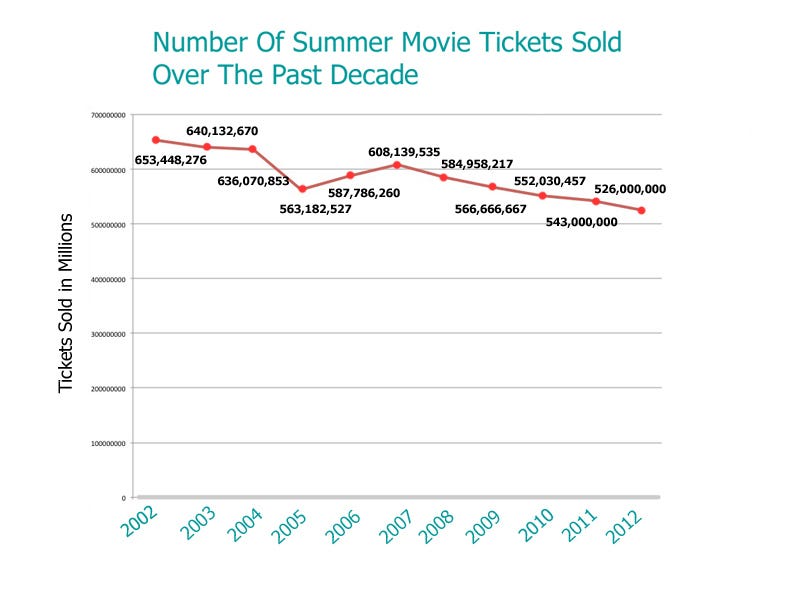
http://www.businessinsider.com.au/see-how-movie-ticket-sales-have-drastically-declined-over-the-past-decade-2012-9
If you were to look at the average age of nightclub attendees, would you conclude that society is getting younger? I think that this if anything is an error in the sample being taken.
If we drill down into Mr Scott's complaint, perhaps we can find reasons for what he sees. Moreover, what and why are the motive and means for "culture" existing the way that it does and for Mr Scott to ask the question.
1. Inputs For Movies
I will admit to feeling a twinge of disapproval when I see one of my peers clutching a volume of “Harry Potter” or “The Hunger Games.” I’m not necessarily proud of this reaction.
Let me offend half the population for a second and suggest that the reading of novels as we know them, is essentially a female pastime. I know that this is a mass-sweeping generalisation but, if you were to do a look at the demographics of who buys them, then I suspect that it is mainly women and always has been.
The modern novel began in the late 1700s and by the middle of the 1840s was a fully formed medium. Reading for pleasure was always a predominantly female pastime; men would usually read more newspapers, periodicals and sciencey things. Go to any writers festival today and you'll even see that the majority of attendees are women.
If you look at who actually buys YA novels, I have no reason to suspect that this is any different at all.
As for the sorts of things which become the grist for the mill to make movies? Think about it - The Wizard of Oz, Robin Hood (who has been made into more films than anyone ever), Gone With The Wind, The Godfather... these all started out as novels/stories. The rise of musicals on film during the 1940s & 50s, was as a result of those being popular on Broadway. Films like Star Trek, Dragnet, Mission: Impossible, Wayne's World, The Naked Gun, all derived from TV series.
In the 21st Century, we live in a society which is largely post-literate. Most people do not read for pleasure and I suspect that the reason that we do see so many comic-book and superhero crossovers is because filmmakers are looking at those for their cultural tie-ins because they will not have read as many books in the first place.
What was the first generally accepted so-called children's novel? This is rather a difficult question to answer but I find it hard to go past "Alice's Adventures in Wonderland" as a possible candidate. But is "Alice's Adventures in Wonderland" even a children's novel? How is that even possible in 1865 before literacy existed en masse among children? If the argument is that adults shouldn't like or consume media meant for children, then if they always have done (from before the advent of cinema, television etc.) then doesn't that suggest that his argument collapses?
2. Who Pays the Bills?
In my main line of work as a film critic, I have watched over the past 15 years as the studios committed their vast financial and imaginative resources to the cultivation of franchises (some of them based on those same Y.A. novels) that advance an essentially juvenile vision of the world.
Film companies will make films to turn a profit. Story - end of. They will usually follow the path of least resistance; that means producing films of relative puerility to put bums on seats.
If you want someone to blame for "an essentially juvenile vision of the world" then how about the post-war baby boom who never grew up; of which Anthony Oliver Scott is a card carrying member. It's people like him who make decisions about which films to make, isn't it?
Also, who are the main attendees of movies? 40 years ago whilst real incomes were higher, there was a more diverse range of ages; now it's more likely to be people aged 15-30, whose incomes and attitudes are more disposable. Maybe the reason why stupid films for 21 year olds are popular in cinemas are because the people who watch those films are stupid 21 year olds? Would Hot Tub Time Machine have even been made thirty years ago? Possibly - Cheech & Chong's "Up in Smoke" was.
How about the rest of us? When things like mortgages, rent, paying the utility bills, costs associated with raising children, arise, arguably people who are actually taking care of their responsibilities and doing the things which adulthood dictates, they're less likely to be at the cinemas in the first place. Again, why should film companies make films for people who won't attend them? That's economic suicide.
3. What Happens When Childhood Fades?
What happens to the boy rebels when the dream of perpetual childhood fades and the traditional prerogatives of manhood are unavailable?
What happens? Darkness and pessimism. Films are darker and edgier than they were 30 years ago. Even the average ratings of films released has been pushed outwards from PG12 to M15+.
What also happens? People don't go to the cinema as much - with less disposable incomes, they stay at home. Question: Why are "Mad Men", "Game of Thrones" and "Breaking Bad" popular? Are those shows "childish" as Mr Scott is so keen to prosecute? What about Borgen, The Killing and The Bridge? Scandi crime drama is exceptionally popular and is very far removed from an extended adolescence.
Also, did Mr Scott consider the possibility that the reason why animated films are so popular amongst older people... was that they always were? What emblem appeared on more aircraft than any other in World War Two? Donald Duck - he was on both allied and axis aircraft.
“When I was ten, I read fairy tales in secret and would have been ashamed if I had been found doing so. Now that I am fifty, I read them openly. When I became a man I put away childish things, including the fear of childishness and the desire to be very grown up.”
- CS Lewis
AO Scott cringes at childishness and asks if adulthood is dead. I've been on the earth for three and half decades and wonder the same thing - whilst I go to a job which I hate, whilst I pay bills which my paycheque struggles to stretch to and whilst I pinch pennies so hard that they scream. Now tell me the answer. Clearly my childhood ended a long time ago.
Anecdote is hardly evidence but if my favourite radio programs are "The Law Report", "The Science Show" and "PM" (Law, Science, Current Affairs), isn't that pretty well much the same sorts of things that say, my granddad would have been listening to 75 years ago?
"When I was young, I thought I had my own key
I knew exactly what I wanted to be
Now I'm sure,
You've boarded up every door
...
While we're living
The dreams we have as children fade away"
- Fade Away, Oasis (1994)
I don't know if childhood fades away. More likely I think, that it's progressively kicked out of us until we bleed. Is adulthood dead? Maybe not for people like AO Scott.
Youth always likes to yell that it is "awesome"; the first sign of maturity is the discovery that the volume knob also turns to the left. If we are talking about defining childhood and adulthood, then shouldn't that be about the markers which actually exist in society, rather than culture, which is a funhouse mirror anyway?
The point is that that I think that Mr Scott is trying to make an argument through the lens of culture and is then wondering why the lens isn't working. Look elsewhere.
http://www.nytimes.com/2014/09/14/magazine/the-death-of-adulthood-in-american-culture.html?smid=fb-nytimes&smtyp=cur&bicmp=AD&bicmlukp=WT.mc_id&bicmst=1409232722000&bicmet=1419773522000&_r=1
This slow unwinding has been the work of generations. For the most part, it has been understood — rightly in my view, and this is not really an argument I want to have right now — as a narrative of progress. A society that was exclusive and repressive is now freer and more open. But there may be other less unequivocally happy consequences. It seems that, in doing away with patriarchal authority, we have also, perhaps unwittingly, killed off all the grown-ups.
- AO Scott, The New York Times, 11th Sep 2014.
It is a rambling and at times confused article, which to be honest is the sort of journalism which I like best, but I think that it makes a couple of distinct errors, which doesn't help the cause.
Firstly I think that that the question of "Is Adulthood dead?" isn't necessarily prosecuted through looking at culture. As far a psychological concept goes, I would suggest that Adulthood is to do with people being self-sufficient, independent and responsible for themselves. In that regards, is it even possible to make such a claim?
You never hear on the news for instance that yesterday in the City of Sydney, 4 million people went to work and came back home, paid the bills, the rent, the mortgage, put petrol in their cars and will do it again tomorrow. The reverse question of "Is Adulthood alive?" is so mundane that no-one need bother to ask the question. Demonstrably, most people do take care of their responsibilities; arguably when you hear about issues like "cost of living expenses" and "mortgage stress" it is precisely because people are doing their best to take care of their responsibilities.
The question of what adulthood actually is, is also so mundane that no-one bothers to ask it very often. Adulthood, insomuch as it is anything, is the default counterpoint to concepts which aren't adulthood.
This might sound ridiculous but I really don't think that childhood was necessarily a protected thing until the Industrial Revolution. I remember reading somewhere that in 1820, roughly half of the workforce in the UK was under the age of 20; it wasn't until the Factory Act of 1833 that made it illegal to employ children under the age of 9 years old.
From this sort of climate and a change of heart, society in late Victorian era set about the task of "improvement" in society and it was from this sort of societal change that we start to see the ideas of public education and social welfare take off.
Even the concept of a "teenager" didn't really start to make very much sense, or even become a cultural touchstone until the 1950s when rising incomes meant that there was a new market to sell products to. Granted that societies have had cultural markers for a very long time such as the Bar and Bat Mitzvah, QuinceaƱera, Seijin no Hi &c but these are mainly coming of age markers, which mark the passage into adulthood rather than a celebration of childhood or adolescence.
Even people's 18th birthday or formally 21st birthday, marks the formal passage into majority which includes the franchise, the right to sue and be sued and to face proper criminal and civil charges as an adult and privileges such as being able to purchase tobacco and alcohol.
In the light of this, Mr Scott's complaint is more a case of complaining about what it is to be grown up. This is where the story gets weird.
That's why I'm sceptical at the way that this question has been framed. Either this is a deliberate case of myopia and choosing not to look at culture going back for a long period of time, or else it is a case of myopia because he doesn't look at society generally.
An old maxim which says that where one stands depends on where one sits might be instructive here. In prosecuting the question of if adulthood has died, it is worth looking at where Mr Scott is coming from. Mr Scott is a movie and television reviewer; so maybe it is worth looking there.
http://www.businessinsider.com.au/see-how-movie-ticket-sales-have-drastically-declined-over-the-past-decade-2012-9
It’s not just this year that summer ticket sales have felt a slump, they’ve been on the decline for the past decade. Viewing ticket sales from the first weekend of May until the labour Day weekend, the slide began back in 2000 when there was a huge drop-off in 50 million summer movie tickets sold.
- Kirsten Acuna, Business Insider, 5th Sep 2012
I don't have a more up to date set of graphs but the data suggests that movie ticket sales are on the slide and have been for at least a decade. That suggests to me a narrowing of audiences rather than an expansion. If that's the case and the sorts of films produced are more "juvenile" then doesn't that mean that the supposed 'adults' which Mr Scott are looking for, are voting with their wallets and just not going to the cinemas like they used to?If you were to look at the average age of nightclub attendees, would you conclude that society is getting younger? I think that this if anything is an error in the sample being taken.
If we drill down into Mr Scott's complaint, perhaps we can find reasons for what he sees. Moreover, what and why are the motive and means for "culture" existing the way that it does and for Mr Scott to ask the question.
1. Inputs For Movies
I will admit to feeling a twinge of disapproval when I see one of my peers clutching a volume of “Harry Potter” or “The Hunger Games.” I’m not necessarily proud of this reaction.
Let me offend half the population for a second and suggest that the reading of novels as we know them, is essentially a female pastime. I know that this is a mass-sweeping generalisation but, if you were to do a look at the demographics of who buys them, then I suspect that it is mainly women and always has been.
The modern novel began in the late 1700s and by the middle of the 1840s was a fully formed medium. Reading for pleasure was always a predominantly female pastime; men would usually read more newspapers, periodicals and sciencey things. Go to any writers festival today and you'll even see that the majority of attendees are women.
If you look at who actually buys YA novels, I have no reason to suspect that this is any different at all.
As for the sorts of things which become the grist for the mill to make movies? Think about it - The Wizard of Oz, Robin Hood (who has been made into more films than anyone ever), Gone With The Wind, The Godfather... these all started out as novels/stories. The rise of musicals on film during the 1940s & 50s, was as a result of those being popular on Broadway. Films like Star Trek, Dragnet, Mission: Impossible, Wayne's World, The Naked Gun, all derived from TV series.
In the 21st Century, we live in a society which is largely post-literate. Most people do not read for pleasure and I suspect that the reason that we do see so many comic-book and superhero crossovers is because filmmakers are looking at those for their cultural tie-ins because they will not have read as many books in the first place.
What was the first generally accepted so-called children's novel? This is rather a difficult question to answer but I find it hard to go past "Alice's Adventures in Wonderland" as a possible candidate. But is "Alice's Adventures in Wonderland" even a children's novel? How is that even possible in 1865 before literacy existed en masse among children? If the argument is that adults shouldn't like or consume media meant for children, then if they always have done (from before the advent of cinema, television etc.) then doesn't that suggest that his argument collapses?
2. Who Pays the Bills?
In my main line of work as a film critic, I have watched over the past 15 years as the studios committed their vast financial and imaginative resources to the cultivation of franchises (some of them based on those same Y.A. novels) that advance an essentially juvenile vision of the world.
Film companies will make films to turn a profit. Story - end of. They will usually follow the path of least resistance; that means producing films of relative puerility to put bums on seats.
If you want someone to blame for "an essentially juvenile vision of the world" then how about the post-war baby boom who never grew up; of which Anthony Oliver Scott is a card carrying member. It's people like him who make decisions about which films to make, isn't it?
Also, who are the main attendees of movies? 40 years ago whilst real incomes were higher, there was a more diverse range of ages; now it's more likely to be people aged 15-30, whose incomes and attitudes are more disposable. Maybe the reason why stupid films for 21 year olds are popular in cinemas are because the people who watch those films are stupid 21 year olds? Would Hot Tub Time Machine have even been made thirty years ago? Possibly - Cheech & Chong's "Up in Smoke" was.
How about the rest of us? When things like mortgages, rent, paying the utility bills, costs associated with raising children, arise, arguably people who are actually taking care of their responsibilities and doing the things which adulthood dictates, they're less likely to be at the cinemas in the first place. Again, why should film companies make films for people who won't attend them? That's economic suicide.
3. What Happens When Childhood Fades?
What happens to the boy rebels when the dream of perpetual childhood fades and the traditional prerogatives of manhood are unavailable?
What happens? Darkness and pessimism. Films are darker and edgier than they were 30 years ago. Even the average ratings of films released has been pushed outwards from PG12 to M15+.
What also happens? People don't go to the cinema as much - with less disposable incomes, they stay at home. Question: Why are "Mad Men", "Game of Thrones" and "Breaking Bad" popular? Are those shows "childish" as Mr Scott is so keen to prosecute? What about Borgen, The Killing and The Bridge? Scandi crime drama is exceptionally popular and is very far removed from an extended adolescence.
Also, did Mr Scott consider the possibility that the reason why animated films are so popular amongst older people... was that they always were? What emblem appeared on more aircraft than any other in World War Two? Donald Duck - he was on both allied and axis aircraft.
“When I was ten, I read fairy tales in secret and would have been ashamed if I had been found doing so. Now that I am fifty, I read them openly. When I became a man I put away childish things, including the fear of childishness and the desire to be very grown up.”
- CS Lewis
AO Scott cringes at childishness and asks if adulthood is dead. I've been on the earth for three and half decades and wonder the same thing - whilst I go to a job which I hate, whilst I pay bills which my paycheque struggles to stretch to and whilst I pinch pennies so hard that they scream. Now tell me the answer. Clearly my childhood ended a long time ago.
Anecdote is hardly evidence but if my favourite radio programs are "The Law Report", "The Science Show" and "PM" (Law, Science, Current Affairs), isn't that pretty well much the same sorts of things that say, my granddad would have been listening to 75 years ago?
"When I was young, I thought I had my own key
I knew exactly what I wanted to be
Now I'm sure,
You've boarded up every door
...
While we're living
The dreams we have as children fade away"
- Fade Away, Oasis (1994)
I don't know if childhood fades away. More likely I think, that it's progressively kicked out of us until we bleed. Is adulthood dead? Maybe not for people like AO Scott.
Youth always likes to yell that it is "awesome"; the first sign of maturity is the discovery that the volume knob also turns to the left. If we are talking about defining childhood and adulthood, then shouldn't that be about the markers which actually exist in society, rather than culture, which is a funhouse mirror anyway?
The point is that that I think that Mr Scott is trying to make an argument through the lens of culture and is then wondering why the lens isn't working. Look elsewhere.
September 29, 2014
Horse 1761 - Australia's Prime Ministers - No 9 - James Scullin
IX - James Scullin
James Scullin was elected before the Great War but lost his seat of Corangamite not too long after. He moved to the inner-city seat of Yarra in Melbourne's inner east and quickly rose through the ranks of the Labor Party. In 1927 he became deputy leader of the party and there was little objection when Matthew Charlton stepped aside as Opposition leader to give Scullin the reins.
Scullin although an economic leftist, still pressed Stanley Bruce's Nationalist government quite firmly on the issues of national debt and although he lost the November 1928 election, Bruce's government became increasingly unpalatable and in the election of 12 October 1929, Scullin took government with 46 out of 75 seats, to give Labor the biggest in their history.
Scullin's cabinet was sworn in on the 22nd of October and just two days later, the stock market crash on Wall St which would herald the beginning of the Great Depression, became front page news. No government which inherited more than a billion pounds of debt and that sort of economic crash could ever hope to succeed and Scullin's government would last just two years; in a climate of total and utter economic chaos.
By the end of 1929, unemployment had already reached 13%, the price of wheat and wool which were Australia's two biggest exports had fallen through the floor and to compound the problem, because the 1929 election did not include a half-Senate election, the Senate was still loaded with Nationalists from the 1928 election.
The 1930 budget came under increasing difficulties beacause the Nationalists wanted to cut government spending, the Commonwealth Bank Board had to power to deny finance to the government unless it got what it wanted (which was also further cuts to spending) and at the same time, the Labor caucus was threatening to rip itself to pieces.
In order to appease the Senate and try to pass some sort of working budget, Treasurer Ted Theodore came up with a plan to further enact budget cuts which he hoped that the state premiers would agree to (at the time, Income Tax was collected by the states and the remitted to the federal government). NSW Premier Jack Lang dissented and soon, other state premiers followed him and they came up with the Premiers' Plan which cut spending by 20% at both state and federal level and also further cut government paid wages and pensions; accompanied with increased taxation rates.
This caused a rift within the party and Joseph Lyons who was the Postmaster-General and Minister for Works and Railways led a revolt and a group who defected with Lyons absorbed the Nationalists to form the United Australia Party. Although not technically a vote of no confidence, the group crossed the floor and successfully passed a motion to adjourn debate on 5 November 1931; and so a snap election was called.
The UAP were the logical opposition to Labor and joined the Country Party in a coalition to win government in the December 1931 election with 50 of 74 seats - Labor was reduced to just 14 and the schism was so rife in the Labor Party that the NSW members who had sided with Jack Lang's revolt, were expelled from the party at national level. "Lang Labor"would remain on the outer for the entire of the '31-'34 term and would only be readmitted in 1936.
Scullin would remain on in politics until 1949 and although he would contest the 1934 election as the Labor party leader, he was pretty well much a tired and spent force, although during World War 2, his office was next to John Curtin's and so I imagine that he would have been consulted for his advice.
James Scullin was Prime Minister in an horrendously tumultuous time. It passed no meaningful legislation and his Labor government remains the only one to have been defeated after only a single term in office.
It is worth noting that the Statute of Westminster was passed in the UK in December of 1931 which marks the start of Australia's legislative independence proper. Also, when the post of Governor-General came up for renewal, Scullin put only forward the name of the Chief Justice of the High Court, Isaac Isaacs, who was the first Australian born Governor-General; even though at the time it was seen as potentially somehow treasonous.
September 27, 2014
Horse 1760 - The Wrong Photo
I almost feel like beginning this blogpost by saying "Hello, my name is Andrew Rollason- welcome to Media Watch". If the ABC is listening and would like to give me a job, then feel free to do so.
The story begins on Wednesday 25th of September when splashed across the front pages of the Sydney Morning Herald and The Age in Melbourne was the following photograph:
The photograph was claimed to be that of the now dead Victorian teenager Numan Haider who was shot and killed after he stabbed two police officers on Tuesday night. It wasn't.
It was in fact 19 year old Abu Bakar Alam, whose family now intends to sue Fairfax Media.
Sharri Markson of The Australian then decided to attack Fairfax Media, with this lovely piece online:
http://www.theaustralian.com.au/media/fairfax-claims-innocent-young-man-was-involved-in-terror-plot/story-e6frg996-1227070222343
A YOUNG man woke up to find his photograph plastered on the front pages of The Sydney Morning Herald and The Age today, with the claim he was the teenager shot dead after being involved in a terror plot against Prime Minister Tony Abbott.
The Herald Sun reports that the man is now nervous about appearing in public after Fairfax Media wrongly labelled him a terrorist. The man told radio station 3AW he was afraid to leave his house.
Not only is the man not a terrorist, but his family helped the Australian effort against the Taliban in Afghanistan.
But, both The Age and The Sydney Morning Herald claimed he was Victorian teenager Numan Haider, who was killed on Tuesday evening during a brawl in which he attacked two counter-terrorism police officers with a knife. The 18-year-old was a supporter of terrorist group Islamic State and had reportedly been in communication with their members overseas.
Fairfax Media’s metropolitan newspapers published a photograph of an innocent young man prominently in their newspapers and on their websites, claiming he was Haider.
Just before midday today, the photograph was pulled from their websites.
Fairfax Media issued a short apology for the photograph admitting it was “published in error”.
- Sharri Markson, Media Editor, The Australian, 25th Sep 2014
The problem is that Ms Markson apparantly doesn't bother to read the newspapers which come out of her own media group. Melbourne's Herald-Sun published the same photograph, albeit smaller:
I emailed ABC's Media Watch yesterday but they replied informing me that it wasn't the same photograph. I don't understand this, considering that the same brown curtain is in the top right hand corner, they same squiggly patterned shirt is in all of them and even the Arabic letter Ł which roughly comes out to be an N in English, also lines up in the same place.
The caption in The Australian says that "A Facebook post shows Haiden with the Islamic State flag", when that isn't in fact the flag of IS at all.
The caption on this flag says "ŁŲ§ Ų„ŁŁ Ų„ŁŲ§ Ų§ŁŁŁ، Ł ŲŁ ŲÆ Ų±Ų³ŁŁ Ų§ŁŁŁ" which translates to "There is no god but God; Muhammad is the messenger of God." which is the same as on the flag of Saudi Arabia, yet the flag of IS says "ŲØŲ§ŁŁŲ© ŁŲŖŲŖŁ ŲÆŲÆ" " which translates to "Remaining and Expanding".
Media Watch have their opinion I suppose but I have one based on what I can see; you can form your own opinion.
What's really amazing is that the Media Editor at The Australian didn't do simple research which anyone could have done; even with a short look at Wikipedia; secondly to accuse the opposition of publishing the wrong photograph when your own media group which you work for and which your columns appear, looks incredibly negligent.
What's worse is that no-one at the two media groups who control the vast majority of news print media in this country bothered to check before they went to print. Mr Abu Bakar Alam, I think has quite a justifiable right to sue not only Fairfax Media but news as well.
What I fear about this is that not only are our two biggest print media groups getting is so horribly wrong but in an environment of increased terror (or so we're led to believe), making mistakes like this can only strengthen the resolve of those who wish to enact and perpetrate harm.
The story begins on Wednesday 25th of September when splashed across the front pages of the Sydney Morning Herald and The Age in Melbourne was the following photograph:
The photograph was claimed to be that of the now dead Victorian teenager Numan Haider who was shot and killed after he stabbed two police officers on Tuesday night. It wasn't.
It was in fact 19 year old Abu Bakar Alam, whose family now intends to sue Fairfax Media.
Sharri Markson of The Australian then decided to attack Fairfax Media, with this lovely piece online:
http://www.theaustralian.com.au/media/fairfax-claims-innocent-young-man-was-involved-in-terror-plot/story-e6frg996-1227070222343
A YOUNG man woke up to find his photograph plastered on the front pages of The Sydney Morning Herald and The Age today, with the claim he was the teenager shot dead after being involved in a terror plot against Prime Minister Tony Abbott.
The Herald Sun reports that the man is now nervous about appearing in public after Fairfax Media wrongly labelled him a terrorist. The man told radio station 3AW he was afraid to leave his house.
Not only is the man not a terrorist, but his family helped the Australian effort against the Taliban in Afghanistan.
But, both The Age and The Sydney Morning Herald claimed he was Victorian teenager Numan Haider, who was killed on Tuesday evening during a brawl in which he attacked two counter-terrorism police officers with a knife. The 18-year-old was a supporter of terrorist group Islamic State and had reportedly been in communication with their members overseas.
Fairfax Media’s metropolitan newspapers published a photograph of an innocent young man prominently in their newspapers and on their websites, claiming he was Haider.
Just before midday today, the photograph was pulled from their websites.
Fairfax Media issued a short apology for the photograph admitting it was “published in error”.
- Sharri Markson, Media Editor, The Australian, 25th Sep 2014
The problem is that Ms Markson apparantly doesn't bother to read the newspapers which come out of her own media group. Melbourne's Herald-Sun published the same photograph, albeit smaller:
Down the corridor from Ms Markson's offices in Sydney, the people at The Daily Telegraph were having fun with the photograph editing it in in photoshop:
What makes this even weirder is that on the same day that Ms Markson published her piece online, her own newspaper The Australian has also published the same photograph up in the top right hand corner:I emailed ABC's Media Watch yesterday but they replied informing me that it wasn't the same photograph. I don't understand this, considering that the same brown curtain is in the top right hand corner, they same squiggly patterned shirt is in all of them and even the Arabic letter Ł which roughly comes out to be an N in English, also lines up in the same place.
The caption in The Australian says that "A Facebook post shows Haiden with the Islamic State flag", when that isn't in fact the flag of IS at all.
The caption on this flag says "ŁŲ§ Ų„ŁŁ Ų„ŁŲ§ Ų§ŁŁŁ، Ł ŲŁ ŲÆ Ų±Ų³ŁŁ Ų§ŁŁŁ" which translates to "There is no god but God; Muhammad is the messenger of God." which is the same as on the flag of Saudi Arabia, yet the flag of IS says "ŲØŲ§ŁŁŲ© ŁŲŖŲŖŁ ŲÆŲÆ" " which translates to "Remaining and Expanding".
Media Watch have their opinion I suppose but I have one based on what I can see; you can form your own opinion.
What's really amazing is that the Media Editor at The Australian didn't do simple research which anyone could have done; even with a short look at Wikipedia; secondly to accuse the opposition of publishing the wrong photograph when your own media group which you work for and which your columns appear, looks incredibly negligent.
What's worse is that no-one at the two media groups who control the vast majority of news print media in this country bothered to check before they went to print. Mr Abu Bakar Alam, I think has quite a justifiable right to sue not only Fairfax Media but news as well.
What I fear about this is that not only are our two biggest print media groups getting is so horribly wrong but in an environment of increased terror (or so we're led to believe), making mistakes like this can only strengthen the resolve of those who wish to enact and perpetrate harm.
September 26, 2014
Horse 1759 - I Don't Know What The Shooting Of A Teenager Tells Us And Neither Do You
The fatal shooting of Numan Haider earlier this week has in my opinion occurred in a climate where sanity has left the building, truth has already gone home and the only actor remaining is madness, who stands alone upon the stage and is yelling as loudly as it possibly can.
I'm pretty sure that we won't be told the whole truth to this story and that we won't be either, on the grounds of security issues; now because Mr Haider lies dead, he will never be brought to trial, which means that there doesn't even need to be a case brought against him either.
We do now that he left both Australian Federal Police Office and a Victoria Police officer with serious knife wounds and that they retaliated from close range; only requiring a single shot to kill him.
There are already problems with the narrative that the media is trying to tell us though.
The photograph which found its way onto the front pages of The Sydney Morning Herald, The Age and The Canberra Times yesterday (Thu 25th Sep) is not actually Numan Haider but 19 year old Abu Bakar Alam, whose family now intends to sue Fairfax Media.
The flag which he was holding, isn't even a flag of a terrorist organisation (or Islamic State) but a black flag with the shahada or Islamic declaration of faith:
ŁَŲ§ Ų„ِŁٰŁَ Ų„ِŁَّŲ§ Ų§ŁŁŁ Ł ُŲَŁ َّŲÆٌ Ų±َŲ³ُŁŁُ Ų§ŁŁŁ
"There is no god but God, and Muhammad is the messenger of God."
This same message appears on the national flag of Saudi Arabia.
It also seems as though Mr Haider had had his passport cancelled and was actually on his way to meet the AFP's Joint Counter Terrorism team, at the Endeavour Hills police station. He apparantly did not want to meet them inside the station and phoned them beforehand requesting that the meeting be held outside; and it is then that the two officers went out to meet him and the incident took place.
This is all set against a background when on the 12th of September, the terror alert was raised to "High", on the 16th the National Security Legislation Amendment Bill (No. 1) 2014* was introduced into parliament which expands the framework and powers of ASIO, ASIS and other intelligence organisations. Mr Haider was killed on the 23rd of September, got front page reportage across the country on the 25th, and mysteriously and almost without any objection, the Senate passed the legislation today, the 26th.
Can you forgive me for thinking that this isn't coincidence?
If a government who has a piece of anti-terrorist legislation before the house, wanted to get that legislation through without question, it is very very convenient that someone who fits the profile of an enemy, is killed and gets national front page media attention.
I'm not suggesting that there is a conspiracy because clearly the Australian Federal Police thought that they had someone worth investigating and it makes sense that armed police officers should want to defend themselves in an attack but this clearly is a public relations problem.
Maybe the AFP and Victoria Police have done their job to the best of their ability but I hope that we don't end up with Numan Haider being held up as a martyr over this.
The problem is that I don't think that we're being told the whole truth and now that Mr Haider lies dead, there's no reason to tell us either.
*http://parlinfo.aph.gov.au/parlInfo/download/legislation/ems/s969_ems_2dbf9bb1-59cd-44ed-8e6a-d106c5535c72/upload_pdf/396762em.pdf;fileType=application%2Fpdf
http://www.aph.gov.au/Parliamentary_Business/Bills_Legislation/Bills_Search_Results/Result?bId=s969
Highlights of the National Security Legislation Amendment Bill (No. 1) 2014 include:
- power to access modify and delete data on peoples computers; without permission of their owners.
- power to access and seize surveillance devices; without permission of their owners.
- power to imprison journalists (and by extension anyone who tweets or blogs) for reporting on matters which it considers breach national security.
- protection from prosecution on either criminal or civil matters for ASIO officers.
That's a really scary set of extra powers to be handing to anyone.
September 25, 2014
Horse 1758 - Australia's Prime Ministers - No 8 - Stanley Bruce
VIII - Stanley Bruce
There is a general trend in Australia politics that when the economy is doing well, the nation will tend to drift to the right and elect economically rightist governments; likewise when things turn sour, the country drifts left.
After the leader of the Country Party Earle Page had made it very clear that the party wanted Billy Hughes gone, Hughes resigned and Stanley Bruce took over as leader of the Nationalist Party and the coalition of 45/70.
At 39 years old, Bruce is still the second youngest Prime Minister to take office and it is that relative youth and spriteliness which propelled his government along.
Bruce had been sent as a delegate to the League of Nations in 1921 and argued for disarmament among nations and had in a small way, boosted Australia's image on the world stage.
He was ostensibly a business man first and foremost and as an importer, he butted heads with Billy Hughes on the issue of the Commonwealth Shipping Live by arguing that it should not be a nationalised industry. Bruce summed up his standpoint on the future of prosperity of the nation with the short slogan "Men, Money and Markets".
He said of himself that:
A plain soldier and business man. I am no politician, nor have I any desire to be one. In the course of my commercial career it has been my fate to have had much experience of politicians and their ways. What I have seen in the course of that experience has given me little respect either for the professional politician or his methods. I am desirous of seeing this country governed in the ways of clear common sense and good sound business principles, and I think that desire of mine is heartily share by the vast majority of the population.
Bruce thought that Australia needed modernising and asked the Tory government of Stanley Baldwin to make changed to trade arrangements in the British Empire.
At home, he wanted infrastructure and development schemes to be put into place and oversaw the The Main Roads Development Act (1923) as well as borrowings of £370m to build the roads and coordinate rail projects.
During Bruce's tenure as Prime Minister, parliament itself shifted from Melbourne to Canberra and the national capital began to take on the functions of administrative government.
Bruce faced problems though. As agriculture prices fell and workers groups such as unions began to make their voice heard and waterfront strikes occured in 1925. Despite this, the Nationalist/Country coalition actually firmed buy one seat to win 51/75 in the 1925 election.
The Commonwealth began to extert force over workers, by re-establishing a Commonwealth police force, passing the Commonwealth Conciliation and Arbitration Act (1928) and the Transport Workers Act (1928) which handed the Federal Government more powers in industrial relations. In consequence, riots broke out on the Melbourne waterfront and relations with the unions and government soured so badly that in the 1929 election, Bruce became the first Prime Minister to lose his own seat.
Bruce's Nationalist Party never really figured in Australian politics again. Two years later the party would cease to exist, when it with a group of Labor Party members who crossed sides, formed the United Australia Party their time would come later.
Bruce would again win a Federal seat but never again be Prime Minister. He would in time serve as High Commissioner to the United Kingdom and as Australia's member to the League of Nations, he would in time take up the positions of the UN's Food and Agriculture Organization and later the first Chancellor of the ANU.
He strikes me as a little strange and also a victim of a confused political landscape. Bruce's government was conservative that accumulated massive debts for infrastructure which is broadly speaking leftist and yet still wasn't able to appease leftist forces; his later career is also in that track.
September 24, 2014
Horse 1757 - The 2014 AFL Grand Final - Using Stats to Pick a Winner
There are loads and loads and loads of really neat method of predicting the result of an Australian Rules match.
If were were to look at the win loss and record for Sydney and Hawthorn, they both ended the season at 17-5. Curiously, they both beat each other at their respective home fixtures. The Grand Final which will be played at the MCG tends to favour Hawthorn but Sydney play there enough for this to be a weak tendency.
I took all the scores from the fixtures that Sydney and Hawthorn played in and plugged them into Excel to do Averages and Trends analysis. The results are really quite surprising:
If you were to look at the average points scored across all matches played (both wins and losses, then:
Hawthorn 16.11.107 def? Sydney 14.13.97
If you were to do a trend analysis looking at all the fixtures to date then:
Hawthorn 18.11.119 def? Sydney 12.11.83
If you were to look at the average points conceded then:
Sydney 16.11.107 def? Hawthorn 14.13.97
If you were to look at the trend for points conceded then:
Sydney 18.11.119 def? Hawthorn 12.11.83
After plugging this into Excel and seeing the figures spit out like this, I was flabbergasted. The numbers for 23 Rounds and Finals Series on a fixture by fixture basis change wildly and yet, the results spat are precisely equal and opposite (ignoring decimal places).
The 2014 AFL Grand Final will be between the highest scoring team against the team with the tightest defence. The final score presumably should be 17.11.113 against 13.12.90 but it would be impossible to say who except for one metric.
Sydney has a tendency to finish the first quarter of any given match 4.8.32 over Hawthorn's 3.5.23. This means that whilst Sydney don't start quickly, they start quicker than Hawthorn does. This even shows in the number of first quarters won for the season which is also in Sydney's favour 16 to 13.
Given that this means a weak tendency for Sydney to be 1.3.9 ahead at the end of the first quarter and that that is certainly enough to swing the fortunes of a football match, then that suggests a Sydney win on paper, which is a bit of a downer as I am a Hawks fan.
On paper Sydney will choke out Hawthorn in the first quarter and take the flag... except that a football grand final isn't played on paper, it's played on green grass and in front of 90 odd thousand people on that last Saturday in September.
September 23, 2014
Horse 1756 - The Language of Fox, Weasel and Skunk Pty Ltd
Meeting Opened by the Chair at 11:04am.
I like big words. Let it be said that I would like to work under a benevolent assiduous boss rather that a querulous one lacking in sagacity. Big words are fun. I also like the fact that you can say something with very short words and still be very precise - or multisyllabic words if you desire for loquacious obfuscation.
What I hate though; what I abhor; what gives me the irrits; gets my hackles, feckles and schmeckles up though, are management type phrases which are weasel words. Writing in the passing voice is all right I suppose but to tergiversate via subterfuge is bunk.
Why are these used? If speaking and writing is about communicating effectively, then who is this language designed for? If it is supposed to make employees hate management, it works. If it is supposed to make the speaker sound more intelligent it fails; this is something I need to be careful with.
During a meeting held in our offices of Fox, Weasel and Skunk Pty Ltd
(as I was taking minutes), I took note of some of the weasel words and phrases being used - there were 22 examples.
These be they (with notes):
1. Wipe The Slate Clean
What slate? Who has a slate? Why do we have a slate? The only reason that anyone ever needs to talk about a slate, is when they are talking about a bar tab.
2. Whole Box And Dice
Monopoly? Risk? Why have we decided to play games? Do you really want to gamble with the future of the company or your employees' future?
3. Action (as a verb)
I have no problem with verbing nouns or nouning verbs. There is nothing strange about 'hammering a nail', 'nailing that exam', 'chairing a meeting' or 'tabling minutes' but there is a perfectly good word for 'action' - 'do'.
"Please 'do' this for me" sounds far better than "Please 'action' this for me", which in all honesty sounds like you're just about to do the Hokey Cokey.
4. Sea Change
Once upon a time, this meant a major change brought about because of the sea. It comes from Ariel's speech to Ferdinand in "The Tempest":
Nothing of him that doth fade,
But doth suffer a sea-change,
into something rich and strange,
Sea-nymphs hourly ring his knell,
Ding-dong.
Suffering a sea change here, invokes terror and visiting Davy Jones' locker (he has kept his gym shoes there for weeks); moving to a lovely new house does not.
5. The Reality Is...
Really? Is it? I reject your reality and substitute my own.
The reality is that the reality is that "the reality is" is a totally redundant statement from the redundant Department of Redundancy Department.
6. Ongoing Basis
This thing continues.
7. Synergies
Synergy comes from the Greek word ĻĻ Ī½ĪµĻγĻĻ (synergos) and means "working together". It is the abstract concept that a thing is greater than the sum of its parts.
In the world of business, since marketing and management are either overhead or indirect costs, by definition, there is almost no synergy ever. Work is produced by people working. Overhead and indirect costs are largely dead weight.
8. Touch Base
I will telephone you later.
9. Blue Sky Thinking
And if the Blue Sky mining company won't come to my rescue; if the sugar refining company won't save me, who's gonna save me?
The company takes what the company wants and nothing's as precious as a hole in the ground.
10. Value Chain
6mm Stainless Steel, I can do for about $19/m galvanised.
11. Rationalisation Of Resources
Economic Rationalism was a buzzword in the 1980s which meant taking public assets and selling them. Rationalisation Of Resources means taking away your job and hiring someone in India to do it for $4 a week.
12. Moving Forward
The country that car is from no longer exists. Put it in H.
13. Integrated Solutions
I've got 99 calculus problems but f(x) ain't one?
14. Service Delivery Methodology
This means "I will do some work for you" or if you're feeling adventurous "This is how I will do some work for you". That five syllable word at the end "Methodology" can be replaced with a handy three letter word "way" in almost every instance.
15. Convergence
Things are coming together. A plan is afoot.
16. Proactive Approach
We will punch you first.
17. Holistic Approach
We're going to look at all of it.
18. Runs On The Board
19. Putting The Ducks In Order
20. At The End of The Day
After our openers got out, we had a middle order collapse and just before teatime, we are in utter peril at 108-9.
21. Outcome Orientation
This is what we want to do.
22. Push The Envelope
I know what this is supposed to mean and in the context of aerospace or mechanical engineering where you are meeting the limits of the laws of physics it makes some degree of sense. In the business world though? Really?
The only envelopes that get pushed in the city, are ones made of brown paper.
I'm pretty sure that everyone at the meeting including myself, would have been far happier if they were down at Balmoral Beach eating fish and chips and watching the waves roll in.
The only reason that I can see for using lifeless and cliched phrases and language like this is to lull the people that you are meeting with into a sense of brain fug so that they won't notice how much they're being taken for a rube.
The Meeting was adjourned at 11:57am
Aside:
The directors of War, Famine, Pestilence and Death Pty Ltd are due to meet at 03:30pm this afternoon.
September 22, 2014
Horse 1755 - The Parable of the Workers in the Vineyard - Three Questions
“For the kingdom of heaven is like a landowner who went out early in the morning to hire workers for his vineyard. He agreed to pay them a denarius for the day and sent them into his vineyard.
“About nine in the morning he went out and saw others standing in the marketplace doing nothing. He told them, ‘You also go and work in my vineyard, and I will pay you whatever is right.’ So they went.
“He went out again about noon and about three in the afternoon and did the same thing. About five in the afternoon he went out and found still others standing around. He asked them, ‘Why have you been standing here all day long doing nothing?’
“‘Because no one has hired us,’ they answered.
“He said to them, ‘You also go and work in my vineyard.’
“When evening came, the owner of the vineyard said to his foreman, ‘Call the workers and pay them their wages, beginning with the last ones hired and going on to the first.’
“The workers who were hired about five in the afternoon came and each received a denarius.
So when those came who were hired first, they expected to receive more. But each one of them also received a denarius. When they received it, they began to grumble against the landowner. ‘These who were hired last worked only one hour,’ they said, ‘and you have made them equal to us who have borne the burden of the work and the heat of the day.’
“But he answered one of them, ‘I am not being unfair to you, friend. Didn’t you agree to work for a denarius? Take your pay and go. I want to give the one who was hired last the same as I gave you. Don’t I have the right to do what I want with my own money? Or are you envious because I am generous?’
“So the last will be first, and the first will be last.”
- Matthew 20:1-16 (NIV)
Link: https://www.biblegateway.com/passage/?search=Matthew%2020:1-16
Abraham Lincoln.
No.
Queensland.
Forty-two.
It turns green.
All of these are excellent answers. The problem is that they’re excellent answers… when we don’t know what the questions are. So it is with this passage from Matthew 20.
Yet again proving that context is everything – to find the questions that this parable is answering, we need to look in the previous chapter. (Link: https://www.biblegateway.com/passage/?search=Matthew+19%3A16-30&version=NIV)
The really short summary is that a rich young man after asking what he needed to do to be saved, went away unhappy after told to sell his possessions and give to the poor, and then follow Jesus.
There are probably many questions and things which can be brought of this parable but I’m only going to look at three questions.
Question 1.
Peter answered him, “We have left everything to follow you! What then will there be for us?”
There’s a question. Jesus addresses that question directly previously but in The Parable of the Workers in the Vineyard he cuts even deeper into the question. Jesus speaks of our attitude.
At the end of the day when the workers receive their pay, they all received what they’d agreed to – a denarius – the going rate for a day’s pay.
Some of the workers who’d been there the whole day, begin to grumble, even though they’d received exactly what they’d agreed to be paid. The vineyard owner quite rightly points this out and also points out that he has every right to be generous with his money.
If we are the workers in the vineyard, will we also grumble about the owner’s generosity? What is the opposite of generosity – stinginess.
If this parable is about entering the kingdom of heaven, then this isn’t really about rewards that we might receive but about our salvation.
What right do we have to complain about who is saved?
Think about how this applies to the people in our own life. What about the people who rub us the wrong way? What about those people of whom it seems that it requires extra grace on our part to deal with them? What about those people who we flat out don’t like? What about the absolute vilest offenders that we can think of who suddenly find Christ? What is our attitude towards them?
It isn't our place to decide who gets to be saved. In fact, we should be reminded that if we were paid according to what we actually deserve, the wages of sin is death, then by rights, none of us even deserve to be paid even a single red cent.
Salvation isn't a matter of seniority, experience, status, power, or wealth (as if any of those things could impressive God anyway), Salvation depends on and is only a result of what Jesus has done. Salvation depends on and only exists because of Jesus’ saving work of dying on the cross for the cancellation of sin, which is a debt, and absolutely nothing which we even can do.
I suppose that technically if the wages of sin is death then we are free to fulfil that contract but after the terms of the contract have been fulfilled, we’re not really in a place which renders us capable of doing anything else, ever.
Moreover, for most people working in the vineyard, it speaks to the fact that people get what they do not deserve; quite the opposite. They get paid generously.
Question 2.
If a rich man can not enter the Kingdom of Heaven, the question is “Who then can be saved?”
There’s a question.
Answer: Anyone.
The vineyard owner asks of some of the people in the marketplace ‘Why have you been standing here all day long doing nothing?’
‘Because no one has hired us,’ they answered.
This might sound like a little bit of a walk-up call but as Christians, we have standing orders to work in the vineyards – to go and make disciples of all nations.
There are probably many people that you know who are just waiting, standing around doing nothing, doing whatever they happen to feel like, because no-one has told them about the Kingdom yet. Even though we live in an age where we can read just about anything, it simply isn't even going to occur to people that they even need saving, unless someone does some work and tells them.
Question 3.
This was the rich young man’s question:
What good thing must I do to get eternal life?
There’s a question.
Of all the people in the marketplace, what good thing did any of them do to qualify them to enter the vineyard? Nothing. How many of them deserved to enter? None.
What’s really impressive, isn’t that people did or didn’t deserve to enter the vineyard but that the vineyard owner was persistently calling them in.
The owner of the vineyard goes out in the morning, at nine in the morning, at noon, at three in the afternoon and as older translations say “the eleventh hour”. That phrase has even passed into idiom and means at the last possible moment.
So it is with us. Christ’s call goes out again and again and again. If you haven’t yet entered the Kingdom of Heaven, it’s still not too late. That offer of salvation from our sins is still on offer.
For the rest of us, the reminder is still there; being in the vineyard means that we need to be productive.
We of course can never earn our salvation, but that doesn't mean that we shouldn't stop working in the vineyard to produce a crop.
The owner of the vineyard will be returning eventually. We should want to be fruitful and not waste our time here.
September 18, 2014
Horse 1754 - ¥£$ It's The Pound Scots
Later today the people of Scotland will vote dissolve the United Kingdom and end the union of the parliaments which has existed since 1707.
One of the issues surrounding this is to do with the currency that Scotland will use after separation. Prime Minister David Cameron and Chancellor of the Exchequer George Osborne, have both made it perfectly clear that they do not like the prospect of sharing the Pound Sterling with a foreign country.
The question then becomes one of what currency an independent Scotland would use and the way I figure it, the only likely outcome is to return to an independent Pound Scots.
The Pound Scots finally saw use in 1707 under Queen Anne who at that stage had a personal union of the crowns of Scotland first and then England. The Pound Scots had been customarily valued at a rate of 12:1.
That is that one Pound Scots would have purchased 1 shilling and 8 pence (1s 8d.) but more importantly that a Scottish Shilling was worth one English Penny.
The Bank of Scotland which had been created in 1695 (six years after the Bank of England) started to issue paper bank notes which were mainly fiduciary and included a "promise to pay" gold coin on demand.
The Royal Bank of Scotland, founded in 1727, issued its own banknotes as did others including the Clydesdale Bank.
The Banknote (Scotland) Act of 1845, allowed banks in Scotland the right to issue notes without any obvious backing and this pretty well much existed until 2009 with the new Banking Act.
The problem that Scotland faces if it becomes independent is that because the rump UK wouldn't allow Scottish banks to produce Pounds Sterling, they'd have to write something else. A customary position would in effect leave central banking duties and monetary policy to a foreign country.
Scotland probably wouldn't be allowed to join the Euro because those same banks would certainly not be allowed to issue Euro currency.
The only viable position as I see it, is to establish a new central bank and overseer to be charged with currency, money supply, and interest rates. A new Reserve Bank of Scotland (for want of a better name) would fulfil that function.
The most likely and seamless way to manage the changeover would be to write into legislation that all banknotes issued by Scottish Banks would automatically qualify as Pounds Scots and a new set of coinage would be issued. The official rate on changeover day would be 1:1; after that, the Pounds Scots would be subject to trading like any other currency. Prices need not change at all. A loaf of Hovis Granary Bread which cost £1.45 Sterling would cost £1.45 Scots.
Just like the other D-Day on 15th February 1971, the changeover would be relatively smooth and take about 18 months.
About the only thing which would need to be decided is what would go on the coins and whether or not pennies and tuppences even need to exist any more. HM Queen Elizabeth would still be the Queen of Scotland, and her face would still be on the back like it is in Canada, Australia, New Zealand and other parts of the Commonwealth.
This is why I don't understand the scaremongering. If the entire of Europe could adopt a new currency relatively easily and the UK has already made a switch from £/s/d to decimal within the lifetime of many people, changing from the Pound Sterling to Pound Scots should be a doddle. It requires no conversions in people's books, no change at all with the notes in people's pockets and coins in Scotland would be replaced in the normal course of circulation though the banks.
Why is it so hard people? In the words of a wise meerkat "Simples."
Addenda:
I don't know what proportion of the £3.5bn worth of currency currently on issue by the Scottish banks has been issued by RBS but if they decide to relocate to London, they would no longer be resident in Scotland and ergo lose their right to issue currency. Furthermore all currency on issue would be illegal and they'd be forced to buy it all back.
I suspect that this might inadvertently cause a run and possibly a collapse. I hope so. RBS received £46 billion in bail-out money in 2008 and 2009, then paid out billions in "bonuses" to its management and not one of its directors went to gaol for negligence. Deliberately causing a run on a bank, might be cause for imprisonment under the act.
September 17, 2014
Horse 1753 - Letters of Last Resort
One of the very first tasks that befalls a Prime Minister of the United Kingdom, is the writing of four handwritten letters which are to be sealed, sent to the captains of the four nuclear capable submarines of the Royal Navy; which are to be opened and acted upon in the event that an enemy nuclear strike has destroyed the British government, the Prime Minister and a nominated "second person" (usually the Deputy PM). As the letter is still in existence after the United Kingdom would have itself presumably suffered a catastrophic existence failure, then it could very well be the last official act of government.
The four letters are sealed and sent to the four nuclear capable submarines and remain unopened until the worst should happen. If there is a change of Prime Minister, these letters are destroyed but still unopened; so the details contained in the letters, will remain unknown to everyone except for the Prime Minister.
I had a go at writing one of these letters... assuming that I somehow became the Prime Minister of the United Kingdom and the task befell me. This is that letter:
Dear Captain,
If you are reading this letter, then the gravity of the situation is already self-apparent. Her Majesty's Government of Great Britain has been destroyed; along with the necessary chain of command which would be necessary to instruct you further.
If you are the Captain of the "Port" crew - you are instructed to take your vessel to the point 54.0000°N and 20.0000°W.
If you are the Captain of the "Starboard" crew - you are instructed to take your vessel to the point 65.0000°N and 6.0000°W.
Once you had reached your designated point, you are instructed to wait until 1830 hours GMT on the next Friday, when you will then listen to Friday Night Comedy and then The Archers on BBC Radio 4 on Long Wave.
Without The Archers there is no civilisation. Without Friday night comedy, there is no joy either.
(You will then read this letter in the presence of all the crew at 1730 GMT).
If in the event there is no Friday Night Comedy or The Archers on BBC Radio 4, then you must evacuate this vessel to the port of Halifax, Nova Scotia, when this vessel must present itself to the Royal Canadian Navy and await instructions from them.
If there is no-one at the port of Halifax who will receive you, then you must evacuate this vessel to the port of Sydney, New South Wales, when this vessel must present itself to the Royal Australian Navy and await instructions from them.
If there is no-one at the port of Sydney who will receive you, then you must evacuate this vessel to the port of San Diego, California, when this vessel must present itself to the United States Navy and await instructions from them.
If it can be properly ascertained in the period between opening this letter and 1830 hours GMT on the next Friday that a state of nuclear war certainly exists, this vessel is free to engage with all enemies but only so far as to defend itself. The vessel must not retaliate with nuclear weapons.
If it can be properly ascertained in the period between opening this letter and 1830 hours GMT on the next Friday that a state of nuclear war certainly does not exist, this vessel is free to engage with all enemies but only so far as to defend itself. The vessel must not retaliate with nuclear weapons.
Above all, this vessel is to maintain standards of professionalism and order. Government doesn't stop merely because the country has been destroyed. Annihilation is bad enough. We do not need anarchy to make it even worse.
We thank you for your continuing endurance.
Regards,
AT Rollason, Prime Minister
Si vis pacem, para bellum
The nations, not so blest as thee,
Must, in their turns, to tyrants fall;
While thou shalt flourish great and free,
The dread and envy of them all.
Rule, Britannia! rule the waves:
Britons never will be slaves!
I have a few things to say about this:
1. There is an assumption that the four nuclear submarines are within radio transmission range of the UK. I also thought about the fact that sending to a fairly remote point somewhere in the middle of the Atlantic would mean that they are well and truly out of the way.
2. The fact that Radio 4 would be out and might come back online, is something of a safeguard. If this was read on a Friday and they heard nothing, then the amount of lead time to evacuate to Canada might only be a few hours but if it was opened on a Saturday, they'd be forced to listen and determine if in fact a nuclear war had taken place for almost a whole week.
3. By sending them to Canada, Australia and then the United States, they will have swept a very large portion of the globe. This should give them adequate time to assess the situation.
4. As a nuclear submarine as a weapon of war is itself a weapon of last resort and the thing which it supposedly is trying to defend has already been destroyed, then I see very little point in retaliating with nuclear weapons, merely as an act of revenge. Usually the point of making maneuvers and attacking an enemy in a war is to gain some sort of advantage; what is the point when there us literally nothing left to be gained?
What's interesting is that the system has been tested this century and purely by mistake:
http://www.manchestereveningnews.co.uk/news/greater-manchester-news/radio-silence-puts-subs-on-nuclear-1157478
THE captains of Britain’s nuclear submarines had a wake up call today - when the BBC mysteriously went off air for 15 minutes. Secret orders to captains say orders to launch a strike are to be opened and acted upon only if the submarine cannot tune in to Radio 4’s Today programme for a given number of days.
THE captains of Britain’s nuclear submarines had a bit of a wake up call today - when the BBC mysteriously went off air for 15 minutes.
The Today programme, which is popular with government ministers, went silent just before the 8 o’clock news because of a fire alarm at BBC HQ.
- Manchester Evening News, 12th August 2004
The thing is that, the Letters of Last Resort are such that not one of them (thankfully) has ever been opened. If you were Prime Minister, you could just as easily draw pictures or write out the words to recipe and no-one would be any the wiser; by the time that they actually did read the letter, you wouldn't live to regret it anyway. Maybe you could even write "So long and thanks for all the fish".
As an exercise, writing Letters of Last Resort is an interesting prospect because it asks you think about a point in time beyond the end. I imagine that it would be a terrible prospect for a Prime Minister to consider and I would suspect that it would be quite a daunting task to face on day one in the new job.
September 12, 2014
Horse 1752 - Vice Rear Cabin Boy Bobo Gargle
- Vice Rear Cabin Boy Bobo Gargle
The problem with writing a biographical piece about military personnel is that a lot of their records* are still part of active files and therefore not able to be released to the public. It's even worse if the person who you happen to be doing research about, has a an interesting past.**
Bobo Gargle was born on 3rd October 1962 in Nyngan, Western New South Wales. Even as a young child, Bobo professed his love for the sea but this was probably because he lived so far away from it.
In 1981 at the age of 19, Bobo joined the Royal Australian Navy and served on several gunboats but it was in the First Gulf War in 1990 whilst on the HMAS Implausible when he really came to fame.
The Implausible was on a mission to clear sea mines from the harbour and the sea immediately surrounding Kuwait, when it was fired upon by the Iraqi Air Force. As a tracking and radar operator, Gargle detected multiple incoming Scud missiles and knew that he had to act but he was also aware that being such a small vessel, the Implausible did not possess adequate anti-air capabilities.
Taking the initiative, Gargle immediately stormed the bridge and after threatening the pilots with a wooden spoon, which was the only thing that he could muster at short notice, he seized control of the ship and thrust the engines to full aft; the Implausible lurched 12 meters in the time that it took for the Scuds to arrive.
All of them missed but had he not acted, at least one of them would have struck the bow of the vessel.
Over the next few years, Gargle would again find himself on the HMAS Ennui during the 1999 East Timorese crisis and the HMAS Rogan Josh during the second Gulf War in 2003.
But it was in naval relations where Gargle would really shine. In 2007 whilst Brendan Nelson was the Minister for Defence, Gargle became a Navy Relations Officer and would communicate issues to the Minister; whilst also providing feedback from the Minster to the Naval chiefs of staff.
The Navy like all military forces, faces the dual challenge of engaging in difficult circumstances whilst at the same time, having to justify its actions to an often hostile press and public. Added to this is the fact that running the miltary is expensive and also involves killing people. There is a strange duality in that society sees this as being necesary for the defence of the nation but still wants to prosectue blame.
This has been especially difficult recently, as it is the Navy who is primarily charged with executing Operation Sovereign Borders. The Navy is charged with performing a function professionally whilst at the same time the job itself is morally repugnant to a great portion of the population.
It was Bobo Gargle's media unit who first made the obvious and gloriouslu obfuscatory terms "on-water" and "operational matters" known to the public.
Of course it it obvious that the Royal Australian Navy deals with "on-water" matters because Navies are by nature a water borne force. Likewise is also obvious that it deals with "operational matters" because not to do so is a self-referential absurdity.
Yet it is in new technology where Gargle is currently trying to communicate covertly.
Secret documents*** obtained by Horse can reveal that the Royal Australian Navy currently has a stealth ship equipped with high-powered laser weaponry, disintegration guns and electromagnetic pulse disturbance weapons. These are installed on a ship which the RAN doesn't admit exists**** called the HMAS Kraken.
Whilst the existence of the Kraken is denied, Gargle's now famous rallying cry for its release, is something of a veiled protest and attack of the secrecy surrounding it.
Horse has it on good authority***** that Bobo Gargle has been offered both the positions of the Governor of New South Wales and Victoria as well as the position of Governor-General of Australia; all of which he turned down. A man of the sea wants to remain with the sea and it is Horse's opinion that he should be offered at very least to be named as a Member of the Order of Australia.
*especially when they don't actually exist
** or in this case, totally made up
***so secret that, I just made them up
****because it doesn't
***** so good because we made it up
September 11, 2014
Horse 1751 - The 2% Emergency
More than likely, you've probably not been paying attention to the machinations surrounding the 2014/15 Federal Budget, other than the reports of cuts to services and various groups complaining about the unfairness of it all. When it comes down to the nitty-gritty of taxation policy, most of us pay even less attention unless it actually affects us.
Having said that, it's probably even more unlikely that you've been paying attention to the actual rates for the current taxation year, unless you were actually in the industry.
Here then are the Individual income tax rates for the year 2014-15:
https://www.ato.gov.au/rates/individual-income-tax-rates/
Already, I can metaphorically hear you snoring.
For the 2014-15 year, the top headline marginal rate is 45%. The ATO's website though, adds this caveat:
The above rates do not include the Temporary Budget Repair Levy. The Temporary Budget Repair Levy is payable at a rate of 2% for taxable incomes over $180,000.
I find this extraordinary.
https://www.ato.gov.au/rates/individual-income-tax-for-prior-years/
The top marginal tax rate for 2005–06 and years prior was 47%, which is precisely the same as 45% + 2%.
Rather than adjust the marginal tax rate, they 2014-15 budget deliberately set out the 2% increase as a separate item. Instead of adjusting one digit, this 2% tax rise will get its own separate item on assessment notices.
What is the purpose of all of this?
In 2014-15 the Medicare Levy rises from 1.5% to 2% to cover the National Disability Insurance Scheme; fair enough. In 1996-97 the Medicare Levy rose from 1.5% to 1.7% to cover the National Firearms Buyback Scheme, following the The Port Arthur massacre; fair enough. In 2011-12 a Flood Levy was instituted to cover the Queensland Floods Recovery program; fair enough.
There is a history in Australia were specific tax rises have been enacted for specific purposes and as a nation, I think that we accept these as being fair and reasonable. The problem with the The Temporary Budget Repair Levy is that when a great number of economists doubt that we even have a so-called "Budget Emergency", it's a bit rich to specifically spell this out.
I don't even object to a tax rise. What I question is why there is a need to call a 2% tax increase a specific thing, when just adjusting the tax rates would have and does mechanically achieve the same function.
I think that naming this as the Temporary Budget Repair Levy, is an exercise in propaganda in the truest sense. Propaganda is about communicating a specific message and usually with the intent of influencing attitudes of people. It's curious that the loaded political term of "staying on message" has entered the lexicon and I think that this is what this is about.
The message that has been repeatedly drilled into us, as though the electorate is moronically stupid, is that the 2014-15 budget is about cleaning up the mistakes left behind by the previous government. Never mind the fact that between 2001 and 2013, there were ten sets of tax cuts which effectively withered away the benefits of the boom of the early 00s, and those twelve years are nicely cleaved in twain by a Federal election. Quite literally those tax cuts were legislated by six of one and a half dozen of the other; so if there is a "budget emergency", both sides were in power and both sides are to blame.
No-one wants to alert us to this though.
This 2% is all about changing peoples' perception; perception is a marvellous thing.
I can't remember who said it but if you were in charge of killing one hundred people, make that one of them is a clown. People will remember that you killed one clown but no-one will care very much about the other 99 people.
So it is here. If the headline marginal tax rate had just risen from 45% to 47% then no-one would have said "boo".
The other thing I find really curious about this is that as strange as this sounds, this tax increase actually might be a marketing ploy to win an election.
As it stands, I think that the next Federal Election should take place between August 6 2016 and the last possible date is 14 January 2017. Before August 2016 though, the government may very well pick up some election triggers because of unpopular legislation.
If people lodging their 2014-15 tax returns are prone to do so later rather than earlier, then they will be lodging them and receiving assessment notices in the first half of 2016. This could very well be during or immediately before an election.
Even if it wasn't it still means that due to changes in the way that the ATO prints assessment notices, they are require by law to disclose the items in those notices; this includes the Temporary Budget Repair Levy. A taxation assessment notice is a perfect piece of propaganda if you want to drive home the case that the previous government was "irresponsible" whilst the current one is cleaning up a "budget emergency".
As a piece of election engineering, using taxation assessment notices is deviously fantastic.
For a start I think that the tax cuts in the boom actually were patently idiotic because taxation is a good counter-cyclical instrument and I also think that it is prudent to undo them. However, to use this as a clarion call that this is especially fiscally responsible as opposed the other side which wasn't, is a little bit dishonest.
It's a bit like having garlic, onions, shallots and radishes for breakfast - it isn't wrong but you just shouldn't do it - and you certainly shouldn't make loud announcements to the person sitting next to you. You might be saying something perfectly sensible but they'll think that your message stinks.
September 10, 2014
Horse 1750 - BIG Numbers On The Doors
Motor Racing is expensive; hideously expensive; so expensive beyond club level motor racing, virtually every car which is put onto a race track becomes a mobile billboard. The thing about having a mobile billboard doing 200mph is that in order to communicate the message of the brand who happens to be paying the bills, it all has to be done fairly efficiently.
In a far off smoky past, the most memorable liveries put on race cars, were provided by the tobacco companies who had their logos and colours writ large across these modern day chariots; with all the subtlety of an egg being struck with a sledgehammer (see Horse 1349).
The thing is though, it isn't just the various tunes of whoever happens to be paying the piper which is memorable. Sometimes, the drivers themselves become like a sort of brand; with their own personal number being on display.
This year, Formula One got around to assigning personal numbers to drivers which they will have for their entire career. MotoGP has been doing this for a while now, with Valentino Rossi's 46, Marc MƔrquez' 93 or Barry Sheene's famous 7. In Australian Touring Car racing, Dick Johnson ran 17 for many years and Peter Brock continued to use 05 long after the Victorian Department of Transport stopped their association.
The way I see it, it makes perfect sense that a number is part of a driver's personal brand; which is as marketable as anything else. Since motor racing is (and let's be brutally honest about this) more or less gloriously pointless, it then becomes a matter of telling a story; stories are memorable if we see the same characters over and over again.
To that end, I don't understand why a billboard which is moving at 200mph needs to relegate what could be a marketable thing, to the status of a small yellow blob in a side window. Whilst money talks, does it really need to yell so loudly that you can't even tell the difference between two identical cars?
NASCAR in the United States learnt this trick years ago - make the numbers on the doors and the roof sufficiently large enough so that you can actually identify who is who. When two dozen fast moving objects go past, all roughly the same size and you can tell which ones are which, then surely that seals the argument doesn't it?
This is why I now present the following exhibit:
In all three cases it's obvious from far away what the numbers are. If your intent is to communicate a message as quickly as possible, then why not do that. While we're at it, why not make the liveries nice and simple as well. The reason that people remember good logos and designs is because they often only have a few design elements. The fact that the Nissan, which is the bottom of the three, is able to ape something which still lives in the memory 30 years later is because the original colour scheme was nice and simple. If people can at best remember only about ten things at once, why force them to do so?
Do something simple and concise once and people will remember it forever. That works equally as well for logos, corporate brands and even something as obvious as putting big numbers on the doors.
Subscribe to:
Posts (Atom)