July 23, 2015

Horse 1944 - Science & Happiness


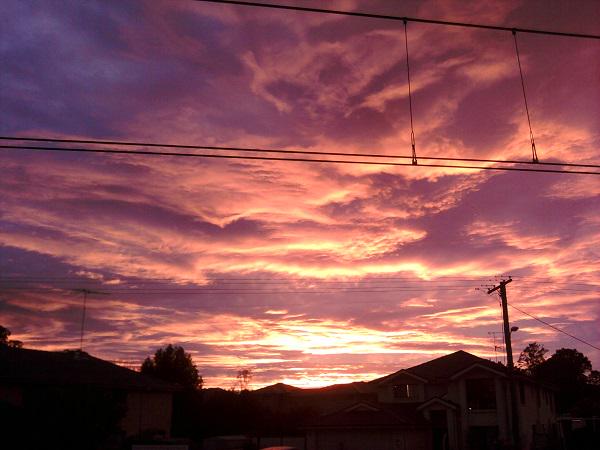
Yes, this is an excuse to post a pretty picture and thus bring some softness to an otherwise sharp and pointed blog. Even though I am colourblind, I can still appreciate the way that the light catches the underside of the clouds and the way that deft shades of colour paint the sky. Words can not hope to convey either the beauty of mornings like this; nor can they express the amount of joy that I feel at looking up and being lucky enough to witness it.

This leads me to a question which was posed of me:
"Does the knowledge of science and how things work diminish the amount of happiness that you get in the world?"
- Thorog85

The short answer to this is 'no' and the long answer to this is below.

If this question is specifically directed at me and trying to extract my own feelings on the subject (where 'you' is in the singular) then logically I'd assume that for this to work, that knowledge and happiness must operate according to some hitherto unknown set of opportunity cost function. That is, that for every unit of knowledge increased, there must be an equivalent amount of happiness decreased. I don't know if that's personally true because I do know that I really like to find out stuff and that I generally derive more entertainment from learning something than I do from a lot of other sources.

I can look up at a rainbow and although I know a fair bit about how the light refracts around the inside of water droplets (even down to the angles of incidence and reflection therein), that does not diminish my appreciation of rainbows. I know for instance that sodium street lamps produce light at pretty discrete wavelengths around 580nm but that does not diminish my fascination with the tobacco stained jaundice that they project and impose upon the world around them. I like the fact that I understand the mechanics of how a note is produced, the mathematics needed to generate a key, how the interaction between various harmonics either sounds joyful or discordant and I certainly enjoy listening to a piece of really complex and seemingly hideous music if the keys to enjoyment of it are understanding how the various themes, phrases and motifs fit together.
If this question is applied to a collective and theoretical 'you', then I'd suggest that the answer is far more complex because I've equally met people who find sciencey type things as boring as bat guano and I've met people who practically live for nowt else.

This question could be asking some broad philosophical question to do with the advancement of science and the general amount of happiness that it has created in the world. If this is the case then I'd argue that many discoveries in science have made people immeasurably happier. It was science that led to the installation of sewer systems and potable water being plumbed directly into people's homes in cities and you mostly don't get people dying of cholera  any more. It was science which led to many cures for diseases such as smallpox and polio and treatments for thousands of ailments; in fact, medicine is probably one of the greatest contributors to people's happiness than anything else. It is quite difficult to be all that happy if you are plagued by illness and death is constantly knocking at the door. Particularly in the twentieth and now twenty-first century, science has given us entertainment devices such as radio, television and now the Internet; all of this riding upon the majestic wings of the printed circuit board, the transistor and even control and domination of electricity itself.

I don't think that we should necessarily be blaming science for people's apparent diminishing returns of happiness. I also don't think that either learning about science, diminishes anyone's individual enjoyment of the world. I think that maybe people would like to conceive of a grinning dumb idiot but I suspect that's because we're more amused by the concept of such a person and if you were to ask anyone if they would actually like to be said person, I suspect that the answer would be 'no'.

What I think definitely does diminish people's happiness is other people. This is something that I need to be mindful of because I'm one of those people who gets excited about something and then wants to tell you about the how and why the thing works. It is people like me who give credence to the stereotypical nerd voice (and the mere fact that I'm even bothering to answer this question in these terms also does the same). But then there's the sort of person who wants to tell you that you are wrong, that this is why you are wrong and that therefore you should feel bad because you are wrong. Immediately I think of the contrast between people like Brian Cox whose love of science is infectious but who doesn't necessarily rag on people and someone like Richard Dawkins who even in biology discussions has a way of making people feel bad for not knowing what he does and that they should immediately die in a hole as a result.

I personally think that knowing about how and why stuff works is cool; I find that entertaining and condusive to my enjoyment and therefore happiness. I also think that you can appreciate things simply and purely for the way they look, sound, smell, touch and taste but I'd argue that even then you're doing science on stuff (albeit simple science).
So Thorog, I don't think that the knowledge of science and how things work diminishes the amount of happiness that you get in the world, either on a personal or societal level.

July 22, 2015

Horse 1943 - Why I Should Be A Host On Top Gear Mk3

Yesterday, apart from being the 46th anniversary of Neil Astronaut kicking the moon and declaring that it was a small step for him (but one heck of a doozie for mankind), was the last day to send in your application videos to the BBC to become the hosts of Top Gear Mk3. The first host, Chris Evans of Radio 2, The One Show on BBC One and Channel 4's The Big Breakfast fame, has already been announced, and the BBC have taken applications worldwide for the other two people who will have what is arguably the best job... In the world. I like so many other have thrown my hat in the ring in the remote chance that someone at Aunty will see my mug and think that I'm wonderful.
I will say this though, I suspect that initially Top Gear Mk3 is doomed to fail.

Oh howl howl howl. Calamity! Cry 'havoc' and let slip the dogs of war... I don't hear you say. I'm just displaying the opposite of schadenfreude - sour grapes - I also don't hear you say. The reason that I don't hear you say any of this is that the medium of a blog post is a silent method of communication and it's one way*. How can I possibly make such a claim? Surely that's dramatic over reach and use of hyperbole? Well, yes it is and 'good work' to you if you noticed that but did you ever stop to think why Top Gear Mk2 worked so well?

Right at the beginning of Top Gear Mk2, there was actually a different lineup. Looking back over what became the biggest export earner for the BBC, that's almost difficult to remember but in that first season, Jason Dawe was there to give practical advice about motoring and talk about issues concerning used cars and the like. Top Gear Mk2 started out very much in the same sort of vein as Top Gear Mk1; which itself was more informational in format. In fact, both James May and Jeremy Clarkson had both appeared on Top Gear Mk1. So what changed and why did Top Gear Mk2 become this multimillion dollarpound behemoth, wiping out all and sundry from your telescreens except for Bake Off, Big Brother, Mastershout, Sherlock and that documentary series about the time travelling physician and his blue Police Box? Writing. That's what.

It must be said that before Top Gear Mk2, Clarkson, Hammond and May were already published journalists with columns in national newspapers. Top Gear Mk2 worked so well because they all took their journalistic sensibilities and then wrote what basically amounts to short columns for television. It's pretty obvious that the best television, radio, theatre, movies, novels, whatever, that continues to endure, does so on the strength of the writing. When you have three journalists writing your pieces for you, then the rest should fall into line fairly easily... and it did.
The other reason that Top Gear Mk 2 worked so well is that wallpapered over the top of good writing, was a classic power trio comedy format. Once Dawe left and was replaced by May, it then meant that Clarkson, Hammond and May fell into the three classic comedy roles of the Brash Leader, Energetic Sidekick and The Only Sane Man. These roles were pretty much interchangeable where required but most of the time they were fairly fixed.

Now I'm not saying that Chris Evans is going to be a bad host (because he's proven himself over many years to be quite competent and entertaining) but I just don't know how in scouring the world for two more prospective partners, that the BBC can possibly hope to make three hosts click together that easily. As the Australian version of Top Gear proved, you can't even cast a like for like set and hope to make it work with that same sort of resonance.
I think that if you did want to make the new show work right out of the blocks, then you do need to critically look at why Top Gear Mk2 worked so well and instead of replacing like for like, start from the strength of three established writers. To that end, looking through the staff who already contribute to the writing of the Top Gear magazine might be a good place to start, or else looking through the tabloid newspapers to find the next set of writers and hosts, is probably the best way to go. Most of the time, good writers will produce better shows than forceful and dominant personalities.

Hence the reason why 740 words after I began writing this, I'd like to state why I'd be the most stellar choice for one of the prospective hosts of Top Gear Mk3... in the world.
Granted, I don't have the most forceful or sparkling personality (I'm quite a bit reserved) but I have an ego slightly larger than Belgium and what I hope is a proven ability to write many dozens of words. If Top Gear Mk3 is going to live and die on the strength of its writing, then I'd like to think that I'd be sufficiently good enough to knock that one out of the field; over the boundary and into the Vic Richardson Gates for six. Writing about cars is something that I already do reasonably often and motor cars have been something of an interest of mine since I was a wee lad.
It's not that I think that scouring the world for application videos isn't an interesting exercise, it's just that I don't know if you really can convey your writing abilities in 30 seconds. You might be able to find someone who at first impression presents well but can they bring their journalistic sensibilities to the table? Unless Aunty gets that right, then Top Gear Mk3 will cough, expire and die.

*Unless you leave a comment below

July 21, 2015

Horse 1942 - The Bishop Moves (♗xc6 dxc6)

Ever since that scandal at a certain hotel, the -gate suffix has been lazily attached to every political scandal wherever possible. The current kerfuffle involving the Speaker of the House of Representatives, Bronwyn Bishop, has been dutifully called "Choppergate" but really there are three issues packed into one.

1. Ms Bishop
I'm going to break one of the cardinal rules of political opinion here by playing the player and not the ball or in Ms Bishop's case, shift about on this diagonally.
The two most obvious qualities of Ms Bishop are her forcefulness and her abrasiveness. These are excellent qualities for someone to have if they want to rise through the ranks of politics to positions of power but not necessarily the best sort of qualities to have once you are there. As the Member for Mackellar, Ms Bishop entered the parliament during a period of steady Labor government; firstly as a Senator for NSW and then she was parachuted into such a safe Liberal seat that the Labor Party didn't even bother to field a candidate at the 1994 by-election of Mackellar.
When in opposition, she has the perfect sort of personality required to attack the government of the day and to hold ministers accountable for their actions on the floor of the parliament. In government though, when the main objective is to decide and enact policy, that's not quite so useful. It's perhaps telling that during the Howard Government, Ms Bishop was installed as Minister for Defence Industry, Science and Personnel, which is not exactly the most central of positions and then swiftly removed again.

2. Expenses Claimed
The headline act of this part of the story is a $5000 helicopter ride to a Liberal Party fundraiser that Ms Bishop claimed as an expense on the public purse. This also brought into light a trip which she made to Europe which cost $88,000; also on the public purse. In her defence, she paid back the $5000 because she wasn't sure if this was allowable or not.
As someone who used to work for the Commonwealth public service, this raises seven kinds of craziness in my mind. For the record, I don't think that she should have been made to pay back a red cent but that this should bring into sharp focus that the current method by which politicians claim expenses is idiotic. I was frequently sent about the country in my job and even put up at the odd hotel here and there; the amount of available expenses that I could claim was nil. The reason for this is that before I was sent anywhere, the issues of plane flights, hotel stays, hire cars and taxi transfers, were sorted out by a central office within the government department. There were no expenses for me to claim because I didn't personally incur any. I find it utterly staggering and bewildering that a similar sort of system does not currently exist in Parliament House. The truth is that human nature being as it is, which is nominally selfish, means that if you give anyone an open ticket to the buffet of public expenses, they will fill their plates up. Such a system is from the outset, open to grift and abuse. I find it impossible to believe that there currently is not a Parliamentary Budget Office through which Members of Parliament make their travel plans. An independent office such as that would remove the ability and power of Members to have even made such a trip like this, it would be subject to the rigours of government audit and because there are 226 Members in both the House of Representatives and the Senate, then such an office would surely be able to negotiate cheaper travel and accommodation arrangements through sheer economies of scale and bargaining power.

3. The Role Of the Speaker.
Prime Minister Tony Abbott in the wake of all of this has placed Ms Bishop on "probation" for the moment. From a strict constitutional standpoint, this is nonsense. Not only is the position of the Prime Minister not even mentioned in the constitution but the notion of a "probation" and whatever the heck that entails, is also not mentioned in the constitution.
If "probation" is indeed a thing in this case, then this is a party disciplinary issue and illustrates perfectly, what is so hideously wrong with the current system.

The only relevant section of the constitution which deals with this is section 35:

http://www.austlii.edu.au/au/legis/cth/consol_act/coaca430/s35.html
The House of Representatives shall, before proceeding to the despatch of any other business, choose a member to be the Speaker of the House, and as often as the office of Speaker becomes vacant the House shall again choose a member to be the Speaker.
The Speaker shall cease to hold his office if he ceases to be a member. He may be removed from office by a vote of the House, or he may resign his office or his seat by writing addressed to the Governor‑General.
- Section 35, Commonwealth of Australia Constitution Act (1900)

In the UK Parliament, the Speaker of the House of Commons upon their appointment, formally renounces their affiliation with the party that they came from, in an attempt to keep the role of the Speaker impartial. In return for their impartiality, they are elected unopposed at the next General Election. I think that this is an excellent set of protocols to adopt if the Speaker is expected to maintain that degree of impartiality.
It's curious to think that the Australia Parliament initially started like this with  Sir Frederick Holder resigning from the Free Trade Party upon his election as the speaker but the second Speaker,  Dr Carty Salmon, retained his membership of the Commonwealth Liberal Party.

The problem is that Ms Bishop hasn't really conducting the business of the House in an impartial manner; frequently ejecting Members under Standing Order 94(a) "Direction to leave the Chamber" that sends MPs out for an hour.
The first Liberal Party member to be ejected by Ms Bishop  under 94(a) was the Member for Herbert, Ewen Jones, who was only ejected but he was only the 109th MP to be ejected by her. Before then, there had been 108 Labor MPs ejected to nil. I haven't been able to find a complete list but it is at least 400 since this term of parliament began in 2013 and it includes records for both a single day at 18 and a week at 47.

Personally I don't really like the way that any of this has been conducted but what is certainty true is that the person at the centre of this, Bronwyn Bishop, is an imposing personality and a redoubtable political operator. Whether or not she should be Speaker is another question entirely and the question of her expenses should be investigated properly along with the whole procedure for MP's expenses.


July 20, 2015

Horse 1941 - Don't Let A Watchman Kill A Mockingbird

I suspect that for vast majority of people who read this post (leave a comment below - it's okay, I don't bite much), that they will only be familiar with Harper Lee's novel "To Kill A Mockingbird" because they were forced to read it in high school. Practically anyone who has studied secondary school English literature will have come across it at some point.
I didn't.
Unlike that great majority of high school English students, I didn't have to read "To Kill A Mockingbird" in school. I went to a selective high school where I'm convinced that the English faculty was getting back at their old high school teachers through us as some kind of proxy. I'm pretty sure that the books that we were set in high school were as a result of some faux intellectualistic attempt to make the English teachers feel better about themselves and the choices that they made rather than an attempt to give us an enjoyable experience.
As a result, I didn't end up reading "To Kill A Mockingbird" until I was in my mid 30s; by which time, I'd acquired the skill of reading fiction for pleasure, after having that skill forcibly beaten out of me in school. Without the pressure to have to analyse the book or write essay questions on it, I quite enjoyed the book for what it was and for that reason, I do not want to read Ms Lee's brand new release "Go Set a Watchman".

In Mockingbird, Atticus Finch is different to a lot of characters that you'll find in a lot of novels because he does what he thinks is right and acts quite nobly whilst doing it. He doesn't appear to be conflicted by angst or turmoil and his aloofness and calmness is kind of different to what you'd usually expect from a protagonist of a novel. There's kind of a literary deftness about viewing the world through Scout's eyes and even though Atticus is stern, Scout has a fondness for her father.
The biggest reason I suppose that I do not want to read "Go Set A Watchman" is that I do not want my impression of Atticus Finch to be tainted. If I never find out that he's a secret racist, or has had an affair or killed someone, or whatever it might be; if I never find those things out then I'm fine with that. Even though Atticus Finch isn't a real person, I'd still rather see the best in him, as I like to do in most people; however deluded and naive that might be.
Mockingbird is a book which I think has stood for so long precisely because there hasn't been a sequel.

In the music world, generally the third record by an artist or band is complete and utter rubbish. They will have written enough songs for the first album and enough stuff for a second one but by the time that the third album comes out, they're always invariably trying to recreate and capture something from before they were famous and it almost never works.
With novelists, unless they'd always intended for there to be a second or third novels as part of a trilogy, the second and third novel is often a hard grind. Going back and writing a sequel might be easier but it probably involves shortcuts; in which case it probably won't be as good. In that respect, I think that one of the greatest events in literary history was when Queen Victoria asked Lewis Carroll to dedicate his next work to her. He duly submitted to her request and his next work was a treatise on some mathematical concept; which failed to capture the public attention.

Think about Star Wars (in my house, everything eventually comes back to Star Wars, Elton John, The Lion King and number plates), the first three films (Episodes IV, V and VI) were always intended as a trilogy and were very enjoyable. The prequels (Episodes I, II and III) which were made many years later are mostly horrible.
I'm worried that in the process of writing "Go Set A Watchman", Ms Lee has either resurrected notes for decades ago and which were never good enough for publication in the first place, or that she's returned to something and can't recapture that spark from oh so long ago.

The other thing that I'm worried about with "Go Set A Watchman" is that this wasn't released for so long because Ms Lee's publishers didn't think it was good enough for publication. Admittedly, I'm hardly what you'd consider to be a literary genius but even these rather paltry and pathetic blurts are edited and changed. Mostly I'll start out with only a basic skeleton of what I want to write and the the finished product ends up markedly different to the first confused shouts into the void. To be honest, the first couple of hundred of these posts are embarrassing. If they were ever published in an anthology, I'm sure that I'd prefer that if was more heavily focused on later, rather than earlier posts. If Watchman is one of those sort of works, then maybe it's akin to a draft or proto work which just isn't as good.
I hope that Ms Lee hasn't been pressured into releasing something that she wouldn't have wanted to escape. Harper Lee is an 89 year old lady and I would feel terrible if I knew that she'd been bullied into publishing this work because the publishers had pestered her finally releasing this until she finally snapped.

I could of course be entirely wrong and Watchman might be a hidden work of rare genius. If that's true then there will be rave reviews and rampant fanfare. I might be tempted to read it under such circumstances but I think that the more likely scenario is as outlined above.

Aside:
The title "Go Set A Watchman" seems more appropriate to me to be a good name for a cricketing novel; when it's half an hour before stumps and a wicket has fallen.

July 18, 2015

Horse 1940 - When To Make A Declaration

Speaking as someone who has only played cricket at levels as high as churches A-grade and Saturday league cricket, I am obviously imminently qualified to write about cricket at Test level. Also, having never been a captain of a side and never having to have had to make decisions which affect the outcome of a match, I'm also overqualified to write about tactics and strategy. It is in that vein, as an armchair expert that I write about that most chimeral of things - the declaration.
I have seen declarations in the past where both captains have come to a mutual agreement to declare both innings without score. This usually happens in the event of rain and there's still some reason, like points on a ladder, where making a declaration of that type makes some sort of sense. Those declarations are sensible. However they're not really of the sort that you'd find in a regular, normal, unaffected match. Those declarations require, in my irrationally exuberant opinion, mathematics.

Even before a ball has been sent down 22 yards in anger, the captains will be aware of one guaranteed aspect of a test match: it lasts five days. Even before you start to work out things like par scores for the ground, this is an immutable fact.
There is also one other guaranteed aspect of a match; that is that in order to win, you must have the other side conclude their innings twice. Under normal circumstances, this means taking twenty wickets and so the biggest single determinant should be the amount of time required to take those twenty wickets.
This means an insanely simple calculation. Ideally, every declaration should be as close as possible to the ideal time required to take those twenty wickets and so dividing the match into four quarters should give you an excellent guide as to when to conclude an innings:

1st Innings: Day 2, the 22nd over (which will occur before lunch)
2nd Innings: Day 3,  the 45th over (which happens half way through the middle session)
3rd Innings: Day 4, the 67th over (which is just after the tea break)
4th Innings: A fourth innings is always chasing a result. Either it succeeds or fails. To declare in the fourth innings of a match is to instantly lose. It would be the sign of an eejit.

Under normal circumstances, declaring earlier than this not only short changes your own batsmen, it gifts the opposition more time to accumulate the runs that you've set for them. Declaring later than this, steals time away from your own bowlers and they'll need that time to take the wickets for you.
In this respect, cricket is similar to Formula One motor racing. If your car lasts for more than a hundred yards beyond the end of the motor race, then the car has been built too strongly and is inefficient. If your car fails before the end of the motor race, then the car has not been built strong enough and this is inadequate.

There are of course exceptions to the above guidelines to making a declaration. If you are batting first and you can keep on batting, then ideally you should treat your first innings as a double innings and declare half way through the middle session on Day 3 as though it were a second innings.
If you are batting second and you can keep on batting, then ideally you should treat your innings as a double innings and declare just after the tea break on Day 4 as though it was the third innings of a match.

This is going to sound almost bizarre but every form of cricket is essentially a limited overs match. In Twenty 20 matches and One Day Internationals, this is explicit but unless for some completely bizarre and unknown reason yet devised and the side bowling wants to bowl more than 90 overs in a day, a Test Match will have 450 overs as a maximum.

Yes I am aware that cricket is a game replete with tradition, pomp and circumstance, and the story of a cricket match ebbs and flows as though it were a living, breathing beast but it is after all a game and the purpose of a game is to win. The declaration is an instrument used in the purpose of winning and say what you like about the psychological advantage it might confer, a game with defined conditions for wining means that this instrument has an ideal set of points as to when it it best deployed.

Aside (and this is a massive aside):
There is an exception to the guidelines above and I think that it would be so dastardly as to have nuclear bomb type implications. Both of which involve either declaring way too late or not at all.

Test Matches are usually played in a series and so winning the series is often more important than any given match within it. If you are in the delightful position of having won previous matches and the current one might allow the opposition to draw, then declaring as late as possible so that the match dribbles out to a draw is acceptable. It might not be exciting and it might not be sporting but if you can steal away the possibility of a win from the opposition then the ends justify the means.

The other exception is when you intend to bat for so long that the opposition spends several days out in the field. If you are batting first and you have the capability of surviving for all five days, you should absolutely and resolutely do it. The glittering prize of an innings of four digits awaits you and the first class record of 1107 runs which was scored by Victoria has been taunting batting teams for almost ninety years. In that case, winning an individual match or even a series is not the objective but winning immortality.

Aside:
At 566-8 and only on Day 2, Australia's declaration was dumb - see above.

July 17, 2015

Horse 1939 - Australia's Prime Ministers - No 20 - William "Billy" McMahon


XX - William "Billy" McMahon

William "Billy" McMahon was one of the original 49ers. That is, he was part of the group of new members to the House of Representatives in 1949 when Menzies led the Liberal Party to government. By the time Gorton was forced to resign in 1971, McMahon had been a cabinet minister in various portfolios for 21 years; which is a record that still stands and would again take some pretty interesting circumstances to break.

As the most senior member of the Liberal caucus and the only really acceptable candidate for both side of the coalition, McMahon was the logical choice for the next Prime Minister
after Gorton resigned the post. What I don't understand though in any sense id why Gorton ran for and won the post of Deputy Leader of the Liberal Party. McMahon was more or less forced to give McMahon a cabinet position and installed him as the Minister for Defence but following a spate of leaks from cabinet meetings, McMahon demanded and got Gorton's resignation.

During Gorton's tenure as Defence Minister, in 1971 McMahon cancelled Australia's plans to build nuclear power stations which also would have included the ability to produce weapons grade plutonium. This was also in line with plans to sign the United Nations' Treaty on the Non-Proliferation of Nuclear Weapons, which would eventually be ratified two years later.

Set against the climate of the continuing Vietnam War, the new Opposition Leader Gough Whitlam called for Australia's formal recognition of China which he opposed. This was made to look somewhat foolish when US President Richard Nixon toured China in 1972.

McMahon held the 1972 election for as long as it was statutorily possible and released a pre-election budget which was denoted in the press a being a "pork barrel" budget (McMahon also accused the ABC of "tremendous bias" in its current affairs programs), which saw government spending increase, especially in the areas of rural spending and social security payments and at the same time reduced personal income tax. At the same time, unemployement rose from 2% to 6% and inflation also rose to 7%.

On the other side of politics, Gough Whitlam and the Labor Party's "It's Time" campaign played on like a bandwagon and people duly got on board. McMahon's government saw an 8 seat swing against it, which wasn't as bad as it could have been but it did bring an end to 21 years of coalition governments; thus McMahon became the longest serving Prime Minister to leading the party, having never taken it to victory at an election.
McMahon would go on to serve as Deputy leader in Billy Snedden's Shadow Cabinet and eventually Father of the Parliament before finally resigning from Parliament in 1982.

July 16, 2015

Horse 1938 - Democracy, Not By Choice Or Consent

Look, I think historical forces have dictated the ebbs and flows of these ideologies or these systems that you’re talking about, be it communism or capitalism, and capitalism has become the dominant force governing most of the planet and it got there through a process of competition, of ideas and delivery, in a similar way, as has democracy. I mean, democracy is finding its own places around the world. It is spreading around the world because people are choosing it. But both of these ideas, capitalism, democracy, even communism, historically these are not very old ideas. 
- Michael Ware, on ABC1's QandA, 13th Jul 2015¹

It always bothers me when I hear claims like this because it's almost invariably made by someone trying to justify democracy and tie it to capitalism as though those two concepts are either entwined and natural, whereas the long game of history leads me to believe otherwise.
Democracy, or at least in the sense that we understand it today of parliamentary democracy elected by a majority of the populace, is not only insanely new in this history of the world but has had to be fought for at every step of the way and often with tremendous losses of life.

This being the year 2015, the 800th anniversary of the signing of Magna Carta, has been symbolically taken to be some sort of great victory for democracy and indeed human rights, when the truth is quite a long way from this in reality. At Runnymede, in probably what was the middle of a boggy field, King John was more or less cornered by the barony to surrender a degree of power and with a list of demands which included representation in parliament. I think that it's reasonable to assume that John would have been under duress as he signed the document because he would have tasted the sword had he not done so.
Magna Carta although it has been held up as all sorts of things, certainly did not extend the franchise to the vast majority of the populace, who were still peasantry who were the de facto property of the lords and barons who ruled over them. For most people, the great 99.99% of people, Magna Carta did precisely bupkiss for them as it specifically excluded serfs and unfree labour from representation and any rights at all. In fact, the Great Council of the Magna Carta, only included 25 barons who represented themselves.
It's also probably telling that in its first incarnation, Magna Carta only lasted about nine weeks before it was flung onto the dungpile by King John.

Things bumbled along for centuries as cities started to coagulate and in England at least, democracy never really woke up for a long time. Not even through the seventeenth century as Charles I became increasingly belligerent towards the parliament and the rise of puritanism led the parliament and the king into outright war, did democracy wake from its slumber. It rolled over as Charles was beheaded, Cromwell became quasi dictator, the monarchy was recalled and even after the glorious revolution and the passing of the Bill Of Rights act which set out many conditions as to how the King and Parliament would work together in future, the franchise was still not extended to the majority of folk.
Really, it was only the coming together of cities and a process which in England is akin to gerrymandering that the franchise was slowly extended via the Reform Acts in the nineteenth century and the rise of unionism that saw any change at all. Faced with a group of relatively rich people in a growing middle class, the franchise was extended slowly as the various factions of parliament were seeking to gain an advantage through the ballot box by the blunt force process of acquiring more votes by including more voters. Even so, the franchise wasn't extended to women, arguing that they lacked the capacity to make informed decisions.
In all honesty, Australia only really played with the idea of giving women the vote in the face of impending federation of the states and a similar sort of thing happened in New Zealand but in places like the United States and Britain, women only got the vote after millions of corpses were flung violently across Europe in the First World War. Even then, in Australia we were still only clearing up the last vestiges of the franchise when we had to take the questions of the rights of Aboriginal peoples to the electorate via a referendum.

At the same time though, actual power was slowly shifting away from governments to that of corporations and now we're kind of at this weird point in history where a lot of governance to do with how we actually live our lives, is being carried out by corporate boards. Corporations reset governance by selling democracy to the people with the most money; so we're back where we started before Magna Carta in a lot of cases. Governments which used to own public goods and services, are now paltry rulemakers.
People aren't choosing democracy. How can they? In what sense do you choose a system of governance anyway? What difference does it make if although you are given the choice of who your elected officials will be, if you actually have no choice at all over the actual economic decisions that matter.
Consider one of the most famous passages in the story of democracy:

We hold these truths to be self-evident, that all men are created equal, that they are endowed by their Creator with certain unalienable Rights, that among these are Life, Liberty and the pursuit of Happiness.--That to secure these rights, Governments are instituted among Men, deriving their just powers from the consent of the governed, --That whenever any Form of Government becomes destructive of these ends, it is the Right of the People to alter or to abolish it, and to institute new Government, laying its foundation on such principles and organizing its powers in such form, as to them shall seem most likely to effect their Safety and Happiness.
- United States Declaration of Independence, 4th Jul 1776²

I wonder about the phrase "the consent of the governed". Consent implies some sort of voluntary permission and I'd argue that unless you were there when the systems were put in place, there is no way that permission can ever be voluntary. Overt consent must surely shift to tacit consent at some point and does that mean to say that you are by default giving your tacit consent to those that govern by not engaging in revolution and civil disobedience?
Is showing up once every few years and putting a few numbers on a ballot really giving your consent to those that govern? I've voted in numerous elections and often I've looked across the spread of candidates and decided that I don't like any of them. I suppose that I prefer the idea of compulsory voting because it does ensure that you have a passing approval of the people or at the very least, a default choice leftover after eliminating those candidates who the majority of people disapprove of the most. Even then, does a vote by the majority of the people imply consent? If you live in a constituency where you are utterly opposed to everything that your sitting member stands for, then I don't think that it makes any sense when you absolutely would not have given your consent to them but have had the tyranny of the majority decide for you.
In the recent referendum in Greece where the people voted "No" to austerity, they've had their wishes trumped by the supranational organisation of the European Union and the IMF by basically twisting the arm of the government to make it agree with what they want. When the people make their voice known through the ballot box and the government either does not or in this case can not listen to the will of the people then there's little point in choosing anything democratically. A vote has been held and even with a simple yes/no question consent was withheld but the government acted anyway.

I seriously wonder if democracy, or at least parliamentary democracy in the form that we have today is either a form of government chosen by, truly representative of, or even with the consent of the people. It's the best that we can come up with for the moment and so the utilitarianist in me says that it will have to do for now.
That sentiment has been echoed before:

Many forms of Gov­ern­ment have been tried, and will be tried in this world of sin and woe. No one pre­tends that democ­racy is per­fect or all-wise. Indeed it has been said that democ­racy is the worst form of Gov­ern­ment except for all those other forms that have been tried from time to time.
- Winston Churchill, to the House of Commons, 11th Nov 1947

¹http://www.abc.net.au/tv/qanda/txt/s4256958.htm
²http://www.archives.gov/exhibits/charters/declaration_transcript.html

July 15, 2015

Horse 1937 - It's Systematic. It's Axiomatic. It's Greece Lightning. - The Greek Debt Crisis Serves As A Warning To Australia

With the Greek debt crisis lurching from bail-out to bail-out and Europe practically making Greece surrender much of its sovereignty in return for another €86bn, the prime minister Alexis Tsipras faces a task of Herculean scale (like cleaning the stables of King Augeas which held immortal cattle and produced an unfeasibly enormous quantity of dung), which obliges him to abandon all promises of ending imposed austerity measures. Thus he faces the wrath of the Greek people which might spell the end of his premiership.
Is the story of Greece instructive though? What could have been done differently? Closer to home, is an economy like Australia immune from being utterly shipwrecked upon the shoals of bankruptcy like Greece is?

If you look over the great economic empires of history, the Romans, the Persians, the Ottomans, the Mongols, the English, the Americans and now the Chinese, all have had one thing in common - the ability to control their own destiny with regards the goods and services they produce.
Greece currently finds itself in a situation where it produces very little of value that it can trade with and is financially ruined as a result. Say what you will, you just can't build an economy based on yoghurt, tourism, cement, concrete and reo-bars. In 2008 Greece's total GDP was €321bn compared with €226bn in 2013.

In a story not dissimilar to Greece, as Australia moves away from producing its own stuff, all that we have to trade with are things we can farm; be they agricultural goods or dirt. We're not even that good with our own dirt either, we sent it overseas to be smelted and it magically comes back as stuff.
If you look through the ASX200, maybe 11 companies are manufacturers? That doesn't seem very smart to me. It appears to me as though the financial system is largely parasitic and that the economy is mostly held up by farming and dirt. Like Greece, we're on the express train to oblivion but we can't afford the diesel to get there.

The biggest underlying problem with the Greek economy is that well before it even joined the Eurozone and the common currency, it stopped attracting foreign investment from about the mid 1990s. That lack of investment spending meant that there wasn't any future benefits to be reaped and this led to a slow process of deindustrialisation. As a result production slowed down, and the number of imported goods which had to be imported increased. Since the amounts paid for imports vastly exceeded the receipts collected on exports, the only possible outcome was an increase in the size of the deficit in the current account; that gets paid for by taking out loans.
Without private receipts, this means that there was an increase in the public debt. This was further compounded by the fact that businesses started to refuse to pay taxation and individuals couldn't sustain the same levels of taxation as they once did.

With falling real wages in Australia and the manufacturing sector withering on the vine (or in the case of the automotive industry, being dared to leave by the Treasurer from the floor of the parliament), Australia is in precisely the same conundrum. I find it utterly scandalous that the Federal Government would even think of contracting any of its capital defence spending to foreign nations; yet last year that's precisely what was being touted when the plan was to build replacements for the ageing Collins class the submarines offshore. What do you do when not even the government is on Team Australia? Of course, no-one particularly wants to set up manufacturing plants here because other countries' labour costs are far cheaper (and our labour costs are also driven by the need to pay for over inflated housing prices).

In Australia's case, this is absolutely an example of the "Dutch Disease" when an economy increases the economic development of natural resources and watches a decline in the manufacturing sector, as the corresponding changes in exchange rates distort prices. Maybe this is an example of the paradox of plenty at work?
Rather than invest in manufacturing, or education, or anything really, governments in Australia squandered the mining boom by giving away tax cuts; now that the price of many commodities (particularly coal, oil, iron ore and grain) continue to fall, the revenues which could otherwise have been collected have been undercut by burning the tax base.
The other thing that Greece tells us is that with issues like an aging population which will add to the cost of state pensions and welfare programs, governments need to think about their tax base structures. Unlike Greece, Australia still retains its own currency and so central banking functions remain relatively autonomous; so at least that's something.

The Greek financial crisis should serve as warning to Australia. Although Australia doesn't have the same sorts of issues of austerity being imposed upon it from the outside, relying on selling dirt isn't wise.

July 13, 2015

Horse 1936 - Switching To Tea Aids Memory

Sydney is a city obssessed with property. Currently, the city is going through the same sort of property price inflation as London experienced in the 1890s. Unlike London though, Sydney doesn't have anywhere near the depth of heritage buildings, nor the same quality of historically important buildings.
This is a tale of my own ignorance about the city in which I live.

Every evening as I make my way home across the Sydney Harbour Bridge, the bus travels over what used to be the egress for trams coming off the bridge. Trams would have plunged into a tunnel and thence to Platform 1 at Wynyard but buses continue overground and onto York St.
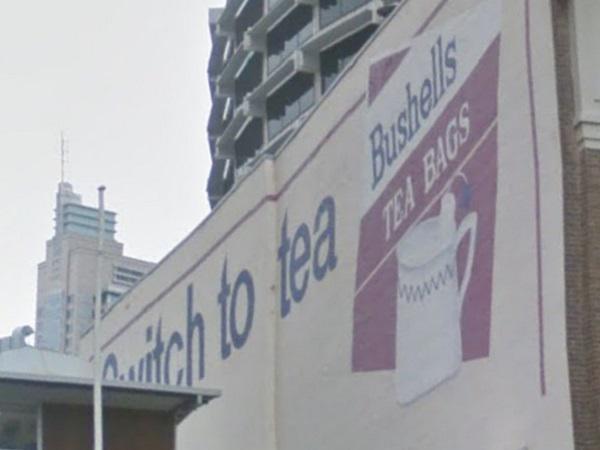
Off in The Rocks and to the left hand side of the bus is this sign which is on the side of 121-127 Harrington Street:


Now I swore blue and blind that I thought that this building was just a bare red brick facade but this signage looks like it was from the 1960s or 1970s. Was I going mad?

As I wandered about The Rocks this morning looking to deliver a packet of papers (and being frozen to the point where even Siberians probably think its a bit cold) I discovered a plaque which informed me that this is called the Bushell's Building. Inside are some pieces of industrial machinery, such as tea blenders and slides, which were left behind from when this building was still Bushell's headquaters and manufacturing plant. Bushell's has long since moved out and been bought out by Unilever but the sign on the outside of the building, was reimagined in 1999 - so I'm not going mad then. It was just a bare red brick facade.
Before the Bushell's Building was a tea factory, it used to be owned by the Sunday Times Newspaper Company (which itself bit the dust in 1930). It makes sense that Bushell should set up his tea factory in The Rocks. It's in the heart of Sydney itself which makes immediate distribution relatively easy and being so close to the docks, also allows for import and export of teas and coffees.

Even just seeing a sign like this makes me think that perhaps the things that we see as familiar should be preserved. Immediately I think of the Arnott's sign on the railway bridge at Strathfield which thankfully has been preserved and I find it crazy for instance that the Coca-Cola billboard at Kings Cross which has been there since 1974 isn't heritage listed yet.

If a city like London can retain elements of the built environment from long ago, then surely a city like Sydney if it wants to call itself a world class city should attempt to do likewise. Great cities like Paris and Athens have done so and even madmen like the Facist leader Benito Mussolini wanted to establish a brand new Rome so that the ancient city of antiquity could be preseved. Cities like New York suffer from the fact that the Tower Building at 52 Broadway, New York, which was the world's fist proper skyscraper and the Cumberland Hotel which carried the first electric billboard, are demolished and disposed of to make room for the next thing there.

Even though Bushells moved out and no longer has anything to do with the building (and so in effect gets free advertising) and even though it is a piece of advertising, I rather like the fact that this has been restored. This sort of thing reminds us that even an great complex thing like a city has a story which continues to live and breathe with the people who live in it. It also reminds me that I'm not going mad.

July 11, 2015

Horse 1935 - Recognising Aboriginal & Torres Strait Islanders In The Constitution: Yes.

In Horse 1534¹, I wrote about the relative pointlessness of including recognition for Aboriginal peoples in the preamble to the Constitution. I'm not interested in mere tokens because whilst they might be symbolic, they achieve very little in reality. I think that the only way that you affect real change in a nation is through the passage of legislation and law; they only way that you affect the real lives of actual people is through the operation of those same instruments, through legislation and law.
When I heard about the Recognise campaign, I was initially hesitant; thinking that it would would produce some mere tokens and not much of lasting value but having read through the proposals by Recognise, I'm quite excited.

This is from Recognise.org :
An Expert Panel – which included Indigenous and community leaders, constitutional experts and parliamentarians – consulted extensively across the nation and reported to the Prime Minister in January 2012.
It recommended that Australians should vote in a referendum to:

  • Remove Section 25 – which says the States can ban people from voting based on their race;
  • Remove section 51(xxvi) – which can be used to pass laws that discriminate against people based on their race;
  • Insert a new section 51A – to recognise Aboriginal and Torres Strait Islander peoples and to preserve the Australian Government’s ability to pass laws for the benefit of Aboriginal and Torres Strait Islander peoples;
  • Insert a new section 116A, banning racial discrimination by government; and
  • Insert a new section 127A, recognising Aboriginal and Torres Strait Islander languages were this country’s first tongues, while confirming that English is Australia’s national language.
- Recognise.org website², as at 11th Jul 2015.


I read through these suggestions and immediately wondered about the mundanity of them. I don't mean to sound blasé on the issue but I think that if you put this set of proposals before the people, then they'd go through without any real opposition at all. I don't think that this would merely meet the statutory requirements required to pass a change to the constitution of a majority of voters in a majority of states but rather, I think that if you put this to the people, it would be a knock out of the park for six, thanks for coming, 90%+ in all states kind of vote.

The thing to remember is that the Constitution isn't some sacred document that was inscribed in stone from high and brought down from the mountain, it is a piece of legislation, albeit a pretty central piece of legislation, and legislation is argued, discussed and thrashed out all the time on the floor of the parliament; literally all the time. This while notion of needing to send this to committee to thrash out the wording of the referendum questions in this case is more or less pointless because really all that needs to be done is ask "do you think we should replace A with B? Yes or No?" and "do you think we should replace C with D? Yes or No?". Five Questions - done; sorted.
To that end, if you just let the people of Australia read through the questions beforehand, via newspaper publication and maybe even a six page A6 pamphlet, then it's reasonable to assume that they'll understand and make up their own minds; which is the point of taking the questions to a referendum in the first place.
Actually I would have thought that for these questions it's a fait accompli anyway because these things are so mind-numbingly obvious as to be trite.

This is why don't understand why when the Prime Minister Tony Abbott, met with Aboriginal elders to discuss the proposed changes to the constitution, why it seemed such a difficulty. If this is a matter of wording, then you could have a select committee from both houses of Parliament meet at 10am, go "bang, bang, bang, bang", have it voted for on the floor of both houses befor lunchtime and then put it to a referendum within a month. How hard is it? Not very.

Symbolically I like the idea that it be put to a referendum on Saturday 27th May 2017, which is the  anniversary of the referendum giving indigenous people the vote and I think that it's a glorious coincidence that that referendum was also held on the 27th May 1967. Perhaps we could also while we're at it, remove Invasion Day (26th January) and replace it with a new national holiday that we could be finally be proud of. 

I'd still like to see six Aboriginal Senators because I think that the only real way to properly recognise the first peoples is with representation in the parliament. If New Zealand can do it, why the heck can't can't we? Maybe the people who thrash out the referendum proposals could look at that too.

July 10, 2015

Horse 1934 - The Mystery Of The Uniform

Think about this for a second. If you took the Richie Cunningham from Happy Days and put him on Fonzie's motorcycle, would he be cool? No. If you took Fonzie's leather jacket and put it on Richie, would he be cool? Again, no. If you put the leather jacket on Richie Cunningham and then put him on Fonzie's motorcycle, would he be cool? Still, no.
How is it then that if you took a Manchester United player and put him in a Liverpool kit, that he would be cool? How is it that when you take Buddy Franklin, who used to be a dead set legend at Hawthorn and you put him in a Sydney Swans kit, that he instantly turns from a legend into a total boofhead?
Something is going on here and that something is the power of a uniform.

For most people, they will see most of their friends replaced through circumstance, several times in their lives. Parents die, children grow up and leave home and even siblings move out and the story of hatch, match and dispatch continues on, on and ever on.
About the only constants in life are people's faith, the continual scratching around to keep the bill collectors and tax collectors at bay and bread on the table, and the football team, or baseball team, or basketball team, or cricket team... that one follows. If you look at FA Cup fixtures on telly, or Australian Rules matches, or baseball games from America, or Hockey Night on CBC, invariably there will always be at least one shot of an old person with an indeterminate number of teeth, who has suffered through years of blinding disappointment and they'll still be there to watch their team lose yet again. Very few organisations illicit such brand loyalty and its certainly an interesting thing to observe.

I'm going to illustrate what I mean with something hideously mundane: Kraft Macaroni & Cheese. The box looks roughly identical to how it did when I was a kid but it no longer comes with that little tin of cheese sauce. The thing which made Kraft Macaroni & Cheese the thing that it was, was that little tin of cheese sauce. Change that out and you have what amounts to an essentially different product.
The weird thing is that if you changed out all eleven players from Liverpool and replaced them all with Manchester United players then the product doesn't actually change. I bet that if you swapped out all eleven players from Liverpool with Manchester United, I'd still follow Liverpool. Unlike Kraft Macaroni & Cheese, you can change out every single component and yet still garner the sort of brand loyalty that other companies and organisations can only dream about. Over the course of five years, a professional sporting team can change its entire staff and even though the players themselves might not show any real loyalty to their employers, the fans will.

This strikes me as odd. A professional sports player has an incentive to show loyalty to their employers because that's where their livelihood is coming from but a fan does not and what's more, players will often move on if someone else is waving a bigger wad of cash at them. What's worse is that a fan actually pays for the privilege of watching their team, which includes watching the players move on and be bought and sold like trading chips. The players move from club to club with as much speed as a ball across the turf but the fans do not.

When you talk about brand loyalty, people will sometimes lie to your face until you probe further. A generation ago if you'd asked someone if they were a Holden or Ford person, then more than likely they'd had a corresponding Holden or Ford sitting in the driveway. Although I might claim to be one of Henry's boys, a blue oval does not sit in our driveway, a lion does; it isn't even a Holden lion either but a French one. (Secretly though, if someone wants to donate many many tens of thousands of dollar pounds to the "Get Rollo an RS Fiesta Fund*" then I'm willing to shoulder your burden however massive.)

Even the uniform itself is subject to change and the fans still remain loyal. If I look through my own wardrobe of Liverpool red kits, there are the sponsors Crown Paints, Candy, Carlsberg and Standard Chartered represented and there are three different kit manufacturers yet despite all of this, it's still the same team. Apart from firms and organisations which outlast generations, that sort of continuity never occurs, and unless you happen to be talking about faith based organisations and family businesses, no other entity has that sort of claim.

Even though styles change, materials technology changes, so long as the basic colours remain the same, a uniform will begin to acquire an aura of its own over time. Before the World Cup of 1954, Brazil played in white but thanks to the absolute tragedy of their 1950 World Cup campaign and losing to Argentina, Brazil changed their kit colour to yellow.
In 1964, Bill Shankly had the Liverpool kit changed from white shorts to an all red kit because it made the players appear larger and fiercer. They bought into the myth and the legend was born.
Even in the genteel and discrete game of Test Cricket where there is little to distinguish the teams, Australia's Baggy Green cap has gone on to become a much treasured thing; helped by the fact that players only get one (or only get a new one when the previous one has become threadbare worn).

From a design perspective, the uniform is something which you mess with at your peril. When Malaysian billionaire Vincent Tan bought Cardiff City FC, he changed the kit from red to blue, in order to try and represent the red dragon of Wales. The fans weren't having a bar of it. Bluebells fans continued to wear their old blue kits and this season, Tan has had to give in to the fans because the uniform is bigger than the management of the club.

I know that I'm waxing lyrical here and and a tendency to be overly sentimental but in the year 2058 when half of my teeth are falling out and I am one of those weird old codgers you see on t' telly, there will still be valiant lads in Liverpool red kits, still be plucky warriors in tangerine Blackpool kits and still enemies in Man United red bits of rag.
That's what a uniform does. It connects fellow travelers through the ages. 

*If someone does want to send me £100,000 for an RS Fiesta, rest assured, I'm not that proud to accept charity. Charity beings at home; I see no reason why it shouldn't be mine.

July 08, 2015

Horse 1933 - Chuck Taylor All-Stars

Basketball was never going to be my sport. This was cemented forever when in Year 7, our sports teacher decided that we were going to play the game and in setting up a practice drill, told us that we had to make a free throw or some such. I was a weedy, weakly 12 year old and the shortest kid in the class, and so there was no way that I could have hoped to make the shot. At this point and in front of the class, I was forced to take shot after shot until I made one and even beyond the point of humiliation; with tears streaming down my face, I still couldn't do it.
In my mind, as a sport, basketball was consigned to the bin and even though this was 1991 and we were in the grip of Michael Jordan fever, all the flashy marketing and hype would never change my opinion. My bedroom wall had a poster of "King Kenny" Dalglish staring back over his shoulder; clad in the Liverpool 7 kit. Putting a ball in the back of the net from 35 yards away, is still more impressive to my mind today than putting a ball through a hoop. Even to this day, I have no idea what a Point Guard is, though I am assured that it probably has nothing to do with a guy standing at the entrance to a building with a Steyr AUG assault rifle.
This didn't change the fact though, that in my wardrobe, a pair of basketball shoes held higher pride of place than my football boots. To this day, they still do; even though I'm ambivalent towards basketball.
There are two names, in the world of basketball, which in my mind stand out more than any others and both of them have shoes named after them. Michael Jordan had the Air Jordan shoes by Nike named after him but I don't think that they are as much a of a classic as the Chuck Taylor All-Star.


Marquis Mills Converse (which is surely one of the greatest names for a businessman ever) started his shoe making firm in 1908. In 1917 he created his first batch of canvas high top basketball shoes and in 1921, the story of Chuck Taylor and these shoes began to entwine.

Charles Hollis "Chuck" Taylor who was an ex-basketball player in high school, became a semi-professional player for the Firestone Non-Skids, which was owned by the tyre company. As this didn't pay enough, he cold called at the Converse Shoes sales offices in Chicago search of a job whereupon he was hired to sell shoes.
Chuck Taylor was a salesman. Chuck Taylor was a shoe salesman. Moreover, having played basketball in high school, Chuck Taylor was a basketball shoe salesman because he understood the game.
Within a year of being hired, Chuck Taylor had already suggested the addition of a rubber patch at the ankle to protect the talus bone. In 1923, the rubber patch with the star was added.

Converse had hired Chuck Taylor  to go on the road, from school to school to promote the game of basketball and at the same time, hawk the shoes which Converse made. Of course, in order to play basketball, one needs a team to play with and so Converse also hired their own team.
During the 1920's and 30's, Chuck Taylor's All-Stars appeared in a whole host of newspapers and he was so inexorably linked with the shoes that he sold, that in 1932 the shoes officially became the Chuck Taylor All-Stars.

Despite having sold more than 600 million pairs of shoes that bore his name, Chuck Taylor never received a commission on them but often lived out of hotels and motels and driving a white Cadillac across America.
He was probably responsible more than anyone else for the inclusion of basketball at the at the 1936 Summer Olympics in Berlin, even though outdoor lawn tennis courts were often used as venues. By the 1948 London Olympics, proper indoor courts were used at the request of the  International Basketball Federation. By this stage though, Chuck Taylor had semi-retired and became the athletic director at Louisiana State University.

It was estimated that during the mid-1960's, Converse held more than 80% of the athletic shoe market but that was eroded to the point where the company dribbled down to bankruptcy by 2001. In 2003 Nike bought out Converse for more than $300m which I suppose is fitting as they own the trademarks of the two greatest names in basketball shoes: Air Jordan and Chuck Taylor All-Stars.

July 07, 2015

Horse 1932 - Why Bother Following England In Any Sport?

When the Matildas lost 1-0 against Japan in the last five minutes of regular time in their Quarter-Final clash at the Women's World Cup, it meant that one of my great internal conflicts would never arise in the tournament. Had they won, the Matildas would have face the Lionesses in the Semi-Final.
Once again, this would have meant that the oldest major rivalry in sport, would be played out yet again on another pitch. It would have been Australia versus England for a chance at the final. Sadly, this didn't take place and my loyalties settled upon England yet again.
The Lionesses couldn't escape their inherent Englishness though and duly lost against Japan, to sent them into the match for third place. Falling over at the critical moment in sport is something which no English team can escape and it applies equally to the ladies as it does to the men.

This brings me to an interesting thought. Although I live ten thousand miles away and on the other side of the planet, why do I follow England? What can possibly be gained by following a nation which keeps on failing at most sporting competitions? Is it some sort of sporting self abuse? Why bother if the expectation is that the team will be rubbish and they're going to lose anyway?
Moreover, what do you do when they buck the trend and defy expectations by actually winning? In 2003 when Johnny Wilkinson potted that ball between the uprights to give England the Rugby World Cup, I genuinely didn't know how to react. If winning is not your default setting, then how do you do so either gracefully or disgracefully?

The England cricket team occasionally pulls off Ashes series wins but the One Day side has never won the Cricket World Cup. England has held the ICC World Number One ranking for the Test, One Day and Twenty 20 formats of the game simultaneously but even when that did happen, the default mode of English pessimism was never far away. Even with The Ashes starting later in the week, I'm fully expecting England to lose the series in a 5-0 whitewash; which again brings me back to the heart of the question. Why bother following England if you.expect them to lose?

The same question could be asked of New York Jets fans, or St Kilda fans, or Newcastle United fans. Although all of them win games occasionally, the chances of them winning a championship are remote in most seasons. Hope exists but it is moored beyond the horizon; out of sight. This is the essence of why people bother - hope.

It is one thing to have a hope which you know will be fulfilled eventually. That is like holding a cheque in your hand which you know one day, you will redeem and claim the reward. It is quite another when you hold out hope for an uncertain thing which might not even happen. Hoping for the uncertain and which in most circumstances will definitely not take place, is the act of both an optimist and a moron but the actual payoff should the thing ever occur, is massive.

If you look at the other side of the piece, fans of Manchester United and now Chelsea, are incredibly smug in comparison. They are often keen to point out how wonderful their team is but if they don't win, they sulk. Supporters of teams that almost never win and in fact expect to lose, aren't as phased if they lose because they're used to it but the joy if they happen to win anything, is incredible.

When five time World Champions, Brazil, were bundled out of the 2014 World Cup, the depths of despair were far far deeper than for England fans who consistently fail. The pill of defeat seems more bitter if you've supped on the sweet nectar of victory. If you haven't tasted victory for more than a generation, then defeat doesn't seem as bitter as it otherwise could have been.
In the case of England, this shows itself up in the writing of songs, such as Skinner and Baddiel's "Three Lions" which contains the line 'thirty years of hurt, never stopped me dreaming'. Scotland who almost never even qualifies for the World Cup had a song by Del Amitri in 1998 called 'Don't Come Home Too Soon'. They did.

If you follow Australia in the cricket, Manchester United in the English Premier League, Real Madrid in the European Champions League etc. then anything less than a win will be disappointing. If you follow England in practically any sport, be it cricket, rugby, hockey, football etc. then most of the time you can expect to lose. England is gloriously rubbish at most sports. When they win though, it's fantastic.

July 06, 2015

Horse 1931 - Border Force!

Do you like fighting brown people? Do you like "getting tough on crime" even at the expense of real action on climate change, unemployment, housing stress, manufacturing, equality issues, racism and indigenous affairs? Then we have the perfect service for you.

BORDER FORCE!

That's right, even in the face of prosecuting budget repair, Border Force is the newest weapon in abrogating responsibility of our obligations under the UN Refugee Convention; stealing budgets from elsewhere, whilst hiding other cuts.

The Australian Border Force is a paramilitary organisation which steals functions and power from both the Immigration and Customs, is Australia's brand new frontline federal authority charged with carrying out the promise of three word slogans like "stop the boats", all while ignoring human rights issues and carrying on behind a cloak of secrecy.

Want to provide information to journalists or speak out against conditions in which refugees find themselves? Don't worry, we've got that covered. People caught disclosing information about cruelty perpetrated to refugees in detention centres such as violence and neglect, can find themselves imprisoned for not one but two years.
Last year, Scott Morrison who was Minister for Immigration and Border Protection at the time that Operation Sovereign Borders was implemented, used his powers under used Section 70 of the Crimes Act to refer staff from the charity Save the Children, who were working on Nauru to the Australian Federal Police for daring to speak up about what they'd seen, No need to worry about due process because with a liberal application of Border Force, they could have been detained and sent straight to prison.

Personally I have no idea why we even need the Australian Border Force if it isn't to cover up and legitimise the cruel treatment of refugees and asylum seekers in our ongoing and undeclared war against brown people.
I don't understand for instance, if you were a terrorist, why you'd consider coming to Australia by boat. That simply makes no sense at all. If you were radicalised by Daesh, Al-Qaeda or some neo-Nazi group, why wouldn't you just come through an airport like any other person on a tourist visa? That'd make far more sense than taking weeks on a leaky boat and ending up in Manus Island. It would be much more efficient and quick to just pass through an airport like everyone else and arouse as little suspicion as possible.
If you were an Australian-born citizen intent on causing terror, then no organisation like The Australian Border Force is going to stop you from planting a bomb in a rubbish bin or running into a cafe brandishing guns.

Maybe Prime Minister Tony Abbott likes playing soldiers. I note that during the offical launch last week, all of the officers to the new organisation were all sporting medals in praise of all the people they'd blown up and they'd all been given lovely new black uniforms, which is ironic considering that the current group on indeterminate brown people who the Australian Government has assigned as the current designated enemy, Daesh or ISIS, is also clad in black.

If The Australian Border Force has been modelled after the US Department of Homeland Security, then that's equally useless at stopping domestic terrorists and wingnuts for precisely the same reasons. If it's modelled after the UK Border Force, then it must invariably fail at its task because the UK has given its Border Force five patrol vessels, whilst The Australian Border Force has been given none.

Perhaps fitting is that within it's first week of operation, the Australian Border Force's staff are planning a two-hour strike at Melbourne's Tullamarine Airport on Wednesday. Maybe that's the real reason why the Border Force was created. Some people face a pay cut of $25,000 per annum, which sounds like a real incentive if you want to keep the borders safe.

Disregard human rights, sound tough on crime, pay people less: you can do it all with Border Force!

Warning: Distasteful right wing formula such as Border Force may be difficult for lots of people to swallow. May cause wind.

July 04, 2015

Horse 1930 - Go West

Being the first week of July, this is the time of year that the incredibly organised and anxious to get a tax refund will get in their documents and ask us to file their tax returns. We won't see the forgetful, the shoe draggers or the recalcitrants until the middle of May next year.
This year though, one of our clients who is exceptionally advanced in years and who usually shows up in this first week did not, due to failing health. His wife arrived instead, with an immaculate and implacable set of documents; each indexed and ordered. She advised us that he is not long for this world and that:
"He is getting everything in order before he has to go west."

Go west. There's an intriguing turn of phrase; the origins of which, I've found incredibly difficult to track down. All that I've found are a set of unconnected bits and I don't know how they fit together.

To 'go west' is to die, to kick the bucket, to expire, to run up the curtain and join the choir invisible.
Perhaps the phrase has its origins in antiquity.
Maybe it comes from ancient Egypt, where criminals were executed on the west bank of the Nile. I find it interesting that the ancient Greek cities of Athens, Sparta and Colosse all executed their criminals beyond the western gates of the city. Five hundred year later, the city of Rome also had a place of execution beyond the western gates of the city.
It could also be that the phrase simply refers to the place of the setting sun.

It doesn't really begin to become a phrase in English until at least the 14th century when yet again it appears in connection with executions of criminals. Yet again beyond the western gates of the city of London, there were execution grounds at Tyburn.
England seems feature again in a possible origin for the phrase when during the early period of transportation of criminals to the Americas, ships would indeed go west to get there. Transportation was something of a commutation of the death penalty and I must admit that I don't understand the mentality which suggests that being sent to America or an island bathed in the equivalent of a perpetual English summer is a net punishment.

In America the story of the phrase 'go west' changes, as after the revolutionary war, the new nation expanded across the continent.
John Babsone Lane Soule was probably the first to be associated with the phrase when he wrote in an editorial for the Terre Haute Express in 1851: "Go West, young man, and grow up with the country."
But it is Horace Greeley who is most associated with it, when in reconstructionist America, he urged his New York Tribune readers to take full advantage of the recently passed Homestead Act and colonise the vast unclamied lands of the continent (and stole from Soule):

Washington is not a place to live in. The rents are high, the food is bad, the dust is disgusting and the morals are deplorable. Go West, young man, go West and grow up with the country.
If you have no family or friends to aid you. Turn your face to the Great West and there build up your home and fortune.
- Horace Greeley, New York Tribune, July 1865.

It is probably this use of the phrase which clouds it somewhat and turns it into a message of hope more that anything else. Indeed it is in this sense that inspired the names of the Marx Brothers film "Go West" in 1940 and the 1941 film "Go West Young Lady" starring Penny Singleton and Glenn Ford.

At this point it would be remiss of me not to mention the Village People's 1978 song "Go West", which in turn spawned the Pet Shop Boys 1993 cover.
This song is rather ambiguous in its meaning though. Depending on whether you take 'go west' to mean to die or as a message of hope, the lyrics to that song change wildly:

Together - We will fly so high
Together - Tell all our friends goodbye
Together - We will start life new
Together - This is what we'll do

Go West - Life is peaceful there
Go West - In the open air
Go West - Where the skies are blue
Go West - This is what we're gonna do
- Go West, Village People (Jacques Morali, Henri Belolo, Victor Willis), 1978

After the Pet Shop Boys cover of the song, it became a standard on football terraces in England and with some modifications to the words, it then becomes an amusing vehicle for the crowd to inform a particular player of their ineptitude and remind them that they are indeed aware of the fact.

Maybe the origins of the phrase 'go west' are lost in the mists of time; never to be revealed again but I think that it's interesting that perhaps the biggest lasting impression of the cardinal direction comes from Frank L Baum's 1912 book "The Wizard Of Oz"; where the Wicked Witch of the West is an embodiment of evil. No other direction has that multitude of connotations attached to it.

A euphemism for death? An inspiration for hope? No other direction has that multitude of connotations attached to it. Except the south.

July 03, 2015

Horse 1929 - I Love Bracket Creep

I start this tale with the famous law from the world of supermarket shopping:

Woolworth's Law: The other checkout line always moves faster.

Woolworth's Law¹ is of course a specific form of confirmation bias or specifically a cognitive bias where people remember information selectively. There is no real reason to believe that the other line always moves faster without any empirical data, it's just that when the line that you happen to be in moves faster than the other lines, you have no reason to complain about it.

There is another famous law from the world of supermarket shopping which is far more practical:

Coles' Law: Finely-shredded cabbage and vinaigrette dressing.

What Woolworth's Law does show though is that everyone loves to complain. Not only does everyone love to complain but they love to complain if they think that they have been slighted. The converse is that people tend to forget when they have been given some sort of benefit because that benefit becomes part of a new normal.

What does any of this have to do with bracket creep? In order to explain that, I first need to illustrate what bracket creep is.

These are the taxation rates for the year 2014/15²:
$00,000 – $18,200 : Nil
$18,201 – $37,000 : 19c for each $1 over $18,200
$37,001 – $80,000 : $3,572 plus 32.5c for each $1 over $37,000
$80,001 – $180,000: $17,547 plus 37c for each $1 over $80,000
$180,001 and over : $54,547 plus 45c for each $1 over $180,000

Let's assume that you were on a wage of $79,000 per annum. That's slightly above Average Weekly Ordinary Time Earnings figures (and well above the median wage because of the distribution skew).
The amount of tax payable, based on an assessment of $79,000 is $18,802 or an effective rate of 23.8%.

If you were to get a modest pay increase of 4% (which is keeping in line with the historical long term average since 1 ab urbe condita - from the founding of the City of Rome on 21st April 753 BC), then your wage would increase to $82,160.00

Something interesting happens. For ever $1 over $80,000, instead of paying 32.5c on that next dollar, you're now paying 37c on that next dollar. Even though your real wage might not have increased because of inflation, the taxation taken has been increased in real terms because you've jumped into that next bracket.
The amount of tax payable, based on an assessment of $82,160 is $19,989.40 or an effective rate of 24.3%.

The difference in the increase of taxation taken is only 0.5% but it is enough to send people who hate paying tax and those who want the government sector to be as small as possible, into spirals of great outrage.

Consider this:
http://www.afr.com/news/policy/budget/gen-y-to-be-slugged-100000-in-extra-taxes-for-canberras-budget-failures-20150701-gi2mql?&utm_source=social&utm_medium=twitter&utm_campaign=nc&eid=socialn:twi-14omn0055-optim-nnn:nonpaid-27/06/2014-social_traffic-all-organicpost-nnn-afr-o&campaign_code=nocode&promote_channel=social_twitter

Gen Y to be slugged $100,000 in extra taxes for Canberra's budget failures
However, as shown in the Grattan research report – Fiscal Challenges for Australia – Treasurer Joe Hockey has shifted the lion's share of his anticipated budget repair over the next four years onto the burden of fiscal drag, or the process by which wage hikes push workers into higher tax brackets.
Also known as bracket creep, the process means the Federal government will extract an extra $25 billion from payrolls by 2018-19, equivalent to more than half of total budget repair job.
- Jacob Greber, Financial Review, 1st July 2015

Oh Calamity! Howl, howl, howl!
CRY HAVOC AND LET SLIP THE DOGS OF WAR!

Bracket Creep is almost always written about as though it was some hideous abomination; the harbringer of all kinds of evil upon the world but is it really?

One of the important functions of taxation, is that it is one of the controls of fiscal policy and can be used to stabilise economic growth and hopefully level out the booms and busts of an economic cycle. In a growing economy, people will automatically pay more in taxation and this means that the mechanism of taxation itself acts as an automatic fiscal stabiliser.

That probably should have happened in the early 00's but before the global financial crisis, instead of collecting more in taxation, the Howard Government chose to cut income taxes. From 2007-2013, the Rudd-Gillard-Rudd Governments also chose to cut income taxes as a method of pursuing expansionary fiscal policy to hopefully stimulate aggregate demand and boost the level of economic activity.

From 1994/95 to 1999/2000 income tax rates remained static and from 2000/01 to 2012/13, we had 10 sets of tax cuts in 12 years, in the face of a mining boom which made no sense at all and the global financial crisis which might have made some sense, if it wasn't for the previous tax cuts.

In essence, Joe Hockey as Treasurer has a horrible task ahead of him. The most effective method of paying down he debt would be to increase taxation rates and collect more in income tax but people would start complaining. He can't sell off very many government assets because the government has very little left to sell and so cutting transfer programs like welfare, health care or defence spending, is also like to set people off complaining.

This is why I love bracket creep. Most voters are too politically ignorant to realise that their pay packets are being shaken just that little bit harder and won't complain. From the government's perspective, bracket creep is great because it requires no legislation at all and when they finally do announce a tax cut, it looks as if they are heroes, even though they might not actually be in real terms.

Also, Consider this:
http://www.abc.net.au/news/2015-05-12/bracket-creep-hurting-low-to-middle-income-earners/6464332
"As soon as you move to $37,001 of income you're moving from [paying] 19 to 33 cents in the dollar... and you may well find that you're losing family tax benefits."
- Chris Richardson, Deloitte Access Economics, as quoted by Eliza Borrello, ABC News, 12th May 2015

Bracket Creep is blamed for all sort of things by people who have a barrow to push. Those things are not grounded in fact.

The whole point of progressive taxation rates is that they employ marginal tax rates. A marginal tax rate is the percentage of tax taken from that next dollar. Yes, someone might very well move from $37,000 to $37,001 but it is only every dollar over $37,000 which is taxed at 32.5%; not every dollar from dollar one. The actual difference between those two amounts is only 35c (including the Medicare levy).

Also, the first Income test which reduces the maximum rate of Family Tax Benefit Part A³, only kicks in at $51,027; the second test begins at $94,316. The Income test³ which reduces the maximum rate of Family Tax Benefit Part B doesn't apply until the primary earner earns more than $100,000 per year.
Those things aren't bracket creep issues. Besides which, if you are on an income of $94,316 which is 122% of AWOTE, you're kind of doing pretty well anyway.

Literally no-one in Australia complained when the Howard, Rudd, Gillard and Rudd Governments cut taxes during the 00's and early 10's. Attempt to raise taxes to implement an actual budget repair and you'll trigger Woolworth's Law. People love to complain if they think they've been slighted; they tend not to care or notice if the government announces no changes to taxation and bracket creep occurs silently.
Bracket creep is like nature reclaiming civilisation. Bracket creep is part of a new normal.

¹Woolworth's Law isn't a real law.  Coles' Law is delicious.
²https://www.ato.gov.au/Rates/Individual-income-tax-for-prior-years/
³http://www.humanservices.gov.au/customer/enablers/centrelink/family-tax-benefit-part-a-part-b/ftb-a-income-test
http://www.humanservices.gov.au/customer/enablers/centrelink/family-tax-benefit-part-a-part-b/ftb-b-income-test

July 02, 2015

Horse 1928 - The Miranda Warning - We Hope You Remain Slient

During the fallout in the wake of Zaky Mallah's appearance on ABC 1's 'Q and A', Daily Telegraph columnist Miranda Devine went on Sky News' 'Agenda' program and this to say about the existence of the ABC itself:

What should happen is that if Mark Scott wants the ABC to be a public broadcaster, let it be funded by the public by donations. It does not, this day and age, taxpayer money should not be paid to a company that ends up being a competitor to commercial companies that are doing it tough.
- Miranda Devine, Sky News, 25th June 2015¹

The real irony is that Miranda Devine is herself, an object lesson in why the ABC needs to exist and why its continued existence is so very important.

Let's for a minute enter the world of Miranda. This is a world which public broadcasting is paid for mostly by donations. Such a world almost exists and it has a name: The United States of America.
America likes to pride itself as a bastion of the triumph of capitalism but it should also be held up as an example of what happens when capitalism is allowed to rule unfettered and unhinged. America is a nation where more than 100 million people live in technical poverty, where at least 30 million people still have no access to healthcare in spite of Obamacare and where public broadcasting is often ineffectual and dolefully inadequate. That’s where unfettered and unhinged capitalism can take you. Actions have consequences.
Those consequences either mean that the public broadcasting in America by The Public Broadcasting Service continually cries poor and that regularly scheduled programming is often interrupted with spots that try to canvass for more donations. Despite this, PBS like the ABC, consistently rates as the most trusted source of news in the United States, which annoys six bells out of the rest of the broadcasting landscape.

One of the jobs of the media as part of the marketplace of ideas, should be to hold up those ideas through the mechanism of journalism (either through print, radio, television or the internet) to public scrutiny, so that those ideas may be evaluated and tested. Ideas form the bricks from which ideologies are built and it is in townships of ideologies that policies and political parties live. The enactment of policy by political parties in parliaments is what determines laws and it is laws which govern how society operates; often with some pretty fundamental implications.
What happens when public broadcasting is so anaemic that it is either ineffectual at transmitting ideas or holding ideas to account? The answer is that those people who have the means and can afford to shout loudest into the marketplace, win.

I suppose that you could argue that from an absolutely capitalist perspective, that this is in fact a perfectly efficient position to arrive at. Those ideas which didn't have the force of money behind them, must wither and die and it it is efficient for them to do so. What happens though if those ideas lead to negative social consequences? If slavery, exploitation, sexism, racism,  poverty, hardship and violence arises as a result of the operation or inoperation of law, then is that the sort of society which we want to live in? (Actually given the front page of the Daily Telegraph yesterday, the answer to that question according to the Daily Telegraph might very well be 'yes'.)
If ideas be the stuff from which ideologies are built and where political parties live, then shouldn't they be held up to public scrutiny; especially if we're forced to live under the laws which they will eventually spawn?

In the United States of America, no such television program like Q and A exists; nor is it likely to ever exist. The commercial free to air networks are would never produce such a program because there would never be a profit in it; not while acres of cooking shows, talent shows, comedy programs and drama can fill up broadcast schedules and keep Rockefeller's Concerto for the Wall Street Piano playing, with its famous crescendo of 'Ka-Ching, Ka-Ching'.

If we turn spotlight to our own island nation, which of the commercial television networks would bother to host a program like Q and A? Better yet, apart from the odd grab on breakfast television, where would the people who go into politics to become our elected officials, to argue about the enactment of laws, go to give voice to those ideas? They will go to those places that can most afford to pay.

This is why Miranda Devine becomes an object lesson. I personally think that her idea of making the ABC live entirely on donations is repugnant and has all the appeal of what happens when you get a whiff of a three day dead cat, it stinks. Even the medium through which her statements were made perfectly illustrates why it is a bad idea. Sky News is a pay-TV channel; which means that it is only accessible to those who can afford to pay.

The United States Declaration of Independence says that in order to secure the rights of Life, Liberty and Happiness, that:
Governments are instituted among Men, deriving their just powers from the consent of the governed.
- United States Declaration of Independence, 4th Jul 1776.

Think about that phrase "the consent of the governed". How can you give your consent to those who want to govern you, unless you first hear what they have to say? How do you hear what they have to say, if you cannot afford to pay to do so? Should the rule of law of a nation be determined by those with the greatest capacity and means to pay? Why is it just and fair?

The comments which triggered this storm in the first place, are in the cold light of examination, perfectly legitimate concerns.
What would have happened if Zaky Mallah's case had been decided by the Minister himself and not the courts? If someone is being accused of something as serious as terrorism or fighting for a foreign power, they why shouldn’t they have the right to have their case heard through a court process?
Quite apart from the fact that we've publicly seen one media organisation yell as loudly as it could in the pursuit of attacking an eighty year old enemy in the name of sheer cussedness, we've had an idea drowned out and we’ve had one of the fundamental ideas of open democracy stamped upon until it bled.
How do you hold up ideas to the subject of scrutiny and have them heard if monied interests have the power and means to drown out all other voices? That’s the world that Miranda Devine is advocating. I don’t want to live in such a place.

¹This quote on Sky News was via ABC1's Media Watch. Sky News is tucked up behind a pay wall.: http://www.abc.net.au/mediawatch/transcripts/s4264050.htm

July 01, 2015

Horse 1927 - The Most Expensive Motor Accident Ever

The Goodwood Festival of Speed (which is a romp around the grounds of the British Automobile Racing Club's President's estate) is probably the greatest annual historic motor show in the world. Every year, priceless machines are thrashed about the grounds and sometimes it ends in bent metal. Invariably when one of these things crashes, the question posed in what is the most expensive car crash ever?

Ever since mankind invented the greatest machine of all time, the wheel, we've gone practically everywhere and at great speed. We've raced chariots, trains, and since the last decade of the nineteenth century, the motor car. Usually it is race cars which push the boundaries of technology and if a race car crashes, especially a Formula One car, then the repair bills can be substantial.

For most of us though, because our motor cars are the second biggest capital asset we're likely to own, they also represent some of our biggest repair bills. Even on a cheap family hack, a small accident might run into thousands of dollarpounds to repair.

There are also costs in retrieving a motor vehicle though and for this reason, I think that this would be the most expensive motor accident ever:


Nope. It wasn't just enough for us to go to the moon. We had to take some cars up there so that we could drive around. Seriously people, you're on the moon! Isn't that far enough?

In less than 23 miles of driving, the Lunar Rover suffered the first extra terrestrial motor accident. Just to prove that even when it is rocket science, people will still klutz it up, Eugene Cernan accidentally broke the fender on the Lunar Roving Vehicle of the Apollo 17 mission with a hammer handle, when he dropped it. They tried to tape it back on but the tape wouldn’t hold because of all the dust on the moon. It turns out that duck tape isn't as almighty as we thought. Still, a kludge was worked out with some clamps, and a map which they found inside the Lunar Module; those bits were later removed.

If you divide the cost of the Apollo program by six (being the number of missions that actually landed on the moon), then you arrive at just under $5 billion per mission in 1970s dollars.
If inflation has been running at 4% (which is an historical average since the beginning of the Roman Empire), then the estimated repair cost in 2015 of that one fender is about $30 Billion. Most of that is simply getting there.
Probably a new fender would only cost tens of dollarpounds to fix at it's only cheap plastic but once again, we're forced to pay some licensed bandit with a tow truck to take the car to the repair shop (in this case NASA and another Apollo style moon mission). Or in this case just abandon it.