August 14, 2015

Horse 1959 - The Treasurer Has Spoken; We're Just Not Sure What He Said

http://www.theaustralian.com.au/opinion/our-taxes-must-be-spent-wisely/story-e6frg6zo-1227476458234
We cannot afford to have a tax burden that stifles growth and costs jobs. We can’t just view the tax system and taxpayers as a collection pool of unlimited funds. So in developing a better tax system, we need to consider the sustainability of our heavy reliance on income tax, especially personal income tax. This is because we need to take into consideration the negative impact and disincentive of higher taxes.
The problem is we have an over-reliance on personal income tax to support our revenue base. Our largest source of tax revenue is personal income tax. It raised about $185 billion last year.
- Joe Hockey, in The Australian, 10th Aug 2015.

On Monday, Treasurer Joe Hockey was given an opinion piece in The Australian. Now whilst in principle I have no problem with someone being free to express their opinion and be paid for the expression of that opinion, I wonder why he took his opinion firstly to The Australian and not the ABC.
The Prime Minister thought it was a problem when "the national broadcaster appears to take everyone's side but our own" in January of 2014 and I would have thought that if government officials wanted to show that they were on "Team Australia" that they would have "at least some basic affection for the home team, so to speak". Which is "the home team"? If The Australian is the doyenne of a subsidiary of an  American multinational mass media company, just who is the "home team" here?
A man much wiser than me once said that "where your treasure lies, your heart will lie also"; from the world of accounting we're told that if you want to find motives, follow the money. It is telling therefore that when Treasurer Joe Hockey writes a piece talking about income tax policy, he does so in The Australian and not on the ABC's website.
Even within the News Corp Australia group, he does so in The Australian and not the Herald-Sun, the Daily Telegraph or the Courier-Mail. This is a piece which from the outset plays to an audience and definitely has them in mind. This is a "discussion" around income taxation policy, knowing that the great unwashed, illiterate masses will not be privy to it. Follow the money; find out where this treasure lies; who he is playing to.

That aside, I find two broad things interesting about Mr Hockey's article.

Firstly he starts with the premise that government revenues have and over-reliance on personal income tax supporting the revenue base.The article then tries to prosecute the case as to why he thinks that income taxes are inherently too high.

Given that in the 2015 budget the projected revenues expected to be collected from Individual Income Tax is $189.6bn and the single largest component of the income side of the budget, it seems strange to me that you'd want to castigate Income Tax itself.

"Our top marginal tax rate is higher than the OECD average and relatively high by international standards."

This is technically correct which is the best kind of correct but in one sentence, this statement is misrepresentative.
The OECD is made up of 34 countries; some are vastly different to others. Australia's top marginal tax rate of 45% might be worth comparing to other industrialised nations like the UK, France or Germany which also have a top marginal tax rate of 45% but is it fair to compare Australia to a nation like the Czech Republic whose top marginal tax rate is only 15% or Switzerland which is a virtual tax haven at 11.5%.¹

"Our personal income tax revenue is subject to unsustainable risk. For example, the top 10 per cent of individual taxpayers pay nearly half the personal income tax collected by the government."

If I was going to design the perfect taxation system, I would want the total taxation base to map perfectly to the total income base. Unfortunately, there is a degree of impossibility about that. Income tax concessions are usually given to the very bottom tier of society because the poorest people in the country are often squeezing pennies so hard that they begin to yell (both the people and the pennies).

When collecting statistics, there's always a bit of lag and so I don't have current figures. In 2011-12, the 1.8 million people in the top 10 per cent of individual taxpayers accounted for nearly 29% of total income. To be in that top 10% you needed to have earnt at least $88,102 when AWOTE was $68,775. Currently, AWOTE is $77,194; so in proportion that top 10% should now be earning at least $98,886. The thing is though, at an income of $98,886 you're not exactly doing badly.

In 2015-16, exactly what is the income share of the top 10 per cent of individual taxpayers? If the bottom say 40% include people who have income diverted to them with the express purpose of avoiding taxation, then maybe it is fair to recoup some of the lost taxation from the people who made those decisions to avoid tax. I deal with instruments such as Trusts and Superannuation Funds and advice clients to make those decisions. Tax avoidance is not and has never been illegal. What I'm suggesting is that there could be a distortion of taxation statistics as part prudent financial planning.

There is a generally accepted principle that if you work harder, then you should accrue greater rewards for that work. We like the idea that the economy is somehow this virtuous entity which apportions its rewards upon the hardest working of society and does not reward the lazy. Whilst that might be true in a theoretical economy where everyone's labour is valued identically, that simply is not the case in the world we live in. Quite often the cleaners of a building work horrible hours and are treated horribly by horrible people for equally horrible pay. If the rewards for work were truly awarded to those people who work the hardest, then cleaners would be paid far more than they are. They are not.
If it isn't the laboriousness of work which is rewarded, then is work rewarded upon the basis of skill? Clearly that is not the cases either, since teachers are not paid more than people in management and neither are people like research scientists. The real rewards to be found in the economy are things like corporate management, financial management, the legal profession and an extremely small slice of the entertainment and sports industries.
The awful truth that no-one likes to admit is that doing work and the rewards for work were decoupled a long long time ago; yet the myth still persists because those people who are paid a premium also tend to hold more of the power in deciding what the rewards for work shall be.

The other thing that really bothers me in this discussion is the annoying fact that ever since about 1975, the rewards for holding capital (which mostly entitles someone to derive benefits from other people's work) have been growing in real terms at higher rates than the rewards doing work in the first place. Returns on capital have generally kept ahead of inflation whereas real wages in many instances have not.
This being apparent by observation, you'd think that it would make sense to tax non-personal services income at higher taxation rates than wages. However, as soon as you suggest that, the instant and obvious retort would be that people in a period of relative dissavings such as pensioners and unemployed people, then that would be unfair.
If the rewards of an economy and the taxation collected therein is to be truly fair, then ideally all income would be taxed at the point of reception but that's impossible as people who collect more in the way of dividends, rent and profits are usually also in a better position to reclassify and divert those income streams into entities like trusts and companies to minimise the amount of tax they pay. The taxation system is invariably complex only because people such as me invent ways of getting around the system. Industries such as the salary packaging industry, live inside the pockets of perks; generating nothing of actual real capital value.

"We need to consider that about 300,000 Australians are expected to move into the second-highest tax bracket over the next two years. In just 10 years, nearly half of all taxpayers will be in the top two tax brackets — an increase from about 27 per cent today to 43 per cent."

"Higher tax rates provide a disincentive to economic activity."

The problem that I have with the argument that bracket creep or rising taxation rates acts as a disincentive to work harder is that it's untrue on at least two fronts. The first being that high taxation rates generally aren't a disincentive to people working harder because in periods such as the 1980s when marginal taxation rates pushed beyond 60%, people still continued to work hard and CEO pay still tended to widen to many multiples of average workers' pay. If the semi confiscatory taxation rates truly were a disincentive to work hard, then why didn't this ever show up in the real world. The second issue I have is that as discussed previously, working "hard" has long since been decoupled from rewards anyway.
At the point where you're likely to experience bracket creep, you're already being paid a princely premium for your work anyway. Besides which, dividends, rents and profits represent the rewards for other people's work; so in reality taxation and transfer in that regard is something of a mechanism for returning the rewards for work back to the people who actually worked in the first place. As for transfer payments to people on disability pensions, old age pensions and unemployment benefits, the total combined transfer payments to those people who do not work is financially cheaper than to people at the top of the pay scale. I suspect that upper and middle class welfare and tax avoidance costs more to governments budgets than transfer payments to poor people, its just that people who control the media have a vested interest to demonize the poor.

Secondly, the other thing which really bothers me about this article is not what is said but what isn't said. The Abbott Government has inherited a seriously eroded tax base caused by the incompetence of the Rudd-Gillard-Rudd Government and the willful idiocy of the Howard Government before that. Had the taxation rates of 2000/01 post GST been indexed to CPI and been allowed to gradually drift upwards, today's budgets would still be in surplus. Hockey as Treasurer who seemingly is allergic to Income Tax Rises to correct the problem, has no real wiggle room at all.

At this point there are four basic options:
1. Bash pensions, disability payments and unemployment benefits to poverty levels.
2. Asset Sales.
3. Raise income taxation rates.
4. Raise the GST.
5. Raise collections from Company Tax.

1. Unless the government really did want to reduce the conditions of  pensioners and people on benefits to that of the nineteenth century, then this probably isn't much of an option. Whilst it might be great for a narrative to get "tough" on people on disability and unemployment benefits, the biggest reason why disability pensions are so high is that governments already don't want to address disability issues and even if you were to reduce unemployment benefits to zero, it only tinkers with a sliver of the budget.

2. Previous governments have already sold off the brightest and best assets that they previously held. What are now private corporations like Telstra, the Commonwealth Bank, CSL, the airports any far too many more, all used to pay their profits into consolidated revenues and this helped to reduce the taxation burden. The only real things left that are worth selling are Australia Post, the ABC and breaking the backs of the States to sell off the hospitals. Corporations like News Corp Australia would love the idea of selling off the ABC and have been pushing for that since practically its inception. Selling off the hospitals to the highest bidder would give us a health care system like the United States; probably with the same sorts of outcomes.
If this is indeed the end game which is being proposed, then please forgive me if I'm more than a little suspicious. "Trickle down economics" is all well and good if you are a government which deals in three word slogans but it's not so great if the thing you happen to be standing under is a very large horse.

3. Raising Income Tax rates whilst it might be a sensible economic option, is like buying a ticket on an express train to Opposition. Governments which raise the rate of Individual Income Tax are very rarely reelected and no politician wants to be the one to give themselves a haircut with a guillotine.

4. GST is regressive and hateful (see Horse 1024²). Reducing Income Tax and increasing the GST would exactly achieve the aim of  conservative party; that is to conserve and entrench privilege. The thing is though that the majority of poorer people are too stupid to realise what's happening to them; they'll only see that their Income Tax has been reduced. Whilst increasing the headline rate of GST might be politically damaging, as part of a broader narrative, in might be saleable.

5. In the 2015-16 Budget, Company Tax accounts for $68.2 billion out of total revenues of $397.9 billion. Now I'm not sure what proportion of total GDP is represented by Companies but I'm reasonably sure that it's probably a heck of a lot more than 17%. I find it absolutely impossible to believe that the corporate sector accounts for less than one fifth of total GDP.
Even more than individuals who have access to vehicles such as Trusts, SMSF and using Companies to avoid tax, very large transnational corporations have access to exotic arrangements which span countries in order to avoid tax. If the government changes the rate of company tax, then all that this is likely to do is change the mix of strategies employed by small business and individuals to avoid tax.

"Second, any reform must be fit for purpose in the modern economy. We have a tax system with 1950s rules that simply doesn’t fit with a modern, globalised economy."

When you have companies who are able to use bizarre sounding setups like the now infamous Double Dutch Irish Sandwich and can pay no tax whatsoever, it makes a mockery of governments taxation receipts. Hockey is quite right to suggest that we need a twenty-first century approach to taxation but that would mean actually standing up to corporations and biting the hand that feeds the political parties. That's almost certainly not going to happen. No nation currently has the ability or even a suitable set of rules which actually does fit with a modern, globalised economy. The corporations like it that way

As Treasurer, Joe Hockey is asked to square the circle. Options 1 & 2 will annoy the left and jeopardise the chances of the party at the next election. Options 3, 4 & 5 will annoy the right and jeopardise the chances of the party at the next election.
Perhaps rhetoric is in fact the best and only option available. It means not doing anything and with the added bonus of kicking the can down the road a little further. An opinion piece in which you can sound lofty and at the same play to an audience. It also makes it harder to work out where this treasurer lies.

Aside:

"It won’t be the government that determines the next technological or commercial breakthroughs. It is hardworking men and women who make the difference."

Is that a promise? The CSIRO is largest patent holder with more than 3500 patents, trademarks and inventions. Things like WiFi, the Hendra virus vaccine, drought resistant cotton varieties and long wear contact lenses were invented by the CSIRO. The government has very much in the past developed important technological or commercial breakthroughs because only governments have the capacity to invest in seemingly profitless enterprises. Governments might not necessarily determines the next technological or commercial breakthroughs but they can help.

¹http://stats.oecd.org/index.aspx?DataSetCode=TABLE_I1
²http://rollo75.blogspot.com.au/2009/08/horse-1024-gst-is-hateful.html

August 13, 2015

Horse 1958 - On Citizenship

Mrs Rollo who is an American, is pursuing the idea of becoming an Australian citizen. After having lived in this wide brown land, which is about three quarters of a mile from the sun in summer and which then plunges the populace into the dairy supermarket freezer in the winter, for the last seven years this starts to make a degree of sense. It's quite reasonable to throw your lot in with the nation who you intend to spend a lot of time with. She, like the great majority of recent migrants, will make an excellent citizen.

I on the other hand am a terrible citizen. Whilst I do obey the law, pay taxes to whom taxes are due, and perform my civic duties of voting and would serve on a jury or the defence forces if called to, I am uneasy about my citizenship and seriously question some of the causes, policies and actions which the nation has done in recent years and continues to do.
In a broad patriotic sense, I'm not particularly good at bearing my allegiance to this nation either. In the sporting arena my heart lies with a sceptred isle, built by nature for herself as a fortress against the hands of war and disease. Three Lions adorn my shirts and I rejoiced when England went 3-1 up to win the Ashes. I also regularly experience disappointment once every four years when England fails yet again at the football World Cup. I am convinced that in many respects, that my possession of a green passport is an historical accident and the time in my life when I felt the most "home" was when I was once in a traffic jam, waiting to plunge into the Queensway Mersey Tunnel and staring across the Mersey at the Royal Liver Building. I think that I identify more with the British characteristics of complaining, queuing and being perpetually disappointed (and writing strongly worded letters to the editor) than I do with the supposed Australian ideals of mateship and the "fair go" which booth sound great as rhetoric but seem to evaporate when asked to be put into practice.

In due course if Mrs Rollo wants to become an Australian citizen she will need to sit a citizenship exam. I thought that such an exam would be easy and so, without any study I took sample citizenship exams online for both Australia and the United States. I scored 100/100 on the Australian citizenship exam but only got 98/100 on the American exam because I didn't know who Susan B Anthony was and I don't know who the Chief Justice of the US Supreme Court is.
If passing an exam is practically the only qualification for citizenship of a country, then I reckon that I could be a citizen of most of the Anglophone world. That's a bit sad. I feel that citizenship should be more than just about passing an exam.

The concept of citizenship is for the most part, entirely ignored by the people who enjoy it. Being a citizen of a country entitles the person to certain legal rights such as the right to vote, the right to work, the right to hold property is some jurisdictions and in theory the right to assistance if in trouble when in another country, as well as legal responsibilities of being called to serve the country on juries, in the defence forces if the country goes to war and in the case of Australia, the responsibility of casting one's vote at the ballot box.
Citizenship is the legal binding of a person to a country and more nebulously the reciprocal binding of that country to the person.

It's not like citizenship is a new concept either. In the book of Acts in the New Testament, Paul is held and bound and waits trial precisely because he was a Roman Citizen; after an uproar in Jerusalem. There is much ado made about the fact that as a citizen, Paul was entitled to a certain level of treatment by the state and its agents and this results in much dithering.
Citizenship was an older concept than that though, with the Greek city states conferring citizenship upon their people as early as the mid 700s BCE. The idea that someone had rights and was able to exercise them was special, when compared with many people who in effect had no real right and slaves who were legal chattel.

A lot of what we consider to be the obligations of states to their citizens and the reciprocal duties of citizens to their states, only really began to solidify during the enlightenment and the. The industrial revolution when the rise of the middle class and their duty to pay taxation was questioned because the citizenry started to demand some sort of benefit from the state they were paying taxes to. The extension of the franchise is inexorably tied to the concept of being a citizen; as is the beginning of questioning about human rights generally.
Australia, which came to the party of statehood relatively late in the piece, had already extended the franchise to most of its citizens by 1902 and made some hideous mistakes with regards Aboriginal peoples; only correcting that in 1962 with amendments to the Commonwealth Electoral Act*.

For most practical purposes though, citizenship doesn't really change all that much. If you happen to be living somewhere as a permanent resident, by virtue of that residency you already are entitled to many of the services that the state delivers. Granted that I am grateful for the privileges which my citizenship entitles me to, I'm still mostly ambivalent to a sense of patriotism. Given that Mrs Rollo came from the United States, which has its own sense of super-hyper-ultra patriotism which descends into parody and is self-aware of the fact, I don't think that she'd be particularly openly patriotic about Australia either.
What citizenship does though is bind you to the nation. If we were to move to the United States, then I would consider becoming an American citizen because if I was to live there for any considerable amount of time, I'd want a say in how the country was run. I have that in Australia because my citizenship is by default but Mrs Rollo would have that through choice.

*The 1967 referendum amended the Constitution to include Aboriginal peoples in population counts in section 127 and to remove the "race" power from section 51.

August 12, 2015

Horse 1957 - The Quiet Place

I think that it's safe to say that I will probably not be the next host of Top Gear, even after my fantastically amazing 30 second audition video that I sent the BBC (which was so fantastically amazing that no one in the world shall ever again see it). Having to do a piece to camera as opposed to writing a blog post, does instantly change your awareness of the environment around you and I'm sure that with better equipment, I could overcome many of the technical difficulties (such as getting a clean sound). What you do become painfully aware of is just how much noise there actually is... in the world.
On my journey to work this morning, I again turned my attention to the noises which I usually ignore and there are as many as there are varied.
There is the whine of powerful electric motors of the train as they pull us on, on and ever on towards the city. They remind me of some sort of stringed instrument except that there is no let up for a very long time. To play such a note upon a viola would require a bow several miles long and no person would physically be able to draw it across the strings. There is the light murmuring of people's conversations on their mobile phones; which are far more subdued than what I usually hear on the trip on the way home again but still as inane. There are the repetitive automated announcements telling us what the next station is, or reminding us yet again that if we feel unwell that we should seek help at the next station. This week is "rail safety week" as we are informed of for the sixth time on this journey and the recorded announcement is again telling us to remind children to remain behind the yellow line when standing on station platforms. There are the involuntary noises that emit from the humans around me such as sneezes, the sounds of coughs and sniffles and the shuffling of mucus; then there are subtle noises such as people's guts churning and reminding them that they haven't had any breakfast.
All of this is quite apart from the fact that people then choose to lock themselves away in their own personalised sonic bubbles with their ear buds, though somewhere off in the distance I'm sure that I can hear AC/DC's "Back in Black". Okay I can't hear any of the words but those same bass chords and riffs are on quick rotation.
It is really difficult to find a quiet space in the world. Maybe a hundred or so years ago, we would have heard the sounds of horses hooves as they carted goods around, on in the office we would have heard the frenzied mechanical clack of the typewriter as opposed to the less romantic clash of plastic on a computer keyboard. Factory workers  in ages past literally lost their hearing as they themselves were lost inside the tumultuous cacophony of machinery and labourers, bricklayers, plumbers, dockers and a whole army of workers heard the human voice.

But where does one find quiet?

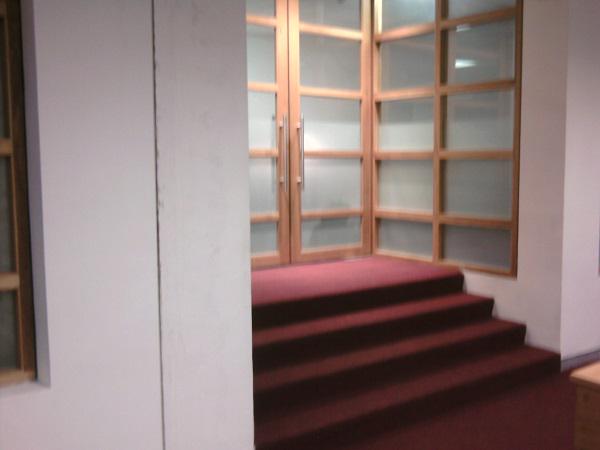
Here:


Four hours after arriving at work, I find myself on my lunch hour; with no real mission and armed with an Opal Card which at this point in the week entitles me to free travel everywhere in Sydney, I caught two buses and just decided to enter a deserted building.
Curiosity which killed the cat and has been found guilty of conspiracy to kill Rollo on occasion, led me up a set of escalators and stairs to this group of offices and landing. According to the directory downstairs, there are no tenants here anymore. This place is spookily quiet; to the point that I can hear my own heart beat and the soft hush of my own blood.
I wonder as I stand in this place that humanity has forgotten amidst the hurrying din, why I find this place so mind warping. Has someone been murdered here? Are there spirits who wish to do me harm? Or could it be that I've become so accustomed to living in a world full of ignorable noises that their absence is unusual.
This place is so quiet that I cannot even hear the so-called white noises which you’d usually find in a building such as the gush of air through the air-conditioning ducts. With no tenants, there probably is no need to switch on the air-conditioning and with nobody visiting this place very often, the people who don’t come here are not concerned about the faint mustiness in the air. You cannot hear smell.
I am by myself. There are no other people here. There are no intrusions to my train of thought as it speeds along and no stops along the way either.  It is terrifying. Unlike being in places where the noise is so loud that you cannot hear yourself think*, in a space like this you can't run away from yourself or your own thoughts. They are front and centre upon the strange; free to tread the boards in front of the proscenium arch; in full view. The upside is that it makes writing something very easy as there are no interruptions.
Of course now that I have found my patch of calm, my own little oasis amidst the sea of noise and confusion, it would be foolhardy of me to divulge where it is. We can’t have every Hugh, Louis and Deward knowing about this place. This is a place where the phone doesn’t ring, where there are no emails to reply to, where there are no pieces of paper that suddenly land on the desk and where no one is demanding that something is done instantly.
There is also no real reason to stay here very long either. Just like a traffic refuge, you can’t hang out there all day if you have places to go to and things to do.

*See Horse 1951: http://rollo75.blogspot.com.au/2015/08/horse-1951-dont-play-that-funky-music.html

August 11, 2015

Horse 1956 - We Want You To Work For Less Pay II

Much has been made in the news recently about the Australian Chamber of Commerce an Industry's proposal to abolish penalty rates at the weekend under the premise that this would create more jobs. This is Economics 101, right? If you lower the costs for a good  (in this case labour) then you shift the supply curve downwards, thus creating a new lower equilibrium position and selling more as a result. The theory says that if employers don't have to pay as much for their labour, then they're going to hire more labour and this will lower unemployment. The problem with the ACCI's suggestion is that it isn't actually true. I think that this is a serious case of synthetic a priori. We've moved into some sort of Kantian fantasy where thinking about a thing will change the thing. The world simply doesn't work that way.

When economists talk about incentives, its often unclear about what they mean by that term. I've read several texts and come to the conclusion that even within the text you're reading, an economist will propose some model about how incentives work and that proceed to ignore that model throat out the rest of the text. Like Kant who never strayed more than about 70 miles from.his house in his whole life, economists have a tendency to live in their own little thought bubble and cultivate friends such as managers and politicians and then wonder why things don't work out in the real world.
I also don't understand how the ACCI arrived at their conclusions either. The example which has frequently been put forward in the media is of cafés and restaurants but having been a member of the Mossman Chamber of Commerce for more than a decade, I can tell you that we do not see any café or restaurant owners. The members of the local Chamber of Commerce tend to be professionals and semiprofessionals like financial planners, legal and paralegal practitioners, real estate agents and the local managers of banks and building societies. These sorts of people tend to want to become members because they can see a synergy in referring clients between each other. Someone who wants accounting work done is also semi likely to want financial planning help as well. Likewise, someone buying property often needs legal assistance in the conveyancing and drafting of legal documents in conjunction with that property. Café and restaurant owners do not become members of the local Chamber of Commerce because they're too busy out in the real world running their cafés and restaurants.
My question in broad teams for the ACCI is who the heck did they speak to? Not once have I seen a single survey conducted and the results published. You can't just think about something and say that that's how the world works.

Yesterday this blog actually bothered to conduct the research. The Horse Independent Poll (which was me armed with a clipboard) went into the streets of Mosman and tested the proposal to see it if was true. I was truly HIP.
I was surprised at just how many cafés there are in Mosman. There are two in Bridgepoint, one across the street from the ex-cinema, six just in the region of Myagah Mews and from Spit Junction through to Mosman Junction on Military Road there are twelve cafés and this doesn't include places like the charcoal chicken shop, the bakeries, the cheese shop or the burger place. There were twenty-one places that I managed to visit in an hour; which I'll freely admit is too small to be a statistically useful sample size but it's better than nothing.

The two questions I asked were:
1. If penalty rates at the weekend were abolished, would this encourage you to employ more people?
2. If penalty rates at the weekend were abolished, would this encourage you to remain open for longer?

The results were surprising. Of the 21 cafés that I surveyed, 0 would employ more people if penalty rates were abolished at the weekend and 0 would remain open longer.
The reasons given for these responses (and that also surprised me, that people will just talk to you without prompting) ranged from "Mosman is dead at the weekend and so there wouldn't be any point", through "I'm not looking to employ any more people", to "It's rude for the Prime Minister to think that we'd remain open just for him. We need our weekends too."
This latter response, or something like it, was echoed by 12 people with 3 specifically name checking the Prime Minister. Cafés it seems, are driven either by more than just money, or come up against hard barriers as to why they don't remain open longer at the weekend.
Maybe this is also worth that Mosman lies within the electorate of Warringah, which just happens to be that of the Prime Minister. In the eleven and a half years that I have worked in Mosman, I've only seen the Prime Minister on the street once and that was during the 2010 election campaign.

The reason why penalty rates exist is because people are in effect rewarded for working in conditions that in some way suck. Overtime exists because it sucks that people need to work longer than their allotted 37.5 or 40 hours a week. Penalty rates for dangerous or dirty jobs exist because those conditions suck in some way. Penalty rates for working at the weekend or during late hours exist because it sucks to be working those hours. Granted that people aren't as religious as they once were and so perhaps the rationale that people want to go to church isn't there any more but working at 11pm on the weekend is crap. Leaving work in the nighttime and in the cold sucks. If an employee is in the city, they also face increased risk of being stabbed.
The thing is that it also sucks for employers to be open longer and later. They have to make sure that everything is locked up, that their employees aren't stealing from them and they also face the fact that leaving work later sucks.

The abolition of penalty rates seems to me like an airline reducing its fare in the hope that people will want to travel 75% of the way to Auckland. Price is not the only thing at issue here. If 0/21 cafés that I surveyed would neither employ more people or remain open longer then the aim of abolishing penalty rates is completely missed. I would suspect that employing one extra person is a bigger step than just slashing people's pay. In the end, the only people who would get thrown off the plane though, are the workers.

Also See:
Horse 1830 - We Want You To Work For Less Pay

August 10, 2015

Horse 1955 - My Favourite Number

Because I work in an accounting firm, people sometimes ask me what my favourite number is, as if that's the sort of thing that they expect accountants to have. I like to joke that if they are prepared to give me that many dollars, then my favourite number is 28 million. There's also this assumption that I must like the number pi because of its apparent nerdiness and whilst pi does make for a very nice nerdulent answer, unless you do happen to be going something which involves practical geometry, then pi is about as useful as putting a knitted beanie on the Sydney Town Hall - it might look cool but its impractical and mostly useless.
So then, for the purposes of answering the question of what my favourite number is, I shall now decide upon one. That number is: 240.

Those of you who happen to be reading this and were born before about 1956 will more than likely understand why I've chosen 240; that is that there are, or rather were, 240 pennies in the pre-decimal pound. Granted that I do have a penchant for old things and if I had access to time travel I'd go to the 1930s and fit out my wardrobe from that period but my reasoning for picking 240 is one of usefulness.

Decimal currency was invented because it was supposedly useful. 100 cents in the dollar means that you can do most calculations in a hurry but in the world of accounting and tax returns, we almost exclusively use whole dollars and tax returns explicitly state "Do Not Show Cents".
Believe it or not, the pre-decimal pound was in fact decimal. It even had a coin which at one point had the words "one tenth of a pound" clumsily written on it; that coin was the florin. A pound of 20 shillings divides to ten 2 shilling parts evenly. This is just one of many useful divisions that the old pound could be evenly sliced.

240 parts = 1d.
120 parts = 2d.
80 parts = 3d.
60 parts = 4d.
48 parts = 5d.
40 parts = 6d.
30 parts = 8d.
24 parts = 10d.
20 parts = 1/-
16 parts = 1/3
15 parts = 1/4
12 parts = 1/8
10 parts = 2/-
8 parts = 2/6
6 parts = 3/4
5 parts = 4/-
4 parts = 5/-
3 parts = 6/8
2 parts = 10/-
1 part = £1

Unlike a decimal dollar of 100 cents, the old pound divided into many useful parts. Allocating monthly expenses come out to whole pennies because 240 divides into twelve but 100 cents does not and you have to round off. Halves, quarters and thirds are all useful fractions of things to be playing with but you can still get a tenth of something if you desire.

As for the argument that a decimal dollar is easier to understand, I think that is demonstrably untrue. People survived quite happily with the old pound and I don't know if that says that the general populace was more intelligent than today or if society has progressively got stupider but even if both of those positions are correct, everyone has more computing power in their smart phones these days than the entire Apollo Program which sent people to the moon; so I don't think that's much of an issue. It is my general experience that most people don’t do simple maths (as opposed to can’t) and so how the currency is divided is largely irrelevant.
Actually, for a country like Japan which has the Yen divided into 100 Sen and 1000 Rin, those divisions are irrelevant anyway. The last time that any Rin coins were minted was 1892 and the Sen disappeared in 1953. Australia’s cent coins have already fallen by the way side and the 5 cent coin should follow New Zealand’s lead and just go away.

Back in Horse 1109* I already wrote of the usefulness of the number 12 which can be divided by 2, 3, 4 & 6. 240 continues that usefulness but to a much larger degree. The pre-decimal pound even had an element of decimalness about it anyway. The two shilling coin, the florin, from its inception in 1849 until 1892 bore the legend “one tenth of a pound”. Technically you could if you wanted to write an amount like £5.7 and it still would have been meaningful and come out to an exact amount. It’s just that £5.7 equals £5/14/-.

I’m guessing that the reason for people asking about someone’s favourite number is as a starter for small talk. Intrinsically there isn’t anything particularly special about any number, it’s just that as humans who live in a world of stories, we like there to be some story behind people’s motives and desires. We are all natural storytellers.
When you think about it, every single human endeavour be it the sciences, human drama, sport, religion, faith, love, even life itself is bound up in stories. Stories are the currency of life. It’s just that my favourite number is a story not only about currency but about a world which has passed and about a lament for a system which is more practically useful.

*Horse 1109 - http://rollo75.blogspot.com.au/2010/09/horse-785-1109-hey-little-twelve-toes.html 

August 07, 2015

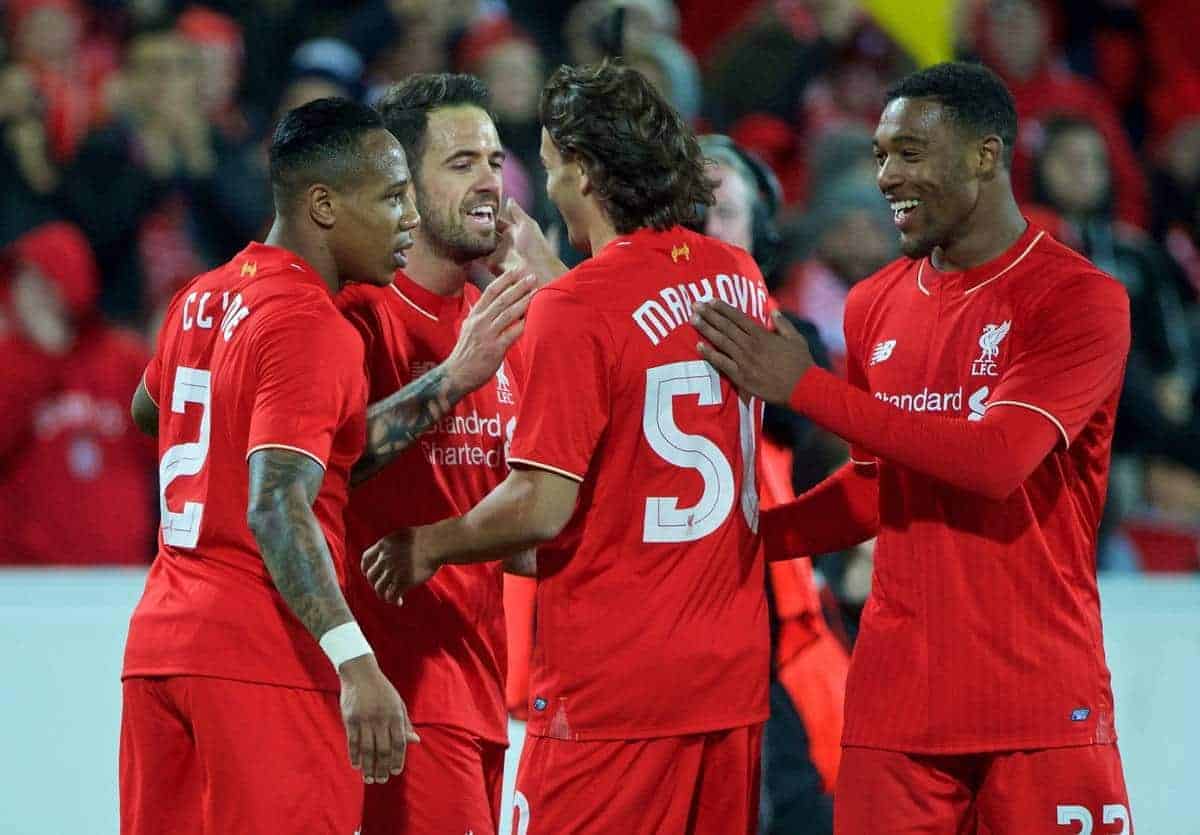
Horse 1954 - Liverpool's Season 2015-16

From an unpredictable and then idiotic unravelling of the title chase in 2013-14, the loss of Luis Suarez in 2014-15, saw them lurch and limp to an impotent sixth. If 2015-16 is to be any different, then at least two strikers will need to start paying dividends on the potential they've shown.


Apart from the opening match at Stoke the next six away fixtures are against Arsenal, Manchester United, Everton, Tottenham, Chelsea and Manchester City. At least 10 points from those would be acceptable, though to be title winning material, they probably need to take home at least 13 points. I have seen 25 seasons of false dawns, so we shall know by the end of November, whether or not to consign the 2015-16 season to the rubbish bin and whether or not the long-suffering of Liverpool fans qualifies them for canonisation to the sainthood.

Brendon Rogers has this strange propensity to play 4-3-3 which I quite frankly do not understand. I don't know if that's supposed to be one player who sits behind the front two but I do know that it often leaves the midfield horribly exposed; I think that Rogers would do well to rethink it.

Being the EA FIFA player that I am, the formation which I most commonly use is either 4-4-2 (or 2-6-2 if I really want to clog up the midfield).
If 4-4-2 is to be adopted then the usual starting keeper would be Mignolet, the four backs would be Clyne, Skrtel, Enrique and Touré, Henderson and Milner would play as a central midfield pair with Coutinho and Ibe on the wings and Sturridge, Benteke and Balotelli would rotate through the two striking positions with other partners. Every position would be rotated through every week.

However, I do not believe in building a default starting eleven simply because I think that that's a waste of talent and resources. Liverpool have 9 listed midfielders. If the season is likely to be 45 games long (which includes all cup and league ties in all competitions), then that means in a 4-4-2 system there are 180 possible starting midfield positions. Under my managership, that would be 20 starts per player and although the players might complain about starting less than half the matches, I'd want them to remember that the manager's job is to manage and that the goal is silverware.

One of the problems that Liverpool have is how to avoid being stretched too thinly over the course of the season. Apart from the league and FA Cup, is the Capital One Cup Cuppity Cup and the Europa League. Almost every club that competes in the Europa League suffers a corresponding drop in the league table. The Champions League seems to provide adequate compensation which leads to improved squad depth but the Europa League is almost like a poisoned chalice.

When Liverpool travel to the Britannia Stadium and play Stoke City on the opening day of the season, the memories of last year's 6-1 defeat hopefully should have faded into the distant past. They were undefeated on their pre-season tour; with the only blips being scored against first by Brisbane Roar in a 2-1 victory and a 1-1 draw against a Malaysian XI in 34° heat and after having midefielder Lucas leave the field with a bloodied face.

This season more than most, Liverpool will need to hit the ground running and running hard or face getting a face full of gravel.

Addenda:
Newcastle United's 2015-16 kit:

Ugh. What were they thinking? The blue section at the bottom of the back, just makes the players permanently look as if they've forgotten to tuck their shirts in and their undies are showing.
The blue IN the stripes looks horrid, the all white back looks horrid and the sponsor which offers short-term, high-cost credit (read loan shark loans) at more than 5000% APR in some cases, is morally bankrupt.
What makes this worse is that tensions against owner Mike Ashley have been growing and the retention on Wonga as a sponsor is seen as a slap in the face to a working class city like Newcastle by a billionaire who has in the past tried to on sell the club to investors from the Middle East.

The alternative offered by The Magpie Brand is a smart looking piece of kit and is led by the supporters themselves:
http://themagpiebrand.co.uk/index.html

August 06, 2015

Horse 1953 - Hiroshima and Nagasaki - Deeply Disturbing

70 years ago and almost at the very end of five months of fire bombing Japan, during which at least 241,000 people and and as many as 900,000 people were killed, the United States would unleash the only two examples of using nuclear weapons during warfare, when it dropped atomic bombs on the Japanese cities of Hiroshima and Nagasaki on August 6 1945 and August 8 1945.
It seems that there were plans for yet more bombs to be dropped and that the first of these might likely have been operational around August 19.

If you read through the official correspondence from various people written to the President and his replies, we very much get the impression that as this was a case of total war, the people with the power to press the nuclear button would have kept on doing so for as long as it was deemed necessary:

http://www.trumanlibrary.org/flip_books/index.php?tldate=1945-08-07&groupid=3704&titleid=&pagenumber=1&collectionid=ihow
"The foul attack on Pearl Harbor brought us into war and I am unable to see any valid reason why we should be so much more considerate of Japan and lenient in dealing with Japan than with Germany.
I earnestly insist Japan should be dealt with as harshly as Germany and that she should not be a beneficiary of a soft peace... If we do not have available a sufficient number of atomic bombs with which to finish the job immediately, let us carry on with TNT and firebombs until we can produce them.
I also hope that you will issue orders forbidding the officers in command of our Air Forces from warning Japanese cities that they will be attacked. These generals do not fly over Japan and this showmanship can only result in the unnecessary loss of many of our fine boys in our Air Force as well as our helpless prisoners in the hands of the Japanese, including the survivors on the march of death on Bataan who are certain to be brought into the cities that have been warned.
This was a total war as long as our enemies held all the cards. Why should we change the rules now, after the blood, treasure and enterprise of the American People have given us the upper hand. Our people have not forgotten that the Japanese stuck us the first blow in this war without the slightest warning. They believe that we should continue to strike the Japanese until they are brought groveling to their knees. We should cease our appeals to Japan to sue for peace. The next plea for peace should come from an utterly destroyed Tokyo..."
- Senator Richard Brevard Russell Jr, Aug 7 to 9, 1945

Even when President Truman was writing in response to church groups, he was entirely unrepentant in his justification for the use of the atomic bomb; even to the point of dehumanising an entire people.

http://www.trumanlibrary.org/flip_books/index.php?pagenumber=1&titleid=234&tldate=1945-08-09&collectionid=ihow&PageID=-1&groupid=3705
My dear Mr. Cavert:
I appreciated very much your telegram of August ninth.
Nobody is more disturbed over the use of Atomic bombs than I am but I was greatly disturbed over the unwarranted attack by the Japanese on Pearl Harbor and their murder of our prisoners of war. The only language they seem to understand is the one we have been using to bombard them.
When you have to deal with a beast you have to treat him as a beast. It is most regrettable but nevertheless true.

Sincerely yours,
HARRY S. TRUMAN
- Letter from Harry S Truman to Samuel McCrea Cavert, General Secretary
Federal Council of The Churches of Christ in America, 11th Aug 1945.

I note that in historian J. Samuel Walker's 1997 book "Prompt and Utter Destruction: Truman and the Use of Atomic Bombs Against Japan" he cites five main reasons that Truman justified the use of dropping the bomb:
- it would end the war successfully at the earliest possible moment
- it justified the effort and expense of building the atomic bombs
- it offered hope of achieving diplomatic gains in the growing rivalry with the Soviet Union
- there were a lack of incentives not to use the weapons
- because of America's hatred of the Japanese and a desire for vengeance
There might be some merit in the first and third of those answers but the second reason is basically "we've paid for the bomb, why shouldn't we use them?"; the fourth reason is a cop out and the fifth is purely based on revenge.

Quite apart from the fact that the firebombing of Japan for five months had achieved almost nothing militarily (which is similar to the thousand bomber raids on Dresden), the two bombs were dropped during a climate of political deadlock in the Japanese Government whilst they were considering the demands for unconditional surrender in the Potsdam Declaration of July 28, 1945; so Japan probably wouldn't have immediately surrendered without the final approval of the Empower anyway. (See Horse 1022 and Justify This!)

I my mind, the dropping of the two atomic bombs on Hiroshima and Nagasaki amounts to nothing short of a war crime. If the results of the war had gone the other way, then I think that there would have been a good case to be made against President Truman to be  prosecuted as a war criminal at The Hague. The indiscriminate destruction of mankind for precisely no good reason and whose effects are felt for decades after, is awful.

The last line in Item 10 of the Potsdam Declaration rings out oh so hollowly:
http://www.atomicarchive.com/Docs/Hiroshima/Potsdam.shtml
Freedom of speech, of religion, and of thought, as well as respect for the fundamental human rights shall be established.
- Article 10, Potsdam Declaration, 26th Jul

There is a chilling book called "Yoko's Diary" which is just the diary entries of a high school girl Yoko Moriwaki living in Hiroshima as she started high school in April 1945. The diary talks about her dreams and about mundane things such as sweeping the floors at school until the last entry when there's something almost biblical in the way the story ends: she was not.
In former times kings and generals would often be either amidst battlefields or on horseback directing troops. President Truman conducted his correspondence from the Oval Office which was more than 7000 miles away. It is difficult to feel any kind emotions towards people whom you've dehumanised and so far away. It is pointless to feel any kind emotions towards people who no longer are.
Just how do you show respect for the fundamental human rights when those rights which include freedom of speech, of religion, and of thought are instantly vaporised?

If Truman had bothered to look outside the windows to his office and thought that there were actually real people on the ground going about their business, who were probably already fearful of what would rain down from the skies, would he have thought twice about dropping the bomb?
Seventy year on and I am still greatly disturbed.

August 05, 2015

Horse 1952 - Travelling Violations

I know that I'm not exactly the most direct person and often prefer to call a spade a pointed tool for digging, lifting, and moving bulk materials such as dirt and earth, but it seems to me that this whole kerfuffle surrounding the misuse of parliamentary travel entitlements could have been solved a long time ago and through mechanisms which already exist.
Even though there will not be a serious inquiry into the use or misuse of parliamentary entitlements, it should go without saying that where any system exists, then someone somewhere will have the potential to abuse that system. In this case, it should have been obvious to all including that if you don't want a metric owl-load of parliamentarians claiming unnecessary travel allowances - don't let them.

Better yet, give all the power to arrange travel to a bunch of specialists:
http://www.aph.gov.au/About_Parliament/Parliamentary_Departments/Parliamentary_Budget_Office/role
As set out in the Parliamentary Service Act 1999, the Parliamentary Budget Officer has the following functions:
- To prepare responses (other than policy costings) to requests relating to the budget by Senators or Members of the House of Representatives.

Even as someone who used to work for the Commonwealth Public Service and was frequently sent around the country, I never even once arranged my own travel arrangements. On every occasion that I was sent into the wide blue yonder, I was given a timetable, an itinerary and a series of tickets and was told that I needed to be at X place, at Y time and would stay at Z hotel. Every aspect of travel on public service business was arranged by someone else, who presumably because they were working for a government agency, had the power to arrange discounts and better offers because the government as a single purchaser had more bargaining power. My ability as a public servant to arrange my own travel plans or claim expenses was precisely nil; if this is true for the foot soldiers and plebs of the public service, then I don't see any good reason why that should not also be the case for the public service's lords and masters, MPs, cabinet ministers and even the Prime Minster.

Nominally it is the Parliamentary Budget Office which handles the expenses of MPs. Is there a good, prudent or even sensible reason why the Parliamentary Budget Office shouldn't also have similar powers? Surely if a single agency handled all travel arrangements for all 226 Members and Senators, then there wouldn't even need to be an inquiry about parliamentarians claiming unnecessary travel allowances because they wouldn't be claiming anything in the first place?
It seems to me (you lived your life like a sandal in the bin) that once you create a sense of entitlement among privileged people, that that entitlement can and will be abused. If I was designing a system from the outset, then I'd separate the authority to pay from the site where those items are paid from. In a small business that usually means having the person who writes cheques from being denied the ability to sign those cheques and likewise, locking the chequebook away from the person with authority to sign. If you remove ability from authority and authority from ability, then this puts in place checks and balances on cheques and balance books.
This parliamentary expenses crisis has shone light on the fact that expenses are firstly incurred and then claimed; which in effect puts the chequebook and the pen to sign cheques in the same hand and that's just not responsible or safe. Ms Bishop has been moved diagonally from the Speaker's Chair to the Government's Back Bench but the system itself has not been altered. I heard on 702 ABC Sydney this morning, that the Minister for Telecommunications, Malcolm Turnbull, called for "common sense" but when common sense doesn't appear to be all that common or is in fact so common that it is beneath the social strata of the Speaker, then the ones who actually suffer are the taxpayers of the land who get the wool pulled over their eyes as they are being fleeced.
I don't think that this is specifically a crisis caused by party politics either. Former Speaker Peter Slipper also ended up vacating the chair based on expenses claims to the value of not even one tenth that Ms Bishop has claimed. No doubt that this could have also happened during the tenure of a Labour government because the conditions which allowed this to be, were, are and will be identical unless the system is significantly changed.

My other question in all of this is "who did have the authority to approve those expenses?" I find it hard to believe that no-one at any point questioned any of the expenses which they were asked to pay. At some point, there was a financial controller who had to have made a series of direct debits through bank accounts, or written cheques, or even looked at credit card statements and I find it utterly incredible that whoever that was allowed these things to pass. Unless you are Channel 7, or Care Flight, or the Department of Defence, at what point does any sane person deem that a helicopter flight is an acceptable expense? Consider my mind boggled.

Parliament Question Time does not return this week because the government needs to find another Speaker in the wake of Ms Bishop's resignation. I fear that even if the Member for Teflon, Mr Sheen, who is the cleanest member of the House, was appointed as Speaker, then because the conditions which have now brought down two previous Speakers (and potentially any Member of Parliament) still exist, something is bound to stick somewhere.

If you want to call a spade a spade and assume the politicians can not be trusted with an expenses allowance, then don't. Let the PBO make those arrangements for them.

August 04, 2015

Horse 1951 - Don't Play That Funky Music, Right?

I went to a wedding at the weekend and that invariably means dressing up for the occasion. Finding a suit for me to replace my old jacket (which Mrs Rollo hates and thinks looks like the box that it came in) was the relatively easy part of the task; the more difficult task was for her to build an outfit. That portion of the afternoon took four times as long and I spent a great deal of time trying to avert my eyes from anyone and being thoroughly annoyed by the music playing in ladies' clothing shops.

The way I understand it, ladies' clothing shops seem to assume that there are two kinds of people: those who are youngish that those who are officially old. Even in department stores, there appears to be only these two categories which are demarcated. In the section that assumes that you are officially old, the music coming through the loudspeakers is almost silent but in the 'normal' section, music is piped in at sufficiently loud enough volumes to wake the dead and then make them wish that they were dead again..

Being a man (and therefore the acceptable target for shouldering the blame for all the world's woes) who was often trapped in an environment where the people who possessed a Y chromosome were outnumbered in ratios of double digits to one, I constantly felt as I I had no place in such premises and that given ample opportunity, I might be clubbed to death by handbags containing cosmetics to a greater value than the budgets of small nations. All the while, I had to endure being assaulted by mostly electronic music which was all set to 4/4 common time; with almost every track emphasizing the first and third beat.

Admittedly the flower of my youth wilted a long time ago and Father Time's children have thought it fun to spray paint the side of my head in silver. Grey hair might very well be a crown of splendour upon the old but because I haven't achieved anything like the silver fox status of QandA's Tony Jones, I just end up looking about as cool as a half eaten sandwich discarded upon the pavement. In such circumstances it doubly signals that I do not belong. Further to that, I can feel icy stares of people who would wish that I would go away instantly and oh I wish that I could comply with that wish.

The music which is spewed forth into every one of these shops is roughly of the same sort as you'd find in a nightclub, which is another place that I have no desire to go. Unlike a nightclub where the purpose is one of entertainment, inside ladies' clothing shops it appears to be one of total disarmament. Most of us have some sort of inner monologue which runs through our heads (hence why some people talk to themselves) but the music is played so loudly that I think that its deliberately designed to drown out that inner monologue in the hope of denying customers the chance to properly think and by doing so, make them spend more money.

You can perform this experiment yourself of you like. Try composing a letter or reading a novel with a favourite song playing through a set of ear buds. That same portion of your brain which interprets language is used both for reading/writing and listening. You can not listen to both your inner monologue and the human voice at the same time. One will be ignored and I suspect that is what the purpose of loud music is. What's worse is that if that inner monologue can be drowned out for a sufficiently long enough period of time, that little voice which might warn of buyer's remorse, disappears.

The other thing which is suspect is going on, apart from the territorial claim upon people's head spaces, is a more general claim upon the aural space of the shopping mall. A multi level shopping mall might contain hundreds of shops, all of which have the aim of wresting money from shopper's wallets. By creating a much bigger bubble within a shop and by closing out the front of the shop with boards hawking special offers, I suspect that shops maximise their profit take by keeping people inside their physical space for longer.

Keep people excited; keep them in your space as long as possible and play the music so loud that they can't hear either their internal monologue or their budget speaking to them. That's the way to suck dollars from your customers. 
No wonder I hate shopping malls so much.

Addenda:
It turns out that I was right. There are more than 150 studies which confirm my suspicion. This is one of them; it's scary:
Excitement at the mall: Determinants and effects on shopping response, Journal of Retailing,University of Texas, Sep 1998.

August 03, 2015

Horse 1950 - Book of Antiverbs, Chapter 1

¹The opposite of a proverb is an antiverb, isn't it?

²If the Bluebird of Happiness suddenly wasn't happy anymore and became sad and blue, how would you tell? If he went to Oxford and got his boxing blues, or became interested in twentieth century musicology and started singing the blues, would he still be the Bluebird of Happiness?

³Would it be a wise investment to follow the White Rabbit down the rabbit hole, in pursuit of the White Whale, or would that project be like paying for a White Elephant? If the project went sour, could you whitewash over it?  How about if a White Knight came and backed the project? How would they even know to invest in it amidst the white noise?

If a bunch of environmentalists invested in Green technology that saw them raking in the green stuff, would everyone else be feeling green at the thought or would they be green with envy? If you were a bit of a greenhorn, would you be skilled enough to greenhouse the income before you decided to green light the project?

Would you be seeing red if the project started trading in the red? Would the red mist come down and leave you red faced because you didn't see the red flags? If you saw serious flaws and marked the plans in red, would you then apply a red seal to them?

Sometimes I wonder if we're living in a new golden age. Certainly we live in an gilt era of 24 carat celebrity where all that glitters is gold. Silence is golden and it's in the golden sunset of your life, when all the anniversaries are golden,

What it is like to be smacked in the bottom by a rainbow? I think if you missed your chance to go for gold, it might be brown trousers time. Get out of the blue and into the black; they give you this but you paid for that. Once you're beaten black and blue and left in a purple haze, would you turn a whiter shade of pale?

Don't be afraid of the dark. Be afraid of what hides in the dark; and of all the horrible things they will do.
Don't judge a book by its cover, though if you intend to read "To Kill A Mockingbird" looking for avian pest removal tips, you will be disappointed.

¹°Avian influenza is not caused by Bird’s Custard.

¹¹The journey of a thousand miles begins with a single step; so it's a good thing I bought new shoes. You will discover your life force; so it's a good thing we bought a Jeep. There is no one willing to speak for us; so it's a good thing we know how to yell. There is no light at the end of this tunnel; so it's a good thing we brought matches.

¹²Doing genetic engineering on various kinds of heads of lettuce might very well be rocket science and brain surgery at the same time.

¹³The reason that it's called Flemish is that when you speak it, it sounds like you've swallowed half a pint of phlegm. However German is the only language that you can spit over someone whilst speaking and still display the height of manners.

¹⁴There are three things a man, one man and his dog "Spot" took to mow a meadow; four which ensured it was not mowed.
A pint of milk, a magazine, a can of beans, a sausage roll.

¹⁵If you want to eat fish, expect bones. If you want to talk garbage, expect pain.

¹⁶A fish only gets caught when it opens its big mouth.

¹⁷If you are caught out in the blazing desert, always remember to carry a car door so that you can wind down the window in case it gets hot.

¹⁸A man never went broke earning income and incurring tax. They only go broke when they don't pay tax and have to pay it back later.

¹⁹A man should buy the cheapest car that his ego will allow.

²°Sometimes when people don't get what they want, they will act as if they never wanted it in the first place.

²¹Lots of people can't cook but everyone can make a dip or buy a dip. Everyone always eats too much at parties but if you only have dips, it creates the illusion that they were only grazing on dip. ²²So forget dinner parties, just have dip parties. Put out 46 different kinds of dip and then people can be like Pokémon - gotta try them all.

²³Don't go to Disneyland, go to Cruithneland.

²⁴Machines should work and people should think. People should work and machines should think. Pity when they don't.

²⁵When you are dead, you don't know you are dead. It's difficult only for the others. It is the same if you are stupid or too drunk to drive.

²⁶Do not tap on the glass. It scares the ice cream.

²⁷Beer comes from hops. Hops are plants. Beer is salad. ²⁸A suspension of corn flakes in milk implies that cereal is soup.

²⁹Everything can be classified as animal, vegetable or mineral. An apple is not an animal and it's not a vegetable because it's a fruit; so it must be a mineral. An apple is a rock.

³°If you can't beat them, join them. This advice might prove difficult when your recipe calls for the use of eggs.

³¹The early bird gets the worm. The late mouse didn't get the cheese.

³²Due to roadworks, it is easier for a needle to pass through the eye of a camel than for a fish van to enter the county of Devon.

³³A proverb quoted by a fool is limp as a two minute noodle once cooked.

July 31, 2015

Horse 1949 - Australia's Prime Ministers - No 21 - Gough Whitlam


XXI - Edward "Gough" Whitlam

For the first time in 23 years, Australia had a Labor Government. Although Labor won a 9 seat majority in the lower house, it still found itself with a hostile Senate; no Senate seats had been up for election, as they had been elected in 1970.

Although Whitlam had been sworn in as Prime Minister on November 5, the full results of the election weren't official for another two weeks. In the interim, Whitlam appointed Lance Barnard as deputy prime minister and between them, they assumed all 27 cabinet positions, with Barnard taking 14 and Whitlam 13.

During the two weeks of the "duumvirate" cabinet, where Barnard was Minster for Everything and Whitlam was Minster for Everything-Else, they ordered the establishment of proper diplomatic relations with the People's Republic of China (and formally broke off ties with Taiwan), eliminated sales tax on contraceptive pills, instructed UN Delegates to vote in favour of sanctions on South Africa die to Aparthied, officially barred discrimination on racial grounds for all sport teams in Australia and announced the end of conscription.

When the full cabinet was establised, the government abolished tertiary tutition fees, abolished the death penalty for federal crimes, established a legal aid framework which would later become the Commonwealth Legal Aid Commission, installed "Advance Australia Fair" as the national anthem and founded the Department of Urban Development to bring many people's houses up to standard by at least ensuring that they were connected to sewers.

Whitlam's government still couldn't pass the legislation that it wanted to though and by March 1974, the Senate rejected 19 bills and 10 of them on their second presentation. Whitlam's solution to this was to offer former Premier of Queensland Vince Gair, the position of Australian Ambassador to Ireland and thus create a casual vacancy in the Senate. In doing so, this would cause the election of six Senators for Queensland and not five; thus in winning 3 of those Senate seats, Whitlam would have taken control of the Senate. 
On 2 April 1974, a group of Country Party Senators kept Gair in their offices beyond the 6pm deadline required to issue the writs for the election of Queensland Senators by plying Gair with beer and prawns and thus the writs were delayed sufficiently long enough not to cause six instead of five vacancies at the election. This delaying tactic became known "the Night of the Long Prawns" but it was irrelevant anyway because Whitlam cited six bills as triggers for a double dissolution and it was held on 18 May 1974. The election changed nothing; even after the election, there was still a hostile Senate.

The Labor Government was returned (being only the second Labour Government returned to office since Federation) and at the Joint Sitting of parliament on  6-7 August 1974, the six bills which had been used to trigger the election all passed.
- Commonwealth Electoral Bill (No. 2) 1973: which added more electorates and reduced population variances.
- Senate (Representation of Territories) Bill 1973: which gave the ACT and NT two Senators each
- Representation Bill 1973: which exluded the territories from population requirements in determining the number of seats they could have 
- Health Insurance Bill 1973: which set up universal health care (which is now Medicare)
- Health Insurance Commission Bill 1973: which set up the Health Insurance Commission (now Medicare Australia)
- Petroleum and Minerals Authority Bill 1973: which set up a body to control petroleum and mining resources

The 1973 oil crisis saw a slump in commodity prices and a spike in prices for goods and services. Inflation ran at 13% and unemployment jumped from 2% to 6%. Whitlam found his budgets facing financial issues and when he wanted to fund plans for various projects such as a uranium enrichment plant, a natural gas pipeline and the final electrification of Australia's railways (which still hasn't happened), he sought funding of $4bn from London firm Dalamal and Sons. It ultimately never resulted in any loans but it galvanised the opposition into delaying passing the 1975 budget.
On the other side of the chamber, Billy Snedden lost the leadership after having failed to win government in the 1974 election and in March 1975, Malcolm Fraser became leader of the Opposition.

Even after passing legislation like the Family Law Act 1975 and Racial Discrimination Act 1975, and after setting up the Aboriginal Loans Commission and handing the Gurindji people  of the Northern Territory title deeds to their tradtional lands, the damage was done. The Appropriation Bills for 1975 were delayed and delayed until six months later when on 11th November 1975, when Whitlam went to see the Govenor-General Sir John Kerr, his government was dismissed and installed Malcolm Fraser as Prime Minister. Before all members of parliament were even aware, the Senate passed the 1975 budget and Kerr dissolved Parliament for a double dissolution election to be held in December.

Whitlam would remain as Opposition Leader for both the 1975 and 1977 elections but ultimately lose both of them. Even though Whitlam's Government has been described as frenetic, breathless and even chaotic, it arguably changed Australian politics in three short years more than any government has done before or since. Those three years still leave long shadows and a legacy today.

July 30, 2015

Horse 1948 - Nope. It's Racism. Stop Whitewashing It.

I am a white man aged between 18 & 70. I make up most of the boards of companies in Australia and I am most of the CEOs. I still control most of the wealth of Australia and up until 2010, I was every Prime Minister of Australia. To any observer who actually bothers to open their eyes, I am a privileged individual. My grandfathers and fathers before me stole countries through the cunning use of flags, dispossessed peoples of their land, drove their rights into the ground which they once held freely and in quiet enjoyment, and rewrote the very law itself to protect myself inside the porcelain towers of privilege that I'd built for myself. When someone shakes that tower or chips away even the smallest patch of whitewashed glaze from its porcelain, I complain longly and loudly that it is their fault. If I could, I would put all people who do not look like me into glass cases; so that I could see them and observe them (but I do not want to hear them) and I also want to put their treasures on display. I am a white man aged between 18 & 70 and my might makes right.

Let's not beat about the bush here. The people booing Adam Goodes are racists. I don't mean this as a term of abuse but as a descriptor which is backed up with repeated evidence. The reason why Adam Goodes has been made a target is that he has decided that enough is enough and has taken a visible stand against that racism.
When I read Miranda Devine's piece in the Daily Telegraph yesterday (in the physical dead tree edition because journalism is worth paying for) I saw someone who has missed the mark badly. The final lines of that piece are below:

http://www.dailytelegraph.com.au/rendezview/only-adam-goodes-can-stop-the-booing/story-fnpug1jf-1227460775525
Well, that’s in your hands, Adam. Apologise to the girl, and recognise that Australians don’t take kindly to being accused of being racists when they are not.
Then the crowd might fall back in love with you.
- Miranda Devine, Daily Telegraph, 29th Jul 2015

Ms Devine is a rightist libertarian who believes in the power of free speech. I should say at this point that I disagree violently with many of the views which she has expressed through her columns but this is not one of them. I believe that free speech is fundamental to the proper operation of a working democracy. In that light, the ideas touted should be evaluated and tested; so that the bad ones wither and die in the great marketplace of ideas. Bad ideas should be allowed to fail to sell. So let's do precisely that.

Football crowds in all codes across the world are known for their bluntness. Booing and jeering is often part of their repertoire (along with more unsavory items in their arsenal) and so it's usually ridiculously easy to work out their intent.
Usually when abuse is hurled at a specific player, it's equally as obvious. For instance, last year when Buddy Franklin was playing for Sydney against his former club Hawthorn, there were obvious cries of "Judas" every time he touched the ball. It was a specific grievance directed at a specific player for a specific reason. This round of booing directed at Adam Goodes is not necessarily directed at him only but also at other Aboriginal players such as Lewis Jetta and no matter which way you like to dress this up, it's a public display of racism writ large for the world to see.
It's so ridiculously easy to work out the intent of the booing that it should be a fait accompli to see that and report it as such. That is, unless you are the Daily Telegraph (or Alan Jones).

The Daily Telegraph has a specific problem with racism in that one of of its columnists was found to have breached the Racial Discrimination Act and specifically section 18C. Of course being part of a powerful organisation, it along with a particular think-tank and even the political party which it nominally supports (maybe even financially, I didn't know and we'll not be told either) as part of its intent to exercise power, wants to repeal section 18C of the Racial Discrimination Act so that it presumably can go back to writing careless pieces with impunity.
The truth is that I don't know if Ms Devine is personally a racist. I do know that the organisation that she works for got into trouble over such an issue and so she might be being directed to write such a piece. She could also be genuinely ignorant and considers that the right to free speech is more important than the harm it causes.

Presumably this piece also appeared in Melbourne's Herald-Sun, Brisbane's Courier-Mail and the Adelaide Advertiser as well as the Daily Telegraph in Sydney where I read it. That is a lot of power to be wielding and in two of those markets (Brisbane and Adelaide), there are no other daily newspapers to act as a counterpoint to cast ideas into the ring. Either due to personal reasons, organisational direction or sheer ignorance, this piece excuses racism and condones it through one of the loudest voices in the country. It is the act of a bully. Sticks and stones might break my bones but words will cause psychological harm; especially when its coming from a powerful organisation.

What are Adam Goods actual options? I'm reasonably sure that he isn't simply performing war dances in isolation but in reaction to the taunts that he receives. Unlike a writer who has the platform of a network of newspapers, Adam Goodes platform is the green grass of a football field. In this context, his response to the racism that he receives is to publicly and visually show pride in his Aboriginality. In a public arena the response to people exercising their right to free speech is a public display of the right to freedom of expression; that if anything, should fit nicely in line with Ms Devine's value set. I find it weird that she is engaging in victim blaming.
Maybe I shouldn't be though. She is a white lady aged between 18 & 70. Maybe we're not so different after all; except that I can see racism for what it is.

Addenda:
Apart from the Sydney Swans and the efforts of a handful of clubs, most notably the Western Bulldogs, neither AFL fans nor the Melbourne media have mounted much of a campaign to come to Goodes’ defence.
...
There is no way the NRL would let it happen. And if they even tried to bury their heads in the sand the Sydney media and community would never have let them get away with it. It’s a city that likes to see action.
- Tim Gleason, Daily Telegraph, 30th Jul 2015

Does the "Melbourne media" include the Herald-Sun? Ms Devine certainly didn't come to Goodes' defence. The Sydney Media probably would let them get away with it - it's mostly the same organisations.

July 29, 2015

Horse 1947 - It's Possible To Rort Expenses, Let Us Prove It

As an accountant, I get to see certain people's spending habits pretty closely. With the aid of Google Maps, I could even track someone's typical day if I wanted to.  I know for instance that one client of ours always visits a particular ATM to withdraw cash, once and only once a week. Another client is quite profligate and uses whatever bank card or credit card happens to take their fancy at any given moment.
I also happen to know that even among our relatively small suite of clients, there is a definite blindness in determining what is and isn't a business expense. Phone bills and particularly mobile phone bills might contain great hordes of personal phone calls and I'd have no idea about it. Motor expenses are frequently totted to business bank accounts and yet I'm pretty sure that there's loads of kilometers driven that aren't even remotely connected with business. For one client who lays their taxi fares monthly, if wasn't until we actually saw when those taxi journeys were made that we realised that many of them happened at 11pm and later, often at the weekend and certainly after the imbibing of intoxicating fermented vegetable produce.
The point is that even for a small practice, identifying what is and is not truly a business expense is sometimes difficult and dare I say it, not worth the economic benefit to track down. The net result is that plenty of non-business expenses end up being written against income and in effect, those personal expenses are being subsidised by the taxpayer through lost taxation revenues. If you were to then multiply that across the economy and especially at very large organisations who don't care, then this must surely be a multi-billion dollar rort which is paid for by the taxpayer.

Imagine my horror then, when I saw this tweet from the Bank Of Queensland:

Ugh.

This neologism wasn't even coined by BoQ either. The first time that I came across this in The Economist newspaper (yes, I know that it looks like a magazine but they insist that due to historical reasons, they are a newspaper), my outrage valve blew open (my irony value had already broken):

http://www.economist.com/blogs/gulliver/2015/03/mixing-business-and-leisure
HOW'S this for a terrible neologism: “bleisure”. It is a portmanteau of business and leisure, and is used to describe what some people claim is a new type of business traveller: one who fits in leisure travel while on the road.
...
In fact, there has long been a segment of the business travel population that has the means and professional flexibility to add leisure days onto business trips. Travel-related businesses, including Bridgestreet, are no doubt eager to attract these customers, who will spend more money per trip than those who like to keep their travel strictly professional. And terrible marketing neologisms such as “bleisure” can help companies think more carefully about how to attract certain subsets of customers.
- The Economist, 19th May 2015

Yes, 'bleisure' is an ugly ugly word. The Scrabble player in me notices that it is an anagram of 'sure bile'; which is precisely what it makes me want to spit.

Let me unpack this for you. The Bank Of Queensland is encouraging people to combine business and leisure in an effort to attract the sorts of clients (banks don't have customers - banks provide services; not products) who would like to do such a thing. It is obviously in the bank's best interest to do this because business clients are worth more to the bank in higher fees and more services they can sell, than ordinary depositors. A bank as a business, wants to sell banking services to those clients who are most profitable; there's nothing necessarily wrong with that, and in fact as this falls in line with the profit motive, it is very much in line with the raison d'être of the bank. Actions have consequences though.

The Bank of Queensland as a business, has precisely zero concern about how its fees are paid; nor does it care about how its services are used and nor does it need to. Their concern extends only as far as the immediate banking relationship between them and their clients. The word 'bleisure' though, by its very existence, is at least a tacit acknowledgement that expenses which are leisure and therefore not genuine business expenses, can, will and are being claimed against profits. Who subsidises those expenses? The taxpayer, that's who.
It's worth remembering when you get on an aeroplane and turn right to be squished in along with all the other sardines in Scum Class, that the vast majority of people who turn left to go to Business Class are claiming that on company expenses. It's also worth remembering that 30% of those expenses are in effect being subsidised by the taxpayer through lost taxation revenues. The same is also true for something like the Qantas Lounge and that's definitely worth remembering when you are trying to lie down to get some kip, on a carpeted floor because your flight has been delayed, whilst those same business people who turn left on the plane also get comfy lounges and in some cases, actual beds. You are also in effect paying for 30% of their ham and cheese croissant and glass of Crown Royal.

The word 'bleisure' infuriates me deeply because we all know that all of the leisure component of that trip will be claimed as business expense. Companies might enter into some sort of funding arrangement with their employees but its highly unlikely. The Tax Office is never going to undertake any auditing of those expenses except in cases where it intends to make a high profile example of someone because of the hideous legal expense required to do so. Accountants in large firms are never going to check up on what is and isn't truly business expenses because they're probably also riding the gravy train to Rort Town. Accountants in small firms are also not very likely to make these checks either because there simply isn't the economic benefit in doing so. Meanwhile, the taxpayer ends up footing 30% of the expenses for 'bleisure' and I'd like to say that they're being taken for a ride but they ain't going anywhere.
It's possible to love a bank... when you combine business and leisure and let the taxpayer pick up part of the bill. Let us prove it.

July 27, 2015

Horse 1946 - Cold Comfort

As I paw at the 'keys' on my tablet this morning, I am convinced that if my body needs 10 litres of blood to run properly, then I only have 9. Instead of being pink, my fingers have started to acquire that particular jaundiced shade of hypothermia and even though they appear to be able to make the tablet work, I can not feel any individual key stroke.
As I closed the front door and stepped outside into a morning where I could feel an icy wind slap against my cheek, before I walked to the train station this morning, I noticed that the car's windows were caked in ice, the grass on the lawns crunched underfoot and I'm sure that even Antarctic penguins would be looking to take a summer holiday because it's so cold here. It's so cold that Geordies might consider putting on a coat.
This is Sydney in the winter. The only consolation is that on SBS World News' nightly weather report, the only city in the whole world with a lower minimum forecasted temperature was Canberra.

If you'd been transported to Australia in 1787 for the hideous and heinous crime of vandalising twelve cucumbers (yes, that did actually happen to a chap called Thomas Chadwick), then arriving in Sydney in a stinking hot summer where the mercury was on its merry way to 40°C, then you might have thought that it was a fate worse than a fate worse than death. Six months later after the colony started to run out of proper clothes and before it had built any substantial buildings, you'd have your sentiments confirmed when the mercury barely escaped single digits centigrade.
This city built around a harbour and at the top of the world (or the bottom depending on your prejudice) can and does get as cold as Blighty on occasion but we seem to be living in some sort of self-imposed delusion because we pretend otherwise.

There was a study which was published in The Lancet* which looked at the rates at which people died of both heat and cold exposure and came to the conclusion that far more people die of cold than heat. As you read through this chilling study you find out that the cold contributed to about 3.9% of all deaths in Sweden, but 6.5% of all deaths in Australia; that compares with only 0.5% of all deaths in Australia caused by excessive heat. That's nuts.
As a result of our self-imposed delusions and the myths that we tell ourselves, we tend to build houses in Australia to cope with the 40°C summer days but not chill during winter and the consequence is that more people in Australia die of cold exposure than in Sweden.
I can attest to that. The house that I live in, is suspended upon brick pillars but the distance from inside to outside is only the thickness of the floorboards and even then there are gaps between some of them. During the day you can look down in places and see daylight peeking under the house. Basically, even in a city where every cent is spent on rent and isn't meant to supplement the government, we live in fancy tents with vents.

When I hear stories of old people dying of exposure in their homes and not being found for days, it's not that much of a stretch to work out why. Old people tend to live either in older homes which aren't as well insulated or they tend to be in a period of dissaving, which means that they feel cost-of-living expenses such as heating their homes, more in the hip pocket. A "make do" attitude probably helps to contribute to higher death rates from cold in older people.
In places like Sweden, Finland, Norway, Denmark, Germany and even England where the government has taken the economic decision to slowly kill off old people and poor people, they've built houses with more substantial flooring and central heating. We design our houses to let the heat escape during yet another summer that blazes on but then suffer as a result of those same houses working perfectly as designed during the winter.
I regularly sit on our back steps on a Sunday morning, with both hands wrapped around a cup of tea,  trying to thaw them out by conduction, convection and radiation; failing at all three because work's a curse and all the heat in the universe is going to cool down - 'cause that's entropy, baby!
Even as I sit here upon the train in my Crombie coat, scarf and bowler hat (because I have both style and flair and my default fashion setting is 1937), yet again I think that I don't belong in Australia. I belong in England where it's still cold and miserable but at least its centrally heated and I'm not going to freeze to death because I'm staying up late to watch football or Formula One racing. I'm also more likely to be sitting in a train which doesn't have the air conditioning set for six months past or in the future.
I can't feel my fingers.

July 24, 2015

Horse 1945 - Northern Territory Statehood

One morning this week after the nation arose from its rage induced coma, following on from the fact that the Speaker of the House of Representatives will not be be investigated for misappropriation of travel allowances in chartering private helicopters, the fact that more people have died on our asylum seeker concentration death camp on Nauru than have actually been resettled, or that the state premiers have decided to collude and scratch at the wallets of the nation for 15% in GST rather than 10% (because it's more "efficient" to steal food from the tables of old and poor people than it is to beg like cowering little wusses at licenced bandits on George St, with their diamond encrusted, Bentley stained head kicking boots), someone had the bright idea to distract us all with the shiny new toy of statehood for the Northern Territory; thus pulling the wool over our eyes as we are being fleeced.

Personally, in my not very well paid opinion, the idea of statehood for the Northern Territory is more obvious than an eight tonne hamster at the front door - open the door and let it in. Constitutionally it's dead simple because section 121¹ allows the Federal Parliament to admit states as it sees fit and if it were to be taken to a referendum, it would be a simple Yes/No question of "Do You Approve Of Statehood For The Northern Territory?". Functionally the Northern Territory pretty well much already acts as a state in its own right now and culturally it already has its own identity, with the crocodile and explosive obsessed NT News being the most visible exponent.
The problem of whether or not the Northern Territory should be a state or not, has nothing to do with the logistics of the Northern Territory being a state. The biggest problem that I can see is what all the other states have to say about it it and in that respect, we should instruct all the bakers in the country to start pulling triple overtime shifts because the bunfight will be absolutely epic; so we need to start making lots of buns now.

The way that the Australian Parliament works is that there are an equal number of Senators from each of the states to act as a house of review (the reason for this was so that the bigger states didn't bully the little ones) and that the number of members in the House of Representatives is as close to double the number of Senators as is practical. Currently and due to Section 3 of the Representation Act of 1983, the number of Senators for each of the states is twelve² - twelve shall be the number of the counting and the number of the counting shall be twelve. Thirteen is right out. There are six states with twelve Senators and two senators from each of the big mainland territories (Jervis Bay Territory which has legally been a territory in its own right since 1989, votes in the NSW House Of Representatives seat of Eden-Monaro because JBT only contains about three dozen people and is nominally ruled by a cat called Wiggles, with an iron paw).
If the Northern Territory were to become a state then it would be entitled to a full compliment of twelve Senators and it that were to happen then six kinds of venom would be spat large by the other states.
The first and most obvious argument which would be put forward against Northern Territory statehood would be that it is too small to be a state in its own right. At only 240 thousand people, the whole of the Northern Territory contains less people than some local councils in Sydney or Melbourne and no-one is particularly suggesting that the eastern suburbs of Sydney should be a state. The obvious counter argument to this is that in terms of area, the Northern Territory is absolutely massive. To put this in perspective, the surface area of Pluto is 1,765,000km² and the Northern Territory has a land area of 1,420,970 km². Maybe that's an argument for Northern Territory planethood. Also, at the time of federation in 1900, Western Australia only had 184,124 people and Tasmania only had 172,475 people³; the Northern Territory has more people than either of those when they became states.

Maybe the solution is to snap existing states in twain and reduce the number of Senators to six each. Numerically, Parliament doesn't change all that much and several areas across Australia would no longer feel like they're getting gypped by their state governments who ignore them - no, they can be gypped by their new state governments instead.
To that end, I propose the states of New England, Capricornia, Riverina... er... Tasphobia, Central Woop-Woop and Rinehartland (the latter where everyone works for $2 a day on 457 Skilled Slave Labour visas just like their Queen's bizarre dream).

I suspect that the main reason why statehood for the Northern Territory will probably fail, is due to the waves of abject terror that would course through the house on the hill in Canberra. The Liberal Party and their minders at the IPA, hate the idea that actual democracy and the extension of the franchise might be given to ordinary people; especially when they've spent many years being as cruel as the law will allow with the NT intervention. That and their previous suggestions to abolish the states in the first place. Giving statehood to the Northern Territory might install hostile Senators who would keep the lower house in check. The Labor Party would hate the idea of Northern Territory statehood because those extra Senators just might curb their unique brand of incompetence to the point that they might have to undertake some actual governance - shock; horror!

As I've indicated previously, I like the idea of statehood for the Northern Territory with the proviso that six of its Senators are Aboriginal-only Senators. Quite frankly, I think that the fact that our first peoples have never properly been represented in the parliament and have never really had their voices speaking to the floors of power, is a 115 year disgrace.

Once we've sorted out Northern Territory statehood, let's turn our attention to an equally pressing matter - why are there no Northern Territory teams in the AFL? The Darwin Crocodiles - bring it on!