October 21, 2015

Horse 2011 - Back To The Past To Imagine The Future

Seeing as today is October 21, 2015; which is the date that Marty McFly travels to in Back To The Future Part II (the rubbish middle one), I thought I'd look into two cars which may or may not have been visions of the future.

Firstly I'll start not with either of those but the star of the Back To The Future trilogy, the DeLorean DMC-12.
John DeLorean who was an ex-engineer at General Motors had previously worked on the Pontiacs GTO, Grand Prix and Firebird and then the no so stellar H-body Chevrolet Vega. His eponymous DMC-12 which was built in Belfast of all places, had the 2.8L V6 out of the Renault Alpine A310 and Volvo 242. It's somewhat gutless 134bhp meant that it would get up to its top speed of 140mph eventually but not even the famous gull-wing doors couldn't convince enough buyers to part with their cash abd within 2 years, the project folded; having been a giant farce from the beginnning.
The only reason that the DeLorean achived any lasting fame was because of the movies.


The Ford Probe in Back To The Future Part II is most likely a 1988 Probe Mk1. It's basically the cousin of the contemporary Mazda 626 and under the hood had a 2.2L inline-4, producing 110bhp.
I don't know exactly if the example in Back To The Future Part II is supposed to be representative of the future, or if it's supposed to be a 27 year old car which has undergone some sort of conversion but I do know that as a movie car, this is the one that I remember the most from this yawnfest of a film.


This 1992 car is a prototype which existed before the 1993 film "Demolition Man", starring Sylvester Stallone and Wesley Snipes came out but this is the other vision of the future of a motor car that I most remember from film. The GM Ultralite also appeared in the 1999 movie Bicentennial Man, with Robin Williams and Sam Neill in it.
Like the Ford Probe, it also threw out a miserly 110bhp but it did so from a inline-3 cylinder engine which was two stroke as opposed to the normal four stroke engines found in cars. The car was mostly an exercise in materials technology and the whole car only weighed 635kg; as a result it could sip at 2.7L/100 km.

This is the thing about trying to imagine cars from the future, invariably because there's always the element of having to build the possible, then these imaginings end up being not that far away from something which will exist. The impossible remains impossible but the possible moves a couple of steps closer because someone imagined it.

That big swooping line on the Probe would not look pit of place on a current Honda Civic. The bulbous and rounded lines of the GM Ultralite look decidedly normal now as compared with the Ford Taurus circa 1999, or even the latest Mazda 3. These cars which embodied the future in the late 80s and early 90s wouldn't look out of place at all on modern roads and there's something a little bit sad about that.

Admittedly the imaginings of the 1950s, when cars suddenly sprouted fins still look like the future imaginings of the 1950s but if you were to take something like the lines of the Citroen DS19 and clean up the obviously outdated decorations, suddenly you have a car which still looks like it's from the future.
I've said it before that I think that the KE20 Toyota Corolla if it didn't have it's 1960s fake plasticy chrome to adorn it, would also look like it was still from the future.

Thanks to improvements in plastics technology and even in paint technology, car designers can pretty well much make cars look like whatever they feel like. I still find it disappointing that cars like the Toyota Corolla and the Hyundai i30 look so very similar. As soon as one trend in fashion hits the auto market, then suddenly everyone builds their own bandwagons and plays the same tune.

The real problem for car designers is to come up with something markedly different and is yet still acceptable to the public. As a design exercise, the GM Ultralite looks amazing but the practicalities of owning a car with gull-wing doors and no B-pillar would render it very annoying very quickly indeed to the average motorist if it was ever going to be sold. The future Ford Probe in the above picture has as far as I can see, no openable doors at all.
The DeLorean was itself a hideously impractical car for precisely this reason. I can't think of any sensible reason why anyone would have bought it when far more competent cars like the Mazda RX-7 or the Datsun Fairlady Z existed. The most futuristic car of the 1980s though had to be the Lamborghini Countach. This was a car which had been a product of the 1970s but through various iterations had become so outrageously bonkers, so expensive and so mind warpingly quick that it earned the right to wear its stupidly impractical scissor doors. I suspect that the GM Ultralite with its gull-wing doors was just like the DeLorean in that it was writing style cheques it knew it couldn't cash.
Both the future Ford Probe and the GM Ultralite, with their covered wheels would present the driver with an absolute headache if they were driving along and needed to change a tyre (unless those covers unlock somehow).

I haven't been to a motor show recently and so I can't say what future car being imagined today would look like but the interior of the current Honda Civic Type R (FD2) makes me think that the only possible direction that future dreamings for motor cars can go, is to either remove the steering wheel entirely and have the car drive itself, or move into some sort of super head-up display mode where every possible menu item is shown on the windscreen like some sort of fighter jet.
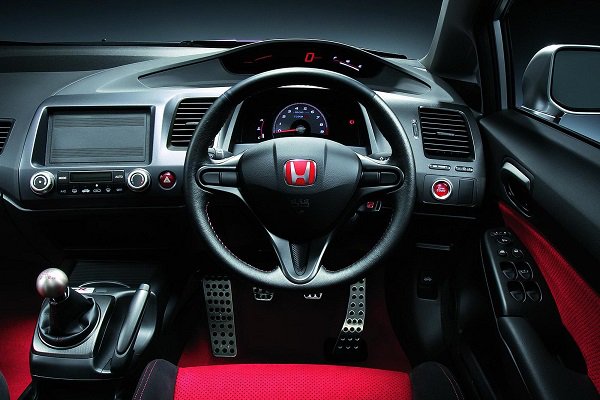

The exterior of whatever future visions of the future are going to be, are still constrained by the same design elements that were always there. The function of a car is to move people around. In doing that, there needs to be some place to put the people, door to be able to get in and out, some windows to look out of, some sort of propulsion device to make it go, lights to light the way and to indicate to others where you are going. Those things haven't really changed since the inception of the motor car.

PS: I still think it neat that even in the imagining of 2015 in Back To The Future Part II, if you look in the top right hand side of the picture, there's still an orange Volkswagen Beetle. I'd like to think that any vision of the future includes at least a few of those for a long time to come.

October 19, 2015

Horse 2010 - A Tragic Tale Told In Three Letter Words

I am Tim and I am six. I had a bad day.
I had my toy bus and my toy car and I was out on the tor and I saw it all.

I saw it. I saw it.
The bad fox has got the red hen!
How sad; too bad. I cry and I cry, for the red hen did not see it at all and now she is of old.

The cat is not sad. He is not mad. The cat is not sad at all. The cat can not see how bad it is, for the red hen did not see it and now the bad fox has got the red hen.
My dad did not see. My dad is out. My mum did not see, for she is out too. The one who saw it was me and I am the one who is sad.

How I cry! Me the one and one of all who saw the bad fox get the red hen. I saw her go icy, I saw her go wan. The red hen did die. She did. The bad fox got her. The red hen was and now she is not. She was and now is not a red hen. A bit of her is yon and a bit of her is yon; for the bad fox got her and now she is not.

The cat did see but he is not sad. The cat is sat on the mat but he is not sad. He is hot; he is old. He did not run for the fox; he did not get the fox. I am mad at the cat for he he did nil. The cat did nil as the bad fox got the red hen. The cat has got a wen on his leg and an ant on his ear and so he is not a bad cat. He is an old cat and he did not run. He did not try at all.

How can I say to all of the bad fox and of all he did? The red hen did not fly and nor did she run. She sat and she sat. She did not see the fox at all. Her lot is up. She sat as if she was not sad at all but now she is not. The fox is a cad, a cur and an oik. He did not get an egg, for the fox got her.

Can I say of the red hen to mum? Can I say of the red hen to dad? I saw as the fox had ire. I saw as the fox bit her leg. I saw her die. I saw her die. I cry and cry for I saw her die. My eye is wet for I cry and cry. I saw her die. How can I go on?
Who is sad for the red hen? Not mum, not dad, not the cat and not the fox!

The fox is not sad for he has won. He has won his lot. He bit the red hen. He bit the red hen, got her and ran. Is he bad for all he has won? Is the fox a dad? Has the fox got a kid of his own? If the fox has a kid, he or she can eat now. The fox and his kid can sup now but the red hen can not. If the fox has a kid, I am not mad but I am sad. The fox got the red hen and he ran.

I do not cry now but I am sad. I put on my hat and I go out. One day, we all go the way of the red hen, for we all die. It is sad but we all go on.

October 16, 2015

Horse 2009 - Alfa Romeo Mito: A Car That Makes No Sense But I Still Want One

On Monday I finally got the opportunity to do something which I've always wanted to do; that is drive an Alfa Romeo Mito. One of our clients said that they drove one and I explained that I think that it is as cute as a button and must be fun to drive. Half an hour later, I drove the car from Mosman to Hornsby and this is where this tale begins.

One of the things that any proper petrolhead has to tick off on their list of cars to own, if they truly are a petrolhead (no such thing as a true Scotsman) is an Alfa Romeo. Sure, Alfa Romeos have a reputation of breaking down and their fame for developing rust is so bad that they come with a six year anti-corrosion warranty (which is itself gimmicky) but that's the thing about a car like an Alfa Romeo. They aren't like normal cars, they're infused with Italian passion to the point whee they leak character (and many litres of oil) everywhere they go.

The 1.4L engine is an interesting animal. When married to the six speed gearbox, it wants to spin up and run away but only runs out of puff. Being only 1.4L and with the kind of torque that a household mixmaster could beat, it had to be mated to a six speed manual gearbox, just to give the driver enough torque to make the car useable at road speeds. The result is that you end up having to move your hand about as though you were mixing cake batter. You end up doing more changes per mile than there are changes in the weather in Melbourne.
The clutch is not that great either. You have to put your foot to the floor to make it work but then the amount of travel to find the bite point is practically nil. I was assured that this is similar to a Maserati and if this is the case, then I don't particularly want to drive a Maserati.
For reasons that I do not understand, the pedals are offset towards the centre and the only place that I could find that was remotely comfortable to drive from was one where my knees where up around my ears but my arms were stretched out in front like Kermit the Frog.

Visibility out the back though is rubbish and whilst you'd like to look in the mirrors to change lanes, I'm convinced that the blind spots are bigger than the areas that you can see out of but that is a common thing with modern cars. In an effort to make them all appear sporty, every car now has a belt line which rises as you go further to the back; as result, so many rear windows on cars are like looking through the slits of a bird watcher's hut. If I was a four year old in the back seats, I would have a view of the sky and nothing else; so it's no wonder today's children demand their own personal cinemas. We don't give them windows to look out of any more, what else are they expected to look at? Not that they'd fit in the back anyway because unless they're so small that they're installed sideways in a baby crib, the only children who'd fit back there are the sort with no legs. The Mito barely qualifies as a 2+2. Maybe a 2+0.2?

It isn't all bad news though. The suspension is firm as you'd expect from a car that purports to be sporty and the handling is simply stunning. It helps that the wheels are jammed into the corners but where the car shines is going through a series of corners with a change of elevation.
The car wants to corner flat but there's a wee bit of give to let you know that the wheels are reading and flowing with the tarmac. The car is a little pitchy because the wheelbase is so short but there's almost no roll and the car points where you want it to go like an excited little Jack Russell.

The Mito is a uniquely frustrating machine whose flaws are immediately obvious to all who step into it but I'm willing to forgive all of it because it comes with something that a Camry, Mazda 3, Audi A4 or BMW doesn't come with - a personality; even though it's chaotic.
It's almost as if the design team who put the Mito together were never in the same room. It's simultaneously annoying and rewarding at the same time. It's an Italian Opera by Puccini with a full orchestra and a kazoo. It is pasta prima vera with a banana it. It is a car that you want to love and hate at the same time. It makes you want to drive it for a thousand miles whilst also making you want steer it straight towards the nearest tree.

It probably handles better than the Ka that I had but you'd never notice it because of all its other shortcomings. I think that at $21,500 it is certainly the cheapest car that you can currently buy from any manufacturer which has won the Formula One World Championship and therein lies the appeal. Just the mention of the name Alfa Romeo conjures up images of an era when racing drivers wore leather helmets, goggles and scarves. The Alfisti are as fanatical as the Tifosi and there's a great deal of kudos in the badge on the front but it still doesn't change the fact that if you want a car in this class that you have to live with every day and you are a boring person, you should be getting a Mazda 2, Fiesta or if you have no personality at all, a Yaris or a Polo.

It is a car which is unashamedly Italian; which could have only come from the Po river valley. The hint is the badge on the front which is of a snake eating a person. Once you get bitten by Alfa Romeo, you're done for. 
Alfa Romeo doesn't give you a car that makes sense, they give you a car that gives you emotions: like joy, anger and confusion. The Mito is all of those in a cute little package that makes no sense at all... and I want one.

October 15, 2015

Horse 2008 - The Longest Domestic Flight... In The World

Australia's national airline Qantas, has recently started a regularly scheduled service between Sydney and Dallas. This means that at 13,756 km, QF7 outbound and QF8 inbound are the longest scheduled flights in the world.
On a forum which I visit, we decided to ask the question of "what is the longest domestic flight in the world?" The answer which I claimed, is significantly further than what anyone else did but it does bring into question of what the nature of a domestic flight is in the first place.

In a lot of people's minds the United States is made up of New York, New England and the east coast and Los Angeles, California and the west coast. The vast interior which presumably is made up of nothingness and amber waves of grain, even has the nickname of "the flyover states" because this is how a lot of people view them. America because of its bigness is the first candidate for finding the longest domestic flight but you can only really go from Los Angeles to New York in one hop. Alaskan Airlines doesn't fly to the east coast and neither does Hawaiian. Los Angeles to New York is a distance of 3,943 km.
The next obvious candidate for the world's longest domestic flight is in Canada, which also shares the North American continent. Air Canada (amongst others) flies from Vancouver to Quebec which is only 3,628 km but if you were to turn the globe, there is one even more obvious candidate.

Stretching across eight time zones (maybe?) is the mostly frozen and empty land of Russia. Some time after the breakup and collapse of the Mongol Empire, the Rus and the Tatars reasserted their control over an even vaster nothingness than America.
There is a pair of daily flights from Moscow in the west to Uelkel, which is way way over in the east and getting towards the Bering Straight. At 6,307 km, this is a truly monumental haul; which is made all the more impressive when you consider that it's probably being done with aging Ilyushin aircraft of dubious quality.
I tried to find a flight from Kaliningrad which is in the eponymous Kaliningrad Oblast in the west and surrounded by Lithuania and Poland but that all became academic as an even longer flight suddenly appeared in the competition.

Air France flies from Charles due Gaulle in Paris to the island of Réunion in the Indian Ocean; which is a distance of 9,375 km. Réunion is a very curious case because being one of the last vestiges of empire, a unique solution was found for it.
The British Empire was one on which the sun did not set because God could not trust the British in the dark. Having learnt the hard way from their experience in America, the British solution of how to administer an empire was to appoint governors and client rulers over foreign territories. This meant that places like Hong Kong which was a Crown Colony because of the Letters Patent of 1843, Canada, the six colonies in Australia, India and the colonies in the Caribbean, were never officially part of the United Kingdom and always remained separate; this was also confirmed as a consequence of the Colonial Laws Validity Act 1865.
France however was far less organised and so the little island of Réunion unlike New Caledonia, was neither independent not separate. A flight from Paris to Réunion leaves France and then lands in France. This in principle is like a flight from Seattle to Anchorage in that the plane which takes off in one country, lands in the same country but flies over another one to get there. It's just that in the case of flying from Paris to Réunion, the plane flies over a whole bunch of countries.
Réunion sends members to both the Assemblée nationale and the Sénat French parliament and the people of Réunion vote in European Parliament elections.

This is where the story gets strange though.

The longest scheduled domestic flight that I could find in the world flies from Sydney to Sydney. Yes, that sounds idiotic but it flies from Sydney to Sydney via Antarctica and it travels a distance of 13,572 km. The crazy thing is that it only flies over Australian territory.
The Australian Antarctic Territory like the Keeling and Cocos Islands, Christmas Island is an Australian overseas territory but unlike those places which have permanent populations, the people living there vote in Federal elections, in the seats that they would otherwise have normally resided if they were living elsewhere in Australia.
Even though there aren't more than maybe half a dozen flights over the Australian Antarctic Territory and even though they exist purely for sight seeing purposes, they leave via the domestic terminal, arrive back at the domestic terminal, no passports are needed to fly and like any other flight they are designated a flight number.

I guess that the reason that this is problematic is that the departure and destination point are the same. Because the flights over Antarctica leave from the domestic terminal, they might even depart and arrive from the same gate; giving you a net distance travelled of nil. To me this is like making a round Australia journey in that you travel thousands of kilometres and end back up where you travel started but isn't that what people going on holiday from Paris to Réunion ultimately do anyway? If you go on a two week holiday, then you end up going home at the end of it. Going for a flight over Antarctica just means that you get home quicker and since this is about the longest domestic flight in the world rather than the destination, I think that this is technically correct; which is the best kind of correct.

For those people who want to travel on what I think is the longest domestic flight in the world, the next of departs on 7th Feb 2016. Flights do leave from Melbourne but that's a shorter flight.
Link: http://www.antarcticaflights.com.au/

October 14, 2015

Horse 2007 - Property Prices and Talkback Radio

If you'd been listening to talk back radio this week, you'd have thought that just the prediction of a slow down in property price growth was utterly terrible. If you'd heard the carry on about the merest hint that property prices might even fall by 20%, then you'd conclude that a market correction or slowdown was worse than ISIS. Forget suicide bombers in Turkey or a 15 year old shooting an NSW police employee in Parramatta - falling property prices are literally the worst thing ever in the history of the universe; worse than terrorism and I kid thee not people said that falling property prices are worse than lSIS and worse than Hitler.
I get the impression that if property prices in Sydney were to fall by 20%, then the entirety of civilisation itself would come to a shuddering halt and the earth will plunge into the sun.
This great wen we call Sydney, is so obsessed with property that it has almost ceased to manufacture real products within its environs, is the measure by which society actually values people and I'm convinced that the only reason that the two daily newspapers in Sydney continue to operate is on the back of the revenues generated by people advertising houses that people are selling to each other.
The difference between Sydney and a pot of yoghurt is that after 200 years, a pot of yoghurt develops a culture. Sydney as a city refuses to and quite frankly, is more concerned about the value of the land that the pot of yoghurt is sitting on.

There are only three kinds of people who truly benefit from rising property prices.
There are people who are just about to sell their houses; rising property prices mean that they can get a higher list price without doing any real work whatsoever. Landlords like rising property prices because they can then justify rent increases without doing any real work whatsoever. The last group of people who like rising property prices are real estate agents; whose whole income cones from living inside the space between lessors and lessees and creaming their cut from the top. Real estate agents who maintain rent rolls on behalf of lessors certainly do no real work whatsoever and when it comes to buying and selling houses, they prefer to run auctions because they can cream a larger cut from the top of the sale for as little work as possible.

There's a really strange sort of irony in the fact that people who pull in more of their income from directly owning property and collecting rent, of owning part of property trusts which collect rent, are often the sorts of people who complain the loudest and longest about the government taxing them and then making transfer payments. The irony is that for most people who earn less than about 60% of AWOTE, their biggest expense is usually rents and those people are the direct recipient of those rents. There's also a rather interesting display of hypocrisy here in that rents are more likely to be paid from the proceeds of doing real work but collecting rent requires almost no real work whatsoever.
Actually in my personal experience, landlords and real estate agent are almost totally derelict in doing any real work whatsoever. I've been in a few places now where basic maintenance needs to be done and either because landlords are lazy or maybe willfully neglectful, they avoid it altogether. Even doing any real work whatsoever, is too much of a task for landlords and real estate agents but the second that tenants stop paying them for some reason, all sorts of fire, brimstone, Sheol and Hades are rained down.

The people who shouldn't care about and probably don't need to care about rising or falling property prices are those people who have laid off their mortgages and live in a house that they own outright. For them, it matter not a dot, not an iota, nor a tiddle; zero, zip, nada, nought, nothing and zilch, what the price of their house is or whether it is nominally rising or falling, except in incidental costs inllcurred as a result of council rates.
Someone who lives in their own house, doesn't pay anyone else rent; nor do they collect it. An owner occupier only really needs to bat an eyelid at the subject when they choose to move houses or at the point that they have died and their estate needs to be liquidated; at that point they can't care anyway because the grave sort of renders that difficult.

The people who would actually benefit from falling property prices are renters and people looking to buy. People who are looking to buy property, once they have settled on a property, transform into a lessor or an owner occupier. People who are renting and more than likely are doing real work to pay for that rent, unless they receive transfer payments, would very mub like to see falling property prices because this results in a pause in the amounts demanded that they should pay. I have never ever ever ever heard of rents falling as a result of falling property prices and I suspect that such a thing is like a blue swan. Such a thing may exist and it is conceivable but there's probably a greater chance of me becoming Prime Minister before that happens.

I don't think that a market correction or property prices falling by even as much as 20% is likely to be all that calamitous or even noticed by much of the general public. I don't think that falling property prices are worse than terrorism, or ISIS, or even Hitler, as much as callers to talk back radio would have us believe. The only reason that it gets so much airplay is that the people of Sydney are obsessed with property prices and the sort of people who complain the loudest and longest are those people who try do do no real work whatsoever if they can get away with it.

Aside:
Dear ISIS,
If you really want to destabilise western societies and cause as much outrage and have people complaining really loudly, why not start investing in cheap affordable housing? By buying property and undercutting the complaining classes, you'll lower rents and you'll start to lower property prices. That really will get the sort of people who ring up talk back radio angry.

October 13, 2015

Horse 2006 - Prices UP + Sizes DOWN

Contrary to nutritionists, dieticians, chefs and popular opinion, I think that there are in fact six and not five food groups.
Those six food groups are:
1. Breads and Cereals
2. Fruits & Vegetables
3. Meat and Meat Substitute (you're not fooling anyone, vegans)
4. Dairy,
5. Fats and Oils
6. Purple.
Group 6, the purple group contains all of those things that come in purple packaging. Ribena, Passiona and Milka chocolate come to mind but the most important item is Cadbury Dairy Milk. The other six groups are things that you need to survive but group purple are all things you need to make it worthwhile.
Something hideous has happened in group purple though; something so hideous and heinous that Cadbury should be reported to The Hague immediately for violation of human rights. That thing is... a block of Dairy Milk has shrunk from 220g to 200g.

Shock, horror, calamity, howls of pain, blood and thunder - declare a national emergency and broadcast the sirens and warnings for people to stay in their homes. This is worse than a nuclear error and a disaster of such magnitude that not even Batman can help us.

Okay, so its not exactly the end of the world and perhaps I am using a case of hyperbole by a factor of more than a million times but it is illustrative and deeply symbolic.

Cadbury used to trade on the slogan that there was a "glass and a half of full cream dairy milk in every 250g block". That might very well have been true but a 250g block shrunk to 220g and now 200g; which means that there's only four fifths of a glass and a half, which equals twelve tenths of a glass in every 200g block and whilst 12/10ths might sound funky and modern and groovy, it's still minus 50g of what we used to get and that's un-Australian.

This has also happened with the Mars Bar which used to be 70g, then 65g, then 60g and is now only 53g. A packet of Tim Tams used to have 13 biscuits before it fell down to 11 and then 9. A Subway foot-long sandwich (and the reason that I know this merely serves to prove that I am a tightwad, a curmudgeon and rather persnickety - which are all excellent qualities for an accountant to have), is now only 11 inches long.

This happens all across the supermarket as well.
For some hitherto unknowable reason, bread is now sold in 680g loaves and not 700g, cereal which used to come in 750g boxes now comes in 700g boxes and canned goods which almost universally came in 500g tins now only come in 440g tins; that's a nightmare when you're cooking and you now have to adjust all of you proportions to be 0.88 of what they were previously. As an accountant I live in a world of numbers but for the average person who forgot how to do long division once they left primary school, this may as well be as unfathomable as theoretical astrophysics.

I suspect two things going on here for the price of what is now less than one.
Firstly, to increase profits, companies can either up their prices which is bad or decrease the amount of stuff inside their packaging to achieve the same effect. Firms will prefer to do the latter because its easier to underestimate the intelligence of the general public because stupidity, ignorance and lack of awareness are three products that it is impossible to glut the market with. Far better to maintain prices and stiff the customer than to send a price signal and make them angry.

Secondly, the other thing which regularly happens in supermarkets is a highly well planned out confusopoly. In an average supermarket there might be as many as two thousand different individual items. By putting some things 'on special' even though people might be being held to an overall increase in their shopping budget of about 2% a year, because they literally can not hold information about all two thousand products in their head, they'll notice the seven items on special before they notice the overall increase in their overall bill. One item that's half price or 10% off, will easily offset the nine other things that had price increases.
What's really galling is if a 440g tin of four bean mix suddenly appears on the shelf as 14% extra free for a time. All that means is that they've saved some of the 500g tins from before, so that people think that they're getting a good deal, then when the 440g tin goes back on sale on the shelves no-one will notice the increase in price when it comes back.

One of the favourite questions that I hear in court a lot, when lawyers want to show that either their adversary or their adversary's client is out of touch with society, is to ask them what the price of a loaf of bread is. Admittedly this question isn't being asked as much at the moment because both Woolworths and Coles are undercutting local bakeries by selling 85c bread at a loss but when this unsustainable madness ends, the price that they'll put the price of a 680g loaf of bread will be more than the 700g loaf of bread which used to exist. Bread is also one of those things which can be differentiated (white, brown, mutli-grain, high fibre, low GI, rye) to the point where supermarkets can even run a confusopoly for this single product.

If that weren't bad enough, the Trans Pacific Partnership agreement (or "let's swindle all consumers in the Pacific at once" agreement) now means that governments have less ability to set quotas on imports, which means that beans from Chile, pineapple from America and tomatoes from Vietnam, can be dumped on any market in the region. Ostensibly this is being done in the name of lowering prices to consumers but everyone knows that multi-national companies will be pocketing the difference and that end-user consumer prices will not change significantly.
Now we can confidently ask 'what's that got to do with the price of fish in China?' and know that South Australian skipjack tuna farmers and fishers will be more than concerned; whilst at the same time a 500g of tuna became a 455g of tuna whilst nobody noticed.

People tend not to notice increases across multiple items and are only sort of aware of a general rise in their overall grocery bills. I also fall into that category but when it comes to me buying single items on a semi-regular basis at work, like a block of chocolate to go with a coffee break, I notice these things acutely. It's akin to having the flu and experiencing an overall malaise but then stepping on a bindi-eye that hitched a ride inside the house.
I'd even go so far as to say that I probably wouldn't be aware of price increases of single items if I didn't believe that Purple is a separate food group. It is isn't it?

October 12, 2015

Horse 2005 - F1: Hamilton Storms Ahead; Raikkonen Causes Thunder (Round 7)

The Sochi Autodrom was built in the same phase of construction as the venues for the Winter Olympics of 2014 and although from the outset it was always intended as a motor racing circuit, the ribbon of tarmac which flows through what amounts to a concrete storm water drain behaves more like a street circuit and is as unforgiving. Carlos Sainz Jr, who has one of the most ironically unfortunate first names in Formula One, found this to his peril when he ran off the road and into a wall during Free Practice 3 on Friday. Toro Rosso worked frantically over the weekend to put his car onto the end of the grid on Sunday.
It was all systems normal during qualifying with an all Mercedes lock out of the front row and apart from the two Ferraris the rest of the first eight places on the grid were Mercedes powered. The weekend and the race was looked over by F1 supremo Bernie Eccleston and Russian President Vladimir Putin who must have been in some sort of secret competition of their own to decide which of them is the creepiest person in the world.

On the opening lap as Hamilton and Rosberg sped away from the field, going into turn 3, Hulkenburg spun his Force India with no help from anybody and tagged Vestappen's rear left wheel which caused it to blow and Eriksson in the Sauber had nowhere to go, running into and tangling with the stationary and backwards facing Force India.
Before the safety car was called out, Rosberg sneakily stole past Hamilton for the lead and Raikkonen found his way past Valtteri Bottas for third; in the start of what would become a race long argument. Somewhere in the chaos of backwards facing cars and tyres exploding, Romain Grosjean either ran into someone or decided that he wasn't getting enough front grip because he brought in a seemingly undamaged Lotus into the puts to adjust the front wing. After a twelve second pitstop where nothing appeared to happen, Grosjean rejoined the race behind the safety and behind everyone in the field.

After the restart on lap 4, Bottas flew past Raikkonen and Sebastian Vettel almost also followed suit but his Ferrari team mate closed the door; much to his annoyance. Rosberg started to complain of a strange throttle response; which could only be explained by a glitch in the fly by wire system and on lap 8, Hamilton inherited the lead. Rosberg would bring his Mercedes into the pits at the end of the lap and looked despondent when he stepped out of the car.

Things quietened down for a while and then on lap 12, Grosjean either lost front end grip as a result of what had happened earlier, or because he lost effective grip in the slipstream of Jensen Button's McLaren. Whatever the cause was, the result was that the Lotus snapped violently and Grosjean was thrown off line. This caused the rear of the car to step out in the marbles and tear itself to pieces against the wall.
During the second safety car period, Ricciardo, Sainz, Vestappen, Button and Perez all came in on lap 13; with Perez hoping to make his new tyres last the remaining 41 laps of the race. A lap later, Alonso and Merhi also came in to attempt to do likewise.
On the second restart on lap 17, Raikkonen again surrendered third place but this time to Vettel and it took nine corners of scrapping for Ricciardo to find a way past Sainz for 10th.

Again the race settled down as Hamilton progressively built a lead and the phase of pit stops of drivers on one stop strategies began to play out.
Vestappen pitted on lap 25. Bottas pitted on lap 27 and fell from 2nd; slotting into 11th but quickly passed Sainz. Vettel also pitted from 2nd on lap 31 but in the interim had built up a sufficient cushion whilst driving in clean air that he slotted back into 6th whilst Bottas was 8th. Raikkonen came in a lap later but fell in behind Bottas for 8th place.
On lap 33, Lewis Hamilton had built up so much of a lead out front, that he pitted from 1st place and rejoined the race back in 1st place. On lap 34, Vettel made use of DRS and easily got past Perez to take 4th and Dannil Kvyat who had taken his Red Bull to 3rd, finally pitted and fell all the way to 9th.
On lap 35, Felipe Nasr pitted from 2nd place, which was the highest placing that he had ever achieved in his Formula One career but rejoined the race back in 7th.

The argument between Raikkonen and Bottas continued and on lap 36, Raikkonen had managed to pass Bottas up the inside going into turn 1 but ran wide on the exit of the corner and had to surrender third place back again. This argument would not be finished just yet.

Further down the field, the McLarens who are beginning to show signs of adequacy, highlighted their last remaining problem with their Honda power units. In periods where top end power doesn't matter, the chassis is quite fine but where the regenerative braking system is supposed to collect and then redeliver power through the hybrid system, Honda still hasn't worked that out.
Maldonado passed Alonso for 12th on lap 40 and Nasr repassed Button for 10th. Four laps later Maldonado also passed Button. Felipe Massa who had been relatively quiet, stormed past Kvyat.
On lap 45, Bottas passed Ricciardo for 4th and Raikkonen managed to pass, unpass, repass and unpass Ricciardo again, a lap later.

Carlos Sainz Jr's race came to a strange sort of end on lap 47 as his front brakes started to flame out; sending him into a spin at turn 8. Most drivers would have got the message after seeing flames belching forth but Sainz didn't and spun for a second time at turn 13 (which was where he'd had his Friday accident) and he clouted the wall, thus ending his race.
Raikkonen finally made his way past Ricciardo on lap 48 but this was more to do with suspension issues on the Red Bull rather than the brilliance of the Ferrari. Ricciardo's Red Bull stopped its charge on lap 49.

The tyres on Sergio Perez' Force India started to go off and both Bottas and Raikkonen breezed past him on lap 52 but their argument would come to a violent conclusion.
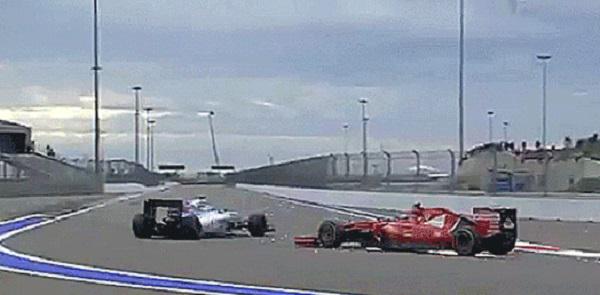
On the very last lap of the race, Raikkonen's temper got the better of him and he tried to jam his Ferrari into a space that it wouldn't fit into. In the process of enforcing Finn on Finn violence, he jammed his Ferrari into the side of Bottas' Williams which destroyed the rear end of the Williams and damaged the Ferrari to the point where it threw sparks all about the track.


As the word “Perkele!” was shouted by both Finnish driver, Sergio Perez who had surrendered 3rd place to them earlier, suddenly inherited it back again as Bottas went out and Raikkonen limped around the track; spewing more fireworks than a local council's New Year's celebration. Raikkonen was handed a 10-second stop-and-go penalty for causing the incident, which was in no way possible not his fault despite his stream of invective over the radio. As he could not serve this penalty during the race, this became a 30 second time penalty which demoted him to eighth in the official standings.

Hamilton who remained untroubled throughout proceedings, took home a very comfortable win, with Vettel second, Perez third; followed by Massa, Kvyat and Nasr.
McLaren managed to get their cars into ninth and tenth which is either a good sign for the future or just dumb luck after the mayhem ahead of them.

Race Results:
1. Hamilton - Mercedes
2. Vettel - Ferrari
3. Perez - Force India
4. Massa - Williams
5. Kyvat - Red Bull
6. Nasr - Sauber

"The John Logie Baird Television Was Better in 1984 Memorial Cup" at the end of Round 7 in Singapore looks like this:

46 Hamilton
37 Rosberg
30 Vettel
11 Massa
11 Ricciardo
11 Raikkonen
9 Kyvat
7 Bottas
6 Perez
4 Grosjean
3 Nasr
1 Hulkenburg

The Constructor's Championship is thus:

83 Mercedes
41 Ferrari
20 Red Bull
18 Williams
7 Force India
4 Lotus
3 Sauber

October 10, 2015

Horse 2004 - The Bathurst 1000km Closed Shop

Once upon a time in the days when motor racing at Bathurst was still largely amateur, apart from the teams with massive budgets running cars which were far superior to the others, there was a whole host of privateer teams running single car teams and on shoestring budgets. The week before the 1000km motor race was always heralded not only by the rumble of articulated trucks but also station wagons hauling trailers with race cars on the back. Teams with exotically local sounding names like Lansvale Smash Repairs, Cleanaway Bins and Norton's Plumbing would be seen alongside the names of multinational electrical corporations, petrochemical companies and in the "bad" old days, the tobacco companies.
This meant that in that race in October, there would be as many as 56 cars in the race and starting fields which stretched so far around the corner that they couldn't even see when the lights had gone green and had to rely on the cars in front of them to start moving. Of course most of them never stood a chance in winning the race (the last time that it happened was a chicken farmer in 1986) but for them, merely finishing the 1000km torture test was an achievement and making it into the top ten was a ticket to becoming a legend in one's own lunch box.
In the 2015 Bathurst 1000, there are only 27 entrants; 26 now that Chaz Mostert has destroyed his Falcon and I think that such a small number is paltry, sad and un-Australian.

We have two sets of eligible race cars running to the same regulations in this country. There is the top level V8Supercars championship and then there is the Dunlop Development Series which has another 30 cars. If both sets of cars were allowed to compete, then there'd be 57 cars in total and something of the magic of oh so long ago might be brought back.

There is an argument that says that having so called "amateur" drivers out on the circuit is a hindrance to professional motor racers but this is clearly a load of nonsense. For a start, drivers in lesser categories usually have far more of their own money invested in the car than a paid driver and so they are far more careful than someone who is going absolutely flat out in search of those extra tenths of a second. Also, if speed is really an issue, then something like the 107% from Formula One could be implemented, where to qualify drivers would need to attain a time within 107% of the pole sitter. For last year's race when the Coulthard/Youlden car achieved a time of 2m05.6080s, then 107% of that would be 2m14.4005s. This is more than achievable considering that last year, Phil Woodbury who drove for the Pacific Hoists team qualified 21st with a time of 2m13.8944s.
Lack of speed is not the issue and to say that it is, is dishonest.

We have this persistent myth in Australia of the "fair go". This is supposed to imply that anyone can throw their hat into the ring and in theory have a shot at greatness. In practice though, the only sport in Australia which actually achieves this is football, which through the FFA Cup means that the very smallest of minnows can have their day in the sun if they can play well enough. 
All other major professional sports in Australia are very much closed shops. Rugby League, Australian Rules, Rugby, Cricket and the V8Supercars championship all operate with licences and or franchise systems; so that the only way in is to either but an existing licence or to convince existing licence and franchise holders that you should be admitted.
In the days before the V8Supercars organisation, the Touring Car Entrant's Group and IMG sports management decided to close the shop, all one needed to do was to apply for a permit through the Confederation of Australian Motor Sport and build a car which met the regulations. It was precisely because of this sort of environment that privateers could even exist but those days have sadly gone. All that remains is a second tier development series; provided you can buy old machinery from an existing franchise holder. 

For the fans who want to see big fields at the premier race on the calendar, they are being horribly short changed. It's especially disappointing when you consider that a lot of the legends of the sport like Peter Brock, Alan Moffat, Dick Johnson, Jim Richards, Alan Grice, Greg Murphy all raced in privateer cars on the mountain; now in a professional series that trades upon its history as part of the mythos, it has deliberately pulled the ladder up behind it.
The 1000km race at Bathurst is worse off for not allowing "the little guy" to have a tilt at glory. The minor legends are not being written any more and that's just bad.

October 09, 2015

Horse 2003 - St Bogan's Day: October 30th

In the weeks leading up to October 30 every year, more than $10 billion will be spent by Australians in decorating their houses in black and blue in preparation for St Bogan's Day.
St Bogan is the patron saint of scabbing off your neighbours and not returning items of garden equipment that you have borrowed throughout the year. If goods are not claimed before midnight on St Bogan's Day, the ownership legally reverts to the person who has borrowed them; which is both a source of annoyance for those poor souls who find that they no longer own some important stuff and a source of joy for those pilfering scabs who no longer feel bad about not returning anything.

Research shows that there were most probably bogans on the First Fleet. Obviously Captain Arthur Phillip was not a bogan because he was a toff but James Cook who had sailed a ship around the world and sticking a flag into any one bit of dirt that he liked, was certainly a forerunner to the modern bogan. Cook's descendants are probably modern day Chavs who live on British council estates and collect benefits. Cook who was a Yorkshireman probably uttered the first words that might be considered to be sort of English when in 1770 he uttered the immortal "This place ent like Yorkshire. It's well rubbish" before sticking the Union Jack in the ground, claiming the continent for Britain and then refusing to return it to its original inhabitants. Owing to the fact that native people didn't claim back their lands before St Bogan's Day, under the doctrine of Terra Nah-your-loss, those lands became the legal property of the British until the population of non bogan people in Australia overtook that of bogans.

It is not known exactly who St Bogan was, or even if there was a St Bogan. The original bogans were first identified in Melbourne's western suburbs like Spotswood and Tottenham but it was soon pretty clear that bogans existed in all mainland capital cities, many rural areas and had undergone damage due to mould whilst living in Tasmania.
Apart from Cook's initial act of boganism in 1770 and Phillip's second act of boganism in 1788 by rocking up and plonking a colony down in Sydney with no intent to return anything, the majority of the First Fleet had been transported to Australia for excessive boganimity or sheilaness. Most were sentenced to death but had this commuted to transportation and especially public transportation because as we all know from the extensive research by that well known historian Joseph Hockey, poor people don't own cars.

Much like the legend of Santa Claus, the origins of St Bogan are shrouded in mystery; with the most likely explanation being that after the first account was written, St Bogan borrowed the first copy and never returned it.
Most versions of the St Bogan story involve the tale of a man who had stolen one of the King's best oxen. St Bogan had some ploughing that he needed to do and borrowed the oxen. When the king sent around his sherrifs to recover the stolen oxen, they were not on the lands of this particular man but in St Bogan's barn and thus could not be found. The man escaped the penalty of death for poaching the king's oxen and he was eternally grateful. St Bogan did not return the oxen.
St Bogan was soon canonised as a saint after three miracles were attributed to him. He turned dirt into mud, he turned water into mud and he made a deaf man blind after a lengthy sermon on the subject of not returning a herd of sheep.
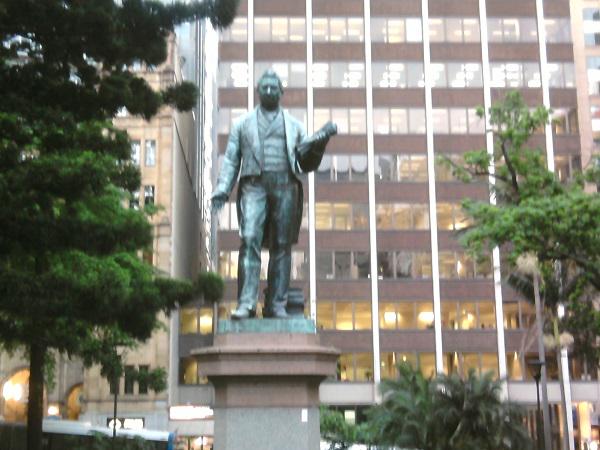
A statue stands above St Bogan's Railway Station in Sydney, where he can be seen holding a copy of the newspaper which he borrowed and has no intention of returning. A brass plaque used to be affixed to the front of the statue but that too has been borrowed with no intention of return.

- Statue of St Bogan above St Bogan's Railway Station

The traditional celebrations on St Bogan's Day involve sending one children round to your neighbours' houses and getting them to ask to borrow no end of useful and valuable items; safe in the knowledge that at the stroke of midnight, all of the stuff that has been borrowed does not have to be returned.
The traditional response to all of these children showing up at the door is to buy them off with cheap sweets because children neither show guile nor skill when it comes to the negotiation for items. Mostly, children who walk away from people's houses having failed to procure either sweets, biscuits, chocolate,  garden furniture, power gardening tools, white goods or small computer equipment, will retaliate by throwing eggs at houses, slashing tyres and throwing excessive amounts of toilet paper over cars and roofs.

Okay. All of this is a lie and there is no St Bogan. However, this is still a culturally more accurate description of the 31st of August on Halloween, when parents send their children out to scab off of their neighbours. The whole iconography of pumpkins also makes no sense because in Australia, it is spring time and the evenings are getting lighter and longer; not darker and colder.
Yes, I am a curmudgeon whose hair has started to grey and whose days are probably fewer ahead than behind but someone more important needs those chocolates and sweets - me!
It would be really really weird if I came round to your house and demanded stuff on the 30th of October. Why is it acceptable for you to send your kids round to mine a day later and do likewise?

I still want to borrow your hedge trimmer forever; with no intent of returning it though. It's the right thing to do on St Bogan's Day.

October 08, 2015

Horse 2002 - Repatriation, Reparations and The Crown

Last week British Prime Minister David Cameron visited Jamaica and Grenada, to engage in trade talks which among other things involved the building of a prison to hold 1500 inmates at the cost of £25m, and the repatriation of prisoners back to Jamaica without the need for their consent to be transferred.
Cameron made the first trip to the Caribbean by a British PM in fourteen years since Tony Blair in 2001, made a similar trip which involved talks and the training of several hundred police officers. Previous to that, it was also 14 years earlier that Margaret Thatcher visited the Caribbean but that had more to do with a Cold War context. Three trips in 28 years by a British PM to the Caribbean seems a little paltry to me; considering the mark that Britain has left on that part of the world.

Investigations were made into David Cameron's family history and it was discovered that General Sir James Duff who Cameron is related to on his father's side of the family, was compensated £4101/0/1 by the Crown after the passing of the Slavery Abolition Act 1833.
It seems rather a bit rich to me, that when compensation was paid out by the British Government in the 1830s, it wasn't paid to the people who were often kidnapped, made to work against their will and beaten and killed if they did not, stolen from their homelands and deposited in a place where they neither knew the language nor kith nor kin, but rather monies were paid to the capitalists who treated people as chattel and who made profits on the blood and bones of the people they oppressed.
Even 180 years later, that should be the cause of scorn, shame and a lot of inward looking but sadly, none of this seems to have occurred at all.
At the 200th anniversary of the passing of the Abolition of the Slave Trade Act 1807, the then Prime Minister Tony Blair did say that "slavery was a thing of the past" but stopped short of an apology. The real message which came out of that is that even if you commit crimes against humanity as a nation, you can not be held responsible and that you do not feel as though you need to apologise. "Bigger gun diplomacy" is as alive in the 21st century as it was in the 19th century.

In an open letter which was published in the Jamaica Observer, historian Sir Hilary Beckles wrote to David Cameron to "contribute in a joint programme of rehabilitation and renewal"
Exactly what such a joint programme of rehabilitation and renewal would entail I don't know exactly but at very least, I think that it should employ at least some level of apology.

Most telling, Beckles' letter reminds Cameron of what Britain has done in the world:
http://www.jamaicaobserver.com/news/Britain-has-duty-to-clean-up-monumental-mess-of-Empire--Sir-Hilary-tells-Cameron_19230957
I speak, Sir, of the legacies of slavery that continue to derail, undermine and haunt our best efforts at sustainable economic development and the psychological and cultural rehabilitation of our people from the ravishes of the crimes against humanity committed by your British State and its citizens in the form of chattel slavery and native genocide.
In this regard, I urge you to be aware that the issue of reparatory justice for these crimes is now before our respective nations, and the wider world. It is not an issue that can be further ignored, remain under the rug, or placed on back burners, as your minister who recently visited us so aptly described your agenda for Jamaica and the Caribbean.
It will generate the greatest global political movement of our time unless respected and resolved by you, the leader of the State that extracted more wealth from our enslavement than any other.
-   Sir Hilary Beckles, Jamaica Observer, 28th Sep 2015.

Intriguingly, Beckles says that "we ask not for handouts or any such acts of indecent submission. We merely ask that you acknowledge responsibility for your share of this situation".

There's an interesting thought. Handouts are one thing but where actual damages have been caused, there is usually a case for compensation. I don't think that it would be difficult to prove a case which for many people is still ongoing, of pain and suffering and emotional distress, which stems from the results of slavery and empire.
People like Dr Shashi Tharoor who is a member of the Lok Sabha, the "House of The People" in the Indian Paliament (the lower house in a bicameral system), thinks that the case to be made that Britian does owe reparations should be made:


The real problem with reparations is the question of who pays and who should be liable. In the case where private profits were extracted from empire as a result of slavery, should the descendants 180 years later be held liable for the actions of people they have never even met? Maybe there are vast estates which still exist as a result of 180 year old profits but is that enough to make someone pay for the actions of someone they might disagree with?
There is a case to be made that the eternal person of the Crown should be held liable for the damages caused by slavery and empire but again, that's a complicated subject.

The obvious question is "Who is the Crown?" Fortunately, that question is answered fairly easily:
http://www.lawcom.gov.uk/wp-content/uploads/2015/03/cp143_Execution_of_Deeds_and_Documents_Consultation.pdf
Corporation - a body which is recognised by law as having a separate legal personality, distinct
from those of its members. A corporation may, for example, generally hold property, and may
sue and be sued, in its own name.

Corporation sole - a corporation consisting of one person and his or her successors in a
particular office or station. Examples include the Crown, government ministers, and bishops.
- The Law Commission, The Execution Of Deeds And Documents By Or On Behalf Of Bodies Corporate - (Mar 2005)

For all practical intents and purposes, the Crown is like a trustee corporation. The Crown is a different person at law to the monarch and whereas the monarch dies (the King/Queen is dead, long live the King/Queen) the legal person that is the Crown survives into perpetuity. Nations like the United States who don't have the person of the Crown for obvious reasons, are more explicit about who their equivalent person is. The United States has Incorporated and Unincorporated Territories which are held in possession by either the individual states or the federal nation state - the Republic.
Parliaments themselves in acting on behalf of the person of the Crown, do so in the same manner as a board of directors and they are elected by the stakeholders who are the electorate. Of course, this still means that Parliaments who act in the capacity of a board of directors, will still act against the wishes and will of the electorate but in the case of Australia for instance, where this is proscribed by the Section 51 condition in the Constitution that governments should act for "good government", this has never ever been tested at law.

The Crown is also a different person, that is a different Corporation sole depending on which jurisdiction you happen to be talking about, and that was confirmed in 2005:

http://www.publications.parliament.uk/pa/ld200506/ldjudgmt/jd051013/quark-1.htm
 9.  The instruction in issue in this case was given to the Commissioner (who was required to direct the Director) by the Secretary of State. He was not of course acting on his own behalf but on behalf of the Crown, from which his authority derived. But it is now clear, whatever may once have been thought, that the Crown is not one and indivisible: R v Secretary of State for Foreign and Commonwealth Affairs, Ex p Indian Association of Alberta [1982] QB 892, 911, 916-917, 920-921, 928. The Queen is as much the Queen of New South Wales (In re Bateman's Trust (1873) 15 Eq 355, 361) and Mauritius (R v Secretary of State for the Home Department, Ex p Bhurosah [1968] 1 QB 266, 284) and other territories acknowledging her as head of state as she is of England and Wales, Scotland, Northern Ireland or the United Kingdom. Thus the Secretary of State as a servant of the Crown exercises executive power on behalf of the Crown in whatever is, for purposes of that exercise of executive power, the relevant capacity of the Crown. The question which divides the parties is: by what test is the relevant capacity of the Crown to be ascertained?
- Lords of Appeal:
Regina v. Secretary of State for Foreign and Commonwealth Affairs (Appellant) ex parte Quark Fishing Limited (Respondents), 13th Oct 2005

If the Crown in New South Wales is a different person to the Crown in Queensland for instance, are those persons jointly, severally or perhaps even both, liable for damages. In the case of India, the person of the Crown who held the Dominion of India no longer exists and if they are liable, to what extent does that bind the person of the British Crown? Similar sorts of questions can be asked about the Crown who held possessions in the Caribbean. The Crown in Jamaica is a different person to the Crown in Grenada, Barbados and Antigua. All of them inherited the same powers as the dominions were granted as a result of the Statute of Westminster 1933 upon gaining their independence; so does that mean that the person of the Crown in Jamaica would sue the person of the Crown in Great Britain?

Of course there is the unpopular problem of what extent a country's problems are its own. India has been a republic since 1948 and whilst it might like to recover monies that it loaned Britain during the First and Second World Wars (which is fair and reasonable and can be easily ascertained by looking at a set of accounts), the question remains as to what current part of India's problems are India's fault and current part of India's problems are Britain's?
A country like South Korea which arguably had the worst economy in the world in 1955, slowly dug itself out of a hole. Has India done that job for itself and to what degree? With ex-colonies in the Caribbean who only won their independence after the Second World War, as Britain pulled its hands back from the economic tiller, what sort of directions did these ships of state sail?
I don't know the answers to those questions and because I am a white male (and therefore in the eyes of many, the chief case of every problem in the world) living in Australia, which has its own terrible history when it comes to the treatment of its first peoples, I'm mostly ignorant about what it's like to live with the effects of oppression, having never experienced it myself. To what extent should I be held liable for the crimes and damages perpetrated by my people, who stole countries and whom I've never met?

There is an interesting passage in Dr Tharoor's speech above:
Britain made all the profits, controlled the technology, supplied all the equipment and absolutely all these benefits came as British private enterprise at Indian public risk. 

If you were to think of something more recent like the 2008 Financial Crisis where £500 billion was thrown at the banks (primarily Lloyd's TSB and The Royal Bank of Scotland), public risk was again on the line as benefits were paid to private enterprise.
Assuming that even was possible, if the British public was made to pay damages, then the people who would actually be paying for those damages to be paid as reparations would most likely be the poor and the old, who would see cuts to services as a result of new budgetary requirements. The same sorts of people who won their fortunes on the backs of slaves 180 years ago, are the sorts of people who would like to throw all the poor people off the scepter'd isle today; or would like to the the Great British public liable, whilst they get away scot free.

I have none of the answers here; in fact, I'm quite sure that I don't even grasp the nuances of the question but I do know that the experience of former PM Kevin Rudd in Australia who made an apology from the floor of the Parliament to the "Stolen Generations" was both symbolic and cathartic - it also cost the Crown zero dollars. I don't know what sort of things would need to be included in an apology from Britain for slavery and empire but I do know that acknowledgement of the damage is necessary; as yet, no British Prime Minister has even looked like making that acknowledgement. How hard is it to say sorry?

October 07, 2015

Horse 2001 - A Flag Odyssey

One one forum that I find quite entertaining, there was a link to and organisation called "Flag For Liverpool" which, not surprisingly, wants to give the City of Liverpool a flag because they currently don't have one.
I thought that the question of what the flag of Liverpool should be was more or less a fait accompli and so I submitted a design which I thought was so obvious that even Blind Freddie could see it - and that design was this:

Intriguingly, the reply I got back was a rejection. Immediately I felt like like a certain famous beagle who got told by various publishers that his manuscript did not suit their present needs. That rejection email is below:

Dear Andrew,
Thank you for submitting a design to Flag For Liverpool. We have reviewed it, and although it is a technically acceptable design we  cannot include it on the site for the following reasons:
1. It is too similar to the flag for the City of London https://en.wikipedia.org/wiki/Flag_of_the_City_of_London
2. We are looking for a flag where all of the design elements represent Liverpool, your design is the flag of England with only a  small part of the design representing Liverpool.
We will be happy to welcome and review any other designs you may have.
 - flagforliverpool.org, 3rd Oct 2015

This rejection email cuts straight to the quick when it comes to flag design. Flag design is one of those thing which has a few design rules as well. The organisation called Ausflag which would like to change the flag of Australia has helpfully "borrowed" the short leaflet from the North American Vexillological Association; which lists the five principles of good flag design¹. They are as follows:
1. Keep it simple
2. Use meaningful symbolism
3. Use two to three basic colors
4. No lettering or seals of any kind.
5. Be distinctive

Flag For Liverpool has rejected my flag on the basis of Point 5 "Be distinctive" in that it is too similar to the flag for the City of London.
I think that there should be a sixth rule similar that of George Orwell's 5 Rules for Effective Writing in his 1946 essay "Politics and the English Language"; which is:
6. Break any of these rules sooner than saying anything outright barbarous².

Equally, there should be some catch-all rule of flag design which allows you to break the rules of flag design because if you are trying to create a cohesive set of things, be they flags, motor cars, appliances, furniture, anything where you want the things to sit together, I think that they should share a common design language.

Consider the set of United States' State Flags³. Although there are some excellent individual efforts such as Arizona, Alaska, New Mexico, Texas, Ohio and the flag which is so shockingly horrible that it crosses the line twice for Maryland, taken together they are an incoherent mess. Some are horrible seals on blue fields, they're different aspect ratios and even the good ones bear no relationship to each other.

Now consider the flags of Finland, Iceland, Norway, Sweden and Denmark. They all use what is known as a Nordic Cross* for their flags and although they are similar, they all fit together as a group. Likewise if you look at the set of Australian state flags, because they are all a circular seal which defaces the British Blue Ensign**, they all fit together and look like they belong together. I also think that for this reason, whilst a common argument is that Australia and New Zealand's flags are too similar, I think that they both work because even though Australia thinks that New Zealand is a little annoying brother and New Zealand thinks that Australia  is a big stupid brother with a massive backyard, the two countries have cultural ties which go back more than a century.

I will readily admit that the flag of London is a defaced cross of St George but I think that it should be; as should all of Britain's principle cities. The flags of Manchester, Liverpool, York, Birmingham, Leeds, London et al, would look better if they shared a common design language.

London's flag currently looks like this:


It would make sense if Lancaster, which is the ceremonial county city of Lancashire had a flag like this:


Likewise, the city of Manchester has on it's coat of arms a ship which celebrates the Manchester Ship Canal. So important is this to the cultural identity of the city that it is also commemorated on the logos of both of Manchester's great football clubs:


Of course they look similar. That is the very point. A flag is about conveying a message as quickly as you possibly can via the medium of a waving bit of fabric.

If the first four rules of keeping a flag simple, meaningful, retaining only a few colours and not using lettering or seals are followed, then it makes perfect sense that the flags of major English cities should look English. It also makes sense that the flags of Cornwall, Devon, Dorset, Gloucestershire, Northamptonshire, Nottinghamshire, Oxfordshire and Derbyshire are all saint's crosses because they fit together as a set.

The thing that bothers me is this line from the email that Flag For Liverpool sent me: "We are looking for a flag where all of the design elements represent Liverpool." When ever you hear "all of the design elements" you just know that something hideous is going to spew forth like the flag of Milwaukee because of compromises and the need to include everyone's opinions. It leads to a horrorshow like this:


The fact of the matter is that the use of the Liver Bird dates well before the 1350s. It's on the coat of arms of Liverpool, both of the towers of the Royal Liver Building, it's on practically all of the dustbins in the city and of most of the drains and bollards as well as on the stationery of the Liverpool City Council which was one the great corporations reformed by the Municipal Corporations Act 1835 and Liverpool gained city status in 1880, which was a whole 12 years before it was used by the famous football club. I would wager that the Liver Bird is the only design element that a flag needs; coupled with the cross of St George, it needs nought else; if Flag For Liverpool think it does, then maybe they're off their trolleys or some such.

If Flag for Liverpool looks for various design elements, they very quickly run into the possibility that to keep everyone happy, they surrender the principles of good design in the first place; if that happens, then they'll violate Rule 1: Keep it simple. 

¹http://www.ausflag.com.au/assets/images/Good-Flag-Bad-Flag.pdf
²http://www.orwell.ru/library/essays/politics/english/e_polit
³https://en.wikipedia.org/wiki/Flags_of_the_U.S._states
*https://en.wikipedia.org/wiki/Nordic_Cross_flag
**https://en.wikipedia.org/wiki/List_of_Australian_flags

October 06, 2015

Horse 2000 - Wittgenstein's Beetle

I think that 2000 is an arbitrary number. I think that the Base-10 system is mostly stupid (see Horse 1109), and most of the first 211 posts which were hosted on Geocities have long since disappeared down the memory hole of the internet. Whoever controls the past controls the future; whoever controls the present controls the past.
And now...

Horse 2000

I have in my life broken bones, tendons and cartilage; so much so that when making trips to the A&E department at the hospital that when they ask for my Medicare card, I'm almost half-expecting them to tell me that I've won an all expenses paid trip to the Islets of Langerhans because I've accrued so many frequent dier points.

Every single time that you're taken beyond the green door and find out exactly what that secret they're keeping is (believe me when I tell you that there is no old piano and they ain't playing it hot back there), at some point you'll be asked to rate your pain on a scale of 1 to ten, or if they're feeling playful 11.
The problem with trying to convey pain in words is that no one else in the world can ever feel the sort of pain that you're feeling. In fact, due to our cosmic loneliness, not only can no one else in the world ever see the world through our eyes but we can also never see the world through someone else's eyes.
It is a vexed problem because pain is a 'qualia'; that is a private, individual, subjective and conscious experience. No only can we never convey what we are feeling adequately, other people's ability to even accurately perceive that same feeling is impossible.

Philosopher Ludwig Wittgenstein proposed a thought experiment in which everyone in a small neighbourhood carried around a small box with a 'beetle' inside. No one is allowed to look into anyone else's box, no one is allowed to show anyone else the 'beetle' in the box and everyone in the neighbourhood can only say that they know what a 'beetle' is anyway by looking into their own box.
If the word 'beetle' could mean anything to these people in the neighbourhood, then it couldn't very well be the name of something because it's possible that the 'beetle' in everyone's box was entirely different. To an Australian who lived in Albury, the 'beetle' might be a small black Christmas Beetle or Anoplognathus. To someone from England, the 'beetle' might be a Four Spot Ladybird. If it had been me, the 'beetle' might be a Volkswagen 1500 Standard or 1600 Special. To my day, the 'beetle' might be either John, Paul, George or Ringo. The box could also be empty for all anyone knows.

The analogy is to say that one can not experience someone else's subjective experiences and that all we have to talk about is what can be established and learned through public experience and shared language. What is actually inside the box, is in fact irrelevant.
The weird thing is that because pain is a thing which we can carry and experience but can only experience in private, individual and subjective terms, then we can't really teach anyone else about this sort of thing because like the 'beetle' in the box, we can't show, we can't look and we can't really even get at it at all.

I make mention of this because as I'm typing this on a rainy morning in September, I have a head cold and a sinus headache that feels as though the M40 bus to Chatswood has just driven straight through my head and violated all sorts of traffic rules.
I have known for a very very very very long time that I see the world differently to most people. I don't just mean in some physical way (because I'm red-green colourblind; which itself is ironic because I like Liverpool FC) but in some fundamental philosophical way that not even I can get at. For me, this is like my 'beetle' in the box, in that I can't show, you can't look and I can't really even get at it at all.
Someone once upon a time even came up with a word to describe this; being 'rolloesque' which is also about as useful as the 'beetle' in the box because the '-esque' suffix merely denotes something that is 'in the manner of' and since I live as Rollo, that's kind of like a subjective pile of nonsense. I would like to think that I've conveyed some shread of meaning but that would depend on whether you think that meaning is derived or received; I have no idea.

I hope that I've been able to bring some sort of light into your darkened lives, or joy into sadness, or anger into ennui, or annoyance into complacency, or even wisdom into whimsy and whimsy into wisdom. I also hope that the quality has improved. I've looked back over 11 years of posts here and have been shocked at what I've found - yuk, hurl, vomit, argh!

October 05, 2015

Horse 1999 - Australia's Prime Ministers - No 25 - John Howard


XXV - John Howard

John Howard was elected to the seat of Bennelong in the 1974 election whilst Gough Whitlam was still Prime Minister and was part of the faction which backed Malcolm Fraser over Billy Snedden. After being Minister for Business and Consumer Affairs, he was then appointed as Treasurer in 1977; which he held until 1983 when Hawke came to power.
Following a brief spell of Andrew Peacock as Leader of the Opposition, Howard held the position of Opposition during the unsuccessful 1987 election campaign.

Politicians generally have one of two broad reactions to losing an election, they either never try again or they go away and learn and by the time of their next tilt, they come back better. Howard was of the latter of the two and following Dr John Hewson who tried to introduce a 15% GST at the 1990 election and an eight month stint by Alexander Downer which came to nothing, in January 1995 Howard was again made party leader and was rewarded with a comprehensive victory in the 1996 election, winning 94 seats.

Howard's first challenge as Prime Minister would happen when a gunman went on a killing spree at Tasmania's historic Port Arthur prison, killing 35 people and injuring 23. The Howard Government acte quickly and almost without opposition from the other side of the chamber, the National Firearms Programme Implementation Act 1996 was passed and restricted the ownership of many automatic and semi-automatic weapons.

A further series of complications arose for the Howard Government following the High Court's desision in Wik Peoples v Queensland which held that native title rights could co-exist with pastoral leases. In response to this, native title legislation eventually took more than two years to rattle through the parliament; with more than 200 amendments being made as the bill was passed back and forth between the two houses.

It is on the economic front that Howard is most remembered though because under his premiership, the taxation system of Australia was fundamentally changed.
In Howard's first term as Prime Minister, his government undertook some highly unpopular spending cuts and made changes to industrial relations regulations which deeply angered those on the left. In conjunction with these spending cuts came the partial sale of government telecommunications company Telstra; which would eventually lead to its full privatisation.
Having previously promised that a Goods and Services Tax (the GST) would "never ever" be part of Coalition policy following the supposedly "unwinnable election which previous PM Paul Keating somehow won, Howard called a snap election on 3rd October 1998. Although the Coalition lost the popular vote by a narrow margin and 14 seats, they still retained 80 seats to Labour's 67 and took that as a mandate to pass the GST legislation.
Again, months of negotiations followed including the last significant thing that the Australian Democrats ever did and wrangle that fresh food would be exempt of GST. The "A New Tax System (Goods and Services Tax) Act 1999" or GST act, was passed in mid 1999 and came into operation in July 2000.

Howard's government probably would have faced difficulty in the 2001 election if it wasn't for the events on 11th September 2001, when two planes crashed into the World Trade Centre in New York City and one into the Pentagon in Washington DC.
Following an incident when they Norwegian freighter MV Tampa was refused landing in Australia because it was carrying 438 rescued refugees (who were mostly Hazaras of Afghanistan), this changed the public's view of the Howard Government and suddenly it was seen to be strong.
Howard promised military support to the United States with the War in Afghanistan and the subsequent "War on Terror" as it came to be known, when Australian troops were also sent to help in the US-led "Multinational force in Iraq".

With the Afghanistani and Iraqi wars still in swing, Howard's Government was rewarded with a fourth term in the 2004 election but it would be the last. From 2006 and onwards, with the change in the Senate, the Coalition won control of both houses of parliament and the new sets of industrial relations changes which collectively came to be called "WorkChoices" which sent industrial disputes through the new Workplace Authority rather than the old Australian Industrial Relations Commission which became largely impotent.

Even with net debt which was cut to less than zero in 2007, this came largely on the back of a commodity boom as a result of the growth of Chinese demands for minerals. Had the Howard Government not embraced a program of asset sales, this would have never have happened. Howard's Government during this time also made five sets of income tax cuts in six taxation years.

In the November 2007 election, Howard's term came to an end; having been Prime Minister for 11 years and having been in Parliament for 33 years. After his time in parliament, the Australian and New Zealand cricket boards unsuccessfully nominated him as their candidate  for president of the International Cricket Council, in 2008 he was awarded the Companion of the Order of Australia (AC) and in 2012 he was appointed as a Member of the Order of Merit (OM) by Queen Elizabeth. He has subsequenty published several books.

October 03, 2015

Horse 1998 - One Day In September: Saturday, 33rd September 2015.


I must admit that I feel somewhat strange today. Today is October the 3rd; yet owing to a result of several programming errors, the Australian Rules Grand Final is on today. I think it quite odd that the "One Day In September" this year is in October. Also, with this weekend being the Labour Day long weekend, which celebrates the eight hour working day (which nobody has worked, for a very long time), it should be the weekend of the Bathurst 1000 but it isn't owing to a dispute between multiple parties almost twenty years ago.
Not that I'm complaining, mind you. Hawthorn has made another Grand Final and thus the flag winning glory trail continues... unless it doesn't.

For years in Australia, the Spring calendar followed a familiar pattern. The New South Wales Rugby League Grand Final was held on the second last Saturday in September. The VFL Australian Rules football Grand Final was held on the last Saturday in September. The 1000km motor race at Bathurst was held on the first Sunday in October; which is the same weekend as Labour Day in NSW. This meant that sometimes, people could watch the Australian Rules final at the MCG on Saturday and then had to make a mad dash up the Hume and Olympic Highways before arriving at Bathurst for the Sunday.
This should be one of those immutable things, like the Indianapolis 500 which is held on the Memorial Day weekend in the United States or the Melbourne Cup horse race which is held on the first Tuesday in November.
Something awry happened somewhere. This year the Australian Rules Final is held on the first Saturday in October, the Rugby League final will be held tomorrow which is the first Sunday in October and the 1000km motor race at Bathurst will be held on the second Sunday in October. Has the world gone mad?

As with so many things, you can largely blame this on television. Television, that thing that used to be a harmless little box in the corner which has now grown into a wall panel and which once upon a time was content to give you a window on the world, has now become a vehicle to "monetise" the audience. No longer content with showing us lovely things to watch, including live sport, television companies now want to extract ever increasing amounts of money from your wallets and if you don't hand over a small fortune to the licensed bandits with their fancy picture palaces, they promise to take away what used to be free to watch and they'll muck with the calendar as well.

In the case of Rugby League, News Corporation and Optus fought so hard over TV broadcast rights (hoping to sell subscription services to customers) that they mucked about with the sport so badly that after two full years of legal wrangling the competition was snapped into two for the 1997 season.
News Corporation again stuck its nose into  Australian rules football and whilst it realised that it could bully about the AFL Commission as easily as it did the Australian Rugby League, this still resulted in the Fox Footy channel on pay-TV.
Mostly it is because of the demands of television that what should have been two dates fixed on the calendar as legendary, they have both been thrown aside and stomped on.

Whilst News Corporation has recently bought the rights to premier motor racing broadcasting in Australia which includes the V8 Supercars and Formula One, and is currently setting about destroying the viability of both just so it can feather its nest, the reason for the change of date for the Bathurst 1000 has nothing to do with them.
That is as a result of a previous argument over television involving the Seven Network, Network Ten, the Australian Racing Drivers' Club and the organisation now known as V8Supercars and formerly called the Australian Vee Eight Super Car Company (AVESCO). Again for a couple of years there were two 1000km races which were held at Bathurst before one of them collapsed; leaving the current race not being held on its traditional Labour Day weekend.

Suiffice to say, I hate the rampant monetisation of sport because the story which happens again and again is that greed becomes the driver and the whole thing is killed. Formula One is currently undergoing something of a crisis to that end, with long time Grands Prix being struck off the calendar because event organisers aren't prepared to stump up the ever increasing amounts of cash demanded to host an event. We have already lost the French, German, Argentine, Sammarinese, Portuguese, Dutch Grands Prix and even the new Korean Grand for precisely that reason.

As I watch the 2015 Australian Rules final and hope that Hawthorn as it attempts to become only the fifth side to win three flags in a row, I remember that this is the weirdest last Saturday in September of all because it's actually in October.

Addenda:
Hawthorn 16.11 (107) def. West Coast Eagles 8.13 (61)

Following Carlton, Collingwood, Melbourne (twice) and Brisbane, Hawthorn is now the fifth team to win three premierships in a row.


Sometimes, everything is glorious and nothing hurts.

October 02, 2015

Horse 1997 - Big Brother Is Tracking You (With GPS)

This morning I am/was making/made (in the future past present tense) a count of all the surveillance cameras that I've been watched over by. Including cameras at train stations, on trains and the bus, as well as cameras facing George Street in the city, I have been lovingly watched over by no less than 14 cameras. In theory these cameras are there for our security and safety but in reality, they have been placed there to identify perpetrators of crimes after the event so that people who suffer damages can sue.

The M30 bus in particular is GPS tracked which means that if you have an iDevice, you can follow the bus on an app; which I imagine is jolly good fun if you like playing with that sort of thing.
My tablet which also comes with some sort of GPS thingy, has this feature where it will display your position on Google Maps. Your position is marked on the map with a little triangle and you can even set it up to record where you've been by leaving a trail. This is incredibly amusing because the arrowhead reminds me of the opening of the BBC comedy Dad's Army and it makes me want to start humming "Who Do You Think You Are Kidding, Mr Hitler?"

All of this sounded fine and lovely until I saw this on the top of a pizza box:


Domino's now also has an app which allows you to follow your order from their shop directly to your door. Again, this sounds like a marvel of the age but I wonder what else is going on. Fast food companies aren't generally renowned for their excellent pay and conditions; so why would they suddenly care about the safety of their drivers. As always, the devil is in the detail and you have to ask what the monetary benefit is in tracking their drivers.

Speed Tracking and Driver Alerts look to me as though Domino's are looking for ways to get out of any possible insurance claims that may arise as a result of drivers doing their jobs. By tracking speed they can get out of having to pay any claims that might happen of they can prove that the driver was speeding. I'm not exactly sure how following sudden braking would invalidate an insurance claim but I'm sure that they'd have their lawyers working on it. If there was cause for sudden braking, that immediately allows a lawyer to cast doubt on the case and ask the question of why the delivery driver was braking.
By keeping tabs on 'Unplanned Stops' the local manager can also keep track of any slacking off that the driver might do. I'm sure that it must happen that a delivery driver would visit their friends either because they were making a delivery to them or because they happened to drop by along the way. Granted there is a case to be made that delivery drivers are doing a semi dangerous job because they are out late at night and they are dealing with the general public but if you were to look at the balance of who and what a firm cares for, is it more likely to be a lower paid employee or the bottom line on a Profit and Loss Statement?

This phenomenon isn't unique among service industries though. GPS technology which keeps track of how someone is driving (I assume that's how this works) can also be fitted to the cars of the general public.


QBE's Insurance Box claims to offer savings on the basis that someone is a 'good driver'. Really? Please forgive my suspicion but since when did an insurance company start caring about how well someone drives? Insurance by definition is a monetary hedge against a bad thing from happening and so it stands to reason that an insurance company would want to avoid paying out when that bad thing happens. If the Insurance Box is keeping track of speed and braking then there's a very strong possibility that they can avoid paying out on claims if they have the proof that the driver was speeding at the time of an incident or if they can cast doubt on the case.

I was once in an "accident" in which I supposedly ran into the back of a Toyota Camry coming home from work. The chap's insurance company AAMI claimed that I had left the scene of the "accident" without giving the driver my details. I had come over the brow of a hill and saw him stopped and so I did come to a screeching halt but fell short by almost thirty feet. This chap then must've taken down my number plate details because the first thing I knew about it was that I was being phoned up by AAMI who had contacted my insurance company.
Even though my little Ford Ka was completely unmarked, because AAMI had already made repairs on his Camry, I was unable to prove that I wasn't in the "accident"; so my insurer was on the hook for an accident which I didn't even have.

Given this, my opinion of insurance companies in general is lower than a snake's belly and so when I see things like GPS trackers in cars and buses, I have to wonder in whose favour the game is being rigged.
Whose safety are these firms really concerned for? Is it the fate of their employees or of their golden children who all share the name Dollar?

PS:
Having said all this, if everyone was forced to compulsorily carry black box recorders in their motor cars, I'm pretty sure that the standard of driving would increase by loads as people realised that their insurance claims weren't being paid out.

October 01, 2015

Horse 1996 - Some Modern Life Hacks For Overworked People

Here at Horse, which is a publication of the University of The Absurd and the School of Half-Baked Ideas, we are often asked by the general public (and by often, I mean never) to come up with tips and life hacks to make your dreary little lives better. Of course, being an astute publication whose readership extends all the way into the tens (not of thousands, just tens) I simply had to address this issue and write a post about practical tips that you can use to make your life better and easier:

Rich People:
Let's face it, being rich is a burden; I am prepared to shoulder that burden however massive and since charity begins at home, why shouldn't it start at my home? Why not send you outrageous fortune to me?

Potato Crisp Buyers:
If you want to buy crisps that no one else likes, buy salt and vinegar crisps.
If you want to buy crisps that everyone likes, buy cheese and onion. Everyone likes cheese and onion.

Sticky Rice:
Nobody likes their rice sticking together and becoming gluggy when they don't want it to. The way to stop rice from sticking together when you want it to is to boil each grain of rice separately and individually set them aside for later use.

Toothpaste:
Don't throw out that old toothpaste tube. Simply refill it with a new tube.

Formula One Teams:
Are you like McLaren and spending a fortune for not much reward? Have you got very few points even after throwing millions into development?  Why not simply rebrand yourself every few years? It worked for Tyrell/BAR/Honda/Brawn/Mercedes-Benz.

Poor People:
It seems to me that the reason for your poverty is a lack of money. Why not simply get more money?

Politicians:
If there is an elephant in the room which your wish to avoid, stop holding meetings at the zoo.

Spectacle Wearers:
If you want to avoid excessive wear and tear on your glasses, just take them off when you're not looking at anything.

Collingwood Supporters:
Stop it. It's silly. That is all.

University Students:
If you want to stop those horrible and nasty smells coming from the kitchen, how about cooking something nice for a change?

Home Heating:
If you live in a house that gets cold during the winter, just put up a poster of Fiji on the wall. Its always nice and warm in Fiji.

Immigrants:
If you're having trouble applying for a Visa, try applying for a MasterCard instead.

Job Seekers:
The best way to make a good impression at an interview is to practice speaking before you get to the interview room. Try impersonating Mathias Cormann, most people can make a good impression of him.

Parents:
If you have rowdy children who constantly demand to be entertained, give them a jigsaw to play with. Just remember to switch it on and leave it running first.

Commuters:
Never make eye contact with anyone. Never speak to anyone. Put earphones in your ears, even if you aren't listening to anything. Stare down at your tablet and try to avoid humanity at all costs.
Or smile at someone. You migt even cheer up their deary day.

Horrible Man In the Grey Suit On Platform 3 at Wynyard:
Stop pretending to read the newspaper. Everyone in the whole station can see that you're leering and checking out that lady. Stop it. Walk away.

Travellers:
Claim that your bags have been tampered with when you arrive at immigration control at the airport. Customs staff will be so surprised by your honesty that whilst they try to reassure you that all is well, they won't notice the contraband that you're trying to smuggle in.

Four Cylinder Car Drivers:
Loud exhausts don't convince anyone that you have a performance car. Fit amusing whistles in your exhaust so that everyone will think you're driving a clown car. Either that or just stop pretending that you have a performance car.

Salsa Chip Dippers:
Double dipping is not allowed under most circumstances except if you're the only one eating chips and salsa. In most cases, if a chip breaks and is stuck in the salsa, it must only be retrieved by use of a new chip. Otherwise, said chip must remain in the salsa forever.

British People:
If you find a foreigner or are in a foreign land and want someone to understand you, speak to them in English and only English. If they still don't understand, speak to them louder and louder and louder until they do. If they still don't understand, stick the Union Jack in the ground and claim their land for Britain. This policy has worked in all previous cases such as India, Australia, Canada, America etc. and the consequences often take years to sort out.

Rich People:
Being rich is expensive but I can save you money. Don't throw out that expensive silverware. Simply wash it and you can even reuse it. If you polish it up, it's as good as new. Better yet, get some servants to wash and polish it for you instead of throwing it all into the streets for the street urchins to find.