September 22, 2022

Horse 3072 - Eudaimonia - Element IV - Sacred

I find it really interesting that the vast bulk of cuneiform tablets that have survived from ancient Sumer, are mostly records of transactions of goods and services and people's complaints about those same goods and services. They survive because the physical media survives and not because of the way they were treated. The commonplace and banal is often discarded and thrown away; literally like yesterday's newspaper. Had they been on something as flimsy as paper, they likely would have been burned.

It is the papyri of philosophy, of religion, of scripture, of the things held to be sacred, holy, and precious, that were committed to memory, that were transferred into books, that were squirrelled away in caves and libraries, and which have on occasion been subject to deliberate desecration, burning, and defacement. In an age of limited literacy, scribes were revered and or alternatively hated, depending of whether or not they worked for the institutions held to be sacred or secular.

It used to be that media was demarcated and sectioned. Granted that there are other issues with having what kind of information and opinion is doled out by only a few gatekeepers but the point stands that separate things in print media used to be kept separate. However on an infinite canvass with an infinite scrolling service like Twitter or Facebook, the serious and the silly, the stupid and the sacred, the sexual and the scandalous, the salacious and the serious, can all scroll on by as the platforms clamber for your attention, without context, without reflection, and without value. When everything is reduced to something to be liked, laughed at, and/or fed into the outrage machine, any judgements which the reader used to make about suitability, are all levelled into a grey goo.

I think that one of the things that societies realised in the past and that we have chosen to thrown away and burn upon the pyre of consumerism, is that ideas of what is pure, sacred and maybe even holy, just might give us a better appreciation of the world that we live in, the limitedness of life, and the vast stretches of nothingness that exist in space and time in all directions.

The Greeks had the word Hagnos (ἁγνός) which kind of hinted at the pure, holy and sacred. I do not think that philosophy was seen as purely an intellectual exercise but rather, that the contemplation of art, of physical space, the unknown, of beauty, of ideas and texts, is more of an appreciation of the sacred and an agreement that there are things which are in fact precious.

Holiness as a concept implies that special things, objects, people, spaces and places, have been set aside or been marked as being different, for either the specific use of the deity or in contemplation of some higher power. In that respect, Hagnos has been reserved for chambers, buildings, mountains, scriptures, and priesthoods. The Hagia Sophia in Istanbul retains its Greek name despite being used as a mosque and the words 'Hagia Sophia' are usually taken to mean in English 'Holy Wisdom'. The really weird thing about the Hagia Sophia is that even after is has been described as the most beautiful building in all of Christendom, it still managed to capture less of a sense of Hagnos than the view from the front door which overlooks the glassy Mediterranean Sea.

High places invariably require an effort to get to; then provides the traveller a view which overlooks the vastness of the world. People will also say that they have had a 'mountain top experience' after going through something important and this might have something to do with the shared cultural heritage that religions have collectively provided us with but I do not think that it is by accident that high mountains are often described as holy places, with the sense of hagnos that tumbles out of them.

The problem is that we've come so far down the road of discrete compartmenalism, that even thinking about what is scared is almost by default associated with religion. Religion or rather, organised religion, has on many occasions been weaponised and what might have been sacred scripture and ritual, have been poisoned by very very powerful institutions, and where ritual and dogma have been weaponised as instruments of control. People quite rightly have objections to this and instead of what should be something to think about freely, is either diminished or rejected outright.

It is exceptionally unpopular to talk about a concept like purity in a society which is unbound, unchained, and permissive at every opportunity. It is even more unpopular to suggest that using sexuality to sell every product imaginable, might not be a good idea for the moral formation of society because when relativism and individualism rule the roost, then any kind of push back is seen as a personal affront. The very thought that those things might be scared has ironically been rejected by a modern society which wants to reject the idea that can anything be sacred at all.

Just as religious people do not have a monopoly over morality, I do not think that religion has a monopoly over sacredness. I do not think that what the Greeks saw as Hagnos necessarily had a connection with thoughts about the afterlife, with prayer and ritual, with scripture and doctrine, or with priests and the clergy. Whether or not you believe in God, is an entirely different question and may or may not have consequences, but Hagnos exists outside of religion.

I have stood at a lookout overlooking a great valley in the mountains and the entire of nature seems to be shouting at you. I was once standing in a valley looking up at the night sky and with no sense of any man-made street light, it was like I could scrape eternity with my fingers. I think that it is possible to find Hagnos in the screaming silence, or maybe in the middle of a profound piece of music, or in moments where the kosmos ceases to exist and a fleeting sense of exhilaration rushes in to fill the space.

Religion might be able to describe things that are true, albeit different things to what Science can describe as true but even then, religion can not describe those things such as beauty, love, inspiration, a sense of awe, except by point you towards those things. Religions themselves are not the objects of worship and they are not actually the thing that is sacred.

Hagnos like art, is one of those things that when experience, the person living through it knows exactly what it is. I have no doubt that a scientist can tell me why various stars shine with different wavelengths of light, or perhaps even describe the motions of the objects in the heavens ever more precisely, like Kelper, Newton, and Einstein might, but none those people can adequate explain why if people stare up at the night sky, we feel small and unimportant against a backdrop of a hundred billion suns. Hagnos has a better handle on wonder and awe, than all of the scientists and religious practitioners put together do.

Any attempt to characterize a sense of Hagnos is going to be limited because the observer of Hagnos is also limited. In that sense, Hagnos is not pro or even anti religion because at some point, everyone has to realise that the universe is bigger than ourselves.

The question then is what you do with that Hagnos. If I am standing on the shoulders of giants and able to see further than anyone who has come before me, does that perspective change me? Does it change my view of other people? If I can see beyond the limited realm of my own blinkered perspective, am I then changed to view others as valuable? And if so, should that perspective change people's views towards the embiggenment of the other eudaimonic elements such as truth, justice, freedom and what not?

In many respects the metaphor of the mountain is the best tool to grasp an idea of Hagnos. I think that Hagnos is akin to climbing the mountain philosophical contemplation because in doing so, one rises above the ordinary and is able to see the depths and broadness of the human experience and even the kosmos. In standing on the summit, we see boundaries far beyond our usual selves, beyond the smallness of a self-centered perspective, and allows our understanding to expand towards others, towards life, towards reality as a whole; towards wisdom, love, truth and freedom.

September 21, 2022

Horse 3071 - Whose Line Is It Anyway? - The Show Where Everything's Made Up And The Points Don't Matter.

 "Never believe everything that you read on the internet."

- Abraham Lincoln, Baltimore Herald-Sun, 35th Feb 1931

It used to be that people had the ability to see obvious lies like the quote above and realise that they are outrageous lies. Abraham Lincoln never said that, never would have known what the internet is, not published that quote in a non-existent newspaper, and certainly on a date that never could have existed. At any rate, publishing anything 66 years after you have died, is extremely difficult.

The internet generally and especially websites like Facebook, is replete with quotes like this; shared by people who have given exactly zero thought to them, and made up by people with either devious, diabolical, or nefarious designs. 


This image has been doing the rounds, circulating in what I assume are 'conservative' political circles in the United States. America seems to have this strange love affair with its so-called Founding Fathers and so I guess that co-opting them in an appeal to authority in an attempt to criticise democracy, is useful in the purpose of undermining their political opponents.

However, if one bothers to check the validity and veracity of these quotes, we verify that they are vile and vexatious.

Jefferson:

I did a comprehensive search through Monticello.org which is a useful and reasonably reliably repository for all things Jeffersonian. The problem is, that this returns nothing. I have to conclude that this Thomas Jefferson quote is purely and simply a fabrication; a lie; it has been made up.

Adams:

This is a thing which actually exists. This particular quote from John Adams, comes from a letter that he wrote in 1814; to do with the failure of the French Revolution and in the context of Napoleon hacking his way across Europe. 

Adams is a particularly interesting character, from what I have read of his letters and papers, it seems that at one point he supported the idea of some kind of mixed government; which would consist of a republic or commonwealth, with or without some kind of monarchy.

The letter is found in full, here:

https://founders.archives.gov/documents/Adams/99-02-02-6371

Franklin:

Not only can I find no solid evidence about this Franklin quote about democracy being two wolves, I don't think that this sounds anything remotely like him. It is one thing to make up a quote but quite another to make up a quote which isn't even in the same style as the person who supposedly wrote or said it. The first citation that I could find for this, was in 1987.

Hamilton:

Hamilton was invited to the Constitutional Conventions as a New York Junior Delegate. Thanks to the Lin-Manuel Miranda musical of his same name, Hamilton one one occasion spoke at the Constitutional Convention for a reported six hours. 

This quote by Hamilton at the Constitutional Convention exists, sort of. Rather, this citation of this quote cuts off the end of Hamilton's sentence; which actually reads:

"Real liberty is never found in despotism or the extremes of democracy, but in moderate governments."

Portions of this speech are found, here:

https://founders.archives.gov/documents/Hamilton/01-04-02-0108

What are we to make of all of this? If we take stock, we have an invented quote, a quote from a private letters, an invented quote which doesn't even remotely sound plausible, and a quote which in cutting off the last clause deletes the point that he was trying to make. 

It probably should be troubling to most people in a marketplace of ideas that there are not only lies being passed off as fact and they get shared and re-shared and remain unchecked, but it isn't. People are mostly happy with sharing utter garbage if it happens to agree with what they already think.

Granted, that in the light of the forging of a new country which was started on the back of a war and predicated on its own contemporary lies, this is not a new phenomenon. It has to be said that to some degree, that these four people were critical and perhaps even fearful of unregulated government.

However, even we we exchange these lies as the truth, it doesn't really make a lot of sense to quote them anyway, with reference to a modern context. Unless there is some absolute immutable truth here, it doesn't do justice to them or us to use quotes which are rooted and reliant upon 18th century European ideas that we no longer use as frameworks for modern discourse.

I don't know if it helps making an appeal to authority in misquoting and misrepresenting 18th century political leaders, if you want to 'prove' a point. It's even more absurd that these people are claimed to be revered, when you attribute lies to them. I simply do not know how you can take it as as gospel truth, when the quotes themselves aren't even real. It's even more more absurd that I as an Australian, having no actual material interest in the political football match which happens in the United States, should be so able see quotes like these and know that they are rubbish. 

Even if these quotes were absolutely reliable (which I am not saying for a second that they are), they why are they being taken as absolute truth in the first place? Does it even make any sense to apply what a bunch of racist and slave owning white men said 250 years ago, in a modern democracy?

At any rate, the people who live in a modern democracy, in the space and time of here and now, are the people who live in a modern democracy, in the space and time of here and now. Four dead guys aren't here, they don't have to think about the problems which exist now, and the apparatus of modern political states which was built after wars that were far more hideous than they could have dreamed of, also exists in the space and time of here and now. Surely democracy belongs to the people who are currently alive, rather than the ghosts of long dead white guys, whom you don't even care enough about to bother to fact check to see if what you claim they said, is real or not?

September 16, 2022

Horse 3070 - Who Goes On The Front Of The Coins?

King Charles III hasn't even appeared on a single Australian coin in that capacity and already the republicans are plotting how to get rid of him. As Australia sleepwalks towards becoming a republic without nary a thought of what that republic should look like, we have already decided to hold a million different conversations in all directions with changing the look of different things including the flags and the coins.

Coins are an interesting piece of historical artefact because not only are they a useful token system to enable the exchange of goods and services, they also hold snapshots in time about what a nation broadly thinks about itself. The reverse on the 5c, 10c, 20c and 50c coins have been around for 56 years; which is an extraordinary amount of time. The obverse since Queen Elizabeth ascended the throne in 1953 has have five different iterations. 

Upon becoming a republic though, we shall  have to decide what we intend to replace the King's head with on the coins. Republics as opposed to monarchies and empires where power is vested in a single person, tend to arrive at three broad answers of what appears on the reverse. Those three answers are either the personification of the nation, or people of historical import, or heraldry.

1 - Personification:

Britain has Britannia who rules the waves; she sits on top of either a lion or a rock and has a shield and a trident. Britain also has John Bull who is the embodiment of stout working folk. He is sometimes accompanied by his bulldog.

Across the Channel, France has Marianne who represents liberté, égalité, fraternité. She has at various time led the poor across the Bastille, or through the streets of Paris; clutching le Tricolore or the Red Flag.

The United States has Columbia who while flying and naked, manifest destinied her way from sea to shining sea and to the west. For a while she wore a Phrygian Cap that made her look like a smurf or a diadem of guns. She was eventually forgotten and supplanted by Lady Liberty who thanks to a present from the French, got given a torch and a tablet. More recently she has been accompanied with Uncle Sam who needs 'You' to join him in fighting whatever wars he wants to pick a fight with this week.

Even New Zealand has Zealandia who as far as I can tell, has no obvious backstory at all.

Australia has no obvious personification who is the embodiment of the nation. The only example that I can find for anyone who resembles the personification of Australia is "the Little Manly Boy" who is supposed to represent meekness and submissiveness to a world of bigger powers. He does what he is told. He does not complain. He is relatively spineless. In some respects he was the perfect personification of Australia at the time, for from 1914, Australia sent some of her brightest sons to become worm food and pieces of splattered meat across the fields of Europe. The Little Manly Boy did what he was told and just like so many young men who did not come home, he did not survive the First World War.

Upon failing to find anyone suitable to fill the job vacancy of Personification of the nation, we might look to people of Historical Import.

2 - Historical Import:

The United States when it wasn't putting eagles, Columbia or Lady Liberty all over its currency, decided to put its dead presidents on the currency. Every single President including the then recently deceased Kennedy who appeared on Half Dollar coins from 1964, was dead. In the just completed Presidential Dollars series of $1 coins, the exceptions to who can appear on them is Clinton, W Bush, Obama, Trump and Biden.

I do not think that Australia can go down this route without immediately running into serious issue. We can not very well put any of the pre-Federation Governors on our coins because I suspect that there isn't a one who wasn't engaged in dispossession and/or extermination of first peoples. Likewise, apart from Henry Parkes who was a serial bankrupt and had so many kids he didn't know what to do, our 'Founding Fathers' are equally problematic. From Barton to Deakin, from Reid to Watson, there aren't also serious objections. Politics is such that even the great Prime Ministers like Curtin, Menzies, or Whitlam, would be invariably objected to by the right-wing proto-fascist media, or the left-wing pseudo-communist intelligentsia.

Probably the only people of historical import that Australia could put on the obverse of coins without serious and major objection are Donald Bradman, Fanny Durack, Peter Brock, and Phar Lap.

I say this with a sense of complete hypocrisy considering that with the exception of the Five Dollar note and the older One Dollar note, we have done exceptionally well at placing people on our notes. We have been almost entirely apolitical with the representation of people on the banknotes and while that works well, having a common obverse across all of the coins is a different matter

3 - Heraldry:

Germany has for a very long time been putting variations of its eagle on the back of coins. The eagle even gets stylised to match the design on the front. Switzerland is able to put its shield with the square cross on it, flanked by the letters CF for Confédération Helvétique. Italy despite the connotations of times past, has also put the fasces on its obverse of coins. 

All of these are fine except that Australia already has been putting its coat of arms on the standard reverse of some coins since 1910. The definitive 50 cent coin still has Stuart Devlin's excellent depiction of the Australian Coat of Arms. Asking this to go from the reverse to the obverse is not impossible but it might cause us to start having a paradigm shift in thinking without using the clutch. 

So now what?

This wouldn't be a blog post on the internet without the author pontificating wildly with half-baked ideas and ill-conceived concepts. Fortunately in a pique of superbia and hubris, I can already fulfil this quota of fipwittery.

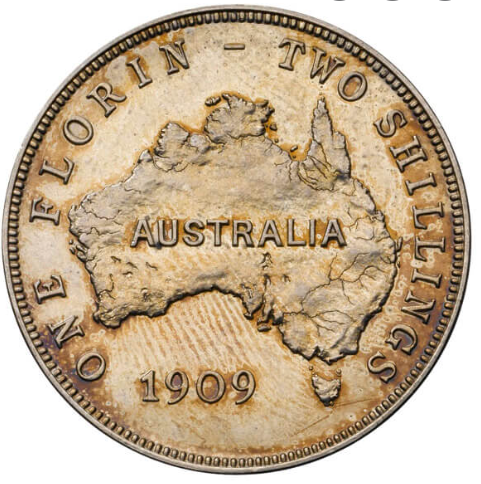
My solution is this:

The 1909 Florin was a pattern piece and was never put into circulation. It is a pity. For a while the 3d. 6d. 1/- and 2/- coins all featured the same coat of arms on them and the 1/2d. and 1d. were among the most boring coin designs in the history of the world. 

As an island nation, the coastline lends itself exceptionally well to being instantly identified. We have used stylised versions of this for "Made In Australia" marks, for the logos of various government agencies at times, and for the logo of years of import and celebrations. On top of this, the outline of Australia is sufficiently round enough that it already fits nicely on a coin. Possibly only France with l'hexagone is as fortunate as well are.

Admittedly we could just invent some national personification but who would it be? We could place our former Prime Ministers and Governors-General on the coins but why risk the permanent outrage? We could take a heraldic turn but the fact is that the One Dollar coin with its kangaroos, the Twenty Cent coin that manages to depict a platypus underwater, or the Ten Cent coin with its mysterious lyrebird, are already pretty close to some of the best coin designs ever. 

The coastline of Australia is apolitical which means that it isn't going to annoy anyone, it is ahistorical which means that how we feel about it in future isn't likely to change, and best of all it is instantly identifiable which means that everyone can look at it and know what it is for.

September 15, 2022

Horse 3069 - Eudaimonia - Element III - Justice

One of the things that Aristotle returns to again and again is the idea that the best sense of human flourishing happens when people live well. "Happiness" is not necessarily a virtue but a virtuous activity which one achieves by doing. Living well consists in doing things and not just being in a certain state or condition. Virtue is not a thing to be gained but a thing to be lived. I think it interesting that when he talks about Dikaios (δικαιος) we get less of a sense of the upright, righteous, and virtuous and more of those long and quiet activities that actually make reality of the virtues of the rational part of the soul. Dikaios sort of hints at the concept of truth but it is more complex than that.

I think that especially over the last 20 years and as embodied by Donald Trump, the idea of what is true has been deliberately degraded. In some respect this is because of the embracing of relativism where the rights of the individual are seen as the highest possible ideal and the consequence of that is that objective truth no longer counts for anything. What might be true for one person is now taken to be not true for someone else and the realms for which relativism is taking hold, are becoming every wider still and wider. To this end, we have turned away from the previous people and institutions which purported to hold out truth and science, the law, religion, and other institutions have all been degraded and ridiculed in public life.

I do not believe that relativism makes any sense if taken to its logical conclusions. Somewhere out there lies the end of absolute solipsism and unless the whole of reality is just a really convincing simulation, then I think that relativism which says that what's true for someone might not be true for someone else, can not possibly be rational or logical. Surely at some point there are some objective truths about the world which everyone has to agree upon. A quick survey of the great religions and the teachers who are credited with founding them, be they Moses or Mohammed, Jesus or Confucius, Buddha or Bahai, will very quickly show that they all arrive at the so-called "Golden Rule" at some point; which is 'do to others what you would have them do to you' or 'don't be a knave'. On that note, justice is seemingly universal in principle but still problematic.

Justice is one of those things that as individuals who are at the centre of our observable universe, know quite acutely if it has been violated. People will often be crying out for justice if they have suffered injury or loss. However, also due to that same fact that as individuals who are at the centre of our observable universe, we are less likely to want to extend justice when we are the party who has been guilty of violating it. 

On that latter point, apart from laws dealing with physical standardisation (such as voltage through a power plug, materials to be used in load bearing floors, how wide road lanes are) most of civil law and all of criminal law deals with either the equitable distribution of justice or what should happen if someone has violated the law.

Most people have a sense of when their person or property has been violated. The entire criminal justice system is about answering the question of what happens when someone's person or property has been violated. Likewise the civil and civic justice system, is about answering the question of what happens in situations where there are competing claims on property and/or the consequences of the making and breaking of contracts and covenants. The problem here should be almost self-evident. The courts as arbiters, can only act after the event when it comes to a violation of person and/or property and can only act while there are things under dispute that can not be arrived at through a process of independent conciliation. The idea of Dikaios (δικαιος) is more about asking the question of how do you live well, before you ever get to any point where a sense of justice is violated.

Dikaios would say that people need to be guided by a sense truth, reason, justice, and fairness, well before the point of failure. Dikaios would say that people should be just and fair when contending with difficult situations and that they would be guided by a sense of understanding of equitable and proper principles before any kind of decision is made or action is taken. This very much requires that any just replies to a situation, in keeping with truth or fact and any just claims, before any thing can go awry. Rather, that justice is practiced not as a method of keeping order but because it is the right thing to do.

Dikaios is not about merely acquiescing to fact. The problem with fact is that it is impersonal and makes exactly zero difference to whether a course of action is equitable. You can make logically correct and factually correct statements of absolute and undisputed fact but that doesn't mean that those statements are just. This is similar to the idea that just because something is legal to do, also does not make it just.

Consider the concept of slavery. Slavery is a thing. Slavery used to be legal. Some jurisdictions have even made directions at law to explain what is to be done about it and how it is to be legally treated. Those three statements are factually correct. Those three statements do nothing to address the underlying injustice of slavery and that people can be owned as chattel goods by someone else. Justice would demand and has demanded that slavery be ended in many jurisdictions. Dikaios would have demanded that the inequity of slavery never be started in the first place. 

More broadly, Dikaios is less concerned about justice and more concerned with the means of how things like fairness, objectivity, equality of opportunity, removal of poverty, and how freedom and liberty is embiggened. Again, as justice is more concerned with what happens when someone's person or property has been violated and is mostly only concerned after the fact, then even ideas concerning a perfectly just world do exactly diddly-squat in redressing actual existing inequality, unfairness, and inequity.

I suppose that at this juncture I should speak about the virtue of charity. Charity as it turns out is a rather poor method of actually providing for people's needs, much less paying for someone's dignity to be enlarged. If we take the entirety of the charitable sector of the economy as the measure, rather than just what people declare on their tax returns then the total amount of charitable giving equates to about 1.7% of GDP. If we then expand this to church donations then this expands all the way to about 2.1% of GDP. Just the Old Age Pension (which by the way we're trying to kick people off of) works out to be about 7% of GDP. If we were to remove that obligation from taxpayers then if all of the total charitable giving was directed to just looking after old people, then we'd very quickly realise that it is not even enough to maintain old people at their current mean status of lifestyle. That isn't to say that charity of itself is a bad thing. It's just that expecting charity is like ordering a few pizzas and trying to feed a football stadium full of people. Of itself it is a good thing, its just inadequate given the collective selfishness of human nature.

Dikaios is concerned with making sure that employers pay their workers a fair wage for doing work, instead of merely exploiting them for their labour. Dikaios would suggest that fair arrangements be made without the need for arbitration, not because of fear of reprisal and being taken to court but rather that it is the right thing to do.

Dikaios wants to know about equality of opportunity for not only things like health care, education, housing, but also ensuring that there isn't favouritism which goes into the provision of those things and the selection of who should be the beneficiaries of those things. 

Dikaios goes beyond social contract theory and that every single person has an equal right to basic liberties, and equal right to opportunities and an equal chance as other individuals of similar ability. Those things are taken as given. Dikaios is less concerned with the freedom and liberty of the individual it it comes as the expense of the freedom and liberty of others. This isn't just some Benthamian theory of maximum utility but something deeper that actually looks beyond the usefulness of a thing and looks at what is good and proper and what leads to people flourishing.

September 14, 2022

Horse 3068 - Fun > Power

Note:

I will be using the name 'Miata' for this car as the names Miata and MX-5 are used in various markets, even though in Australia it has never been called as such.

A common trope/meme/snowclone on the automotive parts of the interwebs is the acrostic poem:

Miata

Is

Always

The

Answer

This is because that invariably when any question is asked about what kind of car that people should get, Miata Is Always The Answer. I personally think that 2 people have a better answer.

While I will admit that Miata is a pretty good automotive answer to a lot of things, it isn't quite the answer to rain, cold, carrying big things like washing machines or roadside shopping, carting your lawnmower around, or taking a nap in. Nevertheless, it is a good answer to the question of fun.

A second trope/meme/snowclone on the interwebs is the suggestion that every car in the world, no matter how impractical the operation turns out to be, should have its engine swapped with a General Motors LS3 V8. Granted that the LS3 V8 is arguably one of the twelve apostles of engines (DFV, Kent, Jaguar V12, Ford Flathead V8, Hemi V8, K20A, RB26DET, M54, Cleveland 351, EJ257, LS3), it is still impractical to put into a Miata.

Sure, I like absurd amounts of power as much as the next revhead who has spend more time inhaling toxic solvents but still have enough sense to know that several hundreds of horsepowers in a car that small is a recipe for Instant Puree Miata d'Arbre. I am just sane enough to realise that wrapping a Miata around a tree because you have installed too much power, is not sensible.

So then, what if you could wrap just enough nonsense into the same package to still frighten you but not enough for God to put the Destroying Angel of Death on speed dial? The answer is not "LS3 all the things" but "LFX this thing".

I had the opportunity to drive this strange beast last week and I have to say, having driven the original which was already pretty nice, this one felt like it was the sort of this which the factory should have sold.

Firstly the what. The LFX is the 3.6L variant of the General Motors High Feature V6 engine. It was supposed to replace the previous applications that the 3800 Buick V6 was good for and it does a pretty good job at this by being more than 10kg lighter. 

LFX found its way into the VE and VF Commodore, Chevrolet Camaro and Cadillacs and turned sideways it also was put into the Chevrolet Impala and other east-west applications including the ZB Commodore where it then acquired the moniker of LGX. LFX V6 is a worthy successor to the venerable Buick 3800 V6 and I've seen enough of this engine to understand why. Most of the components like the cylinder heads, exhaust manifold, intake manifold, fuel injection system, intake valves, and fuel pump etc. are also improvements over the Buick 3800. LFX is a slightly smaller 60° V6, with 24-valves, at 3564cc and can run up to E85 fuel.

Thanks to the combined efforts of Joe Hockey, the IPA and the Liberal Party, General Motors (and Ford and Toyota) all left Australia; so this means that the price of a landed LFX crate motor has shot up inordinately. The entire dealer network which would have sold you an LFX crate motor, basically no longer exists.

If you are going to go that way and buy a virgin crate motor still in crate, then it's going to set you back at least $8500. However, if you go to a wrecker's yard and find a particularly beaten up Commodore, then a use LFX might cost you as little as $500.

From here the usual mate to the back of the engine is the Tremec-TR6060 gearbox and the Ford diff but having said that, the existing Miata gearbox and diff with happily work with LFX.

Weirdly, the engine mounts for the LFX and the Mazda L engine which were already here, are not vastly different from each other. Fortunately, this problem has already been solved that this ended up being a series of bolt-in parts for the owner. There are companies which will sell you the necessary parts for the replacement of one engine for the other. Again, mating the engine to the Tremec TR6060 box wasn't really that difficult and the issue with the diff was also pretty close to being all the shelf parts.

The biggest challenge was a packaging decision, where once installed the plastic engine cover nonsense which usually appears in the VF Commodore, doesn't fit under the bonnet in a Miata. That apparently meant taking to the cover with a saw and some sort of hot iron to smooth over the rough edges. It also meant that the lion badges disappeared.

What we have is a 3.6L V6 Miata which was already a nice handling car, paired with an engine which is vastly underrated. In this setup, it is good for 210 KillerWasps or 275 buff ponies. That's quite enough in a big car like a VE/VF Commodore but for a wee little car like a Miata that's more than enough for a particularly insane driver to run themselves through the Armco Mandolin and turn themselves into human chuck steak. 

I was only able to drive this car through Northern Beaches traffic, which also included a fun little section of expressway and I have to say that this really makes me question the kinds of people who pay tens of thousands of dollars for SUVs with Mercedes, Audi and BMW badges on them. It just seems silly to me to pay for AMG, SQ and M badges on glorified sprog buses when you could have just bought a cheaper wagon and one of these as a second car.

My friend who let me drive this (who is a client of ours) didn't want a Eurobus like everyone else in chambers; because he thought that it was a bit sad that the legal profession who has bucket loads of cash, only seems to want to buy boring things.

Miata Isn't Always The Answer but it is a pretty neat answer for the question that it's answering. My ears were telling me that this was the song of a Commodore but as we were scooting through traffic like a glowing uranium knife through margarine, this Miata with a dash of LFX insane hot sauce answers questions that you didn't even know you were asking. I would say that this was like having as much fun as a kid in a candy store except that this was instant diabetes. Driving an LFX Miata was like being Edmund in a land of Turkish Delight. While I was this, sat sitting in the passenger's seat was the owner (last week QC; this week KC), who seemed proud that someone else understood the crazy joy making abilities of his wee little baby. Money can not buy happiness but it certainly appears as though it can rent it.

There are two ways to do something. The right way and the dumb way. The existence of this car tells me that on occasion the dumb way can be the fun way.

September 13, 2022

Horse 3067 - Constitutional Survey - VI(i)

Chapter II. The Executive Government.

<><><><><>

61. Executive power

The executive power of the Commonwealth is vested in the Queen and is exercisable by the Governor-General as the Queen's representative, and extends to the execution and maintenance of this Constitution, and of the laws of the Commonwealth.

<>

This section is both terrifying in its scope and horrifying in its lack of definition.

The unspoken terror in the Constitution is that the executive power of the Commonwealth is vested in the King and is exercisable by the Governor-General. It is not parliament who actually holds the power of the executive; it is not the cabinet which actually holds the power of the executive; it is the King, being represented by the Governor-General.

This terror and horror is what lies at the heart of the whole argument of republicans. Their argument is not that Australia should "grow up" (which is a stupid turn of phrase in the light that the Commonwealth has existed for 121 years) but rather that the executive power of the Commonwealth ultimately lies with someone 10,000 miles away.

I would argue that it is precisely this terror and horror which is why Australia has the six oldest continuously operating parliaments in the world. Even the mother of all parliaments at Westminster when faced with the Blitz, closed parliament and appointed a War Cabinet which meant shutting the doors. Australia which is on the other side of the world and far away from everything, by historical accident, kept its parliaments operating right through the war.

Under most circumstances, the Governor-General is basically an office with a rubber stamp. Contained within that rubber stamp is vested the executive power of the Commonwealth. I would rather that the person in the office is terrified and horrified of the power they hold, to the point where they won't use it, as opposed to not being terrified and horrified of the power they hold which emboldens them to want to use it. I would rather be ruled by incompetence that will not act, than competence that does.

<><><><><>

62. Federal Executive Council

There shall be a Federal Executive Council to advise the Governor-General in the government of the Commonwealth, and the members of the Council shall be chosen and summoned by the Governor-General and sworn as Executive Councillors, and shall hold office during his pleasure.

<>

Section 62 basically says that there will be a cabinet. My guess as to the reason of why this is in here at all is that this is to remind the parliament that the power to select the Cabinet ultimately rests with the Governor-General and not the Prime Minister of the day. 

<><><><><>

63. Provisions referring to Governor-General

The provisions of this Constitution referring to the Governor-General in Council shall be construed as referring to the Governor-General acting with the advice of the Federal Executive Council.

<>

I am yet to determine what exactly Section 63 is supposed to mean. My guess that is that in theory it supposed to mean that the Governor-General isn't supposed to act without the express advice of the Federal Executive Council but given that the several powers of the ministries are usually given to the relevant cabinet minister, there is not much which the Governor-General could in fact do unilaterally. 

<><><><><>

64. Ministers of State

The Governor-General may appoint officers to administer such departments of State of the Commonwealth as the Governor-General in Council may establish.

Such officers shall hold office during the pleasure of the Governor-General. They shall be members of the Federal Executive Council, and shall be the Queen's Ministers of State for the Commonwealth.

Ministers to sit in Parliament

After the first general election no Minister of State shall hold office for a longer period than three months unless he is or becomes a senator or a member of the House of Representatives.

<>

Section 64 of the Constitution was brought into sharp focus this year after it came to light that the former Prime Minister Scott Morrison convinced the Governor-General David Hurley to appoint him to five extra cabinet positions. It should be pointed out that under Section 64, the Governor-General had complete power to do this; so the idea that there was a Constitutional Crisis is bunk. The Constitution is not in crisis. It was working perfectly. Politics on the other, was doing what politics likes to do and was organising a scandal.

The first clause says that the Governor-General can establish any number of departments of State that they wish; without any kind of reference to rhyme, reason, logic, or reality. The Governor-General could appoint a Minister for Bananas and Bacon, a Minister for Truth, a Minister for Women, a Minister for Sound, and a a Minister for the 1920s if they wanted to. The Federal Executive Council has literally no limits or directions on its makeup or oversight whatsoever.

The Governor-General was perfectly within his power to appoint Mr Morrison to five cabinet posts, or even all of them. It is actually possible under Section 64 for one person to hold every single cabinet post. The closest that we ever got to such a situation was in 1972 when for a period of two weeks, Gough Whitlam held 13 cabinet posts and Lance Barnard held the remaining 15.

The first two clauses make absolutely no mention of who can be a Minister of State whatsoever. Not only is there zero mention of whether or not they can or need to be in either the House of Representatives or Senate but there is also zero mention of whether if they need to be in either the House of Representatives.

When Harold Holt disappeared in 1966, presumably drowned and presumably dead, the Governor-General Paul Hasluck appointed John Gorton as the next Prime Minister. At the time, Gorton was a Senator for Victoria; there was nothing wrong with this. Gorton could have continued the premiership from the Senate and this would have been fine. There have been plenty and still are Ministers in the Senate and nobody even so much as bats an eyelid at this fact. Gorton resigned his Senate seat and for 21 days wasn't even a Member of Parliament. The reason that he resigned his Senate seat was to contest the House of Representatives seat of Kooyong but even that has less to do with convention and more to do with him wanting to be in the House of Representatives because that is where Appropriation Bills (ie the Budget) originates. Convention lasts exactly as long as convention lasts and is only as relevant as it is relevant.

If the Governor-General wanted to appoint a temporary Minister of State during a time of war, who was say a foreign military General, then that would be fine. If the Governor-General wanted to appoint a Minister of State which related to some kind of crisis, then that would be fine. Even if we assume that the Governor-General was a madman and a knave and wanted to appoint a hostile eejit to the position of Minister of State, then that would be fine. 

Section 64 is so open that the Governor-General could appoint Vladimir Putin, Jacinda Ardern, Justin Bieber, Fat Cat, the planet Mars, Rupert Murdoch, Rupert Grinch, Johnathon Thurston, a block of cheese, quite literally anyone and anything to any Minister of State, including the Prime Ministership,  during the pleasure of the Governor-General.

The only stipulation with regards who can be a Minister of State is that they can not hold office for a longer period than three months unless they become a Senator or a Member of the House of Representatives. Other provisions to do with citizenship such as Section 44 with come into play under such circumstances. Taken to the absolute extreme of insanity, the Governor-General could appoint an open enemy of the Commonwealth for 89 days (because this is less than three months), then withdraw their pleasure; then reappoint that open enemy of the Commonwealth for another 89 days, ad nausuem. The actual chance of this is ridiculously close to but not zero.

This is why the appointment of Scott Morrison to five cabinet posts is so scandalous. It isn't that the Governor-General couldn't appoint him to multiple cabinet posts. It isn't that the Governor-General didn't have the power appoint him to cabinet posts. Section 64 gives the Governor-General the power to make Ministers and unmake Minister pretty much on a whim and without reference to reality. The scandal is that unlike Gough Whitham being Minister for Everything and Lance Barnard being Minister for Everything Else, or John Gorton being Prime Minister from the Senate and then Prime Minister with no seat in parliament at all, this was done in secret. Australians are pretty accepting of corruption, racism, knavery, pork-barrelling, crudeness, rudeness, drunkenness, adultery and seemingly sexual harassment and rape within the walls of parliament but when it comes to not telling us, we chuck a nana (especially the Senators from Queensland).

<><><><><>

65. Number of Ministers

Until the Parliament otherwise provides, the Ministers of State shall not exceed seven in number, and shall hold such offices as the Parliament prescribes, or, in the absence of provision, as the Governor-General directs.

<>

Even before the first Parliament sat, the Barton Ministry had 11 Minister. This then makes me wonder what the point of Section 65 was. I have read through the debates in the Constitutional Conventions and apart from George Reid mentioning the number in passing, I do not know why this ever existed. 

Perhaps this was for ceremonial purposes, where the initial photographs would be used in the official propaganda. Australia is a relatively new country and was created after the invention of photography. Perhaps the intent was to show that from the outset, Australia was a real country. Perhaps this was to prove to ourselves that Australia was a real country and not just a confederation of six unfriendly powers. Perhaps, perhaps, perhaps.

<><><><><>

September 10, 2022

Horse 3066 - The Impatient Republic of Australia

After Horse went to press yesterday, the news shot around the world that Queen Elizabeth II died peacefully at the age of 96. The nonagenarian monarch was one the throne for 69 years; having seen 16 Prime Ministers as Queen, and having lived through two world wars, one hot and one cold. Her son Charles III will ascend the throne and oversee a Britain which has decided to play the Australian game of the Thirsty Knife with its Prime Ministers, as a result of brexitatiously brexiting from the European Union and is now left shivering on its own brexitatious bed of nails.

The vast majority of Australians have only ever seen one monarch, some two, some four, though there are a very few number of people who have seen as many as six. Even before the Queen has been laid in state, there have already been discussions about Australia becoming a republic. It is almost as if the republicans have been waiting for this day just to unleash all kinds of agitation. I think that Australia becoming republic is inevitable but mostly because we have a lot of people who after looking at all the other nations around, have decided that we want that. Australia will sleepwalk towards becoming a republic because we simply do not have the imagination to consider what would happen if this came to be.

Advocates for a republic want to wrap the argument in optimism by saying that it is time that we "grew up" and left the monarchy as though it was the same as moving out of home and despite the fact that Australia hasn't really been interferred with by Britain since about 1941. The argument is wrapped around not much more than a change of symbols; seemingly without much consideration of what mechanically happens afterwards.

For my part, I am not really a monarchist. Granted that I do see the story of monarchy as a line of succession which goes well beyond Alfred the Great but that story also happens to include wars, genocides, slavery, exploitation of people and resources; which would have happened with a monarchy or not. The outrages of history when the abuse of greatness disjoins remorse from power, happens if the person at the top is a King, Emperor, Kaiser, Fuhrer, Lord Protector, Captain, General, Pope, Chairman, or President. I don't think that it really makes that much of a difference whether the King is on the back of the coins or not, or if it is Marianne, or Lady Liberty, or a shield thing, or a fasces, or anything else. 

The suggestion for the mechanics of becoming a republic is usually that we'd replace the Governor-General with a President and that nothing will change and that it will all be lovely. Change the name of the Office; change the coins, change the flag; job done. Nope. Politics is never ever that simple and the danger lurking behind the curtain is that where the is an office of power, there is always someone who wants that office. The people who want the offices of power, are almost always the people who are the most ill-advised to have them.

The biggest argument against becoming a republic is in fact the Appointments Scandal with Governor-General Peter Hurley and Prime Minister Scott Morrison. If we run the clock back to 1999, and the Republic of Australia became a thing, then the whole matrix of circumstances changes.

The Australian people rejected the 1999 Republic model, not because they were particularly loyal to the Crown but because polling at the time suggested that the model was wrong. The Referendum Convention although well meaning, was always looking inwards and never really saw the obvious fact that the Australian people have a very strong will and want to elect the head-of-state. The 1999 Republic model failed because the people of Australia want to choose their Grand Poohbah.

As we learned repeatedly throughout the premiership of John Howard and the initial periods of premiership of Julia Gillard, Malcolm Turnbull, and Scott Morrison, the word that gets thrown about is 'mandate'. John Howard frequently claimed a mandate to do horrible things, immediately after an election; based upon the political philosophical standpoint that an election enables the person who has just been handed the keys of office, the power to act. Conversely, incoming Prime Minister are always berated and held to ridicule with the statement that they have no mandate to act because they weren't elected.

If the Republic of Australia was a thing, then the appointments of Scott Morrison to the Ministries of Everything, would have perhaps still been scandalous but immediately justified by the fact that the Grand Poobah was elected to the position which gave him the commissions. As it stands, and as it should have stood, not many people really know what the powers of the Governor-General are and that's a brilliant thing because they are usually loathe to use them. If the Republic of Australia was a thing, then the appointments of Scott Morrison to the Ministries of Everything, was not only just but mandated.

Can you imagine what might have be wrought if Peter Dutton or Pauline Hanson, had been President? If the office of the President is an elected role, we have to absolutely assume that not only will knaves want the role but that knaves will get the role. Australia, which has been crabwalking away from Britain for 122 years, has spent the last 77 years crabwalking towards the United States culturally. We have sent John Howard, Kevin Rudd, Tony Abbott, Scott Morrison, to the tob job recently; we must assume that electing the President immediately opens the job to mandated collusion.

As for the Queen herself, she was someone's mum, grandma, great-grandma, and she got given the job because of circumstances set into motion while she was still a teenager. To be in a job for 69 years is hard. To have been living in a fishbowl for 69 years is even harder. Probably her only night of freedom ever, was on one strange night in 1945 when for a while, unbridled joy broke out. If nothing else, 96 was a decent innings and even your opponents will clap you as you make the long walk back to the pavilion.

As for Australia, the world has changed and already we have people who want change the system further; without regard for the consequences which will unfold. 

The Queen is dead. Long live the King. Long may we say 'God Save the King" because nothing will save us from the knaves who we absolutely will install.

September 09, 2022

Horse 3065 - No, There Doesn't Need To Be A General Election

Note: This post is by means of clarification for a forum.

With the resignation of Boris Johnson as Prime Minister and First Lord of the Treasury of the United Kingdom, members of the Conservative and Unionist Party have elected Liz Truss as leader of the party and then by default as the person suggested to the monarch, to be selected as the next Prime Minister. 

As Liz Truss has not been the leader of the party during a general election, there are sections of both the Twitterati and the Commentariat who have vociferously made their opinions know that she should not have a mandate to govern and that a general election should be held as quickly as possible. When I said "no" I was immediately accused of either being a tory apologist or not understanding how the system works; when that answer doesn't even remotely resemble truth.

Yes, I am Australian. Yes, I do not live in the United Kingdom. Be that as it may, I live in New South Wales which has a Westminster style parliament and in the Commonwealth of Australia which also has a Westminster style parliament. The difference between our Westminster style parliaments and the Westminster style parliament as Westminster is that the Upper Houses (the Legislative Council and the Senate) actually do have the power to block supply; where as the House of Lords does not because of the provisions of the Parliament Act 1911. Very clearly if I live in two jurisdictions with Westminster style parliaments, then I have at least some inkling of their mechanics; so let's set those objections to rest.

In general (and I use even that term advisedly), government is formed from the majority of members on the floor of the lower house because that is usually where Appropriation Bills upon the treasury, Money Bills which have to do with both spending and taxation, and legislation generally originates. The very short punchline is that whoever controls the purse of the nation, controls government.

Notice how I haven't said the word "party" in that explanation. The whole idea that there might be formal parties as opposed to mere factions of MPs who might come together and fly apart all the time, is a relatively recent invention. We can generally credit the invention of formal political parties with the great winds of reform in the early 19th century. Political parties start to become useful only after the franchise was expanded to include people who were not male landowners.

The Prime Minister/Premier in all Westminster style parliaments is selected by the Monarch/Governor-General/Governor because they are either the formal leader of the majority of members or the leader of a useful and likely to be stable majority of members who can control the public purse. In a party system, that almost is always the leader of the largest political party; which itself could very well be in coalition with other parties and members. 

Even then, the leader of that party might not actually be in the lower house but in the upper house. There have been Premiers and Prime Ministers in the past who have come from upper houses, including the House of Lords. 

The situation as it stands is that the Conservative and Unionist Party have a majority of members on the floor of the House of Commons. As the House of Lords has no power to knock back Appropriation Bills, then then Conservatives are the party who is invited to form government. As Liz Truss has now been elected as the leader of the Conservatives, it is her name which has been put forward as the suggestion to the Queen as to whom should be the Prime Minister. As the Queen has now accepted that suggestion and formally invited Liz Truss to be the Prime Minister and First Lord of the Treasury of the United Kingdom, she has taken up the offer.

I absolutely and always reject the notion that any kind of mandate to do anything either does or does not exist. I also reject the notion that there should be a general election just because the leadership of a political party changes. 

At precisely no point at all, did the Conservative majority ever look like it was going to fall apart. Even during the darkest days of the Johnsonian shenaninganry, when motions of no confidence were levelled, was it ever the case that the Conservatives would concede or relinquish the power of the public purse. Liz Truss was always a Member of Parliament and a sitting member of the stable majority of members who can control the public purse she has just as much right to be the Prime Minister as any of them. 

What does change is the hotness of the tempers of the public, who quite rightly are fed up to the back teeth with being fed indigestible right-wing formula and want to spit it out. That is the overlay of politics at work; which the impartial Westminster style parliament doesn't even need to care about. The Parliament at Westminster has been in its current state since 1660. It cares not for the hotness of the tempers of the public or for the nobility or knavery of the members who walk within its walls. To be perfectly honest, it doesn't care who the Prime Minister is or even if there needs to be one. The only thing that matters is who controls the public purse and that person is Liz Truss at the moment; and for that reason, she has the job of trying to lead the business of the parliament.

I hope she does well as indeed I hope that all who lead governments do well. The public needs them to.

September 08, 2022

Horse 3064 - Eudaimonia - Element II - Nobility

What a strange world we live in. As we spend the opening of the third millennium running from side to side like brainless sheep, not only have we decided to abandon all notions of objective truth but the second thing to fall by the wayside it that we have decided to abandon any and all sense of obligation that we might have toward one another. 

As the centre of the observable universe is 19mm behind people's corners, we are actively encouraged to consider that that we are the most important thing in the universe. As a result of deciding that we are the most important thing in the universe, we are actively encouraged by the media to demand our rights (whatever they happen to be at the time) and to consider that any and all obligations that we might have to each other, are secondary to whatever our heart currently desires now.

The problem with having this as a mindset and a permanent mode of operation, is that the longer maturing products of the soul such as patience, calm, peacefulness, and nobility, never grow any more. You can not grow patience when everything has to be demanded now. You can not grow calm or peacefulness in an atmosphere of perpetual yelling. You can not grow nobility in a ground that constantly changes.

I don't think that we tend to understand the idea of what being noble is very well, any more. Certainly the context which I am likely to find it is in referring to noble gases and noble metals; in both cases they refer to things which are unreactive, untarnishable, and unchanging.

When looking at the element of σεμνός (Semnos), we get to look at a concept which is difficult to nail down. Semnos from Greek has been alternatively described in English as the idea of being revered, august, holy, grave, noble. Those things might be close but still do not quite get there.

On the face of it, someone who is noble has cultivated the quiet personal qualities that people admire and then actively decides to behave the way an admirable person would.

We can assume that a noble person is responsible. In the first instance that means that they're going to take ownership for their actions and if they do happen to have made any mistakes, they will not try and shift the blame on anyone else and own up to what they did.

However, in order to take ownership for their actions, that implies that they already had a sense of duty to own them in the first place. Being responsible requires someone to have taken ownership of the things they do and the commitments they get into and then putting that into action. To some degree that also implies that in fulfilling that duty, they will act independently by making decisions without necessarily needed someone else’s approval in mind.

The logical end point of being responsible is that someone knows what their objectives are and then works towards them. Life is frequently stupid, frustrating, obnoxious, and disappointing; and that means not running away when things get hard. Having an objective and sticking it out, means doing the best they can to fulfill their duties and persevering through the stupid, frustrating, obnoxious, and disappointing things that that life throws at them to reach the goals they’ve set for themselves.

However being responsible still doesn't actually arrive at the description of being noble either. One can very easily argue that that singlemindedness is also a common trait with sociopaths who with tread on whoever the need to, to get their objectives done. The abuse of greatness is when it disjoins power from remorse. The abuse of responsibility is when it disjoins power from kindness.

I think that few would argue against one of the most defining traits of a noble person is kindness. I would hope that most of the time, the bare minimum standard of behaviour is politeness but kindness is that extra step which recognises that the person standing in front of us, is a human who is is just as equally complex as we are. Kindness includes being compassionate and forgiving, perhaps behaving with sympathy and empathy, and knowing how to understand other people and care for other people without the intent of selfish gain as a result.

Kindness and responsibility together, still don't actually at the concept of Semnos. Both Aristotle and Plato use the word in relation to someone being noble in battle; and it is really really hard to be kind to someone if you're trying to hack off their head with a sword. Being noble in battle looks at the enemy, who probably also has a mutual obligation to want to kill you and in fact a duty to do so and then accepting the fact that the duty still exists. Semnos also borders the concept of courage.

Courage is not the absence of fear. Fear is a perfectly reasonable reaction and emotion that a thing or a person has the power to harm or kill you. It is perfectly fine to be fearful. Courage means staring into the face of the scary thing a realising that you have to do it anyway. Fearlessness isn't courage either. Fearlessness might indicate recklessness or a lack of sense in the face of a scary thing.

Courage is not letting one's emotions dictate the circumstance but rather courage demands strength on character because it comes from the place which says that better judgement says that the action or thing worth doing is more important.

On that note, better judgement comes from a place of wisdom. It should be noted that someone who is noble can be intelligent but that intelligence is not congruous to being wise. Wisdom is the almost always learned quality which is gained through experience; which admits that it is impossible to always be right and that there are always things to be learnt from the environment, the circumstances, the people, and the current facts; all of which might be subject to change.

Being noble takes responsibility, kindness, courage, and then transforms them into a unified moral production. A moral person might know the difference between right and wrong and even practice it but being noble takes one's moral values and then does hard things with them. It might require fighting against the injustices of the world and standing firm and in the face of things, for what is right. It might not even be particularly convenient or even the right thing to do in the moment but the right thing to do in the long run. Invariably there aren't any rewards for being noble; it just that the practices of virtue are things which should be done as the own end.

September 07, 2022

Horse 3063 - Constitutional Survey - V(iv)

58. Royal assent to Bills

When a proposed law passed by both Houses of the Parliament is presented to the Governor-General for the Queen's assent, he shall declare, according to his discretion, but subject to this Constitution, that he assents in the Queen's name, or that he withholds assent, or that he reserves the law for the Queen's pleasure.

Recommendations by Governor-General

The Governor-General may return to the house in which it originated any proposed law so presented to him, and may transmit therewith any amendments which he may recommend, and the Houses may deal with the recommendation.

<>

In theory the Governor-General acts as that very last check on the power of the parliament. In practice, this is never exercised and I can not honestly think of or find a case in Australia where the Governor-General has withheld assent.

Truth be told, if the Governor-General were to withhold assent to a proposed law passed by both Houses of the Parliament, then there would be a public outcry. I think that there would be some very very hard stares indeed and that the Governor-General would find themselves out on the streets of Canberra even quicker than Jack Robinson would think of his own name, much less say it.

To take this point even further, Governors-General tend to be either ex-military officers, ex-lawyers or judges, and ex-Premiers. Very rarely (probably never) is a Governor-General installed because they are going to be an independent expert of the law. They tend to be very very compliant; to the point of caving into any and all demands that the Prime Minister of the day has. This will become important later in this series.

<><><><><>

59. Disallowance by the Queen

The Queen may disallow any law within one year from the Governor-General's assent, and such disallowance on being made known by the Governor-General by speech or message to each of the Houses of the Parliament, or by Proclamation, shall annul the law from the day when the disallowance is so made known.

<>

Again, I can not think of an instance when a law where the monarch has disallowed any law which has been given the Governor-General's assent. Section 59 says that such a disallowance were it to occur, would have to be presented by speech or message to each of the Houses of the Parliament which presumably is by personal attendance to the Parliament (which would not have been an easy thing to do in 1901), or by Proclamation. Both of these would have been thunderously significant had they ever occurred.

<><><><><>

60. Signification of Queen's pleasure on Bills reserved

A proposed law reserved for the Queen's pleasure shall not have any force unless and until within two years from the day on which it was presented to the Governor-General for the Queen's assent the Governor-General makes known, by speech or message to each of the Houses of the Parliament, or by Proclamation, that it has received the Queen's assent.

<>

If I read this correctly, a bill which has been set aside, begins a countdown clock or two years which if it is given the monarch's assent, then becomes law. I suspect that in the days of steamship travel, that they were counting on a very long process for a bill to be passed. 

If it takes six weeks to get to Britain, then time from the bill to pass from the ship to the Privy Council, then time for the Law Lords to ponder, pontificate and prance about like preening prize ponies, then time for the Privy Council to explain the significance of the bill to the monarch and why it had to be set aside, then time for the signed bill which has been given Royal Assent to go from Britain to Australia, then it might take several months. The whole machinery of parliaments can move glacially if given the chance and Section 60 anticipates that glacial speed. Let's not be too hasty here. 

<><><><><>

These three sections are really the last proper vestiges of empire. In practice they do not get triggered and sit around dormant like Latin textbooks in a fish and chip shop. They might get picked up and even looked at occasionally but they don't really have very much to to with the price of fish. 

In practice Australia has been independent for a very long time and given that on some issues such as voting, or the ability of upper houses to block supply, or the singular problem of Federation itself, Britain was either falling way behind or had no idea how to address these things, then Sections 58, 59, and 60, are not the magical boogeyman trump card that republicans think that they are. 

And yet, I like the idea that if the Governor-General was so horrendously horrible and heinous, that the monarch could cry 'havoc' and let slip the cerberus of legislation.

September 05, 2022

Horse 3062 - Eudaimonia - Element I - Truth

I could be wrong but one of the things that I think that we have lost especially over the past ten years or so, is any kind of political notion of Eudaimonia. It used to be for a while that have witnessed and participated in the worst kinds of horrors that mankind inflicted on itself, we as a world were forced to take a good hard look at ourselves and quite rightly be very very scared of the human condition.

At the centre of human nature, I think that it is self-evident that the centre of the universe is ourselves. The centre of the observable universe is always from the observer's standpoint and because we can see no other, that invariably must mean that selfishness is the default position.

The outworking of that standpoint, in the earlier part of last century resulted in the destruction of 100 million people in two bouts of global unpleasantness; culminating in the literal vapourisation of people by the means of atomic extinction device, not once but twice. 

In the wake of the second bout of unpleasantness, a short period of trying to rebuild the world in a spirit of Eudaimonia took hold. Suddenly, the old Aristotlean idea of Eudaimonia or the state or condition of 'good spirit' ('eu' good + 'daimon' tutelary deity) generally comes out as either 'happiness' or perhaps 'welfare'. In Aristotle's Nicomachean Ethics, eudaimonia is seen as the the highest good for humans and that living a 'good' life and living 'well' is the highest purpose (even though philosophy generally likes to argue longly and loudly about what kind of live being lead and how it is lead, counts as living well).

I would like to posit that there are several elements which hint at what might be taken to living a good life and that all of these can be examined and more importantly, practiced for their own sake. I think that there would be few people who disagree about the value of these things.

Eudaimonia - Element I - Truth.

Aristotle likes to use the word Aletheia; which is a-lethe or 'without concealment'. Truth is that which can be proven, which is self-evident, which can be demonstrated, or which is factual about the nature of reality. Likewise, Alethiology as the study of truth, is different to epistemology which is concerned with the study of knowledge. Granted that there is a semantic difference but it must be said that what is true is a far narrower field than what can be known and how it is known.

Generally speaking, truth is nominally coherent. That is, the facts which go together to make up a true statement or a truth in itself, must all be integrated into something which is at least logical. Admittedly as small and limited beings, we are not actually in possession of all facts and so in a lot of cases, the best fit or explanation which reconciles all known facts is more likely to describe a truth.

I suppose that it might be possible to construct a truth from things which are incoherent but I fail to see how that works by definition. Usually incoherence and being illogical go together. On the face of it, proposing an argument from incoherence, validates it and that doesn't hold up internally.

One of the things which helps if you are trying to establish something as true, is how many people will consent to it. Now obviously just because people agree to a thing doesn't make a thing true, such as saying that the earth is flat when it just isn't, but some things must depend upon the consent of an individual to establishing whether or not a thing is true. 

A thing can be taken to be true if when a series of arguments and statements follow each other in a way in strict consistency. If P=Q and Q=R then it can be taken that P=R. This kind of logic however, falls over if the premises require an a priori standpoint or another test to prove any of the elements. If a thing is able to demonstrate consistency with the facts it considers, then it follows that all possible facts must also be able to demonstrate that same consistency in order to be considered as truth; regardless of how they might affect the theory. A lot of science is based on the principle of trying to look for something to break the system because once broken, a thing does not hold up to being true any more.

Having said that, things might very well be true if they appear to contradict each other but are not necessarily related. The real value of a proof makes itself known which it can reconcile seemingly disparate and unconnected and possibly contradictory facts into a coherent and cohesive whole.

In general if things are cohesive, consistent and people will consent to them, then not only do you get closer to establishing what is true but you also get closer to establishing harmony and peace. Most people will agree that it is not a good idea to murder people, to use violence against people, or to steal from them, and if all of these things are true, then avoiding these things produces the collective good of peace and harmony. That which is peaceful and in harmony, gets closer to what we might call 'good'. 

Especially in the realm of politics, the amount of disharmony and disunity which has erupted, has been less to do with merely people yelling at each other but the abandonment of truth and the repeated propagation of lies. It does not help that news outlets which may once have been the big gatekeepers of collective truth, have decided to disseminate lies in the name of profits. Moreover, the internet which has the ability to connect anyone to anything that they choose to select in their own personal nest of statements, doesn't really do a good job of demarcating the sacred and the silly and fact from fiction. Whereas once in a newspaper the physical sections of the paper kept those things separate, today they are paraded along side each other. Worse, social media which makes no judgement on the value of anything, parades everything in one giant doomscroll. 

Science and Religion and Art all in their own way teach us something about the nature of reality, about the nature of the human condition, and about the nature of ourselves and how we fit into it. It is worth thinking about what it is true, why it is true, whether or not that truth can be broken, or whether or not it can be fashioned into something which is better. Until we've repaid for the dreams we've bought with our lies, we'll be cast away alone under stormy skies.

"In an age of universal deceit, telling the truth becomes a revolutionary act."

September 03, 2022

Horse 3061 - Stage 3 Tax Cuts And The Marginal Utility Of Mayonnaise

https://www.abc.net.au/news/2022-05-11/stage-3-tax-cuts-middle-income-earners-go-backwards-inflation/101053322

Part of stage 3, the part that cuts the rate applying to incomes over $45,000 from 32.5 cents in the dollar to 30 cents, will benefit most taxpayers. The bigger part extends that low rate all the way up to $200,000, abolishing an entire rung of the tax ladder paid by the highest earners. For those very high earners, the part of their income that was taxed at 37 cents will be taxed at 30, as will part of the rest that was taxed at 45 cents.

A politician, on a base salary of $211,250, will get a tax cut of $9,075. A registered nurse on $72,235 will get a tax cut of $681 according to calculations prepared by the Australia Institute. More broadly, a typical middle earner can expect $250 a year, whereas a typical earner in the top fifth can expect $4,230 according to a separate analysis by the parliamentary budget office.

The fate of the middle earner will be made worse by the loss of the $1,000+ middle income tax offset which wasn't extended in this year's budget, sending the middle earner backwards.

The typical female earner will go backwards too after the loss of the offset, getting half as much as the typical (higher earning) male, according to the budget office.

- Peter Martin, ABC News, 11th May 2022

If there is one common trait among every single person in existence, it is that the centre of their universe is between 19mm and 21mm behind their corneas. As a consequence, very few people bother to or even dare to imagine the world complexly, and from any other standpoint apart from their own. I think that it's reasonably fair to say that the realms of religion and economics both recognise the central plank of human nature that people have an almost unlimited propensity for selfishness. 

You can apply this to the question of what people are willing to accept as truth. Right through school, swathes of people can't be bothered to learn anything because learning is hard work. When it comes to the 

formation of opinions to do with deciding policy, people again can not be bothered to bother to learn basic concepts in science, economics, arts, literature; precisely because those things might interfere with and upset their pre-formed demands to be selfish. People's unlimited propensity for selfishness is likely the root cause of all of the vices and outworkings of those vices such as obesity, domestic violence, racism, sexism, et cetera ad nauseum. I am still yet to be convinced otherwise.

You can apply this to the whole realm of politics, from anything from education to health policies, to wages policies and taxation. The kinds of people who in the days long gone would have owned other people as chattel goods, now do not want to pay wages, or for the things which will benefit society as a whole. This has been evidenced by not only the fact that people have only voted for nominally leftist government for 25% of the past quarter century but also in the current and vociferous opposition to the current government's semi-wish to abandon the so-called "Stage 3" tax cuts.

Income tax is actually a tax on the net increase that someone has made over a calendar year. Income Tax Assessment and the 1936 and 1997 acts therein, allow for people and businesses to make deductions from the overall amount being assessed for taxation. The tax rates are then progressively applied; so that the last dollar is taxed at a higher rate than the first one; usually at various taxation brackets. One of the common fallacies that you hear is that when someone moves up into a higher tax bracket, they are worse off. This is obvious rubbish as it is only the very last few dollars which are being assessed at the higher rate; the rest of their income is still being assessed at exactly the same rates as before.

What's lost in this narrative being pushed by richer selfish people, is that it is actually prudent to tax that last dollar at a higher rate of tax because the utility of that last dollar tends to decrease as incomes increase. 

The Utility of a thing is the usefulness of a thing; which is measured or imagined to be measured in theoretical units call 'utils'. Utility generally refers to the amount of enjoyment, usefulness or advantage that a thing confers upon a person.

When we refer to the marginal utility of a thing, we are looking at the amount of enjoyment, usefulness or advantage that the very last slice of a thing confers. If we take an infinitely small slice of a thing, then we can use calculus to work out what the point marginal utility of a thing is. However, while I might derive enjoyment from doing calculus, I am pretty sure that you do not. I am sure that my average enjoyment of doing maths is far more than yours; so I shall explain this concept not with maths by mayonnaise.

Suppose that we have a very small economy, where the distribution of mayonnaise determines how wealthy our citizens are. The citizens of our Kingdom Of The Kitchen are Alice, Bob and Charlie (A, B, C). Alice has 1 jar of mayonnaise. Bob has five jars of mayonnaise. Charlie has 50 jars of mayonnaise.

We can determine their marginal rates of utility by making them eat their mayonnaise. Even if you have unlimited mayonnaise, there is always some point where it is simply unpalatable to keep on wolfing down the stuff. Nobody in the world needs to eat that much mayonnaise. Probably most people will enjoy 1 or 2 teaspoons but by about 10 teaspoons of mayonnaise, it gets pretty horky borky pretty quickly.


You put your teaspoon in, you pull your teaspoon out.

You put your teaspoon in, and you have a little snack.

You keep on eating mayonnaise until you chuck,

And that's what it's all about.

Whoa horky borky borky!

Whoa horky borky borky!

Whoa horky borky borky!

That's what marginal utility is all about.

In general, the marginal utility of a thing tends to go upwards to a point and then drops off after maximum utility/usefulness/happiness has been achieved. At some point, you simply can not eat that much mayonnaise. 

If we were to enact some kind of taxation policy in our mayonnaise based economy, we can compare different kinds of policy mixes.

With a solitary stationary standing statutory rate, we can compare a taxation demand of 1 jar of mayonnaise. Alice loses all of her mayonnaise. Bob loses 20% of his mayonnaise. Charlie loses 2% of his mayonnaise. The average rate of taxation is regressive in this case as the actual burden of taxation falls most heavily on Alice.

With a flat rate of taxation at 20%, Alice loses 0.2 of a jar, Bob still loses 20% which is 20% of his mayonnaise, and Charlie loses 10 jars. 

With some kind of progressive rate of taxation, Alice who has less mayonnaise will have less of her mayonnaise demanded as a percentage than Bob, who will also have less of his mayonnaise demanded as a percentage than Charlie.

The thing is though, that it makes sense to impose progressive rates of taxation precisely because the marginal utility of mayonnaise decreases with each individual jar beyond a point. You can test this my making them eat the mayonnaise. Alice might very well be able to eat 20% of a jar of mayonnaise. Bob would likely start to protest if you made him eat a whole jar. Unless Charlie is some kind of mayonnaise freak, there is no sensible set of circumstances under which he would eat anymore than about a jar and a half of mayonnaise. 

Alice might be taxed at zero mayonnaise. Bob might be taxed at 1 jar of mayonnaise. Even if Charlie is taxed at the rate of 10 jars of mayonnaise, there is still no sensible set of circumstances which suggests that he is going to be short of the stuff as he still has 40 jars.

So it is with money. 

Mayonnaise is subject to the same sorts of marginal utility as mustard, chocolate, houses, knives, chainsaws, poison ivy, cars, and money are. If we substitute our jars of mayonnaise with say $40,000, then Alice has $40,000, Bob has $200,000 and Charlie has $2,000,000.

If we impose a solitary stationary standing statutory rate, then the burden of that taxation is going to fall most heavily on Alice. If we impose a flat rate of taxation, then the actual burden of that taxation is still going to fall most heavily on Alice. If however we impose progressive rates of taxation, then it makes sense to impose a higher rate of marginal taxation upon those dollars that people are the least likely to miss. 

The thing that the right-wing scum media outlets are trying to do at the moment, is justify the baked in "Stage 3" tax cuts. By riling up the Bobs of the world and poisoning their opinions of Alice, they can justify lessening the burden of taxation on Charlie. Guess what? The right-wing scum media outlets are Charlie. Charlie doesn't need the mayonnaise. It's just that Charlie has an unlimited propensity for selfishness. 

Further Reading:

https://www.jstor.org/stable/2548766

- On the Marginal Utility of Money and Its Application, Economica No.40, R.G.D.Allen (May 1933)


September 02, 2022

Horse 3060 - Letters To The Editor

pg 9 - World

pg 15 - Finance

pg 23 - Opinion

pg 24 - Letters

pg 36 - Crossword

pg 37 - Niceword

pg 40 - Weather

pg 48 - Sport

_________________________________________________________________________________

Dear Editor,

I think that all of these striking train employees should put up, shut up, and get on with it. I myself have never gone on strike because I have never worked a day in my life. 

Yours etc.

Lord Sir Alfred Larkington-Wobbleford

________________________________________________________________________________

Dear Editor,

Is this the way to Amarillo?

- Tony Christie

No.

-Ed.

_________________________________________________________________________________

Dear Editor,

I was driving along in my convertible, with the top down, having a lovely time, when I came to the Subway Lane rail bridge. The bridge is so low that I had to make a detour and drive all the way to the roundabout at Farley St and use the overpass.

I hate to stick my neck out like this but it is high time that the council did something about all of the low bridges. I also hate all of the low hanging branches and banners which protrude into the streets around here. Something must be done.

Yours,

G.Raffe

_________________________________________________________________________________

Dear Editor,

My dog has suddenly turned purple, what should I do?

- Mortin Dulux

_________________________________________________________________________________

Dear Editor,

I would like to make a correction to my letter of the 15th of August. For the record, there weren't seven but three.

Yours affectionately,

"Stabby" Wilson (gangster)

_________________________________________________________________________________

Dear Editor,

Has anyone seen my husband Bill? He went out last night in the middle of the night, turned off all of the lights; the television, refridgerator, and microwave oven all stopped working. 

I am ever so worried.

Yours in anticipation,

Jill Electric.

_________________________________________________________________________________

Dear Editor,

I took Eoin Fishburn's advice (see Letters 22nd July) and built a bicycle from all of my discarded cans. Unfortunately as I have not learned to ride a bicycle, I wobbled all over the road and crashed into a wall, thus breaking my bicycle. As I do not wish to rebuild my bicycle made from all of my discarded cans, can anyone suggest how I can recycle my bicycle?

- Bill Mulga (Eaglehawk)

_________________________________________________________________________________

Dear Editor,

I object to supermarkets like Fleming's and Safeway getting their eggs from battery hens. We simply can't afford to go on like this. The national grid can't handle it. We need old fashioned gas powered hens.

Yores,

Mildred Migglestein

_________________________________________________________________________________

Dear Editor,

Is this the way to Amarillo?

- Tony Christie

No.

-Ed.

_________________________________________________________________________________

Dear Editor,

My son Bill went out last night and has not returned. If anyone finds him, then please make sure to give him some money so that he can come home again. I suspect that this is my fault. He was working for me but I have neglected to pay his wages. This should stand as a lesson for all that everyone needs to pay their Bills.

Still in the dark,

General Electric.

_________________________________________________________________________________

Dear Editor,

About a week ago, I accidentally swapped my tube of Colgate with a tube of Dencorub. Suffice to say, hilarity soon ensued but I learned some valuable lessons.

Colgate is not particularly good at treating muscle pain, though it makes your calves smell minty fresh. My breath now smells like a changing room after a boxing much but the upside is that my teeth no longer hurt.

Yours indubitably,

Allen Key.

_________________________________________________________________________________

Dear Editor,

Maths teachers need to stop trying to find me. I just want to be left alone. I'm not one of your petty problems which needs to be solved. We might have had a thing going but now it's over.

Yours in secret,

X.

_________________________________________________________________________________

Dear Editor,

In response to Angela Jones' future letter of the 12th of November, I am a time traveller and have found that if you have a faulty magnetic flux capacitor, this can easily be replaced by wiring two turboencabulators in series and connecting this new hybrid module to the hydrocelator.

Yours quietly,

Julia Verne.

_________________________________________________________________________________

Dear Editor,

I don't know what the answer is but it's got something to do with triangles.

- Pythagoras.

_________________________________________________________________________________

Dear Editor,

It is becoming increasingly obvious that none of these letters are real, that everyone has been made up, and that these letters are only here as a cheap excuse to get laughs.

Yours angrily,

Brigadier Clyde Auburn-Lidcombe.

_________________________________________________________________________________

Dear Editor,

In response to Tony Christie's letters of the 2nd of September, there is no good way to Amarillo. I tried Amarillowing once and I got arrested. Don't do it. It's dangerous. Stay Safe.

Yours in waiting,

Marie Sweet.

_________________________________________________________________________________


September 01, 2022

Horse 3059 - Places To Stay

Welcome weary traveller to The Egg And Scorpion. I note that you have arrived in the wee small hours of the night and are looking for a place to stay. Unfortunately, we closed up for the night some time ago; so all I can offer you is a pint and a pie and kindly advice for $10. The kindly advice is "don't eat the pie." 

Metaphorically speaking, I don't just live on Pedant Corner, I own the pub. The Egg And Scorpion is a lovely Elizabethan pub, with a fine selection of ales and porters on tap. Not only that because I am the one who is the landlord, I have deliberately put the entrance doors on the sides and not cut the door into the actual corner, just to be annoying. That and the fact that inside the pub, the telly is mounted to the wall in that corner. The cricket is on. St Christmas is 223/8 in the first innings against Midsomer who is yet to bat and yes, that 223/8 and not 8/223 (the game shall be scored in runs). If it is 3am and I must be lonely and they are playing cricket at night, imagine how good they must be in the daytime.

There is an Imaginary Sandwich Bar across the street which sells baps at bargain prices; where all the thieves and knaves and liars can get a sandwich and custard slices. Next door to it is a shop that sells knick-knacks and nook-knockers but the doors are always closed, so you have to knock for knick-knacks and nook-knockers. 

Although The Egg And Scorpion is a public house, we don't actually let out rooms for the night. This means that the tourists who have breezed in, often ask me where the good places to stay in town are. 

My friend Ella says that there's the Small Hotel with a wishing well and if you look through the window you can see a distant steeple. It's great for misanthropes because there's not a sign of people and who wants people? So when the steeple bell says, "Good night, sleep well" you can thank the Small Hotel.

There was an Elvis chap who was in here a few nights ago said that he'd found a new place to dwell at the end of Lonely Street. I think that he may have been looking for long term accommodation and to be perfectly frank, I do not think that Elvis ever considered that moving into a hotel was an overly expensive idea. Lonely Street is only a few blocks away from here and although it is pretty quiet, it still doesn't change the fact that paying for a room every night is more money than finding an apartment. Then again, Elvis despite declaring himself to be a postal worker of the US Mail, doesn't seem to have gotten the hint that he has no idea how to address his mail if it keeps on coming back  "Return to sender; address unknown." He should check previous correspondence to make sure that he has used the correct postal address.

Another place that you might try is to drive out of town a little bit. Admittedly that place is not in the centre of town but even if you show up in the middle of the night, the night men are programmed to receive.

The Hotel California is pretty easy to find, given that it is on a dark desert highway and is the only thing around for a while. From what I can gather there appears to be plenty of room and the nightly charges are cheap. They also have a feature which might be able to help out Elvis in that by their own admission you can check out any time you like but are unable to leave. I do not know if this is due poor gyratory road design or if this is because the proprietors are advertising the fact that they enjoy kidnapping people and detaining them against their will but it seems to me that if they intend to keep you there beyond your ability to pay, then they must be bearing the accommodation costs. 

Down the street there's a pub called The Black Crow but I wouldn't suggest staying there. I have heard rumours that that place is rough and people get a mouth full of spiders. Their rooms smell like hotel illness and I think there's a history of domestic violence amongst the proprietors because as they say, the scars they hide are not your business.

There are some other shady places around here like the Hotel/Motel Holiday Inn which sounds far too noisy to be sensible and The House Of The Rising Sun used to have gaming tables but is now replete with slot machines; which are still ruinous for poor boys.

I suppose I could let you kip on the couch by the fireplace because that's warm. We didn't start the fire. It's been always burning since the world's been turning. I can give you the number of the fanciest hotel around here: PEnsylvania 6-5000.