October 14, 2022

Horse 3084 - Eudaimonia - Element VI - Admirable

The word εὔφημος (Euphemos) is like a pack of Araldite in that it comes in two parts. 'Eu' generally is signifier that something is good and 'phemos' is the report about something. In various Greek texts 'euphemos' means anything from the mere the utterance of good or auspicious words, such as a good report, or praise; to the crystallisation of the quality onto something or someone who is then said to be either very important and/or delicate or something that needs protected at all costs.

The English reception of Greek words, particles, and components, is somewhat problematic.  Consider 'euphemism' (good report) which generally means a nicer word standing in for a bad thing; or 'eugenics' (good genes) which has included policies of sterilisation and extermination of people; or 'euthanasia' (good death) which implies a calm method of either assisted suicide or veiled murder. 

The word euphemism which means a good word standing in for a bad word, also can describe a whole line of things which have stood in for the previous word in the euphemism chain; so much so that 'Eu' has itself come to stand in at the beginning of words for concepts which are unpleasant. I want you to throw all of your existing cultural assumptions about 'Eu' away because euphemos is actually genuinely good.

The thing which most people consider as admirable are generally those products of moral formation which have been expensive to produce. One doesn't usually think about things like bravery and valour, patience and long-suffering, or perseverance and determination, as being things which are made and produced but they don't just appear from nowhere. Those qualities which we tend to see in other people and maybe ourselves which are worth celebrating, are generally the result of some kind of serious work in quiet places. Sometimes these qualities are forged and work-hardened as the result of someone moving through bad and hard times. I do not think it a coincidence that the trente-glorieuses immediately followed a twice unpleasantness and the destruction of a hundred million people. 

Bravery and valour are the qualities of facing a dangerous or scary thing and then steeling one's self to do some task or work in the face of that dangerous or scary thing. We hand out medals for valour on the battlefield, where the dangerous and scary thing is the possibility of sudden and imminent death in the face of the enemy but bravery is very often not rewarded nor visible. Bravery might entail acting calmly in the face of unfriendliness which results in racism, sexism, ableism et cetera. Bravery might entail overcoming one's fear of performing a task in the face of physical danger or in the face of loss of face. It has been said that if given the job of performing a eulogy at a funeral, that most people would prefer to be in the casket than standing on the podium.

Qualities to do with standing in the face of unpleasantness, such as something which is boring, or tiring, or difficult; which leads to the moral products of patience, longsuffering, calmness, levelheadedness et cetera, are also all aspects of euphemos. 

It is the quiet and unheralded things such as going above and beyond what's expected, or offering to take on  additional duties and tasks to free up someone else, or simply as an act of kindness, are often expensive in time and effort to the person doing those things. Whether it is by offering an extra hand when you know that someone is overburdened and laid down with work, or uplifting them and making them look better, then this is when euphemos plays out in practice.

When it comes to doing work, the art of euphemos is also important. One can speak about the skill and talent which someone wields in doing a job and also the craftsmanship of that job once completed. This used to be more evident in the manual arts, such as painting, woodworking, cabinetry, pottery and ceramics, needlework and tapestry, and is positively celebrated on the sporting field when sportsball players, runners, swimmers, motor racing drivers et cetera, perform feats of skill. The "beautiful game" is not called that accidentally, for compared with the other football codes such as the two rugbys which are pugilistic, there is an amazing amount of skill in placing a well directed cross from out on the wing, onto the head of a striker at 17 yards away and having them defeat a keeper. We do not appreciate this now but Olympic medals were awarded in the past for things like sculpture, painting, and weirdly to us, town planning.

Euphemos can also involve knowing how to say something which is useful but with tact. Sometimes an opinion is extremely valuable and indeed necessary but should be offered appropriately and kindly and not bluntly or with rudeness or meanness; even though someone should rightly be told that they are doing a really silly thing in a really silly way.

By the same token, refraining from complaining about things and handling feelings of negativity in a much more constructive manner, is far more useful. Granted that life and work is often stupid, obnoxious and daft and filled with stupid, obnoxious and daft, which includes those most stupid, obnoxious and daft of all people, you and I.

Complaining is perhaps unjustly maligned as being a toxic behaviour, which can inhibit people from raising serious objections to things but serial complainers don't exactly develop the most kindly of reputations as they tend to bring everyone else down and ruin positive environments. It might be helpful to stop, get a cup of tea and come back to a thing before developing solutions or taking a different outlook.

Generally those things which display euphemos are those things which are deserving of respect and approval. None of those things just spontaneously happen and are the result of quiet work, practice, and maybe even repeated failure; which ironically is itself a display of euphemos as repeated failure and finally being able to achieve or do a thing is the result of hard work and an outworking of determination.


October 13, 2022

Horse 3083 - Constitutional Survey - VII

<><><><><>

Chapter III. The Judicature.

71. Judicial power and Courts

The judicial power of the Commonwealth shall be vested in a Federal Supreme Court, to be called the High Court of Australia, and in such other federal courts as the Parliament creates, and in such other courts as it invests with federal jurisdiction. The High Court shall consist of a Chief Justice, and so many other Justices, not less than two, as the Parliament prescribes.

<>

Yah well, hey now... here's a thought... ya know, let's have some judges eh; in a Federal Supreme Court, to be called the High Court of Australia, and other federal courts.

Of all of the sections of the Australian Constitution, this is the one that seems the most like they were just phoning it in.

Although having said this, there might have been a reason for naming the highest court in the land the "High Court" of Australia for it was the High Court at Westminster Hall which tried King Charles I and found him guilty of tyranny. If parliament is meant to have an independent bent then having sent job job its meant to sit in judgement, at least recalls this event of history.

<><><><><>

72. Judges' appointment, tenure and remuneration

The Justices of the High Court and of the other courts created by the Parliament:

- shall be appointed by the Governor-General in Council;

- shall not be removed except by the Governor-General in Council, on an address from both Houses of the Parliament in the same session, praying for such removal on the ground of proved misbehaviour or incapacity;

- shall receive such remuneration as the Parliament may fix; but the remuneration shall not be diminished during their continuance in office.

<>

Misbehaviour in Section 72 is pretty limited. Basically it amounts to things like non-attendance, neglect of or refusal to perform duties, or an outrageous breach civil or criminal law of such a quality as to indicate that the incumbent is unfit to exercise the office.

It is really really hard to remove judges due to an outrage of good behaviour. I do not think that a matter of parking fines, drunkenness, petty theft et cetera, would be enough to remove a judge. An outrage of good behaviour would have to be so serious that it would have to be found by proof, in appropriate manner, to the Parliament, and in formal proceedings where the offender has been given proper notice and opportunity to defend themself. 

<><><>

The appointment of a Justice of the High Court shall be for a term expiring upon his attaining the age of seventy years, and a person shall not be appointed as a Justice of the High Court if he has attained that age.

The appointment of a Justice of a court created by the Parliament shall be for a term expiring upon his attaining the age that is, at the time of his appointment, the maximum age for Justices of that court and a person shall not be appointed as a Justice of such a court if he has attained the age that is for the time being the maximum age for Justices of that court.

Subject to this section, the maximum age for Justices of any court created by the Parliament is seventy years.

The Parliament may make a law fixing an age that is less than seventy years as the maximum age for Justices of a court created by the Parliament and may at any time repeal or amend such a law, but any such repeal or amendment does not affect the term of office of a Justice under an appointment made before the repeal or amendment.

<>

Unlike the United States where the empanelment of a Supreme Court Justice is for life, the Australian Constitution was altered by referendum in 1977 to impose a limit on absolute dodderiness. 

To put this in context, when the old age pension was introduced in 1911, it was assumed that most people would die before they got to the age of 65 and hence, not be eligible to receive it. 70 years old, therefore, was at the time, positively ancient. Even now with better health care, most people will retire from work in their 60s or 70s, though that may change in future.

Since High Court decisions outlive Justices, it makes sense that they should at least be young enough to experience some degree of the effects of the decisions that they hand down and hopefully, this should be enough to temper those decisions.

<><><>

A Justice of the High Court or of a court created by the Parliament may resign his office by writing under his hand delivered to the Governor-General.

<>

It may seem strange as to why a resignation notice of a Justice of the High Court would need to be hand delivered to the Governor-General but I think that I understand the rationale. The rest of Section 72 is at pains to separate the legislative and judicial power of the Commonwealth and it makes sense that the structure of the Constitution itself, which not only explains a direct limitation upon the power of judicial removal, should also create a difficulty of the judiciary to remove themselves.

Remember, the desire of Section 72 is to protect and ringfence the judiciary as the interpreters of the Constitution; so in order to do that, it creates a deliberately difficult mechanism of self-removal to reflect the gravity of the situation.

<><><>

Nothing in the provisions added to this section by the Constitution Alteration (Retirement of Judges) 1977 affects the continuance of a person in office as a Justice of a court under an appointment made before the commencement of those provisions.

A reference in this section to the appointment of a Justice of the High Court or of a court created by the Parliament shall be read as including a reference to the appointment of a person who holds office as a Justice of the High Court or of a court created by the Parliament to another office of Justice of the same court having a different status or designation.

<>

Hooray. We have a grandfather clause and an equivalence clause. This is because unless a law says a thing (which includes the Constitution) then is it really a thing at law?

<><><><><>

73. Appellate jurisdiction of High Court

The High Court shall have jurisdiction, with such exceptions and subject to such regulations as the Parliament prescribes, to hear and determine appeals from all judgments, decrees, orders, and sentences:

- of any Justice or Justices exercising the original jurisdiction of the High Court;

- of any other federal court, or court exercising federal jurisdiction; or of the Supreme Court of any State, or 

- of any other court of any State from which at the establishment of the Commonwealth an appeal lies to the Queen in Council;

- of the Inter-State Commission, but as to questions of law only;

- and the judgment of the High Court in all such cases shall be final and conclusive.

But no exception or regulation prescribed by the Parliament shall prevent the High Court from hearing and determining any appeal from the Supreme Court of a State in any matter in which at the establishment of the Commonwealth an appeal lies from such Supreme Court to the Queen in Council.

Until the Parliament otherwise provides, the conditions of and restrictions on appeals to the Queen in Council from the Supreme Courts of the several States shall be applicable to appeals from them to the High Court.

<>

Up until the Australia Act 1986, the High Court of Australia was the second to last appellate jurisdiction of the nation. Section 73 provides that it can hear appeals from lesser courts from any other court in the country. If you have a parking fine which you would like to dispute and you have infinitely deep pockets and you can fight the matter on matters of law, then you can take your parking fine dispute all the way to the High Court of Australia. Though at that point, you may as well have just paid the fine. 

<><><><><>

74. Appeal to Queen in Council

No appeal shall be permitted to the Queen in Council from a decision of the High Court upon any question, howsoever arising, as to the limits inter se of the Constitutional powers of the Commonwealth and those of any State or States, or as to the limits inter se of the Constitutional powers of any two or more States, unless the High Court shall certify that the question is one which ought to be determined by Her Majesty in Council.

The High Court may so certify if satisfied that for any special reason the certificate should be granted, and thereupon an appeal shall lie to Her Majesty in Council on the question without further leave.

Except as provided in this section, this Constitution shall not impair any right which the Queen may be pleased to exercise by virtue of Her Royal prerogative to grant special leave of appeal from the High Court to Her Majesty in Council. The Parliament may make laws limiting the matters in which such leave may be asked, but proposed laws containing any such limitation shall be reserved by the Governor-General for Her Majesty's pleasure.

<>

As far as I am aware, the last vestiges of Australian citizens being able to appeal the decisions of courts in Australia, was extinguished with the passage of the Australia Act:

http://www8.austlii.edu.au/cgi-bin/viewdoc/au/legis/cth/num_act/aa1986114/s11.html

Termination of appeals to Her Majesty in Council

11. (1) Subject to subsection (4) below, no appeal to Her Majesty in Council lies or shall be brought, whether by leave or special leave of any court or of Her Majesty in Council or otherwise, and whether by virtue of any Act of the Parliament of the United Kingdom, the Royal Prerogative or otherwise, from or in respect of any decision of an Australian court.

- Section 11, Australia Act 1986

Although this act can be amended, it does by operation strike off Section 74 of the Constitution.

<><><><><>

75. Original jurisdiction of High Court

In all matters:

- arising under any treaty;

- affecting consuls or other representatives of other countries;

- in which the Commonwealth, or a person suing or being sued on behalf of the Commonwealth, is a party;

- between States, or between residents of different States, or between a State and a resident of another State;

- in which a writ of Mandamus or prohibition or an injunction is sought against an officer of the Commonwealth;

the High Court shall have original jurisdiction.

<>

Section 75 and Section 76 are taken together for the purposes of this discussion.

<><><><><>

76. Additional original jurisdiction

The Parliament may make laws conferring original jurisdiction on the High Court in any matter:

- arising under this Constitution, or involving its interpretation;

- arising under any laws made by the Parliament;

- of Admiralty and maritime jurisdiction;

- relating to the same subject-matter claimed under the laws of different States.

<>

One of the most famous cases in the Supreme Court of the United States is the case of Marbury v Madison [1803] in which...

https://supreme.justia.com/cases/federal/us/5/137/

It is emphatically the duty of the Judicial Department to say what the law is. Those who apply the rule to particular cases must, of necessity, expound and interpret the rule. If two laws conflict with each other, the Court must decide on the operation of each.

- Marbury v. Madison, 5 U.S. 137 (1803)

In practice this is one of those occasions where the constitutional arrangements of the United States is not contained within the Constitution. The American legal system is awash with cases, especially dealing with civic and civil rights, where it is the court that has decided what the state of play is and what those rights are. However, Marbury v Madison (1803) is one of the few cases where the court claimed a right for itself. It has to be said that this was a very very bootstrappy decision; which has echoed down through the ages as not only being accepted but also as useful.

The sweaty men confined in the basements of Town Halls in Australia, arguing about what should go into the Australian Constitution some 90 years later, not only saw the utility in having the High Court have original jurisdiction to say "what the law is" but also thought to codify it such that it couldn't be attacked unless through referendum. 

In America, this right of the court to say what the law is could in theory be overturned by another sitting of that same court. In Australia, that's impossible.

<><><><><>

77. Power to define jurisdiction

With respect to any of the matters mentioned in the last two sections the Parliament may make laws:

- defining the jurisdiction of any federal court other than the High Court;

- defining the extent to which the jurisdiction of any federal court shall be exclusive of that which belongs to or is invested in the courts of the States;

- investing any court of a State with federal jurisdiction.

<>

In 1901 the Commonwealth of Australia started off with exactly one court - the High Court. It stands to reason that eventually the Commonwealth would think about specialist court to deal with specific branches of law. Family law, Industrial Relations disputes and arbitration, the differences between civil and criminal law, appeals at law with regards the interpretation of law, taxation law and the law of contracts. The list goes on and on.

There is also the tension that the newly minted Commonwealth of Australia would have to fight disputes between what its responsibilities and jurisdictions were, as well as having to be the default arbiter between the states within the Commonwealth, for at the time of federation the six states were frenemies and arguably they still are.

<><><><><>

78. Proceedings against Commonwealth or State

The Parliament may make laws conferring rights to proceed against the Commonwealth or a State in respect of matters within the limits of the judicial power.

<>

It makes sense that if the Parliament has the power to define the jurisdiction of the Courts which are created, then it also has the power to confer rights to proceed against the Commonwealth or a State in respect of matters within the limits of said judicial power. 

The most obvious reading of this says that a person who has been brought before the courts, should have some legal rights in the proceedings. It would be ridiculous if someone brought before a court had no legal right to proceed against the Commonwealth or State which brought them there. 

However since 1901, the march of technology is such that there have been things invented which were not yet thought of. Would an audio recording of someone be admissible as evidence? What about a video recording? What about a recording made without someone's knowledge? What kind of documentation is allowable? Would a scanned copy be admissible as evidence? What about a document which never existed as a physical copy? Just the realm of what is and is not acceptable evidence, would need to be defined in the 121 years since the Constitution was written. 

In principle, this is why the Constitution does not have a Bill of Rights attached. The sweaty men in basements of Town Halls in the 1890s, obviously had the forethought that the world would change and perhaps beyond what they could even imagine. Electricity and the Automobile are barely a thing in 1901 but after the First World War, the world would change dramatically and change again and again.

<><><><><>

79. Number of judges

The federal jurisdiction of any court may be exercised by such number of judges as the Parliament prescribes.

<>

Does a thing need to by heard by one judge? A panel? The scary consequence which comes as a result of Section 79 is that Parliament has the power to prescribe that a case could be heard by zero judges. In principle, what this means is that it is possible and legal for the Commonwealth to invent an automatic court with no judge at all because zero judges is still a number of judges.

<><><><><>

80. Trial by jury

The trial on indictment of any offence against any law of the Commonwealth shall be by jury, and every such trial shall be held in the State where the offence was committed, and if the offence was not committed within any State the trial shall be held at such place or places as the Parliament prescribes.

<>

The 7th Amendment to the US Constitution specifies a trial by jury under certain conditions. The United States it would appear, thought of this as an afterthought; which is why it sits as an amendment which has been tack onto the end and is not part of the body of the document. The framers of the Australian Constitution, who did not have such a strange conception of rights (because an Englishman is free to do whatever he likes unless hedged in by law), did not include this as a right to be attached but rather, a specific regulation.

In practice, most of the courts which come about as a result of Sections 77-78, are not criminal cases and as such are not offences 'against' the law of the Commonwealth. Juries are not appointed to Family Law or Industrial Law cases most criminal cases are actually tried within the various state and territory courts and under the various Crimes Acts of those states and territories.

<><><><><>

October 10, 2022

Horse 3082 - Anatomy Of A Hacking

Please Unfriend my old Facebook account. Azu Ssb who is the current owner of that account (according to their email account) is not a nice person. 

I would like to say that last week my Facebook account was hacked. The problem with this is that 'hacked' is not exactly the right word for it. 'Hacked' would imply that the account was compromised. No, what happened was far more insidious. My Facebook account was outright stolen and the person who now operates it, no only has full control of it but then went to the effort of holding it to ransom and asking me to pay to regain control.

Earlier in the week, Optus customers had their accounts compromised when their details were stolen after hackers had got into the databases of the telco. Telstra customers found that there had been a breach of their details not long after. Vodafone customers were told that their accounts might also be under attack. In my case, my Facebook account was stolen not through any of the above avenues but probably by a similar method of attack, where they had got in through via the Virtual Private Network to the Australian Taxation Office.

I will admit to not being very tech savvy. Sure, if you give me a USB cable and a copy of the data dictionary necessary to diagnose problems in a motor car via OBD2, or ask me to set up a printer or other device within a LAN, then I can do those things. I can apparently do seemingly magical thing with SQL and write queries for databases which will generate useful reports which can then be exported to Microsoft Excel; which means that I am very useful in an office environment. I can even plug cameras, microphones, projectors, speakers and other devices into sound desks and video switchers, which is also useful for small scale video and audio production (and by inference edit audio and video). However none of those things were even the slightest bit useful in making sure that my Facebook account wouldn't be stolen.

When we use our software to lodge tax returns, it opens up a Virtual Private Network (VPN) and from what I am led to believe, then for a short period of time sets up a temporary drive as a partition on both the server at the ATO and at our end; so that it can transmit and copy the necessary files to lodge said tax returns. Also as I am led to believe, last week when I was lodging a tax return, the nefarious actor who stole my Facebook account, was also able to gain access to my C: drive and have a rat around for Facebook login details. I have no idea how long it would have taken them to do this but I assume that the process was automated.

The earliest that I found out that my Facebook account was stolen, was when I got a phone call from someone if I was okay and why I was asking for money. I told them that I was fine, that I didn't need any money and that they should ignore my Facebook account.

After this, I tried logging in and found that not only had the primary email details changed but tha Facebook wouldn't accept any of the recovery details either. So after this and logging onto my email account, I found a series of emails from someone, who was demanding that I pay them $109¹ via a PayPal wallet or Bitcoin account, to unlock my Facebook account.

What this now means is that my old Facebook account is now owned by someone else, who wants to demand money from people and who should be ignored. 

Unfriend it.

Now obviously I find this annoying as this means that I have had to rebuild the world but more importantly, have I learnt anything from this:

1. Turn On Two-Factor Authentication.

2. If someone is going to ask you for your email address, do not give any confirmation codes.

3. Make sure that you are polite, even to people who mean to do you harm.

More than likely, the people who have decided that stealing Facebook accounts and trying to extort money from people have already crossed over lines of nicety and managed to quieten down the voices of their conscience to the point where any internal voice that says that they are doing wrong, has been ignored. People who act contrary to their conscience can rightfully said to be either brutes or animals but even so, they must have pretty awful lives if stealing Facebook details is their source of income. 

As someone who has had something stolen from them, I guess that I should feel violated in some way but apart from the inconvenience, I just feel disappointed. On the other side though, the number of people who showed concern and care and who have messaged, or phoned me to ask if I am okay, was lovely. To everyone who took the time however small, please know that you are appreciated. Yet again I am reminded that wrapped inside these electro-mechanical meatbags that we call humans, are both monsters and marvels. People contain multitudes².

Aside:

"Can you do me a help?"

After setting up a new Facebook account to replace the old one, several people have then reported that this is the message that they received from "Me" via Facebook Messenger. Rest assured, I find this request gauche for a number of reasons:

Firstly, even if I was in serious financial trouble, I would not be asking people on Facebook to help bail me out. There are other channels like Kofi, Patreon and GoFund Me which would be far more useful.

Secondly, while the English language has been verbing nouns and nouning verbs since before Arthur decided that securing weaponry from ladies in aquatic settings was a better idea than democracy, I just find this particular sentence construction weird. 

Yes, you can chair a meeting and just to hammer home the idea, you can table the points but "do me a help" sounds daft in my mind's ear. "Can you do me a favour?", "Can you please help me?"; "Help me, Obi Wan. You're my only hope³.", are all better requests. I like the economy of the words used but as someone who very obviously will use a thousand words and whose vociferousness knows no satiety, I am fairly confident that I would never utter anything like this in this way. 

¹ This is an oddly specific amount.

² If you have one quote from Walt Whitman, it is just a quote. If you have many quotes from Walt Whitman, it is a Whitman's Sampler.

³ At the time, Obi Wan was Leia's only hope. Then she found A New Hope.

⁴ No footnote 4⁴.

⁵ ...is right out.

October 07, 2022

Horse 3081 - Group A Bathurst 2022 - What Could Have Been?

This is the weekend of the Bathurst 1000 motor race and it will be 30 years since Jim Richard's now famous infamous speech from the podium in which he told the baying crowd what he thought of them after they had told him what they though of him, following his and Mark Skaife's win in the Nissan GTR R32. There was nothing wrong with the Nissan GTR R32; far from it. It was the best car to make use of the regulations; it's just that the very parochial crowd was annoyed that it had won everything and particularly on the day, it was declared the winner of the Bathurst 1000, after torrential rain had come down, after it had crashed into a wall, and the results were taken from two laps before. The crowd was miffed that a crashed car could win the race. However, that race win sits in a broader story.

By 1992 touring car racing had gotten way out of hand. The international category of FIA Group A Touring Cars had produced a bunch of homologation specials, which had become hideously expensive and ever since TWR had smashed all and sundry with their Jaguar XJR, Volvo with their 240T terror taxi, Ford with their Sierra Cosworth, there had been an arms race. Nissan was the last to step into the fray with their R32 Skyline GTR, after they'd carefully looked at the rules and produced an 2.6L turbo in-line 6, with four-wheel-drive, to go out and conquer the world.

Conquer, it did. It conquered everything to such an extent that it broke touring car racing in Europe and Australia and Japan. Germany had already killed off turbocharging by the time that it entered, Britain has adopted a smaller class; that left the Spa 24 Hours, the Bathurst 24 and the Suzuka 8 Hours as the available places to play. The 1992 Bathurst 1000 was the second last place that the Nissan GTR played in Australia and it won that edition in somewhat controversial circumstances.

The theory behind Group A was that you could take a road car and provided that 5000 examples of the standard road car had been build and 500 'evolution' examples had been built, then you could take what was in spirit as a normal road car and turn it into a racecar. Also, as Group A regulations were kind of the same for both road course and rally work, then in theory you could take a road car and put it in a rally and vice versa. In practice, this was only ever done with cars like the BMW M3, Ford Sierra Cosworth and smaller cars like the Toyota Corolla and Opel Astra.

If you draw the long line across time from the former FIA Group 2, through FIA Group A (and v8supercars which are an extension of Group 3A), then the place where you end up now is likely FIA GT3 and/or GT4 in Europe.

I have previously wondered what would have would have played with the Nissan GTR had the regulations stayed the same for 1993 and 1994 but in 2022, as the 5L V8 Group 3A regulations finally come to a close and the last of the Holden Commodores finally goes round, my thoughts turn to wondering about what we would have had in 2022 had Group A racing continued.

This is a series of speculations:

Nissan:

GTR - as a stand alone machine, I expect that they would have run the V6 2997cc turbocharged version. The 1.4x tariff for turbocharging kicks that up to 4195cc and that means that it would have been running at 1370kg; which given the march of technology would have been about where it was in 1992.

Nissan eventually spun the GTR out of the normal Skyline lineup and it is now a stand-alone sports car in its own right and has been for some time. The GTR currently does go racing in GT3 classes around the world; which is why I suspect that had Group A survived, it still would have been the weapon of choice.

Ford:

Ford has not one but two options which might be sensible.

Mustang - There aint no substitute for cubic inches and the 4951cc Coyote V8 Mustang is the obvious choice. In that trim, the car would be carrying 1470kg. If however the car ran the 5163cc Voodoo V8, it would be kicked up to 1560kg and likely not competitive at all.

The S650 Mustang is bigger than the Falcon, the Sierra, and the Foxbody Mustang which fared poorly in the mid 1980s. Bigness is both the blessing and the curse of this car; which makes it stable but unwieldy.

Puma - The other option would be the Ford Puma. The 1497cc turbocharged Ecoboost Dragon I-3, kicks it to 2096cc. That would be carrying a tiny 1030kg; which means that the Puma in Group A trim would basically be a wee little rocket bunny. 

Chevrolet:

Camaro - The Chevrolet Camaro has a 6162cc LT4 V8. Curiously as the car is already in the highest weight class, then a supercharged variant which kicks it out to 8626cc equivalent, means that it still would only be weighted at 1650kg. This is easily the heaviest car of the bunch but if we're talking about octoton horsepower, then 1650kg might not be an issue.

General Motors do not really sell cars outside of North America very much any more. Having shut down Holden because the Australian Government removed the subsidies and having sold off the Vauxhall/Opel Group, they didn't really see the point in making cars to comply with either Euro 6 emissions standards or Right-Hand-Drive cars.

Australian motor racing organisers would fall over themselves in trying to get the General to play in Australia as that is useful from a marketing perspective.

BMW:

Both the M2 and M3 run the 2993cc turbocharged I-6 engine. At an equivalvent of 4190cc this means that they'd be running at 1370kg. I have no way to predict what BMW what choose to run and it would probably come down what they wanted to market at the time but I would think that the M2 as a smaller car would be a better idea in principle.

In general, BMW have always been semi-ambivalent about going motor racing. As a luxury brand, they often appears to wax and wane with their support. 

Mazda:

Demonstrably the perfect formula for Group A racing was a 2L-3L turbocharged engined car, to take advantage of the weight adjustment. Mazda have in their Mazda 6 a 2488cc turbo V6, which equates to 3483cc under the rules and would carry 1200kg. A twin-turbo V6 could be made to scream its head off and at only 1200kg, Mazda's return to the mountain would have been amazing. 

Toyota:

I think it unlikely that Toyota would choose to run their GT-86 or Supra and the 3.5L Camry would carry too much weight to be competitive. This means that Toyota would have one real arrow in their quiver. The Toyota Corolla GR Gazoo with its 1618cc turbo I-4 would be rated to 2265cc and also run to 1030kg. 

Honda:

Honda might very well be tempted to run their Civic Type-R which in its current ilk of 1996cc turbo I-4 works out to 2794cc as rated and would carry 1150kg. Presumably a Group A Civic would take componentry from the BTCC Civic; which means that they wouldn't have to develop very many new components at all. 

<><><><><>

A theoretical Group A on paper looks pretty strong until you realise that the teams that run machinery are going to look at all of the available options and just pick the fastest. In the late 80s this was the Ford Sierra and then the Nissan GTR, or if you wanted a cheaper race car in Australia you would buy a Holden Commodore.

Therein lies the problem with the formula. It kind of already bakes in advantage to whomever can look at the rules and best exploit them. A 2022 Group A would fail for the same reason as a 1992 Group A did. A category like GT3 and GT4 attempts to equalise the field through balance of performance calculations and GT300 goes one step further with fuel restrictions. V8Supercars went the other way by clamping down and making more and more things spec components.

What's notably absent here is that apart from the Mazda 6 and depending on your definition of what the Honda Civic Type-R currently is, the rest are all coupes and hatchbacks. The market has generally moved away from sedans for the simple reason that there's more profits to be made in selling a similarly sppecificationed SUV. If a 2.5L V6 sedan can sell for $30K, then a a 2.5L V6 SUV can sell for $40K. It will sell less units but at 25% more profits, that's fine.

October 06, 2022

Horse 3080 - GOD ONLY KNOWS (Beach Boys) v YESTERDAY (Beatles) [2022] - Judgement

 The Fake Internet Court of Australia


GOD ONLY KNOWS (Beach Boys) v YESTERDAY (Beatles) [2022] - Judgement


H3080/1


Could you please have a look at this?

- Name Withheld.

https://twitter.com/RockNRoLL_85/status/1576006033319034882

Is “God Only Knows” by The Beach Boys a better song than “Yesterday” by The Beatles?

- @RockNRoLL_85 via Twitter, 1st Oct 2022.

Sometimes it is brought to this fake internet court's attention that there needs to be objective decisions made for subjective questions. While the general principle that "people like what they like" is a good one and as a result, this fake internet court does not want to impose its will upon people's likes and dislikes, the question posed is asking for an opinion of quality and not preference. As a self-appointed judge of a fake internet court, not only do I have the jurisdiction to make a definitive ruling on this but it would be churlish of me not to.

We shall examine the two songs from a technical perspective as well as making a purely subjective judgement on this subject. The unsaid puzzle that lies at the heart of the problem is an existential one; namely, can art actually be 'better' than other art?

Discovery:

"God Only Knows" is a song by American rock band the Beach Boys from their 1966 album Pet Sounds. The Beach Boys if they didn't invent the Surf Rock movement of the 1960s, are at least one of the genre's brightest lights.

"God Only Knows" was written by Brian Wilson and Tony Asher and I guess that you could call it as almost a  Baroque-style love song, which is strange given the kinds of songs which were on the radio at the time; which probably helped to add to its memorability. As is the want of people to superlatise everything, I found one review of this song which called it "one of the greatest songs ever written and on the Beach Boys' finest record".

I have no idea what key that this is supposed to be written in. I think that in some parts, the closest that it ever gets to a I chord of E major and in other parts, the closest that it gets to a I chord is A major. This is very confusing if you're trying to do any serious analysis on it; as the tonal centre of the song is rather weak (if indeed it has one at all).

Second to this, I suspect that all of the chords have been inverted. Assuming that one of the tonal centres is E major, then we should expect to find at least one E major triad with its bass note in the root. I do not think that we get that at all. I suspect that what we get are 6/4 triads. Thirdly, the song employs multiple contrapuntal vocal lines and a brass section; both of which add to the bigness of the sound.

<>

"Yesterday" on the other hand is the second last song on the album Help! by the Beatles. Outside of this particular question, the Beatles have been frequently put on lists as contenders for the greatest band of all time. 

"Yesterday" opens with F7, moving to Em7, then A7 and Dm. If you're going to try and do any kind of technical analysis, then this probably has Dm as the I chord; which is where the structure is trying to return to. The second part of the song starts Em7, then A, Dm, B♭, before resolving back to F major. This is a classic bait-and-switch from McCartney who very obviously wrote this even through it is credited as Lennon/McCartney.

Suddenly, it's not half the trick it used to be. We can now resolve the tonic key. Now "Yesterday" comes easily. What we have here is a song with tonic key of F major; with the added bonus of a string section and Paul McCartney playing chords as though the song was in G but with his guitar tuned down a whole step.

The addition of a string section which happens in a lot of pop music, just like the brass section in "God Only Knows" add to the bigness of the sound because it is employed as a tonal drone.

<><><><><>

These are the facts as this court sees them: These two songs being different in character, are by proof of their longevity, memorable. They are also technically brilliant; which is arguably one of the reasons why they have both been remembered as fondly as they are. Having said that, not being technically brilliant is not an impedance to being memorable and neither is being technically brilliant an indicator that a song will be memorable. Music which survives and is remembered is ultimately because people like it.

Neither of these songs rock particularly hard and in fact it is very difficult to argue that "Yesterday" for instance, is a rock song at all. It is a guitar song which is being played with string accompaniment. This is important as this hints at what both of these songs are in fact trying to do.

By employing relatively weak tonal centres, both "God Only Knows" and "Yesterday" are trying to establish a general feeling of ambiguity and more importantly, the fragility of life, love and loss. If this is in fact a point of the songs, then we're closer to arriving at which is 'better'.

Judgement:

Objectively this court can not make any other ruling than "God Only Knows" is technically a better song. Whilst it is true that McCartney does throw us a fake I chord, it is Wilson who gives a song without a centre. As far as trying to establish the fragility and vulnerability of the singer, then this level of musical doubt, is brilliant.

However, since this court is trying to make an objective decision for a subjective question then "Yesterday" will have to win. The reason for this is that if we harken back to that general principle that "people like what they like", then we have to employ a general test. This court suspects that if both of these songs were being played on a jukebox or by a band at a pub, or being played at a party at someone's house, then it is "Yesterday" which will be sung by more people. Yes it will be sung loudly and badly and flat and with less sense of melody but that is the point of the 'pop' in a pop song. 'Pop' means that it is popular and while being popular is not necessarily a measure of which is 'better', this court has to imagine that the man on the Croydon omnibus, the lady on the Bondi tram, Joe Bloggs and Betty Brown from Sydney Town, would all arrive at this conclusion.

This court hereby decides that "Yesterday" is better than "God Only Knows" but that people are still free to like what they like.

- ROLLO75 J

(this case will be reported in FILR as H3080/1 - Ed)


October 05, 2022

Horse 3079 - Completely Unknowable Fudge Figure

One of the things that you learn very very quickly when working adjacent to the law (I work in a forensic accounting office and have worked on the inside as a court recorder and internal accountant for the Commonwealth Law Courts), is that the legal profession is almost entirely populated by snakes, lions, tigers, and bears (oh my). Although it is true that some people do enter the legal profession because they genuinely want to help people, the system is so adversarial that even the most noble of intentions are soon quelled in favour of fighting for their clients at any and all costs.

To be sure, a profession which is steeped in ceremony, silliness, pomp, circumstance, tradition, class awareness, theatre, and language, is going to develop both witty and witless protagonists, who being paid many many thousands of dollarpounds are going to be gloriously aware of all of the above and will play with all of it. If Santa Claus came to Legal Town and was making his list and checking it twice, he would find that members of the legal profession would not only appear on both lists simultaneously but argue vociferously about the definitions of both 'naughty' and 'nice'.

Also as you might expect, a profession dealing with language and its implications as its stock and trade, is going to develop all kinds of its own cant, where words are made to twist on their own axes until they no longer mean what they aught to. When a member of the legal profession talk about their 'learned friends' they actually mean that they consider the person standing opposite them as both irretrievably stupid and borderline enemies in a blood feud. As for the rest of use who stare inwards like horrified observers to what is often the slowest metaphorical car crash in town, we are consistently made to feel lower than a snake's belly and smaller than a spider's spectacles.

Last week though, I was given a phone call which was a kind of congratulation; because of a line of text that I'd inserted into a report which has gone rogue.

By way of background, the case where I'd inserted this particular note into a set of accounts was particularly heated and nasty. In order to protect the names of the parties, I shall refer to this case as Thunderbolt v Lightning [2018] ("very very frightening" - R). Thunderbolt and Lightning were a married couple going through divorce proceedings and Lightning had kept a set of accounts that can be best described as fanciful. There were so utterly terrible that the Profit & Loss Statements and Balance Sheets didn't even obey the basic rules of arithmetic, much less any accounting standards. If you get a column of figures that do not add up, then it might be considered kindly as a typo.  If you get multiple columns of figures that do not add up, then this looks very much like obfuscation and we have to consider that some or all of the entries are either incompetent or untrustworthy.

My note of a "Completely Unknowable Fudge Figure" which was in a Balance Sheet was to indicate to my boss that the thing didn't add up and that in order to make it fit some kind of arithmetic sense, that I had to insert numbers to make the balances balance. In other words, I had to fudge the figures. 

Unless you have some kind of synesthesia, numbers themselves do not have any personality and so if you want to convey some kind of impression about the information which you have, you need to insert commentary. Most of the notes that I leave in sets of accounts and dividend spreadsheets have to do with the technical information itself such as "No Div Since Listing - Mar 1997", or "Expect Deferred Tax Ben Notice". This was different.

I thought at the time that this would be as far as the notes would go, that is that I thought that this note would only be used for internal consumption. BUT (and never start a sentence with a conjunction) my boss liked this so much that he'd kept several of mu snide asides in the final report and that instead of a complete mess, the figures were so terrible that they were an incomplete mess. For who could hate or bear a grudge against a luscious bit of fudge?

The report for Thunderbolt v Lightning [2018] was submitted with my notes intact and the term 'Completely Unknowable Fudge Figure' not only stayed in the report but was referred to throughout the case; almost as though this were symbolic of the sheer audaciousness of the shenaniganry going on within the accounts. 

This may have been just another fun little entry within the annals of the Family Court of Australia but I got a phone court from a clerk of the court who specifically wanted to speak to me. Their phone call was to inform me that the term "Completely Unknowable Fudge Figure" has now appeared not once, not twice but thrice in other unconnected cases. It would appear that my incendiary aside, has exploded and has started to have minor echoes and ripples through the court.

Now work is heat and heat is work and work's a curse, and all the heat in the universe is gonna cool down 'cause that's entropy man but at least this little blob of work has warmed the hearts of a few. I rather like that not only have I set off my own little skerrick of silliness into the world but it's gone off and had a life of its own.

October 03, 2022

Horse 3078 - Eudaimonia - Element V - Lovely

It never really occurred to me as an Australian that there are some perfectly ordinary words which we use differently to the rest of the world. That's only to be expected when you have an isolated prison island hidden in the summer for a million years; which although was outward looking, up until recently was still quite culturally backwards.

One of those words is 'lovely'; which is mostly used in the United Kingdom in a sarcastic tone, and underused in the United States, where having used it in normal conversation I was accused of sounding old-fashioned for using it. In Australia though, 'lovely' is a perfectly normal word which is used to describe something which is pleasing, pleasant, and agreeable. 

Again, probably due to the fact that we live in a summer paradise for at least half of the year, it follows that as we have the environmental enemy of the weather trying either to freeze you to death or thrash you with rain, being mostly absent, that what follows is a higher degree of friendliness. Having said that, there still are very racist elements in the country and it does not help that we have a pretty dominant right-wing trashmedia controlling most of common discourse. The art of being lovely is practiced far more by the general public than the political and popular press would have you believe.

In thinking through the fifth element of eudaimonia, we find what the Greeks sort of called Prosfile (προσφιλῆ); which comes from the two components from 'pros' (the preposition which means 'for') and 'phileó' which is one of the four general categories of love; which we might consider friendship, both between people and between people and the state.

There is kind of a preemptive sense of manners about this. The point of manners and etiquette is not as is sometimes presumed meant to regulate a set of behaviour for the mere sake of doing so but rather, to draw down the minor barriers for other people. Virtues like patience and kindness aren't just inherently virtuous but actually useful. If we think of other people as having some kind of intrinsic value, even if they may actively want to harm us, then this tends to promote of more peace-motivating set of conditions. If we then in principle attempt to deliberately forget any record of wrong committed against us, what we are left with is a sense of hope which tends to endure through hard circumstance. 

To reclaim a term used by the right-wing trashmedia, 'virtue signalling' is actually a good thing that aught to be done. Signalling in both the economic and psychology sense, means that an actor has indicated either through words but mostly through action that these are the things that they would like to receive and/or purchase. Since the biggest set of signals which exist in economics are the rational decisions that people make in buying and selling goods and services, then signalling is the end point indication that the various actors and the market generally would like more of a thing. Or perhaps metaphorically, putting your money where your mouth is because money talks. More generally, virtue should be signalled and even better practiced and demonstrated, if we want more of it to occur.

This sounds suspiciously like the very old saw 'do to others what you would have them do to you'; for good reason. In general, the great moral philosophers, by they Hammurabi, Aristotle, Plato, Jesus, Buddha, Mohammed, et cetera, are all going to arrive at roughly the same conclusion because that would indicate that at least some kind of common and general morality exists and to be perfectly honest, no new general morality is likely to be discovered or invented beyond 'be nice to people' and 'don't be a knave' because no moral philosopher ever invents a new kind of morality ever, do they?

If you are patient with other people, then what cause do they have really to be impatient with you? If you are kind to other people, then what cause do they have really to be unkind to you? To actually reach the point where it is justified to be impatient and unkind to someone, must mean that you have already crossed some boundary where a bond is severed and you have decided to unperson them. The state of being indecent, unlovely, and unpleasant, is at best disagreeable and and worst a state of war. Competition for riches, power, honour, and position, are in fact the most likely causes which places competitors into a probable position of indecent, unlovely, and unpleasant, because the prize of winning those things is calculated in the minds of the competitors as being worth entering a state of disagreement and of war. 

Prosfile as practiced, assumes that the other person is valuable enough to be considered as being a person; which means that even if there are things such as riches, power, honour, and position, that they should either be shared for the mutual benefit of all, or that one thinks so highly of the other that one is willing to surrender one's claim in preference to the other.

Prosfile in the secondary sense which is used far less in ancient Greek, is in the consideration of that which is aesthetically pleasant, what is beautiful, what is nice. Plato's suggestion of "the forms" which says that there is a theoretical perfect version of a thing somewhere at least hints at the idea that prosfile is a concept which can be obtained. I would like to think though, that in addition to the physical beauty of objects, places, and people, that the intangible beauty of things such as a pleasant afternoon, those fleeting moments of absolute joy, and those temporary moments of glory, if they are not included in prosfile are at least adjacent to the concept. 

It is lovely to be lovely.

September 30, 2022

Horse 3077 - Big Angry Cats vs Danger Noodles

I have been asked by someone to give my prediction of who is going to win the 2022 Rugby League Grand Final. Even when I pointed out that I do not watch Rugby League, I was assured that my opinion would still be useful as I could probably work it out using data. In this respect I am probably the truest neutral that ever existed because not only am I not tainted by personal preference or prejudice on the subject, if the only thing I have available to me is the data with no context, then I'm not going to be tainted by those things. I have no iron in the fire. 

So then, what kind of data am I going use for this endeavour? Wins, draws, losses? No. Points for and against? No. Form over the last five matches? No. Average winning and average losing margin? No. All of these are fine metrics which might be useful for someone who actually cares about the game but I don't. There's one piece of data which is really strange and surprisingly reliable.

You will note that in 20 years of Australian Rules Grand Finals, in a roughly 2:1 ratio you can work out who is going to win, just by looking at the relative angriness of the mascots. It is made a little bit more difficult by trying to decide who would win in a fight between birds/animals/people and the weather but in general whoever you think would win in a fight, will win in the Grand Final.

2002 Lions 75 - 66 Magpies - Cats can rip birds to shreds (1-0)

2003 Lions 134 - 84 Magpies - Cats can rip birds to shreds (2-0)

2004 Power 113 - 73 Lions - Cats should not be playing with electricity (3-0)

2005 Swans 58 - 54 Eagles - I have no idea how to rate bird on bird violence (4-1)

2006 Eagles 85- 84 Swans - I have no idea how to rate bird on bird violence (5-2)

2007 Cats 163 - 44 Power - Cats should not be playing with electricity yet somehow they won? (5-3)

2008 Hawks 115 - 89 Cats - Cats can rip birds to shreds but birds still won? (5-4)

2009 Cats 80 - 68 Saints - Cats have staff (6-4)

2010 Magpies 68 - 68 Saints (no net result)

2010 Magpies 102 - 52 Saints - Birds are a nuisance in nesting season (7-4)

2011 Cats 119 - 81 Magpies - Cats can rip birds to shreds (8-4)

2012 Swans 91 - 81 Hawks - I have no idea how to rate bird on bird violence (9-5)

2013 Hawks 77 - 62 Dockers - Birds are a nuisance in nesting season (10-5)

2014 Hawks 137 - 74 Swans - I have no idea how to rate bird on bird violence (11-6)

2015 Hawks 107 - 61 Eagles - I have no idea how to rate bird on bird violence (12-7)

2016 Bulldogs 89 - 67 Swans - Dogs can rip birds to shreds (13-7)

2017 Tigers 108 - 60 Crows - Cats can rip birds to shreds (14-7)

2018 Eagles 79 - 74 Magpies - I have no idea how to rate bird on bird violence (15-8)

2019 Tigers 114 - 25 Giants - Cats have staff (16-8)

2020 Tigers 81 - 50 Cats - If I had no idea how to rate bird on bird violence, then I have even less of an idea how to rate cat on cat violence (17-9)

2021 Demons 140 - 66 Dogs - Dogs have masters (even if those masters are demons) (18-9)

2022 Cats 133 - 52 Swans - Cats can rip birds to shreds (19-9)

Of itself that seems like a trivial result because anyone can look at a series and draw conclusions from things that aren't there. Humans are pattern seeking machines who  find patterns in information they are presented; including when no such pattern exists.

However, when you then apply this same bizarre reasoning to a similar 20 year period of Rugby League Grand Finals, in a roughly 2:1 ratio you can also work out who is going to win, just by looking at the relative angriness of the mascots. Again, it is made a little bit more difficult by trying to decide who would win in a fight between birds/animals/people and the weather but in general whoever you think would win in a fight, will win in the Grand Final.

2002 Roosters 30 – 8 Warriors - I have no idea how a flock of chickens beat a band of Warriors (0-1)

2003 Panthers 18 – 6 Roosters - Cats can rip chickens to shreds (1-1)

2004 Bulldogs 16 – 13 Roosters - Dogs can rip chickens to shreds (2-1)

2005 Tigers 30 – 16 Cowboys - Big Angry Cats can rip people to shreds (3-1)

2006 Broncos 15 – 8 Storm - Does a horse just stand out in the weather? (3-2)

2007 Storm 34 – 8 Sea Eagles - Bad weather stops birds from flying (4-2)

2008 Sea Eagles 40 – 0 Storm - Except if they just stay in the nest (4-3)

2009 Storm 23 – 16 Eels - Bad weather stops danger noodles from wiggling (5-3)

2010 Dragons 32 – 8 Roosters - Big Angry Mythical Beast can rip chickens to shreds (6-3)

2011 Sea Eagles 24 – 10 Warriors - Birds are a nuisance in nesting season (7-3)

2012 Storm 14 – 4 Bulldogs - Bad weather stops dogs from running (8-3)

2013 Roosters 26 – 18 Sea Eagles - I have no idea how to rate bird on bird violence (9-4)

2014 Rabbitohs 30 – 6 Bulldogs - Rabbits can outrun a dog (9-5)

2015 Cowboys 17 – 16 Broncos - Cowboys can wrangle and break-in horses (10-5)

2016 Sharks 14 – 12 Storm - A shark is unaffected by weather on the surface (11-5)

2017 Storm 34 – 6 Cowboys - Bad weather keeps people inside (12-5)

2018 Roosters 21 – 6 Storm - Except if they just stay in the nest (12-6)

2019 Roosters 14 – 8 Raiders - And if they remain inside a chicken coop (12-7)

2020 Storm 26 – 20 Panthers - Bad weather stops cats from running (13-7)

2021 Panthers 14 – 12 Rabbitohs - Big Angry Cats can rip bunnies to shreds (14-7)

2022 Panthers v Eels

I know nothing about the form of the two sides going into this year's Rugby League Grand Final. I do not really care about Rugby League at all and to be honest, I think that the last truly great Rugby League season was 1966 when St George had won their 11th successive Grand Final. A four-tackle rule was introduced to replace unlimited tackles, which in my opinion was done purely to stop St George from winning more; which says that nobody else could honestly work out how to beat them within the rules that existed.

Having said all of that, as someone who not only knows nothing and actively dislikes the game of Rugby League, my pick for the 2022 champion is the Panthers for no other reason than Big Angry Cats can stop Danger Noodles from wiggling.

Aside:

If I was Grand Poohbah and Lord High Everything Else and in charge of the AFL fixtures list then there'd be a round of:

Lions v Tigers

Cats v Dogs

Demons v Saints

Crows v Magpies

Hawks v Eagles

Bombers v Dockers

And the rest I'm not really bothered with because it should be:

Blues v Reds

Kangaroos v Koalas

Giants v Titans

Swans v Ibises

Suns v Moons

Power v Electricity Blackout

but half of those do not exist.


September 29, 2022

Horse 3076 - Prime Minister Trump Wouldn't Have Sat Back There

“If I were president, they wouldn’t have sat me back there—and our Country would be much different than it is right now,” Trump said. “In Real Estate, like in Politics and in Life, LOCATION IS EVERYTHING!!!”

- Donald Trump via Truth Social, 20th Sep 2022¹.

Possible criminal, likely approver of insurrection, and innocent until proven President of the United States, Donald Trump, said last week of the state funeral of Her Late Majesty Queen Elizabeth the Second of the United Kingdom of Great Britain and Northern Ireland and of the several nations of the Commonwealth, that had he been invited, that he wouldn't have sat so far back down the nave of Westminster Abbey.

Now I do not know if this is because he thinks that his own preeminence is such that it wafts through the world (in which case I would suspect that he may need to consider Axe, Rexona, or Brut 33²), or because he thinks that as President of the United States that he personally projected power because nobody knows as much about power as him³.

As I understand the seating plan of the state funeral, in the front pews were the immediate family and friends, who let's not forget are the relatives and friends of Elizabeth the person; followed by the heads of her immediate government and societies which she was either the patron of or the direct legal owner of (these institutions are generally mace bearing); then followed by the representatives of governments for which the monarch is represented by Governors and Governors-General and the associated Premiers and Prime Ministers; then followed by the representatives of governments for which the monarch is not represented but whom still have a connection through the Commonwealth of Nations; then followed by other representatives of governments, of which President Joe Biden was one of many.

I note that Mr Biden was in the general sort of area within Westminster Abbey, where people like Emmanuel Macron of France, Olaf Scholz of Germany, and Fumio Kishida of Japan sat. This is still a better seating position than the vast majority of the 60 million citizens and taxpayers of United Kingdom of Great Britain and Northern Ireland who actually own and paid for this shindig.

Not to put too fine a point on it, the fact that Justin Trudeau of Canada was seated closer to the front of Westminster Abbey than Mr Biden was, was probably seen my Mr Trump as some kind of affront to a weird nationalistic jingoism; not withstanding the fact that the United States of America literally fought a war to be rid itself of the monarchy. The reason why Mr Biden sat so far back down the nave of Westminster Abbey, that Mr Trump was complaining about, has its root cause in the very reason why Mr Trump actually got to be the President of the United States in the first place.

Now I could have this completely wrong but I take Mr Trump at his literal word and assume that he would take action to move the President of the United States further forwards in the seating plan of a state funeral for a newly departed monarch of the United Kingdom of Great Britain and Northern Ireland and of the several nations of the Commonwealth, the we have to assume that Mr Trump would likely apply for readmission into the Commonwealth.

What a top idea!

Admittedly there are other nations such as India and South Africa who have left the Commonwealth of Nations and reapplied as republics but I think that we have to assume that Mr Trump is deathly serious and that he would not apply to join the Commonwealth as a republic but as a reconstituted monarchy.

America has a really weird political system which has been copied by exactly zero countries in the world. The reason for this is that it is completely bonkers hatstand mental. Nobody in their right mind would actually conceive of inventing a series of constitutions with that kind of presidential/gubernatorial/dictatorial lack of oversight. Not even Japan which twice suffered having nuclear fire inflicted upon it actually opted to go for the American system of government; what they ended up with is something that looks surprisingly similar to Westminster style government. 

In principle, most democratic countries in the world place executive government into the hands of a cabinet formed on the floors of the chambers of their parliaments. Not so the United States. America invented its completely bonkers hatstand mental form of government with reference to nobody at the time because in 1789, there was no sensible alternative form of government other than the parliament at Westminster and America was having none of that. Consequently, America invented a system of government which places more power into the hands of the President than even the King of England had at the time; but without the usual protocols of having the cabinet come from parliament.

If we are to take it at face value that Mr Trump wants to apply for readmission into the Commonwealth; with significant constitutional reform that would place him as Prime Minister of the United States, then his request to be seated further up in the seating plan of a state funeral, might be accepted.

If we assume all of that, then the actual distance achieved would be likely no more than about 4 rows forward because I think that the total governmental delegate from the entirety of the Commonwealth of Nations amounted to 85 people. 85 people divided by 24 per row, is 3.51 rows. 3.51 rows would mean that the Prime Minister of the United States would be as far forward as the Prime Minister of Canada, Prime Minister of Australia, and Prime Minister of New Zealand; who all share dominion status. The Commonwealth of the United States would likely be another constitutional monarchy with a Govenor-General and the Prime Minister in cabinet drawn from the House of Representatives; like Canada, Australia and New Zealand.

If though what I suspect is true, Mr Trump was trying to make even the state funeral of Her Late Majesty Queen Elizabeth the Second about himself; which is simply not cricket.

¹https://truthsocial.com/@realDonaldTrump/posts/109027351625916609

²Where would you be without Brut 33?

³https://www.youtube.com/watch?v=YA631bMT9g8

September 27, 2022

Horse 3075 - I Can Solve The Teacher Shortage In 7 Easy Steps

In what seems like an eternity ago, once upon a time in the deep, dark, dank days of yore, I worked for a season as a curriculum writer at the NSW Department of Education. This wasn't because I have any desire to be a teacher or educator but because they needed someone to fill a post in an office. 

In our wee little office in One Oxford Street, there were 12 desks, and for the 14 months that I was there, no more than 6 people occupying any of those desks. Staff turnover was so frequent that I saw 52 people cycle through those desks, and I was the 53rd person to leave. 

Admittedly this is because the manager whom we reported to, was alternatively cruel, permissive, would want to micro manage every part of a task, or give you no direction whatsoever. As far as random reinforcement goes, I have a very high tolerance for people being knaves but eventually I too found my upper limit and had to quit the job.

If this was an indication the culture which permeated the most internal workings of the NSW Department of Education, then I have no idea how that projects outward to the actual people who do the real work of educating. I do not know if it is still relevant or accurate but from my time looking outwards from the centre of the D of E, I've at least had some idea of the continuing debates around education for about two decades. If I apply my skills which I might have absorbed as a forensic accountant, then allow me to pontificate on a subject on which I only have a passing glance. For it seems to me that the discussions which rage today are identical to those deep. dark, dank days of yore.

The really scary fact facing the Department of Education is that there is a teacher shortage. This is compounded by the second really scary fact that only 50% of teaching students finish their degree. This is further compounded by the third really scary fact that on the teacher training has always been inadequate and that teaching might very well be one of those professions that can not even be taught through training.

I think that it was Jean-Paul Sartre who said that "Hell is other people." When you have 28 such other people, most of whom don't have fully formed mental capacities, characters, or impulse controls, then how do you better prepare teachers for the classroom? It seems from the outside like an impossible task.

1. Respect Teachers' Skills & Autonomy.

Surely this is the most obvious point of action in any workplace. If you are employing someone to do a job, an a professional job at that, and a job which has meant that someone has had to go to university, and a job which means standing in front of a horde of semi-controlled monsters all day long, then the very least that you can do is respect that this person is doing a difficult job, that they are trained to do that job, and that they should be given the necessary time and space to do that job. 

2. Pay Teachers Appropriately.

I know that this might sound like an anathema to right-wing trash-governments who know the price of everything and the value of nothing, and who want to use education as nothing more than an economic signalling process to ensure that their own horrid little sprogs get employed but as teachers are professionals who have gone to university and who stand in front of monsters all day long, then they should be given a respectable remuneration which shows the value that the rest of us think education is worth.

This might sound trite but workers who work, deserve their wages. Workers who do work that people who sit far away in offices, do not want to do,  deserve their wages more.

3.Resource The Schools Dealing With The Most Expensive To Teach Children, The Most.

It should stand to reason that the schools who actually have to educate those children with learning and behavioural challenges, should be given extra resources to do so. I do not believe in equality. People are not the same. What is more important is equity. Equity shouts from the rooftops that every single person is valuable and should be given the best opportunity to learn; which itself poses a whole host of challenges.

4. Abandon The Notion That The Only Thing Which Is Important Is That Which Can Be Measured.

Of course I know that education means that there are going to be standards which need to be met, measured and quantified. Of course I know that testing and evaluating skills according to the attainment and applied demonstration of key learning areas within subjects and disciplines is important. However, standardised test scores are not the only thing which is important.

We send children through an education system for more than a decade; the reason why we do this is that things like literacy, numeracy, and having a decent set of knowledge and skills before one enters the workforce is not only valuable to the individual but to society generally. 

The problem is that those people who think that education is purely about STEM subjects and about producing servile little computers, only believe in what can be plotted on a graph. It used to be that the only degree which existed were Bachelors and Doctorates in Philosophy. Why? Because philosophy encompasses a general theory about knowledge which includes the abstract and useful arts, and the theoretical and applied sciences.

Education should also be about fun, joy, building the person into a more complete version of themselves and a more complete member of society. The people who only see education as useful for producing technical specialists, are idiots.

5. Recognise That Joy Is Necessary For Teachers To Teach & Children To Learn. 

From a policy standpoint, there needs to be at least some kind of tacit admission that in a workplace which might have as many as 30 people in a confined space, that those intangible things like creativity and flexibility, collaboration, co-operation, the relationships which exist between teachers and students, between students and students, and yes between teachers and teachers are all essential to helping teachers teach & children learn. 

I mention the word 'joy' not because of some unattainable notion of glibness but because if you're going to be at a workplace for 40 hours a week, it had better be a semi-pleasant experience. Merely presuming and trying to extract happiness because teachers love to teach, is a sure-fire path to ensuring burn-out; thus leading to teacher shortages in the first place.

6. Do Mot Make Policy Decisions About Education And Schools Without Including Teachers.

Bureaucrats in offices who are two, twenty, two-hundred kilometres away, have no idea what happens in schools. Politicians who work in offices also have no idea what happens in schools.

Teachers and Principals are the people who work at the workplaces. As it is, all teachers have a supervisor and many of them have a collaborative plan with other teachers in their year group or stage. Teachers work collaboratively with other teachers in their staff room. They are the ones who witness first hand what is needed to do the job and what is needed to improve it. Teachers need to be consulted about what happens to them. Teachers need to be consulted about what happens to their workplaces. Teachers need to be able to give feedback to the people who work in offices about what their workplaces are like, what problems and challenges exist, 

7. Remove Unnecessary Admin Tasks.

Administration is necessary in a bunch of fields and is best done by administrators. That might mean giving schools big enough budgets to employ administrators and enough clerical staff to do those jobs properly. I know that this is a wacky idea but Teachers should teach. Giving Teachers administration tasks which in some cases are designed to save the bacon of bureaucrats and politicians, is an explicit waste of their time. 

It seems to me that the current song sheets which the NSW State Government are currently handing out, to be sung by an increasingly vapid media, are demonstrably untrue and highly disrespectful. I have no idea how the current stance by the right wing trashmedia is supposed to help with the teacher shortage and as far as I am concerned it amounts to little more than teacher bashing for nothing more than selling advert space.

September 26, 2022

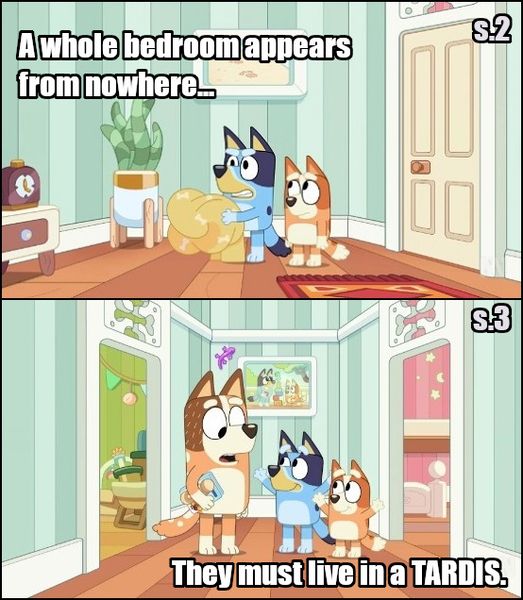
Horse 3074 - Rooms Appearing From Nowhere

On the surface the ABC Kids television program "Bluey" is an animated cartoon for children. One level deeper and it is an animated cartoon which is for parents; and includes teachable concepts. One level deeper and it becomes the subject of literary analysis and has spawned multiple podcasts including "Gotta Be Done" and "The Hammerbarn Project". One level sideways and we find that this program is watched by an entire class of people who do not have children, and just like watching simple stories which are not the usual run of homicides, armed robberies, violent crimes, and endless politics which the news wants to serve up. Bluey is an anti-news program, if you will.

The show Bluey also has a very strong sense of place; being obviously set in Brisbane without directly mentioning it. Various attempts have been made in forums to determine where the Heeler family lives and the general concensus is that they either live in Red Hill or Hawthorne. 

However, the one thing within the Blueyverse that is impossible to nail down is the architecture of their house. Several rooms simply do not make any sense at all and whatever is upstairs can not possibly fit inside the building if you look at it from the outside. 

I have found three possibly plausible theories as to the internal workings of the Heeler House at No.2 Whatever-It-Is Street (which by the way also doesn't make any sense as the long shots of the house show it at the very top of a hill; yet very clearly within the show, the surrounding houses are all on the level).

Theory 1 - The Rule Of Funny:

If we apply Occam's Razor with surgical precision, then this is the theory which hacks away everything but the most rational explanation. If the Heeler house follows The Rule Of Funny, then the only reason that anything needs to exist within the Blueyverse is it does so to be funny at the time. The Rule Of Funny requires the least amount of rational thought because if we accept that this is a work of fiction and that everything only exists within this world because it is a work of fiction, then all continuity is irrelevant and things only need to exist in the moment for dramatic or comedic effect.

If your prime audience for a thing is children who do not care about the internal logic or continuity of the thing, then why should you care? In this respect, the internal architecture of the Heeler House is a bit like Chekov's gun. Anton Chekov once made the remark that "one does not place a gun on stage unless one intends to fire it"; which is a statement about the economy of elements on stage. Chekov obviously wasn't a fan of decoration and so, the various elements on stage in his eyes, should only serve to further the plot. If the Blueyverse is following the Rule of Funny, then the only logic which needs to be applied is if a thing needs to exist in order  to move the plot forward and/or to get a laugh.

Theory 2 - Bluey's Perspective:

One of the meta-theories that I have heard about the Blueyverse is that the show which is designed to be seen through the eyes of children, only includes elements which are rational to children. This theory is similar to The Rule of Funny but differs in that things do not exist in order to move the plot forward or to get a laugh but because these are the things that Bluey notices.

I can speak from personal experience here. My grandparents' house had two levels. Not quite at the top of the stairs, there was a laundry chute. It never occurred to me as a small boy that the laundry chute was in fact a laundry chute because I assumed that it was some kind of hall chest, or another piece of solid furniture. When I opened the laundry chute on one occasion, it was like i had opened the door to another realm. A hole with a shaft of light coming upwards was (and very well might still be) amazing.

As a big person, I was on one occasion staying in London for a couple of weeks. I would leave my semi-squalid backpackers' hostel and walk to the nearest tube station. I remember thinking after a few days that I would like to cross over the river some time and have a look on the other side. It was only after I bothered to look at a tube map that I realised that for the whole time I'd been there, I actually already been crossing under the Thames and had already been on the other side. 

If things in the Blueyverse only exist because they are relevant to Bluey, then this would explain why the architecture of the house makes no sense. Things do not exist in Bluey's house unless they are relevant to her. This is a common experience among small children, I think. They can not possibly imagine that their parents, or their teachers, have lives outside of the immediate context of their own existence. When a child sees a teacher out in the wild, it is as though worlds have collided.

Theory 3 - The House Is A TARDIS:

I can see no evidence of time travel within the Blueyverse. However, I think that we can take it as internal fact that the Blueyverse operates on different laws to our own. As evidenced in "The Decider", they do in fact live in Queensland; albeit some different Queensland to our own. We know that there is industry and commerce; we know that there is air travel (as Chili works in Airport Security), we know that there is a past (because Bandit is an archaeologist), and we know that the default personoid in the Blueyverse is a dog (and that birds, cats, chimps etc exist). 

The conclusion that we have to draw, after trying to work out how the kitchen, front living room, their bedrooms, the hallways, and at least one patio, is that the long shot of the house from the outside is genuine, that all of the inside shots of the house are genuine, and that the house is bigger on the inside than it is on the outside.

The most egregious abuse of the internal architecture of the Heelers' house is at the end of a hallway where the girls' bedroom is. In Season 2, one shot shows that it is by itself at the end of the hallway and that there is a wall which faces their bedroom door. In Season 3, a show from a similar perspective, now shows that there is another door and another room opposite their bedroom door.

If the house follows similar rules to what we knw about TARDIS technology from elsewhere in media, then in a house/building which is bigger on the inside, rooms can appear and be deleted. I have seen examples in this kind of house, where someone has had to run around for ages looking for their room because it has been moved. I have also seen examples where the outside of the thing, merely appears as a single door on a hallway; with the entire room disappearing and reappearing. Other examples in various media franchises exist, such as The Room of Requirement, which only appears when a person is in need of it. This would imply that TARDIS rules for buildings also follow Chekovity.

Conclusion:

For any given piece of media, which exists in multiple episodes, discontinuity errors are always going to creep in. Sometimes they are deliberate and sometimes they are accidental but irrespective of either, there will always be some section of the audience who wants to pull it apart, have a look at all of the pieces, and see why they work or do not work.

This then begs the question: "Why?" Why is there a section of the audience who compulsively wants to pull apart the internal workings of the media that they enjoy?

Theory 1 - The Rule Of Funny:

Oh no. Have we stepped into some kind of meta-narrative here? Have we turned the spectators into the spectacle? Indeed we have!

I suspect that at the heart of everyone who has ever lived, is some component which finds it both fun and funny to open apart everything in the world. The entire realms of enquiry of science, philosophy, religion, art, drama, are all ultimately about opening stuff and have a play with them. 

Theory 2 - Our Perspective:

We can only see the universe through our own eyes and thus, our interpretation of media will only include elements which are rational to us. Remember, books belong to their readers; which means that the reader has some sort of ownership over the books they read and the experiences they have while reading. After something has been published and it has been received by the audience, it belongs to the audience and the interpretation of the audience is the final. Authorial intent is to some degree pointless because whatever interpretation you have of a thing, matters.

Theory 3 - Every Person Is A TARDIS:

Are all people like this? So much bigger on the inside. Do I contradict myself? Very well then, I contradict myself. I am large, I contain multitudes.

September 24, 2022

Horse 3073 - Constitutional Survey - VI(ii)

<><><><><>

66. Salaries of Ministers

There shall be payable to the Queen, out of the Consolidated Revenue Fund of the Commonwealth, for the salaries of the Ministers of State, an annual sum which, until the Parliament otherwise provides, shall not exceed twelve thousand pounds a year.

<>

Parliament provided almost immediately for the salaries of the Ministers of State. The current Parliamentary Business Resources Act 2017 (s.14(2)) provides that a base salary been drawn upon the Consolidated Revenues of the Commonwealth per Section 48 and that there be various allowances are to be paid per Section 59.

Assuming an historical rate of inflation of 4% since 1AUC (Ab Urbe Condita, which began on 21st Apr 753BCE, the traditional date for the founding of Rome), then:

1.04^121 = 115.089

At he time of change over $1 = 10/-

115.089 x £12,000 x 2 = $2,762,136

That £12,000 was meant to cover the entire Federal Executive Council. Prime Minister Barton likely took a salary of £1200. As it stands, most cabinet ministers earn about $370,000 a year; with the Prime Minister currently on $549,250. Prime Minister Barton was on the equivalent of $276,214 but arguably, the role of the Prime Minister and Cabinet is more complex in 2022 than it was in 1901.

<><><><><>

67. Appointment of civil servants

Until the Parliament otherwise provides, the appointment and removal of all other officers of the Executive Government of the Commonwealth shall be vested in the Governor-General in Council, unless the appointment is delegated by the Governor-General in Council or by a law of the Commonwealth to some other authority.

<>

Given that it would be exceptionally easy for a cabinet minister to appoint one of their backers into positions of considerable power, like making them a Permanent Secretary, the Comptroller of Taxation, and Commissioners over quangos, then the ability to enact nepotism would have been seen as dangerous.

Queensland brought to the table a political system which was already beginning to show signs of fracture. The Labor Party by the time that the Commonwealth was invented, had already been in existence for a decade and they were full of reformists, socialists, and radicalists. In 1901, there was no organised rightist political party at a national level. New South Wales brought the Free Soil Party who was full of mercantilists. Clearly, both sides of the political aisle saw the other as ruinous.

I suspect that in the beginning of the nation, that the Governor-General would be seen as a non-partisan actor, who would rise above all of it. Placing the appointment and removal of all other officers of the Executive Government of the Commonwealth in the Governor-General in Council, at least stipulates that the various cabinet ministers have to table their suggestions for appointments before they hand over the keys to the kingdom. 

<><><><><>

68. Command of naval and military forces

The command in chief of the naval and military forces of the Commonwealth is vested in the Governor-General as the Queen's representative.

<>

Once upon a time long long ago, kings and queens became kings and queens through the process of biggest stick diplomacy. It you wanted the biggest hat in the land (that is, the Crown), then you had to raise the biggest army. One of the vestiges of biggest stick diplomacy is that the person is who is actually in control of the biggest stick, is the one who represents the Crown.

Also once upon a time long long ago, Parliament and the Prime Minister founded a new model army who meant to have an independent bent and so, civil war broke out. Parliament then appointed a High Court at Westminster Hall to indict the king for tyranny and the king was sentenced to death even though he refused to accept that the court had jurisdiction.

Now quite obviously placing the control of the military in the hands of the king, is a mere reversion to the law of biggest stick diplomacy. On the other hand, placing the control of the military in the hands of the Parliament and the Prime Minister, is also a mere reversion to the law of biggest stick diplomacy. Placing the control of the military in the hands of the king, and the control of the purse strings of the budget necessary to run said military  in the hands of the Parliament and the Prime Minister, is an uneasy alliance based on mistrust. This is not a check or balance on power (because that in reality is never real) but mutual zugzwang.

<><><><><>

69. Transfer of certain departments

On a date or dates to be proclaimed by the Governor-General after the establishment of the Commonwealth the following departments of the public service in each State shall become transferred to the Commonwealth:

- posts, telegraphs, and telephones;

- naval and military defence;

- lighthouses, lightships, beacons, and buoys;

- quarantine.

But the departments of customs and of excise in each State shall become transferred to the Commonwealth on its establishment.

<>

The invention of the Commonwealth of Australia out of the six colonies which very much acted like frenemies towards each other (and still do) was motivated by the central powers of Europe establishing greater control and influence in the Pacific. The French had moved into places like New Caledonia and Papua was under the control of a newly organised and highly motivated Germany. No doubt the events of 1870 and the fears that France and Germany would eventually hurtle towards each other in another great game, was all too real (and was in the end, correct).

Pooling the resources of the six states, into a single cohesive defensive unit, seemed highly sensible given that if Australia did come under fire, then Britain would likely be weeks' away before any help arrived.

The things immediately being transferred to the Commonwealth are active and civil defence projects. That is, in addition to a common military (see above) the objects of information and of civil defence against infirmity were desirable for the Commonwealth to be in control of. Given the events of 1914 and then 1919 with the great war and then the great flu, then wisdom was proven to be right by her children.

<><><><><>

70. Certain powers of Governors to vest in Governor-General

In respect of matters which, under this Constitution, pass to the Executive Government of the Commonwealth, all powers and functions which at the establishment of the Commonwealth are vested in the Governor of a Colony, or in the Governor of a Colony with the advice of his Executive Council, or in any authority of a Colony, shall vest in the Governor-General, or in the Governor-General in Council, or in the authority exercising similar powers under the Commonwealth, as the case requires.

<>

Say what now?

If there's something which a Governor did at Colony level and that's passed to the Commonwealth, then the  Governor-General now does it.

Have we got it? Good.

<><><><><>