Before I begin this, I need to establish that Mrs Rollo is an American and a Californian. She comes from that almost anonymous section of American society that can be dubbed 'Quiet America' - the not insignificant section which isn't brash and loud, that part of America which quietly rolls up its sleeves and gets things done.
She pointed, quite rightly that in the run up to the 100th anniversary of the landings at Gallipoli, from which we get the date for Anzac Day, with the background of living in a very patriotic nation like America, she was still puzzled at the amount of hoo-haa that the Centenary of Gallipoli is getting.
On the news we've seen reports of school children who have been selected to visit Gallipoli for the centenary and even outside of that context, phrases like 'the birthplace of a nation' are being bandied about.
I'm not sure exactly how it happened but somewhere down the line, I happen to have received a copy of a book called 'Was It Only Yesterday?' which I can only imagine was some sort of high school Modern History textbook and whilst it mentions the Gallipoli Campaign, it does so against the greater story of the First World War and gives more space in terms of column inches to Count Alfred von Schlieffen and his invasion plan for France, as well as the conditions which laid the foundations of the First World War, which was finally triggered with the assassination of Archduke Franz Ferdinand.
The book was published in 1982 and even though I finished high school not quite a decade and a half later, I still don't remember anything like this grand mythologising about Anzac Day and Gallipoli when I was at school. The almost absurd deification of Anzac Day and Gallipoli must have only occurred in the nearly two decades since I left school.
What I want to know is 'Why?'
Anyone who has studied even the most elementary details of the campaign to open the Dardanelles, can tell you that the landing at Gallipoli was part of a broader plan by the British to open up supply lines from Russia's Black Sea ports to the Mediterranean. The Anzac forces landed in a place which was incredibly steep and the opposing Ottoman forces basically spent the best part of a year and a bit pinning them to the spot. It can not be described as anything other than a complete and comprehensive victory for the Ottoman Empire and it only ended after British commanders came to their senses and evacuated the region.
By any sensible measure, the Gallipoli campaign was a total disaster for the Anzac forces and so it really is quite strange that we've turned it into this de facto celebration of Australia.
I think it's because Australia doesn't really have a flashy story to tell about its founding as a nation, that Anzac Day has become this thing in lieu of one. Australia Day is the day that the British sailed halfway round the world; stuck a flag in the ground and then dumped its criminals out with no real plan as to what to do with them. What could be celebrated as Federation Day is rather a bit pointless as it is already New Years' Day and any meaning would be lost; besides which Australia started with a vote and not a war.
Maybe in our rush to run away from under the skirt of Mother England, we've been lured by the wacky tales of flashy Uncle Sam and we're trying desperately to come up with our own mythos - it isn't really working.
What's really absurd is that even the Australian Government is having a go at this. Sprawled across the Australian War Memorial London website is the slogan¹: Gallipoli The Birth of a Nation, 1915
Maybe Gallipoli has become something as a sort of symbol of Australia's national identity but isn't that going a bit far? More than six times as many Australians died on the Western Front in the mud of France and Belgium and names like Pozières, Passchendaele and Fromelles hardly even get a mention.
The last few lines from Eric Bogle's "The Band Played Waltzing Matilda" tell us that "as year follows year, more old men disappear. Someday no one will march there at all." That point has been reached as there as the very veteran in the world of the First World War died in 2012. That means that with no first hand witnesses left to tell us the horrors of shell-shock, of burial alive, of the acrid smells of high explosive and chlorine gas, we're left to make up any story we feel like.
It isn't even the first time that Australians were on the battlefield either. The six colonies had sent troops to South Africa to fight in the Boer War which lasted from 1899-1902 and from 1901, they were no longer sent as representatives of the states but the Commonwealth of Australia. Captain Neville Howse who was Australia's first Victoria Cross recipient, was cited as serving in the New South Wales Army Medical Corps, Australian Forces, when the award was gazetted on 4 June 1901.
Curiously across the ditch, in New Zealand which also shares the holiday, the whole affair is far more subdued. The NZ History website of the New Zealand Ministry for Culture and Heritage makes a passing mention of Anzac Day that "for more people it is also becoming an opportunity to talk about what it may mean to be a New Zealander"².
New Zealand unlike Australia though, actually does have national day of sorts in Waitangi Day; to commemorate when the Treaty of Waitangi was signed in 1840. No such document or date exists in Australia.
Maybe because it is the 100th anniversary of the landings at Gallipoli that Anzac Day has been hyped up beyond the point of sensibility but even so, I fail to see why it is so necessary that for a nation to prove itself noteworthy, needs to do so through the payment of blood.
Australia should be proud on the fact that it became a nation because of a vote and not a war. That along with the preferential vote and the enfranchisement of women should prove that democracy is a far more sensible way to start a nation.
Whilst it might be true that "age shall not weary them, nor the years condemn; at the going down of the sun and in the morning, we will remember them", I just don't know how useful lionising and enlarging the legend of a complete military disaster is.
¹http://www.awmlondon.gov.au/battles/gallipoli
²http://www.nzhistory.net.nz/war/modern-anzac-day

February 19, 2015


February 18, 2015
Horse 1841 - On The Death Penalty
Before I begin this, I should assert that I think that the really unfortunate and tragic fact about all of this is that as a sovereign nation, Indonesia is well within its rights to apply the laws as they stand. As much as the world cries out against it, the death penalty for trafficking hard drugs like heroin existed well before Myuran Sukumaran and Andrew Chan ever even set foot in the country. As far as application of law is concerned, this whole incident is being performed properly and correctly.
Is the law in this case good though? Is it fir for purpose?
Approval has now been passed for convicted drug smugglers Myuran Sukumaran and Andrew Chan to be transferred from Bali's Kerobokan prison; to be executed.
Indonesian president Joko Widodo, who has a history for his cruel "tough line" stance, has now rejected 64 bids for clemency. In addition to this, there have been personal appeals from the Prime Minister Tony Abbott, Foreign Affairs Minister Julie Bishop, her Shadow Minister Tanya Plibersek and a letter signed by 111 MPs.
What do I think of all of this? I hate Indonesian law. Hate is a strong word but in this case, it isn't even close; this is why.
This might sound like a terrible thing to say but I think that even those people who have committed horrible crimes, still have a right to life. I also think that people who have committed horrible crimes also have a right to punishment. I do question though, where in particular the point of punishment ends.
I think that the reason why this offends so many people is to do with the sanctity of human life. As a Christian, I believe that we have been created in the image of God but even if that were not the case, I still think that I'd reach the conclusion that the death penalty is certainly an affront to human dignity and questionable as a method of administering justice.
Secular societies across the world have all reached this same conclusion as well. All 27 nations of the EU have through the Charter of Fundamental Rights of the European Union, reached that point in law. The Universal Declaration of Human Rights didn't explicitly condemn the death penalty but it did affirm that a right to life exists as did possibly the most famous line in English, in the United States Declaration of Independence. Closer to home, Australia took the death penalty off the books with the Abolition of Capital Punishment Act 1973¹.
http://www.ohchr.org/EN/UDHR/Documents/UDHR_Translations/eng.pdf
Article 3
Everyone has the right to life, liberty and security of person.
Article 5
No one shall be subjected to torture or to cruel, inhuman or degrading treatment or punishment.
- Articles 3 and 5, Universal Declaration of Human Rights (1948)
http://www.europarl.europa.eu/charter/pdf/text_en.pdf
Article 2 - Right to life
1. Everyone has the right to life.
2. No one shall be condemned to the death penalty, or executed.
- Charter of Fundamental Rights of the European Union (2009)
We hold these truths to be self-evident, that all men are created equal, that they are endowed by their Creator with certain unalienable Rights, that among these are Life, Liberty and the pursuit of Happiness.
- United States Declaration of Independence, 4th Jul 1776
Why?
There are many interlocked questions of what the state is supposed to do once someone has broken the law but the most pressing is the questioning making the punishment fit the crime. Then there are questions to do with the relative effectiveness of punishment and or rehabilitation of convicts. If the application of the death penalty is a question of punishment and rehabilitation, then the death penalty by its finality means that rehabilitation is more or less pointless. The question of punishment though, is still unresolved because if we assume that the principle of exact retribution is just (the idea of an eye for an eye and no more) then the death penalty starts to look like a case of state sponsored revenge. If as in this case the death penalty is not in punishment for the taking of lives, then serious questions of justice need to be raised.
If this truly is a about delivering justice and administering punishment, then who exactly is the death penalty punishing? Putting fear into someone for the period immediately before they are extinguished might be seen as some as a form of punishment but once they have been put to death, the law can do literally do no more². The problem is that punishment lingers on well after the event for their families and loved ones. If in the period before their execution, the person who is about to be killed, shows remorse and repentance for what they've done, then the state which delivers punishment according to law might be seen as being just but it proves itself through action to be cruel.
The greatest reason why the death penalty has been removed in most jurisdictions is to do with the question of fairness. There are always examples which come up from time to time where someone has pleaded their innocence and still been sent to prison. If they'd been convicted of a crime and been given the death penalty, we would have killed those people; which kind of makes a mockery of the whole criminal justice system. In what way can a system be said to be just if it kills the wrong people?
The other question of whether or not the death penalty acts as a deterrent is very obviously demonstrably false; especially in the case of Sukumaran and Chan - they trafficked heroin anyway. If they weren't aware that death penalty existed for this sort of crime, then quite obviously not being aware of a thing means that that thing can hardly deter you from anything. How can the death penalty deter someone from committing a crime when they don't know that it exists? Of course, practically everyone in the world knows that Indonesia has the death penalty now but that really didn't help anyone at the time, did it? Mind you, the Australian Federal Police provided a three page letter to the Indonesian police, tipping them off about the Bali Nine's movements. If they really cared about the lives of these people, why didn't they try to stop them before the event?
I believe that in the light of Sukumaran showing remorse and Chan being so contrite as to turn his life around to the point where he has become a pastor, they have demonstrated that rehabilitation is entirely possible.
I think that as a nation we are justifiably outraged and are disappointed and angry that the death penalty continues to exist.
¹Abolition of Capital Punishment Act 1973 -http://www.austlii.edu.au/au/legis/cth/consol_act/dpaa1973228/
²And as it is appointed for men to die once, but after this the judgment, - Hebrews 9:27
Logically this is a position of the best possible administration of justice. All attempts at rehabilitation can be done during a person's lifetime and by virtue of the fact that Christ died for the remission of sins, all penalties have already been paid should the person choose to accept payment on their behalf.
Is the law in this case good though? Is it fir for purpose?
Indonesian president Joko Widodo, who has a history for his cruel "tough line" stance, has now rejected 64 bids for clemency. In addition to this, there have been personal appeals from the Prime Minister Tony Abbott, Foreign Affairs Minister Julie Bishop, her Shadow Minister Tanya Plibersek and a letter signed by 111 MPs.
What do I think of all of this? I hate Indonesian law. Hate is a strong word but in this case, it isn't even close; this is why.
This might sound like a terrible thing to say but I think that even those people who have committed horrible crimes, still have a right to life. I also think that people who have committed horrible crimes also have a right to punishment. I do question though, where in particular the point of punishment ends.
I think that the reason why this offends so many people is to do with the sanctity of human life. As a Christian, I believe that we have been created in the image of God but even if that were not the case, I still think that I'd reach the conclusion that the death penalty is certainly an affront to human dignity and questionable as a method of administering justice.
Secular societies across the world have all reached this same conclusion as well. All 27 nations of the EU have through the Charter of Fundamental Rights of the European Union, reached that point in law. The Universal Declaration of Human Rights didn't explicitly condemn the death penalty but it did affirm that a right to life exists as did possibly the most famous line in English, in the United States Declaration of Independence. Closer to home, Australia took the death penalty off the books with the Abolition of Capital Punishment Act 1973¹.
http://www.ohchr.org/EN/UDHR/Documents/UDHR_Translations/eng.pdf
Article 3
Everyone has the right to life, liberty and security of person.
Article 5
No one shall be subjected to torture or to cruel, inhuman or degrading treatment or punishment.
- Articles 3 and 5, Universal Declaration of Human Rights (1948)
http://www.europarl.europa.eu/charter/pdf/text_en.pdf
Article 2 - Right to life
1. Everyone has the right to life.
2. No one shall be condemned to the death penalty, or executed.
- Charter of Fundamental Rights of the European Union (2009)
We hold these truths to be self-evident, that all men are created equal, that they are endowed by their Creator with certain unalienable Rights, that among these are Life, Liberty and the pursuit of Happiness.
- United States Declaration of Independence, 4th Jul 1776
Why?
There are many interlocked questions of what the state is supposed to do once someone has broken the law but the most pressing is the questioning making the punishment fit the crime. Then there are questions to do with the relative effectiveness of punishment and or rehabilitation of convicts. If the application of the death penalty is a question of punishment and rehabilitation, then the death penalty by its finality means that rehabilitation is more or less pointless. The question of punishment though, is still unresolved because if we assume that the principle of exact retribution is just (the idea of an eye for an eye and no more) then the death penalty starts to look like a case of state sponsored revenge. If as in this case the death penalty is not in punishment for the taking of lives, then serious questions of justice need to be raised.
If this truly is a about delivering justice and administering punishment, then who exactly is the death penalty punishing? Putting fear into someone for the period immediately before they are extinguished might be seen as some as a form of punishment but once they have been put to death, the law can do literally do no more². The problem is that punishment lingers on well after the event for their families and loved ones. If in the period before their execution, the person who is about to be killed, shows remorse and repentance for what they've done, then the state which delivers punishment according to law might be seen as being just but it proves itself through action to be cruel.
The greatest reason why the death penalty has been removed in most jurisdictions is to do with the question of fairness. There are always examples which come up from time to time where someone has pleaded their innocence and still been sent to prison. If they'd been convicted of a crime and been given the death penalty, we would have killed those people; which kind of makes a mockery of the whole criminal justice system. In what way can a system be said to be just if it kills the wrong people?
The other question of whether or not the death penalty acts as a deterrent is very obviously demonstrably false; especially in the case of Sukumaran and Chan - they trafficked heroin anyway. If they weren't aware that death penalty existed for this sort of crime, then quite obviously not being aware of a thing means that that thing can hardly deter you from anything. How can the death penalty deter someone from committing a crime when they don't know that it exists? Of course, practically everyone in the world knows that Indonesia has the death penalty now but that really didn't help anyone at the time, did it? Mind you, the Australian Federal Police provided a three page letter to the Indonesian police, tipping them off about the Bali Nine's movements. If they really cared about the lives of these people, why didn't they try to stop them before the event?
I think that as a nation we are justifiably outraged and are disappointed and angry that the death penalty continues to exist.
¹Abolition of Capital Punishment Act 1973 -http://www.austlii.edu.au/au/legis/cth/consol_act/dpaa1973228/
²And as it is appointed for men to die once, but after this the judgment, - Hebrews 9:27
Logically this is a position of the best possible administration of justice. All attempts at rehabilitation can be done during a person's lifetime and by virtue of the fact that Christ died for the remission of sins, all penalties have already been paid should the person choose to accept payment on their behalf.
February 13, 2015
Horse 1840 - Fragments II: Wages, Stories, Chinese Characters, Governor-General, 1 Samuel, McLaren, The Spill, Eurovision, Holden and Schooling
Back in Horse 1770, I published scribblings from my note book which otherwise would have disappeared. Those notebooks have been dispensed with as I have entered the age of tablet computing but in it's place, an abandonarium of sorts has built up. The fragments which once were small and scribbly are now longer and electronicky.
This is either a museum or a bemuseum depending on which way you want to look at it. This post is full of those extra bits, which never made it.
<>
aa1 - On Wages?
The employer-employee relationship is essentially an uneven one. Like so many circumstances where money is involved, the other "golden rule" applies: "whoever has the gold, makes the rules". This is also true in politics as well; it isn't necessarily by accident that the current Prime Minister and Treasurer both happen to represent two of the richest electorates in the country. Money talks, and loudly; this time it's positively yelling until all other possible voices are drowned out. Alas poor Democracy, I knew him.
The biggest single driver in the cost of wages, or rather the wages that people demand, is people's occupation costs; that is, the humble task of putting a roof over one's head. For people further up the income ladder, this includes the repayment of ever larger mortgages but at the end of the income ladder which is most likely to actually benefit from penalty rates, the best that a lot of people can hope to aspire to is keeping the rent collecters at bay.
In modern Australia where the manufacturing sector has withered on the vine or has been kicked violently to pieces, the occupations where you're most likely to find workers who are currently entitled to penalty rates is in sectors like retail and hospitality. In these sectors, workers are not only under the pump in terms of competing with each other but also in terms of job security. Someone who is entitled to penalty rates is also more likely to be employed on a part-time or casual basis. The question of if they're likely to be even called in to work tomorrow weighs more heavily on such peoples' minds than if ever does to salaried workers. Such a set of circumstances isn't really all that helpful in keeping the rent collectors from bashing the front door down.
Mr Abbott's example of a restaurant which didn't open on Sunday nights; specifically because of penalty rates, demonstrates that he either doesn't understand about people's situations or more tellingly, doesn't care about the circumstances and conditions which the people who would be affected by the abolition of penalty rates would face.
It seems that he almost expects services to be open even though a market solution has produced a different outcome; I wonder if this shows an underlying sentiment of entitlement at work here. If it isn't convenient for the workers to work on a Sunday night, Mr Abbott is openly telling people that their inconvenience is not valued and is not worth a paying a premium for. I find this all the more galling when you consider that the terms which define his own working conditions are very generous in terms of allowances; and these allowances make a few dollars an hour in penalty rates pale in comparison.
Looking closer at this restaurant (which isn't named and therefore the actual non-existence of which can not be disproven) as Mr Abbott claims can not afford to stay open specifically because of penalty rates, is already demonstrating a market outcome with respect to wages. The profit motive is the usual reason why business does anything and if it doesn't open on a Sunday night then this might show that it isn't willing to raise prices to cover those rates because it knows that its clientele isn't prepared to pay the increased prices. Mr Abbott (like the Government he leads) however, only sees this as a spending and not a revenue issue; where the only allowable solution is to drive down input costs. This is quite apart from the fact that the cooks and waiters who work in the restaurant probably can not afford to eat there as a customer. Such an attitude says that the fruits of labour do not belong to those that labour but those who derive profits from it. The attitude displayed by the statement that "if you don't want to work weekends, don't work weekends" tries to reframe the issue as one of choice, when in actual fact someone who needs the money might have very little choice at all. You might find it very difficult to quit if this particular job happens to fit with your other obligations in life such as family commitments and just quitting or not working might not be such an easy option to someone who lives from pay cheque to pay cheque.
History is littered with examples where if allowed, employers will pay their employees as little as possible; nothing if they can get away with it. Even today, there are organisations holding out the carrot of "experience" whilst offering that "experience" in unpaid internships; so I very much doubt that there is a lower limit to the level of nastiness that people will descend to. The only reason that awards and penalty rates exist and are protected by law is because people had to fight for them (and in some cases lose their lives in that fight). I suspect that the reason why the current push to abolish penalty rates is on, is because employers have sensed that power has again tilted back in their favour. As more people move into either white collar work where they are paid wages and unpaid overtime runs rampant and as the people who would have once worked in factories now find themselves in retail, the ability for unions to achieve anything at all has been diminished. I don't know if we're likely to see a return to the Combinations Act of 1799 which prohibited people's ability to form unions and engage in collective bargaining because I doubt if the need to pass such legislation even exists any more. There is no need to ban workers' rights to join a union in a labour market where no union exists.
I'm speculating here but it could be that the awarding of Prince Phillip with a knighthood (which I'm largely ambivalent to) was designed to create so much of a media storm as to draw attention away from the fact that decisions and negotiations are being made to erode workers' rights and rates of pay. It's easy to fleece someone whilst you're pulling the wool over their eyes. Why not draw attention to a clumsy action if it makes people forget about the callous one about to be perpetrated against them?
(Abandoned at 1047 words. This was too ranty and the world moved on too quickly)
<><>
aa2 - Telling Stories?
From time to time I am asked by people to write a diatribe on some subject and to this day I'm still amused at just how many people want to read these pieces.
I think that it was really strange to be asked to write this piece on what I think the future for comedy looks like considering that:
1. I am not a comedian.
2. I almost never see live stand-up.
4. I tend not to put things in the right order.
G. I get easily distracted.
4. I tend to repeat things.
4. I tend to repeat things.
3. I don't find the things that most people find funny, amusing at all.
That last bullet point is quite salient. "Watch this TV show - you'll find it funny", they say. Well I'll watch one episode and then in most cases I'll find it as dull as data entry. "Two Broke Girls", "Modern Family", "New Girl" and "The Big Bang Theory" have been the latest series in this list of shows which people have told me that I might find funny; only to be disappointed so profusely that I've gotten up and walked away. None of them have ever made it beyond the ten minute mark, in their attempt to make me watch them.
So as eminently unqualified as I am to write anything about comedy, why am I even attempting to do so; considering that I know next to nothing of what others find funny? Because although I might not know find the same things funny that other people find funny, the overall question of "What now for comedy?" has almost nothing to do with the material of the subject.
Comedy like every single genre of writing, is about the telling of stories. If they're crime fiction, an action movie, serious journalism, financial reporting, opinion pieces, drama series and yes, even comedy shows and live stand-up, they all rely upon the central tenant of telling the arc of some story. All stories have at their core, the complication and resolution of some particular conflict. Pick any subject you like and every story you've ever seen and you'll invariably find this to be true.
Comedy is the telling of these stories for amusement and often in a humorous way. Comedy also is one of the few arenas where the crossing of taboos is seen as semi-allowable. Whether it be through the vehicle of filthy jokes, racism, or even very venturing into the land of the macabre, society seems to have less of a problem with comedy being used as the vehicle for the journey into this territory (of course your mileage may vary depending on where that journey may go and you are perfectly free to not go on that voyage).
These two ideas of comedy as the telling of stories and as the vehicle to cross taboos, defines the form of a whole host of material but even then, those conflicts and taboos can also be defined in ludicrously simple terms.
All stories worth telling are basically the conflict between an individual or a group, against another individual, group, system or concept. Comedy sets up the conflict by trying to get us to side to identify with the first entity, defines the other entity and specifically delineates their 'otherness' and then tells the story of the complication and resolution (or failure to do so) of that complication.
It does so though, with a different palette to journalism or drama. The colours which comedy paints with are many and varied but they really come down to just four:
1. Sarcasm.
2. Stupidity.
3. Surprise.
4. Vanity.
(607 words before I abandoned this. I failed to see where this was going.)
<><><><><>
sm1 - Bad Dads?
I am currently reading through the book of 1 Samuel at the moment; it opens with the end of the period of the judges in Israel and the opening of the short period of the United Monarchy of the nation.
The books of Samuel and later the books of Kings and Chronicles go on to repeat the lines that such and such "did evil in the eyes of the LORD" or "did that which was right in the eyes of the LORD" and so it kind of reads a little like Sellar and Yeatman's "1066 And All That" in classifying things as either a good thing or a bad thing.
The opening of 1 Samuel tells in part, the story of the last two judges Eli and Samuel but inadvertently might accidentally have let something past the radar.
Consider Eli's sons:
Eli’s sons were scoundrels; they had no regard for the Lord. Now it was the practice of the priests that, whenever any of the people offered a sacrifice, the priest’s servant would come with a three-pronged fork in his hand while the meat was being boiled and would plunge the fork into the pan or kettle or caldron or pot. Whatever the fork brought up the priest would take for himself. This is how they treated all the Israelites who came to Shiloh.
- 1 Samuel 2:12-14
Now Eli, who was very old, heard about everything his sons were doing to all Israel and how they slept with the women who served at the entrance to the tent of meeting. So he said to them, “Why do you do such things? I hear from all the people about these wicked deeds of yours. No, my sons; the report I hear spreading among the Lord’s people is not good. If one person sins against another, God may mediate for the offender; but if anyone sins against the Lord, who will intercede for them?” His sons, however, did not listen to their father’s rebuke, for it was the Lord’s will to put them to death.
- 1 Samuel 2:22-25
The man who brought the news replied, “Israel fled before the Philistines, and the army has suffered heavy losses. Also your two sons, Hophni and Phinehas, are dead, and the ark of God has been captured.
- 1 Samuel 4:17
Now consider Samuel's two sons Joel and Abijah:
When Samuel grew old, he appointed his sons as Israel’s leaders. The name of his firstborn was Joel and the name of his second was Abijah, and they served at Beersheba. But his sons did not follow his ways. They turned aside after dishonest gain and accepted bribes and perverted justice.
So all the elders of Israel gathered together and came to Samuel at Ramah. They said to him, “You are old, and your sons do not follow your ways; now appoint a king to lead us, such as all the other nations have.
- 1 Samuel 8:1-5
Now I'm not for a second suggesting that people are responsible for their actions of their adult children but if Eli’s sons "were scoundrels" and Samuel's sons "turned aside after dishonest gain and accepted bribes and perverted justice", then what does that say about the sort of discipline that Eli and Samuel gave their children?
I should temper this by saying that I don't have children of my own and that I'm not even remotely qualified to give out any sort of advice but it seems to me that the biggest factor or the biggest connection that Eli and Samuel's sons have, and probably why they turned out to be such horrid people, is the absence of their fathers.
Eli and Samuel were both Hebrew Judges and were sort of de facto leaders of the nation. In carrying out their role as leaders of the nation, how good were they at being dad?
Were Eli and Samuel really so good at being administrators and good at their job in running the tabernacle that their time was consumed with those things that they were never home?
Actually the case with Samuel is slightly different. As indicated above "he appointed his sons as Israel’s leaders", which means to say that this isn't just a father-son relationship between Samuel and his sons but also a Employer-Employee relationship. If you were running a commercial entity and there was a case of gross corruption taking place, you'd be well advised to impose disciplinary action but maybe because Joel and Abijah were Samuel's sons, he was lax in administering that action.
I find it interesting that Samuel had done his tutelage under Eli and probably learned how to go about the business of administering the tabernacle very well; yet perhaps the job was so demanding, by accident rather than design, Samuel's children are as ill-disciplined as Eli's were.
<><><><><><>
mp4 - The Future's Bright, The Future's Orange?
When the McLaren MP4-30 was finally unveiled, metaphorical gasps could be heard across the automotive world. Those gasps immediately turned to groans and inaudible grumbling as the livery for the all new car, powered by a Honda powerplant for the first time since 1991, was still mainly silver as it had been since 1997.
There were rumours that not even all of McLaren's staff were satisfied, as they'd been hoping for a return to orange, like the days in the 1970s; before Marlboro had put their red and white chevrons on the cars.
Autosport magazine reported that McLaren manager Ron Dennis had fobbed them off saying:
"We have had the same [discussions about livery] inside the team: all of these people were saying, why don't we make it orange - because that was the old colour of McLaren?
Well, I say, 'you just said it - it was the old colour of McLaren. Why the hell do we want to go backwards?
So what do you do? Do you create an aesthetically pleasing design? But for what purpose?
This is the livery of McLaren. It has always been a combination of these colours - and it will only change for commercial reasons."
- Ron Dennis as quoted by Autosport, 1st Feb 2015.
Personally, I think that this is a rather disappointing explanation, as I don't think that McLaren Automotive believes that to be true. Their 12C has a rather delicious shade of burnt orange as a default colour as does their 675LM. Even during the days of West sponsorship when their cars were powered by Mercedes-Benz, their test mules often came out in orange.
So what's going on here? Is Ron Dennis foxing and hoping that a major sponsor will come forth before the beginning of the season? If not, his statements make less sense than a mongoose wearing a tutu which has been duct taped to the roof of the Melbourne Town Hall.
What is the point of looking back to the past? Why does it make commercial sense to do so? The reasons for both of those questions can be found elsewhere on the grid.
In 1906 the forerunner to the FIA decreed that various nations run various colours to identify their cars; most of these made little sense at the time but in the years which followed, they became part of the landscape - Italian cars were to be red, French ones blue, green for British, white for German. In the mid 1930s, legend has it that a particular Mercedes in order to just scrape in under the maximum weight allowance, was scrubbed back to bare metal and these cars became the famous Silver Arrows; this can not be verified.
When McLaren and Mercedes entered into a partnership in 1995, Marlboro was still the dominant sponsor of McLaren and so their red and white colour scheme remained but once they'd left the picture, Mercedes' silver became the order of the day.
That's what makes this latest chapter so strange. McLaren and Mercedes have now parted ways (now that Mercedes-Benz has won both the drivers' and constructors' championships on their own) and so there is really no reason why McLaren need to retain the silver colours.
Look further down pit lane and La Scuderia wouldn't be seen in anything less than that scarletti on their stallions; the tifosi would riot in the streets and there'd be a national emergency in Italy. Mercedes-Benz in setting up a new team, looked back and ran silver on their cars. Jaguar F1 was green until team was bought out by Red Bull. Most recently, Team Lotus have looked back to some of their most famous liveries and are sort of paying homage to their once dominant JPS cars; running then in mostly black despite zero involvement from that company.
McLaren probably should look back to the past.
When companies talk about "brand identity" they need to evoke something quickly and immediately; that's even more critical when your mobile billboard whizzes by the crowds at more than 200mph. By tapping into the past, McLaren would be giving root to the future. Heck, they should probably also consider putting a little kiwi on the nose of their cars as well.
The important thing about motor sport (and indeed any sport) is that it is intrinsically pointless. Apart from those directly employed, it doesn't really matter a lot about who wins one week to the next, or what colours are on the sides of the cars. Precisely because it doesn't intrinsically matter, those things matter immensely. Things like colour schemes and numbers and who drives for whom; whom hates whom because of some on track dispute that happened five years ago, all become part of the story of the thing and that's why looking back to the past is so.important. Without the story of the thing, all motor racing is is a bunch of cars going round and round for two hours; once a fortnight. The irony about sport in general is that so much money is poured into an activity which is intrinsically pointless - even the points are ultimately pointless.
(Abandoned at 751 words. McLaren still may yet appear in Melbourne with an orange car. Fingers crossed).
<><><><><><><>
pm27 - Spill Spill Spill?
With the announcement coming out of the coalition meeting room yesterday that Prime Minister had survived a spill motion, I got the impression that Australia was kind of a little disappointed that it went no further. 'No' got 61 votes to the 'Yes' vote of 39 and there was one informal vote to the yes/no question of whether or not there should even be a spill motion. I'd even heard on the radio, someone's outlandish and highly amusing suggestion that the informal vote was either Tony Abbott writing in Julia Gillard's name or someone continuing the joke of nominating Taylor Swift - #Tay4PM
The unbeaten streak of Liberal Party Prime Ministers surviving spill motions remains intact except if you decide to include John Gorton who resigned as PM that morning.
The question of the current high turnover rate of Prime Ministers is something of a misdirection. In the period from 1901-1912 we had a lot and from 1938-1941 we also churned through a few. In both of those periods, the change at the helm came about because of different parties struggling for supremacy. In the early period, parties still hadn't properly solidified and in the opening period of the Second World War, the two factions which warred were the United Australia Party's iron chariots and the Country Party's rusted ploughshares.
(abandoned at 220 words. That moment in the political zeitgeist had passed so quickly.)
<><><><><><><><>
eu54 - Eurovision Geography Contest?
Shocked I am. Shocked am I. Am I shocked? I am shocked. I am shocked enough that the grammar of Yoda am I using, hmmm. Why am I shocked? Because the European Broadcasting Union has decreed in its wisdom to allow Australia into the 2015 Eurovision Song Contest. Either this says that the EBU has failed really badly on its geography exam and doesn't realise that Australia isn't even remotely close to Europe, or the EBU has hatched an evil plan (muah ha ha) which is so dastardly that it could have only come from a supranational organisation.
The Eurovision Song Contest which is now into its sixth decade, ceased to be a song contest years ago. Probably not since the days of "Puppet On A String" does anyone really care about the songs which apart from one stellar exception in 1974, have mainly amounted to a great big kitschy pile of bupkis.
The best part about the Eurovision Song Contest isn't the songs but the bit at the end where everyone votes. Usually everyone votes for their neighbours which means that the Scandinavian nations all vote off each other, the nations which used to live behind the Iron Curtain all vote for each other, Cyprus and Turkey or Greece and Turkey either swap douze point of null point depending on what half of the island the Cypriot came from, and everyone hates Great Britain, France and Germany despite them being the only three nations solvent enough to stump up the cash to pay for the shindig. Roughly once every seven years, everyone feels all diddly and Celtic and so Ireland wins.
In return for winning the competition, the winning nation gets to suffer the expense of hosting next years' competition. This is why I think Australia has been invited.
Sure, the EBU will probably say that Australia and SBS have faithfully supported the Eurovision Song Contest for many years and that's why Australia has been given an entry but what of this is all part of some mass European conspiracy
(Abandoned at 341 words. I lost interest.)
<><><><><><><><><>
ve17 - Let's Not Go There?
In a great wave of appeasement, Holden announced that even after they shut down their manufacturing operations in Australia, the nameplate "Commodore" will continue beyond 2017. As I was listening to this on the radio on the morning that they were making the announcement and hearing some vague sweeping statement like "we are as committed to Australia as we always been (despite the obvious fact that they're shutting down the plants and firing people), part of me was thinking "whoop-de-do; let's all go down the Strand; have a banana".
Then I found myself wondering why I even care about Holden in particular. Ford are also ceasing manufacturing in Australia and when it comes to the great auto holy-war divide, I've always sat on the blue side. I even find it disappointing that the car which I currently drive isn't a Henry. Other manufacturers have also been and one but they haven't solicited the same rise out of me. British Motor Corp which sold arguably the greatest single automotive achievement ever with the Mini, Toyota with their reliable and sensible (but bland as dish water) Camry and Corolla, and Mitsubishi which gave us the Sigma and Magna have also all closed the curtains on their Australian show. None of those have made me as cross. Why?
I've never owned a Holden and so it follows that because I've never bought one, I am part of the reason why they're leaving. Does Holden really hold a special place in my heart on that basis?
How did Holden which is just one brand of which once upon a time was the world's biggest company in terms of both market capitalisation and profits, weasel its way into the national psyche? I can only think of two reasons.
Firstly, Holden went motor racing. Maybe the adage "race on Sunday; sell on Monday" might be true but motor racing is among other things, the telling of a story. The automotive holy-war in Australia is/was between Holden who have backed a 'factory' team consistently since 1969 and Ford who kept on dropping their favourite sons like a plate of cold sick. Alan Moffat who took Falcons to a 1-2 victory in 1977, would within five years be campaigning Mazda RX-7's; Dick Johnson who had the fastest Sierra in the world did so without any help from Ford; and only just recently, Ford have pulled the plug on the Ford Performance Racing team, leaving Mark Winterbottom what was to be in 2015. Holden though always stuck with it, even during the mad season when Peter Brock had words with the factory and they parted company. Holden returned within the year to set up its own racing team.
Not quite fifty years of competition has placed Holden front and centre in the Automotive story of Australia. This and the question of what weapon they'd take to the mountain have been a deliberate and flagrant effort to embed themselves in the nation's consciousness. To abandon manufacturing here is when it all boils down to it, a perfectly sensible business decision but it is one which cuts deep to the heart of the national psyche. It is as Un-Australian as eagles, baseball, apple pie and Chevrolet.
(Abandoned after 535 words. Ranty. Been said before.)
<><><><><><><><><><>
kd91 - The Kids Are All Right?
(Abandoned at 710 words. I don't know how I expected to end this.)
This is either a museum or a bemuseum depending on which way you want to look at it. This post is full of those extra bits, which never made it.
<>
aa1 - On Wages?
The employer-employee relationship is essentially an uneven one. Like so many circumstances where money is involved, the other "golden rule" applies: "whoever has the gold, makes the rules". This is also true in politics as well; it isn't necessarily by accident that the current Prime Minister and Treasurer both happen to represent two of the richest electorates in the country. Money talks, and loudly; this time it's positively yelling until all other possible voices are drowned out. Alas poor Democracy, I knew him.
The biggest single driver in the cost of wages, or rather the wages that people demand, is people's occupation costs; that is, the humble task of putting a roof over one's head. For people further up the income ladder, this includes the repayment of ever larger mortgages but at the end of the income ladder which is most likely to actually benefit from penalty rates, the best that a lot of people can hope to aspire to is keeping the rent collecters at bay.
In modern Australia where the manufacturing sector has withered on the vine or has been kicked violently to pieces, the occupations where you're most likely to find workers who are currently entitled to penalty rates is in sectors like retail and hospitality. In these sectors, workers are not only under the pump in terms of competing with each other but also in terms of job security. Someone who is entitled to penalty rates is also more likely to be employed on a part-time or casual basis. The question of if they're likely to be even called in to work tomorrow weighs more heavily on such peoples' minds than if ever does to salaried workers. Such a set of circumstances isn't really all that helpful in keeping the rent collectors from bashing the front door down.
Mr Abbott's example of a restaurant which didn't open on Sunday nights; specifically because of penalty rates, demonstrates that he either doesn't understand about people's situations or more tellingly, doesn't care about the circumstances and conditions which the people who would be affected by the abolition of penalty rates would face.
It seems that he almost expects services to be open even though a market solution has produced a different outcome; I wonder if this shows an underlying sentiment of entitlement at work here. If it isn't convenient for the workers to work on a Sunday night, Mr Abbott is openly telling people that their inconvenience is not valued and is not worth a paying a premium for. I find this all the more galling when you consider that the terms which define his own working conditions are very generous in terms of allowances; and these allowances make a few dollars an hour in penalty rates pale in comparison.
Looking closer at this restaurant (which isn't named and therefore the actual non-existence of which can not be disproven) as Mr Abbott claims can not afford to stay open specifically because of penalty rates, is already demonstrating a market outcome with respect to wages. The profit motive is the usual reason why business does anything and if it doesn't open on a Sunday night then this might show that it isn't willing to raise prices to cover those rates because it knows that its clientele isn't prepared to pay the increased prices. Mr Abbott (like the Government he leads) however, only sees this as a spending and not a revenue issue; where the only allowable solution is to drive down input costs. This is quite apart from the fact that the cooks and waiters who work in the restaurant probably can not afford to eat there as a customer. Such an attitude says that the fruits of labour do not belong to those that labour but those who derive profits from it. The attitude displayed by the statement that "if you don't want to work weekends, don't work weekends" tries to reframe the issue as one of choice, when in actual fact someone who needs the money might have very little choice at all. You might find it very difficult to quit if this particular job happens to fit with your other obligations in life such as family commitments and just quitting or not working might not be such an easy option to someone who lives from pay cheque to pay cheque.
History is littered with examples where if allowed, employers will pay their employees as little as possible; nothing if they can get away with it. Even today, there are organisations holding out the carrot of "experience" whilst offering that "experience" in unpaid internships; so I very much doubt that there is a lower limit to the level of nastiness that people will descend to. The only reason that awards and penalty rates exist and are protected by law is because people had to fight for them (and in some cases lose their lives in that fight). I suspect that the reason why the current push to abolish penalty rates is on, is because employers have sensed that power has again tilted back in their favour. As more people move into either white collar work where they are paid wages and unpaid overtime runs rampant and as the people who would have once worked in factories now find themselves in retail, the ability for unions to achieve anything at all has been diminished. I don't know if we're likely to see a return to the Combinations Act of 1799 which prohibited people's ability to form unions and engage in collective bargaining because I doubt if the need to pass such legislation even exists any more. There is no need to ban workers' rights to join a union in a labour market where no union exists.
I'm speculating here but it could be that the awarding of Prince Phillip with a knighthood (which I'm largely ambivalent to) was designed to create so much of a media storm as to draw attention away from the fact that decisions and negotiations are being made to erode workers' rights and rates of pay. It's easy to fleece someone whilst you're pulling the wool over their eyes. Why not draw attention to a clumsy action if it makes people forget about the callous one about to be perpetrated against them?
(Abandoned at 1047 words. This was too ranty and the world moved on too quickly)
aa2 - Telling Stories?
From time to time I am asked by people to write a diatribe on some subject and to this day I'm still amused at just how many people want to read these pieces.
I think that it was really strange to be asked to write this piece on what I think the future for comedy looks like considering that:
1. I am not a comedian.
2. I almost never see live stand-up.
4. I tend not to put things in the right order.
G. I get easily distracted.
4. I tend to repeat things.
4. I tend to repeat things.
3. I don't find the things that most people find funny, amusing at all.
That last bullet point is quite salient. "Watch this TV show - you'll find it funny", they say. Well I'll watch one episode and then in most cases I'll find it as dull as data entry. "Two Broke Girls", "Modern Family", "New Girl" and "The Big Bang Theory" have been the latest series in this list of shows which people have told me that I might find funny; only to be disappointed so profusely that I've gotten up and walked away. None of them have ever made it beyond the ten minute mark, in their attempt to make me watch them.
So as eminently unqualified as I am to write anything about comedy, why am I even attempting to do so; considering that I know next to nothing of what others find funny? Because although I might not know find the same things funny that other people find funny, the overall question of "What now for comedy?" has almost nothing to do with the material of the subject.
Comedy like every single genre of writing, is about the telling of stories. If they're crime fiction, an action movie, serious journalism, financial reporting, opinion pieces, drama series and yes, even comedy shows and live stand-up, they all rely upon the central tenant of telling the arc of some story. All stories have at their core, the complication and resolution of some particular conflict. Pick any subject you like and every story you've ever seen and you'll invariably find this to be true.
Comedy is the telling of these stories for amusement and often in a humorous way. Comedy also is one of the few arenas where the crossing of taboos is seen as semi-allowable. Whether it be through the vehicle of filthy jokes, racism, or even very venturing into the land of the macabre, society seems to have less of a problem with comedy being used as the vehicle for the journey into this territory (of course your mileage may vary depending on where that journey may go and you are perfectly free to not go on that voyage).
These two ideas of comedy as the telling of stories and as the vehicle to cross taboos, defines the form of a whole host of material but even then, those conflicts and taboos can also be defined in ludicrously simple terms.
All stories worth telling are basically the conflict between an individual or a group, against another individual, group, system or concept. Comedy sets up the conflict by trying to get us to side to identify with the first entity, defines the other entity and specifically delineates their 'otherness' and then tells the story of the complication and resolution (or failure to do so) of that complication.
It does so though, with a different palette to journalism or drama. The colours which comedy paints with are many and varied but they really come down to just four:
1. Sarcasm.
2. Stupidity.
3. Surprise.
4. Vanity.
(607 words before I abandoned this. I failed to see where this was going.)
<><><>
tz31 - The End Of Chinese Characters?
I'm going to make a prediction which is so outlandish as to sound like a joke but just sufficiently far enough in the future that it can not be disproven. It is this:
Within 200 years, most Chinese characters will disappear entirely from use and be replaced with Latin characters.
Writing systems originally developed by people who were using then on parchment and paper of various kinds. Apart from cuneiform which was mainly written into clay tablets, all of the current character sets in current use went through that phase of putting ink to paper.
The curious thing is that with the invention and spread of the printing press, in most language and character sets, once they had been captured and standardised, printers sought to rationalise and reduce the number of characters needed for printing. Granted that English gained the letters 'j' and 'u' but it also lost the letter 'thorn'. Both Chinese and Japanese went through a simplification phase and most European languages which use Cyrillic or Greek character sets have also gone through similar sorts of processes.
Turkish is most curious of all in that has already gone through a switch to a Latin character set and now that seems perfectly normal.
So why do I think that Chinese is going to go through a similar sort of revolution over the next 200 years? The reason for that is tablet computing.
Computers are nothing more that fast processing idiots. Even the smartest of artificial intelligence devices is still incapable of asking the question of 'why?'.
(Abandoned at 257 words. I needed more information to make this work and then couldn't be bothered.)
<><><><>
gg3 - The Grand Pooh-Bah of Australia?
The day that Australia becomes a republic (as much as I think that the idea is patently eejitacious) is as inevitable as an oncoming freight train meeting a mango which has been left upon the tracks. I think that the referendum we had in 1999 wasn't a rejection of the idea of a republic but of that particular model. I suspect that had the model proposed been simply to replace the Governor-General with an elected representative and their powers kept as vague and as undefined as they are now, then the 'yes' vote would have waltzed in by a canter after the horse had bolted. I wouldn't be even writing this post because we would have probably officially become a republic on January 1st, 2001.
So if I, the pragmatic monarchist, see this as inevitable and don't want to be the mango, what sort of conditions would I like to see set for the election of our Governor-General?
The referendum on the republic gave me the impression that people would like to vote for the head of state in the same way that they do in the United States (as much as I hate the idea). However, the idea of the Electoral College I think has been proven to be so monumentally stupid that precisely zero countries have copied this system.
Section 128 of the Constitution provides that in order to alter the Constitution, it requires "a majority of the electors" in a "majority of the States". I think that this is an apt and prudent test and should also apply to the head of state.
I'd also suggest that in order to depoliticise the position of the head of state, that all candidates who wish to run, should never have been a member of government at any level including Federal, State and Local levels and they should also not be a member of a political party. If they wish to run for the office of head of state, they ought to resign all memberships to all registered political parties.
(Abandoned at 340 words. A vote for a spill motion for the Prime Minister's job got in the way.)
<><><><><>
sm1 - Bad Dads?
I am currently reading through the book of 1 Samuel at the moment; it opens with the end of the period of the judges in Israel and the opening of the short period of the United Monarchy of the nation.
The books of Samuel and later the books of Kings and Chronicles go on to repeat the lines that such and such "did evil in the eyes of the LORD" or "did that which was right in the eyes of the LORD" and so it kind of reads a little like Sellar and Yeatman's "1066 And All That" in classifying things as either a good thing or a bad thing.
The opening of 1 Samuel tells in part, the story of the last two judges Eli and Samuel but inadvertently might accidentally have let something past the radar.
Consider Eli's sons:
Eli’s sons were scoundrels; they had no regard for the Lord. Now it was the practice of the priests that, whenever any of the people offered a sacrifice, the priest’s servant would come with a three-pronged fork in his hand while the meat was being boiled and would plunge the fork into the pan or kettle or caldron or pot. Whatever the fork brought up the priest would take for himself. This is how they treated all the Israelites who came to Shiloh.
- 1 Samuel 2:12-14
Now Eli, who was very old, heard about everything his sons were doing to all Israel and how they slept with the women who served at the entrance to the tent of meeting. So he said to them, “Why do you do such things? I hear from all the people about these wicked deeds of yours. No, my sons; the report I hear spreading among the Lord’s people is not good. If one person sins against another, God may mediate for the offender; but if anyone sins against the Lord, who will intercede for them?” His sons, however, did not listen to their father’s rebuke, for it was the Lord’s will to put them to death.
- 1 Samuel 2:22-25
The man who brought the news replied, “Israel fled before the Philistines, and the army has suffered heavy losses. Also your two sons, Hophni and Phinehas, are dead, and the ark of God has been captured.
- 1 Samuel 4:17
Now consider Samuel's two sons Joel and Abijah:
When Samuel grew old, he appointed his sons as Israel’s leaders. The name of his firstborn was Joel and the name of his second was Abijah, and they served at Beersheba. But his sons did not follow his ways. They turned aside after dishonest gain and accepted bribes and perverted justice.
So all the elders of Israel gathered together and came to Samuel at Ramah. They said to him, “You are old, and your sons do not follow your ways; now appoint a king to lead us, such as all the other nations have.
- 1 Samuel 8:1-5
Now I'm not for a second suggesting that people are responsible for their actions of their adult children but if Eli’s sons "were scoundrels" and Samuel's sons "turned aside after dishonest gain and accepted bribes and perverted justice", then what does that say about the sort of discipline that Eli and Samuel gave their children?
I should temper this by saying that I don't have children of my own and that I'm not even remotely qualified to give out any sort of advice but it seems to me that the biggest factor or the biggest connection that Eli and Samuel's sons have, and probably why they turned out to be such horrid people, is the absence of their fathers.
Eli and Samuel were both Hebrew Judges and were sort of de facto leaders of the nation. In carrying out their role as leaders of the nation, how good were they at being dad?
Were Eli and Samuel really so good at being administrators and good at their job in running the tabernacle that their time was consumed with those things that they were never home?
Actually the case with Samuel is slightly different. As indicated above "he appointed his sons as Israel’s leaders", which means to say that this isn't just a father-son relationship between Samuel and his sons but also a Employer-Employee relationship. If you were running a commercial entity and there was a case of gross corruption taking place, you'd be well advised to impose disciplinary action but maybe because Joel and Abijah were Samuel's sons, he was lax in administering that action.
I find it interesting that Samuel had done his tutelage under Eli and probably learned how to go about the business of administering the tabernacle very well; yet perhaps the job was so demanding, by accident rather than design, Samuel's children are as ill-disciplined as Eli's were.
(Abandoned at 806 words. This became a sprawling thing.)
<><><><><><>
mp4 - The Future's Bright, The Future's Orange?
When the McLaren MP4-30 was finally unveiled, metaphorical gasps could be heard across the automotive world. Those gasps immediately turned to groans and inaudible grumbling as the livery for the all new car, powered by a Honda powerplant for the first time since 1991, was still mainly silver as it had been since 1997.
There were rumours that not even all of McLaren's staff were satisfied, as they'd been hoping for a return to orange, like the days in the 1970s; before Marlboro had put their red and white chevrons on the cars.
Autosport magazine reported that McLaren manager Ron Dennis had fobbed them off saying:
"We have had the same [discussions about livery] inside the team: all of these people were saying, why don't we make it orange - because that was the old colour of McLaren?
Well, I say, 'you just said it - it was the old colour of McLaren. Why the hell do we want to go backwards?
So what do you do? Do you create an aesthetically pleasing design? But for what purpose?
This is the livery of McLaren. It has always been a combination of these colours - and it will only change for commercial reasons."
- Ron Dennis as quoted by Autosport, 1st Feb 2015.
Personally, I think that this is a rather disappointing explanation, as I don't think that McLaren Automotive believes that to be true. Their 12C has a rather delicious shade of burnt orange as a default colour as does their 675LM. Even during the days of West sponsorship when their cars were powered by Mercedes-Benz, their test mules often came out in orange.
So what's going on here? Is Ron Dennis foxing and hoping that a major sponsor will come forth before the beginning of the season? If not, his statements make less sense than a mongoose wearing a tutu which has been duct taped to the roof of the Melbourne Town Hall.
What is the point of looking back to the past? Why does it make commercial sense to do so? The reasons for both of those questions can be found elsewhere on the grid.
In 1906 the forerunner to the FIA decreed that various nations run various colours to identify their cars; most of these made little sense at the time but in the years which followed, they became part of the landscape - Italian cars were to be red, French ones blue, green for British, white for German. In the mid 1930s, legend has it that a particular Mercedes in order to just scrape in under the maximum weight allowance, was scrubbed back to bare metal and these cars became the famous Silver Arrows; this can not be verified.
When McLaren and Mercedes entered into a partnership in 1995, Marlboro was still the dominant sponsor of McLaren and so their red and white colour scheme remained but once they'd left the picture, Mercedes' silver became the order of the day.
That's what makes this latest chapter so strange. McLaren and Mercedes have now parted ways (now that Mercedes-Benz has won both the drivers' and constructors' championships on their own) and so there is really no reason why McLaren need to retain the silver colours.
Look further down pit lane and La Scuderia wouldn't be seen in anything less than that scarletti on their stallions; the tifosi would riot in the streets and there'd be a national emergency in Italy. Mercedes-Benz in setting up a new team, looked back and ran silver on their cars. Jaguar F1 was green until team was bought out by Red Bull. Most recently, Team Lotus have looked back to some of their most famous liveries and are sort of paying homage to their once dominant JPS cars; running then in mostly black despite zero involvement from that company.
McLaren probably should look back to the past.
When companies talk about "brand identity" they need to evoke something quickly and immediately; that's even more critical when your mobile billboard whizzes by the crowds at more than 200mph. By tapping into the past, McLaren would be giving root to the future. Heck, they should probably also consider putting a little kiwi on the nose of their cars as well.
The important thing about motor sport (and indeed any sport) is that it is intrinsically pointless. Apart from those directly employed, it doesn't really matter a lot about who wins one week to the next, or what colours are on the sides of the cars. Precisely because it doesn't intrinsically matter, those things matter immensely. Things like colour schemes and numbers and who drives for whom; whom hates whom because of some on track dispute that happened five years ago, all become part of the story of the thing and that's why looking back to the past is so.important. Without the story of the thing, all motor racing is is a bunch of cars going round and round for two hours; once a fortnight. The irony about sport in general is that so much money is poured into an activity which is intrinsically pointless - even the points are ultimately pointless.
(Abandoned at 751 words. McLaren still may yet appear in Melbourne with an orange car. Fingers crossed).
<><><><><><><>
pm27 - Spill Spill Spill?
With the announcement coming out of the coalition meeting room yesterday that Prime Minister had survived a spill motion, I got the impression that Australia was kind of a little disappointed that it went no further. 'No' got 61 votes to the 'Yes' vote of 39 and there was one informal vote to the yes/no question of whether or not there should even be a spill motion. I'd even heard on the radio, someone's outlandish and highly amusing suggestion that the informal vote was either Tony Abbott writing in Julia Gillard's name or someone continuing the joke of nominating Taylor Swift - #Tay4PM
The unbeaten streak of Liberal Party Prime Ministers surviving spill motions remains intact except if you decide to include John Gorton who resigned as PM that morning.
The question of the current high turnover rate of Prime Ministers is something of a misdirection. In the period from 1901-1912 we had a lot and from 1938-1941 we also churned through a few. In both of those periods, the change at the helm came about because of different parties struggling for supremacy. In the early period, parties still hadn't properly solidified and in the opening period of the Second World War, the two factions which warred were the United Australia Party's iron chariots and the Country Party's rusted ploughshares.
(abandoned at 220 words. That moment in the political zeitgeist had passed so quickly.)
eu54 - Eurovision Geography Contest?
Shocked I am. Shocked am I. Am I shocked? I am shocked. I am shocked enough that the grammar of Yoda am I using, hmmm. Why am I shocked? Because the European Broadcasting Union has decreed in its wisdom to allow Australia into the 2015 Eurovision Song Contest. Either this says that the EBU has failed really badly on its geography exam and doesn't realise that Australia isn't even remotely close to Europe, or the EBU has hatched an evil plan (muah ha ha) which is so dastardly that it could have only come from a supranational organisation.
The Eurovision Song Contest which is now into its sixth decade, ceased to be a song contest years ago. Probably not since the days of "Puppet On A String" does anyone really care about the songs which apart from one stellar exception in 1974, have mainly amounted to a great big kitschy pile of bupkis.
The best part about the Eurovision Song Contest isn't the songs but the bit at the end where everyone votes. Usually everyone votes for their neighbours which means that the Scandinavian nations all vote off each other, the nations which used to live behind the Iron Curtain all vote for each other, Cyprus and Turkey or Greece and Turkey either swap douze point of null point depending on what half of the island the Cypriot came from, and everyone hates Great Britain, France and Germany despite them being the only three nations solvent enough to stump up the cash to pay for the shindig. Roughly once every seven years, everyone feels all diddly and Celtic and so Ireland wins.
In return for winning the competition, the winning nation gets to suffer the expense of hosting next years' competition. This is why I think Australia has been invited.
Sure, the EBU will probably say that Australia and SBS have faithfully supported the Eurovision Song Contest for many years and that's why Australia has been given an entry but what of this is all part of some mass European conspiracy
<><><><><><><><><>
ve17 - Let's Not Go There?
In a great wave of appeasement, Holden announced that even after they shut down their manufacturing operations in Australia, the nameplate "Commodore" will continue beyond 2017. As I was listening to this on the radio on the morning that they were making the announcement and hearing some vague sweeping statement like "we are as committed to Australia as we always been (despite the obvious fact that they're shutting down the plants and firing people), part of me was thinking "whoop-de-do; let's all go down the Strand; have a banana".
Then I found myself wondering why I even care about Holden in particular. Ford are also ceasing manufacturing in Australia and when it comes to the great auto holy-war divide, I've always sat on the blue side. I even find it disappointing that the car which I currently drive isn't a Henry. Other manufacturers have also been and one but they haven't solicited the same rise out of me. British Motor Corp which sold arguably the greatest single automotive achievement ever with the Mini, Toyota with their reliable and sensible (but bland as dish water) Camry and Corolla, and Mitsubishi which gave us the Sigma and Magna have also all closed the curtains on their Australian show. None of those have made me as cross. Why?
I've never owned a Holden and so it follows that because I've never bought one, I am part of the reason why they're leaving. Does Holden really hold a special place in my heart on that basis?
How did Holden which is just one brand of which once upon a time was the world's biggest company in terms of both market capitalisation and profits, weasel its way into the national psyche? I can only think of two reasons.
Firstly, Holden went motor racing. Maybe the adage "race on Sunday; sell on Monday" might be true but motor racing is among other things, the telling of a story. The automotive holy-war in Australia is/was between Holden who have backed a 'factory' team consistently since 1969 and Ford who kept on dropping their favourite sons like a plate of cold sick. Alan Moffat who took Falcons to a 1-2 victory in 1977, would within five years be campaigning Mazda RX-7's; Dick Johnson who had the fastest Sierra in the world did so without any help from Ford; and only just recently, Ford have pulled the plug on the Ford Performance Racing team, leaving Mark Winterbottom what was to be in 2015. Holden though always stuck with it, even during the mad season when Peter Brock had words with the factory and they parted company. Holden returned within the year to set up its own racing team.
Not quite fifty years of competition has placed Holden front and centre in the Automotive story of Australia. This and the question of what weapon they'd take to the mountain have been a deliberate and flagrant effort to embed themselves in the nation's consciousness. To abandon manufacturing here is when it all boils down to it, a perfectly sensible business decision but it is one which cuts deep to the heart of the national psyche. It is as Un-Australian as eagles, baseball, apple pie and Chevrolet.
(Abandoned after 535 words. Ranty. Been said before.)
<><><><><><><><><><>
kd91 - The Kids Are All Right?
"The right for the masses to be educated is a worthless question. For it is the need for the masses to be educated which is paramount. Their world; their 'kosmos' will metamorphosise beyond all recognition this century and those who labour in the manufactories of this day, will need to transfer their labour to the manufactories of tomorrow; and they will need to know how to do it."
- Edwin Crofter, MP for East Gateshead, 17th Jan 1902
When Edwin Crofter stood on the steps of the Newcastle Town Hall on that arctic day in 1902, how many people understood the implications of what he said? Moreover, how many people ventured out into the cold that day to see the bearded gentleman in the stovepipe hat deliver his speech? Zero. Zero? The reason for this is that I've just made him up. I don't know if there ever even was an MP for East Gateshead.
Why bother telling you a totally fraudulent story? Because this fictional MP has just made two rather interesting points about education; which I will now ramble on about.
What is the point of education anyway? If I asked you what the integral of 3cos x is, or what the valency of oxygen was, or what the difference between the nominative and the genitive cases are, or how an electric motor works, or what the importance of the Rubicon was; if you didn't know, would it even matter? I know the answers to all these questions but does it make even a lick of difference to my life in all honesty? Probably not. As I sit on an electric train, surrounded by plastic fabrications and type this into a tablet computer though, the answers to some of those questions do matter and they matter critically?
If they matter to someone and some of them have implications and real world applications, then it was probably good that someone learned those things. The point of education is wrapped up in there somewhere.
From about the age of 5 or 6, society deems it worthy and efficient to take what are essentially useless humans and put them somewhere for six hours a day. Immediately this does two things. Firstly it frees up the parents of these people (children are sort of people, right?) to go off and provide their labour to the never ending machine of industry. The parents will of course see that as their way to get money to pay for things like housing, food, utilities and what not. Secondly, those six hours a day; every day, teach these little humans not to be animals. Stop biting; stop fighting; be bored. Being bored is an essential skill to learn and cope with because once they leave education, the wheels of industry will impart many many hours of boredom onto them over many many years.
Next, education attempts to provide or impart a toolkit of skills which is necessary to function in society and work those wheels of industry. Humans probably need to know how to read and how to write, for that is a pretty common way that knowledge is imparted by other humans who aren't physically present; and they probably also need to know how to do some arithmetic because that's also kind of important.
Everything else about education is more or less extraneous and kind of rubbish. It is filler. Things like history, chemistry, physics, geography, civics, literature studies and even foreign language studies, do nothing except appear as a footnote on a piece of paper at the end of it all. Educators are for the most part, entertainers of bored humans, who are legally required to be detained for six hours a day for many years.
At the end of their boring entertainment, these humans will leave their education and some of them will never return. They will have received a piece of paper and this then is the next reason why education exists.
Education provides the recipients with pieces of paper which legally certify that these particular humans have passed through the necessary years of chiding and being held in rooms against their will, which signals to potential employers that they are capable of more chiding and being held voluntarily in return for money.
(Abandoned at 710 words. I don't know how I expected to end this.)
February 12, 2015
Horse 1839 - Old Man Yells At Cloud
Once upon a time in the land of times past, when things like music, newspapers, books and computer software still came as physical products, if something went awry you could do something about it. In the age of digital delivery because that stuff no longer exists, when something does die, you're up the data stream withour a binary load lifter.
Yesterday, the CPU in my computer decided that it was too good for this world and rather than getting the blue screen of death, I got a red screen of doom. After getting my computer back from the shop, I've had the task of bringing it back to life, which was mostly easy, except for trying to download a copy of Microsoft Office 2010.
The pack for Office 2010 is a plastic sleeve thing with a card with the product key printed on; that's it. Office 2010 was probably the first version of Office to be delivered digitally and whilst that was probably fine for a new set of computers, now that they are at least five years old, it is a nightmare.
As I type this, the current attempt (number six) at downloading Office 2010 tells me that there is anything between 3 and 6 hours to download it. On every occasion thus far, I've either encountered a fatal exception error, or a storm, or some other weird reason why I can't finish the download. All I want is a working machine.
All of the other programs I have such as Windows 7, HandiSoft, MYOB, even the drivers for the printer and scanner all come on physical disc. Office didn't ; what's worse is that neither do its replacements.
Office 365 is only digitally delivered and the point is that if I can't get Office 2010 to download properly, then what's to say that Office 365 which comes from the same company will be any different at all?
There is a lovely slap in the face from Microsoft as well. When I tried to order a backup DVD, it quoted the price to be as £11.63 which means that its sourced from the UK but when I clicked 'Add' so I could get a Backup DVD sent to me, it returns this message:
DVDs
You do not have any Backup DVDs
Yes. I know that I do not have any Backup DVDs. That's why I just tried to order a Backup DVD. I would like a Backup DVD so that I no longer do not have any Backup DVDs.
As I type this, the download speed has fallen to 8.3KB/s and is now returning an estimate of 6 days to download Office 2010. In that time, I could fly all the way to the UK and get my Backup DVD for £11.63 and still be back before it would be finished downloading.
When digital delivery is even slower than actually flying halfway around the world and picking up the physical product yourself, I start to think that this is all a nonsense.
Dear Microsoft, If you want to know why software piracy is rampant, then maybe it's worth considering that even Captain Oakenface with a wooden peg for a head, is capable of faster delivery of product than legitimately downloading the software.
If your car crashed and you needed replacement parts, you can find them relatively easily. Heck you could probably fabricate them yourself if the need arose. If Microsoft built a motor car, it would do 460mph, crash every eight minutes and in order to restart, you'd have to open and close the windows and press the start button repeatedly.
Stuff like this makes me hate the cloud with a passion and I really despair as I look to the world of 2053 when I'll be 75 years old and sitting in on the floor in my house because all the devices will have crashed and there's no software to even run the toaster.
That whole dystopia in Battlestar Galactica where The Twelve Colonies are in a war with the cybernetic race known as the Cylons is never going to happen. That assumes that there is a working internet and that download speeds are sufficiently fast enough so that the software is capable of being updated or recovered in a crash. That's never going to happen.
Yesterday, the CPU in my computer decided that it was too good for this world and rather than getting the blue screen of death, I got a red screen of doom. After getting my computer back from the shop, I've had the task of bringing it back to life, which was mostly easy, except for trying to download a copy of Microsoft Office 2010.
The pack for Office 2010 is a plastic sleeve thing with a card with the product key printed on; that's it. Office 2010 was probably the first version of Office to be delivered digitally and whilst that was probably fine for a new set of computers, now that they are at least five years old, it is a nightmare.
As I type this, the current attempt (number six) at downloading Office 2010 tells me that there is anything between 3 and 6 hours to download it. On every occasion thus far, I've either encountered a fatal exception error, or a storm, or some other weird reason why I can't finish the download. All I want is a working machine.
All of the other programs I have such as Windows 7, HandiSoft, MYOB, even the drivers for the printer and scanner all come on physical disc. Office didn't ; what's worse is that neither do its replacements.
Office 365 is only digitally delivered and the point is that if I can't get Office 2010 to download properly, then what's to say that Office 365 which comes from the same company will be any different at all?
There is a lovely slap in the face from Microsoft as well. When I tried to order a backup DVD, it quoted the price to be as £11.63 which means that its sourced from the UK but when I clicked 'Add' so I could get a Backup DVD sent to me, it returns this message:
DVDs
You do not have any Backup DVDs
Yes. I know that I do not have any Backup DVDs. That's why I just tried to order a Backup DVD. I would like a Backup DVD so that I no longer do not have any Backup DVDs.
As I type this, the download speed has fallen to 8.3KB/s and is now returning an estimate of 6 days to download Office 2010. In that time, I could fly all the way to the UK and get my Backup DVD for £11.63 and still be back before it would be finished downloading.
When digital delivery is even slower than actually flying halfway around the world and picking up the physical product yourself, I start to think that this is all a nonsense.
Dear Microsoft, If you want to know why software piracy is rampant, then maybe it's worth considering that even Captain Oakenface with a wooden peg for a head, is capable of faster delivery of product than legitimately downloading the software.
If your car crashed and you needed replacement parts, you can find them relatively easily. Heck you could probably fabricate them yourself if the need arose. If Microsoft built a motor car, it would do 460mph, crash every eight minutes and in order to restart, you'd have to open and close the windows and press the start button repeatedly.
Stuff like this makes me hate the cloud with a passion and I really despair as I look to the world of 2053 when I'll be 75 years old and sitting in on the floor in my house because all the devices will have crashed and there's no software to even run the toaster.
That whole dystopia in Battlestar Galactica where The Twelve Colonies are in a war with the cybernetic race known as the Cylons is never going to happen. That assumes that there is a working internet and that download speeds are sufficiently fast enough so that the software is capable of being updated or recovered in a crash. That's never going to happen.
February 11, 2015
Horse 1838 - The Greatest Car Ever Made
Certain motoring writers have praised the 2015 Dodge Challenger SRT Hellcat as "the greatest car ever made", with it's 707bhp and 881Nm of torque. Not only are these figures mindbendingly ridiculous¹, they're done for a retail price of US$26,995.
Personally I fail to see the point. Even if you can burn tyres to the steel belts in a matter of minutes, it's still only a coupe and therefore totally incapable of carrying a cement mixer or even a washing machine. Even the Hyundai Excel X1 which I had and produced less than a tenth of the power of the Hellcat, could easily cart around a cement mixer or even a washing machine. I know this because it did it.
What then is "the greatest car ever made" and how do you objectively produce such an answer? I think that you look at what they all can do and find the best compromise.
Requirement 1 - Power: Must have enough.
The Hyundai Excel that I had when new threw out a paltry 68bhp. It's hardly the stuff that dreams are made of. If you look at the other end of the spectrum, the Bugatti Veyron with its its 16-cylinder, 1001hp engine is mostly unusable. Not even in Germany where the autobahn runs long and free can you unleash all of those horsies.
A car must have a good amount of power and preferably with a nice rumbly sort of engine note. You can't have a proper symphony unless you have an adequate horn section. Likewise, at least six trumpeters on song is probably good.
Requirement 2 - Breeding: Must have a racing pedigree.
Rolls-Royce is Rolls-Royce but because it is Rolls-Royce, it's a bit Mickey Mouse. In comparison Mercedes-Benz has produced various cars which have won Le Mans and the Formula One World Championships and gone Touring Car Racing and even the Dakar Rally.
Owning a motor car is a tribal affair and if you're going to pick tribes, then it's probably a good idea to pick one with a few winners in its history.
Requirement 3 - Cartage: The Washing Machine Test.
It's all good and well to have a car but what happens if you need to take your washing machine to be repaired? What happens if you want to cart around a lawnmower? There's not point in a car which can't do either of those things and no point in getting a car which is too precious and prissy to do those things.
A Porsche Cayenne, BMW X6, or Mercedes-Benx ML350 might very well be able to carry a washing machine or lawnmower but would you? Would you really risk water dripping about in the back or having grass clippings fly about? No.
Requirement 4 - Style: Don't Be An Old Git.
My usual predjudice against SUVs continues (see Horse 1155). My basic assertion is that all SUVs are basically jacked up station wagons. Station Wagons probably are fine for those people who have either given up trying to be cool, or are carting around kiddywinks, or have been allured by the supposed prestige but the fact remains that if you have an SUV or a Station Wagon you are yelling to the world that the last shreds of your youth vanished ten years ago. All SUVs and Station Wagons are uncool.
This is weird because all pickup trucks and utes are cool. Yes, even the Toyota HiLux which is as dull as dishwater is still cooler than every single SUV in existence, There are exceptions though - Proper Four Wheel Drives aren't SUVs though, they are just UVs. If you can drive through a creek, or across a paddock or sand dunes or a muddy bog, that's cool.
Requirement 5 - Friends: Must Be Able To Take Them.
A V8 Holden Ute passes all of the above categories but misses out on the fact that you can't take four friends to the beach, or the cinema, or the theatre, or the football, or the pie shop.
What's the point in having a car if you can't share the journey with a few friends occasionally. Yes you might be able to pootle about in a Lotus but you can't have those rollicky loud conversations that you only get with four or more people.
This also ties in with carting around children. If you are a little bit older and do have children, then at some point after going to see people, the tired little bunnykins need to be taken home to beddy-byes. In that semi-dream like state, there is nothing as magical as being in the back seat of your parents' car and watching the saffron stain or sodium street lamps whizz by; with your head resting on the seatbelt. Children never realise this but once you grow up, that special place is gone forever - adults usually sit in the front.
So then... five competing requirements and all struggling to be heard.
The best way to answer the question of what is "the greatest car ever made" is to find a V8 four-door hatchback that went motor racing. To that end there is only one answer:

The Rover SD1.
Seriously.
Yes, Seriously.
The Rover SD1, which was both its code name and production name, was sold under various titles including 3500, Vitesse and even a Vanden Plas variant. It was European Car of The Year for 1977 and most importantly it fits all of the five requirements.
The police loved the SD1 so much, that when they heard it was going out of production in 1986, they stockpiled cars, so they could use them after they died off.
- Richard Hammond, Top Gear, BBC Two, 18th Jul 2004²
The 3.5L V8 made 190hp in some versions and could be made to produce almost double that, it won the 1984 British Touring Car Championship and missed out narrowly in both the 1985 and 1986 European Touring Car Championships, it could easily take a washing machine because of the nice large hatchback, it still looks quite pretty almost four decades later and you can fit five people in style.
You can't fit a washing machine or five people in a Hellcat.
¹No seriously - that's true - http://www.dodge.com/en/challenger/
²https://www.youtube.com/watch?v=pC07c-DoV5Q
Personally I fail to see the point. Even if you can burn tyres to the steel belts in a matter of minutes, it's still only a coupe and therefore totally incapable of carrying a cement mixer or even a washing machine. Even the Hyundai Excel X1 which I had and produced less than a tenth of the power of the Hellcat, could easily cart around a cement mixer or even a washing machine. I know this because it did it.
What then is "the greatest car ever made" and how do you objectively produce such an answer? I think that you look at what they all can do and find the best compromise.
Requirement 1 - Power: Must have enough.
The Hyundai Excel that I had when new threw out a paltry 68bhp. It's hardly the stuff that dreams are made of. If you look at the other end of the spectrum, the Bugatti Veyron with its its 16-cylinder, 1001hp engine is mostly unusable. Not even in Germany where the autobahn runs long and free can you unleash all of those horsies.
A car must have a good amount of power and preferably with a nice rumbly sort of engine note. You can't have a proper symphony unless you have an adequate horn section. Likewise, at least six trumpeters on song is probably good.
Requirement 2 - Breeding: Must have a racing pedigree.
Rolls-Royce is Rolls-Royce but because it is Rolls-Royce, it's a bit Mickey Mouse. In comparison Mercedes-Benz has produced various cars which have won Le Mans and the Formula One World Championships and gone Touring Car Racing and even the Dakar Rally.
Owning a motor car is a tribal affair and if you're going to pick tribes, then it's probably a good idea to pick one with a few winners in its history.
Requirement 3 - Cartage: The Washing Machine Test.
It's all good and well to have a car but what happens if you need to take your washing machine to be repaired? What happens if you want to cart around a lawnmower? There's not point in a car which can't do either of those things and no point in getting a car which is too precious and prissy to do those things.
A Porsche Cayenne, BMW X6, or Mercedes-Benx ML350 might very well be able to carry a washing machine or lawnmower but would you? Would you really risk water dripping about in the back or having grass clippings fly about? No.
Requirement 4 - Style: Don't Be An Old Git.
My usual predjudice against SUVs continues (see Horse 1155). My basic assertion is that all SUVs are basically jacked up station wagons. Station Wagons probably are fine for those people who have either given up trying to be cool, or are carting around kiddywinks, or have been allured by the supposed prestige but the fact remains that if you have an SUV or a Station Wagon you are yelling to the world that the last shreds of your youth vanished ten years ago. All SUVs and Station Wagons are uncool.
This is weird because all pickup trucks and utes are cool. Yes, even the Toyota HiLux which is as dull as dishwater is still cooler than every single SUV in existence, There are exceptions though - Proper Four Wheel Drives aren't SUVs though, they are just UVs. If you can drive through a creek, or across a paddock or sand dunes or a muddy bog, that's cool.
Requirement 5 - Friends: Must Be Able To Take Them.
A V8 Holden Ute passes all of the above categories but misses out on the fact that you can't take four friends to the beach, or the cinema, or the theatre, or the football, or the pie shop.
What's the point in having a car if you can't share the journey with a few friends occasionally. Yes you might be able to pootle about in a Lotus but you can't have those rollicky loud conversations that you only get with four or more people.
This also ties in with carting around children. If you are a little bit older and do have children, then at some point after going to see people, the tired little bunnykins need to be taken home to beddy-byes. In that semi-dream like state, there is nothing as magical as being in the back seat of your parents' car and watching the saffron stain or sodium street lamps whizz by; with your head resting on the seatbelt. Children never realise this but once you grow up, that special place is gone forever - adults usually sit in the front.
So then... five competing requirements and all struggling to be heard.
The best way to answer the question of what is "the greatest car ever made" is to find a V8 four-door hatchback that went motor racing. To that end there is only one answer:

- The Greatest Car Ever Made
The Rover SD1.
Seriously.
Yes, Seriously.
The Rover SD1, which was both its code name and production name, was sold under various titles including 3500, Vitesse and even a Vanden Plas variant. It was European Car of The Year for 1977 and most importantly it fits all of the five requirements.
The police loved the SD1 so much, that when they heard it was going out of production in 1986, they stockpiled cars, so they could use them after they died off.
- Richard Hammond, Top Gear, BBC Two, 18th Jul 2004²
The 3.5L V8 made 190hp in some versions and could be made to produce almost double that, it won the 1984 British Touring Car Championship and missed out narrowly in both the 1985 and 1986 European Touring Car Championships, it could easily take a washing machine because of the nice large hatchback, it still looks quite pretty almost four decades later and you can fit five people in style.
You can't fit a washing machine or five people in a Hellcat.
¹No seriously - that's true - http://www.dodge.com/en/challenger/
²https://www.youtube.com/watch?v=pC07c-DoV5Q
February 09, 2015
Horse 1837 - Australia's Prime Ministers - No 12 - Robert Menzies

XII - Robert Menzies
When Earl Page refused to serve under Menzies, he withdrew the support of the Country Party for the United Australia Party and so Menzies' first government was a minority government. Menzies first ministry included former PM Billy Hughes as Minister for Industry and future PM Harold Holt as Minister without portfolio assisting the two Ministers for Supply and Trade.
Menzies' and Page's hositilities continued but on the 3rd of September 1939, when Britian and France declared war on the Third Reich following its invasion of Poland on the 1st, Menzies also declared Australia to be at a state of war:
Fellow Australians. It is my melancholy duty to inform you officially that in consequence of a persistence by Germany in her invasion of Poland, Great Britain has declared war upon her and that, as a result, Australia is also at war.
- Robert Menzies, via ABC Radio, 3rd September 1939.
With this declaration of war, Earle Page offered the support of the Country Party to again form a formal coalition government but Menzies point blank refused. Even though the Country Party appointed Archie Cameron as its leader, no formal agreement or coalition was reached until the 14th of March 1940 following the loss of a by-election to a Labor candidate, on the resignation of Richard Casey, who became Australian Ambassador to the United States.
When Cameron agreed to Menzies' demand that the UAP as the major of the two coalition parties should have the casting vote in ministry posts, the formal coalition was agreed upon.
Menzies government was in trouble after three ministers were killed in an RAAF plane crash en route to Canberra and a shock 1940 election result in September which saw the UAP/Country coalition claim only 36 seats from 74 and thus fell 2 seats short of attaining majority government.
With the war intensifying, ALP leader John Curtin offered to form a unity-type government which Menzies refused but he did accept a proposal to set up an Advisory War Council in which both the government and opposition had equal representation.
Menzies left for four months to go to London to discuss strategy and the movements of Australian troops in Europe, as did Prime Ministers from Canada and New Zealand but back home with Arthur Fadden in charge as temporary PM, the domestic situation worsened and when Menzies returned to Australia, he found that he came under increasing pressure to resign, and so did so on 28th August 1941.
VII - Billy Hughes (again - kind of?)
Technically following the resignation of Menzies, Billy Hughes became leader of the UAP. His only action as leader was to convene a joint UAP-Country Party meeting to choose the next leader. The coalition chose Arthur Fadden who was sworn in as Prime Minister the next day.
February 08, 2015
Horse 1836 - The Highest Numbered Street Address In The World
The lowest numbered street address is easy. It's 1. I currently live at number 3 which is also pretty low.
At the other end of the spectrum, the highest numbered street address is probably pretty big isn't it? There are seven billion people on the planet and so you'd think that of all the addresses in the world, because this is clearly a limited series, there must be a biggest number.
This is the quest to find that address.
The conventional way to number a street is to put all of the odd numbers on one side and all of the even numbers on the other.
On the street that I live on, it starts 1, 3 and 5, on one side and 2, 4 and 6 on the other. When you get to the end though, there are 11, 13 and 15 and 16, 18 and 20 on the other. This means that there are no houses numbered 17 or 19. If the street had been numbered as though it were like a court or a circle, then it could have been numbered 1 - 9 up one side of the street and 10 - 18 down the other. 1 would be next door to 2 and across the street from 18.
This is not the only way to number a street address though.
http://www.shibuya109.jp/en/
2-29-1 Dogenzaka, Shibuya-ku, Tokyo
The Shibuya 109 building is one of the few buildings I could reliably find in Tokyo (that and Tokyo-Eki). 109 doesn't refer to its address but is a pun on the characters tō (meaning 10) and kyū (9) as in Tōkyū (109).
The numbering system of Japan is basically: City District - City Block - Building Number.
The Shibuya 109 building is in District 2, Block 29 and because it was the first to be built on that block, it gets number 1. This can get confusing if an intersection has buildings which have been demolished and replaced on multiple occasions because the newest building gets the next number. It might be entirely possible to have numbers 5, 18, 3, 4, 22 and 19 next to each other on the same block.
Irish band U2's song "Where The Streets Have No Name" inadvertently describes most addresses in Japan. Although city blocks have numbers, only the major streets have names; which must have confused the American military in their post-war occupation and reconstruction of Japan.
In some cities in the United States and Canada, streets are often numbered according to a grid. The most common practice is to increase the street address by 100 when you get to the next block. It might be entirely possible to have a block numbered 701, 703, 705, 707, 709, 711, 713, 715, 717, 719 and then the first address on the next block is 801.
On the Overseas Highway which runs through the Florida Keys, house numbers indicate their distance from the zero mile marker in Key West; divided by 1000. The highest house number I've found on Google Maps is 106201; which means that it is 106 miles away from the zero mile marker.
This leads me to wondering what the highest numbered street address is in the world. To that end I've found an address in an amusingly names place called Punkeydoodles Corners in Ontario, Canada; with the address of 986075 Perth-Oxford Rd, Ontario.
I have no idea how or why the number needs to be so big but 986075 is certainly winning the title at the moment.
If anyone can think of a bigger number, please let me know.
At the other end of the spectrum, the highest numbered street address is probably pretty big isn't it? There are seven billion people on the planet and so you'd think that of all the addresses in the world, because this is clearly a limited series, there must be a biggest number.
This is the quest to find that address.
The conventional way to number a street is to put all of the odd numbers on one side and all of the even numbers on the other.
On the street that I live on, it starts 1, 3 and 5, on one side and 2, 4 and 6 on the other. When you get to the end though, there are 11, 13 and 15 and 16, 18 and 20 on the other. This means that there are no houses numbered 17 or 19. If the street had been numbered as though it were like a court or a circle, then it could have been numbered 1 - 9 up one side of the street and 10 - 18 down the other. 1 would be next door to 2 and across the street from 18.
This is not the only way to number a street address though.
http://www.shibuya109.jp/en/
2-29-1 Dogenzaka, Shibuya-ku, Tokyo
The Shibuya 109 building is one of the few buildings I could reliably find in Tokyo (that and Tokyo-Eki). 109 doesn't refer to its address but is a pun on the characters tō (meaning 10) and kyū (9) as in Tōkyū (109).
The numbering system of Japan is basically: City District - City Block - Building Number.
The Shibuya 109 building is in District 2, Block 29 and because it was the first to be built on that block, it gets number 1. This can get confusing if an intersection has buildings which have been demolished and replaced on multiple occasions because the newest building gets the next number. It might be entirely possible to have numbers 5, 18, 3, 4, 22 and 19 next to each other on the same block.
Irish band U2's song "Where The Streets Have No Name" inadvertently describes most addresses in Japan. Although city blocks have numbers, only the major streets have names; which must have confused the American military in their post-war occupation and reconstruction of Japan.
In some cities in the United States and Canada, streets are often numbered according to a grid. The most common practice is to increase the street address by 100 when you get to the next block. It might be entirely possible to have a block numbered 701, 703, 705, 707, 709, 711, 713, 715, 717, 719 and then the first address on the next block is 801.
On the Overseas Highway which runs through the Florida Keys, house numbers indicate their distance from the zero mile marker in Key West; divided by 1000. The highest house number I've found on Google Maps is 106201; which means that it is 106 miles away from the zero mile marker.
This leads me to wondering what the highest numbered street address is in the world. To that end I've found an address in an amusingly names place called Punkeydoodles Corners in Ontario, Canada; with the address of 986075 Perth-Oxford Rd, Ontario.
I have no idea how or why the number needs to be so big but 986075 is certainly winning the title at the moment.
If anyone can think of a bigger number, please let me know.
February 05, 2015
Horse 1835 - The Most Bonkers Race Car Ever
Following on from the announcement that Nissan through its Nismo division in this year's World Endurance Championship (which includes the Le Mans 24 Hour Race) with a with a front-engined, front wheel drive car producing 1250 brake horsepower¹.
I've had a few front wheel cars and probably the most amount of power I've ever had through those wheels is about 110bhp; even then you can still set up an interesting case of torque steer on wet roads. Conventional wisdom suggests that anything more than about 150bhp through the front wheels is generally considered unwise and when you get cars like the Ford Focus ST and the Honda Civic Type-R² sending upwards of +250bhp, it's a wonder why they don't just instantly torque steer you into the nearest tree.
If Nissan can even get this thing to work properly it will be something of a technical coup. Nissan's solution to the problem of torque steer isn't the usual solution of four wheel drive but to send even more power to the front wheels. It's like Nissan decided to employ both Jeremy Clarkson and Tim "The Toolman" Taylor as their engineers.
There mere thought of so much power going through the front wheels is enough to make you want to take the motorway to Crazy Town; provided you don't torque steer your way through the nearest mountain. This honestly sounds like Nissan have produced a car which is actively trying to kill you.
In this brave new world where automotive babies are brought up in jars (and only time will tell if this is an Alpha Plus or an Epsilon Minus Moron), I wondered what the most bonkers idea for a race car actually was.
I'm not thinking about cars like Brabham's BT49B or the Chaparral 2J "fan cars" which used the sensible idea of sucking out all the air out from under them to create ground effect, or the Lotus 56 or STP-Paxton Turbocar which used small jet engines because again they were both sensible ideas. Parnelli Jones had the STP-Paxton Turbocar fail just 8 miles from the end of the 1967 Indianapolis 500 and Joe Leonard's Lotus 56 failed due to a Fuel Shaft failure whilst in the lead in 1968.
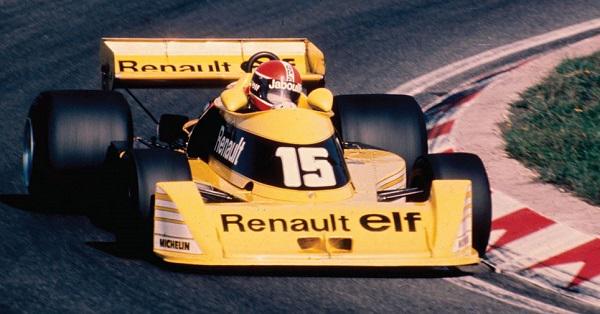
In context, surely the most idiotic racecar for its time must have been Renault's RS-01 in 1977 which pioneered the proper use of turbocharging in F1.
Just a glance through the entry list for the 1977 Formula One World Championship will make it incredibly obvious that the all conquering Ford Cosworth DFV V8 ruled the roost and apart from a few engine builders who ran V12s like Ferrari and Alfa Romeo, God was in his heaven and all was right with the world.
A bright spark and prize nutter at Renault, André de Cortanze, looked at the regulations which had been in place since 1966 and decided that Renault should make use of the sections which allowed forced-induction and committed the company to what must have seemed like at the time, an idiotic project.
The Renault RS-01, looked cumbersome and due to the fact that Renault couldn't immediately work out a way to contain the required pressures for turbocharging such a small engine, they had to cast the engine block from iron; consequently the car was hideously overweight compared with the rest of the field.
Even despite this, for 1977 and most of 1978, it consistently blew its top and expired in a cloud of white smoke, which gained it the name of the "Yellow Teapot". From 28 starts the car only finished 7 times; though it must be said that at the 1978 United States Grand Prix at Watkins Glen, Jean-Pierre Jabouille took it to fourth and scored the first ever points for a turbocharged car in Formula One.
Renault never really made their turbocharged engine work properly until they took a variant of it to Le Mans in the Renault Alpine A442 prototype to compete in the 24 Hours race and it was there that they improved the breed. Of course by 1983, turbocharging was de rigueur and they were vindicated but in 1977, who could have forseen that at all except for André de Cortanze?
The biggest difference between Renault in 1977 and Nissan in 2014 is that in the GT-R LM (even in spite of producing an automotive psychpath), Nissan is using technologies which are reasonably sure to work. Renault broke ground with something that no-one had done before.
¹http://www.topgear.com/uk/car-news/nissan-gt-r-le-mans-car-2015-02-02
²I am always open to the donation of a Honda Civic Type-R... or a Ford Ka.
I've had a few front wheel cars and probably the most amount of power I've ever had through those wheels is about 110bhp; even then you can still set up an interesting case of torque steer on wet roads. Conventional wisdom suggests that anything more than about 150bhp through the front wheels is generally considered unwise and when you get cars like the Ford Focus ST and the Honda Civic Type-R² sending upwards of +250bhp, it's a wonder why they don't just instantly torque steer you into the nearest tree.
If Nissan can even get this thing to work properly it will be something of a technical coup. Nissan's solution to the problem of torque steer isn't the usual solution of four wheel drive but to send even more power to the front wheels. It's like Nissan decided to employ both Jeremy Clarkson and Tim "The Toolman" Taylor as their engineers.
There mere thought of so much power going through the front wheels is enough to make you want to take the motorway to Crazy Town; provided you don't torque steer your way through the nearest mountain. This honestly sounds like Nissan have produced a car which is actively trying to kill you.
In this brave new world where automotive babies are brought up in jars (and only time will tell if this is an Alpha Plus or an Epsilon Minus Moron), I wondered what the most bonkers idea for a race car actually was.
I'm not thinking about cars like Brabham's BT49B or the Chaparral 2J "fan cars" which used the sensible idea of sucking out all the air out from under them to create ground effect, or the Lotus 56 or STP-Paxton Turbocar which used small jet engines because again they were both sensible ideas. Parnelli Jones had the STP-Paxton Turbocar fail just 8 miles from the end of the 1967 Indianapolis 500 and Joe Leonard's Lotus 56 failed due to a Fuel Shaft failure whilst in the lead in 1968.
- Check out those massive rear tyres. They're like trampolines of rubber.
In context, surely the most idiotic racecar for its time must have been Renault's RS-01 in 1977 which pioneered the proper use of turbocharging in F1.
Just a glance through the entry list for the 1977 Formula One World Championship will make it incredibly obvious that the all conquering Ford Cosworth DFV V8 ruled the roost and apart from a few engine builders who ran V12s like Ferrari and Alfa Romeo, God was in his heaven and all was right with the world.
A bright spark and prize nutter at Renault, André de Cortanze, looked at the regulations which had been in place since 1966 and decided that Renault should make use of the sections which allowed forced-induction and committed the company to what must have seemed like at the time, an idiotic project.
The Renault RS-01, looked cumbersome and due to the fact that Renault couldn't immediately work out a way to contain the required pressures for turbocharging such a small engine, they had to cast the engine block from iron; consequently the car was hideously overweight compared with the rest of the field.
Even despite this, for 1977 and most of 1978, it consistently blew its top and expired in a cloud of white smoke, which gained it the name of the "Yellow Teapot". From 28 starts the car only finished 7 times; though it must be said that at the 1978 United States Grand Prix at Watkins Glen, Jean-Pierre Jabouille took it to fourth and scored the first ever points for a turbocharged car in Formula One.
Renault never really made their turbocharged engine work properly until they took a variant of it to Le Mans in the Renault Alpine A442 prototype to compete in the 24 Hours race and it was there that they improved the breed. Of course by 1983, turbocharging was de rigueur and they were vindicated but in 1977, who could have forseen that at all except for André de Cortanze?
The biggest difference between Renault in 1977 and Nissan in 2014 is that in the GT-R LM (even in spite of producing an automotive psychpath), Nissan is using technologies which are reasonably sure to work. Renault broke ground with something that no-one had done before.
¹http://www.topgear.com/uk/car-news/nissan-gt-r-le-mans-car-2015-02-02
²I am always open to the donation of a Honda Civic Type-R... or a Ford Ka.
February 04, 2015
Horse 1834 - Insure ALL The Things!

- I reckon I could be up for some Flower Therapy
The above advert tries to make the point that you don't pay for the things you don't need with ahm Insurance. I suppose that it sort of does that but there is a really strange set of inferences which can be drawn from this advert.
1. We Will Tell You The Things.
The statement that "Flower Therapy is not one of those things" is incredibly authoritarian in nature. The insurance company ahm is dictating to you that you either do or do not need that thing. If ahm does have the power to dictate to you the things that it thinks you need, or at least the things which it will insure you for, what happens if a thing happens which isn't one of the things?
The whole point of insurance is that it is a hedge against an uncertain loss which has been dissipated across many other like insurable items. In the case of health care, those other like insurable items are the health and well being of other people who pay premiums. By having ahm dictate to you the thing which is going to happen, they can exclude you from coverage for an unnamed thing. Suppose that that unnamed thing was a particularly virulent and aggressive form of cancer or leukaemia: what happens then if the thing which you actually need at that time "is not one of those things" which ahm will cover? What if chemotherapy "is not one of those things", or dialysis "is not one of those things"? The insurance company ahm has just expressly dictated to you that you are on your own; how sad, too bad.
2. Other Companies Are Doing Stupid Things.
The statement that "Flower Therapy is not of of those things" combined with the first statement that "ahm insurance covers you for the things you need" sort of implies that other insurance companies cover for things you don't need.
Insurance companies aren't charities though and so I very much doubt that the other insurance companies would charge for coverage on some hitherto unimaginable series of events or conditions which would even warrant flower therapy. Granted that insurance companies have a history in not paying out claims at all in some circumstances, but that doesn't necessarily imply that they'd even charge premiums for a series of events which are never going to happen.
I thought I'd do a little bit of research into finding out what "flower therapy" was; after fifteen minutes of random reinforcement from the Yellow Pages and discovering that there are no practitioners who are listed in Sydney as dealing in flower therapy, the process of elimination leads me to conclude that it isn't even a thing. Mind you, there are some really strange things which health insurance companies will cover you for and charge premiums accordingly. Ear candling is a thing, Swedish cupping is a thing but flower therapy is not a thing.
Flower therapy is not one of those things you need because it is not a thing. Saying that they do not charge for a thing which does not exist, suggests to me that ahm might have a Department of Redundancies Redundancy Department; they will charge you for the administrative expense of running that redundant department.
3. You Need To Pay For Their Profits.
This is a matter of which syllable you put the emphasis on. Obviously you need to pay for their profits because if you want to be covered, you need to pay. If ahm insurance covers you for the things you need, then they've just said that you need to line someone else's pockets.
I have a sort of ideological problem with private firms trading upon the health of the population as a business model. Insurance itself is governed by negative self selection criteria, which mean to say that the people who need it the most are most likely to buy in and the people who need it least are the least likely to buy in, and the most efficient position for any insurance system is when the whole population of insurable items is covered. With health care, this is demonstrably proven with real world examples, as countries with a greater degree of public health care have lower per unit costs.
By ahm insurance as a private firm saying that they cover you for the things you need, they are in effect saying that you need a more expensive and less efficient health care system. Anyone who has suffered through the United States' health care system knows that you need a more expensive and less efficient health care system like you need an untreated hole in the head because the health insurance companies won't cover you.
Hyperbole? Absolutely.
I do wonder though:
If we were to stretch this out beyond the point of sensibility and did find that flower therapy was a thing, would ahm's flower therapy be a good one? Would private patient flower therapy through a more expensive provider be a whole bouquet whilst NHS flower therapy be just a couple of sad looking chrysanthemums? Which health insurance provider did Vincent Van Gogh use, that he was able to get flower therapy but they charged him an ear?
Health insurance generally is the sort of thing which you should consider purchasing because it is prudent to do so. The various kinds of cover which those health insurance companies provide is also a thing worth considering. Flower Therapy is not one of those things which any health insurance companies provide; so why even bring it up?
February 02, 2015
Horse 1833 - The Captain Is Not The Issue
As I write this on the train to work, I note that the Daily Telegraph has called today "D-Day" for Prime Minister Tony Abbott; whilst other pundits have said that this will be one of the most important weeks of his premiership. The reason given is the removal of Campbell Newman from his own seat by his electorate in the Queensland state election, which as at the time of writing is still in the process of vote counting to find a result.
The media is reporting the reason for Tony's removal as his refusal to take advice and this is evidenced by his "Captain's Call" to award a knighthood to Prince Phillip on Australia Day. Can I suggest that there is another reason why Campbell Newman lost his seat in the election, why the LNP in Queensland suffered a greater than expected swing in the election and why Tony will still be Prime Minister at the end of the day and at the end of this term of government.
Not even the Courier-Mail which stands alone as Queensland's daily newspaper, with three weeks of trying to rubbish the Labor Party and a leader who no-one had heard of, could drown out the LNP's message that it intended to sell off what little remains of Queensland's public assets. The alternatives presented were either to spend less on infrastructure and cut government services or to sell off what little remaining assets Queensland has. The other option of increasing taxation or putting pressure on the Federal Government to increase income tax (and thus roll back some of the ten sets of tax cuts between 2001- 2013) at the next COAG meeting was never even considered. The problem was presented as a false dichotomy and to be honest, the people of Queensland saw right through it.
Try as they could, the LNP just couldn't disguise the fact that their election campaign was basically one giant protection racket - give us what we want or we will hurt you. The upcoming NSW state election which is also later this years and has been dubbed a "Poles and Wires" election is shaping up to be the same argument; to be played out for the same reasons. The message that the Queensland election should have sent to the Liberal-National coalition in NSW and nationally is if you pluck enough feathers from a live chicken, it will squeal and then fight back.
Given this, why do I think that Tony will continue his premiership right up until election day? Because the lesson which should be learned, will not be allowed to be learned by the LNP's minders.
One thing that I've learnt after watching the best part of 30 seasons of football is that when a team is doing well, no-one criticises the manager. When a team is doing badly and faces relegation, even in spite of the fact that the players might not be good enough and that the team is rubbish, everyone starts calling for the manager to be sacked.
It should be noted that in 2007 when Kevin Rudd's government was swept to power on the back of a very large swing, John Howard became only the second Prime Minister to lose his own seat. Probably this should have sent a message to the Liberal-National coalition but it did not. Even installing Julia Gillard as Prime Minister in the run up to the 2010 election although it was the result of a fractious Labor caucus, wasn't enough for the electorate to decisively vote to remove the Labor Party. During those six years in the wilderness, what did the LNP learn about the electorate? Precisely nothing. Part of the manifesto of the Liberal-National coalition's 2013 campaign was the sell off of Medibank Private, just as the sale of Telstra had been 17 years' previous. The manager had changed a few times but the team was pretty well much the same.
The sad thing is that Labor hasn't really learned the lesson either. True, they're not actively looking to sell off assets but they've failed to prosecute the case for increasing taxation for fear of being kicked into the cold. The two-party preferred choice in Australia is one of timid incompetence versus cruel arrogance.
You can't go to an election promising to steal away the people's stuff and expect them to be happy about it. Making babies swallow unpalatable and foul tasting formula only produces the results of them screwing up their faces and spitting it out.
The lesson that should be learned is simple:
We like stuff. Don't sell our stuff. We don't want you to sell our stuff. Why are you selling our stuff?!
The media is reporting the reason for Tony's removal as his refusal to take advice and this is evidenced by his "Captain's Call" to award a knighthood to Prince Phillip on Australia Day. Can I suggest that there is another reason why Campbell Newman lost his seat in the election, why the LNP in Queensland suffered a greater than expected swing in the election and why Tony will still be Prime Minister at the end of the day and at the end of this term of government.
Not even the Courier-Mail which stands alone as Queensland's daily newspaper, with three weeks of trying to rubbish the Labor Party and a leader who no-one had heard of, could drown out the LNP's message that it intended to sell off what little remains of Queensland's public assets. The alternatives presented were either to spend less on infrastructure and cut government services or to sell off what little remaining assets Queensland has. The other option of increasing taxation or putting pressure on the Federal Government to increase income tax (and thus roll back some of the ten sets of tax cuts between 2001- 2013) at the next COAG meeting was never even considered. The problem was presented as a false dichotomy and to be honest, the people of Queensland saw right through it.
Try as they could, the LNP just couldn't disguise the fact that their election campaign was basically one giant protection racket - give us what we want or we will hurt you. The upcoming NSW state election which is also later this years and has been dubbed a "Poles and Wires" election is shaping up to be the same argument; to be played out for the same reasons. The message that the Queensland election should have sent to the Liberal-National coalition in NSW and nationally is if you pluck enough feathers from a live chicken, it will squeal and then fight back.
Given this, why do I think that Tony will continue his premiership right up until election day? Because the lesson which should be learned, will not be allowed to be learned by the LNP's minders.
One thing that I've learnt after watching the best part of 30 seasons of football is that when a team is doing well, no-one criticises the manager. When a team is doing badly and faces relegation, even in spite of the fact that the players might not be good enough and that the team is rubbish, everyone starts calling for the manager to be sacked.
It should be noted that in 2007 when Kevin Rudd's government was swept to power on the back of a very large swing, John Howard became only the second Prime Minister to lose his own seat. Probably this should have sent a message to the Liberal-National coalition but it did not. Even installing Julia Gillard as Prime Minister in the run up to the 2010 election although it was the result of a fractious Labor caucus, wasn't enough for the electorate to decisively vote to remove the Labor Party. During those six years in the wilderness, what did the LNP learn about the electorate? Precisely nothing. Part of the manifesto of the Liberal-National coalition's 2013 campaign was the sell off of Medibank Private, just as the sale of Telstra had been 17 years' previous. The manager had changed a few times but the team was pretty well much the same.
The sad thing is that Labor hasn't really learned the lesson either. True, they're not actively looking to sell off assets but they've failed to prosecute the case for increasing taxation for fear of being kicked into the cold. The two-party preferred choice in Australia is one of timid incompetence versus cruel arrogance.
You can't go to an election promising to steal away the people's stuff and expect them to be happy about it. Making babies swallow unpalatable and foul tasting formula only produces the results of them screwing up their faces and spitting it out.
The lesson that should be learned is simple:
We like stuff. Don't sell our stuff. We don't want you to sell our stuff. Why are you selling our stuff?!
No lessons have been learned and the Liberal-National coalition will peddle the message that the leadership is united right up until the next polling day. They won't change the captain. The problem is that they should change the game plan - otherwise the people will continue to react like this.
January 31, 2015
Horse 1832 - Australia Is Too Good For Asia? Expel Them? No!
http://www.abc.net.au/news/2015-01-30/afc-nations-want-to-evict-socceroos-from-asia/6056870
The president of Asia's football governing body says Gulf nations want the Socceroos expelled from the continental confederation.
"There are indications that prove that such desire exists among the confederations of west Asia to evict Australia. But I also know that the Arabs are not the only ones who are not convinced that Australia's membership in Asia's football is feasible."
- AFC president Sheikh Salman bin Ebrahim al-Khalifa, - ABC News, 30th Jan 2015
With Australia hosting and playing in the AFC Asian Cup football final tonight, there is a very real chance that by midnight tonight, Australia could hold both of Asia's top football prizes: The Asian Cup and the AFC Champions League Cup (after Western Sydney Wanderers won it in November).
As the ABC reported, the reason for Arabic nations unhappiness about Australia being in the confederation is because that since it entered the Asian Football Confederation it has appeared at both the 2010 and 2014 World Cups and the knockout stages of all three Asian Cups it has played in including two finals.
The ABC makes the rather obvious point that "there is a feeling among aspirational west Asian nations that the Socceroos are taking a spot away from the rest of the continent"; this was dealt with more bluntly and with all the tact of a sledgehammer hitting an egg by the Daily Mail which ran the headline "Are we too good for Asian Cup soccer?"¹ The answer to the Daily Mail's question is obviously demonstrably 'yes' but in lieu of the fact that Australia is easily too good for Oceania but not good enough for South America, Asia is the logical spot for Australia to play.
The question then is, is that the right action which should be taken? If Australia is showing up the rest of Asia to be not very good, doesn't that imply that Asia needs to lift its game? Or perhaps the other argument might be true, that it isn't that Australia is taking away an Asian spot at the World Cup but that there aren't enough Asian spots - this argument can be made easily.
At the 2014 World Cup in Brazil, thirty-two teams competed:
4 of 47 from the AFC,
4 of 41 from the CONCACAF,
5 of 56 from the CAF,
but
6 of 10 from CONMEBOL and
13 of 54 from UEFA.
There were also zero from the OFC.
Now tell me who's taking up all the spots at the World Cup? Was it Australia did it have more to do with the fact that UEFA by itself took up more than four confederations? CONMEBOL which is from South America only has 10 nations but 60% of them went to the World Cup.
The average rankings at the tournament was thus though:
52.0 - AFC,
23.5 - CONCACAF,
36.4 - CAF
but
10.5 - CONMEBOL and
11.2 - UEFA.
The highest ranked team in Asia which was Iran was ranked 43 but the lowest ranked nation from any other confedration was Nigeria at 44.
It didn't help either that the four Asian nations all came bottom of their groups at the World Cup though - four year's previous in 2010, 3 of 4 escaped the group stages; you have to go all the way back to 2002 to find an African or Asian nation in the quarter-finals.
What to do about this, then eh? I think that the solution is obvious. Don't expel Australia but give Asia more spots in the World Cup. Second to that I think that the OFC should be subsumed by the AFC.
Realistically when you have nations like Tuvalu which has a population of less than 11,000 people or even Tahiti at 183,000, you can't expect any OFC nation other than New Zealand or Fiji to qualify for anything ever; even New Zealand floated plans for join CONMEBOL in 2013.
If the OFC was absorbed by the AFC, the membership of the AFC would increase to 61 nations... sort of. As part of that process, I'd suggest that the entire OFC except for Fiji and New Zealand play as the Oceania Football Team. Combined teams aren't unheard of, even in FIFA - the Soviet Union made it to four European Championship finals and won one and was even Olympic football champion in 1956. The Oceania Football Team would probably never reach those heights but it might give the AFC the necessary bargaining power to some of South America's or Europe's spots away from them.
Expelling Australia from Asia isn't the answer I think. I don't think that the argument should be with Australia for being too good but with FIFA for protecting its own.
¹http://www.dailymail.co.uk/news/article-2932458/Are-good-Asian-Cup-soccer-Middle-East-nations-leading-push-Australia-booted-competition.html
The president of Asia's football governing body says Gulf nations want the Socceroos expelled from the continental confederation.
"There are indications that prove that such desire exists among the confederations of west Asia to evict Australia. But I also know that the Arabs are not the only ones who are not convinced that Australia's membership in Asia's football is feasible."
- AFC president Sheikh Salman bin Ebrahim al-Khalifa, - ABC News, 30th Jan 2015
With Australia hosting and playing in the AFC Asian Cup football final tonight, there is a very real chance that by midnight tonight, Australia could hold both of Asia's top football prizes: The Asian Cup and the AFC Champions League Cup (after Western Sydney Wanderers won it in November).
As the ABC reported, the reason for Arabic nations unhappiness about Australia being in the confederation is because that since it entered the Asian Football Confederation it has appeared at both the 2010 and 2014 World Cups and the knockout stages of all three Asian Cups it has played in including two finals.
The ABC makes the rather obvious point that "there is a feeling among aspirational west Asian nations that the Socceroos are taking a spot away from the rest of the continent"; this was dealt with more bluntly and with all the tact of a sledgehammer hitting an egg by the Daily Mail which ran the headline "Are we too good for Asian Cup soccer?"¹ The answer to the Daily Mail's question is obviously demonstrably 'yes' but in lieu of the fact that Australia is easily too good for Oceania but not good enough for South America, Asia is the logical spot for Australia to play.
The question then is, is that the right action which should be taken? If Australia is showing up the rest of Asia to be not very good, doesn't that imply that Asia needs to lift its game? Or perhaps the other argument might be true, that it isn't that Australia is taking away an Asian spot at the World Cup but that there aren't enough Asian spots - this argument can be made easily.
At the 2014 World Cup in Brazil, thirty-two teams competed:
4 of 47 from the AFC,
4 of 41 from the CONCACAF,
5 of 56 from the CAF,
but
6 of 10 from CONMEBOL and
13 of 54 from UEFA.
There were also zero from the OFC.
Now tell me who's taking up all the spots at the World Cup? Was it Australia did it have more to do with the fact that UEFA by itself took up more than four confederations? CONMEBOL which is from South America only has 10 nations but 60% of them went to the World Cup.
The average rankings at the tournament was thus though:
52.0 - AFC,
23.5 - CONCACAF,
36.4 - CAF
but
10.5 - CONMEBOL and
11.2 - UEFA.
The highest ranked team in Asia which was Iran was ranked 43 but the lowest ranked nation from any other confedration was Nigeria at 44.
It didn't help either that the four Asian nations all came bottom of their groups at the World Cup though - four year's previous in 2010, 3 of 4 escaped the group stages; you have to go all the way back to 2002 to find an African or Asian nation in the quarter-finals.
The question now I suppose is how does anyone expect Africa or Asia or North America to improve if they aren't sending teams to major competitions. I don't think that the big issue is that Australia is taking away a spot from Asia but that Asia and Africa and North America aren't given enough spots.
What to do about this, then eh? I think that the solution is obvious. Don't expel Australia but give Asia more spots in the World Cup. Second to that I think that the OFC should be subsumed by the AFC.
Realistically when you have nations like Tuvalu which has a population of less than 11,000 people or even Tahiti at 183,000, you can't expect any OFC nation other than New Zealand or Fiji to qualify for anything ever; even New Zealand floated plans for join CONMEBOL in 2013.
If the OFC was absorbed by the AFC, the membership of the AFC would increase to 61 nations... sort of. As part of that process, I'd suggest that the entire OFC except for Fiji and New Zealand play as the Oceania Football Team. Combined teams aren't unheard of, even in FIFA - the Soviet Union made it to four European Championship finals and won one and was even Olympic football champion in 1956. The Oceania Football Team would probably never reach those heights but it might give the AFC the necessary bargaining power to some of South America's or Europe's spots away from them.
Expelling Australia from Asia isn't the answer I think. I don't think that the argument should be with Australia for being too good but with FIFA for protecting its own.
¹http://www.dailymail.co.uk/news/article-2932458/Are-good-Asian-Cup-soccer-Middle-East-nations-leading-push-Australia-booted-competition.html
January 30, 2015
Horse 1831 - Law Expert Says X; I Say Y? (QLD Election 2015).
http://www.abc.net.au/news/2015-01-30/campbell-newman-could-remain-premier-if-seat-lost-expert-says/6056538
But the possibility is now being raised that even if he loses Ashgrove, Mr Newman could potentially stay on as Premier.
Professor of Constitutional Law Anne Twomey said if Mr Newman were to lose his seat, but the LNP won, he would have two options.
"One is he can resign as Premier and let somebody else take over and just drop out of politics," she said.
"The second choice is the more controversial one, and that is to stay on as Premier and seek a new seat, perhaps by persuading one of his loyal members to resign and make way for him so that there's a by-election in a new seat.
"If Campbell Newman took a period of time, say under 90 days, in order to become a Member of Parliament by way of a by-election, then that would probably be okay. But if he pushed his luck too far and wanted to just be Premier without a seat full stop, then I think you'd probably see legal action in the courts."
Professor Twomey said there was no express provision in the Queensland Constitution requiring the premier to be a member of parliament, so if Mr Newman lost his seat it would not automatically vacate his office as premier.
The same is true for the Australian Constitution.
- ABC News, 30th January 2015
I live in a world where looking at the law and its consequences is commonplace. As someone who works in an accounting firm and has to know about tax law, I find discussions like this interesting. At the same time, taxation law is so incredibly complex than no-one can expect to know it all by heart because it's constantly changing and being re-written as people try to find ways to subvert and circumvent it.
So whilst I find the above discussion interesting, I also find it so brilliantly pleasing because ultimately it is totally pointless.
Whilst it is true that Professor of Constitutional Law Anne Twomey says that was no express provision in the Queensland Constitution requiring the premier to be a member of parliament, which means that if Mr Newman lost his seat it would not automatically vacate his office as premier, this conveniently ignores the one person in Queensland who has the last say on who is Premier - The Governor.
To that extent, it matters not if there is no provision requiring premier to be a member of parliament, Not even a single iota, not a jot, not a tiddle, not a speck, not even a fig on-board QF2540 from Brisbane to Longreach.
See below:
https://www.legislation.qld.gov.au/LEGISLTN/CURRENT/C/ConstofQA01.pdf
34 Power of Governor—Ministers
Ministers hold office at the pleasure of the Governor who, in the exercise of the Governor’s power to appoint and dismiss the Ministers, is not subject to direction by any person and is not limited as to the Governor’s sources of advice.
35 Power of Governor—removal or suspension of officer
(2) To the extent that it is within the Governor’s power and if the Governor considers there is sufficient reason, the Governor may remove or suspend a person holding an office or place under an appointment made in the name or under the authority of the Sovereign.
Two things here: firstly that it is the Governor who appoints and dismissed the Ministers under Section 34 of the Queensland Constitution and secondly hat it is the Governor who may remove or suspend a person holding an office under Section 34 of the Queensland Constitution.
I am not a constitutional lawyer but because I have been bestowed with the power of literacy, even I can say that if Campbell Newman lost his seat and then the Governor dismissed him as Premier, which seems fair and reasonable to me as he would then not be a member of the parliament, then that would be constitutionally watertight.
There'd be no argument whatsoever and unlike the set of circumstances which led to the dismissal of a Prime Minister in 1975, the powers of the Governor of Queensland are in this case, specifically defined by the highest law in the state, Professor Twomey's conjectures in this case collapse like a soufflé.
Aside:
Professor Twomey said there was no express provision in the Queensland Constitution requiring the premier to be a member of parliament, so if Mr Newman lost his seat it would not automatically vacate his office as premier.
The same is true for the Australian Constitution.
This technically correct - the best kind of correct (sort of).
http://www.aph.gov.au/About_Parliament/Senate/Powers_practice_n_procedures/~/media/AC79BBA0B87A4906A6D71ACCEEF10535.ashx
64. Ministers of State
Ministers to sit in Parliament
After the first general election no Minister of State shall hold office for a longer period than three months unless he is or becomes a senator or a member of the House of Representatives.
Technically if you look through the Constitution, there is no mention of the Prime Minister. There is an Executive Council and there are Ministers (of which the Prime Minister is presumably one) but the office of the Prime Minister is conspicuous by its absence.
Apart from this, if a sitting Prime Minister had lost his seat in the Federal parliament, he would not immediately lose his job as a Minister but after three months, he would.
But the possibility is now being raised that even if he loses Ashgrove, Mr Newman could potentially stay on as Premier.
Professor of Constitutional Law Anne Twomey said if Mr Newman were to lose his seat, but the LNP won, he would have two options.
"One is he can resign as Premier and let somebody else take over and just drop out of politics," she said.
"The second choice is the more controversial one, and that is to stay on as Premier and seek a new seat, perhaps by persuading one of his loyal members to resign and make way for him so that there's a by-election in a new seat.
"If Campbell Newman took a period of time, say under 90 days, in order to become a Member of Parliament by way of a by-election, then that would probably be okay. But if he pushed his luck too far and wanted to just be Premier without a seat full stop, then I think you'd probably see legal action in the courts."
Professor Twomey said there was no express provision in the Queensland Constitution requiring the premier to be a member of parliament, so if Mr Newman lost his seat it would not automatically vacate his office as premier.
The same is true for the Australian Constitution.
- ABC News, 30th January 2015
I live in a world where looking at the law and its consequences is commonplace. As someone who works in an accounting firm and has to know about tax law, I find discussions like this interesting. At the same time, taxation law is so incredibly complex than no-one can expect to know it all by heart because it's constantly changing and being re-written as people try to find ways to subvert and circumvent it.
So whilst I find the above discussion interesting, I also find it so brilliantly pleasing because ultimately it is totally pointless.
Whilst it is true that Professor of Constitutional Law Anne Twomey says that was no express provision in the Queensland Constitution requiring the premier to be a member of parliament, which means that if Mr Newman lost his seat it would not automatically vacate his office as premier, this conveniently ignores the one person in Queensland who has the last say on who is Premier - The Governor.
To that extent, it matters not if there is no provision requiring premier to be a member of parliament, Not even a single iota, not a jot, not a tiddle, not a speck, not even a fig on-board QF2540 from Brisbane to Longreach.
See below:
https://www.legislation.qld.gov.au/LEGISLTN/CURRENT/C/ConstofQA01.pdf
34 Power of Governor—Ministers
Ministers hold office at the pleasure of the Governor who, in the exercise of the Governor’s power to appoint and dismiss the Ministers, is not subject to direction by any person and is not limited as to the Governor’s sources of advice.
35 Power of Governor—removal or suspension of officer
(2) To the extent that it is within the Governor’s power and if the Governor considers there is sufficient reason, the Governor may remove or suspend a person holding an office or place under an appointment made in the name or under the authority of the Sovereign.
Two things here: firstly that it is the Governor who appoints and dismissed the Ministers under Section 34 of the Queensland Constitution and secondly hat it is the Governor who may remove or suspend a person holding an office under Section 34 of the Queensland Constitution.
I am not a constitutional lawyer but because I have been bestowed with the power of literacy, even I can say that if Campbell Newman lost his seat and then the Governor dismissed him as Premier, which seems fair and reasonable to me as he would then not be a member of the parliament, then that would be constitutionally watertight.
There'd be no argument whatsoever and unlike the set of circumstances which led to the dismissal of a Prime Minister in 1975, the powers of the Governor of Queensland are in this case, specifically defined by the highest law in the state, Professor Twomey's conjectures in this case collapse like a soufflé.
Aside:
Professor Twomey said there was no express provision in the Queensland Constitution requiring the premier to be a member of parliament, so if Mr Newman lost his seat it would not automatically vacate his office as premier.
The same is true for the Australian Constitution.
This technically correct - the best kind of correct (sort of).
http://www.aph.gov.au/About_Parliament/Senate/Powers_practice_n_procedures/~/media/AC79BBA0B87A4906A6D71ACCEEF10535.ashx
64. Ministers of State
Ministers to sit in Parliament
After the first general election no Minister of State shall hold office for a longer period than three months unless he is or becomes a senator or a member of the House of Representatives.
Technically if you look through the Constitution, there is no mention of the Prime Minister. There is an Executive Council and there are Ministers (of which the Prime Minister is presumably one) but the office of the Prime Minister is conspicuous by its absence.
Apart from this, if a sitting Prime Minister had lost his seat in the Federal parliament, he would not immediately lose his job as a Minister but after three months, he would.
January 29, 2015
Horse 1830 - We Want You To Work For Less Pay
http://www.2gb.com/audioplayer/85181
If you don’t want to work on a weekend, fair enough don’t work on a weekend. But if you do want to work on a weekend, and lots of people, particularly young people, particularly students, would love to work on a weekend, you want to see the employers open to provide jobs, and you're dead right there.
There are lots of places that are now closed, that use to be open. The hotel that I stay in in Melbourne, doesn't open the restaurant on a Sunday night anymore because of penalty rates. You try to get to a bottle shop for Easter an it's almost impossible because of penalty rates.
Now, I don’t begrudge people the money, you know I'm a high paid worker and the last thing I want to do is begrudge comparatively low paid workers their money but in the end there is a balance that has to be struck here and my preference will always be in favour of more jobs.
- Tony Abbott, in conversation with Ben Fordham, Radio 2GB, 23rd Jan 2015.
(from 0:10:25 onwards)
Already Productivity Commission has the issues of the minimum wage on its list of things for review and has released several issues papers but essentially there are and will always be two tribes at war on the issue. This war is more or less the same war which has been raging in Australian politics from even before federation and which shows no signs of ending soon.
One which says that employees' interests are worth protecting and this includes such things as penalty rates and the other which says that penalty rates should be a choice for individual enterprises and their employees, with little or no regulation.
The employer-employee relationship is essentially an uneven one. Like so many circumstances where money is involved, the other "golden rule" applies: "whoever has the gold, makes the rules". This is also true in politics as well; it isn't necessarily by accident that the current Prime Minister and Treasurer both happen to represent two of the richest electorates in the country. Money talks, and loudly; this time it's positively yelling until all other possible voices are drowned out. Alas poor Democracy, I knew him.
The biggest single driver in the cost of wages, or rather the wages that people demand, is people's occupation costs; that is, the humble task of putting a roof over one's head. For people further up the income ladder, this includes the repayment of ever larger mortgages but at the end of the income ladder which is most likely to actually benefit from penalty rates, the best that a lot of people can hope to aspire to is keeping the rent collectors at bay.
In modern Australia where the manufacturing sector has withered on the vine or has been kicked violently to pieces, the occupations where you're most likely to find workers who are currently entitled to penalty rates is in sectors like retail and hospitality. In these sectors, workers are not only under the pump in terms of competing with each other but also in terms of job security. Someone who is entitled to penalty rates is also more likely to be employed on a part-time or casual basis. The question of if they're likely to be even called in to work tomorrow weighs more heavily on such peoples' minds than if ever does to salaried workers.
Mr Abbott's example of a restaurant which didn't open on Sunday nights; specifically because of penalty rates, demonstrates that he either doesn't understand about people's situations or more tellingly, doesn't care about the circumstances and conditions which the people who would be affected by the abolition of penalty rates would face.
It seems that he almost expects services to be open even though a market solution has produced a different outcome; I wonder if this shows an underlying sentiment of entitlement at work here. If it isn't convenient for the workers to work on a Sunday night, Mr Abbott is openly telling people that their inconvenience is not valued and is not worth a paying a premium for. I find this all the more galling when you consider that the terms which define his own working conditions are very generous in terms of allowances; and these allowances make a few dollars an hour in penalty rates pale in comparison.
Looking closer at this restaurant (which isn't named and therefore the actual non-existence of which can not be disproven) as Mr Abbott claims can not afford to stay open specifically because of penalty rates, is already demonstrating a market outcome with respect to wages. The profit motive is the usual reason why business does anything and if it doesn't open on a Sunday night then this might show that it isn't willing to raise prices to cover those rates because it knows that its clientele isn't prepared to pay the increased prices. Mr Abbott (like the Government he leads) however, only sees this as a spending and not a revenue issue; where the only allowable solution is to drive down input costs. This is quite apart from the fact that the cooks and waiters who work in the restaurant probably can not afford to eat there as a customer. Such an attitude says that the fruits of labour do not belong to those that labour but those who derive profits from it. The attitude displayed by the statement that "if you don't want to work weekends, don't work weekends" tries to reframe the issue as one of choice, when in actual fact someone who needs the money might have very little choice at all. You might find it very difficult to quit if this particular job happens to fit with your other obligations in life such as family commitments and just quitting or not working might not be such an easy option to someone who lives from paycheque to paycheque.
History is littered with examples where if allowed, employers will pay their employees as little as possible; nothing if they can get away with it. Even today, there are organisations holding out the carrot of "experience" whilst offering that "experience" in unpaid internships; so I very much doubt that there is a lower limit to the level of nastiness that people will descend to. The only reason that awards and penalty rates exist and are protected by law is because people had to fight for them (and in some cases lose their lives in that fight). I suspect that the reason why the current push to abolish penalty rates is on, is because employers have sensed that power has again tilted back in their favour. As more people move into either white collar work where they are paid wages and unpaid overtime runs rampant and as the people who would have once worked in factories now find themselves in retail, the ability for unions to achieve anything at all has been diminished. I don't know if we're likely to see a return to the Combinations Act of 1799 which prohibited people's ability to form unions and engage in collective bargaining because I doubt if the need to pass such legislation even exists any more. There is no need to ban workers' rights to join a union in a labour market where no union exists.
I'm speculating here but it could be that the awarding of Prince Phillip with a knighthood (which I'm largely ambivalent to) was designed to create so much of a media storm as to draw attention away from the fact that decisions and negotiations are being made to erode workers' rights and rates of pay. Why not draw attention to a clumsy action if it makes people forget about the callous one about to be perpetrated against them? It's easy to fleece someone whilst you're pulling the wool over their eyes.
If you don’t want to work on a weekend, fair enough don’t work on a weekend. But if you do want to work on a weekend, and lots of people, particularly young people, particularly students, would love to work on a weekend, you want to see the employers open to provide jobs, and you're dead right there.
There are lots of places that are now closed, that use to be open. The hotel that I stay in in Melbourne, doesn't open the restaurant on a Sunday night anymore because of penalty rates. You try to get to a bottle shop for Easter an it's almost impossible because of penalty rates.
Now, I don’t begrudge people the money, you know I'm a high paid worker and the last thing I want to do is begrudge comparatively low paid workers their money but in the end there is a balance that has to be struck here and my preference will always be in favour of more jobs.
- Tony Abbott, in conversation with Ben Fordham, Radio 2GB, 23rd Jan 2015.
(from 0:10:25 onwards)
Already Productivity Commission has the issues of the minimum wage on its list of things for review and has released several issues papers but essentially there are and will always be two tribes at war on the issue. This war is more or less the same war which has been raging in Australian politics from even before federation and which shows no signs of ending soon.
One which says that employees' interests are worth protecting and this includes such things as penalty rates and the other which says that penalty rates should be a choice for individual enterprises and their employees, with little or no regulation.
The employer-employee relationship is essentially an uneven one. Like so many circumstances where money is involved, the other "golden rule" applies: "whoever has the gold, makes the rules". This is also true in politics as well; it isn't necessarily by accident that the current Prime Minister and Treasurer both happen to represent two of the richest electorates in the country. Money talks, and loudly; this time it's positively yelling until all other possible voices are drowned out. Alas poor Democracy, I knew him.
The biggest single driver in the cost of wages, or rather the wages that people demand, is people's occupation costs; that is, the humble task of putting a roof over one's head. For people further up the income ladder, this includes the repayment of ever larger mortgages but at the end of the income ladder which is most likely to actually benefit from penalty rates, the best that a lot of people can hope to aspire to is keeping the rent collectors at bay.
In modern Australia where the manufacturing sector has withered on the vine or has been kicked violently to pieces, the occupations where you're most likely to find workers who are currently entitled to penalty rates is in sectors like retail and hospitality. In these sectors, workers are not only under the pump in terms of competing with each other but also in terms of job security. Someone who is entitled to penalty rates is also more likely to be employed on a part-time or casual basis. The question of if they're likely to be even called in to work tomorrow weighs more heavily on such peoples' minds than if ever does to salaried workers.
Mr Abbott's example of a restaurant which didn't open on Sunday nights; specifically because of penalty rates, demonstrates that he either doesn't understand about people's situations or more tellingly, doesn't care about the circumstances and conditions which the people who would be affected by the abolition of penalty rates would face.
It seems that he almost expects services to be open even though a market solution has produced a different outcome; I wonder if this shows an underlying sentiment of entitlement at work here. If it isn't convenient for the workers to work on a Sunday night, Mr Abbott is openly telling people that their inconvenience is not valued and is not worth a paying a premium for. I find this all the more galling when you consider that the terms which define his own working conditions are very generous in terms of allowances; and these allowances make a few dollars an hour in penalty rates pale in comparison.
Looking closer at this restaurant (which isn't named and therefore the actual non-existence of which can not be disproven) as Mr Abbott claims can not afford to stay open specifically because of penalty rates, is already demonstrating a market outcome with respect to wages. The profit motive is the usual reason why business does anything and if it doesn't open on a Sunday night then this might show that it isn't willing to raise prices to cover those rates because it knows that its clientele isn't prepared to pay the increased prices. Mr Abbott (like the Government he leads) however, only sees this as a spending and not a revenue issue; where the only allowable solution is to drive down input costs. This is quite apart from the fact that the cooks and waiters who work in the restaurant probably can not afford to eat there as a customer. Such an attitude says that the fruits of labour do not belong to those that labour but those who derive profits from it. The attitude displayed by the statement that "if you don't want to work weekends, don't work weekends" tries to reframe the issue as one of choice, when in actual fact someone who needs the money might have very little choice at all. You might find it very difficult to quit if this particular job happens to fit with your other obligations in life such as family commitments and just quitting or not working might not be such an easy option to someone who lives from paycheque to paycheque.
History is littered with examples where if allowed, employers will pay their employees as little as possible; nothing if they can get away with it. Even today, there are organisations holding out the carrot of "experience" whilst offering that "experience" in unpaid internships; so I very much doubt that there is a lower limit to the level of nastiness that people will descend to. The only reason that awards and penalty rates exist and are protected by law is because people had to fight for them (and in some cases lose their lives in that fight). I suspect that the reason why the current push to abolish penalty rates is on, is because employers have sensed that power has again tilted back in their favour. As more people move into either white collar work where they are paid wages and unpaid overtime runs rampant and as the people who would have once worked in factories now find themselves in retail, the ability for unions to achieve anything at all has been diminished. I don't know if we're likely to see a return to the Combinations Act of 1799 which prohibited people's ability to form unions and engage in collective bargaining because I doubt if the need to pass such legislation even exists any more. There is no need to ban workers' rights to join a union in a labour market where no union exists.
I'm speculating here but it could be that the awarding of Prince Phillip with a knighthood (which I'm largely ambivalent to) was designed to create so much of a media storm as to draw attention away from the fact that decisions and negotiations are being made to erode workers' rights and rates of pay. Why not draw attention to a clumsy action if it makes people forget about the callous one about to be perpetrated against them? It's easy to fleece someone whilst you're pulling the wool over their eyes.
Subscribe to:
Posts (Atom)