October 28, 2010

Horse 1122 - I Hate Halloween

(elements of this have been sporked from elsewhere)

I really hate halloween... no scratch that... I really really really hate halloween.

The truth is that I already don't like most of the children in my immediate neighbourhood. Some of them within earshot spend their entire lives from what I can gather, screaming and crying at the top of their lungs either at each other or at their poor frazzled parents.

Why then do I need them showing up at my door and demanding sweets? What would happen for instance if I were to walk 9 doors up the street and ask for lollies? People would think that I'm insane, and then probably ring up some gentlemen in blue to take me away in a fun car with flashing lights.

Miranda Devine in today's Daily Telegraph writes:
http://www.news.com.au/opinion/miranda-devine-asks-why-are-all-men-made-to-feel-like-fiends/story-e6frfs99-1225944489870
In 100 different ways every day the same scenario is played out, reflecting a profound and largely unspoken shift in the way decent men view small children.
These are just ordinary men, fathers, grandfathers, brothers, uncles, who have been made to feel like criminals around children and obliged to suppress their natural, healthy instinct to protect the most vulnerable members of our society.

I don't know about you, but I don't want to be portrayed as some criminal pervert paedophiles. I certainly don't want children showing up at my door just to invite the suggestion. In fact if it came to it, I'd rather be known as a paedophobe; that way the sweet seeking sprogs would scavenge, sally and sortie somewhere else.

No sir, I don't like Halloween, or as it properly should be called "Scab Day" and nor should anyone else. No-one in their right might would vote for a "National Annoy The Crap Out Of Your Neighbours Day" would they? Then why send your kiddies out to do it for you?

Really the only people who actually benefit from it are the sweet manufacturers Messers Cadbury, Nestlé, et al. who have used this fake holiday to foist the sale of their diabetic inducing produce onto the public.

In yesterday's Age in Melbourne there was an article looking at the failure of programs to curb childhood obesity:
http://www.theage.com.au/national/child-obesity-a-losing-battle-20101025-170ya.html
The evidence from the fat battlefront so far shows that many schemes by federal and state governments to prevent childhood obesity have failed to make a significant dent in the girths of young Australians, Productivity Commission researchers have found.
Their report assesses 27 child and student-focused anti-obesity programs whose aims include promoting exercise, improving diet and cutting time spent in front of television and computer screens.

Can I just add a 28th anti-obesity program here? Don't send out increasingly corpulent children out to collect lollies and sweets! When I was a kid in school there was usually one fat kid per class, just one. I think that schools must have had some sort of allocation program to allocate fat kids. Now it seems that every class has more than just the odd fat kid but loads of them. Is that why teachers unions are calling for smaller class sizes? When I was a kid, classes of 34 weren't uncommon. Do 34 kids then equal 24 kids now?

There are theories that halloween started off as something a lot less sweet based. In 16th Century Scotland during the older "All-Hallows-Even", traditionally people would go from door-to-door, dressed up, and then telling jokes or even dancing to get something from their neighbours.

Anyway the upshot is, if children want sweets from me this year, they better be ready to dance for them. It will give me a reason to dress up as an organ grinder and madly yell "Dance! Dance my pretties! Dance for your sweeties! I'm gonna get you, and you're little dog too!". Then throw their reward at their feet so I can laugh malevolently as they scramble around like the pathetic sugar laden terrors they are.

Better yet, make their parents dance. That way the kids will cry and blame their parents for not loving them enough. And thus the cycle continues, children screaming and crying at the top of their lungs either at each other or at their poor frazzled parents.

October 27, 2010

Horse 1121 - The "Christian Right" has Might?

I was listening to NPR this morning (on one of those occasions when they were talking about artistic arrangements of spoons and whatnot) and they were talking to one of their political editors in Washington. Intruguingly, the comment was made that the "Christian Right" still have a considerable influence in Washington. Yet somehow I really wonder if this is in fact the case.

If I compare this comment to the Australian experience, where the Christian Democratic Party, the Democratic Labor Party and the Family First Party account for about maybe 6% of the primary vote at best, is that really any sway at all?

Admittedly the United States is decidedly more open about religion than impassive Australia is but when you figure that actual regular church attendance in the US is only about 9%, how exactly does this relay into "considerable influence in Washington"? Or is this just rhetoric employed to sucker dim-witted Christians into voting for the major parties?

From the outset the First Amendment to the US Constitution states that Congress shall make no law respecting an establishment of religion, or prohibiting the free exercise thereof;. Whilst this doesn't prevent the establishment of openly Christian political parties, the overall tone of the polity is that there should be a separation of church and state and this is stated almost to the point of violent bluntness. If anyone actually tried to set up an openly Christian political party in the US, would they be hounded down until their voice was extinguished?

I suspect that because of this, any Christian element in politics in the US has to somehow worm its way into the caucii of the GoP and the Democrats. If their say in both of those parties is the same as their say in the real world, then proportionally they should have a say of no more than about... 9%.

9% of the vote isn't enough to change policy at all; if you couple this with the fact that voting is a) not compulsory and b) there is actually a system of registration for which political party you happen to side with, I wonder if this would lead to the actual influence of Christian politics in the United States as being something nearer to 4% or 3%.

This is actually a strange paradigm when you consider that in the recent past, the loudest political voices are those do to with the issues of abortion and gay marriage. As Proposition 8 proved, even if you do have a broadly Christian viewpoint on anything, there are still louder voices and the government itself who are able to manipulate policy far better than the Christian element does.

Out of all this, I wonder whether or not the "Christian Right" has an influence at all in Washington, let alone a considerable one. Certainly the outcomes of policy like invading Iraq under the premise of a lie, holding people without trial for several years and the general hatred brewing about Muslims is certainly un-Christian.

Maybe the considerable influence in Washington that the "Christian Right" has is something more mundane... like baking scones or something?

October 25, 2010

Horse 1120 - Murdoch and the BBC

I'm afraid that it's just like old times again. Not content with destroying British industry to the point where it won't function again properly, the last time they were is office, the ****ing Tories have already started on their long term goals of hurting the BBC and ultimately selling it.

When David Cameron became Prime Minister as a result of forming a coalition with the Lib Dems, it may as well have been the magistrate signing a death warrant for the Beeb. Quite frankly it is disgusting that the very first person to go to Number 10 to meet with David Cameron after he became PM was none other Rupert Murdoch. There's nothing like a bit of nepotism is there?
It was Murdoch's newspapers who openly backed the Conservatives; even the chief political editor of News International in London Newton Dunn had this to say:
http://www.newstatesman.com/blogs/mehdi-hasan/2010/04/murdoch-biographer-sun-editor
"It is my job to see that Cameron fucking well gets into Downing Street," proclaimed Tom Newton Dunn, political editor of the Sun, to a group of journalists from rival papers, recently.

The question is, how do you bring down an organisation like the BBC. As an established media outlet, it is heralded the world over for its reportage in often dangerous places. Within the UK it runs four national television stations, nine national radio stations, and lots of regional media outlets. As far as production of media content goes, it is second to none. So then, how do you hurt the BBC? By striking it directly in the hip pocket.

http://www.guardian.co.uk/media/2010/oct/19/bbc-licence-fee-frozen
The BBC licence fee is to be frozen at the current level of £145.50 for the next six years, a 16% cut in real terms, after the corporation today concluded a bruising round of funding negotiations with the coalition government.


http://www.guardian.co.uk/politics/2010/oct/18/bbc-coalition-licence-fee-raid
BBC bosses fear that the coalition government is gearing up for a £500m-plus raid on the licence fee, by forcing the broadcaster to meet the full cost of free television licences for the over 75s.
The benefit – which was introduced by Gordon Brown when he was chancellor – costs £556m, and is currently paid for out of general taxation. But ministers are considering passing the bill on to the BBC as part of this week's comprehensive spending review.

The BBC is an almost independant quango. It raises its own funds through the instrument called the licence fee. People who own a television currently pay £145.50 per year to fund the BBC, and in return they get arguably the finest media organisation in the world.

The BBC itself presents a very real problem for News Ltd. Rupert Murdoch has been complaining for years that the BBC's mere existance robs him of his precious profits, and now that he's backed the Tories in the media (and probably with cash behind closed doors), he and people like him will begin to make the institution suffer which will only get worse and probably lead to the government selling it off (that and the NHS if they can ruin that as well). By cutting the BBC's funding off, firstly by limiting the licence fee, it would then justify "dropping" it as they did with the ABC in Australia, and once the BBC is firmly living in the government's pocket, it then isn't much of a stretch to justify selling it.

What I find particularly hypocritical about News Ltd was these comments he made:
http://www.bbc.co.uk/news/uk-politics-11594936
Mr Murdoch, whose News Corporation owns the Times, the Sun and Sky News, among other media outlets, also said a free society needed an independent press, adding it would "serve the interests of the powerful if professional journalists were muted, or replaced as navigators in our society by bloggers and bloviators".

"A free society needed an independent press"? Really? So let me get this straight, if you remove the biggest organisation with a broadly leftist viewpoint, then society would become more free because the remaining "independent press" is all broadly rightist? Does this work in practice?
In Australia we only have two large newspaper organisations; those being News Ltd. and Fairfax. Both of those groups are nominally centre-right newspapers and in places like Adelaide and Brisbane, Fairfax doesn't even run a large scale newspaper.

I really wonder what Rupert means by serving "the interests of the powerful if professional journalists were muted". Does he mean to say that it serves "the interests of the powerful" ie. him, if the BBC was muted? Also I failt to see how replacing very loud voices such as News Ltd with "bloggers and bloviators" makes society less free. When you consider that in 1920 Australia had 26 metropolitan dailies with 21 independent proprietors, and now has 10 metropolitan dailies with only 2 independent proprietors, can you really say that society was less free in 1920? Likewise in the UK, if the BBC is muted, who do you think is going to move into the void? Would it be Fox News? I sincerly hope not.

One thing that the world does not need is the removal of public broadcasting. The further we move down that road, the more we become like the American market; and the American news market which is mainly dominated by Fox News, has created a nation of really pathetically stupid and insular people. Then again I suppose that's what Mr Murdoch wants, isn't it? A world full of pathetically stupid and insular people who continue to put cash through the till.

October 22, 2010

Horse 1119 - Happiness is No Frills Orange

Something to drink is all I ask for. It's not a very difficult request, or is it?

Perhaps you'd like to try a simple experiment. Just go to your local supermarket and see if you can buy a single serve drink, that isn't either an energy drink or a +500mL bottle.
This leads me to an interesting question: Are our lives really that tiring that we either need to be wired up on caffeine or sugar? Why do we need so much liquid that we're forced to wee half an hour later? This is related to but not quite the same as the great Starbucks question of "why do we actually need a whole pint of scalding, flavoured liquid?"

375mL cans used to be easy to find on supermarket shelves. Granted, they still are there but now they only come in boxes of 10, 12, 18, 24, 30! When will the madness stop? Likewise if you do happen to find a can of drink in the supermarket, it's likely to be an "energy drink" of some sort (either V, Red Bull or Mother) and worse, the 250mL cans are disappearing and were starting to see 500mL cans appear in their place.

All of this makes me think two things which are complementary to each other.
Firstly, caffeine itself is a diuretic which means that it actually forces the production of urine. This means that a while after you've drunk something, that you'll have to take a wee somewhere, and thus require another drink sooner. Quite deliberately, this begins a faster wee-drink-wee-drink cycle, which results in higher profits for the drink manufacturers.
Secondly because is a psychoactive stimulant drug, it's also mildly addictive. The British Journal of Addiction concluded that caffeinism (if that's a word) affects 1 in 10 people but probably is only diagnosed in about 1 in 10,000.
These two things taken together mean that you have a product which is both addictive and forces self-promotion.

Going back to my original tag line that "Happiness is No Frills Orange", No Frills Orange drink from Franklins contains zero caffeine and therefore doesn't produce the negative effects mentioned above and because it's only 375mL, it won't force you to wee half an hour later. The other benefit is that it only costs 49 cents, which means that you can get five or six of them for the same price as Energy Wee-A-Lot drinks.

October 21, 2010

Horse 1118 - Risky Business.

I used to roll the dice
Feel the fear in my enemy's eyes
Listen as the crowd would sing:
"Now the old king is dead!

Long live the king!"
One minute I held the key
Next the walls were closed on me
And I discovered that my castles stand
Upon pillars of salt and pillars of sand
- Coldplay, Viva La Vida

History is one giant game of Risk. Various empires have sprung up and fallen, and the main reason why no-one has ever been entirely successful is that the world is simply to vast and unwieldy to take on all at once. To put it more succinctly, as that great sage BJD once said "Don't spread yourself too thin"

If you look at the truly great empires of history, then India, China, Egypt, the Incas, Mayans, Aztecs, and even the Spanish, French and Soviets have only ever managed to occupy 6 territories at most. Even the US currently only owns two and hasn't really conquered a third. This leaves only four empires in history worth discussing, and even then only one has made a significant tilt at the board.

Greece - 3

The most that the Greek Empire ever achieved was three territories. Those being Southern Europe, Egypt and the Middle East. For this reason, Greece was always bound to fail. Admittedly they did try to push into India, but it was successful. The point is that you can't defend 3 territories with seven borders, and so the Greeks faded into history.

The Romans - 7

The Roman Empire for all it was worth, even at its most extant under Hadrian, still only managed to acquire seven territories. Those being Southern Europe, Egypt and the Middle East, North Africa, Western Europe, Northern Europe and Great Britain. The Romans again made the same mistake as the Greeks, 7 territories with eight borders.
The Roman Empire did make another mistake however, if they'd concentrated on Europe, they may have been able to pick up the continent bonus of five armies.

Britain - 10.

Britain was an empire upon which "the sun never set". Even so it only managed to hold 10 territories: Great Britain, Alberta, Eastern United States, Northwest Territory, Ontario, Quebec, South Africa, India, Eastern Australia, Western Australia.

Ten territories is a good effort but again, it still isn't even good enough to gain an extra bonus army for having sufficient territories. They came tanalisingly close with holding North America, but negelected to conquer Central America, Alaska or Greenland.

The Third Reich - 3

This blog post invokes Godwin's Law by mentioning Hitler but more importantly, why he failed.
Hitler should have known that you only get a continent bonus by taking a whole continent. He gave up on attacking Great Britain, failed in taking the Ukraine, didn't conquer Scandinavia and didn't even reach Iceland.
Hitler should have realised that Europe is a difficult place to start from. Furthermore, the United States, Canada and Britain who actually did move troops through Iceland, would always "break out" into Western Europe, and with the Soviets on the other side, Hitler didn't stand a chance.

Logically the only nation in the world with any real chance as far as I can see is possibly Australia. They own both Eastern Australia and Western Australia. The big problem is New Guinea which is difficult to navigate and a big blob on Indonesia, and then the two vast countries of China and India. Anyone who cab break out of Oceania usually stands a good chance of doing well; although keeping and holding Asia is a massive task, provided you can do it, there is a continent bonus of eight armies, and you would have lots of troops from turning in cards as well.

If only...

October 15, 2010

Horse 1117 - As Wacky as Tom Cruze

Some very strange things are happening at this moment.

I read at The Motor Report, that:
"Holden has today announced the opening of its new body shop at its Elizabeth plant in Adelaide, commissioned to produce panels for the locally-built 2011 Holden Cruze sedan."
http://www.themotorreport.com.au/50949/holden-cruze-production-plant-opens-at-elizabeth
I even checked the Holden website to see if they had any official announcements on it. Curiously the Holden website itself appears to be down, which I can only assume is because they intend to get some massive fanfare out of this.


Admittedly I don't much like the Cruze. It's an unengaging car to drive and currently the cars that we get from Incheon in South Korea are a little bit lacking in the quality department. Somehow the i30 and i20 from Hyundai and dare I say it Kia's Cerato are actually better built.

The Sydney Morning Herald reports:
http://news.smh.com.au/breaking-news-national/holden-opens-new-cruze-bodyshop-20101013-16imy.html
The company on Wednesday opened the new facility at its Elizabeth plant which was developed with the help of a $149 million commitment from the federal government. It will be used to make panels and other parts for the new car which will be produced alongside Holden's existing Commodore range and go on sale early next year.
The new model gives the company more scope to tailor production volumes to meet changing consumer demands and follows a recent decision to reintroduce a second shift at Elizabeth from November and add 50 jobs.


But the SMH gave us a little clue that something might be different:
This photograph shows not the sedan but a hatchback. That in itself might be significant as currently as far as I'm aware, the Cruze is not sold as a hatchback in any market. If this is the case, then Holden may have  themselves a car for export and perhaps keep the Australian manufacturing firm going a little longer than it otherwise would have done.

The ABC it appears may have bished though, the following photo appears with this caption:

A Holden Cruze under assembly on the new production line at the Elizabeth plant in Adelaide. (ABC News)
http://www.abc.net.au/news/stories/2010/10/13/3037117.htm?section=business

No Aunty... those are Commodore panels, and in the background they're Commodore Sportwagon panels. Sorry, I'm not a motoring writer but even I can tell the difference.

October 12, 2010

Horse 1116 - EA Politik '11 - It's In The Game


EA Sports - It's in the Game.

I'm eagerly looking forward to Politik '11 because the last version of the game that I have is only Politik 03.

Back in Politik '03, the biggest challenge was how to win in Australia with Mark Latham as leader of the Labor Party. I always found that you could usually win a few seats in NSW but ultimately, the "who can you trust?" campaign usually shot you out of the water.

I didn't get Politik '09 but that came with the bonus G.F.C puzzle and the whole stimulus  package thing. If you selected Obama you could usually scrape a win in Major League Politics and win Presidency but then you'd find that there'd be all of these little Tea Party things which would ruin your win.

Politik '11 comes with the new features of trying to negotiate a hung parliament and a Great Big New Carbon Tax, and I even found a bonus game in which you could throw crocodiles on the roof of your house. Not that it achieves much but it is wacky.
It also comes with some new add-ons like "Question Time" in the UK, "QandA" in Australia and some sort of "Fox News" thing which I still can't make heads nor tails of in the US.
I have found that if you play the European Parliament Cup, you can actually win MEP seats through little more than blatant racism.

There is one critical error with Politik '11 though. If you pick the LibDems in the UK, for some reason after the election you instantly disappear and a Tory wins office. Also, I picked Gordon Brown as leader of the Labour party, and he was instantly deleted after the election and there appears to be a fault because two identical Millibands appear from nowhere.

I hope that they fix those errors for Politik '12. Hopefully they'll put in a no-confidence option in the Oz League so you can boot the Gillard Government and put in Wayne Swan in as PM. This Abbot option is pretty useless, but it's better than selecting Hockey and Joyce in as the opposition.

October 11, 2010

Horse 1115 - Oh Mr Beecher What Have You Done?

Oh, Mr. Beecher what have you done?
There once were lots of things to read, but soon there will be none,
I'll have to buy a book, 'cause I can not buy The Star,
Oh, Mr. Beecher what a nutty man you are!


http://www.theaustralian.com.au/business/media/crikey-publisher-eric-beecher-lashes-the-abc/story-e6frg996-1225936854078

CRIKEY publisher Eric Beecher has attacked the ABC's for branching into online commentary in competition with websites such as his own.
The comments coincide with debates in countries such as Britain and Germany, as well as other parts of the European Union, about whether the activity of publicly funded broadcasters in channels such as the internet should be limited so as not to "unnecessarily damage" commercial competitors.
And it follows pressure on the traditional audiences and advertising revenues of commercial media operators in most mature media markets following the rise of online competitors.

"As a huge supporter of the ABC, I have been somewhat shocked at (the ABC's) decision to create a website (The Drum) that sits so blatantly in the territory of sites like Crikey and The Punch," Mr Beecher said.
"Operating in the commercial space, we expect vigorous competition from other commercial publishers. But to see the ABC tanks roll up on our lawn was bewildering."

I have two words for Mr Beecher, Crikey, The Punch and indeed The Australian in which this article was published.

GROW UP... You're not nine years old. For goodness sake, take a concrete pill and harden up. (Add appropriate profanities for emphasis).

Media in Australia has already disappeared up it's own fundamental orephus quite some time ago. There are very few if any at all, independant voices in print media in this country.
Of the major circulating newspapers in all capital cities, there are really only two major media groups and they are Fairfax and News Ltd. In suburban media they might hide under the banners of Rural Press Ltd or the Cumberland Newspaper Group etc, but scrape away the shell companies and you are still left with Fairfax and News Ltd.
This means that if you are looking for independant journalism and comment, you need to look online since the big fish have already eaten all of the little ones. To be fair Crikey is indpendant but The Punch sits squarely in the News Ltd. basket.

Both Fairfax and News Ltd are rightist and broadly conservative news organisations. News Ltd even goes so far as openly backing political parties in various countries to shift public opinion if it suits its own ends. It is so bad in the United States that Fox News Channel is virtually devoid of anything other than conservative lackies yelling at so called "liberals" who are basically set up as straw men; I really hope that we never see the likes of that in Australia because its just so mind numbingly puerile.


There are five newspapers which hold 95% of the market in Sydney. The Sydney Morning Herald (which is conservative and rightist), The Financial Review (which is conservative and rightist), The Australian (which is conservative and rightist), The Daily Telegraph (which is popularist and rightist), and the free newspaper at city railway stations MX which as far as I can tell is the place where News Ltd. puts all its pictures of scantily clad women that it couldn't put in The Daily Telegraph. I don't really know if it's conservative and rightist having never bothered to pick up more than two copies of the insipid thing (it isn't even worth giving away), but I imagine that it probably is.

In the light of a broadly conservative and rightist media market, is it little wonder that Beecher should make comments such as these:

"It is full of personal opinions, mainly from the Left and often wacky, which is something that sits uncomfortably with the notion of a rigorously independent publicly funded national broadcaster.
"In doing this, it unnecessarily but almost provocatively reinforces the fairly widespread perceptions of where the ABC and its journalists sit in the political spectrum.

How about we flip this back onto both Beecher and The Australian who published this article?
In doing this, it unnecessarily but almost provocatively reinforces the fairly widespread perceptions of where both Crikey, Fairfax and News Ltd's journalists sit in the political spectrum.
If you can find a discrepancy, then I'd like to hear about it.

I would just like to see what they'd all think of Paris' media. Le Monde is left of centre, Le Figaro says that it is a centre-right newspaper but works out to be far further to the right than that, France Soir is a populist and centrist paper, La Croix tries to be neither left or right but is blatantly Roman Catholic, Le Manifeste is openly communist, La Tribune is staunchly capitalist... and that's just in Paris, that doesn't say anything about the rest of France, whose newspapers are a kaliedoscope of political flavours and colours.
Parisian media benefits from having lots of different sorts of voices being published. Paris itself is a far more vibrant and alive city, partly because the culture of which the media is a part, allows more experimentation and a greater flow of ideas to be exchanged.
Sydney (and by extension Australia) is a cultural vaccuum in which there are only a few select and very loud voices, and those voices happen to be for a very large part, boorish, pathetic and greedy.

"I can now fully understand why the BBC has limited its online activities, especially in the commentary arena," he said of Britain's state-owned broadcaster pulling back on its domestic online footprint.
In August, the BBC promised to "cut its footprint on the web" and "exit some editorial areas entirely" as the Conservative government flagged measures to protect private enterprise from the dominance of the BBC.

I can also under understand why the BBC has limited its online activities. A new Conservative government was elected with backing from the same media interests who are complaining about the BBC. Those same media interests also happen to be broadly the same interests who are whinging about our ABC.
(Actually it was both Rupert and Lachlan Murdoch who went on the attack of the BBC)

News Ltd even went so far as to establish a pay wall around its news websites because of dwindling revenues. Of course this creates a conundrum. If I can not access something because it sits behind a pay wall (and believe me, the sort of crap which sits behind certainly isn't worrth paying a subscription fee for), then what right do they have to complain if I go somewhere else?

Is this a free speech issue? If people/companies have the rights to free speech, then surely as a consumer I have the right to select where I get that free speech from. If Crikey, Fairfax and News Ltd don't wish to put forward a leftist viewpoint and I want to consume it, then surely I have the right to find someone who will.

If the national broadcaster is acting as a marketplace for "personal opinions, mainly from the Left and often wacky" then at very least those personal, Left and wacky opinions have a home and place to go to, because if Crikey, Fairfax and News Ltd don't give voice to them, then they go unheard.

Basically Eric Beecher, News Ltd and Fairfax have seen new markets open up and want to exclude the public broadcasters whereever possible from impinging on their precious profits. Really that is the only quibble that they have. Since as economist Adam Smith said that "everyone is motivated by his or her own self-interest" then what other possible issue could they be crying foul about?

Someone needs to give Eric Beecher, News Ltd and Fairfax a swift kick up the date to disodge their heads which have been firmly jammed up there for so long. Give Aunty and her followers the right to bang a Drum, because when it comes down to it, unless there's a profit in it Beecher and his whinging mates aint interested.

October 07, 2010

Horse 1114 - The Referee IS Always Right

- Shane Perkins: being an idiot.
http://www.news.com.au/anna-meares-and-shane-perkins-go-for-gold-at-delhi-velodrome/story-fn65k7vp-1225935055754
- Photo stolen by me from News Corp.


Two names at the Commonwealth Games stand out more than any others this morning; not because they've covered themselves in glory, but because they've covered themselves in disgrace and stupidity.

Shane Perkins gave a two-fingered salute to officials at the Velodrome after he was sent back to the 7th-12th Keirin cycling event after he was pinged for dangerous riding in the semi final.
Hassene Fkiri was stripped of his silver medal in the wrestling after refusing to shake hands with the new champion Anil Kumar, and then giving the officials a middle-finger salute.

Good. You both get what you deserved... nothing.

As competitors from backyard sports all the way up to national, Olympic and world class events, it should be drummed into everyone that the referee's decision is final and you never have the right to argue with them.

Of the two sports which I play (football and cricket) the laws are quite explicit as to the powers of the official.

Law 5 of the Laws of Football states:
Each match is controlled by a referee who has full authority to enforce the Laws of the Game in connection with the match to which he has been appointed.

Take note of those two important words "full authority". That means that you Shane Shoutymouth have no right to complain, because if the referee's authority is "full", then their decisions and opinions are the only ones which matter.

Curiously one of the sub-clauses says that the refere "acts as timekeeper and keeps a record of the match". This replaced previous clause that the referee was the "sole arbiter of time" as far as the match was concerned. In theory because the referee had "full authority" then they actually had license under Law 5 to break all other nominal rules of time, which leads to the odd postulation that maybe referees had access to time travel... er...

Of course I am running away with myself here but Law 5 goes on to state that:
The decisions of the referee regarding facts connected with play are final.
The referee may only change a decision on realising that it is incorrect or, at his discretion, on the advice of an assistant referee, provided that he has not restarted play.
So not only does the referee effective have the "rule of God" on the pitch, but he isn't allowed to change his decision if the players whinge or have a big sulk.

What's the lesson? Don't talk back to the referee... EVER.

The Laws of Cricket are altogether longer and complicated but equally no softer on their stance. Law 3 deals with the umpires and it has this to say:
3.7 - Fair and unfair play: The umpires shall be the sole judges of fair and unfair play.
3.12 - Consultation between umpires: All disputes shall be determined by the umpires. The umpires shall consult with each other whenever necessary.

If umpires are the "sole judges" of play and "shall consult with each other whenever necessary" it again means that you Shane Shoutymouth have no right to complain.

This principle exists in virtually every sport I can think of. The rules of field hockey state:
11.1 Two umpires control the match, apply the Rules and are the judges of fair play.
11.2 Each umpire has primary responsibility for decisions in one half of the field for the duration of the match.

Motor Racing:
1. The Fédération Internationale de l'Automobile, hereafter termed the FIA, shall be the sole international sporting authority entitled to make and enforce regulations for the encouragement and control of automobile competitions and records,

What about cycling?

Chief Commissaire
1. Has full control of all championship and other events, officials, competitors and accredited team personnel from one hour prior to the commencement of the event or Manager's Meeting until one hour after the completion of the last victory ceremony.

To be fair I can't find the regulations which relate to wrestling but I can't see why the principle should be any different.
That general principle is that if you are a competitor then don't talk back to the referee because they've been appointed as the authority for the competition. If you do decide to talk back, although no-one remembers the name of the referee, your name will go down in history as being a whingey little imp.
Likewise Shane Perkins and Hassene Fkiri will be remembered not because of how many medals they won at these Commonwealth Games but for the fact that they couldn't keep their fool mouth shut.

October 06, 2010

Horse 1113 - Capitalist Negligence?

http://www.wpsdlocal6.com/news/local/Firefighters-watch-as-home-burns-to-the-ground-104052668.html

OBION COUNTY, Tenn. - Imagine your home catches fire but the local fire department won't respond, then watches it burn. That's exactly what happened to a local family tonight.
A local neighborhood is furious after firefighters watched as an Obion County, Tennessee, home burned to the ground.

The homeowner, Gene Cranick, said he offered to pay whatever it would take for firefighters to put out the flames, but was told it was too late. They wouldn't do anything to stop his house from burning.
Each year, Obion County residents must pay $75 if they want fire protection from the city of South Fulton. But the Cranicks did not pay. The mayor said if homeowners don't pay, they're out of luck.
This fire went on for hours because garden hoses just wouldn't put it out. It wasn't until that fire spread to a neighbor's property, that anyone would respond. Turns out, the neighbor had paid the fee.

This is stupid. This is dangerously stupid.

Fortunately we don't live in the dangerously stupid country of the United States. If this was anywhere in the Commonwealth in any Commonwealth country, there is duty of care with regards reasonableness as spelled out in Blyth v Birmingham Waterworks Company (1856).
It is reasonable to expect that the fire brigade will make an effort to put out a fire. Under Common Law, a reasonable person failing to act falls under the grounds of negligence.

Negligence as stated by judge Baron Edward Hall Alderson is "the omission to do something which a reasonable man, guided upon those considerations which ordinarily regulate the conduct of human affairs, would do, or doing something which a prudent and reasonable man would not do. The defendants might have been liable for negligence, if, unintentionally, they omitted to do that which a reasonable person would have done, or did that which a person taking reasonable precautions would not have done."

Equity in English Law and as a result the law in Australia, is distinct from Common Law and Case Law in that the law of equity provides in theory what is just, ethical and... equitable. It might be perfectly legal that if someone hasn't paid the fee for fire insurance but to simply let their house burn to the ground when something could have been done, is disgusting. The mere fact that you can opt out is quite frankly pathetic.

Why stop at fire fighting? If a person didn't pay for the ambulance service should they simply be allowed to die on the side of the road? Is that reasonable, ethical or equitable?
Morally, I question the type of society American is becoming where money is placed in front of life and assistance. By inference, if Australia follows behind America by about 10 years, is this where we're going to end up?

In the fiercely capitalist days of Victorian England, this very issue about fire service came to a blazing conclusion. Following the Great Fire of London in 1666, various fire insurance companies started to spring up, operating their own fire brigades. Affixed to many buildings throughout England (and in North America), small plaques began to appear which denoted not only that the building had fire insurance, but which company they were insured with.

The problem was that fire is not discriminating, and a fire which started in one building could spread to another. If the building next door was with a different insurance company or even had no insurance at all, then it was common practice for fire brigades to let buildings burn to the ground, just like as Mr Cranick found out.

The Metropolitan Fire Brigade Act was passed in 1865 and the responsibility of firefighting away from the insurance companies precisely because they refused to put out fires they didn't have a direct interest in.

Their negligence firstly caused more than 35 buildings to burn down on the north bank of the Thames in 1834 including the Palace of Westminster (aka the Houses of Parliament) and when the Tooley Street fire happened on the south bank in 1861, it lasted 14 days.

http://www.london-fire.gov.uk/TheTooleyStreetFire.asp

Actual history proves that letting the private sector manage the fire departments is not only foolhardly but if things go wrong, it causes a hideous market failure.
All I can say is that personal liberty matters precisely jack squat if you're dead.

October 01, 2010

Horse 1112 - Are AFL players really "soft"?

The thing I find really incredible in the newspapers this week with regards to the replay of the AFL Grand Final, isn't the fact that there is going to be a replay, but that Rules players are somehow "soft" for not playing extra time. Just quietly me thinks that people who hold this opinion are on the whole, part of the increasingly obese and sedentary portion of society and have never done a day of sport since they left high school.

These are the facts.

Rugby League is played for 40 minutes a half. The current format for deciding extra time is the "golden point" rule. In the Roosters - Tigers match last weekend, the match was finally ended in the 101st minute.
Football is played for 45 minutes a half. Extra time if it is to be played then goes on for two periods of 15 minutes.
Australian Rules Football is played for 25 minutes a quarter with time added on for stoppages which typically add on about 7 minutes a quarter.

Now if you follow through the maths and work out the longest typical match for the three codes, you get:
Rugby League = 40mins + 40mins + golden point = 101mins (longest to date)
Football = 45mins + 45mins + 15mins ET + 15mins ET = 120mins
Australian Rules = 32mins + 32mins + 32mins + 32mins = 128mins (typical).

For a regular match, the players are already on the field for longer than a match played to extra time in either Football or Rugby League. In fact the Roosters - Tigers match last weekend which ended in the 101st minute would probably be only just into the fourth quarter of a normal Australian Rules football match.
Accusations which have appeared in the letters column to the Daily Toiletpaper and the Sydney Moaning Herald, are entirely unfounded.

At the end of 131 minutes between the Pies and the Saints at the MCG last weekend (I checked the actual timekeeping), we saw a lot of players who were quite frankly exhausted and within good reason. They'd played their guts out in one of the most exciting finals we've seen in 30 years, and were understandably both physically and mentally drained.
Do you honestly expect them to fight out another period of extra time? Would that mean a match which would last yet another 32 minutes, bringing us up to a neat 160?

Meanwhile I bet that for the vast majority of people complaining, their biggest amount of physical exertion consisted of extending their thumbs to operate the remote, maybe making a run to to kitchen to get more beer and chips, and moving their corpulent posteriors around the couch.
Obviously with such experience, they're in the perfect position to tell Australian Rules players that they're "soft"; especially since the only grab they may have done all afternoon was a flame-grilled Whopper for some unknown reason.

September 30, 2010

Horse 1111 - When we have to say Goodbye

It is always hard to say goodbye to a loved one, even if that loved one happens to be 12 feet long and weighs 1800lbs.

The weekend just been saw me take the dreaded last drive to take my little Ford Ka to the great big highway in the sky (well actually the local wreckers yard), and although it isn't sensible or logical that a grown man should cry over the loss of what is essentially nothing more than an four wheel econobox, it does raise the question "why do we love our cars so much?"

I bought my little red Ka in 2001, which means that I've spent nine years with her. We've been over many many dirt roads and on tracks which are supposedly impassable to anything but big SUVs. Secretly we laughed at drivers of faux-wheel-drives like the BMW X5 and the Volvo XC90, who gag at the thought of getting dirt on their precious paintwork. Believe me, one of the most satisfying things you can to do is to overtake an SUV on a dirt road and flash past at 130km/h whilst they struggle to cope with dust getting in through the windows. For goodness sake people it's the "great outdoors", by definition you need to be outdoors to be in the "great outdoors".

When you think about it, nine years is a long time; it's even longer than I've had some cats and dogs for. When you punt a car through peak hour traffic for two hours every day, five days a week, and probably the same amount of time at weekends for fun, it means that you've probably spent more time with your car, than even your drinking partners down at the local pub; just like being at the local pub, you still need to be aware of the troublemakers, the people singing too loudly and people who barge their way in front of you.
Most of us tend to dislike sitting in traffic for extended periods of time, but since I've been forced to take public transport again, I've again come to realise what an understated joy sitting in traffic actually is. On the train or the bus, there are people with their pod-machines playing their repetitive music far too loudly, other people who smell like they haven't had a wash since 1963, and worst of all there are those people who spill out of the seat they happen to be sitting on and into yours, which squeezes you towards the windows and ever closer to the inevitable smear of grubby head funk that some other weary traveller has left behind.
In your own private commuting space, you can play your own music, make your own smells, eat and drink anything you want to and throw the wrappers on the floor, all without some transit inspector telling you off. If it gets too hot you can either put on your own private AC or perhaps wind the windows down.

Owning a car for any length of time is rather like owning a pair of boots; especially if you bought it new. Every driver leaves their unique imprint in the clutch in rather the same way as your feet over time shape the very insides of the boots. Just like an old pair of boots feels snug and comfy to wear in a way that no new pair can, the longer you own a car, the more comfortable it becomes.
It is true to say that the longer you own any car for, the more familiar you are with its little idiosyncrasies. Moreover you also become aware of when the car feels "wrong" and you instinctively know when things need to be repaired. For the true car nuts out there this may spill over into the realms of obsession and there even are a few strange people to actually like to make repairs on their cars for fun.

Also, because of the fact that your car is the face you present to other road users, it becomes part of your identity. People actually get to know your comings and goings because of the car you drive. I think that it's not only fair to say that the kind of car the someone would choose for themselves is a reflection of their ego but that on the road it actually becomes an extension of one's ego.
From the music you have blaring from the stereo, to the way you drive through traffic be it aggressive, passive or whatever, your little metal ego-bubble is the only thing which other road users see. They do not refer to you by name or even by licence plate, but "that silver Golf" or "the idiot in that yellow sports car". If you were drive like a maniac down a stretch of road and then get out of one car and jump into an entirely different one, other road users aren't instantly going to be nasty to you because they will simply be unaware that you are in fact the same maniac as before. They only see the cars we drive and it is those masks which become our dramatis personæ.

Ultimately a car starts out as a blank canvass. Over time they might be personalised, dressed up with wings, bumper stickers, modifications, or even none of these. What is true about every car is that we paint our memories onto this canvas and our cars being the impartial observers to our lives that they are, take on all of it and not once complain about it.

Especially because of this last point, when you finally have to drive that long last mile, it really is like saying goodbye to part of yourself; so perhaps it is appropriate to shed a tear.
So thanks for the memories little red Ka, even though no-one else though a lot of you, you were all mine, and that is enough.

In Memorandum:
Rossalini (2001-2010)
Ford Ka Mk1 - Colorado Red
Rust in Peace

September 29, 2010

Horse 1110 - Ford Taurus - A Load of Bull

http://www.bloomberg.com/news/2010-09-27/ford-plans-to-cut-product-lineup-to-as-few-as-20-models-ceo-mulally-says.html

Ford Motor Co. Chief Executive Officer Alan Mulally said the second-biggest U.S. carmaker may reduce its product lineup to as few as 20 models.
“There will be less than 30, on our way to 20 to 25,” Mulally said in response to questions on the future lineup of “nameplates” or models after addressing the Confederation of British Industry in London today. “Fewer brands means you can put more focus into improving the quality of engineering.”

Ford intends to axe the Falcon at the end of 2011. Australia will be getting the Taurus instead.

Dear Ford, you suck.

Why should we in Australia have to put up with the Ford Taurus, when the current Falcon is a better car? Moreover, how does it make any sense to replace a decent car with a worse and more expensive one? Wouldn't it make more sense to replace the Taurus with the Aussie Falcon, since the Falcon already employs world's best practice, is 5-star safety rated and is RWD?

I have been to the USA on several occasions and what I find disappointing, is the fact that American built cars although seemingly "identical" are of a lesser quality than their European counterparts.
Having seen the equivalents on US roads themselves - the Cobalt to the Astra, the Malibu to the Vectra, the Focus vs the European Focus, and the US Camry compared to an Australian or Japanese Camry, in every case the US is siginificantly built to a cheaper standard and it shows.

http://www.fordvehicles.com/cars/taurus/

The Taurus (D258 built on Ford's D3 platform) is currently built in Chicago and retails in the US starting at US$25,170 or AU$26,031. Now that's fine whilst the Australian Dollar buys 90 odd US Cents, but if the little Aussie battler were to fall to levels of 60 cents US which it has done in the past, then suddenly the conversion price blows out to more than AU$40,000. This might make sense for the US Parent company but for Ford Australia, it's commercial suicide.

Fair play to Ford we do already get the Mondeo, but the Taurus which is smaller than the Falcon might not be seen as sufficiently different to it. Toyota have have also played this game in Australia by offering the Avalon and the Camry at the same time and that worked tremendously well for them didn't it?

I suppose that the real reason for my disdain is more to do with the fact that once again, yet another manufacturing concern heads off overseas because of the tribute that must be paid to the Holy God Dollar (Amen). It's not just Ford who loses out, but all of the associated parts suppliers, and other related industries also suffer because of decisions taken in board rooms in lands far away.

In principle I don't see how this is any different to the sentiment thrown at Pig Iron Bob in 1938. Back then waterside workers refused to load scrap iron onto ships bound for Japan, which would later be sent back to us in the form of bombs. Nowadays, BHP, Rio Tinto and other mining companies will be selling mining goods, which after being changed will also come back to us in the form of bombs of a different kind.

Thanks Ford. I've driven a Taurus in the US and to be honest, it's crap. Thanks for telling the Australian public what you think of them. I'm sure they'll repay the favour with their wallets.

September 24, 2010

Horse 785 (1109) - Hey Little Twelve Toes

Before we begin this blog post, I'd like to show a video for your education and amusement:


Before we proceed any further, I warn readers that this post contains that most dreaded of subjects... maths.

Consider this:
Now if man had been born with 6 fingers on each hand, he'd probably count: one, two, three, four, five, six, seven, eight, nine, dec, el, do. "Dec" and "El" being two entirely new signs meaning ten and eleven. Single digits! And his twelve, "do", would be written 1-0. Get it? That'd be swell, for multiplying by 12.

The base-10 system has been used by just about every modern civilisation as well as the Ancient Chinese, Roman and Greeks. Even the Babylonians who used base-60, still used the number 10 as a sub-base of their numerical system. The choice of 10 whilst perhaps obvious because we have ten digits, isn't perhaps the best system.

In thinking about the idea proposed by the video above it struck me that base-12 is intrinsically a better system on the basis that 10 is only divisible by 10, 5, 2 and 1, whereas as 12 is a more complex number and is divisible by 12, 6, 4, 3, 2 and 1.

By having a base with more factors, it doesn't necessarily become easier to perform mathematical operations but it does mean there are more repeating cycles within the system.

All of the multiples of 2, 3, 4 and 6 resolve themselves into repeating patterns, even multiples of 8 and 10 do (and obviously 12):

2 - 2, 4, 6, 8, X, 10, 12, 14, 16, 18, 1X, 20
3 - 3, 6, 9, 10, 13, 16, 19, 20, 23, 26, 29, 30
4 - 4, 8, 10, 14, 18, 20, 24, 28, 30, 34, 38, 40
6 - 6, 10, 16, 20, 26, 30, 36, 40, 46, 50, 56, 60
8 - 8, 14, 20, 28, 34, 40, 48, 54, 60, 68, 74, 80
X - X, 18, 26, 34, 42, 50, 5X, 68, 76, 84, 92, X0
10 - 10, 20, 30, 40, 50, 60, 70, 80, 90, X0, E0, 100

Of course it does provide some unexpected results, like 7x5=2E and ExE=X1 which looks totally unfamiliar to us in our base-10 world.

But the idea isn't silly. The British Empire survived quite happiliy using the Pounds, Shillings, Pence system which had 12 pence to the shilling and 20 shillings to the pound; this produced a pound which equalled 240 pence. 240 is divisible by a whole slew of factors and a price of £5/14/11 suddenly doesn't look quite so strange anymore.

If you are prepared do look into this further and develop your own set of multiplication tables then there are even odder results. Apart from 3, there are no numbers ending in 3 which are prime. There are no at all numbers ending in 9 which are prime, and as with base-10 because base-12 has an even base, there are no even primes apart from 2.

All this is theory though.

If we were to apply this to the real world, then people would retire at 55 and the average life expectancy would be 70 in Australia. I would be 28 years old and would have been born in the year 1189, the date today would be 20-9-11E6 and the new millenium would still be X05 years away.
There would only be 50 minutes in an hour, midday would be 10pm and 5pm would be 1500 in 20 hour time. Trains would probably still run 13 minutes late, and the current price of a Big Mac at $4.50 assuming that cents remained the same would be $3.16, however I'd expect that they'd still find someway of ripping us off.

This does mean of course that the romance of Spinal Tap's amps going up all the way to E is somewhat removed though... but if our amps went all the way up to 11, that's two more than E... er eleven.

September 23, 2010

Horse 1108 - Am I Really Not Thinking This Out Far Enough Mr Smith?

Opening

In response to Horse 1107, I received a comment from someone called Damian Smith (website found here: http://dsus2.wordpress.com/) and it appears that Damian has a distinct problem with my viewpoint. Although specifically he didn't address why he has the problem, he raises this comment:

I thought Cannold was a brilliant guest and showed why it's unwise to argue with an ethicist. Chances are they've thought it out better than you have - and I think that includes this blog post.

Horse 1107 in essence mainly deals with the logical fallacy of arguing against a standpoint whilst denying that you in fact rely on that standpoint to argue from. The point is though that I have been accused of not thinking this out far enough, rather than the actual material of the post itself, which is rather what I expect that Mr Smith has the problem with.
In the light of this, there are three distinct issues which are touched upon, which I shall now endeavour to unpack. Before I embark on this though, I need to spell out my standpoint because like everyone else, my standpoint is informed by my values.

Firstly I am a Christian (which is fair enough I suppose). Secondly I hold the principle of the sanctity of life. I personally do not see that a so called "Right to Die" exists, nor do I concede that a right to take anyone else's life exists.

Horse 1108a - Abortion.

http://www.hreoc.gov.au/human_rights/children/index.html
Australia as a signatory to the UN Convention on the Rights of the Child recognises "that children as well as adults have basic human rights. Children also have the right to special protection because of their vulnerability to exploitation and abuse." It is worth taking particular note of the preamble of the Convention which curiously has this to say:
http://www2.ohchr.org/english/law/crc.htm
"the United Nations has proclaimed that childhood is entitled to special care and assistance,"
The UN recognises that "childhood is entitled to special care and assistance". Also Article 6.1 states that "States Parties recognize that every child has the inherent right to life."

It is also worth noting that the non-binding Declaration of the Rights of the Child (1959) stated that "the child, by reason of his physical and mental immaturity, needs special safeguards and care, including appropriate legal protection, before as well as after birth,"

This of course raises a specific question; namely the argument put forward in just about every abortion debate "It's my body, I can do what I want"... Is it really? This quite selfishly states that a mother has an overriding set of rights which are over and above someone who should be "entitled to special care and assistance," also has "the inherent right to life" and according to the UN should have "appropriate legal protection, before as well as after birth". Notwithstanding the fact that the Crimes Act 1900 (sections 82,83 & 84) makes it illegal to procure, administer any drug or noxious thing, with the intent of causing an abortion, what possible ethical standpoint can you take here?
If something is illegal and morally repulsive to the point where there are international conventions on it, then this should send a very strong message shouldn't it?

In case you still haven't got it, abortion is repulsive and I think very wrong. If the UN, HREOC and the Crimes Act agree with me, then at what point can it be said that an ethicist has thought it out better than I have?

Horse 1108b - Euthanasia

In New South Wales at least, murder is defined by section 18 of the Crimes Act 1900, and although suicide as a crime has been abrogated at law under section 31A of the Crimes Act 1900, it does not necessarily imply a right.
A right is either a legal, social or ethical principle of freedom and or entitlement. This definition stems from the discussion papers which were drawn up prior to the Bill of Rights Act 1689.

The biggest problem that I have with the so called "Right to Die" is that once someone has carried through with their decision to commit suicide, then that decision is final. The argument "It's my body, I can do what I want" poses the same question as the abortion issue... Is it really?

If my body is my own, then this implies that my body is my property. In other words, ownership of my body belongs to me. However, since owning property itself is a rights concept, then this implies that there is a distinct difference between subject and an owner but it should be obvious to every sane person that there simple isn't is a distinct difference in reality. This is a circular logical fallacy, since if there actually is a difference between the subject and owner, then my body ceases to be my property.

There is always the problem of consent. As far as the idea of legal rationalism goes, the concept of an individual being compos mentis refer to someone being of sound mind. Can someone who wishes to commit suicide even be said to be of sound mind? Is it even therefore possible for an individual to give consent to their own suicide? And if someone else is involved, even though they might be performing actions on compassionate grounds, does that amount to willful taking of life and therefore a complicitous act of murder? In the case of involuntary euthanasia, where does the line get drawn in the case of murder?

Since society generally has decided to abandon the church as its moral guardians, then leaving an issue like this up to mere politicians who would be invariably asked for a conscience vote is a tenuous proposition. It's much better to err of the side of caution when it comes to matters of deciding law than to pass law with ambiguous consequences. It should be also of no surprise to any sane person that when a law has undefined and ambiguous consequences it also leads to unintended consequences.

Horse 1108c - The Death Penalty


I completely understand the need for a society to demonstrate justice, and the need for punishment for severe and violent crimes. However the possibility of making a mistake, and passing judgment to end someone's life when they were in fact not guilty, forms the underlying basis why Australia abandoned the death penalty in the first place. Moreover the public outrage which followed as a result of Ronald Ryan being hanged in 1967 was also based on the possibility that the verdict could have been wrong; this in part led to the Death Penalty Abolition Act 1973.

It is interesting to look at the UN's Universal Declaration of Human Rights with regards the death penalty. Whilst it is in fact "silent" on the issue, many groups including Amnesty International argue that Article 3, which states that "Everyone has the right to life, liberty and security of person" can be interpreted along with Article 5 "No one shall be subjected to torture or to cruel, inhuman or degrading treatment or punishment" to suggest that the right to life and not to suffer degrading treatment or punishment is universal and that the death penalty violates these rights.
http://www.ohchr.org/EN/UDHR/Documents/UDHR_Translations/eng.pdf

Also of note is that United Nations General Assembly (UNGA) adopted resolutions 62/149 and 63/168, calling for a moratorium on the use of the death penalty. Since then, other regional bodies or civil society coalitions adopted resolutions and declarations advocating for a moratorium on executions as a step towards global abolition of the death penalty.

Most notably, the EU in its Charter of Fundamental Rights of the European Union, outright abolished the death penalty and because it is binding on all EU member states, then likewise the death penalty ceased to exist (if it did) in those nations with the adoption of the Treaty of Lisbon in 2009. The EU's position is pretty well much an extension of the position of the UN.

http://www.europarl.europa.eu/charter/pdf/text_en.pdf
Article 2 - Right to life
1. Everyone has the right to life.
2. No one shall be condemned to the death penalty, or executed.

The nation of Australia itself except for Aboriginal peoples, started out as a penal colony. Any way that you to care to look at it, being transported to a foreign land is still a more humane punishment than the death penalty.

Closing Remarks

Law exists for a number of functions. It acts as a standard which defines what is an isn't acceptable. It acts as a regulator so that society doesn't descend into chaos. It sometimes acts as referee, so that when someone has broken the standards or regulations, it finds appropriate remedies and/or punishments.

Call me an idealist, but I think that law generally should be written to either reflect or uphold the best possible standards. People generally as proven in everyday life, with something even as simple as doing 113km/h on the motorway, will nudge and break those standards on a consistent basis; therefore you can not reasonably expect that people will act according to those best possible standards. Is it then wise to abandon standards simply on the basis of freedom and choice?

I would argue that an "ethicist" hasn't "thought it out better than I have". In this case the ethicist merely has a different viewpoint; and me being well within my right to free speech, and my right to express myself, I also am perfectly capable of saying that the line of argument put forward by Dr Cannold is unacceptable. Furthermore, can it reasonably be said that the "Chances are they've thought it out better than you have" is true, especially considering that I've taken 1500+ words to express that opinion and have the weight of several international organisations behind me?

Perhaps it is worth looking at the preamble to the  UN's Universal Declaration of Human Rights once more:
Whereas disregard and contempt for human rights have resulted in barbarous acts which have outraged the conscience of mankind, and the advent of a world in which human beings shall enjoy freedom of speech and belief and freedom from fear and want has been proclaimed as the highest aspiration of the common people, 

To put it bluntly, Dr Cannold outraged my conscience and if her viewpoint is allowed to continue to fester into the common conscienceness of society generally, in my opinion it will result in barbarous acts in stark contrast to  the highest aspiration of the common people.

September 21, 2010

Horse 1107 - Everyone Has Religion... Including Despicable People

I was watching Q and A last night, and one of the panelists was a Dr Leslie Cannold. Dr Cannold according to the blurb posted on the ABC website is an author, commentator, ethicist and activist. It also goes onto mention that:
http://www.abc.net.au/tv/qanda/txt/s3010595.htm
Her books include the award-winning "The Abortion Myth and What, No Baby"? which made the Australian Financial Review's top 101 books list for 2005.
Leslie regularly discusses ethics on ABC Sydney 702, Brisbane radio 4BC and on the 7PM Project on Network Ten. She is also a regular contributor to Sydney's Sun-Herald where she writes her "Moral Maze" column.
She is President of Reproductive Choice Australia, a national coalition of pro-choice organisations that played a key role in removing the ban on the abortion drug RU486 in 2006 and Pro Choice Victoria which was instrumental in the decriminalisation of abortion in Victoria in 2008.


Already and just from her blurb, she appears to have got my Feckles, Heckles, Hackles, Schmeckles up, but I find this particular comment from Q and A not only to be hypocritical but also highly distasteful.

But I also would very fiercely resist any attempt for someone to tell me that their religious values should dictate what I do.
- Dr Leslie Cannold, Q and A, ABC1 20-09-10.

Really?

If I look through the OED to find a definition of religion, I should logically ignore the first definition which involves the belief and worship of an otherwise controlling and/or supernatural being which may involve one, many or no gods.

Therefore, skipping to the second and third defnitions, we read that Religion according to the OED is:
2. "a particular system of faith and/or worship",
3. "a controlling influence on a person's life"

My great conjecture is that in broad terms, faith is what a person believes or trusts in, and that religion is a set of practices which stem from this; nothing more and nothing less. Equally the term religion could be applied to what Richard Dawkins does as some sort of evangelistic atheism but that opens up another discussion well beyond the scope of this blog post.
If Dr Cannold intends to use "religion" at all as an argument, then everything she puts forward must Vis-Ă -vis must instantly be refuted by her very own arguments. Dr Cannold can not deny that she believes in something because everyone in the world, has their own unique worldview, which is based on what they personally hold to be true, ie what they believe. If this is the case, then she's arguing against religion from the viewpoint of her religion.
I of course refer you to the very famous legal case of Pot vs Kettle.

The questioner correctly put the argument about the separation of church and state, however, you can't separate an individual's religion and their conscience and nor should you ever try and I agree with Christopher Pyne here that if somebody is informed by their religious views in reaching a conclusion on a matter of conscience, that is perfectly their right, in my view, as a member of parliament. They cannot - you cannot simply ask somebody to separate what informs their values.
- Chris Bowen, Q and A, ABC1 20-09-10.

Of course you can't because everybody believes something (even if you believe there is no god, which is still belief of something), ergo everybody has their own unique religion of sorts. Whether or not it is codified is entirely another matter, but since religion is a set of practices, and everybody acts (I can't think of the most general verb, but no-one is totally inanimate), then it is not a logical leap to suggest that everyone has a religion.

If all of this is logical, then even I must concede that religion breeds intolerance and ignorance, because: "everyone from the lowliest peasant, to kings and princes are motivated by self-interest"
- Adam Smith, Wealth of Nations, Book 1.

The thug who robs a 7-Eleven, a lazy plumber who takes too long to do a job, the bankers on Wall St, even the priesthood who do "naughty things", are all "motivated by self-interest"; because of this, the religion that has caused more "mistreatment and unhappiness" than any other is surely the religion of self-interest? I'd say that it's caused both far more bad and good than any organised church, or codified religion ever has.

In the case of Dr Leslie Cannold, we already know that she is pro-abortion, and pro-euthenasia, which may as well be saying that she is in fact pro-death. Australia does not use the death penalty on the basis that it is possible to make a mistake and get it wrong. Once someone has died, they do not generally come back to life in my experience. Yet for some reason, even though we apply this to criminals, we're not applying the same principles to the most vulnerable members of society?

I think the states that have the death penalty are wrong to do so and I think it does indicate a lack of respect for human life and I think they should change their position.
- Christopher Pyne, Q and A, ABC1 20-09-10.

I think that this more than anything else, sums up just why Dr Cannold is so incredibly wrong. How on one hand can you suggest that you advocate "choice" which supposedly increases human dignity, yet through precisely the same act, actively show a lack of respect for human life itself.

Sorry Dr Cannold, but as Martin Luther King, Jr. said people should "not be judged by the color of their skin, but by the content of their character." Taking this into account and judging you on the content of your character, you are despicable.

September 14, 2010

Horse 1106 - Barbara Lives In "Bankworld", Long Live Barbara


I've just seen the "Barbara lives in Bank World" whilst waiting in the queue at an ANZ bank. The funny think is that although Barbara has a gruff exterior, I actually think that I would prefer to do my banking business at A Bank, than the ANZ.

A Bank in these ads os portrayed as an unfriendly institution, however we don't ask our banks to be friendly institutions. What we expect from banks is that they'll either give us ample returns for investing our money them and/or won't charge us high fees for the so called privilege for leaving our money with them (which as I see it is basically the same as rent).

In fact in the past, bank themselves would erect massive facades on the branches of their rural branches to show that they were solid and dependable. If anything, the series of ads with Barbara working for A Bank, shows that A Bank is a serious banking firm. As a prospective investor, I might like to consider placing my funds with A Bank.

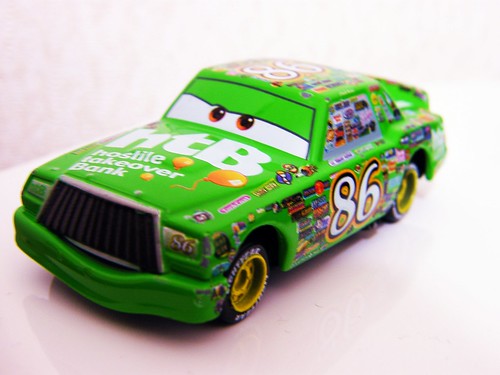
Thinking about this further, the same sort of image is projected in the Disney CG movie, Cars. One of the characters, Chick Hicks, is sponsored by a ficitious banking firm called Hostile Takeover Bank or HTB for short.


The thing is that I would also consider putting my funds with Hostile Takeover Bank for the simple reason that if they're the ones going around making all of these hostile takeovers then at least in the short run, they sound like a highly profitable firm.

Equally back in 2001 and 2002, the online bank Egg (website http://www.egg.co.uk) was the main sponsor of the Egg Sport Astra team in the British Touring Car Championship. Back then as now I still think that those Egg Astras had some of the coolest liveries ever to appear on a race car.


So what does all of this have to do with Barbara who according to the ANZ lives in "Bankworld" and not ours? Logically if Barbara does live in "Bankworld" then more than likely, she's probably a specialist who knows what they are doing, and can do an efficient and worthy job. Ironically whilst I was waiting in the queue in the ANZ, the branch I was in was understaffed, and the staff who were there seemed to go away and ask their supervisors, lords and masters, about what they should do. The thing is that I don't think that Barbara who lives in "Bankworld" would need to - she'd already know what to do.

September 10, 2010

Horse 1105 - Why Bother With a Blog?


From the Cat and Girl webcomic:
http://catandgirl.com/?p=2596

Or some friendly advice from Wired.com:

http://www.wired.com/entertainment/theweb/magazine/16-11/st_essay

Thinking about launching your own blog? Here's some friendly advice: Don't. And if you've already got one, pull the plug.
Writing a weblog today isn't the bright idea it was four years ago. The blogosphere, once a freshwater oasis of folksy self-expression and clever thought, has been flooded by a tsunami of paid bilge. Cut-rate journalists and underground marketing campaigns now drown out the authentic voices of amateur wordsmiths. It's almost impossible to get noticed, except by hecklers. And why bother? The time it takes to craft sharp, witty blog prose is better spent expressing yourself on Flickr, Facebook, or Twitter.

I find the idea that the blog is dead to be an interesting yet strangely familiar proposal. Even if I look around my own little corner of the blogosphere of things that I regularly read, I find that the average time between posts for 2009-10 has now run out to 36.84 days and that the average word count is a paltry 163 words, or a little over three paragraphs.

Of course this was always to be expected anyway. We live in both a post-modern and post-literate society (though I think that it's tending more towards outright illiteracy). People for the most part are suspicious of the concepts of objective truth, and the idea of postliteracy is one where pictures, video and audio replaces the written word for the most part.

Of course we can see actual evidence of this all around us. The Sydney Morning Herald is suffering from falling revenues as readers move online, but coupled with this is that the physical newspaper itself is shrinking. What used to be a hefty daily document, has now more or less become a slimline three section thing, with only the Saturday edition retaining its former chunkiness.

Ray Bradbury's book Fahrenheit 451 published all the way back in 1953, seems to predict the trend towards post-literacy. It's not too big a jump to conceive that "the bees in people's ears, swept away the silence no leaving any time to think or question" could be speaking about people's iPods or that the giant screens installed in people's living rooms (parlors) are the equivalent of today's flat-screen, plasman, LCD, Jumbotrons.
"The public itself stopped reading of its own accord. You firemen provide a circus now and then at which buildings are set off and crowds gather for the pretty blaze, but it's a small sideshow indeed, and hardly necessary to keep things in line. So few want to be rebels any more. And out of those few, most, like myself, scare easily. Can you dance faster than the White Clown, shout louder than 'Mr. Gimmick' and the parlor 'families'? If you can, you'll win your way, Montag. In any event, you're a fool. People are having fun."

That's just it isn't it. People are having fun. People for the most part can't be bothered to read any more than a couple of lines of their own accord. Short of the odd person who still happens to read a novel for fun, the vast bulk of people simply choose not to read. Twitter and Facebook are immensely successful, because can't be bothered to read.

Of course the obvious question which arises from Wired's article is why bother to continue writing a blog if no-one is going to read it? Why bother yelling into the darkness if you know you won't be heard?

Because I can... but am I having fun?

September 07, 2010

Horse 1104 - The Herald Got It Blazingly Wrong

http://www.smh.com.au/federal-election/bob-loves-bananas--as-long-as-theyre-straight-20100907-14ye3.html

Katter may not be mad. Perhaps he is not a bigot, either. The hat makes it hard to tell. He is one of those country men who is confident with misinformation. Who is used to being right even when he is not. Who trained his voice, one imagines, reciting Clancy of the Overflow at public functions. Who always speaks loudly.

Oh dear... just oh dear.

I'm afraid that the Sydney Morning Herald has just made it blatantly obvious that it doesn't just have a speck or a plank its eye but a whole sawmill.

Bob Katter said a great deal of things on the ABC's Q and A last night, including that he doesn't much like homosexuals and then was chided for his views. I think that the chiding is ridiculous. Mr Katter is not only perfectly entitled to express his views, but has the right to do so. Furthermore because of the United Nations' Universal Declaration of Human Rights 1948 of which Australia was a signatory (and helped write), the right is enshrined by law.

Article 19 - Universal Declaration of Human Rights
Everyone has the right to freedom of opinion and expression; this right includes freedom to hold opinions without interference and to seek, receive and impart information and ideas through any media and regardless of frontiers.

Also because of the Bill of Rights Act 1689, the freedom of speech and debates or proceedings in Parliament ought not to be impeached or questioned in any court or place out of Parliament.

Think about that SMH.

Perhaps it didn't occur to the Sydney Morning Herald that the vast bulk of what Mr Katter had to say, was not directed at social law anyway. Most of what Mr Katter wants to achieve is to do with the steady erosion of Australia's manufacturing base and the utterly despicable state that we will soon be a net importer of food.

In 1987, 86 per cent of the passenger motor vehicles in Australia were made in Australia. Eighty-six per cent, Nick. As a result of Mr Keating's and your policies, now only 21 per cent are made in Australia and is there a single person here that believes we'll have a car industry in 20 years in Australia? A single person?
...
Four years ago we became a net importer of fruit and vegetables. Last year we became a net importer of seafood and I don't care what set of statistics you want to look at. Within 14 years we will be a net importer of food.
- Bob Katter, ABC1 Q and A, 6th Sep 2010

Think about that as well dear SMH.

Bob Katter has every right to have his own opinion, like it or not. He has the right to choose to represent the issues he holds dear to his heart in whatever order of priority he chooses, like it or not. He also has the right to represent the interests of whatever make of his constituents he chooses, like it or not. Coupled with all of this is that he is charged with the responsibility of representing the interests of the people in his electorate... and no-one else.

It is an act of political hijack to people to suggest or imply he should represent the interests of all. There are other candidates to cater for the interests of other views. Bob Katter does not have to agree with the moral or immoral majority nor every man woman or child in this nation.

As he himself said, which the SMH quotes in the very article:
“You probably don't consider it to be a small problem [but] in the bigger picture of things it's just not something that occupies my consciousness.”

Why should the issue occupy his consciousness? The people in his electorate are worried about the very existance of their livelihoods. It might be very well to talk about issues of social consciousness, but even more fundamental to that is the ability for people to put food on the table.

But of course the SMH from its little offices in Sussex Street wouldn't know a thing about what its like in rural and regional Australia. Their editors don't really care where their food actually comes from and probably would be content to drive around in European built luxury cars whilst the people who would have had jobs building cars in Australia have to look elsewhere for work.

Remove the planks from your eyes and start banging them over the back of your stupid pathetic heads dear SMH, it might knock some sense into you. Instead of chastising someone who is passionate and prepared to state the glaringly obvious, and what should have been fixed or even talked about for the last twenty years, you berate the man.

Dear SMH, today you have made me sick. I bite my thumb at you.

FOR SHAME.

September 02, 2010

Horse 1103 - The $37 Million Exercise in Cynicism

http://www.dailytelegraph.com.au/news/national/david-jones-37-million-sex-case-starts-monday/story-e6freuzr-1225911089882

The retail giant's former junior publicist Kristy Fraser-Kirk's record $37 million sexual misconduct claim officially starts in the Federal Court when the retail giant and it's former CEO will be given a deadline to lodge their defences to her allegations.

Personally I hope that this case dies quietly. Not because I think that it is a carriage of justice, because without delving into the facts, it is probably likely that there is quite a strong degree of claim to the case*, but rather that the amount of the claim itself and whom the claim is directed is in my opinion a combination of pure vexatiousness, cynicism and bile.
I have two basic problems with the case in principle, and they are outlined below.

Usually in a punitive damages case, the applicant is hoping to collect damage as a direct result of the damage suffered of the offence in question. That amount is determined by either a calculated loss of income and wages question, and or some degree of emotional suffering.
The point to make here, is that if Ms Fraser-Kirk is making a claim based on her, degree of emotional suffering, is that worth $37 million? Because that $37 million certainly isn't reflective of her lost wages and potential earnings power.
If you work through the logic and assume that Ms Fraser-Kirk was on a wage of $80,000 a year (which from what I can determine is ridiculously overstated), then an average career loss would probably be up to five years maximum. That would equate to a loss in potential wages of $400,000 or just a shade over 1% of what she is claiming. Is the amount that she has suffered worth $36.6 million? I seriously doubt it.

The second issue I have with this case, is that David Jones Ltd is being held liable for the actions of an individual.
http://www.smh.com.au/lifestyle/people/upbeat-mcinnes-flies-back-to-face-the-music-20100815-12574.html
"I did so with great sadness as it was a career and a company I loved, that I had helped rebuild.
However, the reason is simple. It was my responsibility, not David Jones's."
- Mark McInnes, August 16, 2010.

It can be very easily argued that David Jones as an employer has a responsibility to provide a safe workplace, and that includes a workplace which is harassment free. However, the company David Jones Ltd itself is a secondary party in this. I hardly think that its fair, just or logical if as a result of David Jones Ltd losing the case, being forced to pay $37 million in damages, that someone in say a store in the Rundle Mall in Adelaide should lose their jobs due to cutbacks.

I have heard it argued that the reason for claiming an amount as outlandish as $37 million is to "make the company hurt". I find that to be somewhat spiurious, because if it was truly about making someone hurt, wouldn't it be more just to make the actual person who caused the hurt in the first place suffer?

To what extent is David Jones Ltd. implicated anyway? Is it an equal basis? If so then how come Mark McInnes isn't also being chased for $37 million? If it truly is about causing "hurt", then isn't it logical for Mark McInnes to lose his house and go and live in the gutter? The thing is that no-one would conceed that that is a carriage of justice at all, yet somehow it's okay for a company to be pinged for the money? And if it isn't about the money, then why go after the company rather than the individual?

Ms Fraser-Kirk has incidentally promised to give most of the money to charity anyway. So what? If I owe you some money, I can't decide to pay a charity instead of you, because my debt is directly with you, not the charity.
Likewise, the fact that Ms Fraser-Kirk has promised to give most of the money to charity is entirely irrelevant to the case. That is entirely her own business, and the fact that she's been trumpeting this in the media is little more than sensationalism.
Besides which, if she honestly and truly feels that she is in fact entitled to the $37 million, then what is her motive for giving most of it to charity? I would contend that deep down she knows herself that the claim is vexatious and is doing to in order to whitewash over her own guilty conscience.

Whilsy all of this might sound harsh, I should point out that as consumers and taxpayers, we all suffer when repeated vexatious legal damages pass through the courts. It is us who pay through higher prices for goods and services, as well as through higher taxes as a result of courts time and the legal profession's time being employed.
That last point is in my not very well paid opinion the reason why this massive figure was chosen seemingly at random in the first place. No doubt that the legal firm Maurice Blackburn who is representing Ms Fraser-Kirk will be paid on a percentage basis. Obviously it is in their best interests to rip for as much money as they can possibly get.


*I don't condone sexual harassment either in the workplace or otherwise. It should go without saying that harassment of any kind is evil, and it should not be tolerated.