I envisage several things which might result from the events of the Labor Party caucus meeting next Monday.
1 - Julia Gillard is returned as the leader of the party, retains her job as Prime Minister. Everything continues as normal.
2 - Julia Gillard is returned as the leader of the party; retains her job as Prime Minister. A vote of no confidence is tabled before the house and the government loses the support of the Independents and the Green. This results in:
2a: The calling of a General Election.
2b: The formation of a new Liberal government provided that they can secure the support of the Independents and the Green with respect to supply bills.
3 - Kevin Rudd regains the job as the leader of the party and becomes Prime Minister. Everything continues as normal.
4 - Kevin Rudd regains the job as the leader of the party and becomes Prime Minister. A vote of no confidence is tabled before the house and the government loses the support of the Independents and the Green. See 2a and 2b.
The real problem that I have with either 2a or 2b is that Tony Abbott as the leader of Liberal Party in the House of Representatives would become the next Prime Minister. Tony Abbott to me seems as directionless a leader as Julia Gillard, whereas at least you could say of Kevin Rudd was that his government did have a series of plans even if they might have been beaten down. The other problem is that an Abbott government would have either Joe Hockey or Julia Bishop as Treasurer. Hockey has the personality to be the PM and given that the role is of minister without portfolio, he can't exactly damage it but having said that his ability to hold numbers is lacking. Bishop on the other hand as Shadow Treasurer has outright lied to the electorate and when pushed about the numbers not actually adding downwards, referred the press to Treasury estimates.
The Liberal Party's brightest and most talented politician for a reason completely unknown to me is hidden away in the minor portfolio as the Shadow Minister for Communications and Broadband. Malcolm Turnbull is easily without doubt the member with the greatest degree of business acumen, having been the Secretary for Australian Consolidated Press, a partner of Goldman Sachs and the CEO of Ozemail. Clearly you'd want such a person either as the Treasurer or the Prime Minister or even both (there is precedent in Westminster Parliaments) and the fact that he's not there is I think nothing short of rank stupidity on the part of the Liberal Party.
Rob Oakeshott told ABC Radio National's RN Breakfast show this morning that if the Government falls over he would approach Turnbull to lead and be the next PM. Clearly Rob Oakeshott and possibly the other Independents are the only sane people in the building.
If Gillard is returned as Prime Minister, then Rudd will probably find himself in the political wilderness. I don't think he'd be ever given another cabinet role while Gillard is in the top job. Likewise if Rudd regains the job as Prime Minister then I don't think we'd see Gillard back in his cabinet either. I think that because Wayne Swan has been so intemperate with his outburst, that would mean that he'd also more than likely lose his job as Treasurer, which is sad because Swan is the closest thing that the Federal Labor has to a sane person.
Assuming that a General Election is called as the result of all of this, then almost certainly we'll see a Liberal landslide. The Labor Party as it currently exists is pretty well much unelectable. It would be the last thing that several Labor backbenchers would want because the actions of their leadership would cost them their jobs despite the quality of the job they'd done.
If that happens, then the fallout from this might be felt for some time. Individual arrogance is probably what caused Chifley to lose his job and ultimately saw the Labor Party walk around in the political wilderness for the next 23 years. I fear that if the events of the past week have a similar outcome, then that's bad for democracy generally.

February 24, 2012


February 23, 2012
Horse 1278 - Alleged Leadership Spills and Electoral Illiteracy
This may shock people but the truth is that the vast majority of people didn't vote for the Prime Minister. Unless you happened to be in the Electorates of Lalor or Griffith, you also did not vote for for either Julia Gillard or Kevin Rudd either.
The Prime Minister is the customary leader of the goverment in the House of Representatves. In fact the office of Prime Mnister is not directly named in the Constitution Act 1900 either. Government itself is made up of a majority of members who sit in the House of Representatves and even then that majority might theoretically be made up of one, two, three, lots of parties and indeed the whole parliament if that should be.
This presents in my mind a tremendous illiteracy and ignorance by the people of Australia if they suggest that they "didn't vote for Julia" or "didn't vote for this government". No. You are of course perfectly correct with the exac definition of those words but the sentiment that somehow the parliament, government and office of the Prime Minister is somehow violated because people don't understand the system, I find somewhat laughable.
I'd even like to reitterate at this point that although Kevin has resigned from his position as a cabinet minister, that doesn't necessarily mean that he intends to run for the office of Prime Minister. Of course he might do so and that is a matter for the Labor Party Caucus when it next meets on Monday but until then, anything which is said in the media to do with speculations about spills and re-spills are little more than a vast chasing at the wind.
Supposing that Kevin does become head of the Labor Party after Monday, that of itself is still no actual guarantee of becoming the Prime Minister. If a vote of no-confidence is passed by the house, then the Governor-General does have the authority to invite someone else to form government. It might be theoretically posible that after Monday, the crossbenchers switch their alliences and we'd have a new coalition government being formed with a new slightly shifted majority of members, as happened when John Curtin replaced Robert Menzies as PM.
There is also the possibility of a vote of no condfidence; such a move I suppose has plenty of historical precedence, although none in Australia. Technically a vote of no-confidence need only be passed with a hideously simple motion such as the motion which read "That this House has no confidence in Her Majesty's Government"¹ which deposed James Callaghan's Labour Government and installed Margaret Thatcher's Conservative Government in the UK in 1979. Treasurer Wayne Swan has also hinted at precisely that in the suggestion that Rudd was "deliberately risking an Abbott Prime Ministership"². Now I don't know if that's necessarily true but to voice such an opinion was either done in the heat of the moment or through very real naked fear.
I still don't honestly believe that there will be a run for the Premiership by Rudd next Monday. I think a sense of self-preservation by MP's tenuously clinging onto their seats would justify that. Not until the player which has made the signing appears on the park and playing, am I inclined to believe rumours.
¹- http://hansard.millbanksystems.com/commons/1979/mar/28/her-majestys-government-opposition-motion#S5CV0965P0_19790328_HOC_190
²- http://www.abc.net.au/news/2012-02-22/wayne-swan-statement-on-rudd27s-resignation/3846188
February 19, 2012
Horse 1277 - Alledged ALP Leadership Spills and Dud Reporting by Australia's Sub-Standard Media
I have been following sport for a very very long time. When it comes to a football club making a new signing, rumours do very little to sway me; even publicity shots of the player shaking hands with the manager and showing off a club shirt with names and numbers on, also do very little to sway me. Not until the player which has made the signing appears on the park and playing, am I inclined to believe rumours.
The same also goes for Formula One. You can have publicity stills of the driver with the team and even have video of the driver actually testing the car. As the Lola Mastercard team showed in 1997, you can even have the whole team show up for Friday qualifying but unless the driver appears in the car on the grid on Sunday, you still can't fully guarantee that the driver has signed for the team.
So it is with politics. Politics is as much of a sport and game as football or Formula One and the players and supporters are just as fanatical and dare I say it, stupid, when it comes to the rumour mill.
I refer now to a report from the ABC:
http://www.abc.net.au/news/2012-02-18/speculation-mounts-cabinet-testing-gillard-support/3837758
Speculation is continuing to mount within federal Labor party ranks that the Prime Minister's allies in Cabinet are testing her support.
There are reports in both Fairfax and News Limited newspapers that ministers, including Nicola Roxon and Craig Emerson, have been privately lobbying their colleagues to support Prime Minister Julia Gillard.
The reports suggest some Cabinet members have been warning backbenchers that a return to a Rudd government would destroy the Labor party.
- ABC Feb 18, 2012
Just because a rumour appears in our obviously partisan press is no cause to assume that anything is happening whatsoever. News Ltd newspapers have often bashed the Labor Party and whilst they haven't declared open support for the Liberal Party in the same way that The Sun and The Times have openly declared their support for the Tories in the UK, its reasonably safe to assume that they do given News Ltd's general stance. It's also reasonably safe to assume that Fairfax newspapers like the Sydney Morning Herald and The Age whilst they don't openly support the Liberal Party, would favour them. Also given that Gina Rinehart who is a mining business woman has openly declared war on the Labor Party and has now become the newspaper group's biggest single non-institutional investor with a 14% holding, that Fairfax's editorial opinions aren't neutral either.
If you actually look at the statements being made by the Labor Party we find comments like this:
But during an interview with SKY news, Finance Minister Penny Wong refused to be drawn on the speculation about an imminent leadership challenge by Foreign Affairs Minister Kevin Rudd.
"You've asked me quite a number of questions on this issue and I've made clear I'm not going to engage with this," she said.
- ABC 18th Feb, 2012
Apart from the obvious that a Labor Party cabinet minister isn't going to openly say if any leadership attempts are being made at all, the fact that Fairfax and News Ltd together keep on badgering ministers and backbenchers is an indication that the only reason that anyone is talking about a supposed challenge for the leadership if it in fact exists is that Fairfax and News Ltd together keep on badgering ministers and backbenchers.
I also think that it's sort of unfair that serious political discussion is being constantly hijacked on precisely this issue. I don't think that it would be beyond Fairfax or News Ltd to insert people into the crowd during episodes of Q and A and to be totally frank, the fact the question of any alledged leadership challenge being asked every single week is both boring and to be honest rather pathetic.
For the record I don't honestly think that there is any serious leadership challenge being mounted within the ranks of the Labor Party; second to that, I think that the reason why its being reported that there is, is because of open manipulation by the media companies. Basically the electorate for the most part are in fact idiots and if you keep on saying something often enough, then eventually it's bound to become truth, right? The whole thing seems to be only a couple of steps away from the American experience in which the media reporting of politics is even more moronic and even shoutier.
Somehow I think that the Australian people deserve better from their media outlets; I think that it's an outright failure in the quality of journalism in this country but I don't think things are going to improve in a hurry.
February 09, 2012
Horse 1276 - Nissan Is No Longer "Missan"
At 11am this morning the official announcement was made that Nissan Motor Co and NISMO will be entering as a manufacturer into the V8 Supercar series. There will be 4 cars run initially with two of them to be run by Kelly Racing and the other two as yet unnamed.
http://www.v8supercars.com.au/championship/newsarticle/official-nissan-to-join-v8-supercars-championship/tabid/70/newsid/12124/default.aspx
NISSAN will join the V8 Supercars Championship in 2013 and become the first new manufacturer to enter the sport under its new ‘Car of the Future’ rulebook. The news was announced today at a press conference in the River Room at Crown Casino in Melbourne.
The Japanese car giant will take on Holden and Ford in next year’s championship – the first run under new ‘Car of the Future’ rules.
Kelly Racing has signed with Nissan to become the company’s factory team and will run four cars next year from their Melbourne workshop. The team will have the full support of the giant NISMO Nissan Motorsport organisation.
- Via Bigpond and the Official V8 Supercars site, 09-02-12
Personally I think that this will be a boon for the sport, will probably help to rekindle interest from new sponsors and raise the profile of the sport overseas.
The question I suppose is where does Nissan get its 5L V8 from? The answer is actually pretty obvious - the Infiniti FX50.
Infiniti being Nissan's "premium" brand for the United States is the only market where the engine is sold. The VK50VE in road going trim puts out 390bhp and is a 90° Double Overhead Cam unit. Presumably for V8 Supercar racing, they'd throw away the DOHC heads and replace them with a SOHC pushrod configuration as per the Car of The Future rules.
Of course they need not even do that. Given the the CoTF rules allow any engine to be "debranded" and placed into any car (it's allowable for instance to put a Holden V8 into a Falcon, they could just as easily use the same racing engines as now which are usually Auroras and simply bolt them in. None of the diff, gearbox, suspension, floorpan, wiring loom, fuel tank, roll cages, firewalls, needs to be developed at all because these are mandated by the CoTF rules.
The Nissan press release doesn't reveal very much unfortunately:
http://www.nissan.com.au/webpages/information/Nissan_Enters_V8_Supercar_Championship.pdf
Looking through the current line up of cars sold by Nissan worldwide, the only suitable donor car is the J32 Teana which is sold in Australia under the Maxima nameplate. We know for certain that it will take the VK50VE because the engine bay is identical to the Infiniti FX.
Somehow I suspect that come mid-2012 because the J32 Teana is now a bit long in the tooth, Nissan will replace it with the new model and that will be the car will Kelly racing gets. As far as Nissan's marketing goes, it's a perfect arena to launch the new car.
I wouldn't mind betting that Nissan are possibly also trying to twist the arms of the JGTC to change the regulations of the Japanese GT500 series to have the car admitted there as well.
I for one welcome out new players and wish them well. Of course my offer to drive if anyone wants me still stands... anyone?
February 08, 2012
Horse 1275 - Something's Wrong And Nobody Notices

What's wrong with this photo?
Can you see it?
No, it isn't the sort of dim expression of the person behind the counter because quite frankly if you were only paid the sort of wages that they probably are, you'd have good reason for your eyes to glaze over too.
Nope, the thing which is wrong with this photograph is the word "mini's". Do you see that now? That apostrophe has been left to hang there in mid-air in state of complete despair. Not only is it plain wrong but it also looks silly.
The apostrophe has three uses:
1. To mark a contraction, as in words like "don't", "isn't", "it's" and "fo'c'sle"
2. To mark a possessive case, as in Jimmy's Kebab or the cats' dinner bowl.
3. To mark words which come from other languages for which we don't have an adequate mark in English like the Qu'ran or Fa'afafine, or the names O'Grady and d'Souza.
Some style guides will allow you to use an apostrophe for plurals of things which aren't actually words in English, such as the phrase to "mind your P's and Q's". I think that this is rather silly because you can end up with a case where an apostrophe has two uses within the same cluster, as in the '90's.
In the sign above the most obvious impression is that it's supposed to be a plural for the word "mini". It looks like it could be a contraction and there might even be a case for a "mini" to own something, if indeed an inanimate food item can own anything at all.
You'd at least think that a large firm like Hungry Jack's which itself has a possessive apostrophe in it's own name would have got this right but they've gone to the trouble of having these things printed and not one person has seen the error.
Looking silly in a formal document even if it is merely an advert poster is a bad thing for a company because it instantly rules you in line to be made fun of...
"The burgers are better at Hungry Jack's... which is a good thing because our grammar is rubbish".
February 01, 2012
Horse 1274 - I Shouldn't Have Expected Actual Journalism in The Australian
On the front page of Monday's Australian the following article ran:
http://www.theaustralian.com.au/national-affairs/bank-bashers-risk-economy-say-leaders/comments-fn59niix-1226256750657
PROFITABLE and well-funded banks are critical to the health of the Australian economy at a time of global uncertainty, bank leaders warned as they urged politicians to stop bashing the big four financial institutions.
- The Australian, 30th Jan 2012.
I really wonder what the intent of running such a thing on the front page of the Oz is. Presumably it's either the banks trying to use media pressure to make the government change policy or it's just the Oz trying to curry favour with its potential advertising base. Whatever the case, I think that the article almost hints at economically illiteracy.
To wit:
In and Economics 101 class on the very first day we would have seen this diagram:
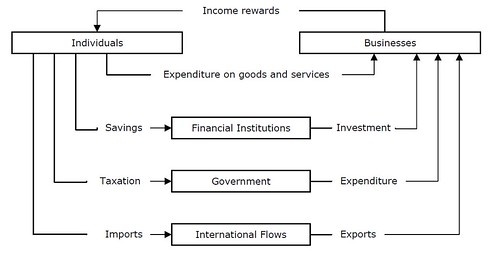
The most basic two sectors of the economy are the Households and Firms. Whilst it's handy to note where the money is flowing in the form of wages and spending, it's even more fundamental to note what ultimately drives every single transaction which exists and which has driven every single economy since before time dot.
Every economy has at its base, the production of goods and services. Heck, we even measure the overall health of the economy on this measure with GDP. The figure of GDP or Gross Domestic Product, is the final market value of all goods and services produced within a country within a financial year.
Whilst it might be true that the banking sector does help to enable the transfer of funds which can be made available for investment, the biggest drivers of GDP are things which are actually being produced and services which are genuinely being performed.
If we take the current Australian economy as an example, the state currently experiencing the greatest growth is Western Australia. Why? Because Western Australia currently is producing a lot of raw goods. Of course it would make logical sense if the Australian economy itself would produce more elaborately transformed goods but we don't seem to be able to do so.
Historically the world's biggest powers have also risen to power on the basis of goods being made and services being performed. In the ancient world, a nation grew more powerful with more people under its control. Admittedly in a world in which agriculture was the biggest single sector, then this was very closely linked to the area of land which a nation could control.
During the Industrial Revolution and the rise of Entrepreneurs, the focus shifted from agricultural products to other sorts of products. We can basically follow the rise of nations with the sorts of products they produced, Britain, the United States and now China have all risen (and sometimes fallen) on the basis that they could make stuff and sell it.
The thing is that the banking sector whilst providing the service of buying and selling funds, is entirely funded on the basis of other sectors in the economy producing goods and services.
I take issue with the statement "PROFITABLE and well-funded banks are critical to the health of the Australian economy" for two rather glaringly obvious reasons.
1. The truth is that if there were no domestic banks at all in Australia, the economy would still function more or less perfectly. The process of producing goods and services would continue as it has done for centuries. In fact the whole idea of banking in a modern context didn't even start until the renaissance. The word bank itself comes from the Old Italian "banca" which described the tables or benches upon which the businesses of houses like Medici, Peruzzi and Bardi operated.
Even in a modern context, a bank is little more than a coupon shifter. Profits are extracted from "customers" who borrow money from the bank and then have to pay back the principle plus interest and the extra money which is used to pay interest comes from the production of goods and services.
2. The implication of the phrase "PROFITABLE and well-funded banks" suggests that Australia has banks which are not profitable or well funded. Just to put this in perspective, the profits as listed in 2011 by just the big four banks were as follows: NAB $5.220bn, WBC $6.991bn, CBA $4.723bn, ANZ $4.510bn. Together they made $21,444,000,000 in profit. The suggestion that the banks in Australia are not profitable is both idiotic and/or an outright lie (mind you, given the rest of News Corp's abilities to make up news, it's not beyond the Australian to lie on it's front cover).
Also, the big four banks have collectively $3,276,512,000,000 in funds under management. Perhaps the Australian would like to explain just how it is that just four banks with more than three trillion dollars under management are some how not "well-funded".
There was one line in the article which I gagged at, which was:
"The Reserve Bank could move on rates as soon as next week because of job layoffs and poor consumer and business confidence, "
Job layoffs? Perhaps we should point the finger at the banks themselves on this one:
http://www.theaustralian.com.au/business/companies/westpac-forecasts-job-cuts-suncorp-sends-back-office-work-to-india/story-fn91v9q3-1226253683491
AUSTRALIA'S financial services industry delivered another blow to the country's workforce today with news of pending job losses and work functions heading offshore.
Suncorp Group said it will cut 71 jobs at its insurance arm to improve back-office efficiency and Westpac said it expects to finish the financial year with fewer staff, the companies said today.
The job cuts are the latest to hit workers in Australia's financial services sector, after ANZ Banking Group announced plans to cut about 130 jobs last week; investment bank UBS predicted that Australia's banks will shed 7000 jobs in the next two years.
-The Australian, 25th Jan 2012.
Poor consumer and business confidence? Well, considering that the Global Financial Crisis itself was caused by the banking sector and their predatory lending practices; allowing ridiculously easy credit to people who should have never been allowed to borrow in the first place which led to a hideous undervalue in the pricing of risk and even dare I suggest outright fraudulent underwriting practices, then wouldn't those things lead to poor consumer and business confidence?
No, the reason for running such an article is to do with Don Argus the former NAB CEO and current NAB chairman Michael Chaney probably have a "quiet talk" with the Australian's editor-in-chief Chris Mitchell. Mind you, Mitchell himself isn't averse to lying either. I guess any excuse to bash the government is good enough, even if you have to write a great big pile of balderdash, blather and bunkum.
http://www.theaustralian.com.au/national-affairs/bank-bashers-risk-economy-say-leaders/comments-fn59niix-1226256750657
PROFITABLE and well-funded banks are critical to the health of the Australian economy at a time of global uncertainty, bank leaders warned as they urged politicians to stop bashing the big four financial institutions.
- The Australian, 30th Jan 2012.
I really wonder what the intent of running such a thing on the front page of the Oz is. Presumably it's either the banks trying to use media pressure to make the government change policy or it's just the Oz trying to curry favour with its potential advertising base. Whatever the case, I think that the article almost hints at economically illiteracy.
To wit:
In and Economics 101 class on the very first day we would have seen this diagram:
The most basic two sectors of the economy are the Households and Firms. Whilst it's handy to note where the money is flowing in the form of wages and spending, it's even more fundamental to note what ultimately drives every single transaction which exists and which has driven every single economy since before time dot.
Every economy has at its base, the production of goods and services. Heck, we even measure the overall health of the economy on this measure with GDP. The figure of GDP or Gross Domestic Product, is the final market value of all goods and services produced within a country within a financial year.
Whilst it might be true that the banking sector does help to enable the transfer of funds which can be made available for investment, the biggest drivers of GDP are things which are actually being produced and services which are genuinely being performed.
If we take the current Australian economy as an example, the state currently experiencing the greatest growth is Western Australia. Why? Because Western Australia currently is producing a lot of raw goods. Of course it would make logical sense if the Australian economy itself would produce more elaborately transformed goods but we don't seem to be able to do so.
Historically the world's biggest powers have also risen to power on the basis of goods being made and services being performed. In the ancient world, a nation grew more powerful with more people under its control. Admittedly in a world in which agriculture was the biggest single sector, then this was very closely linked to the area of land which a nation could control.
During the Industrial Revolution and the rise of Entrepreneurs, the focus shifted from agricultural products to other sorts of products. We can basically follow the rise of nations with the sorts of products they produced, Britain, the United States and now China have all risen (and sometimes fallen) on the basis that they could make stuff and sell it.
The thing is that the banking sector whilst providing the service of buying and selling funds, is entirely funded on the basis of other sectors in the economy producing goods and services.
I take issue with the statement "PROFITABLE and well-funded banks are critical to the health of the Australian economy" for two rather glaringly obvious reasons.
1. The truth is that if there were no domestic banks at all in Australia, the economy would still function more or less perfectly. The process of producing goods and services would continue as it has done for centuries. In fact the whole idea of banking in a modern context didn't even start until the renaissance. The word bank itself comes from the Old Italian "banca" which described the tables or benches upon which the businesses of houses like Medici, Peruzzi and Bardi operated.
Even in a modern context, a bank is little more than a coupon shifter. Profits are extracted from "customers" who borrow money from the bank and then have to pay back the principle plus interest and the extra money which is used to pay interest comes from the production of goods and services.
2. The implication of the phrase "PROFITABLE and well-funded banks" suggests that Australia has banks which are not profitable or well funded. Just to put this in perspective, the profits as listed in 2011 by just the big four banks were as follows: NAB $5.220bn, WBC $6.991bn, CBA $4.723bn, ANZ $4.510bn. Together they made $21,444,000,000 in profit. The suggestion that the banks in Australia are not profitable is both idiotic and/or an outright lie (mind you, given the rest of News Corp's abilities to make up news, it's not beyond the Australian to lie on it's front cover).
Also, the big four banks have collectively $3,276,512,000,000 in funds under management. Perhaps the Australian would like to explain just how it is that just four banks with more than three trillion dollars under management are some how not "well-funded".
There was one line in the article which I gagged at, which was:
"The Reserve Bank could move on rates as soon as next week because of job layoffs and poor consumer and business confidence, "
Job layoffs? Perhaps we should point the finger at the banks themselves on this one:
http://www.theaustralian.com.au/business/companies/westpac-forecasts-job-cuts-suncorp-sends-back-office-work-to-india/story-fn91v9q3-1226253683491
AUSTRALIA'S financial services industry delivered another blow to the country's workforce today with news of pending job losses and work functions heading offshore.
Suncorp Group said it will cut 71 jobs at its insurance arm to improve back-office efficiency and Westpac said it expects to finish the financial year with fewer staff, the companies said today.
The job cuts are the latest to hit workers in Australia's financial services sector, after ANZ Banking Group announced plans to cut about 130 jobs last week; investment bank UBS predicted that Australia's banks will shed 7000 jobs in the next two years.
-The Australian, 25th Jan 2012.
Poor consumer and business confidence? Well, considering that the Global Financial Crisis itself was caused by the banking sector and their predatory lending practices; allowing ridiculously easy credit to people who should have never been allowed to borrow in the first place which led to a hideous undervalue in the pricing of risk and even dare I suggest outright fraudulent underwriting practices, then wouldn't those things lead to poor consumer and business confidence?
No, the reason for running such an article is to do with Don Argus the former NAB CEO and current NAB chairman Michael Chaney probably have a "quiet talk" with the Australian's editor-in-chief Chris Mitchell. Mind you, Mitchell himself isn't averse to lying either. I guess any excuse to bash the government is good enough, even if you have to write a great big pile of balderdash, blather and bunkum.
January 30, 2012
Horse 1273 - Rafael Nadal - Bok Bok Bok
Novak Djokovic finally beat Rafael Nadal 5-7 6-4 6-2 6-7 7-5 in apparently was the longest Grand Slam final in history. At the final presentation, both of them were so exhausted that they found it difficult to even stand up.
.
..
...
....
.....
......
.......
........
.........
..........
.........
........
.......
......
.....
....
...
..
.
Ok that wasn't the point of this post, I just thought I'd mention it for a shred of sanity. The main point of this post is that I think that Rafael Nadal looks like a giant chicken.
Seriously.

I don't know if it's the headband that makes him look like he has a rooster's comb, or if it's his weird strut and scratch thing that he does on the court but I had the thought and it simply would not go away.
The Ladies' Final at the Australian Open had The Squealer versus The Grunter and so all manner of farmyard noises were provided by that match and although Nadal has his own series of grunts I still can't think of him as being anything other than a giant chicken.
It's weird because Nadal is Spanish and the national animal of Spain is the bull; Nadal just doesn't seem very bullish. I always think of him on the court as possessing a sort flair which is more Gallic and maybe that's the reason why I think Nadal is a giant chicken.
.
..
...
....
.....
......
.......
........
.........
..........
.........
........
.......
......
.....
....
...
..
.
Ok that wasn't the point of this post, I just thought I'd mention it for a shred of sanity. The main point of this post is that I think that Rafael Nadal looks like a giant chicken.
Seriously.
I don't know if it's the headband that makes him look like he has a rooster's comb, or if it's his weird strut and scratch thing that he does on the court but I had the thought and it simply would not go away.
The Ladies' Final at the Australian Open had The Squealer versus The Grunter and so all manner of farmyard noises were provided by that match and although Nadal has his own series of grunts I still can't think of him as being anything other than a giant chicken.
It's weird because Nadal is Spanish and the national animal of Spain is the bull; Nadal just doesn't seem very bullish. I always think of him on the court as possessing a sort flair which is more Gallic and maybe that's the reason why I think Nadal is a giant chicken.
January 26, 2012
Horse 1272 - Advance Australia Where?
http://www.perthnow.com.au/news/call-to-move-australia-day/story-e6frg12c-1111118660285
RON Barassi has called for Australia Day to be moved to May to commemorate the day Aborigines were given equal citizenship rights.
He said it was wrong to celebrate the day of the European invasion of Australia when "we took" this land from Aborigines.
The 10-time premiership player and coach said Australia Day should be May 27 - the day in 1967 that clauses in the Constitution that discriminated against indigenous people were removed.
In the 1967 Referendum, 90.77 per cent of Australians - the biggest majority in a national referendum - voted to enable Aboriginal people to be counted in the Census and to be subject to Commonwealth laws, rather than just state laws.
- Perth Now, 26th Jan 2012
To be fair I think that Ron Barassi has a valid point. I suppose eventually if/when Australia does become a republic that this will become the new date for national patriotism but until then, I think that the idea that the 26th of January should be a national holiday is a both misplaced and a little disgusting.
It's not the date of the Federation of the country which was January 1st 1901; it would be pointless to appoint that as a national holiday because it's already New Years' Day. The only other truly national holiday is the 25th of April, and again that isn't exactly a celebration either.
Actually in all honesty, January 26 isn't even the inception of the colony of New South Wales. The eleven ships of the First Fleet arrived in Botany Bay between the 18th and 20th of January 1788. All that the 26th of January commemorates is the day in 1788 when the British flag was first hoisted one Australian soil.
Officially the inception of the colony of New South Wales ahppened on 7 February 1788. Governor Phillip's adress reads:
"What Frobisher, Raleigh, Delaware, and Gates did for America, that, we are this day met to do for Australia, but under happier auspices. Our enterprise was wisely conceived, deliberately devised, and efficiently organised, the Sovereign, the Parliament, and the people united to give it their authority, sanction, and encouragement. We are here to take possession of this fifth division of the globe on behalf of the British people, and to found a State which, we hope, will not only occupy and rule this great country, but will also be the beneficent patroness of the entire southern hemisphere. How grand is the prospect which lies before this youthful nation !"
Contained in Phillip's address is an explicit statement of intent to "take possession" and to "occupy and rule", so it's little wonder that to Aboriginal communities it marks the day on which the British arrived unannounced and simply stole their land.
Legally under the doctrine of terra nullius the land was declared "empty" and therefore it wasn't an invasion. I note that today the 26th of January 2012 marks the 40th anniversary of the Aboriginal Tent Embassy. Since it is an embassy, I think that it would be quite worthwhile to treat it as such and for terms perhaps similar to New Zealand's Treaty of Waitangi to be drawn up.
Quite unlike the Maori in New Zealand, Aboriginal peoples weren't even considered worthy enough to sign a peace treaty with. Also unlike the Maori, there has never been a permanent commission set up to suggest any means of redress either. In fact it wasn't until 1967 that Aboriginal people were even given the right to vote and in that respect Ron's suggestion that May 27 be suggested for a replacement national holiday, I think is quite reasonable.
I don't really like the reasons for this specific date to be held up as a day of national celebration. If people really want to talk about the nation "growing up" then the replacement of this day, I think is a worthy cause.
Dare I suggest that Australia Day itself is Un-Australian?
January 24, 2012
Horse 1271 - Conservatives & Liberals
At about the time of the French Revolution, the terms "left" and "right" took their meanings from where people happened to sit in the French Parliament. Ever since about the 1790s the "left" came to mean a collectivist sort of economy, controlled by the state; and the "right" came to mean a individualist sort of economy and operating to market forces.
Got that? Left = a controlled market; Right = a laissez-faire market.
The word "conservative" at its heart means to "conserve". As far as historical roots go, that meant a conservation of the then evolving hierarchical system which saw royalty at the top, followed people with titles and the landed gentry. Towards the end of the 19th century, the rise of mercantile classes, that is those of business, basically caused a schism in the classical conservative movement.
The mercantile business classes wanted to see a greater degree of laissez-faire capitalism or "liberalism". A liberal in the classic sense of the word and which is the sense from which the British and Australian Liberal parties draw their name.
The problem is that when you speak to an American, because the country deals on another more nebulous axis and is generally right shifted, the words "conservative" and "liberal" mean something entirely different.
America seems to want to deal on a weird sort of Authoritarian-Liberatarian sort of axis. Due the fact that America was born in a state which was a reaction to classical conservatism and never saw a titled gentry, it was the world of business which came to run and which still does run the country.
The American definitions of "conservative" seems to hinge around moral values, which is weird because if the United States is explicitly atheist in its constitution, then this doesn't really make sense. The idea of being free from government control seems to fit well with a Libertarian stance but even that doesn't explain the "conservative" - "liberal" axis.
Basically to be a "conservative" in the United States is for someone to be broadly morally conservative but still economically liberal. In terms of economic parlance, the leadership styles of George W Bush, John Howard and Tony Blair all fell into Neoliberalism.
The only thing to mark a "liberal" in the United States as far as I can make out is either being a Social Progressivist or perhaps suggesting a greater degree of government control in the economy which itself is leftist in the classic sense and in no way at all liberal.
To call someone a "liberal" in the United States as far as I can make out seems to be little more than to find a derogatory epithet for them. That's fine I suppose in a media climate which spends most of its time basically demonising who it doesn't like and yelling at the opposition. It also adequately explains why the functional political literacy of the average American is so low.
Because I am a genuine leftist when it comes to infrastructure, a rightist with regards the functioning of markets, prices, and consumer goods; a social conservative and skeptical progressivist, on various forum boards I've been called both a "conservative" and a "liberal" in the same thread. The scary thing is that I suspect that the people who like to call those names, have no idea what they're actually saying or what they even mean.
January 21, 2012
Horse 1270 - Rollo's Motor Co.
If Toyota want to axe 3000 jobs because they can't be bothered to build cars in Australia, and Ford are thinking of giving the Falcon the chop, and Holden suspect that the next model Commodore will be the last, then it surely heralds the end of car manufacturing in Australia.
Or does it?
I bet that if the Federal Government would give me $145 million, I could very easily have viable car company within 12 months.
My basic premise is that if countries like Germany can produce world class cars, and countries like South Korea can go from making cars which were horrid 20 years ago to producing cars at least on par with those made in Japan, then why is it beyond Australia to do likewise?
Only three car companies build cars in Australia; those all of them are subsidiaries of foreign companies. All of them have proved in the past that if wages are too expensive on one country, they'll just up sticks and move elsewhere.
My gambit is that if a company was setup with the express purpose of building an all-Australian car then provided it was run with the intent of making just $1 of profit per year, then it could both retain those jobs in Australia as well as produce a World-Class car, tested in the toughest conditions on earth and export them.
Personally I can see no good reason why Australia should dig perfectly good iron ore out of the ground, to make steel, only to have it sold back to us in the form of cars.
Why can't we build a car as good as Audi, or Mercedes-Benz, or Honda in Australia? Is it simply beyond the capabilities of Australian workers? Is it really that hard?
So then, this is the challenge Australia. When the next Auto maker decides to naff-off, then let them. I'll take over the car factory and I'll give you back cars. I wouldn't be building the "big Aussie six" either.
http://www.fcai.com.au/news/all/all/292/new-vehicle-sales-top-the-million-mark-in-2011
According to VFACTS, the Mazda3 was the top selling car for 2011 followed by the Commodore, HiLux, Corolla, Cruze and i30. The Falcon comes in at No.9 and selling less than half of the number of Mazda3s. Apart from the Commodore which is only propped by by fleet sales (because if you exclude fleet buyers it falls to No.11, and the Toyota HiLux which is a tradie's vehicle, then the car which Australians are actually buying is a 2L car like they do in Europe.
The current model Focus comes with a 1.6L "Ecoboost" motor, the Cruze is sold with a 1.4L ITI Turbo, and the standard i30 comes with a 1.6L. Clearly then my new car will have to be a 1.6L car and most likely a hatchback.
Like all good cars it will need a name, and as we learnt from Homer's brother Herb in The Simpsons, who owned a motor company: "People don't want cars named after hungry old Greek broads! They want names like 'Mustang' and 'Cheetah'—vicious animal names,"
I had a look around to find all the "vicious animal names" that hadn't been used yet and thought it really quite odd that I can't think of even one car which is called a "Tiger".
Right then... this is the challenge.If someone wants to back me, I'll build the first car of a brand new marque. It will be a 1.6L Hatch and be called the Tiger. The Logo will be this:

Now then, who gonna give me the money? Anyone?...
Or does it?
I bet that if the Federal Government would give me $145 million, I could very easily have viable car company within 12 months.
My basic premise is that if countries like Germany can produce world class cars, and countries like South Korea can go from making cars which were horrid 20 years ago to producing cars at least on par with those made in Japan, then why is it beyond Australia to do likewise?
Only three car companies build cars in Australia; those all of them are subsidiaries of foreign companies. All of them have proved in the past that if wages are too expensive on one country, they'll just up sticks and move elsewhere.
My gambit is that if a company was setup with the express purpose of building an all-Australian car then provided it was run with the intent of making just $1 of profit per year, then it could both retain those jobs in Australia as well as produce a World-Class car, tested in the toughest conditions on earth and export them.
Personally I can see no good reason why Australia should dig perfectly good iron ore out of the ground, to make steel, only to have it sold back to us in the form of cars.
Why can't we build a car as good as Audi, or Mercedes-Benz, or Honda in Australia? Is it simply beyond the capabilities of Australian workers? Is it really that hard?
So then, this is the challenge Australia. When the next Auto maker decides to naff-off, then let them. I'll take over the car factory and I'll give you back cars. I wouldn't be building the "big Aussie six" either.
http://www.fcai.com.au/news/all/all/292/new-vehicle-sales-top-the-million-mark-in-2011
According to VFACTS, the Mazda3 was the top selling car for 2011 followed by the Commodore, HiLux, Corolla, Cruze and i30. The Falcon comes in at No.9 and selling less than half of the number of Mazda3s. Apart from the Commodore which is only propped by by fleet sales (because if you exclude fleet buyers it falls to No.11, and the Toyota HiLux which is a tradie's vehicle, then the car which Australians are actually buying is a 2L car like they do in Europe.
The current model Focus comes with a 1.6L "Ecoboost" motor, the Cruze is sold with a 1.4L ITI Turbo, and the standard i30 comes with a 1.6L. Clearly then my new car will have to be a 1.6L car and most likely a hatchback.
Like all good cars it will need a name, and as we learnt from Homer's brother Herb in The Simpsons, who owned a motor company: "People don't want cars named after hungry old Greek broads! They want names like 'Mustang' and 'Cheetah'—vicious animal names,"
I had a look around to find all the "vicious animal names" that hadn't been used yet and thought it really quite odd that I can't think of even one car which is called a "Tiger".
Right then... this is the challenge.If someone wants to back me, I'll build the first car of a brand new marque. It will be a 1.6L Hatch and be called the Tiger. The Logo will be this:
Now then, who gonna give me the money? Anyone?...
January 20, 2012
Horse 1269 - The Big Day (Out) The Music Died
http://afr.com/p/losing_it_in_the_dosh_pit_9Sm7XAPAA2SGGZN6ZfTDRP
Ken West, the founder of The Big Day Out, says he will lose money on the music festival bonanza this year for the first time in its 20 years of peace and love and selling out.
Poor consumer sentiment, sluggish ticket sales, a shallow pool of international crowd-pulling talent and a glut of rival events mean that the “golden age for Australian music festivals” is over.
- Financial Review, 20th Jan 2012
Has anyone taken a serious look at the music charts to work out why people aren't turning up at music festivals any more?
I might sound like a bit of a silly old git but in the days when people used to play their own instruments, concert goers would go out and see artists play those instruments live.
This may be kind of scary but have a look through the ARIA charts for the year 2011:
http://www.ariacharts.com.au/pages/charts_display_singles.asp?chart=A001CSSAW001001Y
Out of the top 100 selling singles in Australia, only 2 were by artists that actually played their own instruments. They were Avril Lavigne at No.48 who can play a guitar and at No.54 the band Coldplay. That's it. Just two... TWO?!
Pathetic.
What possible incentive is there for anyone to go and see a band live, when they don't even play their music live. If you want to see DJs play with mixing decks, then you can just as easily go to a nightclub. I mean just what is the point?
To give you an idea of the biggest concert I ever went to, this is a photo:
 This was Oasis at Wembley in 2000 and before 170,000 people.
Now you can argue until you're blue in the face about the relative merits of the band but the point is that the 170,000 people who turned up that day, turned up and saw a band play LIVE. This poses a distinct problem when 98% of artists in the Top 100 on the ARIA charts, can't play their own instruments at all, let alone live.
Part of the blame can also be laid at the feet of those prize gits, Simon Fuller and Simon Cowell. They're the people responsible for the television "talent" shows The X Factor and before that Pop Idol. Once upon a time singers and bands would have to grind out their skills and work at it before they were noticed by record company executives; now you can take any Johnny or Jackie Q Public, pluck them out of obscurity, put them in front of a telly audience who is almost a captured market, knock out an album of 12 mediocre songs and they'll never be heard of again. Whether or not they have any actual talent is almost incidental - usually they won't have a lot; hence the reason why they weren't noticed by record company executives in the first place.
Aside from the above, I personally think that a lot of music today sounds utterly rubbish. I was going to put it down to the fact that I'm just getting older and going the same way as a lot of older people before me but if the concert going public is voting with its wallets and simply not turning up at music festivals, then it invites the very real possibility that music today, actually is in fact rubbish.
You could I suppose blame the internet and concepts like dissipation, dispersion and dissemination of talent, however the rules of what's popular on the internet are different again.
According to the official YouTube blog and as reported by MSNBC, the most viewed video of 2011 in the world was the song "Friday" by Rebecca Black. This is a case of music being notable precisely because it was rubbish.
This is noteworthy because it prompted such comments as "I feel sick" from Stephen K Amos and "It is the end of music" from JJJ presenter Myf Warhurst, who as a DJ should have her finger on the pulse of what is popular.
It could be that we're just in one of those periods that the music industry goes through from time to time and needs a major shift to kick it out of its daze.
However, I'd prefer to think that the reason why people aren't going to big music festivals like they used to is because music today is rubbish.
Ken West, the founder of The Big Day Out, says he will lose money on the music festival bonanza this year for the first time in its 20 years of peace and love and selling out.
Poor consumer sentiment, sluggish ticket sales, a shallow pool of international crowd-pulling talent and a glut of rival events mean that the “golden age for Australian music festivals” is over.
- Financial Review, 20th Jan 2012
Has anyone taken a serious look at the music charts to work out why people aren't turning up at music festivals any more?
I might sound like a bit of a silly old git but in the days when people used to play their own instruments, concert goers would go out and see artists play those instruments live.
This may be kind of scary but have a look through the ARIA charts for the year 2011:
http://www.ariacharts.com.au/pages/charts_display_singles.asp?chart=A001CSSAW001001Y
Out of the top 100 selling singles in Australia, only 2 were by artists that actually played their own instruments. They were Avril Lavigne at No.48 who can play a guitar and at No.54 the band Coldplay. That's it. Just two... TWO?!
Pathetic.
What possible incentive is there for anyone to go and see a band live, when they don't even play their music live. If you want to see DJs play with mixing decks, then you can just as easily go to a nightclub. I mean just what is the point?
To give you an idea of the biggest concert I ever went to, this is a photo:
Now you can argue until you're blue in the face about the relative merits of the band but the point is that the 170,000 people who turned up that day, turned up and saw a band play LIVE. This poses a distinct problem when 98% of artists in the Top 100 on the ARIA charts, can't play their own instruments at all, let alone live.
Part of the blame can also be laid at the feet of those prize gits, Simon Fuller and Simon Cowell. They're the people responsible for the television "talent" shows The X Factor and before that Pop Idol. Once upon a time singers and bands would have to grind out their skills and work at it before they were noticed by record company executives; now you can take any Johnny or Jackie Q Public, pluck them out of obscurity, put them in front of a telly audience who is almost a captured market, knock out an album of 12 mediocre songs and they'll never be heard of again. Whether or not they have any actual talent is almost incidental - usually they won't have a lot; hence the reason why they weren't noticed by record company executives in the first place.
Aside from the above, I personally think that a lot of music today sounds utterly rubbish. I was going to put it down to the fact that I'm just getting older and going the same way as a lot of older people before me but if the concert going public is voting with its wallets and simply not turning up at music festivals, then it invites the very real possibility that music today, actually is in fact rubbish.
You could I suppose blame the internet and concepts like dissipation, dispersion and dissemination of talent, however the rules of what's popular on the internet are different again.
According to the official YouTube blog and as reported by MSNBC, the most viewed video of 2011 in the world was the song "Friday" by Rebecca Black. This is a case of music being notable precisely because it was rubbish.
This is noteworthy because it prompted such comments as "I feel sick" from Stephen K Amos and "It is the end of music" from JJJ presenter Myf Warhurst, who as a DJ should have her finger on the pulse of what is popular.
It could be that we're just in one of those periods that the music industry goes through from time to time and needs a major shift to kick it out of its daze.
However, I'd prefer to think that the reason why people aren't going to big music festivals like they used to is because music today is rubbish.
January 17, 2012
Horse 1268 - Stated Policy and Values
Malcolm Turnbull published this speech, which he gave to the recent Young Liberal Convention. I think that a portion of it is worth reproducing because I think that it highlights something particularly worrying; not only about the Liberal Party but about both sides of politics in Australia.
http://www.malcolmturnbull.com.au/media/speeches/the-liberal-values-of-freedom-and-opportunity-in-a-globalised-economy-speech-to-young-liberal-convention-2012/
The truth is that developed economies today face a double challenge – not only is technology reducing the need for labour in many sectors – manufacturing, retailing, logistics, financial services to name a few – but at the same time globalization and the Internet mean that more and more jobs and industry sectors are trade exposed than ever before so that what had traditionally been non-trade exposed occupations (accounting, law, financial analysis, retail for example) are now increasingly trade exposed – which means that their competition is not across the street or in another State, but anywhere in the world where there are many people as well educated and as hard working as Australians but prepared to work for lower wages.
All of this is putting pressure on both employment in the developed world – hence the sluggish jobs free “recovery”, such as it has been, post the GFC in North America, and on incomes – hence middle incomes have flatlined or dropped in real terms in the USA over the last twenty years.
- Speech by Malcolm Turnbull, to the Young Liberal Convention
- via: http://www.malcolmturnbull.com.au/
- Published on: January 16, 2012
I am prepared to accept all of this as fact at face value. The truth is that middle incomes have dropped in real terms ever since the September Quarter of 1981 in Australia and about 1978 in the rest of the world.
Not only have wages themselves been falling in real terms for the last 30 years but it would seem that the gap between executive pay and the average worker is also widening:
http://www.economist.com/node/21542773
Pay at the top grew by over 300% between 1998 and 2010. At the same time, the median British worker’s real wage has been pretty stagnant. These trends mean the ratio of executive to average pay at FTSE 100 firms jumped from 47 to 120 times in 12 years.
- The Economist, 14th Jan 2012
I assume that the UK is a similar sort of economy as Australia. Admittedly Britain doesn't have the ability to keep on mining stuff out of the ground and sell it to China, largely because it's all gone but broadly speaking both countries moved from an agricultural economy, through one which was based on manufacturing to one which is now based on service industries.
I think that it's fair to say that if companies continue to be profitable then if executive salaries have risen whilst that of the average worker has fallen or gone backwards, where the money has come from to pay executive salaries.
Mr Turnbull went on in that speech to describe the sorts of values which the Liberal Party corporately holds:
Values such as self-reliance and enterprise. Personal freedom and personal responsibility. Opportunity and competition.
Personal responsibility is a two-edged sword. In the first instance it is only fit and proper for people to be self-reliant. However the economy is not a place where different players start from the same starting point. If you do start at the bottom, then the only economic chip that you have to bring to the table is your provision of labour. Factor in a dash of competition which is also a race to the bottom and its a recipe to leave those at the bottom there; freedom is pointless without any accompanying power.
I haven't for instance heard any plans coming out of either the Liberal or Labor Party as to what to actually do about the increase of competition caused by globalisation. I would have thought that the obvious thing to do would be to improve the quality of the labour force in Australia through a program of improved education standards but neither party suggests that. Such a program could be seen as an investment in the quality labour itself and would be eventually recoverable through increased income tax as a result of people being able to command higher wages. However, when it comes to governments in Australia investing in... well anything really, both sides of politics have an extremely poor record over the past 30 years. In the three and a bit decades I've been alive, neither the Liberal or Labor Parties have shown any vision or leadership at all. To be totally honest both parties have either been asleep at the wheel or have engaged in policies which have actively hurt the country.
If there are there are many people as well educated and as hard working as Australians but prepared to work for lower wages, doesn't it suggest that because of the values of competition; driven by forcing people to be self-reliant, that the only possible outcome is for wages of the average worker to go even further backwards?
http://www.smh.com.au/business/bankers-face-axe-as-jobs-go-overseas-20120116-1q3aq.html
A report by one of the country's main finance houses says the banks have hired too many staff in the past decade but that trend will reverse as they capitalise on technological advances and send more jobs to India and other lower-cost countries.
- Sydney Morning Herald, 17th Jan 2011.
As stated as part of the values which the Liberal Party corporately holds, ie. "Values such as self-reliance and enterprise" I assume that Mr Turnbull's reaction to the 7000 people whose jobs will be cut is to tell them to "suck it up" and to take some "self-reliance and enterprise" or maybe "personal responsibility" for their actions. How dare these degenerates think that they should rely on a corporate entity such as a bank to provide them with a wage.
The thing is that effects don't happen unless there are causes. In this case, there are multiple causes. Increased competition of labour across global markets as well a business decisions taken by essentially hired hands at corporations many layers above them.
Causes generally don't correct themselves unless there is positive action taken. Actions follow from the set of values which individuals, companies, (political parties?) hold. It just seems to that the Liberal Party as represented by their values statement which Mr Turnbull has expounded upon, intends not only to take zero positive action at all to improve this country but to also blame people and point the finger in the name of personal responsibility.
Really this set of statements is that the Liberal Party would like to return the economy to state of Social Darwinism as per the 1870s. That's fine I suppose but I wouldn't be at all surprised if say in another 30 years time, whether we don't see riots on the streets of Sydney, like we did London, Athens etc.
January 13, 2012
Horse 1267 - Throwing Bones at Lazy Dogs
http://afr.com/p/national/hockey_fights_car_handouts_omeeluYDR3I8k7NkZIYl7N
His comments (Senator Kim Carr) came after The Financial Review reported Shadow treasurer Joe Hockey had told colleagues he will counter any move to reverse the cut not only because of its importance to the Coalition’s overall savings plan, but also out of concern at the mounting federal payments to the big car companies.
The decision escalates the political brawl over industry assistance as former Labor finance minister Peter Walsh warned the federal government against “propping up” the car companies if they could not sustain commercial operations in the long term.
Mr Hockey’s move is the first sign of a shadow cabinet showdown on the principle of industry assistance as his Opposition Leader and several colleagues speak out in favour of strong government support for car makers.
- The Financial Review, 13th Jan 2012.
In this case I agree with the Liberal Party.
The Australian Government in various guises has been kowtowing to the automakers pretty well ever since PM Ben Chifley and the then managing director of Holden Laurence Hartnett, practically begged and licked the boots of Detroit.
The idea that the Australian Government was throwing money at a company which had filed for Chapter 11 Bankruptcy in the United States I found pretty scandalous at the time and when you consider that Holden happily snapped up $149 million in taxpayers funds to "develop" a new small car which they'd already engineered and were then selling in other markets just defies description.
Detroit's attitude to manufacturing in Australia can best be described as contemptuous. It was Detroit who decided that the Holden Monaro could be sold in the United States and then when it failed to meet their expectations even after being a successful car in Australia for four years, they killed it off.
When Holden found an export market for the Commodore under the Pontiac badge as the G8, Detroit killed off the whole Pontiac brand.
Now Holden is building the Cruze hatchback, Detroit has decided in its wisdom that the United States will not get the Cruze in its hatchback form; thus killing off another potential export market.
It's not just Holden who acts this way. Ford at one stage promised to be building the then next-gen Focus Hatch in Australia by 2011 (which never eventuated) and Toyota was able to get millions to set up production of the Hybrid Camry in Australia. Both Ford and Toyota have at various stages threatened to close their Australian manufacturing operations.
Really I wonder what the actual intent of throwing money at what basically are foreign corporations, is about. Corporations like any other businesses exist to turn a profit and the underlying reasons for making a profit are largely to do with labour and materials costs.
Car makers time and time again prove that they're willing to up sticks and start building cars in places where wages are cheaper. The Toyota Hilux is built in Thailand, the Corolla is built in Pakistan, Vietnam, Venezuela, the Philippines etc. and even the Cruze itself is built in places like Kazakhstan, Brazil and Russia.
Holden could very easily shut its doors tomorrow, and just kill off the Commodore; it already imports every other car in its lineup except the Cruze hatch. Ford could do likewise, killing the Falcon. Toyota wouldn't even need to change its lineup, it would just change its sources.
Pray tell why do we continue to throw taxpayers' money at these companies?
January 09, 2012
Horse 1266 - AV Revisited Again Again
Both Horse 1172 and Horse 1182 were written last year as the UK was preparing to go to a referendum over the issue of the Alternative Vote.
Basically the Alternative Vote or Instant-runoff Vote or Preferential Vote, gives voters a chance to rank their preferences on who they'd like to see win the election. After a process of elimination and redistribution, the eventual winner of the election will win having gained more than 50% of the vote.
Many jurisdictions and organisations choose to use the First-Past-The Post-System. This is a simpler system in which the candidate with the most votes wins. I suppose that it's fine if you have only two choices but if you more than about four choices, the system starts to look inadequate.
Consider the results of the Iowa Republican caucuses held last week:
24.5% - Mitt Romney (won by just 8 votes)
24.5% - Rick Santorum
21.5% - Ron Paul
13.3% - Newt Gingrich
10.3% - Rick Perry
00.6% - Jon Huntsman
If Romney won only 24.5% of the vote, then that means to say that 75.5% of voters chose someone else. To put that another way, more than three-quarters of the vote did not vote for him.
If the suggestion that Romney gets 13 of the allotted delegate votes and Santorum gets gets 12 of the allotted delegate votes, then that also means to say that 51% of voters or more than half of them, did not vote for them.
Under an AV system, voters would have had choices if their first candidate didn't succeed. Even under a Proportional Voting system, the allotted delegate votes would have more accurately reflected the will of the voting public.
The thing is that writing in a series of preferences is very simple for a voter to do. With six declared candidates, they'd only have to write 1-6 in the boxes. Also, preferential voting has been in use since 1918 and all votes are counted by hand, so it's not like the system requires the use of complicated voting machines.
I just think that it's crazy that the process for deciding who will be the president of arguably the most powerful nation on earth, is so undemocratic. How you can have a potential candidate go through without the majority of votes and in conditions where not everyone even bothers to show up and vote in the first place is beyond me.
January 08, 2012
Horse 1265 - Thoughts on The Electoral College System
After the two major parties sort out who they're eventually going to put forwards as candidates for the Presidency in the United States, they'll then be put to the vote. The people of the United States though won't actually be voting for the President but rather they'll be voting for the "electors" which on a state by state basis submit votes to a nebulous entity called the Electoral College which will then decide the Presidency for them.
Basically in a nutshell, the Electoral College allocates votes on the basis of the number of members that each state has in the House of Representatives and in the Senate, plus 3 electors for the District of Columbia which has a non-voting delegate to the House of Representatives and no Senators. All up there are 538 "electors" of which a majority of 270 is required to vote in a President. Sounds fun?
The really weird thing about all of this is that a candidate only needs to win in 11 specific states* to take the Presidency because so much weight is given to states like California and Texas. Since they are the most populace states, they have the most seats in the House of Representatives; ergo they have the most electors.
I had a thought about whether an identical system would work in Australia considering that the specific model for electing the President which came out of the 1998 Constitutional Convention was defeated in the Republic Referendum in 1999.
If we assume that the model is identical, with an Electoral College in place and allocating votes on the basis of the number of members that each state has in the House of Representatives and in the Senate, then the actual numbers look like this:
State = Reps + Senate
ACT = 2 + 2 = 4
NSW = 48 + 12 = 60
NT = 2 + 2 = 4
QLD = 30 + 12 = 42
SA = 11 + 12 = 23
TAS = 5 + 12 = 17
VIC = 37 + 12 = 49
WA = 15 + 12 = 27
All up we'd end up with 226 electors for Australia.
Immediately this causes a problem. Almost always, every election for an Australian president would be decided on the whims of New South Wales and Victoria, since they'd control 109 of the 226 votes.
If we read through the notes which led to the federation of the six colonies in 1901, the provision that referenda be passed "if in a majority of the States a majority of the electors voting approve the proposed law"
http://www.aph.gov.au/senate/general/constitution/chapter8.htm
The people who framed the Australian Constitution decided to take the best of both worlds from both the parliament in Westminster and the US Congress. The Electoral College in the United States is very heavily influenced by the states with the most people in them. In Australia the parliament was specifically weighted so that the smaller states wouldn't be bullied by the bigger ones.
I wonder then what the justification of the Electoral College is in the 21st Century. Wouldn't it just be easier to elect a President by nationwide popular vote? You'd still have states like California and Texas dominating the final count, but at least the result would be more truly representative of the population.
And specifically by using the case of Australia, I think it very easily highlights the inherent problem with the system itself. Former PM Paul Keating called the Australian Senate "unrepresentative swill", so I wonder what he thinks of the Electoral College. Since no proposal the change the system has passed through the Congress, I guess it's the game which will continue to be played.
*The Twelfth Amendment to the United States Constitution states that "a majority of all the states shall be necessary to a choice". In regards that, 26 of 50 states must approve the president-elect, which itself poses a problem if the 26 littlest states decided to band together and vote someone in.
January 06, 2012
Horse 1264 - The Race for the US Presidency
With the beginning of an Olympic year, January also marks the beginning of a race of Marathon proportions, that for the US Presidency. Apart from the completely baffling system of caucuses and primaries, which only eventually result in who gets put on the ticket and a quite frankly punishing schedule for the candidates, it does make for some interesting viewing.
As an Australian from the other side of the Pacific, I am thankful that we aren't bombarded with the panoply of adverts on television which the American public faces every single day, but I still find the whole thing sort of amusing and watch it rather like one does a neutral Test Match (in cricket).
The 2012 Primary Schedule can be found here:
http://www.2012presidentialelectionnews.com/2012-republican-primary-schedule/
Of itself the results from Iowa don't really suggest much of themselves, other than that there still may be five candidates still left with a reasonable chance of picking up the Republican nomination.
A summary of the results is listed below:
24.5% - Mitt Romney (won by just 8 votes)
24.5% - Rick Santorum
21.5% - Ron Paul
13.3% - Newt Gingrich
10.3% - Rick Perry
00.6% - Jon Huntsman
You can basically assume that Perry is likely to do well in the southern states as he is the incumbent Governor of Texas. Gingrich will probably also expect to pick up a few states in the south, coming from Georgia.
I think that we can basically assume at this point that Jon Huntsman's race may as well be dead in the water. Intriguingly he's probably contributed to more of the American economy than any other single person in the past year in his role as the Ambassador to China but because he isn't and wasn't ever a sitting Senator or member of the House of Reps, that doesn't show up on his resume.
One state by itself is obviously way too early to call anything, so the next test is next Tuesday with the New Hampshire primaries. I find it surprising that there will be 30 candidates listed on the Republican ballot and wonder why that many of them think that they'd have any hope at all.
I am however prepared to make a rash prediction that at the end of the election cycle, we'll be left with Mitt Romney as the Republican hope for the presidency; running with Florida Senator Marco Rubio. Rubio sits firmly in the "Tea Party" and with the GOP moving steadily to the right anyway, I think he'd be the most palatable choice that the Republicans can muster for the Vice-Presidency.
I also think that it's pretty well a foregone conclusion that Obama will run again for the Democrats and that Hilary Clinton will be his running mate. Basically Hilary would replace Joe Biden, and he'd replace her as Secretary of State.
So that's with I think, Romney-Rubio vs Obama-Clinton in November.
Then there's always comic relief from Jimmy McMillan, self-proclaimed karate expert:
"Yes, the revolution is on. And Jimmy McMillan has to be the driver of this bus..."
From 49mins onwards...
http://www.nydailynews.com/blogs/dailypolitics/2010/12/now-ive-heard-it-all-from-jimmy-mcmillan-updated
January 04, 2012
Horse 1263 - Making Straight Streets
In those days John the Baptist came, preaching in the wilderness of Judea and saying, “Repent, for the kingdom of heaven has come near.” This is he who was spoken of through the prophet Isaiah:
“A voice of one calling in the wilderness,
‘Prepare the way for the Lord,
make straight paths for him.’”
- Matthew 3:1-3
In church on Sunday the pastor made an off-hand comment that we being in the 21st Century, might find it a little bit difficult to relate to this concept in the same way that a 1st Century audience would have done. It is very true that in our post-literate, post-authoritarian society, we simply do not view people with titles in the same way as people even 100 years ago did. There isn't the same level of respect of position for Kings, the Gentry and Appointed Officials like the Police, Politicians and the Military as there once was.
Perhaps then, a revisit of history is in order.
To take a 1st Century approach to this, I think warrants a look at two rather famous Roman roads.
The Appian Way or Via Appia runs from Rome to the Adriatic port city of Brindisi and is 563km long. Once called the "Queen of the Roads", this most famous of ancient roads is by modern standards rather weedy. It is at best only about 3m wide and as such is rather pointless to send modern traffic over. Its original purpose was to either send legions down the boot of Italy, or as a royal road when emperors would either walk or be driven down it in horse drawn carriages. If the road was being used as for royal duties, people were employed to sweep the roads of dust and people so that the emperor could travel down in in comfort.
The other rather famous Roman road is in Britain and carries the name of Watling Street. The word "street" comes from the Latin "strata" and meant nothing more than a road which had been paved. Again, people were employed to sweep the street but unlike the Via Appia, it was never paved for its entire length, and strictly speaking it is not contiguous either, with the term being applied during the middle ages.
I should also mention the city of Paris, not for the Champs-Élysées which is arguably the most beautiful street in the world (if not the most expensive piece of real estate) but for the series of avenues and boulevards hacked through the city by the architect Baron Georges-Eugène Haussmann under the direction of Napoleon III.
From 1853-1870, Haussmann had entire buildings, apartment complexes and major parts of suburbs cut through like a trowel passing through unturned earth. Co-incidentally, Haussmann's plans also conveniently hacked through some of the poorest areas of Paris, displacing the poor and ultimately driving great masses out of the city entirely.
Even today if an expressway is built such as the Warringah Expressway north of the Sydney Harbour Bridge, people are displaced from their houses as roads are built.
In 2007 when the APEC Conference was held in Sydney, the city went into "lockdown" with streets closed, very high barriers with razor-wire erected and an extremely high level of security employed.
I wonder if that's the sort of thing that John was trying to get at. I find a parallel to the sorts of things above just 9 verses later:
"His winnowing fork is in his hand, and he will clear his threshing floor, gathering his wheat into the barn and burning up the chaff with unquenchable fire."
- Matthew 3:12
This very much implies that the imminent arrival of the Messiah would require some pretty major changes in Jewish life. The King would be arriving soon and the old order would be hacked through to the same degree as the buildings of the cities mentioned above. People's lives would need to be swept clean, or else face being displaced entirely.
Actually in the broader scheme of things, that is precisely what happened anyway. Jesus' Kingdom arrived, the temple in Jerusalem destroyed by the Romans in AD.70 and the Roman Empire would eventually officially convert to Christianity. Did John's warning go unheeded?
December 28, 2011
Horse 1262 - DRS and Absolute Impartiality?
Rahul Dravid was bowled off a no-ball, given out and proceeded to walk off, except that the South African umpire Marais Eramus told him not to go and referred the decision to the video umpire Paul Reiffel. Reiffel duly noted that Peter Siddle has overstepped the mark, and the man they call "The Wall" was still not out at the end of the day's play.
Under normal circumstances letting a batsman play on because they were genuinely not out is fair and reasonable but given that both Shaun Marsh (given out for a duck) and Test debutant Ed Cowan who fell at 68 and was well on his way to making a Century on debut, were both given caught behind despite not actually making contact with the ball, I begin to smell a rat.
Why is it that an Indian batsman was allowed to continue, but two Australian batsman were denied the use of the same technology?
Personally I don't really like the ability of players in any sport to challenge the decision of the officials.
Law 5 of the Laws of the Game of football used to read that the referee among other things was the sole arbiter of the match and curiously the sole arbiter of time. Did that make him a Time Lord?.. and have access to time travel?
Law 3 of Cricket states that Before the match, two umpires shall be appointed, one for each end, to control the game as required by the Laws, with absolute impartiality.
It's that last thing which I've found particularly grating about the decision to let Rahul Dravid stay at the crease. I can understand the Board of Control for Cricket in India's stance that the DRS shouldn't be used but then don't particularly like that same stance when if they should be stading up for the principle, why have they not even made a peep about it when they've benefitted from it?
At the 2011 ICC World Cup, India were on both ends of decisions referred through the DRS:
http://iccworld-cup2011.blogspot.com/2011/02/dhoni-infuriated-by-udrs-decision.html
When Ian Bell survived a DRS review for an LBW decision going on to make another 52 runs, the Indian captain MS Dhoni was livid; calling the DRS "an adulteration of human decision and technology"
Yet when Sachin Tendulkar had a decision reversed against Pakistan also at the same tournament the BCCI made no official noise whatsoever.
http://www.thenews.com.pk/NewsDetail.aspx?ID=13503
I mean fair dos if the two captains have agreed to either use or not use the DRS before the match, but if one side benefits from its use but the other side is denied its use then the absolute impartiality of the umpires is surely compromised.
Furthermore if the BCCI wants to take a stand against the system, then should that stand be consistent, rather than only disagreeing with decisions that go against them? It is totally understandable given human nature that we have a rather selfishly and corrupted view of justice, but there's still something wrong about a set of circumstances which causes a batsman to be out when he clearly wasn't (and denying him a Test Century on debut) and another batsman to be not out also when he clearly wasn't because of the country which he happens to come from*.
*Oh yes India, this is pointed at you. The BCCI have had all sorts of power disputes with the ICC and this is just one of them.
December 22, 2011
Horse 1261 - Jesus Son of Nun
The little notes at the bottom of my bible in the Gospel of Mattew, indicate that Jesus or Ἰησοῦς is the Greek for of the name Joshua. The name יְהוֹשֻׁעַ or Yehoshua in Hebrew means "Yahweh is salvation" and in Greek and most Orthodox churches, Joshua is almost always rendered "Jesus son of Nun" in the Greek to differentiate them.
Now a lot of the Old Testament can be taken as Object Lesson for what was and is to come; so I'm wondering what sort of parallels should be drawn between the two.
Joshua was one of the twelve spies sent by Moses to report on Canaan and only he and Caleb gave reports which were optimistic in Numbers 13 & 14 and ultimately he would be the one to lead the nation of Israel in conquest of the land.
Maybe there is a parallel between Jesus in Joshua in that Jesus was sent to make a report; not on the condition of the enemy but of the soon to be arriving Kingdom of God. It could also be said that Joshua's job was to conquer the land of Canaan and to smash strongholds. Jesus' job was conquer sin and also to smash strongholds, though maybe that's too long a bow to draw.
Maybe there really isn't any parallel to be drawn, maybe Jesus name יְהוֹשֻׁעַ simply means "Yahweh is salvation" and that's that. It doesn't need to be any more complicated than that does it?
December 20, 2011
Horse 1260 - Death Of A Madman... Enter The Madman?
The BBC:
http://www.bbc.co.uk/news/world-asia-16239693
North Korean leader Kim Jong-il has died at the age of 69, state-run television has announced.
Mr Kim, who has led the communist nation since the death of his father in 1994, died on a train while visiting an area outside the capital, the announcement said.
The Age:
http://www.theage.com.au/world/kim-jong-il-dead-20111219-1p1sk.html
Kim Jong Il, the second-generation North Korean dictator who defied global condemnation to build nuclear weapons while his people starved, has died, Yonhap News reported.
He is believed to have been 70 years old, although North Korean official records said he was 69 years old.
The news came in a radio broadcast at noon local time, Yonhap reported, citing North Korea's official media. The veteran leader died on December 17 at 8.30am, a weeping announcer said, Agence France-Presse reported.
I can only hope that this is the beginning of North Korea's acceptance back into the free-world and the reunification process; maybe even bringing back the Emperor. Hopefully Seoul and Pyongyang will start talks more or less immediately to finally get rid of the stupid line that separates the two Koreas.
I was born into a world of two Germanys and two Koreas. East and West Germany were reunited in 1990 rather seamlessly as it finally turned out but the 38th parallel that marks the DMZ between the Koreas remains.
Not long after the news reached the South, I got a text message from a friend of mine in Busan who has gone home for Christmas. He seems to think that the television report was all staged, even down to the crying from the lady and that Kim actually died maybe two days ago because he was apparantly seen opening a shopping centre (after seeing this new invention in China) on Friday and that maybe North Korean media were waiting for the most appropriate moment to break the news.
The South remains on high alert; almost a state of emergency because really no-one know much about the third son Kim Jong-Un at all. Quite unlike his father who had maybe the best part of 20 years being groomed for the position, Kim Jong-Un has had at best 15 months. One of his older brothers Kim Jong-Nam had fallen out of favour after being arrested and deported from Japan in 2001 because he wanted to go to Tokyo Disneyland and had travelled on a forged Dominican Republic passport.
The next few weeks and months will be interesting as the new Kim begins to show his hand. Presumably his government will be propped up by China merely to stop a wave of refugees from fleeing North Korea's borders. Given that there are 1.2 million soldiers under the employ of the government from a population of 24 million, even just the economic task of demobbing them should reunification ever appear on the cards is a difficult one. Quite unlike the two Germanys, where the East was the biggest and most prosperous economy other than Russia on the dismal side of the Iron Curtain, North Korea in comparision is impoverished and very very closed.
There are also reports of a missile being tested off the coast. Presumably this is a show of strength because I'm sure that the military probably wouldn't be all that happy at an untested 20-something assuming control of the armed forces.
Some commentators have mentioned that maybe there is an opportunity for the people to rise up in much the same way as many peoples have done in the so-called "Arab Spring" of 2011. I don't think this highly likely because as far as I'm aware, there are no mobile phone networks in North Korea to speak of, the internet as we know it doesn't really exist and certainly none of the social media tools like Facebook or Twitter that were instrumental in Egypt, Libya and Tunisia.
If the cult of personality fades, the three most likely outcomes for North Korea are regeiem collapse, a military coup and the status quo being maintained in much the same way as when Khrushchev took Stalin's position.
I like many South Koreans would love to see the day of a reunited Korea but I just don't see it happening in the near future. I hope and pray that history proves me wrong.
December 17, 2011
Horse 1259 - T20 Big Bash - A Shiny Diamond Duck
Last night was the beginning of supposedly a shiny new era in Australian cricket with the first ever match in the new T20 Big Bash between the Sydney... oh I don't care.
And that is the point.
The first of the new T20 competition only got a paltry 12,287 people turning up. This I imagine would be very disappointing because being a Friday night in summer, you should be able to get far more than that.
The biggest problem as I see it isn't the format of the game but a horrid case of mismanagement of promotion.
Firstly rather than simply add two teams to the existing state sides to make 8 (I would have added NSW Country and Northern Victoria), they decided to tear down everything and rejink the colours so that they have zero connection which what went on before.
Cricket in Australia has been played between the states since 1892. That's 119 years of tradition simply just dumped into the bin. And seriously, in Sydney who in blinkies is going to want to support a team that plays in pink? PINK?!
The second major problem is that the new T20 competition is exclusive to Foxtel. When the late Sir Kerry Packer basically re-invented and reinvigorated cricket with his World Series Cricket in 1977 and again when the ACB relented in 1979-80, he had a ready audience on Channel 9.
The point is that cricket on free-to-air telly had an audience of several million, whereas the new T20 competition is only available to Foxtel subscribers and even then only to people to have further subscribed to the sport package. Casual cricket fans and people who aren't really cricket fans but might have watched it anyway, will now not see any of the T20 matches at all.
Kerry O'Keefe on ABC's Grandstand made the comment that in Sydney on a Friday night, everyone is probably out drinking and at pubs and clubs. Okay, so those people will probably already be at pubs and clubs and wouldn't have turned up anyway but most pubs and clubs do have Foxtel so they'll no reason to then go to the cricket, so the question is who is the intended audience of the new competition?
If cricket is on Foxtel then the rights are owned by News Ltd; that gives away the answer away. The rights can then be onsold to World Sport Group, Astro and the SuperSport channels throughout India, Malaysia and the rest of South East Asia, and into the Arabic nations (maybe even China?).
The T20 Big Bash seems to be a vehicle merely to sell TV rights to other countries and leave Australians largely ignored. That's fine I suppose but it does suggest the reason why I was watching free-to-air ABC1 and Midsomer Murders.
Even if the people who sell TV rights are able to extract just 50 cents from every person in India, that would still be half a billion dollars which would easily satisfy most broadcasters need for profits.
December 16, 2011


December 15, 2011
Horse 1258 - Bob Katter FC - Canberra Crocodiles
http://www.abc.net.au/rural/news/content/200908/s2653462.htm
"I mean, if you could imagine 20 or 30 crocodiles up there on the roof, and if all that roof was illumination, and saying that we wouldn't see anything in this room because of a few croco-roaches up there,"
- Bob Katter (visionary), 12th Aug 2009
Bob Katter didn't know it at the time but I hope that his words will inspire a nation's capital. Currently Canberra has no A-League team; it has a W-League team in Canberra United, but that's it.
Allow me to dream for a couple of minutes and present what I think is a truly visionary idea, inspired by one of this country's greatest heroes.
To truly represent the nation's capital, a Canberra side should probably play in Green and gold. Either in a green or gold at home; since there are already more goldish teams in the A-League with both the Central Coast Mariners and the Newcastle Jets. Green therefore is the logical colour. To that end, a strip similar to the existing Canberra United strip would be good:

Next there is a question of the name of the team. For alliterative purposes, a team playing in green and called the Canberra Crocodiles would be quite good I think.
Next we turn our attention to the stadium. Bob Katter's wise words already point the way - "if you could imagine 20 or 30 crocodiles up there on the roof, and if all that roof was illumination". I can't imagine 20 or 30 crocodiles up there but I can imagine one very big illuminated one:

Turkish club Bursaspor will be moving into Timsah (Crocodile) Arena in 2013. All we need to do is find the designers and ask them to do it again. Basically Canberra Stadium (formerly Bruce Stadium) is a rubbish venue. When heavy rains come, it floods and a deep pool starts to form. I imagine that in a prolonged period of heavy rain you could probably hold mock sea battles there just like they did in the Colosseum.
So then, Canberra's new A-League team playing out of the redeveloped and renamed "Bob Katter Stadium" I think would be the sort of irreverent thing befitting a nation like Australia.
The question then is, what would Bob himself think?

Let's hope the Canberra Crocodiles are that football illumination up on the roof that the country sorely needs.
"I mean, if you could imagine 20 or 30 crocodiles up there on the roof, and if all that roof was illumination, and saying that we wouldn't see anything in this room because of a few croco-roaches up there,"
- Bob Katter (visionary), 12th Aug 2009
Bob Katter didn't know it at the time but I hope that his words will inspire a nation's capital. Currently Canberra has no A-League team; it has a W-League team in Canberra United, but that's it.
Allow me to dream for a couple of minutes and present what I think is a truly visionary idea, inspired by one of this country's greatest heroes.
To truly represent the nation's capital, a Canberra side should probably play in Green and gold. Either in a green or gold at home; since there are already more goldish teams in the A-League with both the Central Coast Mariners and the Newcastle Jets. Green therefore is the logical colour. To that end, a strip similar to the existing Canberra United strip would be good:
Next there is a question of the name of the team. For alliterative purposes, a team playing in green and called the Canberra Crocodiles would be quite good I think.
Next we turn our attention to the stadium. Bob Katter's wise words already point the way - "if you could imagine 20 or 30 crocodiles up there on the roof, and if all that roof was illumination". I can't imagine 20 or 30 crocodiles up there but I can imagine one very big illuminated one:
Turkish club Bursaspor will be moving into Timsah (Crocodile) Arena in 2013. All we need to do is find the designers and ask them to do it again. Basically Canberra Stadium (formerly Bruce Stadium) is a rubbish venue. When heavy rains come, it floods and a deep pool starts to form. I imagine that in a prolonged period of heavy rain you could probably hold mock sea battles there just like they did in the Colosseum.
So then, Canberra's new A-League team playing out of the redeveloped and renamed "Bob Katter Stadium" I think would be the sort of irreverent thing befitting a nation like Australia.
The question then is, what would Bob himself think?
"I approve of this plan, The people are crying out for something different"
Let's hope the Canberra Crocodiles are that football illumination up on the roof that the country sorely needs.
Horse 1257 - How much wood would a woodchuck chuck if a woodchuck could chuck wood?
How much wood would a woodchuck chuck if a woodchuck could chuck wood?
http://www.smh.com.au/opinion/column-8/column-8-20111214-1ouv1.html
Jarad Bennett, of Singleton, astonished Column 8 by asking ''How much wood would a woodchuck chuck, if a woodchuck could chuck wood?'' Not because we hadn't heard the question many times, but that it was being discussed over dinner the night before, and the answer was given by a fellow who assured us that it had appeared in a Donald Duck comic in the 1960s. Apparently a woodchuck, if it could, would chuck ''16 board feet of lumber'', but we stand prepared to be corrected.
-Column 8, Sydney Morning Herald, 15-12-11
The Woodchuck (Marmota Monax) or Groundhog weighs anywhere between 4-9lb, so an average woodchuck would weigh roughly 7lbs. (I'll be using imperial here because Metric is decided French). Assuming the average 16-hand tall horse is about 1000lbs and generates 1 horsepower, then the average woodchuck is 7/1000ths as big a horse.
1 horsepower is 33,000 ft.lbs/min or 550 ft.lbs/sec. 7/1000ths of that is 3
3.85ft.lbs/sec.
How much wood would a woodchuck chuck if a woodchuck could chuck wood?
I think roughly 4 pounds or about 8 kilos. That also seems perfectly reasonable to me too.
December 09, 2011
Horse 1256 - The Opportunity Cost of a Decade
So far the war in Iraq has cost this much money:
###
Iraq War Cost
I'm not going to use this post to discuss whether or not the underlying reason for the war in Iraq was to do with oil or not, but I do wonder about the money which was spent and what would have happened had all of it been used for more profitable purposes.
In economics the term for this is called the "Opportunity Cost". If we assume that money is a finite thing (you can't spend money you've already spent on something else because you've already spent it, DUH), then I wonder what the Opportunity Cost of the War actually is.
The "Dwight D. Eisenhower National System of Interstate and Defense Highways" or more simply the Interstate Highway System of the United States is the largest public works project ever undertaken in history. Even if you adjust the costs for inflation going back to 1956 when it started, you end up with a figure of just over $517 billion. Even with the clock ticking above, the War in Iraq has cost at least one and half times that of the largest public works project ever undertaken in history.
What else could have been done with that money?
Could the United States have had a Universal Health Care System? What about funding research into finding alternative renewable energies other than oil? How would the world have changed if more than $800 billion had been spent on that?
If you adjust for inflation, then the cost of sending 12 clowns to the moon only cost about $99 billion. What sort of advances in space technology could have been made with $800 billion? Would we already have people on Mars by now?
Sure, sending people to the moon was a colossal waste of money but it was probably a more inspiring waste of money than 8 years of needlessly blowing people up.
What's not to say that if Iraq and Afghanistan hadn't been invaded/liberated/whatever you like to call it, that during the Arab Spring of 2011, they wouldn't have decided their own fate for themselves; maybe earlier?
Perhaps the most worrying thing of all is that over the next decade (the tens?) the Baby Boomers in the USA will start to collect on their Social Security benefits. Almost none of the money that will be required to pay those benefits was ever saved in advance. I'm wondering what would have happened if instead of spending more than $800 billion on blowing people up, whether that money wouldn't have been better put to use in training and educating the generation who will be paying for those benefits through their taxation. How much more productive would the population have been if $800 billion had been spent on improving the quality of the labour force instead of the almost negligible benefits of being at war.
Just what was the true opportunity cost of the last decade, and will the next one be a so-called "lost decade" because of it?
December 05, 2011
Horse 1255 - Channel 10, No Longer "Your Home of Motorsport"
http://www.telegraph.co.uk/sport/motorsport/formulaone/8919026/Jonathan-Liew-Formula-One-takes-a-step-backwards-with-new-TV-rights-deal-between-BBC-and-Sky.html
But it did mark the end of an era — of terrestrial television’s 35-year stranglehold of Formula One.
Given that Sky in the UK is largely a News Ltd organisation and that they also own a considerable chunk of Foxtel, what's to stop F1 coverage going to pay TV in Australia?
Given that the only motorsports events in Australia which are covered by the Anti-Siphoning laws are the Australian Moto GP, Bathurst 1000 and the Australian Formula One GP, what's to stop Foxtel from simply buying the lot and sticking it on Pay TV?
Channel 10 has already done its level best to insult people who don't have HD by showing races up to three hours late because of this policy successfully managed to show ZERO races live on standard definition television. Not even the Brazilian GP which started at stupid o'clock Australian time was shown live and on standard definition the telecast started after 25 laps had been completed (I was watching live timing).
Channel 10 has already had a poor record of showing F1 (see Horse 1187 and 1191 for further details) so I suppose they have been preparing us for this in a roundabout way.
If it does go to Foxtel then my interest will probably become more academic and I'll be forced to read results in much the same way I do English Premier League Football because I'm not a subscriber.
The CEO of Ten Network Holdings Limited is none other than Lachlan Murdoch. The TenSport Website merely says that they will be live streaming in 2012 but I note that the drop down menus for Formula One have already been removed. I wonder what that says.
I can guess:
The lineup on ONE HD and Channel 10 will be thus:
18 March - Australian GP - ONE HD
The rest of the season... Foxtel.
But it did mark the end of an era — of terrestrial television’s 35-year stranglehold of Formula One.
It was in 1976 that the BBC first started showing every race of the season live. Until then, its output had been restricted to the odd marquee race.
But the introduction of blanket coverage transformed the public’s relationship with the sport. This was the golden age. Formula One became a staple of our Sunday afternoons, the likes of James Hunt, Gilles Villeneuve and Murray Walker infiltrating our living rooms every fortnight and becoming household names in the process.
From next season, though, the BBC will share its coverage with Sky Sports, who will show half the races exclusively live on a dedicated channel. Sky will clearly plough considerable resources into a sport it has largely ignored thus far — you can guarantee, for example, that Sky Sports News will suddenly deem it a good deal more newsworthy than it used to — but by and large, it feels like another step backwards.
Given that Sky in the UK is largely a News Ltd organisation and that they also own a considerable chunk of Foxtel, what's to stop F1 coverage going to pay TV in Australia?
Given that the only motorsports events in Australia which are covered by the Anti-Siphoning laws are the Australian Moto GP, Bathurst 1000 and the Australian Formula One GP, what's to stop Foxtel from simply buying the lot and sticking it on Pay TV?
Channel 10 has already done its level best to insult people who don't have HD by showing races up to three hours late because of this policy successfully managed to show ZERO races live on standard definition television. Not even the Brazilian GP which started at stupid o'clock Australian time was shown live and on standard definition the telecast started after 25 laps had been completed (I was watching live timing).
Channel 10 has already had a poor record of showing F1 (see Horse 1187 and 1191 for further details) so I suppose they have been preparing us for this in a roundabout way.
If it does go to Foxtel then my interest will probably become more academic and I'll be forced to read results in much the same way I do English Premier League Football because I'm not a subscriber.
The CEO of Ten Network Holdings Limited is none other than Lachlan Murdoch. The TenSport Website merely says that they will be live streaming in 2012 but I note that the drop down menus for Formula One have already been removed. I wonder what that says.
I can guess:
The lineup on ONE HD and Channel 10 will be thus:
18 March - Australian GP - ONE HD
The rest of the season... Foxtel.
December 02, 2011
Horse 1254 - The Spirit of the AE86 Corolla

As a result, the 86 offers fun driving at a level unprecedented in earlier sports cars.
It carries on the spirit of the AE86 Corolla in its aim to be a car that evolves with its owner.
I wonder if Toyota's statement that the new "86" "carries on the spirit of the AE86 Corolla" is true or not. Personally I think that it's going to be a very successful marketing ploy, but that the 86 moniker isn't really deserved.
The original "hachi-roku" or 86, has a chassis code that tells its own story:
A - for the 4A engine, 1.6L in-line four cylinder (96kW)
E - is Corolla
8 - The 8th Gen Corolla was E80 and variants
6 - if for the sixth variant of this generation.
If you were to compare that with the current "86" then the chassis code might read (I speculate because I don't know yet):
D - for the D-4S boxer flat-4 engine, "jointly developed" by Toyota and Subaru (though in reality entirely Subaru). Subaru call the engine the FA20 in their documentation; it puts out 149kW
KD - which I think is about the right sequence for what the next Toyota model is
1 - is for the 1st Generation.
0 - is for the only variant of this generation.
Putting it all together we'd get DKD10, which if it was actually carring on the "spirit of the AE86 Corolla" by taking an existing one, should read DE155.
Really if the car was going to be a sporty variant of the Corolla, then nearest thing which actually does carry on "spirit of the AE86 Corolla" would have been the Corolla Axio as used in Japan's Super GT series:

Perhaps they meant it slightly differently. The Corolla was a car for the masses, and a reasonably small one meant for spritely city driving. Surely a 1.6L variant of an existing 1.5L car would have been in order; perhaps making a coupe from an existing sedan.
A donor car to fit that purpose would have been the Third Generation Toyota Yaris. Taking the existing chassis code as a guide from that car would have produced a code of ZP133 with the engine presumably being the 1.6L "Valvematic" in-line four in the European and Japanese Domestic Market Corolla/Auris. Curiously in 20 years, the engine puts out just 1kW more than the 4A engine from the original AE86 but does so sipping just 7.3L/100km rather than 10.8L/100km.
If the car is pitched in the low $30K range as is being suggested, then the car's logical competitor is the Subaru Impreza which also reveals its new Fourth Generation next year and with the same engine.

Given that Subaru's BRZ is pretty well much exactly the same car but with a different badge on it and has already been revealed by Autoweek, I don't know why people would by the Toyota 86. If all it comes down to is the badge on the front, then I'd prefer the Subaru. Subaru has more street cred which has been built through rallying and the 86 doesn't really carry on the "spirit of the AE86 Corolla" at all.
Maybe it should have really been called Toyotabaru?
Subscribe to:
Posts (Atom)