The broadest possible definition of "art" is a piece of work which demonstrates creative skill.
We usually think of the visual arts like painting, sculpture, photography, computer graphics but equally the theatre, film, television, dance, music, architecture, radio are also good things to include in that broad of the arts.
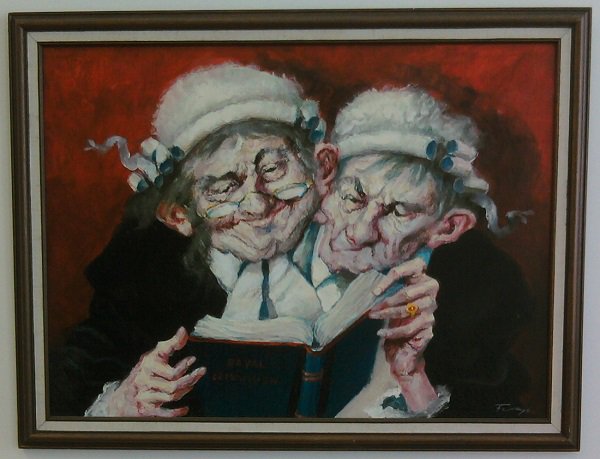
On the lower floor of our offices at work, hangs this picture which was painted by someone of whom I have no idea who they are. Apart from the painting "Defeat of the Spanish Armada, 8 August 1588" by Philippe-Jacques de Loutherbourg, I think that this painting in our offices is one of my most favourite paintings in the whole world.
It isn't as grand or as technically brilliant as a Dutch master but I really love its slap dash approach and the playfulness about it.
Having worked in the rarefied air of the Commonwealth Law Courts, I have seen many judges and barristers of this ilk. These are wizened and weather-beaten gentlemen who have seen the worst of all life's ne'er-do-wells and knaves, pass before them; in wood panelled rooms where the law and justice is dispensed.
Sometimes they spend years listening to tales of horror and woe and sometimes they are troubled by the perpetual serpent twisting of law and into infinite boredom. It is little wonder that they are seen as out of touch with society; yet in actual fact have probably stared at the very worst that society has produced at eight yards.
It is unclear if these two gentlemen, seen poring over the bound copy of a text from a Royal Commission (which intriguingly has the title on the wrong cover), with arthritic knuckles, collars, cuffs and wigs, are sneering with glee or disdain for the text in front of them. We don't know what this Royal Commission would be looking into but we can guess that must be of great importance to warrant calling for one and we can guess that it must be howling of controversy.
Even though the chap on the left is sans moustache, they very much remind me of those famous hecklers from The Muppet Show, Statler and Waldorf. I can imagine that this picture had it been a photograph, might have been taken in the private lounge; on the other side of the wood panelling where the public never treads and where the smells of sherry, whisky and hundred year old cigar smoke fill the air. Perhaps they are recalling old cases like Jarndyce and Jarndyce, or the utter tediousness of similar cases like Barstone, Carstone, Darstone and Farstone.
Their wigs are dirty and unwashed and the vagueness of the background gives a timelessness to this, which means that it could be in 1811, 1911 or even 2011. They are so interchangeable with the legal heroes of the past, that even in the present they are indistinguishable.
There is another painting downstairs in the office of a beach scene but the perspective is rubbish and it just looks like the sort of painting that you put in an office so that the walls aren't bare. This painting though, is just ace because even though there are loads and loads of paintings that I've seen (even at Mosman Art Gallery) which leave this behind in the dust in terms of technique and execution, not many do as well as capturing that cheeky spark which this one throws to the world in buckets.
I know virtually nothing about art. I can't tell you what's good, bad or indifferent and maybe my taste in art is like McDonald's is to cuisine, but if a piece of art makes me think something or feel something about it, then it's done its job; and I think that this painting has done precisely that.
The grand list can be found here: http://fatmumslim.com.au/wp-content/uploads/2016/02/PHOTO-A-DAY-MARCH-16-1024x1024.jpg
This is how to play along: http://fatmumslim.com.au/how-to-play/
March 03, 2016
March 02, 2016
Horse 2085 - Day 2 - Good (March Photo Hunt)
Good, Better, Best. We will never rest.
'Til our good is better, and our better, best.
I am not entirely sure where this rhyming couplet comes from but for some reason I am tempted to think that it is what was cast into the end plates of Furphy & Sons' water carts; as used by the Australian Infantry Forces at Gallipoli and the like. I may have misremembered this entirely and I could very well be speaking a complete furphy but if I am correct then the following photograph represents today's prompt excellently.
Today's Photo Hunt challenge is "Good".
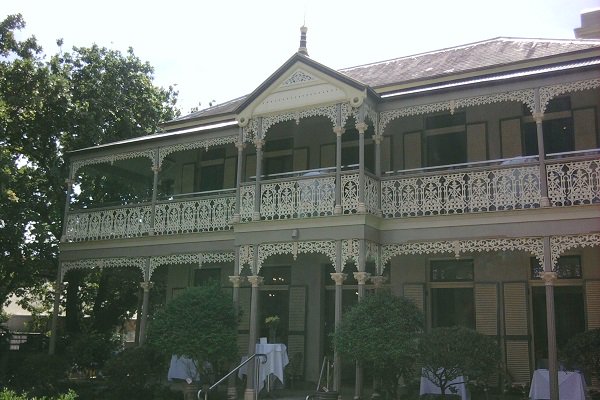
This is Boronia House in Mosman. Usually I find that Mosman with its trappings of wealth, finds ways to display that wealth that are vulgar and ugly. I admit that I don't like the Audi Q7s and BMW X5s that slowly Bob around the suburb, ferrying children to school and then idle chattering people to the overpriced coffee houses that litter suburb but when Mosman does find ways to beautify itself, it does pretty well (money helps). Money doesn't spontaneously buy taste and class but occasionally, it does renovate it.
I have no idea what Boronia House used to be. I have no idea of its history, or who owned it, if it was the estate house of some large landholding, if it was a hotel: I know nothing. What I do know is that its current function of being a tea house and a high tea house at that, is an apt function that befits its grandeur.
I like the wrought iron filigree work, I like the columns and their capitals, I like the finials and I like that the tables have clean linen tablecloths and that there are superfluous and abundant flowers. Someone has taken due care and diligence and shown the building the respect and love it deserves. It is a joy to look at.
Naturally if we're talking about a tea house, then at some point the subject of tea seems appropriate. I am convinced that one of the reasons that Britain simply had to go into the world and carve out an empire, through the process of stealing countries with the cunning use of flags, is that Britain is a dreary dreary island. Had the British won the lottery of geography and started out on the Mediterranean Sea, then there would have been no need for any of it. But because Britain was a rainy little tin top island which was only mildly protected from the Atlantic by Ireland, then the impetus to become a seafaring band of ruffians was baked into the very dough of Britishness.
Naturally, after having acquired India with its lovely spices, Britain simply had to make tea time a very British thing and thanks to historical accident, I live in the shadow after the passing of empire and tea time is still a thing.
There are few things in this world that are as good as a lovely cup of tea. America having ceremonially dumped its tea in Boston Harbor, forged itself as a coffee nation and while coffee is the drink of industry, the enlightenment and business, tea is the drink of calm, peace and serenity (so much serenity).
You can have 'nice' cups of coffee and there are coffee snobs who want single origin artisan coffee but only a cup of tea can be described in the way that Mrs Rollo has suggested: 'magical'. I like to say that it's always time for tea time and truth be told, even if it's overly strong builder's tea, I could drink loads of the stuff.
It is only tea that comes with a full set of paraphernalia it is only tea that we name not one but two breaks during the day after - it is Morning Tea and Afternoon Tea. Morning Coffee merely sounds like that thing that people have before they stare at the 156 emails that have arrived since last night.
It seems to me that the most goodest things are often the simplest; there's very little that's more gooder than a nice cup of tea. Sometimes a nice cup of tea can be improved by serving it in fine china, with jam and scones; on a sunny afternoon, in a pleasant tea house.
"It is a mark of insincerity of purpose to spend one's time in looking for the sacred emperor in the low class tea shops."
- The Wallet of Kai Lung, Ernest Bramah Smith (1900)
I question why one would even bother looking for the sacred emperor in the low class tea shops. I question why one would even bother looking for anything other than tea in the low class tea shops. Tea shops are for tea.
A good cup of tea is about the goodest thing I can think of; I can't think of much more gooder.
The grand list can be found here: http://fatmumslim.com.au/wp-content/uploads/2016/02/PHOTO-A-DAY-MARCH-16-1024x1024.jpg
This is how to play along: http://fatmumslim.com.au/how-to-play/
'Til our good is better, and our better, best.
I am not entirely sure where this rhyming couplet comes from but for some reason I am tempted to think that it is what was cast into the end plates of Furphy & Sons' water carts; as used by the Australian Infantry Forces at Gallipoli and the like. I may have misremembered this entirely and I could very well be speaking a complete furphy but if I am correct then the following photograph represents today's prompt excellently.
Today's Photo Hunt challenge is "Good".
This is Boronia House in Mosman. Usually I find that Mosman with its trappings of wealth, finds ways to display that wealth that are vulgar and ugly. I admit that I don't like the Audi Q7s and BMW X5s that slowly Bob around the suburb, ferrying children to school and then idle chattering people to the overpriced coffee houses that litter suburb but when Mosman does find ways to beautify itself, it does pretty well (money helps). Money doesn't spontaneously buy taste and class but occasionally, it does renovate it.
I have no idea what Boronia House used to be. I have no idea of its history, or who owned it, if it was the estate house of some large landholding, if it was a hotel: I know nothing. What I do know is that its current function of being a tea house and a high tea house at that, is an apt function that befits its grandeur.
I like the wrought iron filigree work, I like the columns and their capitals, I like the finials and I like that the tables have clean linen tablecloths and that there are superfluous and abundant flowers. Someone has taken due care and diligence and shown the building the respect and love it deserves. It is a joy to look at.
Naturally if we're talking about a tea house, then at some point the subject of tea seems appropriate. I am convinced that one of the reasons that Britain simply had to go into the world and carve out an empire, through the process of stealing countries with the cunning use of flags, is that Britain is a dreary dreary island. Had the British won the lottery of geography and started out on the Mediterranean Sea, then there would have been no need for any of it. But because Britain was a rainy little tin top island which was only mildly protected from the Atlantic by Ireland, then the impetus to become a seafaring band of ruffians was baked into the very dough of Britishness.
Naturally, after having acquired India with its lovely spices, Britain simply had to make tea time a very British thing and thanks to historical accident, I live in the shadow after the passing of empire and tea time is still a thing.
There are few things in this world that are as good as a lovely cup of tea. America having ceremonially dumped its tea in Boston Harbor, forged itself as a coffee nation and while coffee is the drink of industry, the enlightenment and business, tea is the drink of calm, peace and serenity (so much serenity).
You can have 'nice' cups of coffee and there are coffee snobs who want single origin artisan coffee but only a cup of tea can be described in the way that Mrs Rollo has suggested: 'magical'. I like to say that it's always time for tea time and truth be told, even if it's overly strong builder's tea, I could drink loads of the stuff.
It is only tea that comes with a full set of paraphernalia it is only tea that we name not one but two breaks during the day after - it is Morning Tea and Afternoon Tea. Morning Coffee merely sounds like that thing that people have before they stare at the 156 emails that have arrived since last night.
It seems to me that the most goodest things are often the simplest; there's very little that's more gooder than a nice cup of tea. Sometimes a nice cup of tea can be improved by serving it in fine china, with jam and scones; on a sunny afternoon, in a pleasant tea house.
"It is a mark of insincerity of purpose to spend one's time in looking for the sacred emperor in the low class tea shops."
- The Wallet of Kai Lung, Ernest Bramah Smith (1900)
I question why one would even bother looking for the sacred emperor in the low class tea shops. I question why one would even bother looking for anything other than tea in the low class tea shops. Tea shops are for tea.
A good cup of tea is about the goodest thing I can think of; I can't think of much more gooder.
The grand list can be found here: http://fatmumslim.com.au/wp-content/uploads/2016/02/PHOTO-A-DAY-MARCH-16-1024x1024.jpg
This is how to play along: http://fatmumslim.com.au/how-to-play/
Horse 2084 - I Am Old (But Not Old Old)
As I was standing on the 243 bus to Neutral Bay this on Friday afternoon (Friday 26th), a lady who looked far too young to be having children, told her son to get up so that a man could have the seat. I was expecting to see some chap with a walking stick and didn't find anyone and it immediately became apparent that the man that she was giving her seat up for, was me.
Now apart from the fact that even at the age of 37 (I had to calculate that because it's so irrelevant to me) I still find being called a "man" somewhat jarring, the fact that I was considered old enough for someone to consider giving up their seat for is nothing short of mind blowing. Seriously; like wow man, what is going on?
Mathematically speaking, I were to die at exactly twice the age I am now (which would be 74 years old), then nobody in particular is going to think that would be some great tragedy. A 74 year old man who dies is utterly normal. Furthermore if you were to triple 37, you get 111 (I know this because of the game Dive¹). Someone aged 111 is well old; therefore I’m definitely into that middle third.
Okay, time's pesky little urchins have arrived and have spray painted my temples in grey, my close up eyesight is on the verge of fading out to a blurry mess and hæmorroids have come to visit but I honestly didn't think that I was 'old'. If the average life expectancy is 84, then that means that I technically entered the middle third of my life as many as seven years ago and am thus 'middle aged', so that can only mean that I've been living in the county of Denial for a long time. That just means that I have a more complete mailing address for my terrace house on Pedant Corner, Grumpy Towers, Dunny-On-The-Wold (what is a Wold² anyway?).
I've already found that modern music has berm annoying for quite some time, my radio mainly stays on ABC News Radio, Radio National and 702 ABC Sydney, I would rather go somewhere quiet than a place full of noise and it is true that tweed is starting to look interesting to me but surely I can't be that far down the line, can I?
The fact that I left high school almost twenty years ago, that I've been waiting for Liverpool to win the league for twenty-six years, that I can remember the days before the internet, before the GST, and that I've started to use phrases like "I can remember" and "kids today", aught to have been enough to give me the idea that I'm old but maybe I'm just adding forgetfulness and stupidity together to get senility.
By your powers combined, I am Captain Old Git. Even my cultural references are old hat and withering on the vine.
I've already done that thing where you walk into a room and forget why you walked in there. Kinder people would suggest that this is to do with efficiencies in the brain; dumping old information as the head that it is contained in, passes across a threshold an across a memory horizon. There's probably some fancy pants pseudo-scientific name for it but really it can be described with those three little words "sad old git".
I'm not so old that I need to know where the nearest lavatory is at all times but I do like the idea of having adequate reading material on hand before one does enter the smallest room in the building and become enthroned upon the Royal Doulton. On that front, I like the works of Quentin Letts, Jeremy Clarkson, George Orwell or Seneca because in a weird sort of way, I like to be reminded of melancholia whilst performing what should be a serene action. It's also worth remembering that Mama Cass and Elvis Presley dies whilst on the lav. History records that they probably died of a heart attack but the most logical explanation that I can think of is that someone must've walked in on them. Ten Thousand Thundering Typhoons, what d'ya think you're doin', man?
I will admit to watching television and conveniently having darkness descend as I am watching, then waking up two minutes before the end and wonder what the point of staying out on the couch was. I'll also admit to lying awake in the middle of the night, worrying about the results of a football match that I can't watch and running around the four walls of my mind like some confined beast. How is it that I'm able to invent the most fantastic devices and designs in my head, only to have them all flit away at the first remembrance. Also, can someone tell me the point of waking up at 02:27am to remember a thing from five weeks ago that I couldn't recall at the time? What's the point of that?
Fair enough, this whole blog post has been something of a ramble where I've forgotten half way through what the point was; so maybe that does prove that I'm probably closer to grave than what I thought but does that mean that I'm so old that someone thinks it worthy enough to give their seat on the bus? Actually... I'm old enough that I could have been her dad. In her mind, maybe I am old enough. That's just scary.
¹Dive – a pretty neat game http://alexfink.github.io/dive
²A Wold is a woodland – as in the Cotswolds or Stow-on-the-Wold
Now apart from the fact that even at the age of 37 (I had to calculate that because it's so irrelevant to me) I still find being called a "man" somewhat jarring, the fact that I was considered old enough for someone to consider giving up their seat for is nothing short of mind blowing. Seriously; like wow man, what is going on?
Mathematically speaking, I were to die at exactly twice the age I am now (which would be 74 years old), then nobody in particular is going to think that would be some great tragedy. A 74 year old man who dies is utterly normal. Furthermore if you were to triple 37, you get 111 (I know this because of the game Dive¹). Someone aged 111 is well old; therefore I’m definitely into that middle third.
Okay, time's pesky little urchins have arrived and have spray painted my temples in grey, my close up eyesight is on the verge of fading out to a blurry mess and hæmorroids have come to visit but I honestly didn't think that I was 'old'. If the average life expectancy is 84, then that means that I technically entered the middle third of my life as many as seven years ago and am thus 'middle aged', so that can only mean that I've been living in the county of Denial for a long time. That just means that I have a more complete mailing address for my terrace house on Pedant Corner, Grumpy Towers, Dunny-On-The-Wold (what is a Wold² anyway?).
I've already found that modern music has berm annoying for quite some time, my radio mainly stays on ABC News Radio, Radio National and 702 ABC Sydney, I would rather go somewhere quiet than a place full of noise and it is true that tweed is starting to look interesting to me but surely I can't be that far down the line, can I?
The fact that I left high school almost twenty years ago, that I've been waiting for Liverpool to win the league for twenty-six years, that I can remember the days before the internet, before the GST, and that I've started to use phrases like "I can remember" and "kids today", aught to have been enough to give me the idea that I'm old but maybe I'm just adding forgetfulness and stupidity together to get senility.
By your powers combined, I am Captain Old Git. Even my cultural references are old hat and withering on the vine.
I've already done that thing where you walk into a room and forget why you walked in there. Kinder people would suggest that this is to do with efficiencies in the brain; dumping old information as the head that it is contained in, passes across a threshold an across a memory horizon. There's probably some fancy pants pseudo-scientific name for it but really it can be described with those three little words "sad old git".
I'm not so old that I need to know where the nearest lavatory is at all times but I do like the idea of having adequate reading material on hand before one does enter the smallest room in the building and become enthroned upon the Royal Doulton. On that front, I like the works of Quentin Letts, Jeremy Clarkson, George Orwell or Seneca because in a weird sort of way, I like to be reminded of melancholia whilst performing what should be a serene action. It's also worth remembering that Mama Cass and Elvis Presley dies whilst on the lav. History records that they probably died of a heart attack but the most logical explanation that I can think of is that someone must've walked in on them. Ten Thousand Thundering Typhoons, what d'ya think you're doin', man?
I will admit to watching television and conveniently having darkness descend as I am watching, then waking up two minutes before the end and wonder what the point of staying out on the couch was. I'll also admit to lying awake in the middle of the night, worrying about the results of a football match that I can't watch and running around the four walls of my mind like some confined beast. How is it that I'm able to invent the most fantastic devices and designs in my head, only to have them all flit away at the first remembrance. Also, can someone tell me the point of waking up at 02:27am to remember a thing from five weeks ago that I couldn't recall at the time? What's the point of that?
Fair enough, this whole blog post has been something of a ramble where I've forgotten half way through what the point was; so maybe that does prove that I'm probably closer to grave than what I thought but does that mean that I'm so old that someone thinks it worthy enough to give their seat on the bus? Actually... I'm old enough that I could have been her dad. In her mind, maybe I am old enough. That's just scary.
¹Dive – a pretty neat game http://alexfink.github.io/dive
²A Wold is a woodland – as in the Cotswolds or Stow-on-the-Wold
March 01, 2016
Horse 2083 - Day 1 - Green (March Photo Hunt)
I only remembered about this late in the day; when I realised that BJD would more than likely attempt another go at compiling a set of photographs for the month of March. I followed the links to last year's set and lo and behold I found that a list for 2016 had been compiled¹.
Maybe B will post his photos to the website this year and hopefully, get beyond Day 9² like in 2015.
This brings me to today's photograph - Green.
If the colour red can to be associated with labour politics at the end of the nineteenth century and then communist and socialist politics in the opening chapter of the twentieth century, then the colour green might occupy a similar sort of role as it has come to symbolise environmental politics at the end of the twentieth and beginning of the twenty-first century. Green Parties are found in most of the parliaments of the world's industrialised nations with the obvious exception of the United States.
It is through the efforts of green political parties that the environment is even remotely considered. From the actual inclusion of environmental legislation, to the protection of certain wilderness areas, to thinking about what mankind's impact is on the natural world, the use of the colour green is a powerful symbol in the abstract of an entire set of policies.
Oh the layers of abstraction here.
If there was the Stone Age, the Bronze Age, the Iron Age, the Dark Ages, the Middle Ages and the Steam Age, the we are not living in the Space Age or even the Silicon Age but the Carbon Age.
Carbon chemistry underpinned the steam age as coal was burned in factories and steam trains but it has been the rise of the petrol and diesel combustion engines as well as the widespread use of plastics which has really come to define the last 100 years. The first proper plastics arrived in the 1930s and plastic is so ubiquitous, that it's hard to imagine what the world would look like without them.
Plastic though is not without its problems. There are the environmental issues surrounding its manufacture and another equally vexed set of problems when these goods finally come to the end of their useful life. Sure, some plastic can be recycled but because we're so good at the engineering that goes into creating plastic products, after they are thrown away, they tend to degrade very slowly indeed. The idea of a green plastic bag is tenuous at best and because plastic does survive for so very long, it's likely to still be in the environment well after its consumer has died.
The individual story of how this particular plastic bag came to be here is quite mundane. Presumably it was a carrier bag which came from a supermarket, and judging by the array of coffee cups and other wrappers which I could see in there, it was probably used as a bin liner in an office.
Thus, the short life of this plastic bag has come to its logical end. Having served two dull tasks, it now suffers an ignoble end and will become landfill in a rubbish dump. Although it has such phrases as "Return To Earth" and "Helping To Save Our Planet" printed on it, this somewhat remarkable product of long-chain hydrocarbon organic chemistry, has been cast aside. The technology to produce such a thing didn't even exist 80 years ago and yet here it is being cast aside as a piece of refuse.
There is something almost ironic about the fact that the colour green which is the colour of plant life, is itself sort of hijacked to make products which are demonstrably bad for the environment, seem nicer than they otherwise would be. I have seen leaves and plant badges on various motor cars to indicate the 'Eco' model. Nissan even goes so far as to call its electric car the Leaf; which although it doesn't have any tailpipe emissions, because of the cadmium in its batteries, presents an even more challenging disposal problem when they finally become unserviceable, than had it been a conventional car.
¹That list can be found here: http://fatmumslim.com.au/wp-content/uploads/2016/02/PHOTO-A-DAY-MARCH-16-1024x1024.jpg
This is how to play along: http://fatmumslim.com.au/how-to-play/
²BJD's website http://bjd.id.au/
Maybe B will post his photos to the website this year and hopefully, get beyond Day 9² like in 2015.
This brings me to today's photograph - Green.
If the colour red can to be associated with labour politics at the end of the nineteenth century and then communist and socialist politics in the opening chapter of the twentieth century, then the colour green might occupy a similar sort of role as it has come to symbolise environmental politics at the end of the twentieth and beginning of the twenty-first century. Green Parties are found in most of the parliaments of the world's industrialised nations with the obvious exception of the United States.
It is through the efforts of green political parties that the environment is even remotely considered. From the actual inclusion of environmental legislation, to the protection of certain wilderness areas, to thinking about what mankind's impact is on the natural world, the use of the colour green is a powerful symbol in the abstract of an entire set of policies.
Oh the layers of abstraction here.
If there was the Stone Age, the Bronze Age, the Iron Age, the Dark Ages, the Middle Ages and the Steam Age, the we are not living in the Space Age or even the Silicon Age but the Carbon Age.
Carbon chemistry underpinned the steam age as coal was burned in factories and steam trains but it has been the rise of the petrol and diesel combustion engines as well as the widespread use of plastics which has really come to define the last 100 years. The first proper plastics arrived in the 1930s and plastic is so ubiquitous, that it's hard to imagine what the world would look like without them.
Plastic though is not without its problems. There are the environmental issues surrounding its manufacture and another equally vexed set of problems when these goods finally come to the end of their useful life. Sure, some plastic can be recycled but because we're so good at the engineering that goes into creating plastic products, after they are thrown away, they tend to degrade very slowly indeed. The idea of a green plastic bag is tenuous at best and because plastic does survive for so very long, it's likely to still be in the environment well after its consumer has died.
The individual story of how this particular plastic bag came to be here is quite mundane. Presumably it was a carrier bag which came from a supermarket, and judging by the array of coffee cups and other wrappers which I could see in there, it was probably used as a bin liner in an office.
Thus, the short life of this plastic bag has come to its logical end. Having served two dull tasks, it now suffers an ignoble end and will become landfill in a rubbish dump. Although it has such phrases as "Return To Earth" and "Helping To Save Our Planet" printed on it, this somewhat remarkable product of long-chain hydrocarbon organic chemistry, has been cast aside. The technology to produce such a thing didn't even exist 80 years ago and yet here it is being cast aside as a piece of refuse.
There is something almost ironic about the fact that the colour green which is the colour of plant life, is itself sort of hijacked to make products which are demonstrably bad for the environment, seem nicer than they otherwise would be. I have seen leaves and plant badges on various motor cars to indicate the 'Eco' model. Nissan even goes so far as to call its electric car the Leaf; which although it doesn't have any tailpipe emissions, because of the cadmium in its batteries, presents an even more challenging disposal problem when they finally become unserviceable, than had it been a conventional car.
¹That list can be found here: http://fatmumslim.com.au/wp-content/uploads/2016/02/PHOTO-A-DAY-MARCH-16-1024x1024.jpg
This is how to play along: http://fatmumslim.com.au/how-to-play/
²BJD's website http://bjd.id.au/
Horse 2082 - Some Days That Did Not Exist, Weird Days That Do Exist.
Continuing my obsession with the calendar, there are some even stranger stories which need to be told.
Most people know about the fact that the Julian Calendar will slowly drift by one day every 128 years. This posed a problem for someone like Pope Gregory XIII; so he was able to convince the Catholic church to change its calendar to his eponymous system which is the one we currently use.
Add a leap day as February 29 on years that are divisible by four (like 2016)
Unless they are also divisible by 100 (like 1800 or 1900).
Unless unless they are also divisible by 400 (like 2000).
Hence the reason why 1900 didn't have a February 29 but why 2000 did.
This was all very nice until you realise that some countries like England who were not very Catholicy at all (owing to Henry VIII who was cranky all the time) and the countries who had Eastern Orthodox churches also didn't like the pope, all told Pope Gregory XIII in no uncertain terms that he was wrong.
Eventually though, these countries did fall into line; with England finally doing so in 1752, Russia in 1918 and Greece being the last in 1923.
In the case of England. New Year's Day used to be April 25 which was Lady Day, or rather the Feast of the Annunciation of the Virgin Mary. In 1752, the calendar was punted forward by 11 days and the Wednesday 2nd September 1752 would be followed by Thursday 14th September 1752.
One remaining vestige of this is that the tax year in the UK which used to begin and end on April 25, was also punted forward by 11 days to April 6.
Sweden who was still using the Julian Calendar and who was in the middle of a 21 year war called the "Great Northern War" with Russia, added two leap days in 1712 and thus the year 1712 in Sweden had both a 29th and a 30th of February.
Sweden would adopt the Gregorian Calendar in 1753, when the 16th of February was followed by 1st March.
Russia on the other hand was still happily using the Julian Calendar right through the First World War. After it did finally adopt the Gregorian Calendar in 1918, the first day in February 1918 was February 14th.
This caused its own silliness, with the October Revolution of 1917 which had begun on October 25, now being celebrated on November 7th.
One of the days which I found that didn't fit into anything described here is what the Chinese Government politely refers to as the political turmoil between the Spring and Summer of 1989. This event is more commonly known as the June Fourth Incident or more bluntly as the Tiananmen Square Massacre.
I have seen this referred to as the May 35th incident as a way of subverting internet censorship in China.
One of the accounting programs that I use does better than all of these. It uses 40 days in every month and 15 months in the year. Those extra days and months are there for you to throw through journal entries without upsetting individual months.
They are labelled Undecimber, Duodecember, Trescember which are confusingly named because they are the 13th, 14th and 15th months. The 37th of Trescember (37-15-2016) isn't a normal date for most people but in the accounting world, it's allowed.
Most people know about the fact that the Julian Calendar will slowly drift by one day every 128 years. This posed a problem for someone like Pope Gregory XIII; so he was able to convince the Catholic church to change its calendar to his eponymous system which is the one we currently use.
Add a leap day as February 29 on years that are divisible by four (like 2016)
Unless they are also divisible by 100 (like 1800 or 1900).
Unless unless they are also divisible by 400 (like 2000).
Hence the reason why 1900 didn't have a February 29 but why 2000 did.
This was all very nice until you realise that some countries like England who were not very Catholicy at all (owing to Henry VIII who was cranky all the time) and the countries who had Eastern Orthodox churches also didn't like the pope, all told Pope Gregory XIII in no uncertain terms that he was wrong.
Eventually though, these countries did fall into line; with England finally doing so in 1752, Russia in 1918 and Greece being the last in 1923.
In the case of England. New Year's Day used to be April 25 which was Lady Day, or rather the Feast of the Annunciation of the Virgin Mary. In 1752, the calendar was punted forward by 11 days and the Wednesday 2nd September 1752 would be followed by Thursday 14th September 1752.
One remaining vestige of this is that the tax year in the UK which used to begin and end on April 25, was also punted forward by 11 days to April 6.
Sweden who was still using the Julian Calendar and who was in the middle of a 21 year war called the "Great Northern War" with Russia, added two leap days in 1712 and thus the year 1712 in Sweden had both a 29th and a 30th of February.
Sweden would adopt the Gregorian Calendar in 1753, when the 16th of February was followed by 1st March.
Russia on the other hand was still happily using the Julian Calendar right through the First World War. After it did finally adopt the Gregorian Calendar in 1918, the first day in February 1918 was February 14th.
This caused its own silliness, with the October Revolution of 1917 which had begun on October 25, now being celebrated on November 7th.
One of the days which I found that didn't fit into anything described here is what the Chinese Government politely refers to as the political turmoil between the Spring and Summer of 1989. This event is more commonly known as the June Fourth Incident or more bluntly as the Tiananmen Square Massacre.
I have seen this referred to as the May 35th incident as a way of subverting internet censorship in China.
One of the accounting programs that I use does better than all of these. It uses 40 days in every month and 15 months in the year. Those extra days and months are there for you to throw through journal entries without upsetting individual months.
They are labelled Undecimber, Duodecember, Trescember which are confusingly named because they are the 13th, 14th and 15th months. The 37th of Trescember (37-15-2016) isn't a normal date for most people but in the accounting world, it's allowed.
February 29, 2016
Horse 2081 - When February 30 Comes (Or A Month Of Sundays)
Thirty days hath September,
April, June, and November.
Thirty-one hath all the rest,
Except for February clear which has 28 and 29 in a leap year
This is how I'm sure how most of us remember how many days are in each month - a poem. Not only that, a poem which doesn't even scan all that well.
Another way would be to look at your knuckles. Starting with your left hand, every knuckle is a month of 31 days; every valley between then is a month of 30 days. This even takes account of the fact that July and August which are consecutive, both have 31 days. Run out of knuckles? Just move onto your right hand.
The calendar has always seemed to me to be a thing, which is the result of accident, was obviously never designed and is quite frankly, nuttier than a bag of nuts, Brazil, Wal, Pea and M5 Hex. The only people that I can think who benefit from its continued use are calendar printers and the dead pope Gregory XIII and Julius Caesar, who are credited with trying to sort out the calendar.
There needs to be someone to finally sort out the mess once and for all. All of this is enough to drive a sane person crazy, or a crazy person to science. I am that crazy person that the world needs.
Voila!
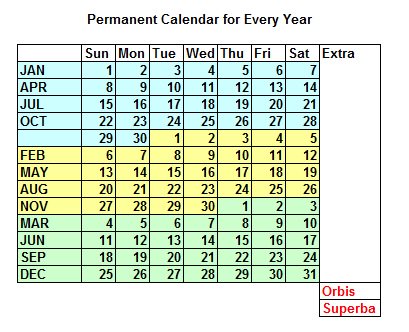
My proposal for the calendar is so small, that it can be printed on one page and every single year would be identical forever.
Unlike the International Fixed Calendar as invented by Moses B. Cotsworth and used by Kodak for
61 years¹, my calendar has 12 months as per normal and in addition to that, every quarter is identical.
Every quarter would be precisely 91 days long, which is 13 weeks. This is incredibly useful for accounting purposes because having every singe quarter an identical length of time, removes those small variations which are caused by the quarters currently having different lengths.
You will note the addition of two extra days in the bottom right hand corner. I have called these Orbis and Superba. Like Cotsworth's Year Day and Leap Day, these two days would either occur as New Years' Day but not in any month or week or as New Years' Eve.
Let's be honest, nobody wants to work on New Years' Day as it is and an additional day which would immediately follow once every four years, instead of adding it into February of all places (Why does it only have 28 days? Who was the nuff-nuff who thought that one up?) it would be added to that space between December and January.
Orbis is a good name for that extra day because it marks the arbitrary point in the year where we make one orbit of the sun, and Superba is called that because it is an extra, a bonus day.
I do realise that this confines people's birthdays permanently to the same day every year but people who were born on some dates which are always holidays, like Anzac Day for example, always get a public holiday on their birthdays anyway. If peoples' birthdays are what we're worried about, surely people can just learn to tolerate it. If the people who currently have their birthday on February 29 still want to remain mysterious, then they can choose to celebrate it on Superba. Whatever.
This idea is hardly new at all. Elisabeth Achelis founded The World Calendar Association in 1930 and proposed a calendar to this which is based on exactly the same principles, except that she proposed that the 31-day month be the first and not the third in the quarter. Issac Asimov's World Season Calendar was also for four 91-day quarters but he proposed that they be labelled A, B, C & D (May 10 would be B-40 for instance).
I would of course be stark raving bonkers to think that anyone would seriously adopt a calendar like this because even though the current calendar is an illogical mess, no-one can be bothered to change it.
... and because once every four years or so, I get to write a post like this which says exactly the same thing because some things never change.
¹https://en.wikipedia.org/wiki/International_Fixed_Calendar
April, June, and November.
Thirty-one hath all the rest,
Except for February clear which has 28 and 29 in a leap year
This is how I'm sure how most of us remember how many days are in each month - a poem. Not only that, a poem which doesn't even scan all that well.
Another way would be to look at your knuckles. Starting with your left hand, every knuckle is a month of 31 days; every valley between then is a month of 30 days. This even takes account of the fact that July and August which are consecutive, both have 31 days. Run out of knuckles? Just move onto your right hand.
The calendar has always seemed to me to be a thing, which is the result of accident, was obviously never designed and is quite frankly, nuttier than a bag of nuts, Brazil, Wal, Pea and M5 Hex. The only people that I can think who benefit from its continued use are calendar printers and the dead pope Gregory XIII and Julius Caesar, who are credited with trying to sort out the calendar.
There needs to be someone to finally sort out the mess once and for all. All of this is enough to drive a sane person crazy, or a crazy person to science. I am that crazy person that the world needs.
Game Over.
Unlike the International Fixed Calendar as invented by Moses B. Cotsworth and used by Kodak for
61 years¹, my calendar has 12 months as per normal and in addition to that, every quarter is identical.
Every quarter would be precisely 91 days long, which is 13 weeks. This is incredibly useful for accounting purposes because having every singe quarter an identical length of time, removes those small variations which are caused by the quarters currently having different lengths.
You will note the addition of two extra days in the bottom right hand corner. I have called these Orbis and Superba. Like Cotsworth's Year Day and Leap Day, these two days would either occur as New Years' Day but not in any month or week or as New Years' Eve.
Let's be honest, nobody wants to work on New Years' Day as it is and an additional day which would immediately follow once every four years, instead of adding it into February of all places (Why does it only have 28 days? Who was the nuff-nuff who thought that one up?) it would be added to that space between December and January.
Orbis is a good name for that extra day because it marks the arbitrary point in the year where we make one orbit of the sun, and Superba is called that because it is an extra, a bonus day.
I do realise that this confines people's birthdays permanently to the same day every year but people who were born on some dates which are always holidays, like Anzac Day for example, always get a public holiday on their birthdays anyway. If peoples' birthdays are what we're worried about, surely people can just learn to tolerate it. If the people who currently have their birthday on February 29 still want to remain mysterious, then they can choose to celebrate it on Superba. Whatever.
This idea is hardly new at all. Elisabeth Achelis founded The World Calendar Association in 1930 and proposed a calendar to this which is based on exactly the same principles, except that she proposed that the 31-day month be the first and not the third in the quarter. Issac Asimov's World Season Calendar was also for four 91-day quarters but he proposed that they be labelled A, B, C & D (May 10 would be B-40 for instance).
I would of course be stark raving bonkers to think that anyone would seriously adopt a calendar like this because even though the current calendar is an illogical mess, no-one can be bothered to change it.
... and because once every four years or so, I get to write a post like this which says exactly the same thing because some things never change.
¹https://en.wikipedia.org/wiki/International_Fixed_Calendar
February 26, 2016
Horse 2080 - A Funny Thing Happened To Me On The Way Here...
I'm here all week. Try the veal.
I have to preface this by saying that I'm not a comedian nor have I ever been at the mic in a comedy club. Quite frankly, I don't think that your average punter wants to here a nine minute comedic rant which might involve such esoteric subjects as politics, utilitarianism, downdraft carburetors and epistemology Kantianism. No, they want to hear mother in law jokes, vaguely bawdy stories which include innuendo and straight up swearing.
If I were to stand upon the small stage, treading the boards under the presidium arch, I suspect that I would encounter a darkened room of silence and possibly find the odd flying glass which would impolitely prompt me to leave. However, just before that tulip glass would have shattered into ten thousand pieces and brought forth a river of crimson, had this been a film or on television there would also be either a tumbleweed, the sound of crickets chirping or the noise of someone coughing. This post looks at the relative merits of all three.
Tumbleweeds:
I shan't explain what a tumbleweed is because that might be the beginning of a self referential spiral which could lead to the formation of a micro black hole; so before this explanation disappears into its own gravitational orifice, I should explain how the device of the tumbleweed is best executed.
Tumbleweeds suggest an environment devoid of all life. The sight of a tumbleweed is usually associated with deserts and mesas. If one saw a tumbleweed merrily bouncing across the stage of a comedy club, the tumbleweed itself would be the source of much merriment and mirth because of a juxtaposition of place even though the poor Charlie behind the microphone would probably be tanking badly and need the theatrical hook to pull them off stage.
Of these three, the tumbleweed is the kindest of the comedic silence indicators because it's just so daft. It would also help if the tumbleweed was accompanied by the sounds of a light breeze as well.
Crickets Chirping:
This is almost always in response to a joke which has been cracked, or after the comedian as asked for audience participation and has got nothing. Tumbleweeds weeds indicate a general quietness but the sounds of crickets represents an active abandonment. Either the audience has walked out through boredom or they are being really quiet.
The sound of crickets is more of a forlorn sort of sound than the bounce of a tumbleweed. If a comedian gets cricket sounds, then they are doing badly. Their jokes have failed.
Coughing:
This has to be about the worst possible noise for a comedian. The sound of people coughing indicates that they actively hate the comedian and actually resent their presence. Perhaps there might be some other act which follows or else they're just waiting for the appropriate time to bring forth boos. Either way, coughing lets the comedian know that the audience would rather be somewhere else or they wish for the comedian to be somewhere else. This is one step away from the audience telling the comedian to go somewhere else and if they're not feeling particularly polite, they might even tell them how to get there. Put it this way, the audience would be far ruder in telling the comedian how to get to somewhere else than if the comedian had asked how to get to Sesame Street (or Amarillo if you happen to be older and want a different cultural reference).
Now there was a point to all of this. The question which I'd been posed is why don't I go into comedy. The truth is that while I might have a lightning quick wit, dashing good looks, an ego the size of Texas and the ability to write profundities and witticisms about subjects both sharp and banal, I'm actually as funny as a cow stuck in a barbed wire fence. I'm sure that if I was on stage, I'd get tumbleweeds, crickets chirping and coughing as well as that glass flying through the air.
Comedians who find themselves hosting radio programs, or on television, or packing out venues, are able to do so because they possess talent, ability and practice; I hold none of those things. In fact it was my mum who said it best: "You're not funny, you're stupid". That might not have been incredibly encouraging and it might have been dream shattering but having shattered dreams is better than having a flying glass shatter on the side of your face.
I have to preface this by saying that I'm not a comedian nor have I ever been at the mic in a comedy club. Quite frankly, I don't think that your average punter wants to here a nine minute comedic rant which might involve such esoteric subjects as politics, utilitarianism, downdraft carburetors and epistemology Kantianism. No, they want to hear mother in law jokes, vaguely bawdy stories which include innuendo and straight up swearing.
If I were to stand upon the small stage, treading the boards under the presidium arch, I suspect that I would encounter a darkened room of silence and possibly find the odd flying glass which would impolitely prompt me to leave. However, just before that tulip glass would have shattered into ten thousand pieces and brought forth a river of crimson, had this been a film or on television there would also be either a tumbleweed, the sound of crickets chirping or the noise of someone coughing. This post looks at the relative merits of all three.
Tumbleweeds:
I shan't explain what a tumbleweed is because that might be the beginning of a self referential spiral which could lead to the formation of a micro black hole; so before this explanation disappears into its own gravitational orifice, I should explain how the device of the tumbleweed is best executed.
Tumbleweeds suggest an environment devoid of all life. The sight of a tumbleweed is usually associated with deserts and mesas. If one saw a tumbleweed merrily bouncing across the stage of a comedy club, the tumbleweed itself would be the source of much merriment and mirth because of a juxtaposition of place even though the poor Charlie behind the microphone would probably be tanking badly and need the theatrical hook to pull them off stage.
Of these three, the tumbleweed is the kindest of the comedic silence indicators because it's just so daft. It would also help if the tumbleweed was accompanied by the sounds of a light breeze as well.
Crickets Chirping:
This is almost always in response to a joke which has been cracked, or after the comedian as asked for audience participation and has got nothing. Tumbleweeds weeds indicate a general quietness but the sounds of crickets represents an active abandonment. Either the audience has walked out through boredom or they are being really quiet.
The sound of crickets is more of a forlorn sort of sound than the bounce of a tumbleweed. If a comedian gets cricket sounds, then they are doing badly. Their jokes have failed.
Coughing:
This has to be about the worst possible noise for a comedian. The sound of people coughing indicates that they actively hate the comedian and actually resent their presence. Perhaps there might be some other act which follows or else they're just waiting for the appropriate time to bring forth boos. Either way, coughing lets the comedian know that the audience would rather be somewhere else or they wish for the comedian to be somewhere else. This is one step away from the audience telling the comedian to go somewhere else and if they're not feeling particularly polite, they might even tell them how to get there. Put it this way, the audience would be far ruder in telling the comedian how to get to somewhere else than if the comedian had asked how to get to Sesame Street (or Amarillo if you happen to be older and want a different cultural reference).
Now there was a point to all of this. The question which I'd been posed is why don't I go into comedy. The truth is that while I might have a lightning quick wit, dashing good looks, an ego the size of Texas and the ability to write profundities and witticisms about subjects both sharp and banal, I'm actually as funny as a cow stuck in a barbed wire fence. I'm sure that if I was on stage, I'd get tumbleweeds, crickets chirping and coughing as well as that glass flying through the air.
Comedians who find themselves hosting radio programs, or on television, or packing out venues, are able to do so because they possess talent, ability and practice; I hold none of those things. In fact it was my mum who said it best: "You're not funny, you're stupid". That might not have been incredibly encouraging and it might have been dream shattering but having shattered dreams is better than having a flying glass shatter on the side of your face.
February 24, 2016
Horse 2079 - It's The Senate, Carol Brown.
There has been something of a kerfuffle in the media of late with regards the proposed legislation to change the way that Senate ballot papers work. Having read through the proposal, I personally think that it's an ace idea and that it probably should have been how the system worked all along.
The way that elections to the Senate currently works is that the members of the chamber are elected on the basis of proportional representation. To be elected, a member needs not a 50% + 1 majority of votes but only needs to secure that particular proportion of votes to be elected.
As it currently stands, each state gets twelve Senators. This means that in every half-Senate election, six Senators are chosen. The number of votes required works out to be a quota which ends up being one sixth of all formal votes within the state. However, since there can be more than two hundred candidates, getting to that one sixth of the vote can be a complex process.
Under the current system, voters can mark a "1" above the line which assigns a group ticket based upon how that group has chosen to allocate their preference flow. Voters are still perfectly free to number every box below the line (I am proudly a below the line voter) but the number of people who do, is only a small fraction. As a result, the deals worked out in negotiations well before election day, ends up being quite important. One of the criticisms of above the line ticket voting, is that voters don't really know where their preferences are flowing and this means that parties who can best manipulate the system can secure the best results, even though they may have only taken less than 1% of first preference votes.
The change to preferentially numbering the groups above the line would mean the instead of parties being able to negotiate long chains of preferences, the would really only have a say in how their own group was numbered. The two major blocs, the Liberal & National coalition and the Labor Party, like the idea that they probably will have a greater chance at winning the last seat when it comes down to preferences, and minor and micro parties will no longer be able to engage in manipulation and negotiation to secure that last seat to such a degree.
Ricky Muir of the Australian Motoring Enthusiast Party, got a paltry 0.51% of first preference votes and still managed to elected; despite achieving 0.0354% of a Senate quota. The rest came through preference deals through such manipulation and negotiation.
I kind of suspect that David Leyonhjelm of the Liberal Democratic Party was elected to the Senate, with 9.5% of first preferences, probably as a result of such manipulation and being in the first position on the ballot paper, after having gained about 1% in previous state elections.
Although I like the idea of lots of different voices speaking into the parliament, I like the idea that by changing the way that group tickets are distributed, more control over how someone votes is handed back to the voter. This of course assumes that you are voting above the line; if you vote below the line, you still have total control over where your preferences go as before.
I think that the change to the group voting system is likely to have several obvious effects. Firstly that I suspect that the number of candidates all competing for the Senate will fall markedly. If micro parties realise that they won't derive the same benefits from unseen negotiations, then I suspect that this will discourage lots of them from registering. Strangely I think that this will also result in wedge parties having a greater say in future. Parties like the Democrats who even used to have the slogan "keep the bastards honest" in the past and The Greens at the moment, are likely to find that their wedge is likely to become larger. I can very much see The Greens having as many as twelve Senators in a future Senate and the balance of power to boot. The majors are probably aware of this but I suspect that they'd prefer to negotiate legislation with a group who has open manifestos and is predictable than someone from a party of one whom nobody has ever heard of before.
If Clive Palmer's United Party remains a thing, then there is a possibility that it might retain seats. Though given that Clive himself has an approval rating in his lower house seat of Fairfax of 2%, that he was elected in 2013 on a majority of 36 votes and that several of his party went rogue, it is equally likely that they may not continue to exist either. If however it doesn't just disappear below the surface of the waves (in the way that the replica Titanic also failed to do), then the change in group voting could help them. Put it this way, if the Palmer United Party had existed in the bunfight that was the 2010 election, then I suspect that the PUP could have held the balance of power in both houses of parliament; the world could have looked quite different.
It's definitely worth remembering as the Prime Minister Malcolm Turnbull and Opposition Leader Bill Shorten thunder at each other from a distance of two maces away, that the major parties wouldn't even be considering this unless they could first see some benefit in it for them. Forget all notion of improving democratic process, no.
In the words of former Liverpool FC manager Bill Shankly: "If a player is not interfering with play or seeking to gain an advantage, then he should be". I think that this is exactly what is going on here. If no advantage is being seemed, then it wouldn't have been pursued. There are more red herrings going around at the moment than red herrings being served in a red herring casserole on board the HMS Red Herring.
The way that elections to the Senate currently works is that the members of the chamber are elected on the basis of proportional representation. To be elected, a member needs not a 50% + 1 majority of votes but only needs to secure that particular proportion of votes to be elected.
As it currently stands, each state gets twelve Senators. This means that in every half-Senate election, six Senators are chosen. The number of votes required works out to be a quota which ends up being one sixth of all formal votes within the state. However, since there can be more than two hundred candidates, getting to that one sixth of the vote can be a complex process.
Under the current system, voters can mark a "1" above the line which assigns a group ticket based upon how that group has chosen to allocate their preference flow. Voters are still perfectly free to number every box below the line (I am proudly a below the line voter) but the number of people who do, is only a small fraction. As a result, the deals worked out in negotiations well before election day, ends up being quite important. One of the criticisms of above the line ticket voting, is that voters don't really know where their preferences are flowing and this means that parties who can best manipulate the system can secure the best results, even though they may have only taken less than 1% of first preference votes.
The change to preferentially numbering the groups above the line would mean the instead of parties being able to negotiate long chains of preferences, the would really only have a say in how their own group was numbered. The two major blocs, the Liberal & National coalition and the Labor Party, like the idea that they probably will have a greater chance at winning the last seat when it comes down to preferences, and minor and micro parties will no longer be able to engage in manipulation and negotiation to secure that last seat to such a degree.
Ricky Muir of the Australian Motoring Enthusiast Party, got a paltry 0.51% of first preference votes and still managed to elected; despite achieving 0.0354% of a Senate quota. The rest came through preference deals through such manipulation and negotiation.
I kind of suspect that David Leyonhjelm of the Liberal Democratic Party was elected to the Senate, with 9.5% of first preferences, probably as a result of such manipulation and being in the first position on the ballot paper, after having gained about 1% in previous state elections.
Although I like the idea of lots of different voices speaking into the parliament, I like the idea that by changing the way that group tickets are distributed, more control over how someone votes is handed back to the voter. This of course assumes that you are voting above the line; if you vote below the line, you still have total control over where your preferences go as before.
I think that the change to the group voting system is likely to have several obvious effects. Firstly that I suspect that the number of candidates all competing for the Senate will fall markedly. If micro parties realise that they won't derive the same benefits from unseen negotiations, then I suspect that this will discourage lots of them from registering. Strangely I think that this will also result in wedge parties having a greater say in future. Parties like the Democrats who even used to have the slogan "keep the bastards honest" in the past and The Greens at the moment, are likely to find that their wedge is likely to become larger. I can very much see The Greens having as many as twelve Senators in a future Senate and the balance of power to boot. The majors are probably aware of this but I suspect that they'd prefer to negotiate legislation with a group who has open manifestos and is predictable than someone from a party of one whom nobody has ever heard of before.
If Clive Palmer's United Party remains a thing, then there is a possibility that it might retain seats. Though given that Clive himself has an approval rating in his lower house seat of Fairfax of 2%, that he was elected in 2013 on a majority of 36 votes and that several of his party went rogue, it is equally likely that they may not continue to exist either. If however it doesn't just disappear below the surface of the waves (in the way that the replica Titanic also failed to do), then the change in group voting could help them. Put it this way, if the Palmer United Party had existed in the bunfight that was the 2010 election, then I suspect that the PUP could have held the balance of power in both houses of parliament; the world could have looked quite different.
It's definitely worth remembering as the Prime Minister Malcolm Turnbull and Opposition Leader Bill Shorten thunder at each other from a distance of two maces away, that the major parties wouldn't even be considering this unless they could first see some benefit in it for them. Forget all notion of improving democratic process, no.
In the words of former Liverpool FC manager Bill Shankly: "If a player is not interfering with play or seeking to gain an advantage, then he should be". I think that this is exactly what is going on here. If no advantage is being seemed, then it wouldn't have been pursued. There are more red herrings going around at the moment than red herrings being served in a red herring casserole on board the HMS Red Herring.
February 23, 2016
Horse 2078 - Lockout Laws Are Probably The Best Policy
http://www.abc.net.au/news/2016-02-21/about-8000-protest-against-sydney-lockout-laws/7187372
About 8,000 people have gathered in Sydney's CBD to protest against the New South Wales Government's lockout laws in the inner city. The Keep Sydney Open rally started at Sydney's Central Station at 12:30pm before making its way to the CBD.
The NSW Government introduced the laws in 2014 in response to antisocial behaviour in the CBD.
They impact venues in Kings Cross, Darling Harbour, The Rocks and parts of the CBD, and mean no shots after 10:00pm, no new customers after 1:30am and no alcohol served after 3:00am.
Protesters called for the restrictions on trading hours to be lifted and the NSW Government to consult with venues before making further decisions. They claim the laws were putting Sydney's reputation as a global city in jeopardy.
- ABC News, 21st Feb 2014.
Roughly 8000 people marched through the city at the weekend protesting the NSW State Government's lockout laws. The laws officially close the doors to licenced premises after 1:30am and impose official closing times of 3:00am.
The people who usually object to an imposition of law such as this are businesses who wish to remain open longer and people who also wish to stay out longer. The most common argument that I've heard on the radio and by reading social media over the past few days has been that people are smart enough to make informed decisions about what they do with their time and that government shouldn't have the right to legislate against morality. Meanwhile on the other side of this debate are people like the police and hospital staff, whose job it is to patch up the results of having lairy drunk people at the weekend.
As it is, in Sydney the number of assaults have fallen by 20% in the CBD and as much as 45% in Kings Cross since the lockout laws were introduced. That should be more than enough to convince people that the laws have done something useful.
I find it interesting that in this particular debate, not one person from the the NSW Hoteliers Association or Clubs NSW, has actually acknowledged that the sale of alcohol by their members, might in some way contribute to an economic cost which has to be borne by the taxpayer.
There is a market based solution to the problem but I guarantee that the NSW Hoteliers Association and Clubs NSW would vociferously protest it at every turn. The State Government could issue licences which allow opening beyond the standard doors closing time of 1:30am and lockout of 3:00am and charge the full economic cost of patching people back together. I expect that nobody would choose to accept such terms and immediately everyone would start screaming blue murder.
Negative externalities such as this bear a striking similarity in spirit to say tailings from a mine spilling into the water table or smog being produced by factories. As they have never in the past ever had to pay for the effects of their goods and services, it simply isn't seen as a problem at all. It is all very well to advance the wishes of your membership but to refuse to acknowledge that private profit comes at public cost in this case, is at very least myopic.
Lets be honest about this, Sydney although it claims to be a world city is really just a regional centre that got out of hand. Just about everyone who lives in this swirling mass of humanity will openly admit that Melbourne with its laneways and cafés, is a far better city. Instead of cafés in laneways, Sydney has coward punches and fights on George Street.
One of the reasons for Sydney's problems with drunken violence is that after 6:00pm on any day of the working week and especially at the weekends, everything in Sydney is shut. There is no opportunity for a spot of evening retail therapy if all the shops have closed. Following on from this, at 10:00pm, all the restaurants close down as well. Having catered for the theatre and movie crowds, the restaurants proper and all of the bistros all start turning out the lights. As a result, some people go home and others stay on. Between the hour of midnight and 1am, the trains begin to shut down as well. Here is where our story really starts to get interesting.
Sydney is a massive place. It measures 80km north to south and maybe 70km east to west. After all the trains have stopped running, this leaves a lot of people wandering around the CBD with no real way to get home other than to wait for the bus; which may come once every hour.
There are several solutions at this point. The NSW State Government could choose to run trains through the night at the weekends and this would almost certainly reduce the amount of drunken violence in the city as people had the chance to go home. This is the most expensive option and a government which is already strapped for cash isn't very likely to ever pursue it.
It could choose to extend trading hours for pubs and clubs in the city, however this has been empirically tested with some 24 hour licences in the past and there reaches a point where establishments just don't hire people. The net effect in economic terms for the state government isn't markedly improved.
As a result we have the lockout laws. Universally hated by those who have licences, they are probably the most pragmatic solution to the problem.
Maybe the government could look into other initiatives that would change the character of the city; in the same way that other cities around the world have done. Physically limiting the size of venues is an interesting suggestion that might produce worthwhile outcomes but I think it would be rather difficult to coerce licence holders into reducing the size of existing venues. This could be a solution if it is applied to the issuing of new licences but it might very well create a premium for larger venues which are preexisting if they are on sold.
I'm not personally sure how I feel about the lockout laws. Sending people out into a cold night in the middle of winter in at Sydney all at once isn't perhaps the best solution but I reject the perspective that people's liberty is absolute. As a taxpayer, it is me who pays the on costs of pubs and clubs remaining open to the wee small hours; not the pubs and clubs. Whatever solution that the government came up with, would have been derided by someone and so they were on a hiding to nothing. I think that what we have ended up with is one of the least worst solutions and so I don't think that piling on the government when they've been trying to do their best and govern the ungovernable makes sense. I think that the protest march through the city looked more than just a little silly.
About 8,000 people have gathered in Sydney's CBD to protest against the New South Wales Government's lockout laws in the inner city. The Keep Sydney Open rally started at Sydney's Central Station at 12:30pm before making its way to the CBD.
The NSW Government introduced the laws in 2014 in response to antisocial behaviour in the CBD.
They impact venues in Kings Cross, Darling Harbour, The Rocks and parts of the CBD, and mean no shots after 10:00pm, no new customers after 1:30am and no alcohol served after 3:00am.
Protesters called for the restrictions on trading hours to be lifted and the NSW Government to consult with venues before making further decisions. They claim the laws were putting Sydney's reputation as a global city in jeopardy.
- ABC News, 21st Feb 2014.
Roughly 8000 people marched through the city at the weekend protesting the NSW State Government's lockout laws. The laws officially close the doors to licenced premises after 1:30am and impose official closing times of 3:00am.
The people who usually object to an imposition of law such as this are businesses who wish to remain open longer and people who also wish to stay out longer. The most common argument that I've heard on the radio and by reading social media over the past few days has been that people are smart enough to make informed decisions about what they do with their time and that government shouldn't have the right to legislate against morality. Meanwhile on the other side of this debate are people like the police and hospital staff, whose job it is to patch up the results of having lairy drunk people at the weekend.
As it is, in Sydney the number of assaults have fallen by 20% in the CBD and as much as 45% in Kings Cross since the lockout laws were introduced. That should be more than enough to convince people that the laws have done something useful.
I find it interesting that in this particular debate, not one person from the the NSW Hoteliers Association or Clubs NSW, has actually acknowledged that the sale of alcohol by their members, might in some way contribute to an economic cost which has to be borne by the taxpayer.
There is a market based solution to the problem but I guarantee that the NSW Hoteliers Association and Clubs NSW would vociferously protest it at every turn. The State Government could issue licences which allow opening beyond the standard doors closing time of 1:30am and lockout of 3:00am and charge the full economic cost of patching people back together. I expect that nobody would choose to accept such terms and immediately everyone would start screaming blue murder.
Negative externalities such as this bear a striking similarity in spirit to say tailings from a mine spilling into the water table or smog being produced by factories. As they have never in the past ever had to pay for the effects of their goods and services, it simply isn't seen as a problem at all. It is all very well to advance the wishes of your membership but to refuse to acknowledge that private profit comes at public cost in this case, is at very least myopic.
Lets be honest about this, Sydney although it claims to be a world city is really just a regional centre that got out of hand. Just about everyone who lives in this swirling mass of humanity will openly admit that Melbourne with its laneways and cafés, is a far better city. Instead of cafés in laneways, Sydney has coward punches and fights on George Street.
One of the reasons for Sydney's problems with drunken violence is that after 6:00pm on any day of the working week and especially at the weekends, everything in Sydney is shut. There is no opportunity for a spot of evening retail therapy if all the shops have closed. Following on from this, at 10:00pm, all the restaurants close down as well. Having catered for the theatre and movie crowds, the restaurants proper and all of the bistros all start turning out the lights. As a result, some people go home and others stay on. Between the hour of midnight and 1am, the trains begin to shut down as well. Here is where our story really starts to get interesting.
Sydney is a massive place. It measures 80km north to south and maybe 70km east to west. After all the trains have stopped running, this leaves a lot of people wandering around the CBD with no real way to get home other than to wait for the bus; which may come once every hour.
There are several solutions at this point. The NSW State Government could choose to run trains through the night at the weekends and this would almost certainly reduce the amount of drunken violence in the city as people had the chance to go home. This is the most expensive option and a government which is already strapped for cash isn't very likely to ever pursue it.
It could choose to extend trading hours for pubs and clubs in the city, however this has been empirically tested with some 24 hour licences in the past and there reaches a point where establishments just don't hire people. The net effect in economic terms for the state government isn't markedly improved.
As a result we have the lockout laws. Universally hated by those who have licences, they are probably the most pragmatic solution to the problem.
Maybe the government could look into other initiatives that would change the character of the city; in the same way that other cities around the world have done. Physically limiting the size of venues is an interesting suggestion that might produce worthwhile outcomes but I think it would be rather difficult to coerce licence holders into reducing the size of existing venues. This could be a solution if it is applied to the issuing of new licences but it might very well create a premium for larger venues which are preexisting if they are on sold.
I'm not personally sure how I feel about the lockout laws. Sending people out into a cold night in the middle of winter in at Sydney all at once isn't perhaps the best solution but I reject the perspective that people's liberty is absolute. As a taxpayer, it is me who pays the on costs of pubs and clubs remaining open to the wee small hours; not the pubs and clubs. Whatever solution that the government came up with, would have been derided by someone and so they were on a hiding to nothing. I think that what we have ended up with is one of the least worst solutions and so I don't think that piling on the government when they've been trying to do their best and govern the ungovernable makes sense. I think that the protest march through the city looked more than just a little silly.
February 19, 2016
Horse 2077 - Who Would I Vote For In The Presidential Election?
I got an email earlier in the week; from someone who wasn't spam!
Rollo Horse whatever,
You like to write about politics and about how things should work. How about you just come out and say directly who you're voting for in this election. Who do you say should be the next President and who do you think that Christians should vote for to uphold our values?
Yours,
Simon Fox
Before I start this post, I'd like to say that I will often answer people's emails and questions and even write blog posts if you want me to. My email address is rollo75@yahoo.com.au I will also withhold your details if you like.
And now...
Firstly, I need to say that I am not a United States' citizen. I am also not a United States' resident. I have no right to vote in an election, in a country that I don't live in. As an Australian citizen, I have the right and responsibility to vote in elections here and will do so when the next election is called.
I tend to view politics in other countries, particularly in the Anglosphere, in the same way as I do as a neutral spectator of sport. There may even be yelling at the television as the players score pointgoals and over analysis of the results.
Even though I am not an American citizen and have no voting rights, because people know that I am a Christian, I've found that in discussions online especially, people expect me to side with the Republican Party for reasons that elude me. To be honest, I don't really like their stance on many social equity issues. I also don't particularly like the Democrats either because I don't really like their social policies either. As someone who thinks that the state is a demonstrably proven better deliverer of services and infrastructure, the entire of the United States political system is skewed too far to the right for me and I especially don't like the almost free ride given to supranational corporations who have come to expect that they are above the law and in consequence, manipulate political parties and evade taxation, yet are perfectly happy to extract profits.
In this election, the candidate who most closely aligns with my political leanings is Bernie Sanders. If I were a citizen, I would be persuaded to join the Democrats just to participate in the political process to get him installed at 1600 Pennsylvania Avenue. Bernie Sanders isn't really a Democrat and as far as I can tell, only joined that side of the race because it was a means to an end.
In the presidential race, I would probably vote for Sanders but not because he is running as a Democrat. In fact, if Sanders was beaten by Hilary Clinton on the Democrat side of the race, I would vote for a third party candidate out of spite. Actually, I really don't like the vast bulk of policies which have enacted by both parties from well before I was born and as a result, I wouldn't be able to bring myself to vote for either of the two party machines in the Congress. My default position if I had the franchise would be to vote for third party candidates in an American election, just as I do in Australia.
The First Amendment to the Constitution prohibits the Congress from making laws which establish religion or prohibit the free exercise thereof. It does not prohibit people from expressing their faith; nor does it prohibit people of faith from speaking into the Congress.
To this end, I don't understand why if America is supposedly a nation where lots of people profess their faith, why they don't set up political parties for the purpose of speaking up in the political process. The media talks about the parties speaking to "evangelicals" as though they were some ethnic group which has to be appeased, though Paul did write about the concept of our citizenship being in heaven and so there might be some merit in that.
I would personally find insulting to on one hand be spoken to with certain phrases as though I were some vote vending machine who automatically spits out a vote and then on the other, have to sit through other discussions which talk about denying people's dignity. It makes no sense to me why you'd want to vote for someone whose policies actively do nothing for the safety and wellbeing of people at home with respect to issues gun violence and healthcare and what amounts to sabre rattling on the world stage. It also makes no sense to me why you'd want to vote for someone whose policies include the destruction of unborn babies, the legalization of drugs in lieu of providing proper medicine and healthcare and what also amounts to sabre rattling on the world stage.
I very much don't like the existing duopoly and would choose to vote for third party candidates who actually represented policies which upheld the dignity of human life. I don't understand why Christians in the United States continue to support either side of the enmeshed machinery. Democracy is such that if you could get enough support you could throw axes and crow bars into the machine and watch as the whole thing fell in a heap. You could then rebuild the machine so that it actually worked properly.
There is an argument to be made that if you want to affect change then you need to get on the inside. There is merit in this but if sufficient numbers of people dared to be different, this would send a far stronger message than what currently happens where Christian voices just add to the political cacophony. By singing a different song, new noses are added; those noises are distinct.
Who should Christians vote for to "uphold our values"? Someone who actually does so, would be a good place to start.
One of the idiotic things about the United States Presidential election system is the stupid winner takes all approach to the Electoral College. In a p!ace like California, if there were four candidates, then someone could take just 26% of the vote and walk away with 53 Electoral College votes. In practical terms this means that if a Christian party was set up, it could in theory go on and take iout massive number of seats, owing to the fact that voting is only optional and that Christians who tend to do community better than the rest of the general population, also tend to be more civically minded and get out to vote. It puzzles me why people who know that their best interests are not being served, continue to vote for the major parties. To keep on doing the same thing and expect a different result is madness.
We do have Christian parties in Australia who dare be different and when you get a large enough block of them in the parliament, they can and do effect change. I'll even openly say that I like the idea of Muslim parties in legislatures because it's important to learn that the vast majority of people have roughly the same sorts of hopes, dreams and desires and that living peaceably with all people first requires listening to what they have to say. I think that one of the greatest contributors to world peace in the latter half of the twentieth century and opening of the twenty-first has been the rise of cheap air travel. Visit other countries and you learn that most people in the world are the same over; all most people really want is to go home at the end of the day and see their families, put a roof over their heads and dinner on the table. Legislators of all political colours and religious creeds should make it their business to ensure that this happens.
The natural objection is the misplaced argument that there should be a separation of church and state. I say misplaced because there's a subtle bait and switch by most people who make such an argument.
It must be said that rule by the clergy usually results in disaster. The internal running of churches is absolutely something which the state should not do and likewise, churches should get on with the task of being the church. This however should never deny individuals, who might very well be excellent politicians and administrators for a national executive, from speaking into parliaments. As a Christian, I want independent voices speaking into parliaments with messages that are obviously and distinctly different. In addition, I think it equally important to have Islamic voices, Bhuddist voices, and religious voices from a whole spectrum of beliefs inside the parliament. I think it necessary in a democracy, to have people of all faiths and indeed no faith, all contributing to the national discussion.
My particular preference for independent candidates, stems from the fact that they do not have to toe the party line, and because of this they are free to highlight unpleasant things which the major parties have colluded in obfuscating. An independent voice which points out the injustice and cruelty of various policies, shatters the silence like a sledgehammer passing through your front window.
To this end, I think that one of the greatest figures in American politics was Teddy Roosevelt. Apart from being a firebrand and something of a maverick, in 1912 he'd had enough of running with the goats and ran like a crazed ram as a candidate for his Progressive Party. He ultimately lost the election and so we'll never know what may have been but I bet that had he been successful, th shock would have been so seismic that we'd be in a vastly different place, more than a hundred years later.
These things might be noble principles for good government a start:
- Do not defraud or rob your neighbor. Do not hold back the wages of a hired worker overnight.
- Do not pervert justice; do not show partiality to the poor or favoritism to the great, but judge your neighbor fairly.
- Do not oppress widows, orphans, foreigners, and the poor.
- When a foreigner resides among you in your land, do not mistreat them. The foreigner residing among you must be treated as your native-born. Love them as yourself.
- There will always be poor people in the land. Therefore be openhanded toward them.
- Do not exploit the poor because they are poor and do not crush the needy in court,
Someone who considers turning these things into policy sounds to me like someone who I'd like to vote for.
So Mister Fox, who do I think that Christians should vote for to uphold our values? Someone who will do so. Do your research. I just think that a lot of the time, that it's not the two major party machines.
You don't have to follow the goats.
Rollo Horse whatever,
You like to write about politics and about how things should work. How about you just come out and say directly who you're voting for in this election. Who do you say should be the next President and who do you think that Christians should vote for to uphold our values?
Yours,
Simon Fox
Before I start this post, I'd like to say that I will often answer people's emails and questions and even write blog posts if you want me to. My email address is rollo75@yahoo.com.au I will also withhold your details if you like.
And now...
Firstly, I need to say that I am not a United States' citizen. I am also not a United States' resident. I have no right to vote in an election, in a country that I don't live in. As an Australian citizen, I have the right and responsibility to vote in elections here and will do so when the next election is called.
I tend to view politics in other countries, particularly in the Anglosphere, in the same way as I do as a neutral spectator of sport. There may even be yelling at the television as the players score pointgoals and over analysis of the results.
Even though I am not an American citizen and have no voting rights, because people know that I am a Christian, I've found that in discussions online especially, people expect me to side with the Republican Party for reasons that elude me. To be honest, I don't really like their stance on many social equity issues. I also don't particularly like the Democrats either because I don't really like their social policies either. As someone who thinks that the state is a demonstrably proven better deliverer of services and infrastructure, the entire of the United States political system is skewed too far to the right for me and I especially don't like the almost free ride given to supranational corporations who have come to expect that they are above the law and in consequence, manipulate political parties and evade taxation, yet are perfectly happy to extract profits.
In this election, the candidate who most closely aligns with my political leanings is Bernie Sanders. If I were a citizen, I would be persuaded to join the Democrats just to participate in the political process to get him installed at 1600 Pennsylvania Avenue. Bernie Sanders isn't really a Democrat and as far as I can tell, only joined that side of the race because it was a means to an end.
In the presidential race, I would probably vote for Sanders but not because he is running as a Democrat. In fact, if Sanders was beaten by Hilary Clinton on the Democrat side of the race, I would vote for a third party candidate out of spite. Actually, I really don't like the vast bulk of policies which have enacted by both parties from well before I was born and as a result, I wouldn't be able to bring myself to vote for either of the two party machines in the Congress. My default position if I had the franchise would be to vote for third party candidates in an American election, just as I do in Australia.
The First Amendment to the Constitution prohibits the Congress from making laws which establish religion or prohibit the free exercise thereof. It does not prohibit people from expressing their faith; nor does it prohibit people of faith from speaking into the Congress.
To this end, I don't understand why if America is supposedly a nation where lots of people profess their faith, why they don't set up political parties for the purpose of speaking up in the political process. The media talks about the parties speaking to "evangelicals" as though they were some ethnic group which has to be appeased, though Paul did write about the concept of our citizenship being in heaven and so there might be some merit in that.
I would personally find insulting to on one hand be spoken to with certain phrases as though I were some vote vending machine who automatically spits out a vote and then on the other, have to sit through other discussions which talk about denying people's dignity. It makes no sense to me why you'd want to vote for someone whose policies actively do nothing for the safety and wellbeing of people at home with respect to issues gun violence and healthcare and what amounts to sabre rattling on the world stage. It also makes no sense to me why you'd want to vote for someone whose policies include the destruction of unborn babies, the legalization of drugs in lieu of providing proper medicine and healthcare and what also amounts to sabre rattling on the world stage.
I very much don't like the existing duopoly and would choose to vote for third party candidates who actually represented policies which upheld the dignity of human life. I don't understand why Christians in the United States continue to support either side of the enmeshed machinery. Democracy is such that if you could get enough support you could throw axes and crow bars into the machine and watch as the whole thing fell in a heap. You could then rebuild the machine so that it actually worked properly.
There is an argument to be made that if you want to affect change then you need to get on the inside. There is merit in this but if sufficient numbers of people dared to be different, this would send a far stronger message than what currently happens where Christian voices just add to the political cacophony. By singing a different song, new noses are added; those noises are distinct.
Who should Christians vote for to "uphold our values"? Someone who actually does so, would be a good place to start.
One of the idiotic things about the United States Presidential election system is the stupid winner takes all approach to the Electoral College. In a p!ace like California, if there were four candidates, then someone could take just 26% of the vote and walk away with 53 Electoral College votes. In practical terms this means that if a Christian party was set up, it could in theory go on and take iout massive number of seats, owing to the fact that voting is only optional and that Christians who tend to do community better than the rest of the general population, also tend to be more civically minded and get out to vote. It puzzles me why people who know that their best interests are not being served, continue to vote for the major parties. To keep on doing the same thing and expect a different result is madness.
We do have Christian parties in Australia who dare be different and when you get a large enough block of them in the parliament, they can and do effect change. I'll even openly say that I like the idea of Muslim parties in legislatures because it's important to learn that the vast majority of people have roughly the same sorts of hopes, dreams and desires and that living peaceably with all people first requires listening to what they have to say. I think that one of the greatest contributors to world peace in the latter half of the twentieth century and opening of the twenty-first has been the rise of cheap air travel. Visit other countries and you learn that most people in the world are the same over; all most people really want is to go home at the end of the day and see their families, put a roof over their heads and dinner on the table. Legislators of all political colours and religious creeds should make it their business to ensure that this happens.
The natural objection is the misplaced argument that there should be a separation of church and state. I say misplaced because there's a subtle bait and switch by most people who make such an argument.
It must be said that rule by the clergy usually results in disaster. The internal running of churches is absolutely something which the state should not do and likewise, churches should get on with the task of being the church. This however should never deny individuals, who might very well be excellent politicians and administrators for a national executive, from speaking into parliaments. As a Christian, I want independent voices speaking into parliaments with messages that are obviously and distinctly different. In addition, I think it equally important to have Islamic voices, Bhuddist voices, and religious voices from a whole spectrum of beliefs inside the parliament. I think it necessary in a democracy, to have people of all faiths and indeed no faith, all contributing to the national discussion.
My particular preference for independent candidates, stems from the fact that they do not have to toe the party line, and because of this they are free to highlight unpleasant things which the major parties have colluded in obfuscating. An independent voice which points out the injustice and cruelty of various policies, shatters the silence like a sledgehammer passing through your front window.
To this end, I think that one of the greatest figures in American politics was Teddy Roosevelt. Apart from being a firebrand and something of a maverick, in 1912 he'd had enough of running with the goats and ran like a crazed ram as a candidate for his Progressive Party. He ultimately lost the election and so we'll never know what may have been but I bet that had he been successful, th shock would have been so seismic that we'd be in a vastly different place, more than a hundred years later.
These things might be noble principles for good government a start:
- Do not defraud or rob your neighbor. Do not hold back the wages of a hired worker overnight.
- Do not pervert justice; do not show partiality to the poor or favoritism to the great, but judge your neighbor fairly.
- Do not oppress widows, orphans, foreigners, and the poor.
- When a foreigner resides among you in your land, do not mistreat them. The foreigner residing among you must be treated as your native-born. Love them as yourself.
- There will always be poor people in the land. Therefore be openhanded toward them.
- Do not exploit the poor because they are poor and do not crush the needy in court,
Someone who considers turning these things into policy sounds to me like someone who I'd like to vote for.
You don't have to follow the goats.
February 18, 2016
Horse 2076 - Put The Boot Into Pensioners And Steal Their House - A Message From The ACCI
http://www.abc.net.au/news/2016-02-15/acci-calls-for-reform-to-avoid-greek-style-debt-crisis/7167580
A key part of the ACCI submission is to review the aged pension and to force retirees who own homes to transform the pension into a loan that would be repaid when the home is sold.
"It seems irrational really for a family home not to be counted when you look at pensioners' capacity to fund themselves," Ms Carnell argued.
"For people in multi-million dollar homes that really are keeping those homes for the purpose of I suppose giving them to their children when they die."
- Peter Ryan, ABC News, 15th Feb 2016
http://www.theaustralian.com.au/national-affairs/acci-plan-turn-age-pension-into-loan-recoup-from-sale-of-home/news-story/1a95cea52452de607c5cd4f1f6ed373e
The Business Council of Australia, which has vowed to push for “transformational tax reform”, is yet to release its pre-budget submission.
ACCI’s chief executive, Kate Carnell, said budget repair had to be accompanied by broad economic reforms, including changes to workplace relations, infrastructure, trade and education. On savings, she pointed to welfare and social security, which account for a big share of government spending.
Changes to the Age Pension could encourage “innovative financing solutions that guarantee that pensioners can remain in their homes and still save billions of dollars from spending”, she said.
This year, $44 billion will be spent on the Age Pension. The chamber wants the government to consider converting pension payments to elderly homeowners into a loan that is repaid when the property is sold.
- Annabel Hepworth, The Australian, 15th Feb 2016.
https://www.acci.asn.au/news/may-s-budget-chance-government-show-commitment-spending-restraint
The Government should consider transforming pension payments to owner-occupiers into a loan that is recoverable against their property when it is sold, potentially with a residual value that would allow pensioners to access equity for other purposes, such as aged care. While retirees should be able to maintain a minimum residual value, at present very little of the equity in owner-occupied housing is being drawn down for other purposes.
- Kate Carnell AO, Media Release, ACCI, 14th Feb 2016
Let me just reiterate this. The Australian Chamber of Commerce and Industry, who styles itself as the largest and most representative business association, actively wants take the very homes that elderly people live in away from them, to fund their retirement.
As a member of the Order of Australia, Kate Carnell has made a mockery of what that honour entails. If this hideous proposal is ever enacted, it will be one of the highest degrees of disservice to Australia and humanity at large.
If a government suggested this as policy, I guarantee that it would find itself on the end of one of the biggest voter backlashes ever seen in this country and deservedly so. This proposal which would force the elderly to borrow against the equity in their own homes is both repugnant and dare I say it evil, for a variety of reasons.
Firstly, the sorts of people who would actually need to borrow against the equity in their home are exactly the sort of people who can least afford to do so. The superannuation which from the outset creams investment revenues from the poorest of people is already one giant steaming pile; which is designed to entrench the inequalities which existed during people's working lifetime and perpetuate it into retirement. Superannuation more or less confines people in single income families to poverty and it disadvantages women in particular, whose earning capacity is severely limited during the early years of their children's lives, should they choose to be a mother. Yes, I do admit that stay at home dads do exist but they are som few in number as to be statistically irrelevant.
The most likely customers of such a scheme which would force people to draw against the house that they live in, are widows whose superannuation hasn't stretched far enough. Perhaps I haven't made this clear enough. This plan by the ACCI, has as its primary consequence, the devouring of widow's houses.
The next effect would be that any estate which would have existed is immediately dispersed. Under such a setup, unless the family remortgages the house, then the prime asset of an estate is not available for the next generation. I can imagine a situation where children who more than likely would have grown up at the lower end of the socioeconomic spectrum and may have seen inheriting their parent's house as their only way onto the property ladder, suddenly finding that through operation of the law that they lose in the worst possible way. By operation of the law, they would get nothing.
Secondly, the underlying tone from the ACCI is that their members shouldn't have to bear the costs of the Age Pension. Already the tap of wages has been progressively turned off over the last thirty years, so firms already reap the rewards of that. Then there's the ridiculous situation where companies are able to avoid tax altogether by shifting income to tax havens.
I totally get it. Companies do not like to pay tax and as a result the don't like the expenses which the government has to carry to warrant imposing that tax in the first place. Well guess what? As a citizen of a nation, I think that its perfectly reasonable that the nation should solve collective action problems together. If firms don't want to pay tax, then by inference they couldn't care less about their corporate citizenship. Quite frankly, I think that you should be forced to live where your money is. If you a firm which doesn't want to pay tax here, then you should leave. Go away. If you can't be bothered to pay tax in Australia, you shouldn't be allowed to make profits here.
Organizations like the ACCI, free perfectly at liberty make statements like this because their words neither carry the weight of law, nor the responsibility of government. This doesn't mean that their words have zero consequences though because they are enmeshed with the political parties which determine and enact policy. Lobby groups whose raison d'etre is to push governments to act in certain ways, usually end up having more input into the shaping of laws than the voting public; which seems to make a mockery of the concept of democracy to me.
The people who lose out most from this are people who never had much to begin with. People with lots of money in Superannuation Funds, who have been paying tax at only 15% and 0% on concessional contributions, wouldn't even have to bother.
Realistically, the people who actually would be forced to do this are poorer people who have outlived their super, because they weren't paid particularly large wages during their lifetimes. If the equity in their house runs out, then what? Are they thrown into the street?
Once upon a time, we were more than capable of paying pensions as a nation. After two world wars, we thought it our duty to pay the widows of tens of thousands of service people and that was when GDP was far less than what it is now. That duty to provide support, if you believe what the ACCI says, no longer exists.
Beware of the practioners of the law. They like to walk around in fine clothes and demand to be greeted with respect in the marketplaces and have the most important seats in town meetings and the places of honor at banquets. They devour widows’ houses and for a show make pious speeches.
A key part of the ACCI submission is to review the aged pension and to force retirees who own homes to transform the pension into a loan that would be repaid when the home is sold.
"It seems irrational really for a family home not to be counted when you look at pensioners' capacity to fund themselves," Ms Carnell argued.
"For people in multi-million dollar homes that really are keeping those homes for the purpose of I suppose giving them to their children when they die."
- Peter Ryan, ABC News, 15th Feb 2016
http://www.theaustralian.com.au/national-affairs/acci-plan-turn-age-pension-into-loan-recoup-from-sale-of-home/news-story/1a95cea52452de607c5cd4f1f6ed373e
The Business Council of Australia, which has vowed to push for “transformational tax reform”, is yet to release its pre-budget submission.
ACCI’s chief executive, Kate Carnell, said budget repair had to be accompanied by broad economic reforms, including changes to workplace relations, infrastructure, trade and education. On savings, she pointed to welfare and social security, which account for a big share of government spending.
Changes to the Age Pension could encourage “innovative financing solutions that guarantee that pensioners can remain in their homes and still save billions of dollars from spending”, she said.
This year, $44 billion will be spent on the Age Pension. The chamber wants the government to consider converting pension payments to elderly homeowners into a loan that is repaid when the property is sold.
- Annabel Hepworth, The Australian, 15th Feb 2016.
https://www.acci.asn.au/news/may-s-budget-chance-government-show-commitment-spending-restraint
The Government should consider transforming pension payments to owner-occupiers into a loan that is recoverable against their property when it is sold, potentially with a residual value that would allow pensioners to access equity for other purposes, such as aged care. While retirees should be able to maintain a minimum residual value, at present very little of the equity in owner-occupied housing is being drawn down for other purposes.
- Kate Carnell AO, Media Release, ACCI, 14th Feb 2016
Let me just reiterate this. The Australian Chamber of Commerce and Industry, who styles itself as the largest and most representative business association, actively wants take the very homes that elderly people live in away from them, to fund their retirement.
As a member of the Order of Australia, Kate Carnell has made a mockery of what that honour entails. If this hideous proposal is ever enacted, it will be one of the highest degrees of disservice to Australia and humanity at large.
It also flies dead in the face of the ACCI's own statement which says that:
Our policies aim to ensure Australia has an environment for doing business that encourages free enterprise, investment & entrepreneurship, & for businesses to be acknowledged & supported as the creators of wealth, jobs & living standards.
I for one fail to see how stealing the equity from the elderly creates any wealth and all or improves living standards. If anything, it destroys their wealth and may even destroy the potential living standards of their children.
Firstly, the sorts of people who would actually need to borrow against the equity in their home are exactly the sort of people who can least afford to do so. The superannuation which from the outset creams investment revenues from the poorest of people is already one giant steaming pile; which is designed to entrench the inequalities which existed during people's working lifetime and perpetuate it into retirement. Superannuation more or less confines people in single income families to poverty and it disadvantages women in particular, whose earning capacity is severely limited during the early years of their children's lives, should they choose to be a mother. Yes, I do admit that stay at home dads do exist but they are som few in number as to be statistically irrelevant.
The most likely customers of such a scheme which would force people to draw against the house that they live in, are widows whose superannuation hasn't stretched far enough. Perhaps I haven't made this clear enough. This plan by the ACCI, has as its primary consequence, the devouring of widow's houses.
The next effect would be that any estate which would have existed is immediately dispersed. Under such a setup, unless the family remortgages the house, then the prime asset of an estate is not available for the next generation. I can imagine a situation where children who more than likely would have grown up at the lower end of the socioeconomic spectrum and may have seen inheriting their parent's house as their only way onto the property ladder, suddenly finding that through operation of the law that they lose in the worst possible way. By operation of the law, they would get nothing.
Secondly, the underlying tone from the ACCI is that their members shouldn't have to bear the costs of the Age Pension. Already the tap of wages has been progressively turned off over the last thirty years, so firms already reap the rewards of that. Then there's the ridiculous situation where companies are able to avoid tax altogether by shifting income to tax havens.
I totally get it. Companies do not like to pay tax and as a result the don't like the expenses which the government has to carry to warrant imposing that tax in the first place. Well guess what? As a citizen of a nation, I think that its perfectly reasonable that the nation should solve collective action problems together. If firms don't want to pay tax, then by inference they couldn't care less about their corporate citizenship. Quite frankly, I think that you should be forced to live where your money is. If you a firm which doesn't want to pay tax here, then you should leave. Go away. If you can't be bothered to pay tax in Australia, you shouldn't be allowed to make profits here.
Organizations like the ACCI, free perfectly at liberty make statements like this because their words neither carry the weight of law, nor the responsibility of government. This doesn't mean that their words have zero consequences though because they are enmeshed with the political parties which determine and enact policy. Lobby groups whose raison d'etre is to push governments to act in certain ways, usually end up having more input into the shaping of laws than the voting public; which seems to make a mockery of the concept of democracy to me.
The people who lose out most from this are people who never had much to begin with. People with lots of money in Superannuation Funds, who have been paying tax at only 15% and 0% on concessional contributions, wouldn't even have to bother.
Realistically, the people who actually would be forced to do this are poorer people who have outlived their super, because they weren't paid particularly large wages during their lifetimes. If the equity in their house runs out, then what? Are they thrown into the street?
Once upon a time, we were more than capable of paying pensions as a nation. After two world wars, we thought it our duty to pay the widows of tens of thousands of service people and that was when GDP was far less than what it is now. That duty to provide support, if you believe what the ACCI says, no longer exists.
Beware of the practioners of the law. They like to walk around in fine clothes and demand to be greeted with respect in the marketplaces and have the most important seats in town meetings and the places of honor at banquets. They devour widows’ houses and for a show make pious speeches.
February 17, 2016
Horse 2075 - Top Gear Mk3: We Don't Know What It Is Yet
Amidst a flurry of fanfare and hype, the great and powerful BBC launched their new lineup of hosts for what will be Top Gear Mk.3. Some say... that the new show will be vastly different as at sails off towards a new horizon and that it will chart its own direction, still others say that the BBC has launched a ship of fools which is destined to snag a reef and disappear under the surface of the sea; all we know is, that what ever direction it sails off in, it will live and die on the strength of the writing, as it always has done.
Top Gear Mark 1 had a series of rolling presenters and survived on television from 1979 until 2001. It was presented as a magazine style program and eventually failed because the sharpness of the writing grew dull. One of the common criticisms that I've heard was that it tended to focus too much on showing gadgets and widgets, rather than cars themselves.
Top Gear Mark 2 was retooled less as a gadgetry show and after a few seasons, quickly found its rhythm as a show of three blokes mucking about. Mark 2's biggest strength was that Clarkson, Hammond and May were all firstly journalists and when they presented pieces to camera, they knew what they were saying because they were the ones who had written the pieces. They also wrote in the voice of caricatures of themselves; which meant that when it came to delivering that material to camera, they were well equipped to do so.
For Top Gear Mark 3, of the seven presenters, Rory Ried is already a motoring journalist and so in theory should be able to write well; Queen of the Nürburgring, Sabine Schmitz is an accomplished television presenter and should also be able to present well; Eddie Jordan is also quite skilled at writing and as a former owner of a Formula One team has proven that he has the personality to defend his viewpoint; Chris Evans worked on radio and has previously hosted BBC's The One Show on television and so is already quite accomplished at doing the job of ringmaster; Matt Le Blanc as an actor can already project his personality on screen effectively; Chris Harris is already something of a star on YouTube which means that he can write and perform to camera, and Stigs are specifically bred for the purpose of driving motor cars and the faulty ones are quietly released into the wild.
I imagine that Top Gear Mark 3 will return to something more like a magazine format, with interstitials between the segments and or with throws back to the central studio. Again, how well the show works will depend on the strength of the writing but that's true for any scripted television show.
I think that one of the biggest mistakes that particularly the media is making at the moment when writing about something that they haven't even seen yet, is that Top Gear Mark 3 doesn't look like or hasn't been set up like Top Gear Mark 2. It's one thing to take the format of a television show and retool it for another country but when that happens, the new show often takes on a new life of its own.
In the case of Top Gear where Mark 2 was such an iconic thing, a simple retool is impossible. If the BBC had merely decided to plug in three new presenters to functionally fill the same roles as Clarkson, Hammond and May, they would forever be directly compared to Clarkson, Hammond and May; since those three were writing for themselves, that direct 1:1 switch would have failed. By deliberately setting out from the outset by being markedly different, Mark 3 will very much be obviously different.
It's also worth remembering that Mark 2, had an initial period where it wasn't James May who appeared on the show but Jason Dawe, who took on more of a consumer review role and looked at used cars. This was eventually tweaked and dropped. If Mark 3 is to survive, then it will also need time to be allowed to breathe and find its own voice.
If I'd been in charge of Mark 3 and been given an open slate, I would have had former test cricketer Andrew Flintoff, BTCC driver Paul O'Neill, ex Formula One driver Jensen Button and comedy blogger the delusional Rollo (because you have to back yourself) to host the show and then it would have been rebranded again. It would be a show of four blokes mucking about but it would be different.
As it is, nobody yet knows what Top Gear Mark 3 even is; to comment about things you have not seen is like driving down a road in the dark with no headlights. It can be done but if you're doing 80 miles an hour in a Holden Opinion and you hit a wombat of truth, then you can expect your suspension to collapse and repairing the façade of bodywork might be difficult. All we can really do at this stage is look at the cover and try to guess what is under there based on the shape of the cover. It might be dull, or hideous but it also might be a thing of joy and beauty. It might also be a sleeper that looks kind of boring on the outside but goes like the wind and puts a smile on our faces.
Top Gear Mark 1 had a series of rolling presenters and survived on television from 1979 until 2001. It was presented as a magazine style program and eventually failed because the sharpness of the writing grew dull. One of the common criticisms that I've heard was that it tended to focus too much on showing gadgets and widgets, rather than cars themselves.
Top Gear Mark 2 was retooled less as a gadgetry show and after a few seasons, quickly found its rhythm as a show of three blokes mucking about. Mark 2's biggest strength was that Clarkson, Hammond and May were all firstly journalists and when they presented pieces to camera, they knew what they were saying because they were the ones who had written the pieces. They also wrote in the voice of caricatures of themselves; which meant that when it came to delivering that material to camera, they were well equipped to do so.
For Top Gear Mark 3, of the seven presenters, Rory Ried is already a motoring journalist and so in theory should be able to write well; Queen of the Nürburgring, Sabine Schmitz is an accomplished television presenter and should also be able to present well; Eddie Jordan is also quite skilled at writing and as a former owner of a Formula One team has proven that he has the personality to defend his viewpoint; Chris Evans worked on radio and has previously hosted BBC's The One Show on television and so is already quite accomplished at doing the job of ringmaster; Matt Le Blanc as an actor can already project his personality on screen effectively; Chris Harris is already something of a star on YouTube which means that he can write and perform to camera, and Stigs are specifically bred for the purpose of driving motor cars and the faulty ones are quietly released into the wild.
I imagine that Top Gear Mark 3 will return to something more like a magazine format, with interstitials between the segments and or with throws back to the central studio. Again, how well the show works will depend on the strength of the writing but that's true for any scripted television show.
I think that one of the biggest mistakes that particularly the media is making at the moment when writing about something that they haven't even seen yet, is that Top Gear Mark 3 doesn't look like or hasn't been set up like Top Gear Mark 2. It's one thing to take the format of a television show and retool it for another country but when that happens, the new show often takes on a new life of its own.
In the case of Top Gear where Mark 2 was such an iconic thing, a simple retool is impossible. If the BBC had merely decided to plug in three new presenters to functionally fill the same roles as Clarkson, Hammond and May, they would forever be directly compared to Clarkson, Hammond and May; since those three were writing for themselves, that direct 1:1 switch would have failed. By deliberately setting out from the outset by being markedly different, Mark 3 will very much be obviously different.
It's also worth remembering that Mark 2, had an initial period where it wasn't James May who appeared on the show but Jason Dawe, who took on more of a consumer review role and looked at used cars. This was eventually tweaked and dropped. If Mark 3 is to survive, then it will also need time to be allowed to breathe and find its own voice.
If I'd been in charge of Mark 3 and been given an open slate, I would have had former test cricketer Andrew Flintoff, BTCC driver Paul O'Neill, ex Formula One driver Jensen Button and comedy blogger the delusional Rollo (because you have to back yourself) to host the show and then it would have been rebranded again. It would be a show of four blokes mucking about but it would be different.
As it is, nobody yet knows what Top Gear Mark 3 even is; to comment about things you have not seen is like driving down a road in the dark with no headlights. It can be done but if you're doing 80 miles an hour in a Holden Opinion and you hit a wombat of truth, then you can expect your suspension to collapse and repairing the façade of bodywork might be difficult. All we can really do at this stage is look at the cover and try to guess what is under there based on the shape of the cover. It might be dull, or hideous but it also might be a thing of joy and beauty. It might also be a sleeper that looks kind of boring on the outside but goes like the wind and puts a smile on our faces.
February 15, 2016
Horse 2074 - Remember The Quiet Workers (Exodus 37-40)
Our church is currently on a program of reading through the bible in a year. Although this sounds like a monumental task, it probably works out to be no more difficult than reading through something like the four great works of Chinese literature, or the major works of Tolstoy over a similar period.
As of today (the 15th of February; or what Snoopy called Gloat Day - the day that you're supposed to gloat over how many Valentine's Day cards you got), we completed the book of Exodus. The Exodus being the story of the Jewish nation being led out of captivity under Pharonic Egypt and into a period of nomadic life. The book of Exodus concludes with the completion of the Tabernacle, which is a movable Tent Of Meeting, where God would meet with the nation. Mostly the end of my book of Exodus is a list of directions as to how to build the tabernacle and then a description of that list of instructions being carried out. As far as grand narrative goes, the best word to describe such a thing is "dry". To be totally blunt, it is a little dull; although having said that, it's not like it was designed to be exciting.
This brings me to the point of this blog post. We live in a multi coloured, all singing, all dancing, super-hyper über flashy society. In less than one hundred years, we've gone from a world where the most exciting forms of media was text in a newspaper or novel, through a world where audio was king, a time where cinema had no sounds, to talkies where sounds and audio were married, to having television transmitted directly into people's homes, firstly in black and white, then in full colour, then live from anywhere in the world, to the point now where you can literally watch just about anything you like on a device which you can put in your pocket. Despite all of this, we're still bored.
We have the ability to watch live sport, cartoons, epic movies, dramas, politics, the news from everywhere in real time and yet I see people on the train who are still bored as they match up saccharin pieces of candy which will give you diabetes just from looking at them, so they can score ten thousand glorious points.
We want everything done now if not yesterday or sooner. We want to live in a dream, in a record machine; we want the whole world inside our mouths. We want everything to be yummy yummy yummy and we will spit out everything that's not yummy. It is as if in the battle between ego, superego and id, that the id has been let loose inside a lolly shop and is disappointed if everything it wants isn't available right here and right now.
This insistence carries over into the world of work and business. As consumers we expect everything to work perfectly all the time and when we don't get it, we throw a great big hissy fit. When the Telstra mobile network went down for a few hours last week, the backlash was so vociferous that they ended up having to give away free data on Sunday to avoid any future bad publicity; that resulted in everyone piling onto the network to take advantage of the system while they could.
In our rush to demand the finest of everything available to humanity here and now, we often trample the people who deliver the goods and services we're impatiently demanding. Coupled with business' desire to lower input costs, this results in a degradation of our opinion of labour and of the people who provide it. When you have a degradation of opinion, this results in a loss of dignity and this is accelerated if we can classify people who labour for us as other.
So what does any of this have to do with the end of the book of Exodus and is a essentially a boring story? I think that the end of the book of Exodus is partly a boring story about work. Just like the list of credits in a movie is about returning dignity to the vast majority of people who you don't see in the movie; who actually did the bulk of the boring work, the end of the book of Exodus credits the people who built the tabernacle. Theologically it is about setting up a specific way that God should be approached and that that specific method was obediently carried out to the letter rather than an approximating but it also credits Bezalel, who otherwise would have gone down completely forgotten in history.
In our super-hyper über flashy world where we want everything done if not yesterday or sooner, it is all too easy to forget the people who do the boring jobs. I don't care if you do happen to be the CEO of some multi national corporation, if you don't treat the people who do the mundane tasks with dignity, then quite frankly you deserve to have your bins in your office overflowing of rotting and stinking rubbish. The cleaners, the retail staff, the store people, the administrators, the call center staff, the drivers and all the people who do the boring work, deserve to be treated with dignity; especially if you're too tight fisted and mean to pay them a decent wage.
This especially goes for those people who do things voluntarily; to help out. Those people don't even get recompensed for their effort and usually these are the people quietly working away; who everyone would immediately notice if their work wasn't done.
There's an old proverb which says that "steady plodding brings prosperity". I think that it's worth celebrating those who plod on. There should be dignity in dull plodding work. History might celebrate the big names but it makes many many plodders to build the world.
As of today (the 15th of February; or what Snoopy called Gloat Day - the day that you're supposed to gloat over how many Valentine's Day cards you got), we completed the book of Exodus. The Exodus being the story of the Jewish nation being led out of captivity under Pharonic Egypt and into a period of nomadic life. The book of Exodus concludes with the completion of the Tabernacle, which is a movable Tent Of Meeting, where God would meet with the nation. Mostly the end of my book of Exodus is a list of directions as to how to build the tabernacle and then a description of that list of instructions being carried out. As far as grand narrative goes, the best word to describe such a thing is "dry". To be totally blunt, it is a little dull; although having said that, it's not like it was designed to be exciting.
This brings me to the point of this blog post. We live in a multi coloured, all singing, all dancing, super-hyper über flashy society. In less than one hundred years, we've gone from a world where the most exciting forms of media was text in a newspaper or novel, through a world where audio was king, a time where cinema had no sounds, to talkies where sounds and audio were married, to having television transmitted directly into people's homes, firstly in black and white, then in full colour, then live from anywhere in the world, to the point now where you can literally watch just about anything you like on a device which you can put in your pocket. Despite all of this, we're still bored.
We have the ability to watch live sport, cartoons, epic movies, dramas, politics, the news from everywhere in real time and yet I see people on the train who are still bored as they match up saccharin pieces of candy which will give you diabetes just from looking at them, so they can score ten thousand glorious points.
We want everything done now if not yesterday or sooner. We want to live in a dream, in a record machine; we want the whole world inside our mouths. We want everything to be yummy yummy yummy and we will spit out everything that's not yummy. It is as if in the battle between ego, superego and id, that the id has been let loose inside a lolly shop and is disappointed if everything it wants isn't available right here and right now.
This insistence carries over into the world of work and business. As consumers we expect everything to work perfectly all the time and when we don't get it, we throw a great big hissy fit. When the Telstra mobile network went down for a few hours last week, the backlash was so vociferous that they ended up having to give away free data on Sunday to avoid any future bad publicity; that resulted in everyone piling onto the network to take advantage of the system while they could.
In our rush to demand the finest of everything available to humanity here and now, we often trample the people who deliver the goods and services we're impatiently demanding. Coupled with business' desire to lower input costs, this results in a degradation of our opinion of labour and of the people who provide it. When you have a degradation of opinion, this results in a loss of dignity and this is accelerated if we can classify people who labour for us as other.
So what does any of this have to do with the end of the book of Exodus and is a essentially a boring story? I think that the end of the book of Exodus is partly a boring story about work. Just like the list of credits in a movie is about returning dignity to the vast majority of people who you don't see in the movie; who actually did the bulk of the boring work, the end of the book of Exodus credits the people who built the tabernacle. Theologically it is about setting up a specific way that God should be approached and that that specific method was obediently carried out to the letter rather than an approximating but it also credits Bezalel, who otherwise would have gone down completely forgotten in history.
In our super-hyper über flashy world where we want everything done if not yesterday or sooner, it is all too easy to forget the people who do the boring jobs. I don't care if you do happen to be the CEO of some multi national corporation, if you don't treat the people who do the mundane tasks with dignity, then quite frankly you deserve to have your bins in your office overflowing of rotting and stinking rubbish. The cleaners, the retail staff, the store people, the administrators, the call center staff, the drivers and all the people who do the boring work, deserve to be treated with dignity; especially if you're too tight fisted and mean to pay them a decent wage.
This especially goes for those people who do things voluntarily; to help out. Those people don't even get recompensed for their effort and usually these are the people quietly working away; who everyone would immediately notice if their work wasn't done.
There's an old proverb which says that "steady plodding brings prosperity". I think that it's worth celebrating those who plod on. There should be dignity in dull plodding work. History might celebrate the big names but it makes many many plodders to build the world.
February 13, 2016
Horse 2073 - Trafalgar Square, Mosman: A Story That Nobody Is Sure About; In Memoriam Of Someone That Nobody Remembered
In 1912 the suburb of Mosman was a quiet place. Taronga Zoological Park was under construction and the tram lines diverted at Spit Junction; with one route continuing down Military Road towards where the new zoo was being built and towards Balmoral Beach, and the other towards The Spit and a wharf which no longer exists. Spit Junction proper was in what is now called Mosman Square and the intersection of Military Road and Spit Road wasn't really anything, except that it had a corner store on what was a proper corner. In July of that year though, the intersection would change dramatically with the construction of two impressive buildings.
On the southwest corner the Bank of New South Wales purchased the land from a resident and then promptly demolished the building and replaced it with a two storey affair which subsequently passed through several hands including the Commonwealth Bank and the Bank of Australasia before eventually being divided in half and becoming offices and a jeweler's shop, which is the current configuration of the building today. Next to that though, on the city side, another building was erected which has a slightly more amusing history.
From what I can gather, the first building on the site was built by James Halstead in 1899. There is some speculation that he was the person who gave the building its name and that this was simply carried over to the new building; however I can't corroborate that with any records that I found in the local history unit of the library. The more likely story is told below.
Warning: Some of this might be wildly untrue. The following contains weapons of mass speculation.
Benjamin Nelson who was a property developer, built his own building which he hoped would be filled with fancy shops. Unfortunately, as the banks decided to locate themselves along Military Road and towards the zoo, the retail traffic that his imagined fancy shops would attract, never materialized. In a bid to bring tenants to his building, Nelson did something which is kind of remarkable. Instead of painting the building or reducing the rent, he ordered that a fancier façade be built on the roof and he decided to put a name on the building. Naming a building is not particularly uncommon but what the name that Nelson had affixed to his new façade wasn't the name of the building: Nelson had chosen to rename the intersection. Moreover; owing to the fact that his name was Nelson, the name of the intersection would be Trafalgar Square. That name is still on the building today.
A lot of names for places are arrived at through historical accident that just happens to settle. Chatswood for example was originally named Chattie's Wood after Charlotte Harnett, wife of then Mayor of Willoughby. That name has been shortened as is often the way in Australia. The Meccano Set is an intersection which is so named because of the steel signage gantry which hangs above it. I'm sure that whoever Thompson's Corner in Pennant Hills and Pearce's Corner in Hornsby are named after are mostly lost to obscurity but the names have lasted longer than their fame.
Trafalgar Square in Mosman sounds like it was named after the maddening gyratory circus in London and maybe it was but at the time of naming, it was a funny shaped t-junction; with a building owner on an ego trip.
It certainly provides a vast contrast to the Trafalgar Square in London which got its name after the great Admiral Lord Horatio Nelson aboard HMS Victory commanded the British fleet to an unmitigated smack down victory (22 French and Spanish ships lost to the British 0) off the coast of Cape Trafalgar.
Even though the name has stood proudly over the intersection for more than a hundred years though, it hasn't stuck. When the tram lines were ripped up by the Cahill Government, what was a sort of mish-mash of an intersection, was turned into a fairly normal t-junction with Military Road towards the zoo becoming a reasonably minor road. Nelson's building with the name Trafalgar Square, found itself in a busier place but still nobody stopped because the road became a main arterial. Worse, the name Spit Junction shifted from the tram junction when it disappeared, to the t-junction which previously hadn't borne the name.
I don't know if Benjamin Nelson was alive by that stage but I can imagine him being petulant when nobody called the t-junction of Military Road and Spit Road the name which he had bestowed upon it: Trafalgar Square. The name still survives as a hundred year old appendix to a story that no-one is really sure about and as evidenced by the fact that everyone calls the intersection Spit Junction, they don't care about it either.
On the southwest corner the Bank of New South Wales purchased the land from a resident and then promptly demolished the building and replaced it with a two storey affair which subsequently passed through several hands including the Commonwealth Bank and the Bank of Australasia before eventually being divided in half and becoming offices and a jeweler's shop, which is the current configuration of the building today. Next to that though, on the city side, another building was erected which has a slightly more amusing history.
From what I can gather, the first building on the site was built by James Halstead in 1899. There is some speculation that he was the person who gave the building its name and that this was simply carried over to the new building; however I can't corroborate that with any records that I found in the local history unit of the library. The more likely story is told below.
Warning: Some of this might be wildly untrue. The following contains weapons of mass speculation.
Benjamin Nelson who was a property developer, built his own building which he hoped would be filled with fancy shops. Unfortunately, as the banks decided to locate themselves along Military Road and towards the zoo, the retail traffic that his imagined fancy shops would attract, never materialized. In a bid to bring tenants to his building, Nelson did something which is kind of remarkable. Instead of painting the building or reducing the rent, he ordered that a fancier façade be built on the roof and he decided to put a name on the building. Naming a building is not particularly uncommon but what the name that Nelson had affixed to his new façade wasn't the name of the building: Nelson had chosen to rename the intersection. Moreover; owing to the fact that his name was Nelson, the name of the intersection would be Trafalgar Square. That name is still on the building today.
A lot of names for places are arrived at through historical accident that just happens to settle. Chatswood for example was originally named Chattie's Wood after Charlotte Harnett, wife of then Mayor of Willoughby. That name has been shortened as is often the way in Australia. The Meccano Set is an intersection which is so named because of the steel signage gantry which hangs above it. I'm sure that whoever Thompson's Corner in Pennant Hills and Pearce's Corner in Hornsby are named after are mostly lost to obscurity but the names have lasted longer than their fame.
Trafalgar Square in Mosman sounds like it was named after the maddening gyratory circus in London and maybe it was but at the time of naming, it was a funny shaped t-junction; with a building owner on an ego trip.
It certainly provides a vast contrast to the Trafalgar Square in London which got its name after the great Admiral Lord Horatio Nelson aboard HMS Victory commanded the British fleet to an unmitigated smack down victory (22 French and Spanish ships lost to the British 0) off the coast of Cape Trafalgar.
Even though the name has stood proudly over the intersection for more than a hundred years though, it hasn't stuck. When the tram lines were ripped up by the Cahill Government, what was a sort of mish-mash of an intersection, was turned into a fairly normal t-junction with Military Road towards the zoo becoming a reasonably minor road. Nelson's building with the name Trafalgar Square, found itself in a busier place but still nobody stopped because the road became a main arterial. Worse, the name Spit Junction shifted from the tram junction when it disappeared, to the t-junction which previously hadn't borne the name.
I don't know if Benjamin Nelson was alive by that stage but I can imagine him being petulant when nobody called the t-junction of Military Road and Spit Road the name which he had bestowed upon it: Trafalgar Square. The name still survives as a hundred year old appendix to a story that no-one is really sure about and as evidenced by the fact that everyone calls the intersection Spit Junction, they don't care about it either.
February 11, 2016
Horse 2072 - The Huffington Post: A Band Of Sweary Thieves? Maybe.
A funny thing happened to me on the way here tonight... No, seriously. This is odd.
Of all the people who I knew who started a blog in the late 90's, I am the last one who generates anything on a semi regular basis if at all. As soon as a platform came along which allowed comments to be posted, I allowed those to appear as well. Mostly the comments that I get these days are spammers who are trying to sell something or drive traffic to their own clickbaity domains but occasionally I will get genuine comments.
Last night, I got a comment on a post which I'd written about the US Presidential race which was so poorly written that it was laughable, so laden with profanity that even a tradesman would have asked for an apology, and carried threats of harm to my family and children (I don't have any children; so good luck with that). The comment would have gone straight into the Deleted Folder, which would have gone into the Recycle Bin, which itself would have gone into a Nuclear Waste Holding Container to be buried for ten thousand years if it wasn't for the accusation that I'd stolen the post from the Huffington Post.
I did a quick search to have a look for the various key phrases in the posy in question but I couldn't find anything and immediately wondered what in Lincoln's name was going on.
It wouldn't surprise me in the slightest that the Huffington Post had stolen a blog post of mine. For reasons that aren't clear to me, other than the bigger army method of diplomacy, copyright law doesn't apply to large firms when they steal content, freeboot and monetize individual's stuff but if an individual were to do likewise, they'd be all over it like a swarm of wasps on a cake that had been left out in the rain. It also doesn't surprise me that the Huffington Post, which is renowned for exploiting writers would either plagerise or spork content either.
I have a pretty good idea of the number of people who read this blog on a regular basis, where they live in the world, whether they arrived by Twitter, Facebook, Paper.Li, various news aggregators or even directly. I can even tell how many bots sweep by, searching fo r URLs to link to. What I can't tell is how much is plagerised, sporked and stolen. That's frightfully difficult considering that I've generated blog posts which comprise well over two and a half million words over the years. I suppose that I could get some sort of program to trawl the web for me but it's just not worth the effort.
This brings me to the subject of the Huffington Post. When the Huff Post started an Australian arm, they sent on email to various journalists and bloggers to ask if they would write for them. I had the tenacity to ask how much I would be paid to write for them and they told me that I would be paid nothing. In return for writing for the Huff Post, they would give me "exposure", they said. I sent them a curt by polite reply explaining that you can't pay the bills with "exposure" and I declined their "generous" offer. I have subsequently found out that this was not uncommon and that the Huffington Post solicited lots of bloggers to write for free for them.
So when I got a sweary, badly written and threatening comment from someone claiming that I'd taken content from the Huff, I was both amused and confused. If this was just some random person on the internet who likes to spit bile, then that's fine because those people are as common as house flies, buy what bothers me about that is that they've seen something on the Huff Post and are blaming me of theft, while the Huff Post is selling advertising space. If however this was someone from the Huff Post themselves who are firing a warning shot because their web trawlers have found similar content, and that is something which I wouldn't put past them, then it seems strange to me that you would want to chop down the very cherry tree which you've been stealing cherries from.
If there is someone who would like to actually pay real money for me to write for them, then that would be just fine. Everyone has their price and my price just happens to be some number of dollars. If you want to throw a bucket of many thousands of dollarpounds at me, then I would gladly accept your burden however gigantically massive it is. Capitalism, Ho! If however, you are the freebooting, invective dripping, thieves at the Huffington Post, then I'm afraid that you've made your mission and objective clear. Let's see ye be stealing this.
Of all the people who I knew who started a blog in the late 90's, I am the last one who generates anything on a semi regular basis if at all. As soon as a platform came along which allowed comments to be posted, I allowed those to appear as well. Mostly the comments that I get these days are spammers who are trying to sell something or drive traffic to their own clickbaity domains but occasionally I will get genuine comments.
Last night, I got a comment on a post which I'd written about the US Presidential race which was so poorly written that it was laughable, so laden with profanity that even a tradesman would have asked for an apology, and carried threats of harm to my family and children (I don't have any children; so good luck with that). The comment would have gone straight into the Deleted Folder, which would have gone into the Recycle Bin, which itself would have gone into a Nuclear Waste Holding Container to be buried for ten thousand years if it wasn't for the accusation that I'd stolen the post from the Huffington Post.
I did a quick search to have a look for the various key phrases in the posy in question but I couldn't find anything and immediately wondered what in Lincoln's name was going on.
It wouldn't surprise me in the slightest that the Huffington Post had stolen a blog post of mine. For reasons that aren't clear to me, other than the bigger army method of diplomacy, copyright law doesn't apply to large firms when they steal content, freeboot and monetize individual's stuff but if an individual were to do likewise, they'd be all over it like a swarm of wasps on a cake that had been left out in the rain. It also doesn't surprise me that the Huffington Post, which is renowned for exploiting writers would either plagerise or spork content either.
I have a pretty good idea of the number of people who read this blog on a regular basis, where they live in the world, whether they arrived by Twitter, Facebook, Paper.Li, various news aggregators or even directly. I can even tell how many bots sweep by, searching fo r URLs to link to. What I can't tell is how much is plagerised, sporked and stolen. That's frightfully difficult considering that I've generated blog posts which comprise well over two and a half million words over the years. I suppose that I could get some sort of program to trawl the web for me but it's just not worth the effort.
This brings me to the subject of the Huffington Post. When the Huff Post started an Australian arm, they sent on email to various journalists and bloggers to ask if they would write for them. I had the tenacity to ask how much I would be paid to write for them and they told me that I would be paid nothing. In return for writing for the Huff Post, they would give me "exposure", they said. I sent them a curt by polite reply explaining that you can't pay the bills with "exposure" and I declined their "generous" offer. I have subsequently found out that this was not uncommon and that the Huffington Post solicited lots of bloggers to write for free for them.
So when I got a sweary, badly written and threatening comment from someone claiming that I'd taken content from the Huff, I was both amused and confused. If this was just some random person on the internet who likes to spit bile, then that's fine because those people are as common as house flies, buy what bothers me about that is that they've seen something on the Huff Post and are blaming me of theft, while the Huff Post is selling advertising space. If however this was someone from the Huff Post themselves who are firing a warning shot because their web trawlers have found similar content, and that is something which I wouldn't put past them, then it seems strange to me that you would want to chop down the very cherry tree which you've been stealing cherries from.
If there is someone who would like to actually pay real money for me to write for them, then that would be just fine. Everyone has their price and my price just happens to be some number of dollars. If you want to throw a bucket of many thousands of dollarpounds at me, then I would gladly accept your burden however gigantically massive it is. Capitalism, Ho! If however, you are the freebooting, invective dripping, thieves at the Huffington Post, then I'm afraid that you've made your mission and objective clear. Let's see ye be stealing this.
February 10, 2016
Horse 2071 - "How Is This Considered A Lowly Paid Worker?" How Indeed?
On ABC1's QandA program (which has become part of what's known as Outrage Monday in some quarters), a question was put to the panel which I think is interesting.
I've got a lot of 18 year old staff members that earn up to $38 an hour on a Sunday in the hospitality sector. We've had to increase the costs of running weddings and events and saw us have a decrease of one third of our events last year. We lost 17 events because we had to put the price up on Sundays. Lower rates would mean more jobs, certainly in the wedding and events sector. I'm not saying to rip them off at all. Even on a Monday to Friday, they earn $23 an hour as a casual as an 18 year old, with a level 3 hospitality worker earning over $38 per hour on a Sunday as an 18 year old, how is this considered a lowly paid worker?
- Mary-Anne Lowe, on ABC1's Q and A, 8th Feb 2016.
Mary-Anne Lowe is a businesswoman in primarily the wedding and events planning sector. She is the owner and operator several businesses including Events with Style, Bridal Events Australia, The Riverstone Estate and the Linley Estate, Kilsyth, which are in Melbourne's North East.
She seems like a pretty driven sort of person because she is also a Councillor on Maroondah City Council in Melbourne's North East.
It probably seems incredible to this lady that her staff are paid $23 an hour and as much as $38 an hour on Sundays. As an employer, she is motivated to reduce input costs and for most businesses, the biggest input cost are labour; naturally as a businesswoman, as that's the largest input cost, then logically that's the one that deserves the most attention. Scratch the surface though and even the most rudimentary of calculations tell a pretty telling tale.
Let's just assume for a second that one of her members of staff is employed at $38 an hour and that their entire working week is crammed into Sunday. At $38 an hour for 40 hours, and yes I know that there aren't forty hours in a Sunday but clearly this lady is living in a fantasy land, so that's what we're up against, that's $79,040 per year. Average Weekly Ordinary Time Earnings or AWOTE is $X and so that's what we're up against.
If we assume that they are on $23 an hour and working 40 hours a week, which is still a fantasy since she herself said that these people were "casual staff", then that's $47,840; which is way lower than AWOTE and still lower than the median wage in Australia.
A more reasonable assumption is that her staff as casual labour, are on far less hours than forty a week and so even the estimate of $47,840 per year for each and every one of her staff seems optimistic at best. If they are on $20 hours per week, which might be more likely, they're probably on an effective yearly wage somewhere in the region of about $32,000 a year.
If they happen to be living in the cheapest possible accommodation in the region of Kilsyth, in Melbourne's outer eastern suburbs, where train and tram dare not tread, then the absolute scummiest place that I could find was still charging $340 per week. If you take away $17,680 from the wage that this lady is paying out, then you're going to be left with $14,320 a year or just $276 per week and from that tax, petrol (because public transport in that part of the world doesn't exist), electricity, water, gas, telephone and internet has to be taken out and that's before you even think about groceries and going out.
This is before you even consider the fact that the sorts of people who are likely to be employed in this line of work are either those people who aren't particularly well educated and that this is all that their skill set will allow, those who are looking to make a little bit extra because their budget was already tight, and students who are looking to compliment what meager funds might already be available to them or worse, they are working to pay their own way through university. All three wish that they were paid more and perhaps if life was a little bit friendlier, none of them would even find themselves needing to work in such circumstances.
Ms Lowe probably looks at the realm of casual staff and thinks to herself that there are people flipping burgers who are being paid far less than she is paying for her staff and has come to the conclusion that she must be some sort of uber generous saint. Given that her turnover is more than $2 million a year (or so she boasts on one of her myriad of websites) then it's probably reasonable to also assume that she herself is on a multiple of at least five times and possibly ten times the average wage of her employees.
The Hospitality General Award 2010³ says that for a Casual worker, they should be paid 125% of the base rate which is $19.10 an hour, which works out to be $23.88 an hour. I don't know how "generous" you are being if you're only prepared to pay what the award says. Ms Lowe kind of implies that she would like to pay her employees less if the law allowed.
She also doesn't go on to qualify why exactly she "had to put the price up on Sundays". The award has been in place for 5 whole years now; and hasn't had any modifications to it. That means that the price of wages also hasn't risen in that period. This remains a mystery.
It must be said that humans are both selfish and incredibly egocentric creatures. We tend to have a very high view of our contribution to the world and think of ourselves as being wonderfully virtuous, such as being kind or generous or competent, when the demonstrated reality might be far from that indeed. For instance, if you ask people how charitable they are, most people will proclaim that they are immensely so but probe into their tax returns and the truth often dissolves their claims in the same way that a furnace does to a piece of tissue paper. The actual charitable rate across the nation is closer to 1% and statistics show that it tends to fall as income rises.
Again, I would suggest that Ms Lowe probably looks at her group of friends and because they're all leading wonderful lives, then the inference must be that her employees are also leading wonderful lives because she is so generous with her wages. Her question on QandA almost seems to come from a place of smugness. "How dare you accuse me of paying low wages!" she might say. I will confess though, that while it isn't fair to put words into someone else's mouth, I have seen exactly this attitude from other business owners before, even in circumstances where they weren't even paying the award wage. Admittedly I do not have the advantage of looking at this books of the business and it's safe to assume that everything is totally above board but attitude is important and often attitudes accidentally spill out of the well of people's hearts through that smallest of openings, their mouth.
The right to free speech exists; as does the right (and responsibility) of those listening to judge what has been said.
So no, I can not reliably say that this lady does pay her employees a low wage definitively but the inference that I draw shows that it might be likely. For her to stand up on national television and declare that she'd like to pay her employees less, in spite of the fact that they are being hired on days which is already inconvenient and that they are probably the sort of people who would appreciate every dollar they have more than she does, indicates to me that there might already be attitudes on display.
In answer to the original question of "how is this considered a lowly paid worker?", well I would have thought that someone on 40% of AWOTE or just 60% of the median wage would statistically be considered to be at the lower end of the income scale but obviously I simply don't know. I'm only basing my conclusions on statistics.
I've got a lot of 18 year old staff members that earn up to $38 an hour on a Sunday in the hospitality sector. We've had to increase the costs of running weddings and events and saw us have a decrease of one third of our events last year. We lost 17 events because we had to put the price up on Sundays. Lower rates would mean more jobs, certainly in the wedding and events sector. I'm not saying to rip them off at all. Even on a Monday to Friday, they earn $23 an hour as a casual as an 18 year old, with a level 3 hospitality worker earning over $38 per hour on a Sunday as an 18 year old, how is this considered a lowly paid worker?
- Mary-Anne Lowe, on ABC1's Q and A, 8th Feb 2016.
Mary-Anne Lowe is a businesswoman in primarily the wedding and events planning sector. She is the owner and operator several businesses including Events with Style, Bridal Events Australia, The Riverstone Estate and the Linley Estate, Kilsyth, which are in Melbourne's North East.
She seems like a pretty driven sort of person because she is also a Councillor on Maroondah City Council in Melbourne's North East.
It probably seems incredible to this lady that her staff are paid $23 an hour and as much as $38 an hour on Sundays. As an employer, she is motivated to reduce input costs and for most businesses, the biggest input cost are labour; naturally as a businesswoman, as that's the largest input cost, then logically that's the one that deserves the most attention. Scratch the surface though and even the most rudimentary of calculations tell a pretty telling tale.
Let's just assume for a second that one of her members of staff is employed at $38 an hour and that their entire working week is crammed into Sunday. At $38 an hour for 40 hours, and yes I know that there aren't forty hours in a Sunday but clearly this lady is living in a fantasy land, so that's what we're up against, that's $79,040 per year. Average Weekly Ordinary Time Earnings or AWOTE is $X and so that's what we're up against.
If we assume that they are on $23 an hour and working 40 hours a week, which is still a fantasy since she herself said that these people were "casual staff", then that's $47,840; which is way lower than AWOTE and still lower than the median wage in Australia.
A more reasonable assumption is that her staff as casual labour, are on far less hours than forty a week and so even the estimate of $47,840 per year for each and every one of her staff seems optimistic at best. If they are on $20 hours per week, which might be more likely, they're probably on an effective yearly wage somewhere in the region of about $32,000 a year.
If they happen to be living in the cheapest possible accommodation in the region of Kilsyth, in Melbourne's outer eastern suburbs, where train and tram dare not tread, then the absolute scummiest place that I could find was still charging $340 per week. If you take away $17,680 from the wage that this lady is paying out, then you're going to be left with $14,320 a year or just $276 per week and from that tax, petrol (because public transport in that part of the world doesn't exist), electricity, water, gas, telephone and internet has to be taken out and that's before you even think about groceries and going out.
This is before you even consider the fact that the sorts of people who are likely to be employed in this line of work are either those people who aren't particularly well educated and that this is all that their skill set will allow, those who are looking to make a little bit extra because their budget was already tight, and students who are looking to compliment what meager funds might already be available to them or worse, they are working to pay their own way through university. All three wish that they were paid more and perhaps if life was a little bit friendlier, none of them would even find themselves needing to work in such circumstances.
Ms Lowe probably looks at the realm of casual staff and thinks to herself that there are people flipping burgers who are being paid far less than she is paying for her staff and has come to the conclusion that she must be some sort of uber generous saint. Given that her turnover is more than $2 million a year (or so she boasts on one of her myriad of websites) then it's probably reasonable to also assume that she herself is on a multiple of at least five times and possibly ten times the average wage of her employees.
The Hospitality General Award 2010³ says that for a Casual worker, they should be paid 125% of the base rate which is $19.10 an hour, which works out to be $23.88 an hour. I don't know how "generous" you are being if you're only prepared to pay what the award says. Ms Lowe kind of implies that she would like to pay her employees less if the law allowed.
She also doesn't go on to qualify why exactly she "had to put the price up on Sundays". The award has been in place for 5 whole years now; and hasn't had any modifications to it. That means that the price of wages also hasn't risen in that period. This remains a mystery.
It must be said that humans are both selfish and incredibly egocentric creatures. We tend to have a very high view of our contribution to the world and think of ourselves as being wonderfully virtuous, such as being kind or generous or competent, when the demonstrated reality might be far from that indeed. For instance, if you ask people how charitable they are, most people will proclaim that they are immensely so but probe into their tax returns and the truth often dissolves their claims in the same way that a furnace does to a piece of tissue paper. The actual charitable rate across the nation is closer to 1% and statistics show that it tends to fall as income rises.
Again, I would suggest that Ms Lowe probably looks at her group of friends and because they're all leading wonderful lives, then the inference must be that her employees are also leading wonderful lives because she is so generous with her wages. Her question on QandA almost seems to come from a place of smugness. "How dare you accuse me of paying low wages!" she might say. I will confess though, that while it isn't fair to put words into someone else's mouth, I have seen exactly this attitude from other business owners before, even in circumstances where they weren't even paying the award wage. Admittedly I do not have the advantage of looking at this books of the business and it's safe to assume that everything is totally above board but attitude is important and often attitudes accidentally spill out of the well of people's hearts through that smallest of openings, their mouth.
The right to free speech exists; as does the right (and responsibility) of those listening to judge what has been said.
So no, I can not reliably say that this lady does pay her employees a low wage definitively but the inference that I draw shows that it might be likely. For her to stand up on national television and declare that she'd like to pay her employees less, in spite of the fact that they are being hired on days which is already inconvenient and that they are probably the sort of people who would appreciate every dollar they have more than she does, indicates to me that there might already be attitudes on display.
In answer to the original question of "how is this considered a lowly paid worker?", well I would have thought that someone on 40% of AWOTE or just 60% of the median wage would statistically be considered to be at the lower end of the income scale but obviously I simply don't know. I'm only basing my conclusions on statistics.
February 09, 2016
Horse 2070 - Woollahra Station: The Hole Truth
The train on platform number five goes to Bondi Junction. First stop Martin Place, then King's Cross, Edgecliff, Woollahra and Bondi Junction.
This announcement is not made on platform five at Town Hall but it should be. Woollahra Station sort of does exist, incomplete, waiting to be finished. It is like a gaping open gash upon the landscape and not quite forty years after the Eastern Suburbs Railway was opened, albeit 44 years behind schedule, it still stands as one glorious monumental hole, to the memory of incompetence past.
A lot of the original tile work in the Eastern Suburbs Railway was still in place when I used to work at the Law Courts. Sydney was in the grip of another rebranding exercise of its railways and was busily tearing down the white enamel roundels which were still remnant from the previous major rebranding. The Eastern Suburbs Railway Line with its faux five star hotel bathroom tile work looked out of place when it opened in 1979 and today it looks more out of place as age has wearied it and the years condemned. Yet despite this, the modernisation of King's Cross and Edgecliff stations have turned them from 70s monstrosities which crossed the line of taste twice, into works of mediocrity which are fit to be ignored forever.
This brings me to Woollahra Station. Where it would have been is perfectly obvious. The open hole will still take an eight car railway station and could easily be covered over so that the noises of trains stopping as opposed to them not stopping, would be entirely quietened. The building of Woollahra Station would require the eviction of precisely zero people since the site is already in use, would cause the disruption of zero roads since the tunnels have been in place since the 1930s and will increase the usability of existing infrastructure. I can see no logical reason whatsoever, why work on Woollahra Station should not commence tomorrow. It should have been finished forty years ago; if it was meddled with by the local residents.
I'm pretty sure that the residents of 2016 would really really like to thank the residents of forty years ago for this great stinking hole in the ground. An injunction was granted to the Woollahra Residents Action Committee in the Supreme Court of New South Wales to prevent Codelfa Construction Pty Ltd from being able to work the required number of hours to complete the Eastern Suburbs Line. This case of liturgious knavery meant that Codelfa didn't complete the job and to compound the issue, the State Rail Authority then took them to court for incomplete performance. This case was fought tooth and nail until it ended in the High Court of Australia, some two years after the Eastern Suburbs Railway Line was finally opened and a whole six years after the injunction was granted.
The second piece of idiocy in this story comes from the Wran Government who decided to sell all of the land which should have extended the Eastern Suburbs Railway Line through places like Maroubra and Randwick and which would have connected it up to the Port Botany Goods like, thus connecting the airport to the rest of the train network as early as 1980. That presumably didn't happen because Wran's government which was Labor, was of the opposite political colour to the Eastern Suburbs.
These two acts of political spite and stupidity combined and conspired together the other day when I had to take some documents to Woollahra from Mosman. Had things been built properly and not ripped to pieces, the journey could have been made by one tram and two trains; instead of a bus, a train and another three buses.
Just like Joe Cahill who died in office in 1959 and left us with the legacy of an opera house which cost 11 times more than it should and can't even hold an opera inside it, ripping out the biggest tram network in the world at the time, Neville Wran left us with the legacy of unbuilt railway lines, unfinished railway stations and the cancellation of the Warringah Transport Corridor.
Woollahra Station could have been a thing; should be a thing and it is a crying shame that it is not a thing. Why isn't it a thing?
This announcement is not made on platform five at Town Hall but it should be. Woollahra Station sort of does exist, incomplete, waiting to be finished. It is like a gaping open gash upon the landscape and not quite forty years after the Eastern Suburbs Railway was opened, albeit 44 years behind schedule, it still stands as one glorious monumental hole, to the memory of incompetence past.
It's not even a whole hole. It's only half a hole.
A lot of the original tile work in the Eastern Suburbs Railway was still in place when I used to work at the Law Courts. Sydney was in the grip of another rebranding exercise of its railways and was busily tearing down the white enamel roundels which were still remnant from the previous major rebranding. The Eastern Suburbs Railway Line with its faux five star hotel bathroom tile work looked out of place when it opened in 1979 and today it looks more out of place as age has wearied it and the years condemned. Yet despite this, the modernisation of King's Cross and Edgecliff stations have turned them from 70s monstrosities which crossed the line of taste twice, into works of mediocrity which are fit to be ignored forever.
This brings me to Woollahra Station. Where it would have been is perfectly obvious. The open hole will still take an eight car railway station and could easily be covered over so that the noises of trains stopping as opposed to them not stopping, would be entirely quietened. The building of Woollahra Station would require the eviction of precisely zero people since the site is already in use, would cause the disruption of zero roads since the tunnels have been in place since the 1930s and will increase the usability of existing infrastructure. I can see no logical reason whatsoever, why work on Woollahra Station should not commence tomorrow. It should have been finished forty years ago; if it was meddled with by the local residents.
I'm pretty sure that the residents of 2016 would really really like to thank the residents of forty years ago for this great stinking hole in the ground. An injunction was granted to the Woollahra Residents Action Committee in the Supreme Court of New South Wales to prevent Codelfa Construction Pty Ltd from being able to work the required number of hours to complete the Eastern Suburbs Line. This case of liturgious knavery meant that Codelfa didn't complete the job and to compound the issue, the State Rail Authority then took them to court for incomplete performance. This case was fought tooth and nail until it ended in the High Court of Australia, some two years after the Eastern Suburbs Railway Line was finally opened and a whole six years after the injunction was granted.
The second piece of idiocy in this story comes from the Wran Government who decided to sell all of the land which should have extended the Eastern Suburbs Railway Line through places like Maroubra and Randwick and which would have connected it up to the Port Botany Goods like, thus connecting the airport to the rest of the train network as early as 1980. That presumably didn't happen because Wran's government which was Labor, was of the opposite political colour to the Eastern Suburbs.
These two acts of political spite and stupidity combined and conspired together the other day when I had to take some documents to Woollahra from Mosman. Had things been built properly and not ripped to pieces, the journey could have been made by one tram and two trains; instead of a bus, a train and another three buses.
Just like Joe Cahill who died in office in 1959 and left us with the legacy of an opera house which cost 11 times more than it should and can't even hold an opera inside it, ripping out the biggest tram network in the world at the time, Neville Wran left us with the legacy of unbuilt railway lines, unfinished railway stations and the cancellation of the Warringah Transport Corridor.
Woollahra Station could have been a thing; should be a thing and it is a crying shame that it is not a thing. Why isn't it a thing?
February 08, 2016
Horse 2069 - Twenty-First Century Astrology
We have just entered the new year on the Chinese zodiac and as such it is the year of the Monkey. I don't know what that means exactly but I'm sure that it probably has nothing to do with the Monkey King, the Fish, the Pig or the monk Tripitaka. The Chinese zodiac with it's twelve animal signs for the various years, is kind of like the western zodiac with its twelve signs, in that it is total bupkis.
In the twenty-first century we have risen above such gibberish and replaced it with modern scientific things such as the Myers–Briggs Type Indicator; which is also total bupkis. For the record, I was born in the year of the Metal Cat, the star sign of Lambda and have the personality type of WBUR.
I think that one of the reasons why this sort of bupkis exists is that the world is a complex place and that people are equally complex. There are seven and a bit billion people on this planet and its useful for our tiny little brains to make quick judgments and compartmentalise people. This is why when we meet people for the first time, we tend to ask questions about where people come from and what sort of occupation they have. Like it or not, stereotypes are actually useful tools for making sense of the world. It's when stereotypes are used as excuse for discrimination and/or bigotry, that they become a problem. I automatically assume for instance, that when I speak to a
The Chinese zodiac is at least useful in the respect that provided that you know the order of the animal procession, you can work out what year someone was born in and just like the designation of which generational cohort someone comes from, you can paint someone with the broadest of brush strokes.
The philosopher Bruce Hood, wrote that the self is an illusion which is so strong, that we even delude ourselves into thinking that there is such a thing. Erving Goffman proposed that there might not even be a true self and that we we put on a series of charades to portray ourselves in the best light. If this is true, then logically it should be impossible for a self to accurately assess itself.
I've even read the theory that everyone has multiple personalities, which work together and come out at different times depending on the situation and that they appear on stage as actors as needed and that some hardly ever appear.
The Myers–Briggs Type Indicator also attempts to paint people with equally wide brush strokes with a sixteen colour pallette. Mostly it does this by arranging its four categories as dichotomous, and only admits room for either one thing or the other. The possibility that there might be a sliding scale of introversion or extroversion, which might be different in varying situations, and that there could be many multitudes of degrees in between isn't even considered.
I personally prove just how pointless the test actually is because depending on what time of day it is, how happy, sad, angry, joyous, content, frustrated, excited or in a patch of ennui I am, I can truthfully answer the questions in the test and arrive at all sixteen destinations. The Briggs-Meyer Personality Test is in my not very well paid opinion, a zodiac for intelligent yet deluded people but then again I would think that, for I am a WBEZ who was born in the year of the Cat.
I have read proper books into the study of personality and granted there are proper metrics which look into things like openness, temperament, risk aversion and the like, but these sorts of studies have looked into traits which can kind of be measured empirically and over a longer to timescale than just a single snapshot of a point in time. The Myers–Briggs Type Indicator has been generally shown to be useless in the real world by the US Army; if there was anyone who could benefit the most from having a tool such as this, its the army.
I suppose that the reason why people still want to read bupkis like astrology readings in the newspaper, want to know which of the sixteen personality types they are, or even stupid questions like the clickbaity "Which Justin Bieber Song Are You?", or " Which Hunger Games Character Are You?", is that we like to curate temples in our own minds to our own brilliance.
Humans are all a little narcissistic and the truth is that we like to look in the mirror at ourselves, even if the image is cracked and warped. Humans are also fiercely tribal and whether it is in the realm of politics, sport, occupation, interests or even personality, we want to know who is in our tribe and who is not. I bet that if there was a clickbaity survey of "Which Potato Are You?", that people would still want to know which tribe that they fit into (by the way, I am a Russet Burbank).
You can find out which modern astrological sign you are by clicking the link below. Be warned though, if this does seem creepily accurate, that's probably because you have narcissistically mapped your feelings onto the test, just like you would for your regular zodiac sign.
http://www.16personalities.com/free-personality-test
In the twenty-first century we have risen above such gibberish and replaced it with modern scientific things such as the Myers–Briggs Type Indicator; which is also total bupkis. For the record, I was born in the year of the Metal Cat, the star sign of Lambda and have the personality type of WBUR.
I think that one of the reasons why this sort of bupkis exists is that the world is a complex place and that people are equally complex. There are seven and a bit billion people on this planet and its useful for our tiny little brains to make quick judgments and compartmentalise people. This is why when we meet people for the first time, we tend to ask questions about where people come from and what sort of occupation they have. Like it or not, stereotypes are actually useful tools for making sense of the world. It's when stereotypes are used as excuse for discrimination and/or bigotry, that they become a problem. I automatically assume for instance, that when I speak to a
The Chinese zodiac is at least useful in the respect that provided that you know the order of the animal procession, you can work out what year someone was born in and just like the designation of which generational cohort someone comes from, you can paint someone with the broadest of brush strokes.
The philosopher Bruce Hood, wrote that the self is an illusion which is so strong, that we even delude ourselves into thinking that there is such a thing. Erving Goffman proposed that there might not even be a true self and that we we put on a series of charades to portray ourselves in the best light. If this is true, then logically it should be impossible for a self to accurately assess itself.
I've even read the theory that everyone has multiple personalities, which work together and come out at different times depending on the situation and that they appear on stage as actors as needed and that some hardly ever appear.
The Myers–Briggs Type Indicator also attempts to paint people with equally wide brush strokes with a sixteen colour pallette. Mostly it does this by arranging its four categories as dichotomous, and only admits room for either one thing or the other. The possibility that there might be a sliding scale of introversion or extroversion, which might be different in varying situations, and that there could be many multitudes of degrees in between isn't even considered.
I personally prove just how pointless the test actually is because depending on what time of day it is, how happy, sad, angry, joyous, content, frustrated, excited or in a patch of ennui I am, I can truthfully answer the questions in the test and arrive at all sixteen destinations. The Briggs-Meyer Personality Test is in my not very well paid opinion, a zodiac for intelligent yet deluded people but then again I would think that, for I am a WBEZ who was born in the year of the Cat.
I have read proper books into the study of personality and granted there are proper metrics which look into things like openness, temperament, risk aversion and the like, but these sorts of studies have looked into traits which can kind of be measured empirically and over a longer to timescale than just a single snapshot of a point in time. The Myers–Briggs Type Indicator has been generally shown to be useless in the real world by the US Army; if there was anyone who could benefit the most from having a tool such as this, its the army.
I suppose that the reason why people still want to read bupkis like astrology readings in the newspaper, want to know which of the sixteen personality types they are, or even stupid questions like the clickbaity "Which Justin Bieber Song Are You?", or " Which Hunger Games Character Are You?", is that we like to curate temples in our own minds to our own brilliance.
Humans are all a little narcissistic and the truth is that we like to look in the mirror at ourselves, even if the image is cracked and warped. Humans are also fiercely tribal and whether it is in the realm of politics, sport, occupation, interests or even personality, we want to know who is in our tribe and who is not. I bet that if there was a clickbaity survey of "Which Potato Are You?", that people would still want to know which tribe that they fit into (by the way, I am a Russet Burbank).
You can find out which modern astrological sign you are by clicking the link below. Be warned though, if this does seem creepily accurate, that's probably because you have narcissistically mapped your feelings onto the test, just like you would for your regular zodiac sign.
http://www.16personalities.com/free-personality-test
Subscribe to:
Posts (Atom)