August 14, 2013

Horse 1529 - The End Of Leasing Lurks - Who's Next?

One of the things that we learn about the law and particularly taxation law is that it is hideously complicated. Since 1997 with the introduction of that year's Income Tax Assessment Act the amount of legislation which revolves around taxation has increased at least twenty-fold. Given that complexity of taxation law, it stands to reason that there should be an whole other law in operation; that being the Law Of Unintended Consequences.
Not surprisingly, an entire industry has sprung up within the space created by what is essentially a lurk and a perk and they have cried all kinds of blue murder that that lurk and perk will end.
The website and "Who's Next?" campaign is being run by something called the rather Australian Salary Packaging Industry Association. To be honest it's a bit of a bleeding hearts campaign, for what the advert doesn't admit amidst the squealing and bleating is that the perk advantaged a few select people but that advantage must by inference have been bought by the rest of us through tax avoided. Whilst tax avoidance isn't illegal, I still don't much like whinging when a business model which only exists through exploiting taxation rules, wants to change public opinion to retain that advantage for a privileged few.

A novated lease basically allows a business to lease a motor vehicle on behalf of an employee, with the lease payment being made from that employee's pre-tax income which helps to lower the amount of tax which would otherwise be assessable.
Secondly because the vehicle is effectively owned by the employer, the GST which comes about as a result of buying the vehicle and any running costs (for what is basically a private-use thing most of the time) can be offset by the employer's total GST collection obligation.

http://www.whosnext.com.au/who-it-affects/#.UgsNpdJHJ4w
Job cuts and redundancies are already a reality. Further job losses in the motor vehicle manufacturing and leasing industries resulting in higher unemployment rates are predicted. ASPIA data has shown 35% of packaged cars are made here in Australia by Toyota, Ford and Holden.
- Who's Next website, as at 14-08-13

If we believe the statistics from the Australian Salary Packaging Industry Association, only 35% of "packaged" cars are made in Australia. Not only does this mean to suggest that two-thirds of the vehicles which are "packaged" cars are NOT made in Australia but I'm willing to bet that the vast bulk of those are also luxury cars anyway (I note that ASPIA is being cute by stating that only 5% of them are BMWs Audis and Mercedes-Benz, they do not speak of the other myriad of car brands), which means that all this time, we the taxpayer have been in effect subsidising the rich - the same people who we know also cry foul at so called "welfare cheats".
We also know that Ford in particular has announced the closure of its Australian manufacturing operations and this like Toyota and Holden, wasn't caused by the residual effects of changes in taxation law but because of the absolute advantage of producing cars in places like Argentina (see Horse 1390), Thailand, Poland and Malaysia. Second to this, the price point at which people are buying cars in Australia has fallen, as Opel found out.

According to the Department of Treasury:
http://www.treasurer.gov.au/DisplayDocs.aspx?doc=pressreleases/2011/050.htm&pageID=003&min=wms&Year=2011&DocType=0
This measure improves the underlying cash balance by $953.9 million over the forward estimates.
- Wayne Swan, Dept of Treasury, 10 May 2011

Let's just back up the subsidised car here. "This measure improves the underlying cash balance by $953.9 million". Nine hundred million dollars. The cost of that nine hundred million dollars would otherwise have to be borne by someone and that someone is the Australian taxpayer. Forgive me, but muggins doesn't like being taken for a ride... especially when I can't even go for a ride in the car with which I've been taken for a ride.
I already personally object to the fact that private motor car use is for the most part written off as business expenses. Small businesses with fewer than 20 employees will often have a structure where someone's car is then owned by the proprietary limited company and all of that car's expenses will be taken to be business expenses.
Never mind the fact that if governments were serious about getting people to use public transport, there'd be a tax deduction for public transport expenses such as bus and train tickets, not subsidising private motor vehicle expenses which is how the law currently operates.

All of this is quite apart from the fact that FBT law and operation was one of the components which was looked at by the Australia's Future Tax System Review (by Ken Henry):
http://taxreview.treasury.gov.au/content/finalreport.aspx?doc=html/publications/papers/final_report_part_1/chapter_12.htm
Recommendation 9:
Fringe benefits that are readily valued and attributable to individual employees should be taxed in the hands of employees through the PAYG system. Other fringe benefits, including those incidental to an individual's employment, should remain taxed to employers at the top marginal rate (and non-reportable for employees). The scope of fringe benefits that are subject to tax should be simplified.
and
b. The current formula for valuing car fringe benefits should be replaced with a single statutory rate of 20 per cent, regardless of the kilometres travelled.
- Australia's Future Tax System Review, 2nd May 2010

The Australian Salary Packaging Industry Association has a willing and able partner in its fight against the government closing its lurks and perks. The commercial press which itself relies on advertising to survive, isn't likely to expose or even report something which has the potential to harm its revenue stream. It's simply not in their own interest to kill the goose that lays the rorty eggs.

Let's call this whole FBT thing and particularly the notion of novated leases for what it is, a lurk and perk, which lives inside a tax minimisation scheme. The whole industry only exists because someone looked long and hard to work out how to game the system. Cars were the one last luxury which could be subsidised through the taxation system and this loophole is finally being pulled shut; in line with a recommendation which has been known about for at least 3 years.
If your whole business model is solely about exploiting taxation law and that law (like all taxation law) is subject to change, it just doesn't seem very sustainable, or smart.

Who's Next? I hope it's other lurky-perky rorty-tory wibbly-wobbly timey-wimey tax avoiders. Is it fair that the taxpayer should continue to fund people's cars? I DON'T THINK SO*.

*I was in Italy with a friend and this woman comes up and throws my friend a baby. Then when he caught it, her other kids ran up and took his wallet right out of his pocket. So let that be a lesson to you. If you're ever in Italy and someone tosses you a baby, just swat it. Swat it to the ground and say: "I DON'T THINK SO!"
- Anthony Clark

Horse 1528 - Flushed With Pride

Drug, drug, I'm on the drug. I'm on the drug that killed River Phoenix
- TISM, (He'll Never Be An) Old Man River.

SBS1 recently ran a documentary series from the BBC, hosted by Michael Mosley; entitled "Pain, Pus & Poison" (Link from SBS: http://www.sbs.com.au/documentary/program/1260) . I found it really quite intriguing if a little gory (I can't stand to see the insides of people). It got me thinking though, it's all very well to be putting pills and poisons into our bodies to help cure us of diseases and ailments, but the human body is not an entirely efficient machine.
Even if the drug someone took worked absolutely perfectly, there must be at least some trace of it passing through someone and out... the other end. What happens to those drugs if you were to multiply that by a factor say five million people in a city the size of Sydney? Where do all those lovely chemicals go? Presumably they take a free trip Malabar and Bondi.

The news a few days ago showed a... "thing" in the sewers of London which was the size of a bus and made of grease, fat, sanitary pads, baby wipes, as well as collecting the residue of poos and wees.
Amusingly as if to sugar coat the news (bad choice of metaphor, I know), it was given the nickname of the "Fatberg", as if that would somehow make the story more palatable (again, bad choice of metaphor).
If that sort of thing can accumulate in the sewers, what of all the hormone replacement drugs, pain killer medicines, anti depressants, opiates, barbiturates, cannabinoids , not to mention all the caffeine that we collectively like to pour down our throats in the form of tea, coffee and increasingly, energy drinks? All of those drugs don't simply disappear into a void but through us, down our sewers and finally into our oceans and I'm willing to bet that they'd have a much bigger effect on a 2kg fish or a 660fg bacteria than a 70kg person (the ocean though does dilute things on a massive scale). The LD.50 for a little fish or bacteria is far far smaller than even the smallest of a person, just on a sheer matter of scale.
If you don't believe that the problem is real, consider this abstract from the US National Library of Medicine National Institutes of Health:
http://www.ncbi.nlm.nih.gov/pubmed/12146820
Caffeine has been detected in Boston Harbor seawater with concentrations ranging from 140 to 1600 ng l(-1), and in Massachusetts Bay seawater at concentrations from 5.2 to 71 ng l(-1). Sources of caffeine appear to be anthropogenic with higher concentrations in the seawater of Boston's inner harbor and in freshwater sources to the harbor. 
- Siegener R, Chen RF. Environmental, Coastal and Ocean Sciences Department, University of Massachusetts at Boston, May 2002.

We already know that agricultural runoff like Phosphates and Nitrates are known to cause blooms of algae, which in turn deoxygenate vast areas of coastal zones, thus killing fish populations; and industrial runoff has vast effects in the oceans but I couldn't really find any mass studies into the effects of our drug use washing into the ocean.
Chemicals which aren't explicitly designed to have effects on living things like Mercury, build up in the environment and can radically alter the way that fish and animals' brains work. Mercury is a known neurotoxin and has a cumulative effect; especially as it works its way up the food chain.
What effect would something like Penecillin have for instance? Would the micro flora of ecosystems be destroyed? How about anti-bacterial drugs? If they're designed to kill bacteria in the human body, that's all well and good but out in the oceans, are they breaking food chains?

Toilets and sewers are wonderful things because they remove us from our own waste products and send them far far away. When we do send our problems far far away, they become like rich kids sent away to boarding school: they grow up, they become bigger and they have the potential to harm us. The adage "out of sight, out of mind" is appropriate here because it suggests the idea that something is easily forgotten or dismissed as unimportant if it is not in our direct view and from both an aesthetic and hygienic point of view, that is the entire point of sewerage systems.
The point is that if we flush stuff away because it's bad for us, then it also follows that what we inadvertently flush away which was once good for us, might not be so good for the things living in the ocean.

August 13, 2013

Horse 1527 - Abbott To Be The Next Prime Minister

Twenty-Five days out from an Australian Federal Election and trends usually start to solidify; this time around is no real exception. Even with the inevitable bounce-back that the Labor Party has gained by the reappointment of Kevin Rudd, Galaxy, Newspoll and Nielsen polls still show a slight swing towards the Coalition.
Plugging these figures into the standard swing calculations and plotting it against trends on a week-by-week basis and I've found something rather odd. The trend line appears to be heading to an asymptotic parallel which is 2.7% in favour of the Coalition. Curiously though, the two-party preferred trend seems to give the total number of votes nationwide to the ALP with 51.6% of the popular vote.

So what does a 2.7% swing look like?
Basically it means that three "independents" will remain, Wilkie, Bandt (Green) and Katter (KAP) and that the Liberal Party will pick up 3 seats in Victoria, 3 seats in Queensland and 5 seats in NSW.

I think that it's fair to say that the final result will be:
LNP: 86 seats
ALP: 62 seats
KAP: 1 seats
Grn: 1 seats
What that means is that Tony Abbott will be appointed as Prime Minster on September 9th.
... and that is probably the least interesting thing about this election. More worrying is what is going to happen after the election.

The next Federal Election will probably occur c.Aug 2016 and with the exception of WA, all states and territories will have their own elections before it. This means that there is a possible window of opportunity in which all states and territories could have Liberal/National Coalition governments; since it's been expressly stated that the GST will not increase without the consent of all states and territory governments, that might be entirely possible from mid-2014 onwards. If so, it would see an increase of the GST from 10% to 12.5% or even 15% for the financial year 2015-16 onwards.

Of course I have been wrong before (Horse 1359).

Horse 1526 - Review The Decision Review System

The current Ashes series between England and Australia has again brought up that hoary old chestnut of the argument surrounding the use of technology in the game and the use of the DRS (which the Indian Board of Control for Cricket has refused to adopt). Questions are being asked about the reliability of the technologies used and in some quarters, whether or not they should be used at all.
I personally think that they should not be used because cricket, that most genteel of games, deserves a higher and better mode of conduct and I think that the DRS erodes that.

The DRS or Decision Review System was, as I understand it, originally meant to assist umpires in difficult decisions where the evidence that the umpire saw on field wasn't conclusive. It now is a system where teams seeking to gain an advantage can appeal to overturn the decisions of the people who are entrusted to oversee and enforce the laws of the game.
Do I think that umpires will get decisions wrong sometimes? Yes. Do I think that there are some umpires who are bad at their job? Also, yes. Is that necessarily any different to the real world though? The thing about sport is that it intrinsically does not matter. Even that reason sort of makes a mockery of the "need" for layers upon layers of accuracy - it isn't brain science... or rocket surgery.

Put yourself in the position of an umpire. It is really hard being an umpire; even at parish/village/church level, there is pressure from both sides which is placed upon the head of the man in the middle. Their own side will make them feel bad for giving someone out, even if it is the correct decision; the opposition will accuse an umpire of being biased, even if the decision not to give someone out was obvious. The poor old umpire is on a hiding to nothing most of the time, they can not morally share in the joy of a batsman scoring freely and as if to add insult to insult, they stand in a totally thankless position.

If it is a televised match, the umpire then also becomes the object of scorn from people (sometimes 10,000 miles away) who have the benefit of a myriad of technologies, ranging from replays, slow motion footage, Hot Spot and HawkEye etc. but the umpire must make their decision in real time, in full speed and sometimes trying to judge the faintest of noises from 66 feet away.
This is quite apart from standing around outside for six hours a day and if it is a Test Match, for five consecutive days. Spectators at the ground have the luxury of amusing themselves during lulls (sometimes via the over-eager imbibing of fermented vegetable products) and the players themselves are either engaged in playing the game if they're fielding or batting, but the umpire must remain a model of concentration for 540 deliveries or 600 deliveries during a One Day International. Cricket was originally a game invented by sheep farmers with presumably little else to do, yet the modern game has caused international controversy, appeared in Hansard and other parliamentary records and is literally a billion dollar industry. Is it too much to ask that we respect the people we entrust to oversee the game?

I think that there is a place for technology in the game of cricket but I don't think that the right to question the decisions of the umpires should be given to the players who are obviously self-interested. I think of the words of the football manager Bill Shankly:  "Any player not seeking an advantage should immediately seek to do so". A corollary of this is that players of any game, once given the opportunity to manipulate the game in their favour will tend to do so and in an era of players being paid many many dollarpounds it exacerbates the issue.

There is also one very special thing about cricket which I think serves to justify my opinion; that is Law 3 of the Laws of Cricket:
http://www.lords.org/mcc/laws-of-cricket/laws/law-3-the-umpires/
3.1 - Appointment and attendance - Before the match, two umpires shall be appointed, one for each end, to control the game as required by the Laws, with absolute impartiality. 
3.7 - Fair and unfair play - The umpires shall be the sole judges of fair and unfair play.
- retrieved from the Marylebone Cricket Club website.

Yes, yes, I'll admit it, too many laws and you have a festival for lawyers but not enough laws and you descend in chaos. Cricket though is at heart an orderly game; played by gentlemen. The Laws of Cricket include phrases which have entered the lexicon such as "the benefit of the doubt". They admit that there might be difficult decisions but suggest that the game be played with equity. Just like a court of equity, it works better and is more noble if the judge is allowed to do their job in peace.
I just think that undermining the authority of the umpires is inherently against the spirit of the game and that the DRS itself is a means to that end.

August 09, 2013

Horse 1525 - The Power That News Corp Wields But Denies

http://blogs.news.com.au/dailytelegraph/timblair/index.php/dailytelegraph/comments/these_people_cant_count/
UPDATE. A News Corp statement:
Recent political commentary has perpetuated a long-standing myth that News Corp Australia owns 70% of Australian newspapers.
News Corp Australia owns or co-owns 33% of all ABC and CAB audited newspapers in Australia.
News Corp Australia newspapers are popular - over half the adult population of Australia chooses to read a News Corp Australia newspaper each week. This means that News Corp Australia has a 59% share of newspaper circulation.
All of this ignores television, radio and the myriad of online news sources which offer more diversity in opinion than at any time in history.
-via Tim Blair, Daily Telegraph, 6th Aug 2013

Tim Blair was rather quick to point out that Mr Rudd's assertion that News Corp owns 70% of the newspapers in Australia was materially wrong. Whilst this is technically true (they actually only own 146 of 443), the total market share of News Corp in terms of revenues collected is about 59% and the amount of influence that their papers wield is considerable.
Of the 35 daily newspapers in major metropolitan centres News Corp and Fairfax own all of them with the sole exception of the West Australian. In some centres like Adelaide or Brisbane, there are no daily Fairfax populist newspapers; I make this distinction because the Financial Review is sold in all states and territories but only carries a tiny fraction of daily readership.

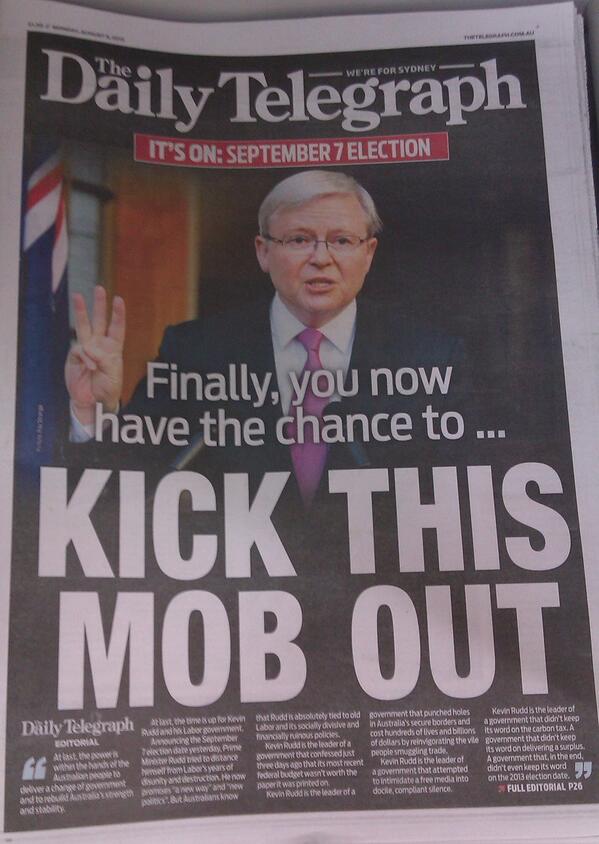
A few days ago, the Daily Telegraph in Sydney ran with this as its front page:
Now I should point this out from the outset. It is NOT illegal for a newspaper to be partisan, it is NOT illegal for a newspaper to push its own political agenda and it is NOT illegal for a newspaper to run editorials and stories which are very biased and one sided.
The question I ask is, is it good for democracy?

I bet that if you were to take a complete survey of the Australian public, the actual level of political engagement would be far lower than those in the news suspect. How many people for instance know who the current Minister for Trade is? Who is the Shadow Treasurer? What of the Leader Of Government Business in the Senate? Moreover, how does a Bill become Law?
I think that there is a very large tendency for political pundits and those of us who follow the game, to overplay what most people actually know and more importantly what they actually care about.
It is true that if you look at the raw figures for the Twitter hashtag #qanda on a Monday night, it does usually top the list of trending items but in terms of tweets per minute, both #BBAU and #XFactorAU outnumber it twenty-fold. What this indicates is that although there are highly engaged people in politics in Australia, there are far more people who are not. I'm also willing to bet that the average age of people who tweet with the hashtag #qanda or even #AusPol is probably on the wrong side of 30 whereas for #BBAU and #XFactorAU its more likely to be closer to 25.
Okay, so maybe social media is a terrible sample because of the inherent age bias, its then worth considering that other bastion of social commentary, the world that is talkback radio.

All of this ignores television, radio and the myriad of online news sources which offer more diversity in opinion than at any time in history.

More diversity in opinion? Really? 
Here we find something very odd. If we were to look at radio stations around the country like 4BC, 5AA, 3AW and 2UE, we find a very vociferous group of people who very obviously vote to the right and these radio stations are more than happy to play to their audience.
The day that the Daily Telegraph ran this cover, it basically got free publicity in Sydney on 2GB, 2UE and to a lesser extent on 702 ABC Sydney. Its mission which was to change the political dialogue, worked absolutely perfectly; even amongst people who hadn't even seen let alone read the newspaper.

News Corp Australia mastheads account for 59% of the sales of all daily newspapers and with sales of 17.3 million papers a week), it is easily Australia’s most influential newspaper publisher by a considerable margin. That makes it very difficult to downplay the power to change political dialogue because that's far harder to quantify.
News Corp is possibly only second in scope to the ABC in sheer size of political coverage. The separation of the business into publishing and media companies didn't really do much either to diminished the size of that shadow.
News Corp even has a presence on on television, producing such shows as Channel 10's "Meet The Press" and also "The Bolt Report" which dovetails nicely with Mr Bolt's editorial pieces in News Corp newspapers like the Daily Telegraph, Herald-Sun, Courier-Mail etc.
Then there's always programs on Foxtel like "Australian Agenda" which subscribers in an indirect way, have already paid for. They too dovetail nicely with opinion already printed in newspapers.

Indeed Tim Blair was quite quite correct to state that Mr Rudd's assertion that News Corp owns 70% of the newspapers was wrong. I ask Me Blair though as to what sort of power to change the colour of the overall political dialogue that a newspaper like the Shepparton Adviser has, or that the The North West Star has. How about the Illawarra Mercury which services an area just 70km from Sydney? How about the Newcastle Herald?
Maybe these are just the whimpers of a dog which is slowly being put to sleep. Even ten years ago, I saw newspapers as commonplace on the train but now? Smartphones and Tablets are becoming ubiquitous and even physical dead-tree books are disappearing, as people read more lines of electronic ink - maybe that's what News Corp fears: people reading news from the BBC and ABC.
In the UK News International openly backs political parties, sometimes declaring that "Labour's Lost It", "The Sun Backs Blair" and most famous of all:
I don't know if the Daily Telegraph, Courier-Mail of Herald-Sun will proudly crow that they helped the Coalition if they win but I wouldn't put it past the organisation. As it is, The Australian makes no bones about who it backs and alternatively, who it thinks should be "destroyed":

http://www.theaustralian.com.au/opinion/editorials/needed-a-policy-for-julia-direction-for-labor/story-e6frg71x-1225916087426
Greens leader Bob Brown has accused The Australian of trying to wreck the alliance between the Greens and Labor. We wear Senator Brown's criticism with pride. We believe he and his Green colleagues are hypocrites; that they are bad for the nation; and that they should be destroyed at the ballot box.
- The Australian, Sep 9, 2010

Even so, its still odd to see News Corp complain about Rudd complaining about them when they attacked him in the first place and then claim ignorance of the power they wield.

Addenda:
As I was writing this, this appeared in my Twitter feed:

Obviously the people at the Slightly Twisted Refreshment Lounge in Brisbane were annoyed at what they saw was market control and bias at the Courier-Mail. I think that the fact that there is not a plurality of newspaper owners in Australia means that little backlashes like this are going to be more common.
I however, think that this is brilliant.

August 08, 2013

Horse 1524 - Where Is The Future Surplus?

http://www.smh.com.au/federal-politics/federal-election-2013/15-abbotts-big-promise-to-cut-company-tax-20130806-2rdjk.html
An Abbott-led Coalition government would cut company tax by 1.5 percentage points within two years taking the current 30 cents in the dollar rate down to 28.5 cents.
In a boon for business, which has long called for tax relief to increase incentives and create jobs, Opposition Leader Tony Abbott will travel to Adelaide on Wednesday to unveil what, at $2.5 billion a year, is likely to be the biggest single spending promise of his 2013 election campaign bid.
- Sydney Morning Herald, 7th Aug 2013

Yesterday I asked the question "Where Is The Surplus?" (Horse 1523) and today I ask a similar question, "Where Is The Future Surplus?" If this sounds like I'm repeating myself, then to a large degree I am and you should probably read the other piece if you want to stop reading now.

A Budget Surplus is when total government taxation receipts exceed payments made by the government sector; conversly a Budget Deficit is when government taxation receipts fall short* of payments made by the government sector.
For 2013/14 the government expects to spend $398bn and collect $387bn leaving a budget deficit of $11bn. Of that $387bn in taxation receipts, $74bn comes from companies in comparison with $125bn from personal income tax.

Assuming that Mr Abbott if elected does decide to drop the corporate income  ax rate from 30% to 28.5%, this represents exactly a 5% reduction in expected revenue (all things remaining constant) because company tax is assessed on every dollar of corporate income; starting from zero.
In real terms that means that in order to just keep on standing still, a Liberal Government would need to find another $3.7bn from other sources.

Those "other sources" probably include natural attrition of the public service as alluded to by Mr Abbott in his Budget reply back in May, or perhaps more worryingly, a stagnation in transfer payments to the least well off in the community or worse, a raise in the GST which is both regressive and I think, hateful (Horse 1024).

I refer to Mr Abbott's comments in the week of the Federal Budget:
http://www.smh.com.au/federal-politics/political-news/gst-may-be-up-for-review-as-abbott-view-impresses-20130517-2js59.html
''We will have a comprehensive debate about tax reform but we haven't even won a first term, let alone a second term.
Who knows what people might put up to us - then we will have a white paper, informed by the best expertise the Commonwealth can muster in the wake of that consultation, and if there were to be any changes in the second term, we'll seek a mandate for them.''
- Tony Abbott, as quoted in the Sydney Morning Herald, 18th May 2013.

The only real reason I can think of as to why there would need to be a tax reform just three years after Ken Henry published his otherwise eponymous "Australia's Future Tax System Review", is too look at the one thing which he wasn't allowed to get his mits on - the GST.
The mere fact that Mr Abbott has "no plans" to increase the GST, isn't of itself enough to suggest that he isn't au fait with the idea. Back in July, Shadow Treasurer Joe Hockey didn't rule the idea of increasing the GST but suggests that it was the various state governments who had to lead that argument and to be honest, to get all state governments to agree to collecting more money in GST is probably easier than getting them to commit to a Federal spending plan like Gonski.

Incidentally, if Labour are "run" by the Unions, then the Liberal Party is run by groups like the innocuously named Institute of Public Affairs. They identified $22bn in "savings", which is slightly more than the $17bn which Mr Abbott was talking about yesterday. These "savings" are really quite savage and I think show what's really bubbling below the surface:
http://catallaxyfiles.com/files/2013/03/Commonwealth-reform-negative-value-adding-components.pdf
I'm pretty sure that privatising the ABC, dismantling the Human Rights Commission, the Australian Commission for Law, Aboriginal Land Councils, the ACCC and the NBN are all worthwhile "savings".

It's all very well to announce a cut in taxation if it means a return to surplus I suppose but it means that the electorate has to accept whether they like it or not, a reduction in the size, scope, value and ability to deliver the sorts of government services they expect. That's where the surplus is likely to come from.

Addenda:
The ABC has a nice set of Budget things to play with here:
http://www.abc.net.au/news/specials/budget-2013/
I had a look at it and found much to my joy, the figures I quoted were correct.

*fall short - I think that the logical opposite of "Exceed" should be "Deceed" but I've never ever seen that in print. Would Romans 3:23 now read: "for all have sinned and deceed the glory of God"?

August 07, 2013

Horse 1523 - Where Is The Surplus?

One of the great lies of economic rightist politics is the perpetuation of the myth that the Government sector is only a consumer and somehow produces nothing (see Horse 1458). In consequence, rightist politics likes to peddle the desire for government surpluses which are achieved through reducing the size and scope of government sector budgets.
The buzz word which is almost always used is "waste", as though there's loads of money just being bandied about like its going out of style or something. I can tell you through personal experience in working in the government sector, that many many many hours of overtime are put in and are never ever paid and the threat your job being axed unless you reach upper management is always looming large. If there was wholesale "waste" going on, I personally never saw it. That's just inconvenient though and doesn't fill up column inches in newspapers.

The basic motivation is that in essence, people don't want to pay for anything, or if they do have to pay, they want to pay as little as possible. That same motivation in principle is why slaves were transported across the Atlantic, why clothing is now made in countries like Bangladesh where workers are paid less than $4 a week and why rightist political parties who are funded by interested parties with very strong motives, like to tout policy where people and companies should pay less in taxation. They like to pitch to our emotions and especially our desires not to pay for anything. On a grander scale, the American Revolution was famous for the slogan "No taxation without Representation"; across the world that has somehow morphed into a much simpler two word slogan "No Taxation"; that is "we don't want to pay for anything".

So why do I mention all of this with respect to proposed government surpluses which are currently being touted by the Liberal Party and to a lessee extent Labor? Because it should come as no shock that a government surplus, runs almost counter to the ideal of not paying for things.
By definition a government surplus is when the government collects more in receipts than it spends. The problem is that for a government to collect more than it spends, it first has to collect taxation receipts. Quite literally a government surplus is when people pay more to the government sector than the cost of running the government sector. Already, people don't like paying for things but to create a government surplus, people must quite literally pay for nothing (or in the case of drawing down debt, paying for things which they've already got for "free").

It's weird because taxation and government spending in an ideal economy should be designed to run counter cyclical. That is, when the economy shrinks, government spending should increase by and equal and opposite amount to flatten the trough; and when the economy is growing, taxation receipts should also increase so as flatten the peak.
The problem is that if you do an analysis of real world figures, we find that this is simply not the case.

This link illustrates the point perfectly:
http://www.ato.gov.au/Rates/Individual-income-tax-for-prior-years/
Firstly, the top marginal tax rate over the past 30 years has dropped from 60%, to 49%, then 48%, 47% and now finally 45%. Also, in the name of countering "bracket creep" the tax-free threshold has been progressively extended further and further.

Granted that countering bracket creep is probably a good idea because over time and people will ask for more dollars in a cycle of cost-push and wage-push inflation as a counter to lost buying power.  However, if we just look over the past 10 years which includes the scope of the mining boom, we find the following figures:
http://guidesacts.fahcsia.gov.au/guides_acts/ssg/ssguide-1/ssguide-1.1/ssguide-1.1.a/ssguide-1.1.a.375.html
http://www.aph.gov.au/About_Parliament/Parliamentary_Departments/Parliamentary_Library/pubs/MSB/21
Average Weekly Ordinary Time Earnings:
Year - AWOTE - Adj for 52.178 wks:
2003 - $0878.80 - $45,854.03
2004 - $0931.40 - $48,598.59
2005 - $0960.00 - $50,090.88
2006 - $1022.60 - $53,357.22
2007 - $1051.30 - $54,854.73
2008 - $1103.60 - $57,583.64
2009 - $1145.10 - $59,749.03
2010 - $1201.90 - $62,712.74
2011 - $1259.40 - $65,712.97
2012 - $1322.60 - $69,010.62
2013 - $1393.00 - $72,683.95

If we then use AWOTE for the basis of Assessable Income because it makes sense to compare an "average" set of ordinary earnings with an assessment based on same, then we find that the tax assessed is thus:
http://www.ato.gov.au/Rates/Individual-income-tax-for-prior-years/

Year  - Wage - Assessed - Effective Tax Rate
2003 - $45,854.03 - $09,928.00 - 21.65%
2004 - $48,598.59 - $10,751.00 - 22.12%
2005 - $50,090.88 - $10,887.00 - 21.73%
2006 - $53,357.22 - $11,357.00 - 21.28%
2007 - $54,854.73 - $11,056.00 - 20.16%
2008 - $57,583.64 - $11,274.00 - 19.58%
2009 - $59,749.03 - $11,774.00 - 19.71%
2010 - $62,712.74 - $12,363.00 - 19.71%
2011 - $65,712.97 - $13,263.60 - 20.18%
2012 - $69,010.62 - $13,975.25 - 20.25%
2013 - $72,683.95 - $15,168.97 - 20.87%

Okay, so the raw numbers don't suggest much other than a general 4.72% increase in AWOTE but further analysis of the last set of figures yields this:


If the mining boom started in 2005, we should have expected that taxation rates would have increased as people's wages were subject to bracket creep; in fact the biggest single yearly jump of AWOTE was of 6.52% from 2005 to 2006. In contrast though, we saw not an increase in average tax assessment due to bracket creep but a deep cut in taxation rates because of governmental policy.
Already we find a major problem. Government surpluses were achieved under the last few years of the Howard Government which should have been expected with a mining boom but due to the fact that future taxation cuts had already been slated all the way to 2011-12, it would have been exceptionally churlish and economically stupid for the newly appointed Rudd Government to wind them back in a shrinking economy; post GFC. Even with bracket creep, the effective taxation rates under both the Rudd, Gillard and second Rudd Governments were still lower than before the boom under the Howard Government.
Furthermore, in order to have actually reaped the benefit of the mining boom, appropriate mining taxes should have been put in place in 2004 and not years after the event. Personal Income Tax rates would have been more effective had they not been dropped 10 successive times in 10 successive years.

I suspect that had taxation rates been fixed at 2003 levels, there probably would have been a surplus in 2012/13 as Mr Swan promised. What's never ever mentioned in the media is that if there isn't a government surplus due to taxation cuts, then the money simply hasn't disappeared but must have remained in the pockets of taxpayers. Especially during the months of July and August, I can tell you that in addition to peoples' motivation that they don't want to pay for anything, they also want to thrust their hands out for as many deductions and handouts as they can possibly get. This motivation also translates into votes; people will tend to vote for the party which they think will return the greatest amount of money to their pockets and naturally the promise of tax cuts is held out quite a lot.

So then, where is the surplus that was promised? Open your wallet, it's still there; it's just that you haven't paid it to the government yet. It didn't magically disappear. Collectively Australia, it's still in your wallets because you don't want to pay for anything.

August 02, 2013

Horse 1522 - What's a Logo?


As the picture above shows, the old City Rail logos are being replaced across Sydney's trains with this er... bouncy thing. If the official name "The Hop" is anything to go by, then I suppose that it's trying to convey the impression that one can... hop? Um, what? Okay, I'll admit that unless I'd been told that explicity, I'd have no idea whatsoever what the logo is trying to convey and therein lies the problem.

A logo should be an instantly recognisable statement about the organisation. It should be distinctive enough that it doesn't need any embellishments and because logos will appear on every single piece of stationery and corporate propaganda they also need to be readily reproducible; though that job has been made far easier with the advent of computers (jpgs, vector graphics etc).
Logos don't necessarily need the name of the company, they don't even really need to convey the concept of the thing they represent either, though some amount of literal visual representation is often advisable: think of Shell, Apple or Target.

The thing is that Transport for NSW (which sounds suspiciously like Transport for London) already has a perfectly acceptable logo:
I've seen this logo on the fronts of buses and it looks quite smart. The waratah which is already the traditional flower of NSW would work well across all Sydney trains, buses and ferries. Even so, it still had its critics - at the time of introduction in 2009, the then opposition leader Andrew Stoner said:

http://www.dailytelegraph.com.au/news/nsw/nsw-has-been-deflowered-by-nathan-rees/story-e6freuzi-1225750629414
"Nathan Rees is so incompetent that he can't even get a new logo for the state right. Only Nathan Rees could confuse the NSW waratah with the Indian lotus" 
- Andrew Stoner, via the Daily Telegraph, 15th July 2009

This is to miss the point entirely. The stylised flower on the flag of the Northern Territory does not look remotely like Sturt's Desert Rose, Vodafone's logo doesn't look remotely like a telephone and to be honest, I still think that the Commonwealth Bank's logo looks like someone's dipped an Arnott's SAO in Vegemite, even though they say that it's supposed to look like the Southern Cross (I still think that a big grinning elephant looks better).

Just so long as the logo is distinctive enough, then there's no reason to tinker with it very much. The Coca-Cola logo pretty well much dates from 1896, Ford's signature has been adorning cars since 1909 but the blue oval dates from about 1927, General Electric's logo is largely unchanged from the 1900 version and the London Underground logo which now finds its way onto buses, trams, ferries and of course tube trains, has been in use since 1908.
In the words of the Mortein advert from at least before 1942: "When you're on a good thing, stick to it" and to be totally frank, I really didn't see what was wrong with the old "L7" logo.

I really really don't understand why Sydney trains just don't use the waratah. As a thing, I think that it works well. It's weird because the sentiments coming out of the Minister's own statements, seem to agree with the need for unified branding:
http://www.transport.nsw.gov.au/media-releases/fixing-trains-new-approach-customer-service
“Unlike other global cities like London and Paris, we have never had one integrated and recognisable brand for transport.
When you go to London and see the round symbol you know there is public transport nearby, whether it is the underground or a bus or other mode – it’s an integrated system that works well.”
- Minister for Transport Gladys Berejiklian, via Transport For NSW, 18th Apr 2013

It's kind of strange to consider that the bouncy hop logo is so terrible, when you consider that concurrently the same organisation has produced a logo for the new Opal Card system which is quite brilliant.
As a thing it looks quite pretty and official. As a device which appears on ticket barriers at train stations, ferry wharves and soon to be inside buses, it's obvious that that's where the Opal Card is supposed to go. This is a wonderful example of logo as device and I honestly hope that no-one decides to muck about with this for a very very long time.
I even like the name too. An Opal is a colourful thing which is sort of visually represented in the logo. I hope that it is better received than Melbourne's Myki or London's Oyster cards.

As for "The Hop"? Well, I think that the only reason that the logo was changed at all, is because Transport Minister Gladys Berejiklian intends to privatise the rail network and she needs the branding space to do it in. She's already half done it with the ferries by "franchising" them to Transdev Australasia and Transfield Services.

August 01, 2013

Horse 1521 - Is The Volt Cool?

Today I saw not one but two Holden Volts in Mosman. The experience was a little eerie I must admit because the first one I encountered was in a quiet street and it slinked sliently, slowly seeking a spare space like some slimy silver serpent, spitting out smug.
The other nearly bowled me over on a pedestrian crossing doing 50km/h. I hadn't heard it at all and the driver was looking downwards; probably texting. I can only wonder what is going to happen when some hooded youth who is listening to music meets one of these things; I suspect that in a contest between Volt and Hoodie, Volt wins.


Of course, I ask the question of the Volt (as in fact I do with practically every car on the road) "Is it Cool?"

The default criteria for a car being "cool" generally revolve around the sorts of people who are likely to buy it. European hatchbacks are cool, most people movers and SUVs are not. Diesels and Hybrids are normall not cool and neither are American cars generally because they're prone to falling to bits easily. German cars are usually cool, except for 3-box sedans like the 3-Series, A4 and C-Class which are bought by annoying business people and middle management.
So when looking at whether the Volt is cool or not, the first thing to do is to review what it is: an American built hybrid hatchback. On the face of it, it's not looking good.

Sometimes when asking what something is, it cab be useful to review what it is not.
The Holden Volt is not a Toyota. Toyota's Prius which is its hybrid, is like most Toyotas, uncool. There are exceptions like the GT-86 and even Corollas from the 1970s but in general, most Toyotas from E90 onward are as fun as long division (admittedly there are people who actually like long division; they're weird) ; the current adverts for their Camry even celebrate this fact by using the song "Hip To Be Square".
Although the Holden Volt on the other hand will probably attract the hug-a-rainbow crowd, the people who want to look oh so trendy and eco-friendly whilst also owning a massive kill-o-barge SUV and also the same sorts of people who think that hypermiling is a fun fun game, it's also likely to be bought by geeks and nerds   because of the technology. The question then is, are geeks and nerds cool? Well, not really but it's the geeks and nerds who have not only made techy things like iPods, WiFi and laptops possible but also   even things like plastics, dyes, fabrics and medicines even exist.
Score 1 for the geeks and nerds.

Is the car inherently cool? Well... no.
This question revolves around the question of styling, which actually has very little to do with the mechanicals underneath.
Previous Holdens like the Torana A9X and the Monaro GT350 had a look about them which said: "If you don't fear me, I'll bite your face off". Other Holdens like the VB-VL Commodore give away their German ancestry and all looked proper and correct. Still other Holdens like the FJ, FC, FE etc. shared design trends with those coming out of Detroit and although they too (like cars coming out of Detroit) had a tendency to wallow about, even on a dead straight bit of road, they still demanded to be looked at.
The Volt says... er... Okay, stylistically it comes from the same family as the Cruze, Barina and Spark (all being Daewoos), which I suppose means that... it's sort of anonymous.
I kind of like Opel's Corsa and the Adam is so cute I wanna give it an ickle bitty blankie but if I had a Volt sitting in the driveway, I don't think I'd be filled with that same sort of joy. I know I felt it with the Mk.1 Ford Ka that I had and both the current Ford Fiesta and Mazda 2 do it for me, but the Volt? Not really.

Does the car sound cool? There are very few engine noises as symphonic as a Jaguar V12 expect for possibly a Ferrari V12. There's something sort of visceral about the utter gall and rudeness of a V8 under full power and yet even they will settle into a nice burbly rumble. There's even something to be said for the homeliness of a clattery diesel.
The Volt though has a 1.4L GM Family 0 engine, which also features in the Opel Corsa, Opel Astra, Holden Barina and Holden Cruze. Yet the Volt which is roughly the same size as the Cruze, tips the scales at a massive 1715kg which is a full 103kg heavier than a VF Commodore. At 111kW at its peak, it's not particularly powerful but at 370Nm of torque, it's comparable to the Cruze's 2L diesel (360Nm). Unlike the Cruze though because electric motors deliver maximum torque at zero revs (thanks to  John Ambrose Fleming's left-hand rule for motors), it should win most traffic light grands prix to about 15km/h.
Basically the Volt is a mid-size family hack, which sounds... of not very much.

So then, the Volt is a kind of bland looking car, which is slightly geeky and might accidentally run someone over because it is so quiet. But is it cool?

In all honesty... YES!!!

What?! I don't hear you ask.
There are a few cars which are inherently uncool but cross the line twice. Volvo traded off of this for a very long time and it eventually built the 240T and 850T5, both of which earned the name "terror taxi". Saab spent most of their existence building cars which were hideously flawed; yet still carried off a quiet sort of confidence that no other company could achieve.
The Volt could have been better styled but that might compromise its slipperiness through the air. The Volt could have been fitted with a different set of dials and instruments but that would have changed its geeky nerdy personality, which it wants. It could have even had fake engine noises both inside and out but that's sort of silly.
The Holden Volt ends up being cool simply because it is none of the things which would otherwise make it cool. This means that it's going to end up with a sort of exclusivity like the Kia Magentis, Holden Piazza, BMW 3 Series Compact (E36) and the Ford Laser Lynx. Volts will be remarked at by other road users but only people who own a Volt will know the weird satisfaction they have from owning one.
The Volt is cool because the people who give cars reputations for being uncool, won't buy them.

July 30, 2013

Horse 1520 - Silver Arrow Streaks Superbly (Rd.10)

In the days before DRS, KERS and other acronyms, the Hungaroring was nicknamed the Hungaboring. Built behind the former Iron Curtain, the circuit is an undulating, twisty affair which seems to breed impatience in the drivers and this year's GP was no exception.

At the start, pole sitter Hamilton lept out into the lead, but behind him Vettel bogged the start in his Red Bull, was nearly taken out by Alonso's Ferrari, whilst simultaneously almost taking out Grosjean's Lotus himself. Hamilton's team mate Nico Rosberg got off to a flyer before tagging Felipe Massa's Ferrari and ruining the end fence on his front wing. Rosberg ceased to have any real impact on the result and his engine finally gave out on lap 64.

Most of the race turned on people's changing fortunes with tyre strategy. Every pitstop would file someone roughly 19 seconds further down the road and it was this aspect which had the most bearing on the outcome of the rave.
Hamilton came out behind Jenson Button and made short work of him, yet Vettel whose car was slightly understeery all weekend came out immediately behind Button; where he would remain for 12 frustrating laps.

Following closely behind was Romain Grosjean who also found getting past Button difficult, Grosjean turned in on him and the two of them scraped side. Grosjean would be given a post-race 20 second penalty but during the race, he was given a drive-through penalty after all four of his wheels left the track during an overtake of Massa's Ferrari.
Pitstops continued to dictate the order and Kimi Räikkönen in the Lotus came out ahead of Vettel, and Mark Webber who up to that point had had a very quiet race, suddenly found himself in fourth; ahead of Alonso. That's pretty much how it ended, with Lewis Hamilton taking the win by more than ten seconds.

Once again the Hungaroring lives up to its reputation for producing relatively calm Grands Prix. I think that because it has such a difference in elevation and types of corners as opposed to a Tilkedrome (Korea, Bahrain, China) that it probably should remain on the calendar. Also, the crowd figures at the circuit are quiet pleasing to see - I'd rather see packed stands than empty fields.

It has taken Lewis ten rounds to score his first victory of 2013 but with  Räikkönen finishing second and Vettel coming in third, it's going to take quite a large number of miracles if he wants to have a shot at this year's title. Räikkönen leapfrogs Alonso into second but Vettel still maintains a handy buffer at the top of the standings.

Horse 1519 - I Am Hannibal


Sid Meier's Civilization (also now known as Civ1) was released back in 1991 and is really the first "4X" style of game. Those 4 Xs being: eXplore, eXpand, eXploit, and eXterminate (especially helpful for Daleks).
Civ1 is very much a 2D flat cylindrical world that works roughly the same as a turn-based board game.
The nice thing with a 22 year old computer game is that there are a few editors and things to help you hack into the back of the software. Armed with one such hacking tool, I proceeded to right one wrong of the game and add back, possibly the single greatest unit that never came with it originally - the Elephant* unit.
Basically an Elephant unit is a bit like what a Musketeer is later in the game. It's a slow moving piece but is reasonably useful in both attack and defence. I've set it up as follows:
Requires "Horseback Riding"; A/D/M 3/3/1. Cost 40; Gunpowder obsoletes.


Historically, war elephants have been used by the Babylonians, various Indian armies, Chinese, Alexander the Great came across them when fighting the Persians and simply had to have them, Egypt under the Ptolemies had them; lastly and most notably, the Carthaginians used them; especially under Hannibal.

I really only know a few things about Hannibal:
1. He was the Carthaginian commander during the First Punic War.
2. He attacked Rome by coming over the Alps...
3. With Elephants...
3a. With Elephants.
3b. WITH ELEPHANTS.
3c. WITH ELEPHANTS!
It was as though Hannibal had read the then 300 year old "The Art Of War" by Chinese general Sun Tzu.

"Engage people with what they expect; it is what they are able to discern and confirms their projections. It settles them into predictable patterns of response, occupying their minds while you wait for the extraordinary moment — that which they cannot anticipate."

 "Seem humble to fill them with conceit. If at ease, exhaust them. If united, separate them. Attack their weaknesses. Emerge to their surprise."

If you'd been a Roman general circa 218BC and you'd seen elephants coming over the alps, what the heck would you think? How does one even get elephants over the alps? Do you put skis on them? That'd be pretty surprising and extraordinary; certainly something which they cannot anticipate. How do you even feed elephants on a mountain trek? Moreover, how do they survive the cold?

So of course, if there was one weapon that I absolutely had to back-hack into Civ1, it would be the Elephant unit. At 40 shields, they're the same cost as Chariots and later on Knights and as such along with Militia and a lot later on Armor, are the only units I'll bother building because... Elephants... Elephants... ELEPHANTS... ELEPHANTS!

*Elephants have been mentioned sixteen times in this post; including down here. I am Hannibal.

July 29, 2013

Horse 1516a - Letters to the World, on the birth of Prince George

http://www.bbc.co.uk/news/uk-23443504
The Duke and Duchess of Cambridge have named their son George Alexander Louis, Kensington Palace has said.
- 24 July, 2013

See? By George, I was right!


The future king has now been born. If the Commonwealth countries decide to retain the monarchy and not become republics, then you'll have after Elizabeth II, Charles III, William V and then George VII. When he does become king, he'll be facing to the right on the coins.

++++++++++++++++++++++++++++++++++++++++++++++++++++++++++++++++++++++

Dear England,
I know that you have an identity crisis and it's understandable because you have a long history of having an identity crisis.
For instance, "The History of England" by Thomas Babington wasn't really just about "England" but about the whole British Empire. This is called Metonymy where a thing stands for the whole; just like when "Westminster" stands in for "The British Government", "Number Ten" for the office and or the person of "Prime Minister and First Lord of The Treasury of the United Kingdom of Great Britain and Northern Ireland" or "America" when people only want to refer to "The United States of" therein.
However, when people talk of "The King of England" they do specifically mean the The King of "England". Yes, there is a United Kingdom, so although to you share a country, a monarch etc. you do still exist with your own monarch, whom you share.

Yours sympathetically,
Rollo

++++++++++++++++++++++++++++++++++++++++++++++++++++++++++++++++++++++

Dear Scotland,
If you do decide to dissolve the Union, then you'll have to work out whether to call your new currency a Pound, Merk, Ryal, Noble, Unicorn or something else. Also because James I of England was firstly James VI of Scotland, he like all monarchs will be firstly the King Of Scotland before any other nation.
You'll also have to work out if you want your own regnal numbers or not. If there's a Richard or Henry after George, I can't imagine you'd want Richard IV or Henry IX when there's never ever been a Richard or Henry as King of Scotland before.

Yours advisedly,


Rollo

++++++++++++++++++++++++++++++++++++++++++++++++++++++++++++++++++++++

Dear Wales,
Under the Laws in Wales Acts (1535–1542), you're still a vanquished nation. After Charles, William will probably become the new Prince of Wales and then George after him.
I shouldn't worry too much though, England is more likely to become a republic than Scotland and I guess that you could become a kingdom which would be better than a principality.

Yours grievedly,
Rollo

++++++++++++++++++++++++++++++++++++++++++++++++++++++++++++++++++++++

Dear Northern Ireland,
Yeah... you're weird. Just try not to blow yourselves up... or annoy the Republic to the south of you.

Thank you,


Rollo

++++++++++++++++++++++++++++++++++++++++++++++++++++++++++++++++++++++

Dear Canada,
Keep on making coins exactly the same as those in America. That way they'll get all confused when they find them in their vending machines.
Also, you might want to give up speaking French. The French already look down on you (and the Belgians... and the Swiss), so I don't know why you want to persist with this silly language.

Veuillez agréer,
Rollo

++++++++++++++++++++++++++++++++++++++++++++++++++++++++++++++++++++++

Dear Australia,
You'll probably be a republic when George VII is King, so you'd better get used to the idea of having people like John Howard, Billy Hughes, Alfred Deakin, Kevin Rudd and Tony Abbott on the back of coins. Deep down, you know you'll copy America and put dead politicians on them.
Please note that as the world's highest consumers per capita of magazines, you'll probably end up buying more printed photographs of little George per capita than any other country.

Best regards,
Rollo

++++++++++++++++++++++++++++++++++++++++++++++++++++++++++++++++++++++


Dear New Zealand,
Hey bros. Those pakehas have a new tamaiti. That's pretty choice. Get you jandals on, let's pack the chilly bin, get to the dairy and go tramping.

Chur,
Rollo

++++++++++++++++++++++++++++++++++++++++++++++++++++++++++++++++++++++


Dear America,
Just a warning. Okay, so you've long since decided that being part of the empire is not for you and you've also decided that the trappings of empire such as cricket, tea, curry, lager, football etc. are also not for you, so this is a heads up to let you know that at some stage in the future, the weird coins which come across the border from Canada and get stuck in your vending machines will bear the name George VII.

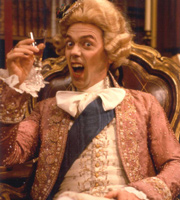
We're aware of the trouble that the name George causes you. We admit, one of them was truly bonkers:

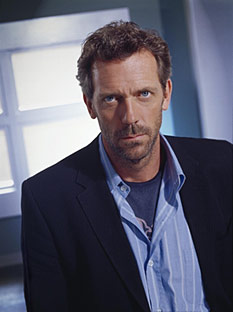
It should be noted that George III was in fact a Time Lord and didn't actually die in 1820 but travelled to the early twenty-first century, where he went on to become a noted surgeon, infectious disease specialist and renal physician. He was however still a misanthrope, cynic, narcissist, and curmudgeon.

It appears though that you have taken him to your hearts, which is weird since most English people on American television and movies usually end up playing the bad guy, Jeremy Irons in particular.

Yours satisfactorily,
Rollo

++++++++++++++++++++++++++++++++++++++++++++++++++++++++++++++++++++++

Dear France,
To be honest, you're a chaotic bunch and since the Acts of Union was passed in 1707, you've had the end of your own kingdom, an empire which was also a republic, a restoration, the July monarchy, a second republics, a second empire, a third republic, the Vichy government, a provisional government and the fourth and fifth republics. Stop it! It's too confusing to keep up with it all.
Maybe you should have considered being part of the British Commonwealth when the offer was made after WW2. It would have been far less confusing and might've added some much need stability to your nation. I'm sure that the offer is still there.

Yours exasperatedly,
Rollo


++++++++++++++++++++++++++++++++++++++++++++++++++++++++++++++++++++++

Dear Greece,
You didn't like King Constantine II and exiled him; he lives in London. His son Pavlos married Marie-Chantal and is now Prince of Denmark but lives in New York. Clearly you don't think much of the monarchy.
The current Duke of Edinburgh, Philip, once said of himself that he was the only Greek in England who didn't own a fish and chip shop. He married into a fairly successful family whose business looks pretty secure for a long time. Perhaps you should consider making Philip the king? That way you can share Charles, William and George in the future.

Yours hopefully,
Rollo

July 26, 2013

Horse 1518 - What is Cadillac?

The easily recognizable Cadillac logo dates back to the company's founding in the early 1900s, but over the last 110 years, there has been an on-again, off-again love affair with the wreath surrounding the crest. Cadillac's current badge design has used the wreath since the 1980s, but Automotive News is reporting that GM's luxury division is planning to ditch the laurel wreath for a cleaner-looking logo.
The new logo could make its debut as early as next month on a new concept car that will be revealed at the Pebble Beach Concours d'Elegance, although the report also says that it might be until 2015 before it makes its way to a production car. Even then, it doesn't like anything has been finalized yet, as the article also says that plans could still change.
- Autoblog, 23rd July 2013

The easily recognizable Cadillac logo? Easily recognizable?!  Surely they jest. I for one would not have recognised this as any company's logo unless they said so:

Whilst it is true that a logo should speak something of the car underneath, it is the prestige, the traditions and the history that really give life to a logo. To be honest, I don't really think that this logo particularly screams "Cadillac" to me. I don't know what it says exactly but it sure ain't Cadillac.
Just what is a Cadillac anyway? Often the best way to define what something is, is to have a look at what is is not.

BMW, Audi and Mercedes-Benz spring to mind immediately as three marques of German luxury. BMW and Audi built their reputations on building cars which are very well appointed. Mercedes-Benz in particular became known as the pinnacle of German luxury because in addition to building cars with very high levels of trim, they also spent a fortune on technological research and development.
Seeking to apply for readmission to society after one of their sports cars crashed at the 1955 Le Mans 24 Hour Race, killing 84 people including the drive, Mercedes-Benz would spend the next 30 years leading the world in seriously paying attention to safety and crash testing. In a round about sort of way, it helped by doing its part in reinforcing stereotypes about Germany and Germans with ruthless efficiency.
Cadillac is definitely not German though.

Marques like Datsun, Toyota and Mazda, started out by building cheap and uninspiring cars. However, they did so by doing something which was common of a lot of Japanese firms in the 30 years post WW2, and that was to take existing ideas and build them to a better quality than their rivals.
Even to this day, Toyotas are still not usually seen as exciting but incredibly reliable.
Cadillac is not Japanese either.

Britain after the Second World War has built a car industry which like so much that is venerated in British society, started in people's sheds. The nation of tinkerers gave us Jaguar, TVR and Noble, as well as the garagistas like McLaren and Lotus.
British cars are famed the world over for being brilliantly designed but variable build quality depending on what day the car left the factory. British cars contain compulsory random faults, which are so random that two cars produced on the same day will have different faults. Then there's Jaguar which is noted for its amazing talent in wasting more oil than a fish and chip shop.
Cadillac isn't even British either.

So what is Cadillac?
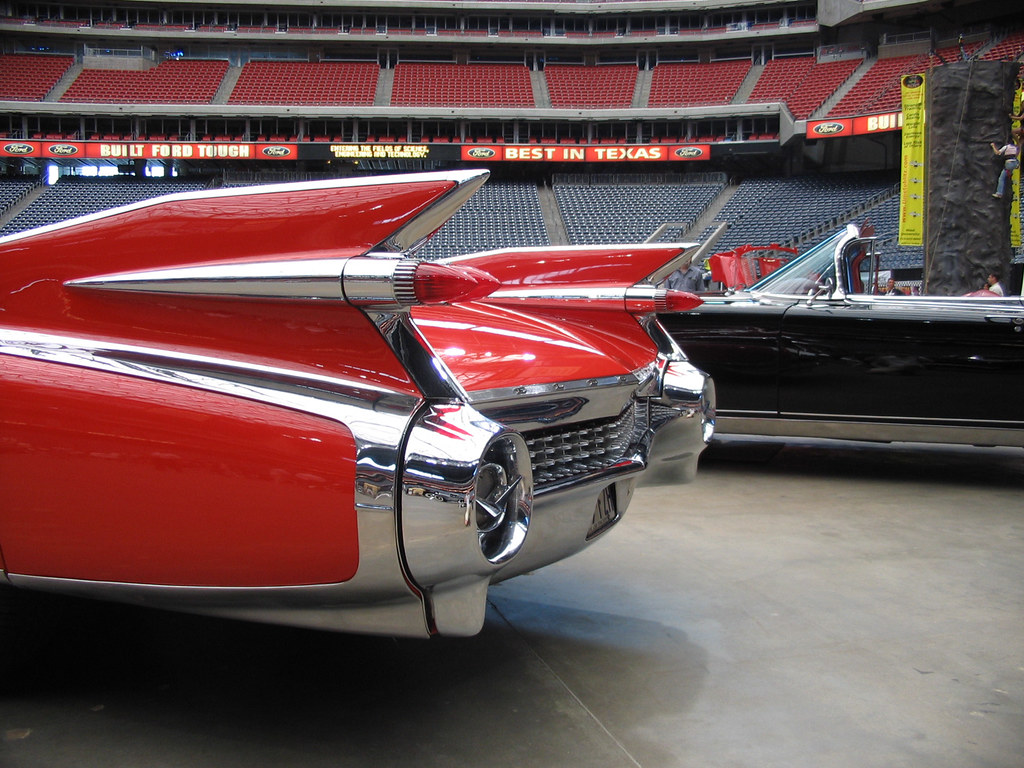
This:

Even if I were to show you even just this much of the car, most petrolheads would be able to tell you the Make, Model and Year. (Cadillac Eldorado Biarritz 1959).

One of the things which America does very well is ostentatiousness. This is a nation which took the game of Rugby, made it slower for television, added marching bands at half time and watches it at home with copious amounts of grilled animal and potato snacks with flavours developed in an underground chemical bunker. This is a nation which isn't afraid add unnecessary amounts of cheese to food. This is a nation where a "large" coffee isn't enough and you get enough scalding brown liquid in a bucket sized cup to be able to drown a cow.

A Cadillac should have more chrome and silverware than Buckingham Palace, more leather than an Italian furniture store, as many ornamental fins and skirts as is possible to fit, an engine so massive, loud and raucous that it will cause another 1970's style oil crisis the second you put your foot down, and be kitted out with so much bling that the amusingly illiterately named rapper Xzibit, will simply be unable to Pimp Your Ride.
The whole car should be one giant cacophony of noise and confusion. It should be full-fat, high tar, dolphin unfriendly, high-carb, eat the whales, burn the forests, mental, bonkers, crazy-go-nuts, with cherries on the top, super-extra-ultra caffeine, five dollops of cream, extra-extra-burn-your-eyeballs Tabasco and chili sauce, ten sugars and don't hold the anchovies.

To be honest, the "wreath" around the logo isn't really that important at all. What is important is that a Cadillac has to be a Cadillac. The ideal Cadillac logo would be of Chuck Berry with his guitar; on fire; standing atop a raging bull; diving headlong into a volcano.

That's what Cadillac is.

July 25, 2013

Horse 1517 - Australia's Asylum Seeker Policy

I think that we've really seen over the past few days, just why Kevin Rudd was reinstalled as Prime Minister. It's pretty obvious that the short term goal was to win the impending election and then worry about the problem of governing later.
I think that we also saw why the problem of "boat people" is so intractable - being Prime Minister is a walk in the park to being Immigration Minister. They really are on a hiding to nothing.

The Indonesian Government (quite rightly according to its position of twisted logic) sees itself as a "transit country". Indonesia is not the final goal for asylum seekers and as far as the Indonesian Government is concerned it doesn't really care what happens to them.
Australia on the other hand because it is the "destination country" has all sorts of problems in dealing with people who come out of desperate circumstances and who literally will sacrifice everything including their lives to ensure a better life for themselves and their children.

Who can blame them? If my home was left but a pile of smouldering rubble as is often the case in civil war-torn Syria, or where violence is being exacted in a confused game as in Sri Lanka, or where religious fanatics are trying to install their favourite kind of nutter to power as in Egypt, Turkey and Pakistan, I'd think about upping sticks and moving on too.
Then there are those countries which we've willingly aided and abetted big brother America in bombing the snot out of, like Iraq and Afghanistan.
We should remember that 30 years ago equally desperate people came from places that we helped in bombing the snot out of, like Vietnam, Laos, Cambodia and Myanmar and I'd suggest that they've all made this country richer for their arrival and contribution to society.

I can understand the willingness in wanting to smash so-called "business models" but really that misses the point entirely. When you have next to nothing and all you want is to live peaceably and not in fear of who might come to kill you, to risk everything is in many respects the most sensible course of action. At least in a detention centre you're going to be fed and clothed, which might be a lot better than where you came from.

What I think is curious is both the dishonesty of language used particularly by the Liberal Party in the sphere of this debate and the failure of the Labor Party to call it for what it is.
- It is not and never has been illegal to seek asylum in another country. Whether or not someone is a genuine refugee should be assessed on a case by case basis, looking at the facts.
- It is illegal to overstay the conditions of one's visa, to deliberately mislead the Department of Immigration about the terms on which you arrived.
Yet the Liberal Party in particular likes to frame the language in terms of "stopping the boats" whereas the facts show that more people who are "illegal" immigrants arrived by plane.

I think its also curious that Mr Abbott likes to suggest that policies "worked" under the Howard Government. Never mind the fact that Australia did enter into two wars which were never authorised by the UN and were probably illegal (but no-one ever decided to test this in court). Never mind the fact that the people who were displaced by those actions took in some cases more than five years to filter to Australia, which by the way was conveniently after the Labor Party won the 2007 election. I wonder what Mr Abbott has to say about his part in the government in two illegal wars which in part have resulted in the people he clearly doesn't like arriving here. I also wonder why no-one has ever called him up on it.
Consider the following:

http://news.bbc.co.uk/2/hi/middle_east/3661134.stm
When pressed on whether he viewed the invasion of Iraq as illegal, he said: "Yes, if you wish. I have indicated it was not in conformity with the UN charter from our point of view, from the charter point of view, it was illegal."
- Kofi Annan, via the BBC, 16 Sep 2004

http://www.truth-out.org/archive/item/86116:afghanistan-where-empires-go-to-die
"Under the charter, a country can use armed force against another country only in self-defense or when the Security Council approves. Neither of those conditions was met before the United States invaded Afghanistan. The Taliban did not attack us on 9/11. Nineteen men - 15 from Saudi Arabia - did, and there was no imminent threat that Afghanistan would attack the US or another UN member country. The council did not authorize the United States or any other country to use military force against Afghanistan. The US war in Afghanistan is illegal."
- Marjorie Cohn, professor at Thomas Jefferson School of Law, president of the National Lawyers Guild, 17 Sep 2009

Also consider the United Nations High Commissioner for Refugees' opinion on the Howard Government's so-called "Pacific Solution":
http://www.unhcr.org/47ac3f9c14.html
UNHCR welcomes the end of Australia's Pacific Solution which comes to a close today
...
UNHCR had strong concerns about the 'Pacific Solution' 
...
We welcome the prompt decision taken by the new Australian Government to end the Pacific Solution and bring the refugees to Australia. We hope that any continuation of offshore processing on the Australian territory of Christmas Island reflects the letter and the spirit of the 1951 Refugee Convention.
- UNHCR, Briefing Notes, 8 February 2008

I'd concur with Mr Abbott that the Pacific Solution "worked", if being inhumane and garnering the scorn and ire of the UNHCR was the intent. I imagine that it's very easy to suggest that your policies are working when the only boats which come to your electorate are the Manly Ferry and people's yachts worth $10m plus.

Mind you, I think that the current Rudd Government's policy of simply dumping asylum seekers in Papua New Guinea is just as bad if not worse. Notwithstanding the fact that some writers like those at The Economist have said that "PNG's governments are notorious for corruption, and ever run the risk of turning the state into a fully-fledged kleptocracy".¹ I wonder how Papua New Guinea is supposed to cope with extra arrivals. There's been no mention as to what sort of facilities they have to house these people. The only reason that I would suggest that they've even agreed to it is probably some sort of kickback payments.
¹ - http://www.economist.com/blogs/banyan/2011/08/papua-new-guinea-and-australia

Really I think that this boils down to little more than some sort of greed. The bottom line for a lot of people is nothing more than the bottom line. Put simply, they don't want to have to pay for people once they've arrived and they're not prepared to pay the wages to employ them either. The current Rudd Government's ad campaign which has appeared in Fairfax and News Corp Australia's newspapers basically could have been summed up in two words: Go Away! 

Mr Abbott's constituency, the Federal Electorate of Warringah, is a moneyed and predominantly white only suburb. I have heard old ladies on the bus discussing bombing asylum seekers' boats and think nothing of it.
In contrast, I live in the Federal Electorate of Chifley which according to the last census has people from 197 countries living within its boundaries.
To be totally honest, I hope that the next generation learns to live with an even more diverse range of people. I'm quite proud of the fact that as I look around the trains and buses on my daily commute that I honestly can not guess where people came from, and that this country was generous enough to open its doors to an ever increasingly colourful palette of cultures.

Surely it makes more economic sense to house  people properly and process their applications efficiently than to leave them languishing in detention centres for years. Canada has a processing time of just 8 days. Eight?! Why can't Australia do this?
If this is merely about "stopping the boats" then why not make passage safer and commission a 3000 berth ship to do the job. Why do we need a Pacific Solution, a Malaysia Solution or a Papua New Guinea Solution? Why can't we have an Australian Solution? Why not have on shore processing and treat people with the dignity that they deserve as human beings?

I don't see the arrival of a few people who have risked everything as a threat to national security at all. If anything, the character and courage that they've shown in getting here should prove instructive and enlightening to a complacent people who are more worried about their property values - the value of people is far greater.

Never before have the words of Donald Horne rung quite this true:
Australia is a lucky country, run by second-rate people who share its luck.

July 24, 2013

Horse 1516 - Prince (name yet to be determined - possibly George), the future King of (realms yet to be determined)

It's been impossible to avoid the news that Princess Catherine, Duchess of Cambridge, has given birth to a son who will be in time the future king. What he will be king of exactly is still unknown, for history itself might have several cards to play before he ascends the throne.

I like almost two generations of people, have only ever seen one monarch on the throne of England and the birth of William and Kate's baby I suppose is of some significance but possibly not to the country I live in.
Assuming that following Elizabeth II will be Charles III and after him William V, then by the time that the new baby (who I'm guessing will probably end up being named George*) grows up and does eventually become George VII*, Australia will have probably become a republic and I myself in all likelihood will have long been dispatched and met my maker.

It's also unclear as to what George VII* will be King of domestically. Scotland is threatening to dissolve the Union with England which has stood since Queen Anne and what's to say that England itself won't in time become a republic? Who's to even know what the future status of Wales, Northern Ireland and the other dependencies will be? What of the other realms in the greater British Commonwealth?
By historical accident, the current monarch is firstly Scotland's monarch. As Elizabeth I left no children, James VI of Scotland became James I of England in a personal union of the crowns. Legally the monarch is first the Queen or King of Scotland, then England. Little George* could very well be King of only one country north of the border.
If Scotland does leave the Union, they'll have to reorganise the delivery of government services such as the defence forces, schools, hospitals, taxation, roads and even have to work whether to call their new currency a Pound, Merk, Ryal, Noble, Unicorn or something else. And on that note:

The coins of George V bore the legend:
Dei Gratia: Brit Omni: Rex: Fid Def: Ind Imp
By the Grace of God, of All the Britons, King, Defender of the Faith, Emperor of India.

By the end of George VI's reign it was shortened to:
Dei Gratia: Brit Omni: Rex: Fid Def
By the Grace of God, of All the Britons, King, Defender of the Faith

Yet by the time George VII (assuming that will be his name) becomes king, there's a distinct possibility that he could end up as just simply:
Dei Gratia: Rex
By the Grace of God, King

Little George* as King of Scotland (and the other realms) in the latter half of the twenty-first century, could very well end up being not "King of All the Britons" and because Scotland has no official state church, there is never a "Defender of the Faith" in Scotland.
Actually it remains to be seen whether Dei Gratia would even be included because as the world slowly closes its eyes and ears to religion generally, George* might end up with the rather paltry title of just "King", and there wouldn't be any need for a legend at all if that's the case.

This is all quite apart from the fact that this little child won't really live a "normal" life. Granted that newspaper and magazine sales are sliding as we move to digital media but it still doesn't change the fact that he'll be living his life to some degree in a fish bowl, with the prying eyes of the world looking on. He'll never meet his grandma precisely because of the relentless pursuit to death of the paparazzi. 
It's worth remembering though that his Great-Great-Grandpa, George VI, who had the role thrust onto him with some reluctance steered both the monarchy and helped Britain through the Second World War and the further dissolution of the empire. So even though he might be "born great" and  "have greatness thrust upon" him, it's still possible for him to "achieve greatness"; even though we don't what he'll be king over yet.

*yeah, I don't know what his name is going to be either but I couldn't very well just leave it. He's probably going to be a George or a James though. I don't think he'll be a Edward or Henry.

July 23, 2013

Horse 1515 - The Inevitable Decline Of America

The question posed to me is what do I think are the causes for the decline of America. Actually in broad terms I think that the answer is ludicrously simple but to understand the decline of America, requires one to understand the rise of America in the first place.

On of the key factors which defines which empires will rise and fall the most relative to each other is that annoying idea of Gross Domestic Product - what is the general overall level of goods and services that a country/empire can produce? In essence, all that Gross Domestic Product is, is a fancy way of saying "all the stuff we made and all the work we did" in any year.
Now whether you can force other people to work for you through direct slavery, or perhaps through the means of empire, or even get your own people to produce greater amounts of stuff through better methods and technological means, is largely irrelevant - empire building is mainly determined on how much stuff you can produce. If you look at all of the biggest world powers in history and compare them with their contemporaries, that principle works for the Egyptians, the Romans, the British, really any great empire in history you choose, including the Americans (even though they don't like to admit that they even have an empire). The American empire differs from most of the ones before it in that it isn't built on land and territory and the number of people it controls but the size and scope of the markets it can sell to.

America became top dog in the first place, because it uniquely had the ability to expand westward across a continent which the native peoples were unable to defend or control. The North American continent is tremendously rich in natural resources and more than easily could handle an economic shift from a largely agrarian society to one mainly deriving its income from manufactures.
America was doubly helped with a change in thinking of how best to finance the initial investment of ventures, through the rise of the limited liability corporation. This meant that America especially was able to continue to make new and better products (and finance the investment in capital equipment required to make them), more efficiently and cheaply. However, up until about 1940, Britain still led America when it came to the value of manufactures that it exported. Indian cotton may have traveled across the seas but it was British fabric and clothing produced in places like Lancashire which went back the other way. There is a tremendous irony that it is now Bangladesh which was formerly part of the Union of India who now makes more clothes than Britain. Britain always looked outwards to find new markets, whereas America was largely isolationist until two world wars jolted it into waking up.
America came to properly rule the roost after 1945 when places like Britain, Germany, France, Japan etc. faced a bigger task in rebuilding themselves than producing goods for export. With other countries in a period of rebuilding and the United States still retaining the extra capacity to produce many many manufactured goods, suddenly it found loads of export markets and many many willing buyers.

The thing is though that limits are eventually found. The Roman Empire merrily expanded outwards as it went along but the funds to push its borders outwards came largely from newly conquered lands. Older provinces still sent tribute and taxation back to Rome but again, empire building (of which capitalism is a form) relies on that principle. The Roman Empire basically stopped growing when it reached a point where it couldn't support so many military troops being spread over such a large area.
The British Empire became ever more successful but only up to the point where there were no new lands and markets to conquer. The British Empire was one on which the sun never set and also one in which virtually every bit of land in the world worth having, was occupied. The British Empire basically stopped growing when it reached a point where there were physically no more new lands to find.
America is no different. The empire isn't as overtly based on land but it still relies on conquering new markets; there must be a point where there are no new markets left to find.

The problem with the United States in particular is that the relentless pursuit of profit led to a more prosperous and productive workforce. Higher wages equal lower profitability and it was the oil crisis of the early 1970s that basically set the ball rolling for the end of manufacturing in the United States.
American companies now "hire" more people than ever before. Whilst GDP growth of the United States has stagnated, the profitably of US companies continues to grow. They've voluntarily chosen to move production where wages and ground rents are vastly lower.
Countries like China, Vietnam, Laos, Bangladesh and India, are now the manufacturing centres of the world and the rules of empire building - that is, that empire building is mainly determined on how much stuff you can produce - are still quietly lurking away in the background.
I would argue that because companies have voluntarily chosen to move production overseas, the wages which would have been paid domestically are not being paid to Americans, simultaneously lowering domestic aggregate demand; thus shrinking the economy at home but conversely stimulating aggregate demand via increased wages in those places where stuff is being made.

The 21st Century has been nicknamed the "Asian Century" by some commentators and that's largely predicated on the same principle - how much stuff can and will be produced. It has been estimated that more than a quarter of a billion people have been dragged out of poverty in China and India; likewise the closure of factories and the death of low skilled jobs in the United States is leading to the third-worldification of America. China and India are in part gouging their new empires out of the old.
And the process will happen again. China in particular is building infrastructure in Africa in the hope of opening up even cheaper manufacturing centres. As the nations of Africa begin to step out of the shadows of their old colonial masters, they step into the shadows of their new ones.
If and when Africa does finally begin to follow the same the rules of empire building - empire building is mainly determined on how much stuff you can produce - it too will gouge out its markets from existing ones.

The short story is that the American Empire grew for a while, reached its logical limits and then just like the Empires before it including Rome, will decline due to a combination of decadence, political corruption and military expenses. The two biggest cause though is monetary troubles caused by a larger degree of unemployment of the working classes, brought about because American business has chosen to make less stuff and do less work in America.