Taxation law is hideously complex.
The reason for this isn't because law makers like complex legislation but rather that they are always a few steps behind people who are constantly inventing schemes in order to get out of paying it.
Famously one of the slogans of the United States Revolution was "No Taxation Without Representation" though more properly expressed, the actual motives of practically everyone in the world ever are just the first two words: "No Taxation"
People do not want to pay for anything if they can get away with it. Two of the most delightful words in the English language are "Free" and "Cake" in that order and this underlying principle explains the rise of file sharing websites and the like but I digress. People don't even like paying something, even when what they happen to be paying for is the overall stability and cohesion of society except in very rare circumstances:
"I like to pay taxes. With them, I buy civilization."
- Oliver Wendell Holmes Jr., Former Associate Justice of the Supreme Court of the United States
Taxation systems should be designed in such a way that it is predictable, both in time and amount; that it is collectible, and that it isn't burdensome. The biggest issue for taxation legislators is the problem of collectibility and making sure that it is collected. Remember, people do not want to pay for anything if they can get away with it and exacting taxation from such people is often difficult and is itself expensive.
Just to illustrate the problem of collectibility, let's start with the example of one of my personal pet peeves - motor expenses and deductions.
The general principle of whether something is actually an expense and therefore deductible is laid out in Section 8 of the Income Tax Assessment Act 1997:
http://www.austlii.edu.au/au/legis/cth/consol_act/itaa1997240/s8.1.html
General deductions
(1) You can deduct from your assessable income any loss or outgoing to the extent that:
(a) it is incurred in gaining or producing your assessable income; or
(b) it is necessarily incurred in carrying on a business for the purpose of gaining or producing your assessable income.
- Section 8.1, Income Tax Assessment Act 1997
This sounds simple enough, right? Expenses should relate to the income being generated. That's fair, reasonable and sensible.
Immediately our problem that people do not want to pay for anything if they can get away with it, rears its head and they start looking for ways to game the system. "My car expenses are necessary for my business," they'll whinge. Firstly, you have to see if that's actually true.
Travelling from your house to work isn't (and shouldn't be) deductible because income is generated at work and so it doesn't really matter where you live. Where you live either through choice or necessity is your own business. I know that it sounds harsh but is it really fair that in effect, you ask everyone else to subsidise your trip to work just because you live far away?
Motor expenses incurred in the course of doing work should be those incurred in the course of doing work. If you travel from worksite to worksite, either as tradespeople or salespeople, then there is a very strong case that those expenses are incurred in the course of doing work; it's certainly stronger than the case for those people who work in the same office all day long.
What about those salespeople and managers? Even this starts to get really complicated. There is a stronger case to be made that tradespeople who drive a ute or a van, are going to be using that vehicle in the course of their work, than for salespeople and managers who are more likely to be driving a luxury car or a sports car. Those kinds of cars are more likely to be used for private use and sorting out which is which, might be something which they like to forget to tell you about.
The thing is that you can't even impose a material test upon usage, on the basis of kilometers driven either. A bread salesperson might visit ten different supermarkets in a day whereas a builder might be relatively static on one worksite.
Suppose you do decide to impose a material test upon usage on the basis of kilometers driven, how do you test it? Where do you get the figures from? If you tell people that they need to keep a logbook, what's to make sure that those figures are truthful? Do the tax collectors have to then do audit checks of all the logbooks for proof?
You can't suggest some minimum number of kilometers that need to be required to be driven either. What about farmers? A manager's car which is driven from office to office might very well travel ten or even twentyfold the number of kilometers driven by a farmer's ute or tractor our in the fields.
If on the other hand you try and impose some sort of maximum number of kilometers, then what about those people who drive more than that? Haven't you just penalised them? If there is some maximum number of kilometers, then what's to stop everyone from simply using that as a figure?
What about other associated costs? What about car washes and cleaning? Someone who owns a Ferrari is more likely to claim that as a necessary expense because they want their car looking nice. There might be an expectation for a salesman to look impressive.
How about costs like spare parts and maintenance? A Ferrari is going to be more expensive to maintain than a Kia. Does this become a question of fairness? If it costs more to maintain a Ferrari than a Kia, haven't we in effect, just created a greater subsidy through taxation for the rich? Is that fair?
How about how motor expenses relate to personal income tax? Can I choose to have the business own and operate the vehicle in exchange for lower wages and thus lower the amount of income tax I pay? In answering that question, you immediately have to open a whole other set of questions with regards taxation on fringe benefits? If cars are owned and operated by businesses, again, how do you prove that they're not being used for private purposes?
Remember, people do not want to pay for anything if they can get away with it and in consequence an entire industry exists around the question of salary packaging and especially with regards to motor expenses.
What of other ownership costs? If interest on loans relate to buying the vehicle, should they be allowed as an expense? What if the car is under a leasing arrangement? What if that arrangement is between the business and an employee?
This sort of line of questions must inevitably result in rules, clarifications and qualifications surroundings those rules and this is only for one kind of expense!
Mutliply that sort of questioning across a range of industries, then do it for capital gains, then do it for gifts, asset ownership arrangements &c. and in doing so you need to create loads and loads and loads of rules just to cope with all the et ceteras.
People who do not want to pay for anything if they can get away with it are constantly looking for exceptions and loopholes and devising schemes so that they do not have to pay; this is especially true of the finance industry where the amounts of money to be saved by not paying are immense.
In consequence, all sorts of questions get asked like:
- Is a Jaffa Cake a cake or a biscuit?
- What sort of tax is payable if a chicken is cut into pieces, or roasted, or both, before it is sold?
- What is a sheep?
- What are the appropriate rates to depreciate assets?
- What about tax that I've already paid on income earnt overseas?
It's enough to throw your hands in the air in exasperation and run around like Yul Brynner in "The King & I" with his "et cetera, et cetera, et cetera" and then finding et ceteras multiplied by et ceteras.
Taxation law is hideously long and complex because it needs to be. If everyone is gaming the system all the time and actively inventing ways to get out of paying it, then it must require being added to and rewritten all of the time and in doing so, it will always lag behind people's new schemes.
Taxation law if anything is et cetera factorial. It is the ultimate &c!

September 06, 2014


September 05, 2014
Horse 1748 - Is the United States Bill of Rights Obsolete?
On a forum that I visit which happens to be about motorsport of all things, the following question was posted:
So you are saying that the United States Bill of Rights, part of the original amendments to the Constitution, is totally obsolete?
This question wasn't directly posed at me, though I think that it warrants investigation.
The oldest law currently on the statute books which is still in force in Australia is part of the Statute of Marlborough passed by King Henry III of England in 1267. Under the doctrine of reception and subsequent Statute of Westminster Adoption Act (1942), laws which affect the Commonwealth of Australia, remain in force until they are repealed or replaced. The Distress Act (1267) which forms part of that Statute of Marlborough, makes it illegal to seek recompense for damages through other means than the courts. In other words, don't take the law into your own hands.
This proves in principle at least that just because laws are old, doesn't mean that they are obsolete for that reason. Even though the word has changed significantly since 1267, in the 747 years since, people have not.
With respect to the Bill of Rights, firstly I think it strange that even before a piece of legislation became law, they needed to be tacked on to the end. The US Constitution should govern how the government is to be run and this seems to me to be almost unrelated. Secondly, I rather like the idea that under common law principles, people are disposed to do as they see fit unless hemmed in by legislation.
I think that the best way to tackle the question of the supposed obsolescence of the United States Bill of Rights is to got through each of them one by one.
Amendment I
Congress shall make no law respecting an establishment of religion, or prohibiting the free exercise thereof; or abridging the freedom of speech, or of the press; or the right of the people peaceably to assemble, and to petition the Government for a redress of grievances.
The United Kingdom has the Church of England as the official state church with the Monarch as head of the church and patron. This is probably a leftover of a strange state of affairs when Henry VIII wanted a divorce, Rome wouldn't give him one, and so he set up his own church with himself in charge so that he could.
The House of Lords also has within its chamber, the Lords Spiritual and Temporal, which again are a left over from the time when the church, the barons and the King all ran the country in a merry triumvirate dance to an ancient rhythm.
America though was a mix of Puritans, Presbyterians, Catholics, Methodists, Lutherans &c. and there was no way that in 1789 that it could even consider having a state church. It would have been a political nightmare.
There's also the rather pointed fact that the clergy perhaps aren't as business savvy as businessmen and career politicians. Politics has often been likened to a bear pit and one wonders if a meek and mild shepherd, would last long. This is compounded by the fact that any church's first job is to be ambassadors of their religion and their God/god/s or lack thereof. This isn't to say that the church shouldn't have a voice in parliament but I'd suggest that the elected members should better accurately reflect the people that they purport to represent.
The argument for so called separation of church and state I think is quite weak because the House of Lords as an august institution has proved if nothing else that sometimes, legislation desperately needs a conscience but by the same token, the separation state and church is more important because the state really should have no business in how churches operate or impose restrictions or prohibitions on the free exercise thereof except where real harm may come to people.
The right to free speech I think is pretty fundamental to a society but again I draw from one of my favourite cases in Australian law:
http://www.austlii.edu.au/au/cases/cth/UKPCHCA/1936/4.html
"'Free' in itself is vague and indeterminate. It must take its colour from the context. Compare, for instance, its use in free speech, free love, free dinner and free trade. Free speech does not mean free speech; it means speech hedged in by all the laws against defamation, blasphemy, sedition and so forth; it means freedom governed by law."
- James vs Commonwealth of Australia 1936
I do think that people should have the right to say pretty well whatever they like and be judged upon that basis. Whilst I also think that there is no right not to be offended by free speech, there is also no right to force someone to consume your free speech and it is on that basis that I think that censorship of harmful material is a perfectly sensible outcome.
The right to assembly and and to petition the Government for a redress of grievances is I think, pretty fundamental to a working democracy. Granted that police have a duty to maintain public order, but I still think that the whole right to protest and even as we've seen this week, occupy public space peaceably, is also important.
Amendment I - Tick
Amendment II
A well regulated militia being necessary to the security of a free state, the right of the people to keep and bear arms shall not be infringed.
America which was a series of British Colonies already had the right to bear arms, some 87 years before the founding of the United States itself. The Bill of Rights (1689) has this to say:
http://www.legislation.gov.uk/aep/WillandMarSess2/1/2/introduction
That the Subjects which are Protestants may have Arms for their Defence suitable to their Conditions and as allowed by Law.
- Bill of Rights Act (1689)
"Protestants" at English law had already been determined through other legal determinations to include all subjects.
Given that America was a fledgling nation, it made sense at the time that a militia would be needed to defend the nation. The problem is that in 2014, the whole entire first half of the amendment is more or less totally ignored and only the last part is ever properly considered.
Granted that in Federalist Paper No.46, James Madison does talk about the militia standing in opposition to the standing army and that the United States Armed Forces still actually do compromise one twenty-fifth part of the number of the United States' population, I'm pretty sure that neither Madison nor Jefferson who was largely responsible for the Constitution and Bill of Rights ever foresaw the use of machine guns and high-powered rifles in the hands of a largely unregulated rabble.
It really makes me wonder whether the words in the 1689 act of "suitable to their Conditions and as allowed by Law" are actually more compatible with a society which changed from being largely rural to urban.
Is the right of the people to keep and bear arms even necessary to the security of a free state any more? If not, the question becomes one of utility and fitness of purpose. Just because something happens to be is permissible, allowable and lawful does not mean that it is expedient, profitable or good.
If the law itself is not fit for purpose, then what happens but the selfishness of mankind comes fully into display; the law though consequence and operation must soever be a Bad Thing.
Amendment II - Fail
Amendment III
No Soldier shall, in time of peace be quartered in any house, without the consent of the Owner, nor in time of war, but in a manner to be prescribed by law.
This is where most students of United States Constitutional Law will gloss over because (and let's be perfectly honest about this) it is patently dumb.
The Third Amendment though, sits in context with the Quartering Act of 1774 which required that British troops should be accomodated wherever necessary, including in people's private homes.
This is one of those things which should have been in separate legislation or simply put into a Repeal Act. Instead this now hangs in a treasured place in the Bill of Rights but everyone is too scared as a dormouse to remove it.
In 1776, this made perfect sense but now it just sort of looks idiotic.
Amendment III - Fail
Amendment IV
The right of the people to be secure in their persons, houses, papers, and effects, against unreasonable searches and seizures, shall not be violated, and no Warrants shall issue, but upon probable cause, supported by Oath or affirmation, and particularly describing the place to be searched, and the persons or things to be seized
General warrants to search for stolen property were apparently relatively easy to obtain before the advent of a modern police force. The power of entry into people's real property via the instrument of a general warrant came into serious disrepute when then then Prime Minister John Stuart, 3rd Earl of Bute, was attacked in a satirical newspaper called The North Briton. The publisher, a John Wilkes MP, was arrested, had his house searched, paper seized and charged with sedition and libel all on the basis of a general warrant in April 1763. Forty-nine people were arrested in raids across London in connection with the case but Wilkes was later convicted and spent 22 months in prison.
Mostly Wilkes was arguing over the freedom of the press and the right to publish the transcripts of parliament and eventually governments were forced to back down on the issue.
In the age of the pamphleteer, small run monographs were being written and circulated much like the internet and blogs of today. This required the use of printing presses and so naturally, governments who didn't particularly like things being written against them, would have like the idea of using a general warrant to search and seize property.
The Fourth Amendment with the advent of modern policing also protects against police simply entering premises with similar nefarious intent as the people of oh so long ago. This is useful and fair.
Amendment IV - Tick
Amendment V
No person shall be held to answer for a capital, or otherwise infamous crime, unless on a presentment or indictment of a Grand Jury, except in cases arising in the land or naval forces, or in the Militia, when in actual service in time of War or public danger; nor shall any person be subject for the same offence to be twice put in jeopardy of life or limb; nor shall be compelled in any criminal case to be a witness against himself, nor be deprived of life, liberty, or property, without due process of law; nor shall private property be taken for public use, without just compensation.
This amendment says several thing. It that "infamous" cases shall be tried in a Grand Jury, it introduces the concept of double jeopardy at law and protects individuals from being forced to incriminate themselves. It also sets about to protect people's property with due process.
This amendment is compact and does in a few sentences which would normally take reams of legislation should do. The problem is that it exists in a Bill of Rights, where it should be held in the main body of the constitution itself as limiting clauses on the powers of government.
This is an otherwise excellent piece of law.
Amendment V - Tick
Amendment VI
In all criminal prosecutions, the accused shall enjoy the right to a speedy and public trial, by an impartial jury of the State and district wherein the crime shall have been committed, which district shall have been previously ascertained by law, and to be informed of the nature and cause of the accusation; to be confronted with the witnesses against him; to have compulsory process for obtaining witnesses in his favor, and to have the Assistance of Counsel for his defence.
Like the third amendment, this particular amendment states what should be obvious. I note that Article III, Section 2 of the Constitution requires defendants be tried by juries and in the state in which the crime was committed; and so I really wonder why most of this was here at all. This belongs in The Department Of Redundancy Department. If this was removed, no-one would even know of its passing.
Amendment VI - Fail
Amendment VII
In Suits at common law, where the value in controversy shall exceed twenty dollars, the right of trial by jury shall be preserved, and no fact tried by a jury, shall be otherwise re-examined in any Court of the United States, than according to the rules of the common law.
This is fairly self explanatory except that $20 in 1789 probably buys the equivalent of $100,000 now, Either the framers deliberately allowed for inflation, such that the dollar amount required to have a jury would gradually decline in real terms or they intended to review it. Most of this makes sense apart from this little detail.
Amendment VII - Tick - but mostly pointless
Amendment VIII
Excessive bail shall not be required, nor excessive fines imposed, nor cruel and unusual punishments inflicted.
Students of law in the United States might argue that because Guantanamo Bay isn't technically US soil, that the Eighth Amendment doesn't apply there and so cruel and unusual punishments have been inflicted there and without reference to either the Fifth or Sixth Amendments.
Having said that, this should be upheld and the fact that the United States chooses not to in some cases isn't the fault of the law but the enforcement of it.
This was pretty well much lifted verbatim from the Bill of Rights Act 1689:
That excessive Baile ought not to be required nor excessive Fines imposed nor cruell and unusuall Punishments inflicted.
- Bill of Rights Act (1689)
This amendment requires interpretation as to what cruel and unusual punishments are; which might be subject to change but I still think that that's the job of courts anyway,
Amendment VIII - Tick
Amendment IX
The enumeration in the Constitution, of certain rights, shall not be construed to deny or disparage others retained by the people.
If there was no specific Bill of Rights, then this provision under common law would be absolute. Under common law principles, people are disposed to do as they see fit unless hemmed in by legislation.
I think that the fact that the Bill of Rights exists at all, limits people's vision and blinkers their thinking to the extent to what is written down instead of allowing people to be free unless their actions cause harm to others. The Ninth Amendment is what Mill's "On Liberty" discusses at length in the third chapter. The amendment is bad because it exists but the intent is possibly the mos important of the ten,
Amendment IX - Tick
Amendment X
The powers not delegated to the United States by the Constitution, nor prohibited by it to the States, are reserved to the States respectively, or to the people.
Mostly the actions of this clause have been by the States, passing legislation to hack away at the Federal Government's power. Article Six, Clause 2 of the United States Constitution provides that Federal Law is the supreme law of the land but states have still taken legislative action to protest against what the Federal Government is doing.
This is mostly pointless but the states would kick up a stink at its passing; so it has to stay.
Amendment X - Tick
My Answer to the question:
So you are saying that the United States Bill of Rights, part of the original amendments to the Constitution, is totally obsolete?
Not totally.
Some of them are pointless, one is archaic, one is barbaric and the rest are fine.
Actually in compiling this, I think I've come to the conclusion that a Bill of Rights is monumentally foolish. I think that even having a Bill of Rights detracts from the position of parliament as the people's representative when it comes to the making law, by placing more power into the hands of unelected judges. If judges are elected, then that politicises what should be impartial positions; which is precisely what happens in America.
Not having a Bill of Rights is probably a better solution but in the interim, they still require a clean up but US politics being such that it is, ensures that that will never happen.
September 04, 2014
Horse 1747 - Just Des(s)erts
On particular publication which shall remain nameless* remarked that in a recent criminal case, the knave who had been convicted was getting their "just desserts".
Oh dear.
No doubt that you will remember from your primary school or high school English classes that there is a difference between "deserts" and "desserts" and that you should know that difference. The former is an arid place with very little rain and the latter is a nice sort of dish which is usually sweet and usually comes at the end of a meal.
"Just deserts" when taken to mean an arid place is patently absurd, as is "just desserts" which seems to imply that a tasty confection is the proper reward for finishing one's meal**.
No, "just deserts" are getting what one deserves; where "desert" is the singular noun which comes from the action of deserving. The fact that they are just stems from some reckoning against a moral standard or compass.
If there are "deserts", then are there "preserts" from the verb to preserve or "conserts" from the verb to conserve? If not, why not?
Wildlife conserves speak to me of the act of putting animals in jars; given that I have seen Ram Jam, Ham Jam and Lamb Jam on sale, perhaps I'm not as stark raving bonkers as I first suspected.
The thought had crossed my mind of "Des' Desert Dessert Deserts" as some sort of reward of confection for performing some act in an arid place but without any context, I couldn't tell you if Des was handing out the reward or if he was noble enough to receive them.
Three Little Kittens who had found their mittens after previously losing them, were also apparantly deserving of pie, though as cats can not taste sweet, it doesn't make sense that they would be given desserts as just deserts***.
If I walked into a bakery looking to buy pie**** and I found just desserts, I would be well disappointed and the proprietor will have curried my disdain. They would curry my favour by selling me a pie of a similar ilk***** and their just deserts would be to have silver cross their palms.
Mind you, I am now confused about the Christmas Pie which Little Jack Horner was eating whilst he was sat in the corner. Silver sixpences and shillings were regularly snuck into plum puddings and Jack, who was a self-proclaimed "good boy" found a plum in his Christmas Pie. I don't know if his just deserts came out of a dessert or not.
On the train as I was scribbling away I noticed that a few seats over, a lady was tapping away on her tablet****** and playing Candy Crush Saga. I don't really know anything about the game other than to say that just looking at its saccharin sweet colour scheme is enough to induce diabetes amd I assume that based on its name, that there's no delicious savoury meats in that game at all; just desserts.
Curiously, the fact that I can scribble such marshmallowy fluff on the basis of just two words as inspiration, probably proves that in my mind, there aren't just deserts*******.
*I don't want to quote just two words.
**There may be an argument if the meal in question happpens to include Brussels Sprouts, as they are little green balls of terror; harvested from Hades' Half-Acre.
*** Nor is it explained how Mother Cat cam to be in possession of said pie either.
**** Your expectation of what kind of pie, shows off your cultural biases.
***** Or Elk, if we are again talking about wildlife preserves... in jars.
****** Which is too bitter a pill for me to swallow; also too big.
******* I'll leave the interpretation of those two words to you, dear reader.
******** This is certainly too many footnotes to be sensible*********.
********* And also enough to say that if you have read this far, you are getting your just deserts**********.
********** Ten Stars! If I cash them in, maybe I can buy some Christmas Pie from the perfect purveyor of pies previously mentioned.
*********** Please sir, I want some more.
************ MORE?!
September 03, 2014
Horse 1746 - It's Australian But It's Not Super
I am 35 years old, which means two things:
a) that I am too old to be distracted by the passing parade of soap stars, music idols and so-called reality TV, not to know when I am being taken for a ride¹.
b) not old enough to be in a position of income or management or political power to do anything about it.
I think to think myself as being born in that glorious age which thanks to the economy throwing wage earners off the back of the train (the year I was born) and dragging us along; whilst hoping that we end up getting bloodied and bruised to the point where we're going to die (and soon), that I happen to be right at the beginning of an entire generation who can look forward to a future standard or living which is actually worse than our parents.
Hospitals, schools, universities, telecom systems, roads, railways, water, gas, electricity generation have all either been or are going to be privatised; thanks to a diet of right-wing baby formula which no-one but the rich can either digest or afford.
Yesterday, saw another smack in the face for people who have already had their teeth knocked out.
In the negotiations which saw the Mining Tax repealed, the previously legislated increases to superannuation were also kicked further down the tracks. This is perfect for those people who are already making use of what amounts to tax-free incomes right now, employers who no longer have to pay as much into their employee's super funds but terrible for those people for whom retirement is still decades away (if it is even going to exist by then).
Firstly, I've always thought that retail superannuation is a giant con. To make real increases requires that all fund managers to better than the market average and this is patently absurd. Secondly, fund managers are recompensed for their hard work of moving one bunch of numbers from one screen to another by collecting a percentage of the funds - this means that they cream off the top when funds generally are doing well, and gouge out real capital when they are not.
The real tragedy though is the fact that pushing back previously legislated increases to superannuation means that the benefits of compound interest from even 0.25% over a thirty year time frame, are not passed on to superannuates. Short-term "savings" for employers now might mean a worse future for their employees later.
The thing is that we were sort of warned about this sort of thing when Dr Ken Henry led his taxation review, which when to publication in 2010.
http://taxreview.treasury.gov.au/content/downloads/final_report_part_2/AFTS_Final_Report_Part_2_Chapter_A.pdf
The retirement income report recommended that the superannuation guarantee rate remain at 9 per cent. In coming to this recommendation the Review took into the account the effect that the superannuation guarantee has on the pre-retirement income of low-income earners.
Although employers are required to make superannuation guarantee contributions,
employees bear the cost of these contributions through lower wage growth. This means the increase in the employee’s retirement income is achieved by reducing their standard of living before retirement.
The effect of this reduction in a person’s standard of living before retirement is likely to fall most heavily on low- to middle- income earners who are unlikely to be in a position to offset the increase in the superannuation guarantee by reducing their other savings. However, it has been argued that the benefits from improving a person’s standard of living in retirement offset the effect of the decrease in their standard of living before retirement.
- pgs108-109, The Australia's Future Tax System Review (Henry Review) 2008
I further look at this with abject terror when I consider the rhetoric concerning cuts to pensions coming out of politics now and wonder what we'll be seeing in thirty years time. By that stage, it will be assumed that people will be relying on superannuation; which provides even greater reasons to consider abandoning pensions altogether.
According to AWOTE² figures, wages in 2013-14 wages increased by 2.6% whilst at the same time the Consumer Price Index suggest that prices increased by 3%. In real terms, this means that the average wage went backwards.
Personally, my wage rose 0% and now that superannuation increases have been pushed back, I won't see those increases either. Just looking at an average rate of growth at 4% (which is a good rate since the end of the Roman Republic in 27BC) I estimate that I'll be put of pocket personally to the tune of $103,000; that's a tune which the piper is handsomely paid for and I really really hate the song. The chap who said that poor people don't drive cars is now ensuring that my super is being stripped to the value of five good cars.
I imagine that in the world of 2053 when I 'retire' at the age of 75, that due to wage competition in Asia and then Africa, real wages will not only be going backwards but actual dollar wages will do as well. I can see us all merrily sleepwalking into a world similar to the 1830s³ and if the conclusions of Thomas Pikety are anything to go by (where the rewards on capital will continue to accelerate faster than the attributable rewards on labour) then I can also imagine a world of social discord as well.
The poor plead for mercy, but the rich answer harshly - "Please let us back on the train" No.
¹Double Negative.
²AWOTE - Average weekly ordinary time earnings https://www.ato.gov.au/rates/key-superannuation-rates-and-thresholds/?page=38
³http://www.parliament.uk/about/living-heritage/transformingsociety/livinglearning/19thcentury/overview/poorlaw/
September 02, 2014
Horse 1745 - The Five Greatest Inventions Of All Time (Maybe?)
There was a television program on 7Two during the week called "Inventions Which Shook The World". I found some of it quite surprising to think that many of the devices we see just about every day were invented so long ago. I think that it's fair to say that the century in which the world changed the most during the period of 1800-1900, when the foundations for the industrial world either came to fruition or were initially laid down.
It got my mind ticking over about what constitutes the greatest inventions of all time and to this end, I'd like to suggest five:
1. Electricity
Whilst electricity is a natural phenomenon, it is the generation, transmission and harnessing of that power which I think is important.
Whilst the light bulb might have scraped away at the darkness where once only the feeble lights of candles and gas lamps struggled, electricity itself does so much more than merely turning night into day.
To this point of the day, I've switched on and off several lights (none of which actually were filament bulbs), taken a shower heated by electricity, boiled water in an electric kettle to make coffee, taken milk out of a cold refrigerator powered by electricity, walked in the twilight of electric street lamps and travelled on an electric train and you are reading this on a device which is also powered by electricity.
The story of electricity is really the story of power. Electricity basically changed the world from a coal and wood burning place to a coal, gas and nuclear burning place with the generators being far away, rather than in the things they power. Fire driven engines such as trains and stoves and steam engines which powered the wheels of industry, have practically all been replaced by much larger engines which produce power from hundreds of miles away; even the wheels of industry themselves have in many cases been replaced by virtual wheels, thanks to computers. Where once typists, accountants and record keepers occupied great rooms in businesses, a whole host of them have been replaced by a quietly humming set of electronic brains in boxes.
Even the two 'essential' services that we would like to be hooked up to our homes, are the water and the electric. Especially in the last decade, we have shown that we do not necessarily require telephone lines any more but you'd be hard pressed to find anyone who would choose to live in a modern house with no electricity; this is in stark contrast to even a century ago.
2. Bricks
I am perfectly aware that buildings can be made from stone, steel, glass, wood and fabrics but I think that it's fair that the vats majority of buildings which have a life-cycle of more than about 60 years, are all built from bricks (or at least most of the good ones).
Living in a yurt sounds kind of neat for a while and whilst it's true that I live in a fibro house, I honestly don't see it surviving much beyond the year 2030. Lost of buildings have been made from wood in the past too but wood isn't really any more an invention than steak is.
Bricks allow solid, warm buildings to be built without the need for vast numbers of stonemasons. Bricks can be made on-site or carted to a site with far more ease than dressed stones ever could. Granted that skyscrapers are for the most part made from steel and concrete but it's still worth remembering that great buildings can be made from bricks - the Chrysler Building which is 77 storeys tall, is a brick building with a steel structure.
Concrete and steel though, aren't exactly the sorts of things we tend to build peoples' homes from. Unless you happen to live in a very large concrete estate, the buildings we mostly live in which are smaller, are all built from brick.
3. Numbers
Science as a pursuit of knowledge isn't exactly an 'invention' per se but rather, a long line of incremental advances, which all stack on top of each other. Mathematics as a science does have important advances such as calculus and imaginary numbers and the complex field but underpinning all of these is a little invention which is different in concept to mathematics - numbers.
Counting is something which the ancient Egyptians, Hebrews, Assyrians, Greeks, Romans, Aztecs, Chinese &c. all did. Counting is important if you want to take stock of what exists in an empire and if you want to exact taxation and tribute from your citizens and subjects. However, doing maths and counting very large things with Hebrew, Greek or Roman numerals is both tedious and difficult.
I find it interesting that some Aboriginal languages for instance have no words for numbers greater than about six, beyond the vague concepts of 'little mob' and 'big mob'. I also find it completely bizarre that French which you'd assume is a relatively modern language, doesn't have a word for seventy, eighty or ninety and chooses to call them sixty-ten, four-twenty, four-twenty-ten (soixante-dix, quatre-vingts and quatre-vingt-dix).
In the fourth century AD, Indian mathematicians invented a positional decimal system, which we call the Hindu–Arabic system. Persian mathematician Al-Khwarizmi wrote a book in about the year 825 called "On the Calculation with Hindu Numerals" and these numbers spread to Europe during the middle ages.
I would suggest that the importation of these numbers, probably helped to fuel the renaissance and the enlightenment. Science itself wouldn't be as useful without a written abacus with which to perform mathematical gymnastics which is needed for calculation, extrapolation and recording of data. Numbers are the ultimate tool which hammered science into shape.
4. Writing
In 2007, Sherman Young wrote a book called "The Book Is Dead, Long Live The Book" which stood as a marker point, declaring another milepost in the death of publishing. Yet it's existence helps to prove my point here.
Writing carries out two extremely important functions. Firstly, that information is recorded, stored and disseminated; secondly and in consequence, that ideas live well beyond the moment that they were created in and even beyond the lives of their creators. I can still read the works of Suetonius, King Solomon, Cao Xueqin or Charles Dickens and all of those people are as dead as the dodo. Furthermore, I can know that there even was a dodo, having never seen one because someone wrote about them and drew them.
Up until the invention of the phonograph in 1877, the spoken word was ethereal dissolved like a snowflake into the air itself. Thanks to writing, we have access to the words, thoughts and ideas of people from hundreds and thousands of years ago.
The nuns in "The Sound of Music" may have asked the questions of 'How do you catch a cloud and pin it down?' and 'How do you hold a moonbeam in your hand?' but the answer is ludicrously simple - writing. I could tell you the story of Jack Weatherspoon who caught a cloud, then grabbed a moonbeam and used that to lash the cloud to a lamppost, in the name of publicly ridiculing the cloud. Yes, the idea sounds idiotic but now that I have committed that idea to text, it's no longer an ethereal thing which disappears forever.
5. The Wheel
This seems horribly incredibly clichéd to include the wheel in a list like this because it's not like I'm breaking any new ground at all (in fact I'm not with any of this piece). Really, the lever, wheel, inclined plane, screw, wedge and pulley were already acknowledge by scientists in the Renaissance as the six classical simple machines. All of them are about magnifying the force inputted into a system by a mechanical advantage factor. The wheel though is of specific cultural importance.
It is the wheel which improves the loads by which humans, beasts of burden and even other machines can pull and carry by lowering resistance due to friction. Wheels allow the use of carts, carriages, trains and weapons of war derived from these. Wheels also drive the internal mechanisms of devices which further improve the loads and efficiencies of devices.
Wheels also serve as symbols of power. The chariots of the Canaanites were very formidable to the Israelites who were scared of them and chariots and carriages themselves required horses and oxen to pull them. It was the Iron Horse which helped to open up the world from the 1820s onwards and wheels within machinery are what drove factories to increase production of every sort of manufacture many millions of times over.
As entertainment, Roman chariot drivers earnt winnings which make modern sports stars look feeble. 'Scorpus' who drove chariots in the late 80s and 90s AD won ridiculous amounts of money and Gaius Appuleius Diocles who drove in the 2nd century AD reported won almost 36 million sestertii, which would work out to be about US$15 billion today. Fernando Alonso who drives for the most famous motor racing team in the world, Scuderia Ferrari, is only paid about €20 million a year.
Even during possibly mankind's greatest achievement of the twentieth century, landing on the moon, what did NASA do on their fourth journey? They sent a car up there.
Cars, Trucks, Trains, Chariots, Carriages and even Ezekiel's shopping trolley which had wheels within wheels and went wherever it felt like, have enamoured us for a long time. Apart from air and sea travel, it is wheels which opened up continents, drives products to markets and allows people to journey to new places.
This list of five great inventions is so obviously feeble that it fails to describe much at all, however I think that in principle, they shook the world harder than any of the devices in the television series. Concepts like agriculture, science, politics &c. however important they are, I don't know if they constitute an invention.
If you'd like to disagree with me, then please feel free to do so. Argument and the pulling apart of ideas is both fun and interesting to do but remember in doing so, you will have to reply in writing, using a computer which uses electricity, which is generated by a power station which has turbines driven by wheels. Maybe this is a a semantic self-referential paradox but it's still fun to think about.
September 01, 2014
Horse 1744 - Hunting Unicorns
Whilst listening to the Test series between England and India, a comment on Twitter mentioned that there are unicorns in the Bible (such is the nation of Test Cricket that side discussions often have nothing to do with the at times dour performances on the pitch).
I'm hardly a scholar by any stretch of the imagination but the thought seemed patently absurd to to me; so absurd in fact that it must have been correct because you don't make up stuff like this. Lo and behold, a search for the word 'unicorn' turns up nine matches¹. What is going on here?
Being the annoyingly curious creature that I am, I decided to check the Hebrew for these and find that the word that is consistently being translated by the King James Version as a 'unicorn' is the Hebrew word רְ אֵ מִ ים or 're'im' which comes out in English 'auroch' which was a bovine type of animal (in the same family as cows), the last of which died in 1627. They are now extinct.
This sets up another question. Why did the translators who compiled the King James version of the Bible, choose to use a word which seems so strange? I suspect that the answer to this lies in the fact that the language of 1611 is also a very different animal to the one we now speak a little over 400 years later. This seems to me as though what on the face of it appears to be some sort of mistranslation, wasn't at the time.
The story of the King James Version or more properly the Authorised Version is itself quite complex and is set into an equally complex period of time. Elizabeth the First of England had died; leaving behind no children and so James the Sixth of Scotland became James the First of England as well.
Elizabeth's father Henry the Eighth had exacted a purge of Catholic monasteries and churches, following his own disagreements with the church in Rome and within a year of becoming King of England, James set about commissioning a new Bible in English. This was also set amidst a political environment which included the Gunpowder Plot which was an attempt to blow up the King and the Parliament.
This new version which was more or less demanded by puritan factions within the Church of England, was translated from Greek for the New Testament, and from Hebrew and Aramaic texts for the Old Testament. The fact that they took seven years from 1604-1611 to finally bring the text to publication, indicates to me that this was seen as highly serious work and further suggests to me that this was not a mistranslation for the time.
How do you write a new bible for a nation which at that stage was largely illiterate. Moreover, how do you explain concepts to people when they do not travel very far and more than likely, never travelled more than a hundred miles in their entire lifetime.
I think it interesting for instance that the entire of the King James Version uses only about ten thousand different words, whereas Shakespeare's works include about twenty-one thousand words. The there is the fact that the English language itself was in a state of flux and the translators deliberately chose words which at the time were slightly archaic to try and counteract this.
It is also worth bearing in mind that in 1611 there probably wasn't even a standard dictionary in use. 'A Dictionary of the English Language' by Samuel Johnson, didn't appear until 1755, which was still a gross of years away; even then his dictionary isn't necessarily and attempt to define words but rather to describe them (sort of). What is a dictionary anyway? Should a dictionary be proscriptive and say what should be, or descriptive and tell what already is?
Words are funny. There is no 'lead' in a lead pencil. A 'Jerusalem Artichoke' does not come from Jerusalem and neither is it an artichoke. 'Kiwifruits' come from China. When Sherlock Holmes proclaims to Watson that 'the problem is most singluar' he does not mean that there is only 'one' problem. When you go to the fridges in the newsagent for an ice cream a 'Golden Gaytime' has considerably different connotations to when it was released in 1959. I have even overheard youths on the train refer to their new 'kicks' as being 'fully sick' and 'awesome' at the same time and that to me conjures up a mental picture of a very large lake of vomit.
Think about this. A Bicorn is the sort of thing that you'd find on the head of Napoleon and a Tricorn can be sometimes found on the head of Jack Sparrow. I own a Cheese Cutter, a Bowler, a Pork Pie and I would like to have a Stovepipe. Have I made my point by now?
The translators group in 1604 was probably looking for a word to stand in place of a 'thing with horn/s' which was in common usage, in a language which at the time was still not standardised even from region to region upon that sceptred isle and had to be readily understood by everyone. A 1604 'unicorn' is almost certainly not the same as a 2014 'unicorn'; which by now has come to settle on something quite specific.
Probably in 1604, their 'unicorn' encompassed a large group of horned animals which upon reflection also included rhinoceroses, which are served very well indeed by that name.
Proverbs 30 for instance contains a word which even in modern English is either rendered as a 'hyrax' or a 'rock badger', a word which thanks to Hebrew's lack of vowels could either be a spider or a lizard and a phrase which is kind of uncertain.
The word 'bull' is used 155 times in the New International Version. Here's the really odd thing though: male cows, seals, alligators, buffalo, whales, gnus, elephants, moose, chinchillas cats, reindeer, could all be properly be called 'bulls' and yet in common usage, when we talk about being 'gored by bulls' everyone knows what you are talking about unless you talk about herding them.
Almost certainly and in the spirit that the comment was made, this was a point of trivia as if to say "ooh look, isn't this interesting?" but equally there are people in the world who would use something like this as a point of ridicule.
I think that questioning everything is a noble pursuit; even more noble though is to bother to find out the answers to those questions because merely asking them without caring what the answer is, is altogether pointless. Despite this, posterity will serve Him; future generations will be told about the Lord. They will proclaim his righteousness, declaring to a people yet unborn: He has done it!
¹https://www.biblegateway.com/quicksearch/?quicksearch=unicorn&qs_version=KJV
²https://www.biblegateway.com/quicksearch/?qs_version=NIVUK&quicksearch=bull&startnumber=26
August 31, 2014
Horse 1743 - The Islamic State - Over Before It Started
Laying aside morality for a moment and the utter barbarism of laying people to waste for no discernible reason that I can fathom, the Islamic State (inasmuch as it can be called a 'state', which I don't think that it is yet) will need to establish three things before it can properly live up to its self proclaimed; incorrectly described epithet. Those three things are:
1. Legitimacy
2. The Rule of Law
3. Provision of Public Services
1. Legitimacy
Suppose that the Islamic State does eventually form some semblance of statehood or transforms into something closer to that of being a nation; even if it does achieve those ends via the means of the Kalashnikov, it still needs the consent of those people which it intends to govern.
Empires of old including those at their most brutal like the Romans or the Mongols and even the British, all learned that although you could subjugate peoples and even force them into slavery by the use of brute force, to actually go about the task of governance requires the tacit support of at least some kind of organisational structure, even if it is a military one.
Usually this is done by the use of military force which acts as some form of de facto martial police force. Whilst the Islamic State has proven itself very effective at taking territory and conquering people, I'm not sure if it has even proven itself capable of doing much else yet. Even the Taliban in northern Afghanistan did show that for a while it was capable of at least a passable degree of governance even if it was savage in doing so.
2. The Rule of Law
If you were to take a survey of all the laws enacted by governments, then apart from those which govern the physical standards of things (like weights, measures, voltages &c.) then pretty much the rest of all laws hinges on property rights and responsibilities; those being the rights as they relate to rights and responsibilities as applied to one's person and those relating to property that can be owned, both real and intellectual.
The rule of law is the principle that it is the legal framework and the laws as enacted which should govern a nation and not the whim of government officials, kings or kaisers. If kings and kaisers should feel themselves above the rule of law and declare that they have some divine right, then history has proven time and time again that it has interesting ways of eventually making them submit to it.
Again, the Islamic State hasn't even looked like it has even thought of any real overarching cohesive structure apart from a top-down sort of self proclaimed theocratic absolute monarchy led by Abu Bakr al-Baghdadi. If it wants to achieve any sort of lasting effect, then this will need to be rectified or else face descending into splintered anarchy.
3. Provision of Public Services
This is going to sound really dumb to anyone not familiar with Afghan politics before 2001 but the Taliban had actually established things like schools and marketplaces. The problem was that under the Taliban, the regions of Afghanistan which they controlled were run by 'jirga' which presumably ran like Pashtun tribal councils. The Taliban did not hold elections as they felt that political process itself was in opposition to sharia law.
The problem with the Islamic State is that if they decide to run their caliphate anything like the Taliban did with the regions of Afghanistan that they held, then it will be marked by a notable absence of state institutions; this hold distinct problems. People expect to live in places that have access to even basic provisions like water and maybe electricity. I seriously doubt how or even if the Islamic State has even thought about how or if it is going to set about making policy to do with the provision of public services. If it decides to do nothing, then that is highly likely to cause angst and unhappiness, which potentially could plunge the whole thing into a desperate rabble and general civil disorder is likely to follow.
All governments face those three issues and most civilised nations get about to answering them in one way or another. Failure to do so, usually results in a failed state.
Curiously the NGO think tank the Fund for Peace characterizes a failed state as having the following characteristics:
- Loss of control of its territory, or of the monopoly on the legitimate use of physical force therein
- Erosion of legitimate authority to make collective decisions
- Inability to provide public services
- Inability to interact with other states as a full member of the international community
Apart from the last of those four, they marry up with what I've just described. The problem is that the Islamic State if it isn't actually a failed state already is a violent non-state actor and that in itself is still cause for concern.
1. Legitimacy
2. The Rule of Law
3. Provision of Public Services
1. Legitimacy
Suppose that the Islamic State does eventually form some semblance of statehood or transforms into something closer to that of being a nation; even if it does achieve those ends via the means of the Kalashnikov, it still needs the consent of those people which it intends to govern.
Empires of old including those at their most brutal like the Romans or the Mongols and even the British, all learned that although you could subjugate peoples and even force them into slavery by the use of brute force, to actually go about the task of governance requires the tacit support of at least some kind of organisational structure, even if it is a military one.
Usually this is done by the use of military force which acts as some form of de facto martial police force. Whilst the Islamic State has proven itself very effective at taking territory and conquering people, I'm not sure if it has even proven itself capable of doing much else yet. Even the Taliban in northern Afghanistan did show that for a while it was capable of at least a passable degree of governance even if it was savage in doing so.
2. The Rule of Law
If you were to take a survey of all the laws enacted by governments, then apart from those which govern the physical standards of things (like weights, measures, voltages &c.) then pretty much the rest of all laws hinges on property rights and responsibilities; those being the rights as they relate to rights and responsibilities as applied to one's person and those relating to property that can be owned, both real and intellectual.
The rule of law is the principle that it is the legal framework and the laws as enacted which should govern a nation and not the whim of government officials, kings or kaisers. If kings and kaisers should feel themselves above the rule of law and declare that they have some divine right, then history has proven time and time again that it has interesting ways of eventually making them submit to it.
Again, the Islamic State hasn't even looked like it has even thought of any real overarching cohesive structure apart from a top-down sort of self proclaimed theocratic absolute monarchy led by Abu Bakr al-Baghdadi. If it wants to achieve any sort of lasting effect, then this will need to be rectified or else face descending into splintered anarchy.
3. Provision of Public Services
This is going to sound really dumb to anyone not familiar with Afghan politics before 2001 but the Taliban had actually established things like schools and marketplaces. The problem was that under the Taliban, the regions of Afghanistan which they controlled were run by 'jirga' which presumably ran like Pashtun tribal councils. The Taliban did not hold elections as they felt that political process itself was in opposition to sharia law.
The problem with the Islamic State is that if they decide to run their caliphate anything like the Taliban did with the regions of Afghanistan that they held, then it will be marked by a notable absence of state institutions; this hold distinct problems. People expect to live in places that have access to even basic provisions like water and maybe electricity. I seriously doubt how or even if the Islamic State has even thought about how or if it is going to set about making policy to do with the provision of public services. If it decides to do nothing, then that is highly likely to cause angst and unhappiness, which potentially could plunge the whole thing into a desperate rabble and general civil disorder is likely to follow.
All governments face those three issues and most civilised nations get about to answering them in one way or another. Failure to do so, usually results in a failed state.
Curiously the NGO think tank the Fund for Peace characterizes a failed state as having the following characteristics:
- Loss of control of its territory, or of the monopoly on the legitimate use of physical force therein
- Erosion of legitimate authority to make collective decisions
- Inability to provide public services
- Inability to interact with other states as a full member of the international community
Apart from the last of those four, they marry up with what I've just described. The problem is that the Islamic State if it isn't actually a failed state already is a violent non-state actor and that in itself is still cause for concern.
August 28, 2014
Horse 1742 - Monkey Selfie Is Malefic Monkey Business
http://www.mirror.co.uk/news/world-news/monkey-selfie-officials-rule-nobody-4088663
It was an hilarious picture which was shared around the world but also caused one of the year's most complex legal issues.
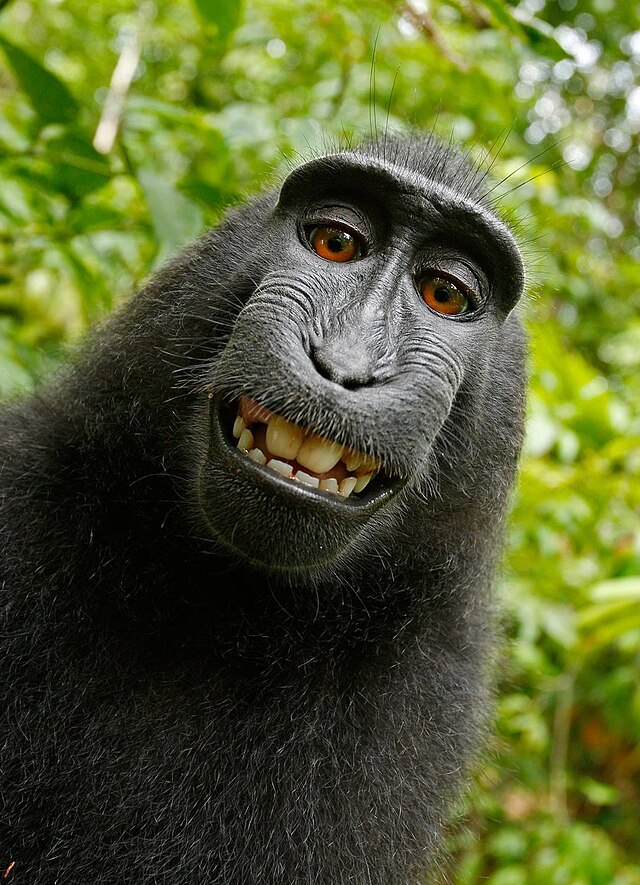
When this cheeky monkey took a selfie on a photographer's camera, it led to questions about who owned the copyright - the monkey or the snapper.
But now the US copyright office has finally made a decision, judging that neither hold any rights.
It has ruled that any work created by an animal does not belong to them or anyone else. This also includes plants, nature, divine or supernatural beings.
- Anthony Bond, The Daily Mirror, 22 Aug 2014
Dear, oh dear, oh dear, oh dear, oh dear.
Whilst I suspect most people will look at "Monkey Selfie" and think that this is amusing, I think that this is a terrible miscarriage of justice and sets a very dangerous precedent.
The US copyright office has now basically said that when an animal takes a photograph, copyright can not be claimed by the person who went to the effort of setting up the equipment which enabled the photograph to even exist in the first place.
Although it should sound obvious, a Professional Photographer derives their income from the sale of the images they produce; those images require effort to produce. Copyright in principle is about making sure that artists are compensated for that effort. The production of art in general as with anything requires effort, be that physical or intellectual or otherwise, in my opinion should be duly rewarded for that effort.
The issue surrounding Monkey Selfie, stems from the fact that Wikimedia unilaterally asserted because the photograph which had originally appeared in a Daily Mail article was the work of a non-human animal, then copyright could not vest with a legal person; as it could not vest with a legal person, it fell into the public domain.
What I think that this says is that Wikimedia has asserted that Mr Slater doesn't deserve to be paid for his work, despite the fact that he set up a photo shoot and owns the camera equipment, and that's bad. This also sends out a strong price signal over the value of photographs.
Economist Friedrich Hayek described a "price signal" in his 1988 work "The Fatal Conceit" as something which communicates the value of something via the mechanism of changes in prices. If something is valued at zero, which is the net result of declaring something to be in the public domain because no economic rights can be derived from it, then you may as well copy something which is worthless.
The free market establishes one thing and one thing only - price. The free market does not establish what is morally or legally right. It was the free market incidentally which determines why someone in Bangladesh can be paid $4 a week to make clothing; in conditions that are unsafe. People if they can get away with it, will want to pay nothing for everything.
The problem with paying nothing though, is that is doesn't compensate people for their effort and in effect, doesn't put food on the table; doesn't keep the rent collectors or the utility companies from the door.
In this case, I am very much reminded of the opening few words of the old Clause IV of the British Labour Party:
"To secure for the workers by hand or by brain the full fruits of their industry..."
Is a labourer worthy of their wages? Why shouldn't the fruits of labour come to those that labour?
In that Daily Mirror article I quoted, Mr Slater's complaint is pretty well much that sentiment.
"It makes me very angry, I'm a professional photographer - it costs me over £2,000 to do the trip. It's my livelihood.
You take 20,000 shots to get one image that sells, it was potentially a good earner for me, I've lost over £10,000 because of it."
- Anthony Bond, The Daily Mirror, 22 Aug 2014
I'd even further suggest that this sends a very strong message to professional photographers: DO NOT under any circumstances give your camera equipment to anyone else. Never let an animal take another selfie ever again.
Linky things:
The Sulawesi Macaques who took this: http://www.djsphotography.co.uk/Tropical%20Forests/Sulawesi%20Macaques.htm
David Slater's Website: http://www.djsphotography.co.uk/
It was an hilarious picture which was shared around the world but also caused one of the year's most complex legal issues.
When this cheeky monkey took a selfie on a photographer's camera, it led to questions about who owned the copyright - the monkey or the snapper.
But now the US copyright office has finally made a decision, judging that neither hold any rights.
It has ruled that any work created by an animal does not belong to them or anyone else. This also includes plants, nature, divine or supernatural beings.
- Anthony Bond, The Daily Mirror, 22 Aug 2014
Dear, oh dear, oh dear, oh dear, oh dear.
Whilst I suspect most people will look at "Monkey Selfie" and think that this is amusing, I think that this is a terrible miscarriage of justice and sets a very dangerous precedent.
The US copyright office has now basically said that when an animal takes a photograph, copyright can not be claimed by the person who went to the effort of setting up the equipment which enabled the photograph to even exist in the first place.
Although it should sound obvious, a Professional Photographer derives their income from the sale of the images they produce; those images require effort to produce. Copyright in principle is about making sure that artists are compensated for that effort. The production of art in general as with anything requires effort, be that physical or intellectual or otherwise, in my opinion should be duly rewarded for that effort.
The issue surrounding Monkey Selfie, stems from the fact that Wikimedia unilaterally asserted because the photograph which had originally appeared in a Daily Mail article was the work of a non-human animal, then copyright could not vest with a legal person; as it could not vest with a legal person, it fell into the public domain.
What I think that this says is that Wikimedia has asserted that Mr Slater doesn't deserve to be paid for his work, despite the fact that he set up a photo shoot and owns the camera equipment, and that's bad. This also sends out a strong price signal over the value of photographs.
- apparently I am legally allowed to use this, as it has fallen into the public domain
Economist Friedrich Hayek described a "price signal" in his 1988 work "The Fatal Conceit" as something which communicates the value of something via the mechanism of changes in prices. If something is valued at zero, which is the net result of declaring something to be in the public domain because no economic rights can be derived from it, then you may as well copy something which is worthless.
The free market establishes one thing and one thing only - price. The free market does not establish what is morally or legally right. It was the free market incidentally which determines why someone in Bangladesh can be paid $4 a week to make clothing; in conditions that are unsafe. People if they can get away with it, will want to pay nothing for everything.
The problem with paying nothing though, is that is doesn't compensate people for their effort and in effect, doesn't put food on the table; doesn't keep the rent collectors or the utility companies from the door.
In this case, I am very much reminded of the opening few words of the old Clause IV of the British Labour Party:
"To secure for the workers by hand or by brain the full fruits of their industry..."
Is a labourer worthy of their wages? Why shouldn't the fruits of labour come to those that labour?
In that Daily Mirror article I quoted, Mr Slater's complaint is pretty well much that sentiment.
"It makes me very angry, I'm a professional photographer - it costs me over £2,000 to do the trip. It's my livelihood.
You take 20,000 shots to get one image that sells, it was potentially a good earner for me, I've lost over £10,000 because of it."
- Anthony Bond, The Daily Mirror, 22 Aug 2014
I'd even further suggest that this sends a very strong message to professional photographers: DO NOT under any circumstances give your camera equipment to anyone else. Never let an animal take another selfie ever again.
Linky things:
The Sulawesi Macaques who took this: http://www.djsphotography.co.uk/Tropical%20Forests/Sulawesi%20Macaques.htm
David Slater's Website: http://www.djsphotography.co.uk/
August 27, 2014
Horse 1741 - Euthanasia - Human Dignity?
Imagine for a second that the year is 2024. In the August election which has just been held, the government led by former Prime Minister Penny Wong was defeated 79-71 by incoming Wyatt Roy's Liberal Government; which also has a friendly Senate.
Medicare it is argued is too expensive to continue and the Medicare Australia Act 1973 has been repealed.
In this brave new world of market driven health care, hospitals are looking to lower input costs to drive profits even harder. In this new legislative environment, the rate of patients suddenly being euthanised has skyrocketed. How did this happen?
Back in the day whilst Tony Abbott was still Prime Minister, the Euthanasia and Patient Consent Act of 2017 proved fairly easy to pass with both sides of the chamber declaring it a triumph of "human dignity". Patients "right to die" was extended in Commonwealth legislation for the first time.
Of course the "right to die" is supposed to be safeguarded with a legal instrument of consent or via a Power of Attorney but as we all know, these things in practice are incredibly easy to obtain; both in periods of calm and chaos in peoples' lives.
Suddenly a legal instrument signed five years ago and mostly forgotten, has all the importance of a Presidential Order and all the force of an express train meeting an egg at 100mph.
It is curious, that mainly poorer people are being euthanised. One of the consequences of a market driven system is that price looms as a very large factor in decision making. Poorer people who have less market power and less of an ability to pay very large bills, can be more easily coerced into giving their "consent".
It is also strange that people who face bankruptcy as a result of expensive medical bills, also find it easier to give their "consent" to being euthanised, thus creating a bankrupt estate, where not even creditors can chase any more.
Does this sound far fetched? Remember, it is only a few short steps away and the Law of Unintended Consequences isn't very far away either.
Admittedly my moral compass is informed by my Christianity. I just don't think that anyone has the right to take a life; not even their own. It seems to be that given human nature, in every single circumstance where there is the capability to abuse the system, someone invariably will. Introduce the factor of profits that can be increased by simply eliminating expensive patients and amazingly so called "human dignity" dissolves in the wake of economic necessity.
When even death itself can be reduced to the status of a cost driver, the concept of human dignity becomes a nonsense.
In my line of work, I frequently see instances where someone has been coerced into doing something, which they never would otherwise intend to do. Once a contract or a legal instrument has been signed though, it is often difficult to show that duress has taken place or even that the terms of a contract are unfair because it is often easier to prove that there has been a reasonable degree of consent applied.
In the case of euthanasia, where someone would probably require signing a legal instrument which would end their own life, to later go back and show that duress or unfairness existed, all seems rather pointless after someone is dead.
Again, to argue about "human dignity" also seems pointless after someone is dead, irrespective of whichever God, god, gods or complete lack thereof you happen to believe in. It should be obvious to all that with euthanasia, there is no "undo"; the decision is irreversible.
John Stuart Mill in "On Liberty" (1859) said that:
"The only purpose for which power can be rightfully exercised over any member of a civilized community, against his will, is to prevent harm to others."
I think that the argument against euthanasia, even against some people's will, is to prevent harm to others. Does it really promote "human dignity" to reduce some people to the status of an input cost?
That world of 2024 I described is only a few pieces of legislation away. I don't want to live in that world. I hope we never ever get there.
August 23, 2014
Horse 1740 - Rollo's Challenge to Film & Television Makers
I have a challenge for the film makers and the makers of television programs because I want to see if what I propose can actually be done anymore; for curiosity's sake - that is, can a blockbuster film or major television series be produced in the twenty-first century which is G rated, which isn't a "family film" and isn't "for the children"?
I don't suggest this because of some sort of weird moral crusade against the film and television studios, it's just that, I've seen a distinct lack of imagination when it comes to the kinds of film and television which is being produced, which is on some sort of cycle of becoming darker and edgier to the point where it's all just quite a bit hokey and banal.
At the bus stop where I change from the train to the bus on my morning travel as a cut-lunch commando commuter, I happen to stand outside on of Sydney's biggest cinema complexes. I took a quick survey of all the films which were on the current roster and found that there was currently showing:
G rated - 1 film
PG rated - 2 films
M rated - 6 films
MA rated - 3 films
This means that the average age rating on a film currently on show in Sydney this week is age 14. 14 isn't quite M rated but is does mean that or 75% of films, you couldn't actually take a 14 year old in to see them.
Obviously this is all an economic decision on the part of movie makers. They're only likely to produce films which will return a profit and so from that perspective, it all seems perfectly understandable to me. The problem though is that the G and PG rated films which are usually on offer are so predictable and puerile, it makes me even wonder if said 14 year old who could get in to see the rest of the films, would even want to see the remaining three.
Although Tom Lehrer in the 1960s said that "smut, is a market that you can't glut" and whilst I might find myself ever increasingly offended by what's on offer at the cinema, I'm in a small minority and they're not likely to miss my dollars any way but when cinema turnover peaked in about 2002 and has been on the slide ever since, maybe there might be something to be made of my challenge here.
Just what is on offer at the cinema anyway? More superhero stories? Crude comedies that are poorly written? The twenty-first century equivalent of kitchen-sink dramas?
Where are the modern day equivalents of "Dial M for Murder" which was basically a film set in three rooms? Where is our twenty-first century "Citizen Kane"? In an age of political corruption and deadlock, how come we don't see a new "Mr. Smith Goes to Washington"?
The basic stories are always there; there's constant inspiration being generated, why is it so very hard to produce intelligent films these days, which would still be remembered in 60 years' time. When the people of the year 2074 look back, will they remember the films of 2014? I doubt it.
This isn't even a rant about things "being better in my day" because (and let's be perfectly frank about this) in my day, which is now, the films ARE rubbish. I want better quality writing and more intelligent film making. Are the audiences of 2014 really so stupid that the film makers should treat us all like dolts?
There's your challenge. Make for me just one film in the next 12 months which is rated G and is smart enough, or funny enough or brilliant enough that I can take my grandchildren to.
Why can't we have nice things?
August 22, 2014
Horse 1739 - What If Insensitive Comments Actually Do Represent The Electorate?
I was upstairs in the heavens yesterday, whilst my boss was downstairs with a client and I heard a rant from a client which I think although was incredibly vulgar and so blue that it could paint the entire Royal Australian Navy a nice shade of azure, was equally scathing and exact with its intent.
I went along the lines that if Mr Hockey thinks that "poor people" don't drive cars because they can't afford them and that the Prime Minister Tony Abbott specifically targets Muslim people as not being on "Team Australia", that although they might be clumsy with their words, they might in fact be expressing the views held by their electorate.
Back up the bus for a second? What was this chap suggesting here? This warranted further thought.
Mr Hockey is the Federal Member of Parliament for North Sydney and has been since 1996. Mr Abbott is the Federal Member of Parliament for Warringah and has been since 1994. Both of these electorates lie on the north side of Sydney Harbour and in relatively well to do areas.
The statistical level of poverty in the electorate of North Sydney is less than 0.5%. The percentage of Islamic people living in electorate of Warringah is also less than 0.5%.
The arguments whilst insensitive (Joe has since publicly apologised for his comments), might actually be representative of what the people of the electorates of North Sydney and Warringah really think. Since a Member of Parliament is firstly a local member, who is elected by their electorate; appointed by their local branch of their political party, in those respects, they are directly answerable to their local constituents. The fact that they keep on being elected, must mean to suggest that those constituents think that their local members are doing a good job at representing them.
What we're noticing here is a distinct highlighting of the concept of the "other", which is useful political device (so useful that I'm probably making use of it in this very post). The problem is that in this case, the members of the "other", also happen to be part of the same nation.
The physicality of Canberra doesn't exactly help either. When we exile Members of Parliament to Canberra (and let's be honest, that's pretty well what's going on here) we send them to a place which is physically separated from the vast majority of society. Parliament House is even separated from Canberra's own central business district. The climate of Canberra is such that on occasion is doesn't even encourage people to go outside. The lack of trains in Canberra, even means that Members of Parliament travel by car and don't even see the people of Canberra.
How are you even expected to meet the "other" if you never ever see them?
Compare this with London for instance. The Houses of Parliament in the Palace of Westminster in bang in the centre of SW1 in the conurbation of the great wen of London. Ten million souls live in London and Members of Parliament must brush past a kaleidoscope of people, if they even want to get anywhere.
If Members of Parliament take the tube, then they must travel on the same trains as the general public and even if they get escorted about by car, they still have to pass through less well to do suburbs.
To get to Canberra from their electorates, both Messrs Hockey and Abbott, would get into a car, take an expressway to the airport, passing through the eastern suburbs of Sydney, which are relatively well to do and the expressway even passes through two golf courses. Even from a purely visual perspective, they'd never even pass the "poor people" who "don't drive" or the Muslim people who supposedly aren't part of "Team Australia"; what ever the heck that is supposed to mean.
If Canberra is self-contained bubble and separated both metaphorically and physically, then what of the electorates of North Sydney and Warringah? I can attest through experience that when I tell clients that I live in Marayong, most of them have no idea where that even is; the place where I work is in Mr Abbott's own electorate.
I can't even blame the people of the electorates of North Sydney and Warringah for this either. Think about your own friends. I'll be that most of them live within 10km of where you do. Parents send their children to mostly local schools and people attend clubs, churches, social groups and activities which are also mostly local. In broad principles, most people who live a fairly close sort of area, also happen to fall within the same socio-economic group. Note that this isn't necessarily a rag against the people of the electorates of North Sydney and Warringah; it just that this is what is. It goes for practically everyone.
The people of the electorates of North Sydney and Warringah, also don't see the "poor people" who "don't drive" or the Muslim people who supposedly aren't part of "Team Australia" because they don't need to. Why should they? Supermarkets, schools, hospitals etc. all exist in their own suburbs, so why do they need to travel when they can access those things locally?
I think of the former Prime Minister Paul Keating (who I didn't really like) who was known for his exceptionally colourful language on occasions. I don't think that he would have made these sort of comments because he was the Federal Member of Parliament for Blaxland which is deep in Sydney's western suburbs. He wouldn't have been able to get away with such comments because his local electorate would have shown their wrath with a backlash at the ballot box. This sort of thing has happened before: think of John Howard in 2007 or Sophie Mirabella in 2013 who both came under the ire of the people of their electorates; who voted with their... votes.
In 2012, US Presidential candidate Mitt Romney probably helped to blow apart his hopes of running for president by saying that "47 percent of the people who will vote for the president (Obama) no matter what" and that "my job is not to worry about those people". Again, as insensitive as that was, it probably might have been quite true.
The difference between a US Presidential candidate and someone hoping to be the Australian Prime Minister is that the Australian Prime Minister only needs to be concerned about his own electorate. Government is formed by a majority of members; of which the Prime Minister is but one. Firstly, they must represent their own electorate and in this case where the electorates of North Sydney and Warringah don't actually contain any "poor people" who "don't drive" or the Muslim people who supposedly aren't part of "Team Australia", maybe Messrs Hockey and Abbott actually are representing their electorates.
They keep on being elected; so demonstrably, they must already be doing so.
Mirrored at Medium:
https://medium.com/@rollo75/what-if-insensitive-comments-actually-do-represent-the-electorate-3ee5df4542fc
August 21, 2014
Horse 1738 - Australia's Prime Ministers - No 7 - Billy Hughes
VII - Billy Hughes
William Morris "Billy" Hughes was a wiley political character who was described by his opponents as a spider, a rat and a crab. He was a political journeyman who would go on to be a member of six diffent political parties, be expelled from three of them; represent four different electorates and in two states.
Before federation, he had been secretary of the Wharf Labourer's Union, first national president of the Waterside Workers' Union and eventually during the formalisation of the Labor Party would become part of the federal party.
After Andrew Fisher's health had declined and he resigned, Hughes was appointed as his successor and followed on in that same policy style; enacting legislation including an improved pension for elderly people in benevolent asylums.
Hughes and the Labor Party disagreed violently over the issue of conscription and in October of 1916 a plebiscite was held on the issue - it failed.
The disagreement was so heated that following the plebiscite, in November of 1916, Hughes was expelled and 24 member of the Labor Party followed him to form the National Labor Party although it was never formally constituted and had no structure to speak of.
For the 1917 budget, it would depend on member of the Commonwealth Liberal Party for supply they formally merged to form the Nationalist Party of Australia.
As the Nationalist Party Prime Minister, Hughes would oversee the end of the war and attend the Paris peace conference of 1919. Legend has it that during the peace conference, when negotiating repatriations that Germany was expected to pay, if Hughes didn't like what was being said, he claimed that his hearing aid wasn't working.
Hughes signed the Treaty of Versailles and asked of the then United States' President Woodrow Wilson: "I speak for 60,000 dead, How many do you speak for?" Wilson would later declare that Hughes was a "pestiferous varmint".
Hughes also demanded that Australia have representation independent of Britain in the League of Nations, however he was opposed to Japan's request for racial equality in the organisation.
Hughes would also be instrumental in Australia's taking up of preferential voting and although the governments he led would win the 1917 and 1919 elections, the 1922 election was only finally won with the help of entering into a coalition with the Country Party; a coalition which in broad principles still exists today. In February of 1923, the Country Party leader Earle Page made his intentions clear that the coalition with Hughes as Prime Minister was untennable and rather than risk government, Hughes resigned in favour of Stanley Bruce.
Hughes would remain a member of Parliament and would change parties again, being a member of the United Australia Party and finally the Liberal Party until his death in October 1952. He was the last member to have remained from the first parliament and at 90 years old, the oldest member of an Australian parliament ever.
Aside:
The Gillette Safety Razor was awarded a patent in 1904 but it wasn't until during WW1 that Gillette won a contract to supply American soldiers that they really took off. Schick's single edge razor was developed in the 1920s and things took off from there.
The reason I mention this is that Billy Hughes was the last PM with a moustache. One wonders if the widespread use of the razor is a coincidence or not.
August 20, 2014
Horse 1737 - Redesigning The State Flags For Fun And Frivolity
In Hello Internet Episode 18¹ there was a passage of discussion about the United States' state flags² and how they collectively are a giant wibbly-wobbly graphical mess. A group called the North American Vexillological Association, in 2001 ranked all the US and Canadian state and provincial flags³ and the best of them showed strong graphic design standards, whilst the worst were all of the "seal on a bed sheet" design.
I had a thought about the Australian state flags and realised that if Australia does at some point become a republic, then the idea of having a defaced blue ensign with the state badge on, would become intolerable (or maybe not, there is the curious case of Hawaii which has the Union Flag in the canton despite never being a British colony or possession) and so, they would all need to change.
Fortunately though, there are already two perfectly acceptable flags in Australia which could serve as a model for new flags to replace all the state flags on that terrible day of Australia's becoming a republic. I used the ACT's flag as the template because the southern cross in the Northern Territory's flag is actually graphically different for reasons that I do not know.
The basic idea that I took, was to take the badges from the existing state flags which I do not think need to change at all and place them into the right hand field. The southern cross would remain on the left hand side and the colour schemes all came from the colours that we already associate with the states. Obviously since I'm only using Paint that came with Windows, they're not going to be brilliant and I suppose that I could have centred the badges or resized them and fiddled with Pantone colours but the point was to show the concept; which I think is obvious.
I also think that it is pretty obvious which state is which too.
These then are the 8 "state" flags, in order that they came to be:

New South Wales - 1788

Tasmania - 1825

Western Australia - 1829

South Australia - 1836

Victoria - 1851

Queensland - 1859

Northern Territory - 1911

Australian Capital Territory - 1911
The colours were chosen on the basis of the state's primary colour, except for Western Australia because the black swan badge on a yellow field just looked silly. Tasmania got red stars on that same basis because they looked better, as did the blue stars for South Australia (and in keeping with their third colour, although it does kind of inadvertently look like I'm biased towards the Adelaide Crows).
Other than that, I think that they all look fine; maybe a little dull but importantly, obvious.
Addenda:
The national flag should be equally as obvious. I had a bit of a muck about for three minutes and came up with this:
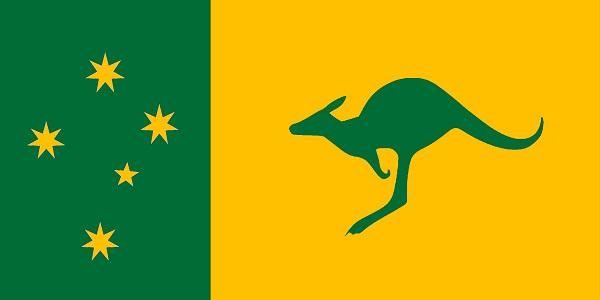
Surely that's as obvious as the nose on your face.
Links:
August 19, 2014
Horse 1736 - Fourteen Minutes In A Foreign Country
Sometimes Sydney has weather which would belong equally well in places like Berlin or Moscow or even Tokyo. Although Sydneysiders like to rag on Melbournians because they live in the "rainy city", the unbelievable truth is that Sydney gets more rain in a year; it's just that unlike Melbourne's drizzle, in Sydney, it just chucks it down.
Last night was one of those evenings and as I stepped off the train at Marayong, I realised that I'd left my brolly on the train. As I got back on to get it, the doors closed and I went to Quakers Hill... this is that story.
Previously, I had been to Quakers Hill Station in the early morning on several occasions if I'd wanted to get a seat by taking a train back one station but I'd never got off there at night; the whole experience is totally different.
There is a strange sort of beauty about the world underneath the cover of night. With the rain and mist blanketing everything and closing down distance of vision to only a few hundred yards, it means that the ability for street lamps to scrape away the darkness is severely limited; to the point that the street lights do not appear as they usually do but as spheres of light suspended in space; hanging on nothing.
The problem with sodium lighting is that the light which is produced is all uncannily one colour (that yellow is 589 nanometres in wavelength if you we're interested, which you're not) and it bathes the world in a horrble jaundiced light, as though someone had washed the world in nicotine stains. Nowt looks healthy at all.
In stark contrast, the pale blue lights of the railway station's fluorescent tubes, which flicker according some hither to undiscernible pattern, paint the immediate area in a pale blue; though they do not really do a better job at holding back the darkness; only their immediate domain receives their indigo hue. Unlike the sickly tones of the street lamps, they paint their domain with all the charm of a hospital corridor. This is made ever more the worse when you consider the hard shapes of the railway station; the cool, aloof tones of the tile work, the concrete form work and the unforgiving metal structures.
It is all incredibly deceptive. The colour temperature tricks you into believing that the place is sterile but even a customary glance reveals that dust, grime and other filth has invaded every surface and not even Ajax, the champion of all grease, would halt this opponent if his hand were tilted at it.
The rain lazily didn't bother to go around me either; it decided to cut straight through, with ten thousand tiny daggers. I took refuge in an elevator which helpfully wasn't perfumed by either of those two companions, Eau de Uriné or Vasser Von Viktoria (Bitte!)
As the doors closed, the silence was surreal. I imagine that if anyone was watching surveillance screens wiuld have been confused at the fact that I was just standing there but Big Brother I imagine, had gone home. After three minutes of silence (yes, I was watching the station clocks tick by), the lift moved upwards but when I got to the concourse level, there was no sign of love behind the doors; called by no-one.
As I stepped out of the lift and into the concourse, I saw four Opal Card posts, standing as though they were they posts for an unmanned border. I was reminded of Checkpoint Charlie in Berlin and the starkness of the architecture of the station, whilst it strictly wasn't of the Brutalist style (as per Le Corbusier or Ernő Goldfinger) it was still pretty brutal and reminded me of the sort of thing you find in East Berlin.
Opal Card Readers - Standing Like Checkpoint Charlie
Just like the abandoned border posts of East Germany, Sydney Trains has undertaken an equally comprehensive policy of systematically abandoning its ticket offices. Where once were stationmasters in uniforms with shiny buttons, hiding behind steel grilles, they have been largely replaced by these sleek, shiny poles. The real irony that the only splash of colour to be found is the Opal Card logo.
The actual distance between Marayong and Quakers Hill is only about three kilometres but last night in the wind and the rain, it felt as though I was in the transit area of some foreign airport. For fourteen minutes, I kind of felt as though was in a foreign country: they do things differently there.
Sometimes there is a strange beauty in starkness.
August 14, 2014
Horse 1735 - Paperclip and Big Blue Milk Crate: On Public Art

It looks like you're writing a letter. Would you like help?
Sydney City Council has commissioned two pieces of public artwork in conjunction with the NSW Government's $220 million light rail project. There has been a whole host of opinion from outrage to confusion to ridicule on these two proposed pieces and in this post I offer my two penneth worth.
I think that a major problem with public art in modern times is both that the artists who produce it and the general public who for want of a better word 'consume' it, is that the once assumed bulk of mythology which people had, no longer exists.
For instance, the J. F. Archibald Memorial Fountain in Hyde Park has the Greek god Apollo who represents the Arts (Beauty and Light), whilst Diana, goddess of purity, of peaceful nights and charity, and Theseus and the Minotaur is in another of the sections of the fountain. These things may have meant something to people even 80 years ago, would they still have the same cultural relevance today?
Even in an era where we're going about mythologising the First World War and especially Gallipoli (you can expect to hear a lot about that over the next year and a bit), there aren't a lot of people who know many of the names of the soldiers who fought in that war.
In comparison, when Britain was setting about mythologising its history, it erected statues to people like Lord Horatio Nelson, Henry Havelock and Charles James Napier.

Some student is missing a coffee table
Almost everyone who I've spoken to about this, hates this giant blue milk crate as an idea for a piece of public art; I on the other hand love it.
This unlike the Sydney Opera House, which fails to live up to its title in that it is impossible to actually hold an opera in the Sydney Opera House, does live up to its title "Pavilion" in that it will be a pavilion.
Australia has loads of big things. There is a Big Banana, a Big Prawn, a Big Pineapple, a Big Guitar, a Big Merino, a Big Axe, a Big Miner's Lamp, a Big Mango, a Big Sausage King, a Big Tap... Wake up an smell the big cup of coffee. The Big Milk Crate is about as Australian as you can get. Yes it's a Big Blue Milk Crate but... it's a BIG BLUE MILK CRATE. What's so hard to understand?
The thing I really love about this is that it's obviously just so pointless. All big things are inherently pointless. Isn't that kid of what we like about them? This goes to the whole other end of the spectrum. This isn't like the giant paper clip thing where we're all scratching our collective noggins, wondering what in blue blazes is going on, this is a big blue milk crate; we know exactly what it is.
"I'll meet you at the milk crate" would be as ubiquitous as the UK city of Liverpool's "Meet under a statue exceedingly bare". There's no symbolism here. It just is.
All of this brings me squarely to the question of "what is public art for?" and let me tell you, I am totally unqualified to answer that.
As someone who lives in a predominantly urban environment, I get to walk around and see statues of people and things in public spaces and assume that most of the time that they are in commemoration of history. Some pieces of public art completely baffle me though. There is a sculpture at Allan Border Oval in Mosman, which looks kind of like a tree bit is made up of silhouettes of magpies. I can attest, after having six stitches over the years from magpie strike that there are in fact magpies that live in that park, but it is beyond me as to why there should be a piece of public art in dedication of them.
At Federation Square in Melbourne, the public "art" which is officially called "Nearamnew" is supposed to invoke images of the outback but anyone who has tried to get across its undulating cobble stones in a hurry, just thinks that it is a public hazard.
On the other hand there is a sculpture in Sydney called "The Bounds of Friendship" which is basically two interlocking rings and is supposed to mark the voyage of the First Fleet from Southampton to Sydney. What I like about this is that there is an identical set in Southampton.
The symbolism is pretty obvious once you read the plaque and from an aesthetic point of view, it is what it's supposed to be. Again, it probably isn't pretty but it makes sense. Inherently, it's no worse than a giant paper clip thing.
Hmmm Donuts... public art...
If it were up to me, I'd like to see someone invent a new set of symbolism which would personify Sydney (see Horse 1695) but I suspect that that is all a bit too hard. I guess I'll begrudgingly have to accept that what we get for public art is either a statue of some public figure, weird shapes which are supposed to symbolise an abstract concept (and do it badly), or a big thing.
Maybe we should just have a 400 foot tall statue of Tim Cahill, with one hand shading his eyes and the other pointing out into the distance. As the dawn rises over the city, Big Tim Cahill would symbolise...
okay I've got nothing.
Subscribe to:
Posts (Atom)