The following excerpt is from a letter that we received in the mail from Telstra:
This letter is to let you know that on and from 14 September 2009 there will be some changes to our bill payment fees.
We offer a range of ways to pay your bill. Some of these options incur higher administration costs for Telstra so we're introducing the below fees for their use:
a) A new $2.20 payment administration fee will apply for each bill payment sent through the mail or made in person at a Telstra Shop or Australia Post. This fee also applies to bill payments made using Electronic Funds Transfer. Electronic bill payment options which will not incur this fee are highlighted below.
Let me get this straight by me paying a bill, Telstra is going to charge me a fee for the "privilege" of paying my bill. This is essentially a penalty for keeping within the boundaries of the contract. Has anyone else in the world come up with such a blatant rip off?
An "administration fee"? Come on, seriously. If we pay via the net, surely it is us doing the administration for you. Or if we pay at the post office, then it's the Post Office who does the administration, not Telstra. Besides which, isn't administration one of the implied overheads of any business?
And if the "administration fee" is as a result of the mess left behind by that farty trumped-up little smeghead Sol Trujillo, then why are we the customer forced to pay the bill? Wasn't it his fine management which saw the share price (and ergo people's investment in the company) fall from $5.68 to $3.08 under his tenure? How come Telstra don't make him pay the "administration fee".
And since we're on the subject of fees grounded in the most tenuous, and shallow ground of justification, where do the Commonwealth Bank, the National Australia Bank (of whom it seems strangely appropriate that they should have on their documentation "nab"), Westpac and the ANZ get off in charging so called "account service fees"? Just what is the service they provide?
Firstly they take our money on deposit and then invest it which means that they already make money from our money. Secondly the interest they pay back is covered ten-thousand fold by the interest they charge on mortgages and lending. Thirdly, with them closing branches and in effect forcing us to do "internet banking" doesn't that mean that we're actually servicing our accounts ourselves?
But the fee that really got my feckles, hackles, schmeckles up and tingling were two fees which we got from a legal firm. They owed us a fair amount of money for the work we had done from them, and they charged us a "postage fee" and a "late payment fee". They charged us for them handling our demans to be paid and them being late in paying us. Not surprisingly, I took this directly to the principal of the law firm and refused to pay them, and also consequently refused to ever do any work for them again... except now they have a court order, ordering us to do work for them in the case.
I think I should start mailing out my own fees and charges for frivolous things, like waiting time in the post office queue, charging fees to companies like Harvey Norman for putting annoying adverts on the telly, and a congestion charge for those people who crowd out the doors on train carriages.

August 20, 2009


August 19, 2009
Horse 1027 - Very Petty Larceny
Welcome to Adelaide, City of churches, and where life is so inexorably dull that the top news story has been...
http://www.news.com.au/story/0,,25918893-1246,00.html
A spate of cucumber thefts has Adelaide police in a pickle. More than $10,000 worth of cucumbers have been stolen in 11 separate robberies in the past three months.
Thieves have targeted market gardens north of Adelaide, with police saying the latest robbery - of 50 bags of cucumbers - was reported from a glasshouse at Virginia at the weekend.
http://www.news.com.au/adelaidenow/story/0,22606,25886628-5006301,00.html
Theives have stolen 34 buckets of cucumbers from a northern suburbs grower. The theft happened at a Buckland Park property sometime on Sunday night or Monday morning.
The victim picked 34 buckets of cucumbers on Sunday, to be collected for market on Monday, but thieves stole the entire lot.
http://www.abc.net.au/news/stories/2009/08/12/2653384.htm
Police say a grower could be responsible for the theft of more than $10,000 worth of cucumbers in Adelaide's north. There have been 12 separate cucumber robberies during the past three months, the most recent involving 150 bags on Tuesday night.
I imagine that the police are really confused by this. The question isn't why someone would want to steal cucumbers, (because according to the Bureau of Meteorology, South Australia is suffering from drought) but how you track down said cucumbers.
http://www.bom.gov.au/climate/drought/drought.shtml
The obvious lame puns abound in the Advertiser such as the above "cucumber thefts has Adelaide police in a pickle" but I note that not even a News Corporation newspaper have stooped to using the phrase "over a barrel" with the memories of Snowtown still looming in the memory of South Australians.
These cucumber thefts reminded me of a raid on an olive grove in May last year:
http://www.news.com.au/story/0,23599,23733873-2,00.html
Busy thieves have stripped an entire olive grove of its fruit in an overnight raid, the latest of a series of such bizarre thefts.
Quentin Von Essen, who runs an olive grove in Lovedale, in NSW's Hunter Valley, was alarmed to find that all but two of his 400 trees had been stripped of their olives earlier this month.
Mr Von Essen said he was dumbfounded how it could have happened without anyone noticing. "It would take approximately six people up to three days to pick our olive grove," he said.
Have we as a nation progressed at all... ever? Some convicts, ne'er do wells, ruffians, rapscallions, that arrived to these shores on the First Fleet on that day in 1788 were sent out here because of petty larceny, thievery, and pickpocketness. It makes me wonder in the 21st Century in a supposedly more enlightened time whether or not we actually have made any progess as a nation... if we're stealing cucumbers and olives I would suggest not.
CUCUMBER THEFT!
http://www.news.com.au/story/0,,25918893-1246,00.html
A spate of cucumber thefts has Adelaide police in a pickle. More than $10,000 worth of cucumbers have been stolen in 11 separate robberies in the past three months.
Thieves have targeted market gardens north of Adelaide, with police saying the latest robbery - of 50 bags of cucumbers - was reported from a glasshouse at Virginia at the weekend.
http://www.news.com.au/adelaidenow/story/0,22606,25886628-5006301,00.html
Theives have stolen 34 buckets of cucumbers from a northern suburbs grower. The theft happened at a Buckland Park property sometime on Sunday night or Monday morning.
The victim picked 34 buckets of cucumbers on Sunday, to be collected for market on Monday, but thieves stole the entire lot.
http://www.abc.net.au/news/stories/2009/08/12/2653384.htm
Police say a grower could be responsible for the theft of more than $10,000 worth of cucumbers in Adelaide's north. There have been 12 separate cucumber robberies during the past three months, the most recent involving 150 bags on Tuesday night.
I imagine that the police are really confused by this. The question isn't why someone would want to steal cucumbers, (because according to the Bureau of Meteorology, South Australia is suffering from drought) but how you track down said cucumbers.
http://www.bom.gov.au/climate/drought/drought.shtml
The obvious lame puns abound in the Advertiser such as the above "cucumber thefts has Adelaide police in a pickle" but I note that not even a News Corporation newspaper have stooped to using the phrase "over a barrel" with the memories of Snowtown still looming in the memory of South Australians.
These cucumber thefts reminded me of a raid on an olive grove in May last year:
http://www.news.com.au/story/0,23599,23733873-2,00.html
Busy thieves have stripped an entire olive grove of its fruit in an overnight raid, the latest of a series of such bizarre thefts.
Quentin Von Essen, who runs an olive grove in Lovedale, in NSW's Hunter Valley, was alarmed to find that all but two of his 400 trees had been stripped of their olives earlier this month.
Mr Von Essen said he was dumbfounded how it could have happened without anyone noticing. "It would take approximately six people up to three days to pick our olive grove," he said.
Have we as a nation progressed at all... ever? Some convicts, ne'er do wells, ruffians, rapscallions, that arrived to these shores on the First Fleet on that day in 1788 were sent out here because of petty larceny, thievery, and pickpocketness. It makes me wonder in the 21st Century in a supposedly more enlightened time whether or not we actually have made any progess as a nation... if we're stealing cucumbers and olives I would suggest not.
August 18, 2009
Horse 1026 - Do they really want your "Loyalty"?
Franklins, Woolworths and Coles currently all have so called "loyalty" programs designed to retain business and in theory keep you playing the Jewish Piano in their stores.
The following comes from Franklins' own website:
http://www.franklins.com.au/home/inner.asp?mainID=3&pageID=23
- Present your Loyalty Club card when you shop at Franklins and you earn one point for every dollar you spend.
- When you reach 2000 points, you can redeem them for payment for your grocery purchases or for Franklins Vouchers.
To put this in perspective, to 2000 points gets you $20 of stuff. To get 2000 points you needed to have spent $2000. This means that effectively the rate of return is 1% of everything you've spent. If you do a weekly shop, this means 1 week in every two years is returned to you.
What happens if you choose to shop around and actually bother to look for better deals when you go shopping? Doesn't this mean by inference that you'll either spend less or worse, because you'd have spent at more places than just Franklins, that the once in two years blows out even further?
What about those small time shoppers like myself who only buy a few items during the week? Some of the things I buy don't even register a single point through the tills. Did Franklins raise their prices by 1% to cover this marvellous service? Would consumers even notice if they had done?
I don't mean to single out Franklins, but Choice magazine in one issue had worked out they Franklins had the best loyalty program. If that's the best, then that means that Woolworths' Everyday Rewards and Coles' tie-in with FlyBuys must be crudtacular.
If the supermarket giants really wanted you to "save money" they'd simply lower their prices wouldn't they? Perhaps it's just easier to take Franklins' own advice "It's cheaper through the tills, when you shop No Frills". Yeah... that's what I think of your loyalty programs.
August 14, 2009
Horse 1025 - Kia Builds a Car... For Real!
I am not a motoring journalist (though if anyone wants to offer me a job as one then I'll gladly take it) and as such I haven't really driven an extremely wide range of cars. To clarify this, I have driven almost no sports cars at all. What I've driven tend to be small commuter-boxes and family hacks, and most of them are pretty similar. So when I find something I'm impressed with, it must be pretty good.
Take note people, the next sentence is either going to sound blasphemous or illogical to you, so be prepared.
The Kia Magentis is excellent.
WHAT? Let me repeat that - The Kia Magentis is excellent.
KIA?!
To be perfectly honest, I'd looked at Kia through prejudiced eyes. The Mazda 121, which was built by Kia and then sold as a Kia Pride in England was rubbish. The second generation which was not even sold by Mazda (because even they realised it was rubbish) was sold in Australia as the Ford Festiva... which was rubbish. The 1st Generation Kia Rio (DC)... was also rubbish. The 2nd Gen Kia Rio (DE) is not rubbish, but it is boring. How then does the Magentis make the leap from not being rubbish, to beyond boring and into excellent?
The Magentis is styled ultra-conservatively; I guess that Kia don't want people turned away by its looks. If you look behind the bland exterior the car begins to shine when you turn the key.

Firstly it has a list of features which makes even a Mercedes-Benz E-Class look tame.
- Anti-Lock Brakes (ABS)
- Electronic Brakeforce Distribution (EBD)
- Emergency Brake Assist (EBA)
- Electronic Stability Program (ESP)
- Traction Control
- Dual Front Airbags
- Side Airbags and Curtain Airbags
- Variable Valve Timing (CVVT)
- Variable Intake System (VIS)
That in itself looks like an impressive list of kit, which makes me think that Kia have gone all out with this car. The Magentis puts out 119kW from a 2.4L in-line four. The car isn't "kick-you-in-the-pants" quick but it does have an adequate amount of perk and would probably very easily sit on 110 clicks all day if you let it.
I'd say that the Magentis probably has its gun sights aimed squarely at the Ford Focus, Mazda 3, Toyota Corolla and the Holden Astra... except that Holden have replaced the Astra with the Cruze (which is decidedly rubbish compared with the Astra H it replaced)
The Astra G & H (the Prawn had an Astra G) had an almost lazy directness about it, i.e. the car tracked in the direction you pointed it. The Magentis feels far stiffer, and even more direct than the Astra if that's possible. I didn't stress the car too hard but it has even less body roll than a Honda Integra and when it exits corners, it again points true.
The gearbox (I drove a manual) had nice short throws in it, and unlike the Corolla who's clutch has no feeling whatsoever, the Magentis is light enough to be smooth, but must have tensioners or something to let you know precisely where the "bite" points are.
Ergonomically everything comes to hand well, though I was again disappointed like so many other cars, with the incredible sea of grey plastic for the dashboard.
I found the textures on the knobs interesting, but across the rest of the dashboard there wasn't anything outlandish or even really all that different from any other car.
Just like B's Hyundai Accent (LC) was the first car that Hyundai built "properly", the 2009 Kia Magentis (MG) has benefitted from tweaks in the Hyundai powerplant and chassis updates. This is the car that says that Kia has finally made it to par, well it hasn't just scraped over, it's done everything asked of it well. The car might not yell "Look at Me!" but that's a good thing, because it means that you can leave it in a carpark and know that it will still be there when you get back. Not every car needs to have a GT badge stamped on it.
This is Kia's first "proper" car. Kia say in their adverts that they have "the power to surprise" but it's not really a surprise if you've been waiting 20 years. Doing things well is sometimes more important.
August 13, 2009
Horse 1024 - GST is Hateful
I shuddered when I heard rumours in the newsagent's this morning that if this Carbon Emissions Trading Scheme takes off, then it would mean imposing a higher rate of GST. Admittedly it's only a rumour and the only article I could find on the piece was this offering from Brisbane's Courier-Mail, which being a News Corporation publication is as reliable as trying to predict the results of horse races based on the contents of your handkerchief.
http://www.news.com.au/couriermail/story/0,23739,25912087-3122,00.html
KEVIN Rudd wants to effectively increase the GST by a quarter to 12.5 per cent. That's in year one - after that it could go to 15 per cent and even higher, completely outside any control by the Parliament.
The reality is, the awful truth is thus and facts are that...
Regressive? A regressive tax is a tax imposed in such a manner that the relative tax rate decreases as income increases. In simple terms, a regressive tax imposes a greater burden on poor people than on the rich.
Assume for me if you will that we have 4 people, all earning Ÿ30,000, Ÿ40,000, Ÿ60,000 & Ÿ100,000.
If a weekly budget includes Ÿ250 in rent, Ÿ50 in petrol, Ÿ30 in electric bills, Ÿ10 in water bills, Ÿ10 in services rates and Ÿ100 in groceries then all up that would be Ÿ450/week or Ÿ23,400 a year. At a 10% GST that works out to be Ÿ2340 in tax.
But we'd also have to assume that as people's income increases, then obviously they can spend more right? Well almost, but not quite. For as people's income does go up, although they might buy nicer things, their absolute capability of buying stuff stops at some point. No-one for instance can fill the car with petrol anymore than full. No-one can buy more groceries than they can fit in their house.
So instead of Ÿ23,400 being spent for each of our four consumers, they might in fact be only able to spend Ÿ23,400, Ÿ24,440, Ÿ24,960, Ÿ26,000 and therefore pay Ÿ2340, Ÿ2440, Ÿ2496 and Ÿ2600 in GST respectively. Or if you will...
Ÿ30,000 = tax Ÿ2340 = 7.8%
Ÿ40,000 = tax Ÿ2440 = 6.1%
Ÿ60,000 = tax Ÿ2496 = 4.1%
Ÿ100,000 = tax Ÿ2600 = 2.6%
Obviously I'm making assumptions all over the place here but as an illustration it works well enough.
The question is "Is this equitable?" "Is it fair?". Quite frankly, I don't think that it is. Especially considering that in the majority of cases, people's wages are not determined by them; in fact the poorer a person is, the less power that they have to determine their wage. The inverse of this is also true, in that if you give poorer people extra cash in the form of a stimulus payment, the more likely they are to spend it, simply because they need to survive.
In essence, to increase the GST from 10% to 12.5% as possibly suggested means that the tax becomes more regressive and therefore falls even harder on poor people:
@10% GST
Ÿ30,000 = tax Ÿ2340 = 7.8%
Ÿ40,000 = tax Ÿ2440 = 6.1%
Ÿ60,000 = tax Ÿ2496 = 4.1%
Ÿ100,000 = tax Ÿ2600 = 2.6%
@12.5% GST
Ÿ30,000 = tax Ÿ2925 = 9.75%
Ÿ40,000 = tax Ÿ3055 = 7.63%
Ÿ60,000 = tax Ÿ3120 = 5.20%
Ÿ100,000 = tax Ÿ3250 = 3.25%
The burden is still three times harder on poor people than on the rich at a rate of 12.5% than at 10% but what this doesn't tell you is that the total amount of money that they have at the end of the year is even tighter than it was before. It decreases from Ÿ4260 to only Ÿ3675, and the poorer you are the more hurtful that is.
I'm still convinced that the GST in principle is a hateful hateful tax, but fiddling with it to hurt poor people harder from a political party which was elected on rhetoric of "Working Families", "Working Families" & "Working Families" is nothing short of scandal.
http://www.news.com.au/couriermail/story/0,23739,25912087-3122,00.html
KEVIN Rudd wants to effectively increase the GST by a quarter to 12.5 per cent. That's in year one - after that it could go to 15 per cent and even higher, completely outside any control by the Parliament.
The reality is, the awful truth is thus and facts are that...
The GST is a regressive tax.
Regressive? A regressive tax is a tax imposed in such a manner that the relative tax rate decreases as income increases. In simple terms, a regressive tax imposes a greater burden on poor people than on the rich.
Assume for me if you will that we have 4 people, all earning Ÿ30,000, Ÿ40,000, Ÿ60,000 & Ÿ100,000.
If a weekly budget includes Ÿ250 in rent, Ÿ50 in petrol, Ÿ30 in electric bills, Ÿ10 in water bills, Ÿ10 in services rates and Ÿ100 in groceries then all up that would be Ÿ450/week or Ÿ23,400 a year. At a 10% GST that works out to be Ÿ2340 in tax.
But we'd also have to assume that as people's income increases, then obviously they can spend more right? Well almost, but not quite. For as people's income does go up, although they might buy nicer things, their absolute capability of buying stuff stops at some point. No-one for instance can fill the car with petrol anymore than full. No-one can buy more groceries than they can fit in their house.
So instead of Ÿ23,400 being spent for each of our four consumers, they might in fact be only able to spend Ÿ23,400, Ÿ24,440, Ÿ24,960, Ÿ26,000 and therefore pay Ÿ2340, Ÿ2440, Ÿ2496 and Ÿ2600 in GST respectively. Or if you will...
Ÿ30,000 = tax Ÿ2340 = 7.8%
Ÿ40,000 = tax Ÿ2440 = 6.1%
Ÿ60,000 = tax Ÿ2496 = 4.1%
Ÿ100,000 = tax Ÿ2600 = 2.6%
Obviously I'm making assumptions all over the place here but as an illustration it works well enough.
The question is "Is this equitable?" "Is it fair?". Quite frankly, I don't think that it is. Especially considering that in the majority of cases, people's wages are not determined by them; in fact the poorer a person is, the less power that they have to determine their wage. The inverse of this is also true, in that if you give poorer people extra cash in the form of a stimulus payment, the more likely they are to spend it, simply because they need to survive.
In essence, to increase the GST from 10% to 12.5% as possibly suggested means that the tax becomes more regressive and therefore falls even harder on poor people:
@10% GST
Ÿ30,000 = tax Ÿ2340 = 7.8%
Ÿ40,000 = tax Ÿ2440 = 6.1%
Ÿ60,000 = tax Ÿ2496 = 4.1%
Ÿ100,000 = tax Ÿ2600 = 2.6%
@12.5% GST
Ÿ30,000 = tax Ÿ2925 = 9.75%
Ÿ40,000 = tax Ÿ3055 = 7.63%
Ÿ60,000 = tax Ÿ3120 = 5.20%
Ÿ100,000 = tax Ÿ3250 = 3.25%
The burden is still three times harder on poor people than on the rich at a rate of 12.5% than at 10% but what this doesn't tell you is that the total amount of money that they have at the end of the year is even tighter than it was before. It decreases from Ÿ4260 to only Ÿ3675, and the poorer you are the more hurtful that is.
I'm still convinced that the GST in principle is a hateful hateful tax, but fiddling with it to hurt poor people harder from a political party which was elected on rhetoric of "Working Families", "Working Families" & "Working Families" is nothing short of scandal.
BOO!!!
August 12, 2009
Horse 1023 - Twelve Men Good and True
Thomas Randolph in his poem The muses looking-glasse; and Amyntas circa 1635 wrote:
"I had rather... haue his twelve Godvathers, good men and true, contemne him to the Gallowes."
The twelve Godfathers, good men and true is referring to none other than that of a jury; a panel of twelve people selected from society to judge the fate and evidence placed before them, of some other member of society accused of some serious crime.
Legend has it that the first ever jury, was formed in the city of Chester in north-west England in 946AD, though one must wonder at both the validity of the story and of the sense of it.
The wife of the Governor of Hawarden (a village 5 miles west of Chester and who's most famous son was PM William Gladstone), was praying in the local church for a break in a drought which was causing crops to fail, resulting in famine. Apparantly, a thunderstorm broke out and a statue of the Virgin Mary fell on top of her, killing her instantly.
A court was called and twelve good men and true, found the statue guilty of murder and condemned the statue to be hanged.
Because it was a statue of the Virgin Mary it was then decided that God should decide its fate, so the statue was thrown into the River Dee until it was "drowned".
The people of Chester, some 5 miles down the River Dee who found the statue and pronounced it quite dead, then buried the statue. It is belived to have been buried under what is now called the Roodee, or the stump of presumably what once was a sandstone cross marking its grave.
Now I don't know about the sense about finding a statue guilty of murder, but it does show that even in the dark ages people were thinking about more equitable ways of deciding the results of court proceedings. If twelve men good and true decide something, then the chances are that it must be equitable, albeit incredibly silly.
August 07, 2009
Horse 1022 - "The Bomb" was Unjustified
The 6th of August and the 9th of August are the anniversaries of what I think are possibly the most reprehensible atrocities of war ever committed, the dropping of nuclear weapons on Hiroshima and Nagasaki.
I think that this was an abhorrent waste of life, and to think that people actually justify it makes me really angry.
This is why:
26 Jul 1945
The Proclamation Defining Terms for Japanese Surrender or the Potsdam Declaration was issued by US President Harry S Truman, UK PM Winston Churchill¹, and President of the Republic of China² Chiang Kai-shek.
The Ultimatum delivered to Japan stated that it would face "prompt and utter destruction" but no mention of the bomb was made.
30 Jul 1945
Japan initially rejected the terms of surrender but wanted to have it modified so that the Japanese Government would still retain the Emperor. Japan requested two weeks leave to discuss the terms of surrender; this was granted. This would have meant that a Japanese surrender would have been submitted on the 13th of August.
2 Aug 1945
Emperor Hirohito flies to Vladivostok for a conference with Stalin. At this point we either have to concede that Hirohito was either looking for an ally for negotiations with Potsdam, or perhaps to for Japan to become a Soviet Protectorate. I guess we'll never know.
3 Aug 1945
The US Air Force destroys Vladivostok's air strip and port facilities citing that intelligence had detailed "important activity in that area". It has never been stated by US official just what that "important activity" was, but it effectively locked Hirohito in Soviet territory.
5 Aug 1945
After considerable debating, the Japanese War cabinet was deadlocked 6-6 on whether or not to accept the terms of surrender. Because the casting vote was that of Hirohito himself, the Japanese PM Kantaro Suzuki issued a statement of "Mokusatsu" with regards the instrument of surrender.
This is where it gets interesting. What does "Mokusatsu" mean? Mokusatsu literally means two concepts: "silence" (moku), and "kill" (satsu). This can be taken in a multitude of ways. Either it's as aloof as "no comment" in English or it can just mean to let a subject die. Considering that the Japanese War cabinet thought that they still had 8 days to come up with an answer and that Hirohito himself could not cast the deadlock breaking vote, Mokusatsu from a Japanese perspective is perfectly reasonable, but to the Allies it was seen as hostile.
6 Aug 1945
The city of Hiroshima is devastated by the dropping of a nuclear bomb and 140,000 people were instantly killed. After the Hiroshima bombing, President Truman announced, "If they do not now accept our terms, they may expect a rain of ruin from the air the likes of which has never been seen on this earth."
9 Aug 1945
The city of Nagasaki is also like Hiroshima, levelled by a nuclear bomb strike. 90,000 people were killed instantly.
10 Aug 1945
Major General Leslie Groves, the director of the Manhattan Project, sent a memorandum to General of the Army George Marshall, Chief of Staff of the United States Army, in which he wrote that "the next bomb should be ready for delivery on the first suitable weather after 17 or August 18."
12 Aug 1945
Hirohito surrenders with the following address:
"Moreover, the enemy now possesses a new and terrible weapon with the power to destroy many innocent lives and do incalculable damage. Should we continue to fight, not only would it result in an ultimate collapse and obliteration of the Japanese nation, but also it would lead to the total extinction of human civilization.
Such being the case, how are We to save the millions of Our subjects, or to atone Ourselves before the hallowed spirits of Our Imperial Ancestors? This is the reason why We have ordered the acceptance of the provisions of the Joint Declaration of the Powers."
The truth is I have no idea whether or not Hirohito intended to surrender or negotiate a close to the war by the 13th of August. Whatever the case, the fact remains that he was never allowed to, by virtue of the fact that either because of something as shabby as mistranslation or deliberate pigheadedness³ on the part of Truman and his War Council, the destruction of 230,000 innocent people happened at an order; I think needlessly.
For all the bickering that goes on behind world leaders desks, people often forget that it's servicemen and civilians who actually bear the brunt of warfare. A Japanese person sitting at home minding their own business is no more or less valuable than an American, a Briton, a Ghanaian, a Bolivian or whoever else you'd like to nominate.
I don't care if they are the enemy, the fact remains that most enemies if given the chance would prefer to be left alone with the morning's newspaper and a cup of coffee than be sent off to fight for their country; especially if they didn't really need to.
Since this is the anniversary of the destruction of so many lives, I would like to nominate someone in counterpoint. Neville Chamberlain more or less knew that war with Germany was inevitable but that he delayed it for two and a half years, saving unknown countless lives. Although he is seen as a weak leader for not engaging Hitler, I think that he was well aware that it wasn't going to be him personally that was doing the fighting, but other people's sons, brothers, daddies and mates.
Now justify it for me.
¹Churchill resigned as PM on 27th Jul 1945
²The People's Republic (Communist) didn't start until 1949
³"pigheadedness" appears to be an actual word that the spell checker recognises
August 06, 2009
Justify This!
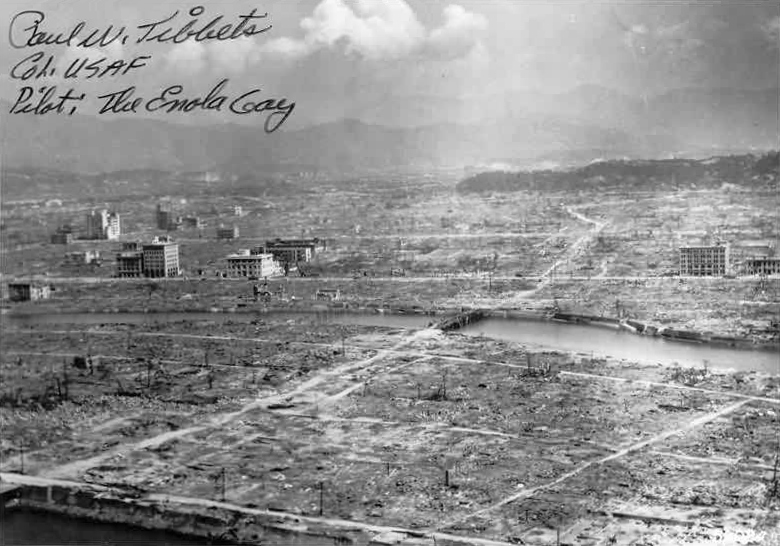
Eisenhower wrote in his memoir The White House Years:
In 1945 Secretary of War Stimson, visiting my headquarters in Germany, informed me that our government was preparing to drop an atomic bomb on Japan. I was one of those who felt that there were a number of cogent reasons to question the wisdom of such an act? During his recitation of the relevant facts, I had been conscious of a feeling of depression and so I voiced to him my grave misgivings, first on the basis of my belief that Japan was already defeated and that dropping the bomb was completely unnecessary, and secondly because I thought that our country should avoid shocking world opinion by the use of a weapon whose employment, was I thought, no longer mandatory as a measure to save American lives.
MacArthur wrote in tabulations to a US Senate Committee:
Use of the atomic devices was completely unnecessary from a military point of view. We at that point had no intention to invade Japan, the threat of Russia entering the war with Japan on August 11 would have seen them accept the terms of Potsdam by well before September 1 and certainly Operation Starvation would have seen total surrender before October 1.
I AM STILL ANGRY
July 31, 2009
Horse 1021 - White Friday... Friday 31st
Today is Friday 31st of July, which I think should be called White Friday and a day of universal superstition of good luck.
When you think about it, every month of the year contains a 13th day of the month. Since any month can start of any day of the year, then statistically there's a 1 in 7 or 14.258% chance of there being a Friday 13th in any given month.
But only 7 of the 12 months of the year actually have a 31st day of the month in them. A 1 in 7 chance of something that's 7 in 12, gives you a 1 in 12 chance of it happening or only an 8.333% chance of there being a Friday 31st.
Does this mean by inference that because a Friday 31st is only 58.444% as common as Friday 13th, whether or not it should be 71.102% luckier (being the inverse)?
Should I now throw pepper over my right shoulder, let white cats cross my path and start gluing mirrors back together?
I'm still not going to walk under a ladder though. That has nothing to do with luck, that's simply good advice... stuff could fall on your head!
July 29, 2009
Horse 1020 - What the National Anthem Says About Australia
What does a nation's national anthem actually say about the nation? Can you learn anything from it? Do for instance "the rocket's red glare, the bombs bursting in air" imply that the United States likes blowing things up? Is "God defend New Zealand" implying that anyone can just walk in and steal the place? What then for Australia?
Verse 1
Australians all let us rejoice,
For we are young and free;
Does this mean that we're all a bunch of gormless teenagers? We're rejoicing about being young? Surely someone's having a laugh.
We've golden soil and wealth for toil,
And we're all lazy bozos who can't be bothered doing work for ourselves. Golden soil? I've seen red, black, brown but not golden.
Our home is girt by sea;
Yay, we're an island... and we didn't fail Year 1 geography.
Our land abounds in Nature's gifts
Of beauty rich and rare;
It's a good thing that nature is gifting us things, because we said earlier that we aint working for them.
In history's page, let every stage
Advance Australia fair!
In joyful strains then let us sing,
"Advance Australia fair!"
Joyful Strains? The anthem openly admits that it's too hard to sing.
Verse 2
When gallant Cook from Albion sail'd,
To trace wide oceans o'er,
True British courage bore him on,
Till he landed on our shore.
This is clearly an admission that we don't know our own history. Cook was on a mission to observe the transit of Venus across the sun and then of conquest. To be perfectly honest, Cook didn't exactly deliberately set out to "land" here either, he sort of bumped into it and then tried to go around; even then he had trouble doing it.
Then here he raised Old England's flag,
The standard of the brave;
This is a point from my chair in Pedant Corner. Cook sailed under the Union Flag, not England. England didn't exist by itself as a separate entity from 1707 onwards.
With all her faults we love her still,
Her faults? What of ours? History certainly repeats itself, doesn't it?
"Brittannia rules the wave!"
Only one? Which one? The Mexican Wave? The New Wave? The Royal Wave?
In joyful strains then let us sing
"Advance Australia fair!"
Verse 3
Just to prove that we don't even know our own national anthem, the whole thing is 6 verses but most Australians only sort of half know the first, generally don't know the second that's sung (which is the third), and only a very small number know about the existence of the other four.
Beneath our radiant southern Cross,
We'll toil with hearts and hands;
In verse 1 we said that we had wealth for toil. Why are we now toiling in verse 3? Has that wealth now run out?
To make this Commonwealth of ours
Renowned of all the lands;
For those who've come across the seas
We've boundless plains to share;
I think that that this is actually a pretty good exposition of what our intended immigration policy was. We've boundless "plains" to share. That's right, the immigrants can have the scabby bits in the middle, we'll keep the edges.
With courage let us all combine
To advance Australia fair.
In joyful strains then let us sing
"Advance Australia fair!"
Verse 4
While other nations of the globe
Behold us from afar,
Really when does this happen? Only at the Olympic Games and even then only for about the first 3 days when the swimming medals are the first handed out.
We'll rise to high renown and shine
Like our glorious southern star;
Now we're getting just plain pompous here. Not to mention that there actually is no Southern Star. Polaris or the North Star doesn't have a Southern Hemisphere equivalent, the Southern Cross points the way to the South Pole, but in the celestial South Pole, it's just blank space.
From England, Scotia, Erin's Isle,
Who come our lot to share,
Where's Wales? Actually when you think about it the Union Jack is a composite of the four constituent parts of the UK. The Cross of St George for England, the Cross of St Andrew for Scotland, the Cross of St Patrick for Ireland, and Wales' bit... Jack!
Let all combine with heart and hand
To advance Australia fair!
In joyful strains then let us sing
"Advance Australia fair!"
Verse 5
Should foreign foe e'er sight our coast,
Or dare a foot to land,
We'll rouse to arms like sires of yore
To guard our native strand;
Actually when in 1942 this was tested, the radio operators in Darwin didn't believe the warning and we did nothing at all. There was no rousing of arms either, half of the Australian Army was already in North Africa fighting off Rommel.
Brittannia then shall surely know,
Beyond wide ocean's roll,
Her sons in fair Australia's land
Still keep a British soul.
This was also tested. How Appropriate in an Ashes series:
The Aussies love the English, you might find it quite strange.
'Cos we sent them all down under, with only balls and chains.
And when they see the English, they always shout and scream.
But when they had the chance to vote they voted for the Queen.
In joyful strains the let us sing
"Advance Australia fair!"
Indeed. After 5 verses I'd be straining too.
What you mightn't know is that the Advance Australia Fair was written by a Scotsman called Peter Dodds McCormick (who went under the pen-name of Amicus). The December 1st 1878 edition of the Sydney Morning Herald called the song "decidedly patriotic" and that it was "likely to become a popular favourite" (I guess the Herald knew what tit was talking about). The song itself was sung at the Federation ceremony on Jan 1, 1901 and at the opening of the Parliament House in Canberra in 1927 but wasn't declared official until 1984.
What's even worse is that a sixth verse which was well known before 1930 seems to have been unceremoniously dropped on the quiet. An anthem if you track the definition of the word comes from the Greek ἀντίφωνα (antiphōna) which means "the opposite voice". The word originally meant a song sung as two parts of a Psalm or other Hymn.
With Christ our head and cornerstone,
we'll build our Nation's might,
Nice sentiments I'm sure, but is that really the case?
Whose way and truth and light alone,
can guide our path aright.
This is entirely true, but if you look at successive governments whose policy it's been to erode things like the Family Law Act, and the Marriages Act quite recently, I really wonder which path the nation is headed down.
Our lives, a sacrifice of love,
reflect our Master's care
95% of the time most Australian's are looking out for number on. Considering that we've been told in the other verses that we're lazy, then making a sacrifice? Perhaps in times of extreme hardship but not generally.
With faces turned to heaven above,
Advance Australia fair.
In joyful strains then let us sing,
Advance Australia fair
What have we learnt from all this then?
The national anthem itself affirms that Australia is British, that Australians are lazy, that they don't really know their history and that we're as pompous as those we hate in Britain. Also I don't think that it's much of a stretch to declare that because it was written by a Scotsman whilst he was in Scotland, that the song isn't Australian, certainly isn't National, and doesn't really qualify as an anthem under the definition of the word.
No wonder we don't really know it... it speaks so much about us as a nation.
July 27, 2009
Horse 1019 - 11% More Rip-Offedness!
Why bother going on a mission to Mars? It will be smaller by the time we get there.
The size of a Mars Bar has been reduced from 60g to 53g or a decrease of 11.66%, but did the price drop by an according 11.66% to $1.50? Heck No!
http://www.news.com.au/story/0,27574,25563517-36398,00.html
Mars Snackfood Australia general manager Peter West said the move was a direct response to Australia's obesity debate and the company's bars had too many calories.
"Big food is an issue - the portion size that people are eating, whether (it's) the muffin you buy, or the cake, or when you go to a restaurant, the size of the plate in front of you," Mr West said. "We want to make sure we sell our portions in the right size."
Mr West said the price of Mars Bars (from $1.70) had not decreased, although some of the company's other brands would be cheaper.
Admittedly complaining about the price of chocolate is rather a foolhardy thing to do, especially when coupled with the fact that this was reported in a Murdoch newspaper but I have several questions here:
When has there ever been an "obesity debate"? I would have thought that simple common sense (which apparently isn't so common anymore) dictates that obesity is caused a surplus of calorie intake. ie More calories consumed than expended. Where's the debate? There's no debate. So what exactly is going on here?
Does Mars Snackfood Australia (the name snackfood should give the game away here) suddenly care about the health and welfare of its customers? Of course not. The real issue can be boiled down into a very few select words from the article:
11 per cent smaller - The price, however, won't change.
The same simple equation which governs obesity also governs profits. Profits is caused a surplus of monetary intake. ie More dollars collected than expended.
We've seen this before. Cadbury reduced the size of their chocolate blocks from 250g to 200g. Once upon a time there were 13 Tim Tams in a packet before it became 12, 11 and now only 9. Coca-Cola have introduced a new 450mL bottle which is set to replace their 600mL. Head and Shoulders reduced their 500mL bottle down to 450mL. Even the standard size of a loaf of bread fell in 1998 from 750g to 680g and for what purpose? Profits.
Yet again we see business gouging the wallets of people and then "sugar coating" it with an emotional excuse. Well guess what Mars? I'm never going to buy another one of your products again. As a riled consumer who votes with my wallet, I'm taking my hard won moneys and spending them on Titan bars at Aldi, so ha and nyah. And just to add insult to injury, I'm adding to my list of companies that I have contempt* for. Ha and double nyah!
*Rollo's Contempt List:
News Corporation, Holden and GM (but not Opel or Vauxhall), Chrysler, AIG, Commonwealth Bank, Westpac, St George, BMW, Vodafone, Telstra, Fiat, Qantas, Emirates, Optus, Campbell's, Wesfarmers, Microsoft, Caltex, Shell, Mobil, Total, Lion Nathan, Renault, and La Porchetta.
July 23, 2009
Horse 1018 - How Much We Like/Hate Your Club
I have this theory that suggests that the more successful a club is, the more hated that club is likely to be. It usually follows that hate follows success.
So then I have complied a highly non-scientific method of determining how much people are likely to hate any given club, or alternatively, how much people are likely to like any given club if they are a neutral.
To this end I give you The Great Premier League Likability Index:
This handy guide will give you an empirical guide to how much people are going to like your team. By following these handy little instructions, we'll work out scores for the entire premier league.
Supporter Base:
- Add 1 point for every year your club has been in the top flight. Because a club's following is built on how long they survive. It follows that a club with a long standing should generate a loyal following.
- Add 3 points if they have just been promoted. A club which is only newly promoted has a small boost as people tend to look favourably on the newbies.
Snobbery Value:
- Deduct 2 points for every £100m the club is worth. Nobody likes a bunch of rich snobs who think they can buy a title.
- Add 1 point for every thousand seats that the club stadium has under 100,000. Big stadia although can pack more people in, tend not to have supporters from that city.
People Hate Success:
- Deduct 2 points for every piece of silverware that the club has won in the past 20 years.
- Add 1 point for every year that the club has won diddly squat.
Nationalistic Fervour:
- Add 1 point for every English, Scottish, Welsh, Irish (incl. NI) or Australian international in the squad.
- Deduct 1 point for every German, Italian, Spanish, Portugese, Brazillian, or Argentine international in the squad.
Colour is Important:
- Deduct 5 points if the club plays in Red or Blue at home
- Deduct 3 points if the club plays in White at home
- Add 5 points if the club plays in any other colour at home
If we apply all of these then we get the following values:
221 Stoke City
190 Hull City
141 Burnley
134 Everton
132 Bolton Wanderers
117 Fulham
112 Aston Villa
107 West Ham Utd
104 Wolverhampton
97 Sunderland
94 Birmingham City
92 Manchester City
91 Tottenham
87 Blackburn Rovers
87 Portsmouth
87 Wigan Ath
78 Arsenal
37 Chelsea
33 Liverpool
-55 Manchester Utd
Not surprisingly, Manchester Utd is the most hated of clubs because it is a) the most successful, b) the richest, c) has a massive stadium, from which we conclude that the supporters aren't from Manchester and d) is the least English of football clubs.
What I find interesting is that Aston Villa, Everton, Bolton, Fulham and West Ham which have been bouncing around the doldrums for the past 10 years have a good core of ex-England players but aren't really all that successful with them.
Blackburn, Portsmouth and Wigan are all not very English, but at the same time have between them won a score of trophies.
Stoke City would be a neutral's favourite, mainly because they embody the underdog. They've never won anything, they play out of a tiny stadium and they have a few Scotland players. They'll probably get relegated, but everyone loves willing on the underdog, right?
July 22, 2009
Horse 1017 - If Cats Could Talk
I have been asking several questions as to what goes on inside my cat's head. Obviously the cat is less intelligent than people, but he does display on occasion some quite sophisticated thought patterns and even appears to try to manipulate his owners to get fed.
Among one of the thoughts that I've had (and have had lengthy discussions on) is the question of how does the cat actually think. Being an English speaker, nominally most of my thoughts are composed in English, though I will admit that having learnt elementary Japanese and a small amount of French and Latin, occasionally I will think in those languages as well.
What then of the cat? Is it possible to conduct sophisticated thought without the use of a cognisant language. How do you hang ideas in any framework without a language to tie them altogether? Is this also true for deaf people? If you were born deaf, and never ever heard language, then how would you compose ideas and thoughts?
Then I asked the question "Is there some default language which all people latently have?" Perhaps the answer to this might explain my above conundrum.
Merritt Ruhlen in his book "The Origin of Language" suggest that in fact, all modern languages share a common origin. By using a series of arguments based on reconstruction, the known proto-languages, a series of classification and by testing with known common roots, he's able to build quite a compelling argument for this theory.
The idea is consistent with the rest of science. If you create orders and super-families Eurasiatic (Indo-European, Uralic, Altaic, Eskimo/Aleut), Dene-Caucasian (Basque, Caucasian, Sino-Tibetan, Na-Dene), and Amerind (Native American languages from the US to South America), and then compare these to the isolated groups of Dravidian etc Austronesian etc, then by extrapolation, it all leads back to only one language.
Take a simple word such as aq'wa (water). It appears in what seemingly looks like totally unrelated languages all over the world. How is it possible for instance that Indo-European languages share more in common with Eskimo/Aleut languages than Semitic languages which immediately neighbour it?
There is a relatively simple way to describe what's going on though:
"Now the whole world had one language and a common speech." - Genesis 11:1
"The LORD said, "If as one people speaking the same language they have begun to do this, then nothing they plan to do will be impossible for them. Come, let us go down and confuse their language so they will not understand each other."
So the LORD scattered them from there over all the earth, and they stopped building the city. That is why it was called Babel (confusion) — because there the LORD confused the language of the whole world." Genesis 11:6-9
If science seemingly confers with the Bible that there was indeed only one root language, does this mean that this is a set of default settings? Do deaf people have this language as some sort of default?
What about my cat? In Genesis 3:1 we read this:
"Now the serpent was more crafty than any of the wild animals the LORD God had made. He said to the woman, "Did God really say, 'You must not eat from any tree in the garden'?""
My cat is certainly crafty, but what I find conspicuous by its absence is the issue that Eve throughout this discussion isn't surprised that the serpent could talk. Was it a commonplace thing to do before the fall? Does my cat still have the default pre-Babel language locked inside his head?
It's an interesting question. Of less interest is what the cat would actually say if he could talk. I'm 99% sure of what that would be.
Feed me.
July 17, 2009
Horse 1016 - Permanent War Economy
"Apart from that I believe the same mentality still exists today, I don't want to dwell on something that happened in the past & which I can do nothing about. It's just too depressing." - Warwick Reynolds, 15th Jun 2009
The above comment was made in reference to the utterly hideous amount of money spent by the US Government on its military; it does of course raise the big super ultimate question of... "Why?" The answer I fear, is one of hopelessly entangled, misplaced and dangerous ideology.
I take you back to 1944 and a fellow called Ed Sard, who predicted that after WW2, that the USA would "retain the character of a war economy even in peace time." The idea being that a "permanent war economy" would keep military spending high, and thus keep demand levels sufficiently high enough to avoid a repeat performance of the Depresssion which really had only been stopped by the outbreak of the war.
The reasoning behind this is surprisingly sound. Basic economic theory states that the level of income in the economy is dictated by "all inputs less all outputs" or:
Income = (Consumer Spending + Investment Spending + Government Spending + Receipts on Exports) minus (Savings + Taxation + Payments for Imports)
Income = (C+I+G+X) - (S+T+M)
By increasing the amount of Government Spending, you increase the amount of money being pushed into economy, and therefore incomes over time should increase.
Or to put it another way, in economic lulls or recessions, when C and I fall through consumer and business sentiment becoming pessimistic, G should either rise or stay large enough to keep the economy ticking over.
http://www.gpoaccess.gov/usbudget/fy10/pdf/fy10-newera.pdf
For Financial Year 2009 the estimated cost of base expenses for the Dept of Defense is $697bn which sounds like a huge amount of money but actually only represents about 3%-4% of GDP. This from an historical high of 38% in 1944 and even during the height of the Vietnam War where it still didn't hit 10%.
During the Depression when Consumer Spending shriveled up because people were unemployed, and Investment Spending also withered away, countries like Britain and the US didn't really recover until the outbreak of war when instantly, Government Spending was raised massively to put fighting men and munitions on the front line.
Quite truthfully, if you applied pre-1941 policies to the US budget; including, then four Neutrality Acts and the stated policy from 1918-1939 of "United States Non-Interventionism" then there hasn't been any logical enemies for the US when you consider that apart from the bombing of Pearl Harbour and Guam, there hasn't been a single act of war on US soil*.
Not only does the "same mentality still exist today" but it's actually ingrained policy. The real irony is that the United States which prides itself on being the shining light of capitalism, is in reality by operation of its budget, operating a part command economy, which in effect is subsidised by the Government. How's that for a leftist policy, eh?
As a result of the war, United States Secretary of Defense Charles Erwin Wilson (former CEO of General Motors), saw increased productivity during WW2 as the perfect justification for a permanent war economy; even Eisenhower in his farewell address made mention of the "military-industrial complex" which is in effect an Iron Triangle.
Our toil, resources and livelihood are all involved; so is the very structure of our society. In the councils of government, we must guard against the acquisition of unwarranted influence, whether sought or unsought, by the military-industrial complex. The potential for the disastrous rise of misplaced power exists and will persist. We must never let the weight of this combination endanger our liberties or democratic processes. We should take nothing for granted. Only an alert and knowledgeable citizenry can compel the proper meshing of the huge industrial and military machinery of defense with our peaceful methods and goals so that security and liberty may prosper together. - Dwight D Eisenhower
The real question left totally unanswered by all of this, isn't why spending billions of dollars is a good idea, but why in particular it should be spent on the military. To this I don't have an honest answer. Personally one of the most ridiculous things I found about America was seeing this sticker or stickers like it on people's cars:

For some absurd reason, it has been drilled into Americans through that most highly dubious of notions "patriotism", that somehow it's unpatriotic not to "support the troops" whatever the heck that means, and considering that every single taxpayer has in fact been doing so since 1775.
It therefore makes perfect sense to me in principle why $697bn is spent on the military when 46 million Americans have access to zero healthcare, and 37 million people live below the poverty line. Poor and sick people don't have political power to move government, nor do they have the ear of politicians or the president, whereas people in business and the military do. You could call it institutionalised apathy for the poor and sick, but surely that's common in any oligarchy?
http://news.smh.com.au/world/37-million-americans-live-in-poverty-20080827-437a.html
"What I was even more surprised and disappointed by was how he knew full well that this was a colossal waste of money - that there were things on earth of far greater importance"
- BJD, 15th July, 2009
Sadly, I'm not at all surprised with the colossal waste of money, I've long held the opinion that spending billions of dollars on the instruments to kill people (let's be totally honest about this), is fundamentally wrong and stupid.
The moon program was one component of the space program** which itself employs the very same aerospace companies responsible for building both the aeroplanes which drop bombs on people, and building other aeroplanes to carry people overseas. Those companies don't care where their profits come from.
A far wiser man than me once said: "For where your treasure is, there your heart will be also." It should therefore be fairly obvious where the heart of the US Government actually is. It's either in the perennial subsidy of the war machine, or operating the war machine itself, both of which are consistent with the idea of said "permanent war economy".
*Say what you will about 11 Sep 2001, it was never an act of war. It was a series of terrorist attacks by a non-sovereign entity.
**
Much of the NASA budget is directly military. These programs are usually classified. In addition, much of NASA's work is "dual-use," with military applications closer at hand and more powerfully directing NASA's activities than civilian mission components. For the purposes of this table we assume that 50% of NASA outlays are military.
- US Budgetary Papers, FY 2008, Note 3
The above comment was made in reference to the utterly hideous amount of money spent by the US Government on its military; it does of course raise the big super ultimate question of... "Why?" The answer I fear, is one of hopelessly entangled, misplaced and dangerous ideology.
I take you back to 1944 and a fellow called Ed Sard, who predicted that after WW2, that the USA would "retain the character of a war economy even in peace time." The idea being that a "permanent war economy" would keep military spending high, and thus keep demand levels sufficiently high enough to avoid a repeat performance of the Depresssion which really had only been stopped by the outbreak of the war.
The reasoning behind this is surprisingly sound. Basic economic theory states that the level of income in the economy is dictated by "all inputs less all outputs" or:
Income = (Consumer Spending + Investment Spending + Government Spending + Receipts on Exports) minus (Savings + Taxation + Payments for Imports)
Income = (C+I+G+X) - (S+T+M)
By increasing the amount of Government Spending, you increase the amount of money being pushed into economy, and therefore incomes over time should increase.
Or to put it another way, in economic lulls or recessions, when C and I fall through consumer and business sentiment becoming pessimistic, G should either rise or stay large enough to keep the economy ticking over.
http://www.gpoaccess.gov/usbudget/fy10/pdf/fy10-newera.pdf
For Financial Year 2009 the estimated cost of base expenses for the Dept of Defense is $697bn which sounds like a huge amount of money but actually only represents about 3%-4% of GDP. This from an historical high of 38% in 1944 and even during the height of the Vietnam War where it still didn't hit 10%.
During the Depression when Consumer Spending shriveled up because people were unemployed, and Investment Spending also withered away, countries like Britain and the US didn't really recover until the outbreak of war when instantly, Government Spending was raised massively to put fighting men and munitions on the front line.
Quite truthfully, if you applied pre-1941 policies to the US budget; including, then four Neutrality Acts and the stated policy from 1918-1939 of "United States Non-Interventionism" then there hasn't been any logical enemies for the US when you consider that apart from the bombing of Pearl Harbour and Guam, there hasn't been a single act of war on US soil*.
Not only does the "same mentality still exist today" but it's actually ingrained policy. The real irony is that the United States which prides itself on being the shining light of capitalism, is in reality by operation of its budget, operating a part command economy, which in effect is subsidised by the Government. How's that for a leftist policy, eh?
As a result of the war, United States Secretary of Defense Charles Erwin Wilson (former CEO of General Motors), saw increased productivity during WW2 as the perfect justification for a permanent war economy; even Eisenhower in his farewell address made mention of the "military-industrial complex" which is in effect an Iron Triangle.
Our toil, resources and livelihood are all involved; so is the very structure of our society. In the councils of government, we must guard against the acquisition of unwarranted influence, whether sought or unsought, by the military-industrial complex. The potential for the disastrous rise of misplaced power exists and will persist. We must never let the weight of this combination endanger our liberties or democratic processes. We should take nothing for granted. Only an alert and knowledgeable citizenry can compel the proper meshing of the huge industrial and military machinery of defense with our peaceful methods and goals so that security and liberty may prosper together. - Dwight D Eisenhower
The real question left totally unanswered by all of this, isn't why spending billions of dollars is a good idea, but why in particular it should be spent on the military. To this I don't have an honest answer. Personally one of the most ridiculous things I found about America was seeing this sticker or stickers like it on people's cars:
For some absurd reason, it has been drilled into Americans through that most highly dubious of notions "patriotism", that somehow it's unpatriotic not to "support the troops" whatever the heck that means, and considering that every single taxpayer has in fact been doing so since 1775.
It therefore makes perfect sense to me in principle why $697bn is spent on the military when 46 million Americans have access to zero healthcare, and 37 million people live below the poverty line. Poor and sick people don't have political power to move government, nor do they have the ear of politicians or the president, whereas people in business and the military do. You could call it institutionalised apathy for the poor and sick, but surely that's common in any oligarchy?
http://news.smh.com.au/world/37-million-americans-live-in-poverty-20080827-437a.html

"What I was even more surprised and disappointed by was how he knew full well that this was a colossal waste of money - that there were things on earth of far greater importance"
- BJD, 15th July, 2009
Sadly, I'm not at all surprised with the colossal waste of money, I've long held the opinion that spending billions of dollars on the instruments to kill people (let's be totally honest about this), is fundamentally wrong and stupid.
The moon program was one component of the space program** which itself employs the very same aerospace companies responsible for building both the aeroplanes which drop bombs on people, and building other aeroplanes to carry people overseas. Those companies don't care where their profits come from.
A far wiser man than me once said: "For where your treasure is, there your heart will be also." It should therefore be fairly obvious where the heart of the US Government actually is. It's either in the perennial subsidy of the war machine, or operating the war machine itself, both of which are consistent with the idea of said "permanent war economy".
*Say what you will about 11 Sep 2001, it was never an act of war. It was a series of terrorist attacks by a non-sovereign entity.
**
Much of the NASA budget is directly military. These programs are usually classified. In addition, much of NASA's work is "dual-use," with military applications closer at hand and more powerfully directing NASA's activities than civilian mission components. For the purposes of this table we assume that 50% of NASA outlays are military.
- US Budgetary Papers, FY 2008, Note 3
July 15, 2009
Horse 1015 - Beating the Soviets
http://bjd.au.com/index.php?bloggid=2004002157&directlink=true
Ever wondered why the manned space programme took a back seat after the US got to the moon?
Cos the point of going to the moon - was ONLY to beat the Soviets.
Nothing more.
- BJD, July 14, 2009
I say, Thank you Mr Kennedy.
I've read through my esteemed colleague BJD's post and the corresponding comments about the theory that the only reason why America went to the moon was to beat the Soviets; whilst I agree both in principle and fact, I suspect that Kennedy's reasons for placing a man on the moon were bound up ultimately in a much bigger fear - namely the diversion from what could have been a nuclear war.
When the bleeping tin ball Sputnik was launched on October 4, 1957, it was done so using the R-7 launch vehicle which was designed initially to carry nuclear warheads. Did this send waves of fear through the US Defence Dept? You bet.
http://en.wikipedia.org/wiki/R-7_rocket
"It is of great urgency and importance to our country both from consideration of our prestige as a nation as well as military necessity that this challenge [Sputnik] be met by an energetic program of research and development for the conquest of space.... It is accordingly proposed that the scientific research be the responsibility of a national civilian agency.... NACA is capable, by rapid extension and expansion of its effort, of providing leadership in space technology."
- National Advisory Committee for Aeronautics (NACA) Director, Hugh Dryden, 14 January 1958.
Personally I think that the only reason why a civilian agency was even mooted was to make the proposal palatable to the US Congress. Suddenly it was possible to land a nuclear warhead on any point on the planet, and so it was very much "spare underpants time" in the Pentagon.
So what does this have to do with putting a man on the moon? Kennedy I think was very much scared about the possibility that the Soviets intended to do nasty things to the USA.
Less than three months after Kennedy assumed the Presidency in April 1961, he ordered the unsuccessful Bay of Pigs invasion in Communist Cuba. US-trained force of Cuban exiles were to invade southern Cuba with support from US government armed forces to overthrow the Cuban government of Fidel Castro. The Cubans themselves were backed by the Soviets.
In September of 1962, Nikita Khrushchev agreed to place nuclear missiles in Cuba; these facilities were discovered by U-2 Spy Planes, and by about October 8 the world probably came very very close to nuclear war. The only reason that the Cuban Missile Crisis came to and end was to do with a no-invasion agreement brokered by the United Nations Secretary-General U Thant, Kennedy and Khrushchev on October 28, 1962.
"It shall be the policy of this nation to regard any nuclear missile launched from Cuba against any nation in the Western Hemisphere as an attack on the United States, requiring a full retaliatory response upon the Soviet Union."
- John F Kennedy, October 22 1962.
Is it little wonder therefore that Kennedy wanted to engage the USA and the Soviet Union in a race to the moon whatever the cost? "Fantastic expenditures which wreck the budget"? Kennedy himself said that only justification for it was to beat them [The Soviets]. I also think that "beating the Soviets" given the events that immediately preceded the quote of November 21 1962 was inexorably bound up with "defense, the top priority of the United States government"
Money after all is said and done is merely a tool. By committing monies untold and fantastic, I think that Kennedy probably saved maybe 100 million people's lives. If nuclear war actually had broken out, then I shudder to think what would have happened.
July 13, 2009
Horse 1014 - Their Finest Hour
"...if the British Empire and its Commonwealth lasts for a thousand years, men will still say, 'This was their finest hour."
- Sir Winston Churchill
One of the many things I constantly find of forums and the like, is the ill-conceived notion that Britain was unable to defend itself in WW2. Or perhaps more succinctly (and usually as an exact quote) "we saved your ass in WW2". I don't doubt the contribution that the US made in turning the tide of the war, but the theory that the USA "saved" Britain from Nazi Germany is materially nonsense when you look at the events in sequence.
The Battle of Britain which began on the 10th of July 1940, was really as a result of a serious of hideous defeats and pullouts by the British. France had surrendered on June 22, and this more or less led to what Hitler had wanted, his "Fortress Europe", however one thing stood in his way... England. As the order from Hitler himself said:
"Since England, despite its militarily hopeless situation, still has not shown any signs of being prepared to negotiate, I have decided to prepare a landing operation against England and, if necessary, carry it out. The objective of this operation is to eliminate the English home country as a base for the continuation of the war against Germany..."
- Adolf Hitler
Now whilst I don't intend to look at the actual air battle itself (which is the subject of making many books to which there is no end, and much study wearies the body) the key dates are worth noting.
The Battle of Britain ran from 10 Jul 1940 to 31 Oct 1940. The United States itself had a series of Neutrality Acts which prevented US troops or citizens from fighting in overseas conflicts.
The counter-claim always invariably put forward is "what about Lend-Lease?", again, what about it? Lend-Lease didn't come into existence until the Lend-Lease Act of 11 March 1941, some 5 months after the Battle of Britain. How can a program possibly help or even save anyone's "ass" after the event?
The truth is that when Britain was standing on its own against the German War Machine, it was doing precisely that. This fortress built by nature for herself, against infection and the hand of war, this blessed plot, this realm, this land, this England, stood firm; nobody "saved" it but England herself.
July 08, 2009
Horse 1013 - The People's Bank
http://business.smh.com.au/business/peoples-bank-to-break-the-big-four-20090707-dbtx.html
THE growing power of the Big Four banks has been targeted by a coalition of six influential economists, who have petitioned the Prime Minister and the Treasurer to set up an inquiry into Australia's financial system.
They have suggested the Government set up a "basic bank" so Australians can deposit money with Australia Post and have it managed by the Future Fund.
The so-called people's bank would be similar to New Zealand's successful Kiwibank, which was set up to break the dominance of the Australian-owned majors.
What a top idea! It's just a pity that it's so fundamentally flawed.
The whole concept of a bank set up by the people is far from a new idea. Virtually every building society, be it St George, IMB, The Rock & Hume were all set up by member; for members.
Bendigo Bank was set up as a series of "Community Banks", wherein the capital to set up the bank came from the initial pledgeholders, who then became shareholders.
The problem therefore is not the concept itself, which of itself is sensible and prudent, but the whole question of trustworthiness of the management of this new bank.
It's blatantly obvious that this new bank requires prudent management. If it is the Federal Government in charge, then there is nothing to stop the Government if it was going through dour times, from selling it. Remember that the Federal Government did once own a bank of its own and thanks to the guttersnipery of the then Keating Government, between 1991 and 1996 it was privatised. To be honest, the Labor and Liberal Parties have both shown that they're about as trustworthy as either Chairman Mao or Fuhrer Hitler.*
There's the rub. If "the people's bank" was to be set up and be managed by the Future Fund, which itself came about because of the sale of supposedly "the people's telecom" Telstra, then in say 2013 when the economy is really in economic kaka, then it too will be sold into private hands - so much for "the people's bank"
Or perhaps are these merely machinations or a governmental leak surrounding RuddBank?
http://www.abc.net.au/worldtoday/content/2008/s2600611.htm
*who started the "People's Republic" and the "People's Car"
July 06, 2009
Horse 1012 - Help, There's An Emergency Going On
I think that as far as I'm concerned, my football season has been ended due to injury.
The incident happened in the second half, after I brought a potential scorer on top of me. I think that I won the ball but with a mass of bodies littered about the six-yard box, who knows? I took out his feet and he came crashing in over the top of me, so it was entirely my fault but did he score? No - mission accomplished.
Now I'm not usually the sort of person to complain about this sort of thing, but it seems to me that human knees probably could have been designed a little better. Basically human knees unlike hips which are a sensible ball and socket affair, are two bits of bone, held together with elastic bands called ligaments, and a patella or "kneecap" acting as a... knee cap. In all seriousness, a ball and socket joint would have been more
The two ligaments I've torn are the Medial Collateral Ligament (MCL) and the Lateral Collateral Ligament (LCL). These two are the lacky bands which control twist in the lower leg. This sort of injury is usually the domain of skiers, tennis players, netballers and Chubby Checker who also twist a lot.
The other major injury I've sustained are the Scaphoid, Capitate, Trapezoid and Trapezium Carpals which may or may not have been smashed. My wrist is currently in a cast as I type this, which is somewhat annoying. The only real upside is that I can sort of look a bit like Dr Zoidberg if I hold my right arm in the air... which aint much of an upside in all honesty.
Still, I can't be accused of not being committed to a tackle. If anything by playing on I showed heart and ticker... and stupidity.
July 02, 2009
Horse 1011 - I Officially Hate Music
http://rollo75.blogspot.com/2008/07/horse-894-day-music-died.html
I don't know if this is an unintended consequence, but I've found that in the days that followed (including this morning) I can't listen to music of any sort on the radio and any enjoyment I would have got from it has been drained to the point of zero.
1 year ago today in the name of changing what went into my mind, I put a sledgehammer through my iPod and threw out all my CDs and between 80%-90% of my DVDs and comic books. So then one year on what are the results?
No seriously, that's it. I actually find myself hating music, in anything, hidden as the background in television programs, in adverts, in shopping centres, and especially on the radio.
In the car, any music is met with a swift "shut up!" on my part before either the station is switched, or the whole radio is given the flick entirely.
At first this was because of a deliberate effort to do so, but now it's more through sheer annoyance, not only at the sounds but at the very concept itself.
There are of course two great points of irony here:
The first of which is that the CD single as from today is no longer on sale in Australia. There are no singles in CD format that can be bought from any outlet in the country... mind you, you'd actually be pushed to find a new music outlet these days.
The second is that I'm involved in the music ministry at church. For this I adopt an entirely different attitude. Behind the VDP or the sound desk, one doesn't actually need to listen to music for enjoyment purposes. My purpose there is for the rest of the congregation. So as far as I'm concerned, if they're getting something out of it, then that's good, but as for my own devices, well... it's not about me is it?
Of course, I don't necessarily mean to rag on musicians who I must admit have more talent and skill than I posess. It's just that with the radio off, and with constantly annoyed by music, I can't appreciate that talent or skill, and already have no desire to listen to their output.
I don't know if this is an unintended consequence, but I've found that in the days that followed (including this morning) I can't listen to music of any sort on the radio and any enjoyment I would have got from it has been drained to the point of zero.
1 year ago today in the name of changing what went into my mind, I put a sledgehammer through my iPod and threw out all my CDs and between 80%-90% of my DVDs and comic books. So then one year on what are the results?
I HATE MUSIC.
No seriously, that's it. I actually find myself hating music, in anything, hidden as the background in television programs, in adverts, in shopping centres, and especially on the radio.
In the car, any music is met with a swift "shut up!" on my part before either the station is switched, or the whole radio is given the flick entirely.
At first this was because of a deliberate effort to do so, but now it's more through sheer annoyance, not only at the sounds but at the very concept itself.
There are of course two great points of irony here:
The first of which is that the CD single as from today is no longer on sale in Australia. There are no singles in CD format that can be bought from any outlet in the country... mind you, you'd actually be pushed to find a new music outlet these days.
The second is that I'm involved in the music ministry at church. For this I adopt an entirely different attitude. Behind the VDP or the sound desk, one doesn't actually need to listen to music for enjoyment purposes. My purpose there is for the rest of the congregation. So as far as I'm concerned, if they're getting something out of it, then that's good, but as for my own devices, well... it's not about me is it?
Of course, I don't necessarily mean to rag on musicians who I must admit have more talent and skill than I posess. It's just that with the radio off, and with constantly annoyed by music, I can't appreciate that talent or skill, and already have no desire to listen to their output.
July 01, 2009
Horse 1010 - We've Finally Crossed the Digital Divide

http://www.abc.net.au/radio/digital/
Today being July 1 is the first official day of digital radio in AUstralia. Never mind the fact that ABC DiG, ABC Classic, SBS Radio 1 and SBS Radio 2 have already been in operation for three years, also we'll conveniently ignore the fact that Britain has already had digital radio for 10 years, and worse XM and Sirius Satellite Radio already meant that you could have been listening to digital radio from another country for 6 years.
In 2003 I was listening to the whole spectrum of radio stations in the UK in a Vauxhall Corsa - a Corsa! That car was sold here as a Barina for goodness sake. GM's cheapest car in its lineup already had had digital radio as standard as early as 6 years ago.
Whilst radio stations are congratulating themselves on how well they've adopted "new technology" bear in mind that the radio stations themselves spent a great deal of time putting in submissions as to why they couldn't adopt it; mainly on the grounds of cost.
Australians always seem to get everything last. Despite what tech-strong companies tell you, they're more content to bicker over standards for a commercial advantage than actually provide the customer with new technology.
Let's see just how bad we've been, shall we?
Radio - 4 years
8MK Detroit - 1920
3AR Melbourne - 1924
TV - 21 years
NWDR Berlin - 1935
GTV 9 Melbourne 1956
FM Radio - 35 years
RCA NYC - 1940
2JJ - 1975
Colour TV - either 21 or 8 years
NBC - 1954 (NTSC)
BBC2 - 1967 (PAL)
ABC - 1975
Internet - 2 years
MCI Mail - 1988 (open to commercial use)
OTC - 1990
3G Mobile - 2 years
NTT DoCoMo - 2001
3 Mobile - 2003
On the face of it, we should be getting quicker with our adoption of new technologies. As the world gets ever more connected, then those technologies should equally pass around the world on a more or less equal timeframe. Why then have we spent the best part of 8 years dithering about the adoption of standards, when the parts of the industrial world are already ahead of us?
Subscribe to:
Posts (Atom)